14145. Mechanics & Traders Bank (New York, NY)

Bank Information

Episode Type
Run β†’ Suspension β†’ Reopening
Bank Type
state
Start Date
October 26, 1907
Location
New York, New York (40.714, -74.006)

Metadata

Model
gpt-5-mini
Short Digest
75ca8c41baa9b120

Response Measures

None

Description

Articles describe a run during the Panic of 1907 (Oct 1907), followed by the bank's suspension/closing Jan 29, 1908 with examiners/receivers taking charge, and eventual reorganization and reopening as the Union Bank of Brooklyn in August 1908. Bank is repeatedly described in the sources as a state institution and part of the Morse-Thomas chain; suspension was driven by loss of confidence and inability to obtain further Clearing House support.

Events (5)

1. October 26, 1907 Run
Cause
Macro News
Cause Details
Heavy withdrawals and loss of confidence during the wider Panic of 1907 and clearing-house stringency; large drains on the bank over several days.
Measures
Branches delayed opening; paid depositors as possible; directors and officers spoke publicly to reassure depositors and attempted to supply cash for payrolls.
Newspaper Excerpt
This bank has paid out close to $8,000,000 in the past three or four days. The institution is solvent... There has been a steady drain on the Mechanics and Traders' and its dozen branches in Manhattan and Brooklyn all week.
Source
newspapers
2. January 29, 1908 Suspension
Cause
Bank Specific Adverse Info
Cause Details
Loss of depositor confidence tied to association with the Morse-Thomas interests and inability to take up Clearing House certificates; renewed drain on resources prompted voluntary closing to avoid run.
Newspaper Excerpt
Mechanics and Traders Bank... did not open their doors today. Both banks, it is declared positively by directors, are solvent... The bank is a state institution... All these branches will remain closed tomorrow.
Source
newspapers
3. February 29, 1908 Receivership
Newspaper Excerpt
Attorney General... named J. Henry Haggerty and Joseph B. Ford [as receivers] ... The appointment of receivers came as a complete surprise to [the directors].
Source
newspapers
4. March 4, 1908 Other
Newspaper Excerpt
Stockholders voted to reduce the capital stock from $2,000,000 to $1,000,000... next step will be to obtain the consent of depositors to the system of deferred payments already announced.
Source
newspapers
5. August 18, 1908 Reopening
Newspaper Excerpt
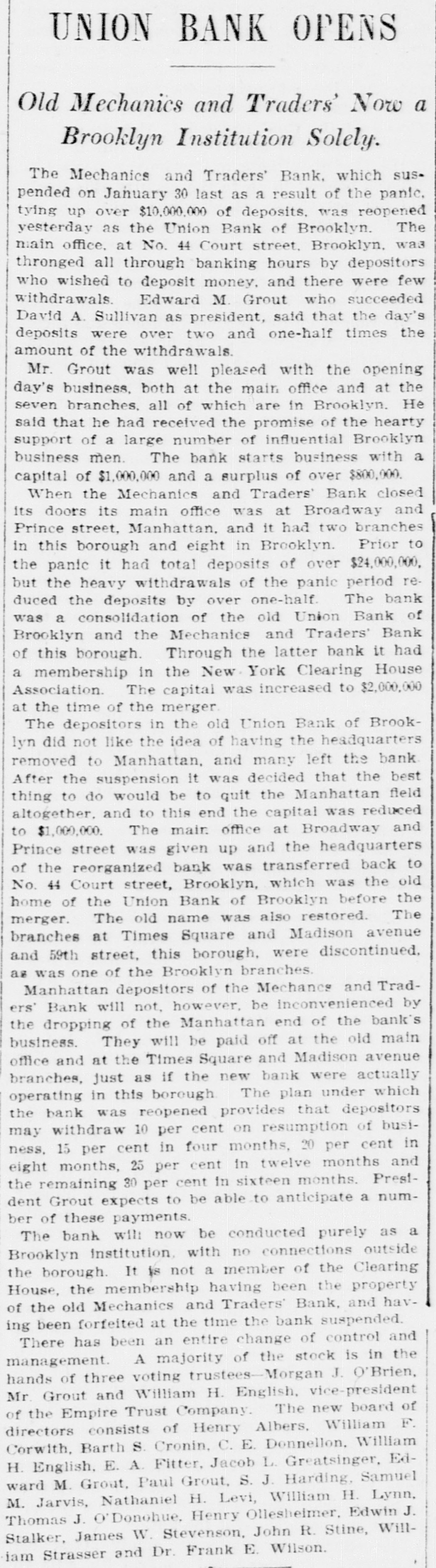
The Mechanics and Traders' Bank, which suspended on January 30 last... was reopened yesterday as the Union Bank of Brooklyn. The main office... was thronged... The plan provides that depositors may withdraw 10 per cent on resumption, 15 per cent in four months, ... remaining 30 per cent in sixteen months.
Source
newspapers

Newspaper Articles (24)

Article from The Evening World, October 26, 1907

Click image to open full size in new tab

Article Text

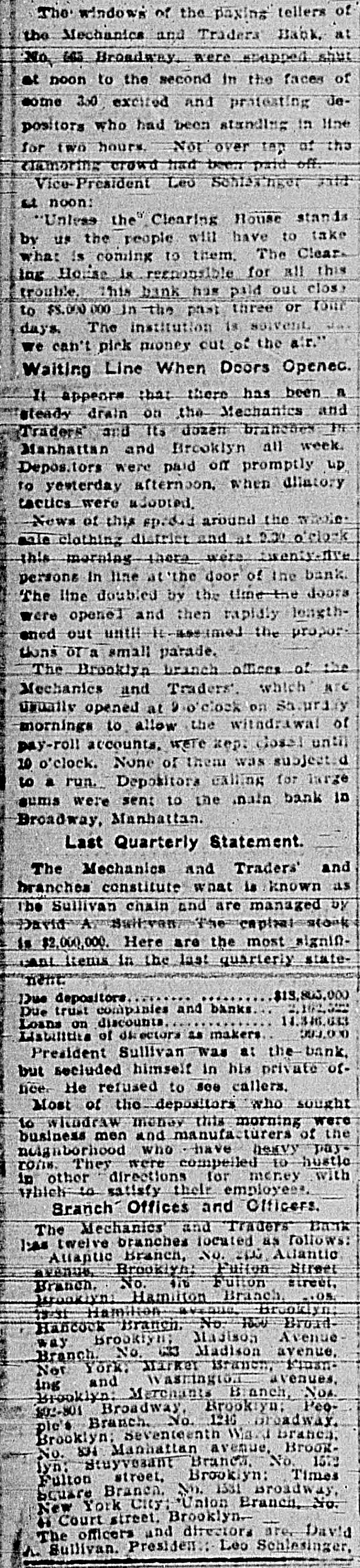
the Mechanics and Traders Bank. at No. 663 Broadway were shapped shut at noon to the second in the faces of some 300 excited and protesting depositors who had been standing in line for two hours. Not over tep of the clamoring crowd had been paid off. Vice-President Leo Schlexhget and at noon: "Unless the Clearing House stands by us the people will have to take what is coming to them. The Clear. Ing House is responsible for all this trouble. This bank has paid out close to $8,000 000 in the past three or four days. The institution is solvent. we can't pick money cut of the air." Waiting Line When Doors Openec. It appears that there has been a steady drain on the Mechanics and Traders' and its dozen branches 15 Manhattan and Brooklyn all week. Depositors were paid on promptly up to yesterday afternoon. when dilatory tactics were adopted. News of this spedid around the whole. sale clothing district and at 2.30 o'clork this morning there were twenty five persons in line at at'the door of the bank. The line doubled by the time the doors are opene] and then rapidly longthened out untH It assumed the propor Lons ora small parade, The Brooklyn branch offices of the Mechanics and Traders'. which are usually opened at 9-o'clock on Shurday mornings to allow the withdrawal of pay-roll accounts, were kep: closs! until 10 o'clock. None of them was subjected to a run. Depositors calling for large eums were sent to the nain bank in Broadway, Manhattan. Last Quarterly Statement. The Mechanics and Traders' and branches constitute what is known as the Sullivan chain and are managed by David A Bullyan The capital stork is $2,000,000. Here are the most signincant Items in the last quarterly statenent. $13,805,000 Due depositors 2,192,322 Due trust compinies and banks. Loans on discounts 14.346.633 393,000 Lisbilities of directors as makers President Sullivan was at the bank, but seciuded himself in his private ofnce. He refused to see callers. Most of the depositors who sought to withdraw meney this morning were business men and manufacturers of the neighborhood who have heavy payTOTAL They were compelled to hustle in other directions for money with which to satisfy their employees. Branch Offices and Officers. The Mechanics' and Traders Bank has twelve branches located as follows: Attantic Branch, No. and Atlantic evenue, Brooklyn: Fulton Street Branch. No. 415 Fulton street, Brooklyn: Hamilton Branch ..05 19-31 Hamilton avenue, Brooklyn Hancock Branch. No. 1550 Broid way Brooklyn; Madison Avenue Branch. No. US3 Madison avenue, Nor York, Mirket Branch, Finsnthat and Washington avenues,

Article from New-York Tribune, October 27, 1907

Click image to open full size in new tab

Article Text

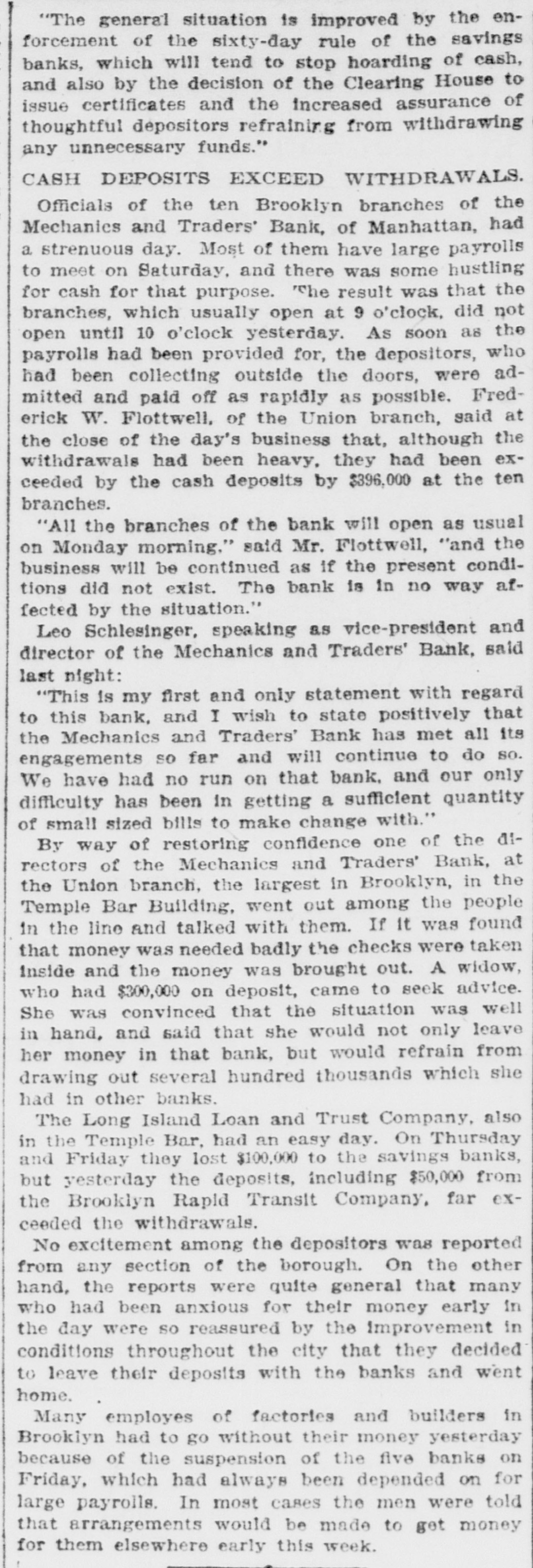
"The general situation is improved by the enforcement of the sixty-day rule of the savings banks, which will tend to stop hoarding of cash, and also by the decision of the Clearing House to issue certificates and the increased assurance of thoughtful depositors refraining from withdrawing any unnecessary funds." CASH DEPOSITS EXCEED WITHDRAWALS. Officials of the ten Brooklyn branches of the Mechanics and Traders' Bank, of Manhattan, had a strenuous day. Most of them have large payrolls to meet on Saturday, and there was some hustling for cash for that purpose. The result was that the branches, which usually open at 9 o'clock, did not open until 10 o'clock yesterday. As soon as the payrolls had been provided for, the depositors, who had been collecting outside the doors, were admitted and paid off as rapidly as possible. Frederick W. Flottwell, of the Union branch, said at the close of the day's business that, although the withdrawals had been heavy, they had been exceeded by the cash deposits by $396,000 at the ten branches. "All the branches of the bank will open as usual on Monday morning," said Mr. Flottwell, "and the business will be continued as If the present conditions did not exist. The bank is in no way affected by the situation." Leo Schlesinger, speaking as vice-president and director of the Mechanics and Traders' Bank, said last night: "This is my first and only statement with regard to this bank, and I wish to state positively that the Mechanics and Traders' Bank has met all its engagements so far and will continue to do so. We have had no run on that bank. and our only difficulty has been in getting a sufficient quantity of small sized bills to make change with." By way of restoring confidence one of the directors of the Mechanics and Traders' Bank, at the Union branch, the largest in Brooklyn, in the Temple Bar Building, went out among the people in the line and talked with them. If It was found that money was needed badly the checks were taken inside and the money was brought out. A widow, who had $300,000 on deposit, came to seek advice. She was convinced that the situation was well in hand, and said that she would not only leave her money in that bank, but would refrain from drawing out several hundred thousands which she had in other banks. The Long Island Loan and Trust Company, also in the Temple Bar. had an easy day. On Thursday and Friday they lost $100,000 to the savings banks, but yesterday the deposits, including $50,000 from the Brooklyn Rapid Transit Company, far exceeded the withdrawals. No excitement among the depositors was reported from any section of the borough. On the other hand, the reports were quite general that many who had been anxious for their money early in the day were so reassured by the improvement in conditions throughout the city that they decided to leave their deposits with the banks and went home. Many employes of factories and builders in Brooklyn had to go without their money yesterday because of the suspension of the five banks on Friday. which had always been depended on for large payrolls. In most cases the men were told that arrangements would be made to get money for them elsewhere early this week.


Article from The Washington Times, October 27, 1907

Click image to open full size in new tab

Article Text

EARING HOUSE CERTIFICATES TO STRENGTHEN BANKS Association Decides to Adopt Strong Measures and Relief Is Certain. NEW YORK, Oct. 26. With the unan imous decision of the New York Clearing House Association today to issue clearing house certificates for the settlement of debit balances by the banks, leading financiers believe that the final steps have been taken to restore conditions in financial circles to their wonted calm. The issue of these certificates will release for general circulation a large sum of currency, and the scarcity of money new the only cloud that lingers on the horizon. s Of scarcely less importance as tending to restore confidence was the introduction of a resolution in the meeting of the Clearing House Association providing for the readmission of trust companies to membership in this assoclation. This will place the trust companies under the rules of the clearing house, and tend to prevent recurrence of the situation which brought about the slump last week. News of Gold Imports Aid. Announcement of the early arrival of gold imports from Europe further improved the situation today. There is a balance of $60,000,000 in our favor in the trading between Europe and the United States, and an influx of the yellow metal from Europe at this time will serve to hasten the return to normal conditions in the financial world. Heidelbach, Ikelheimer & Co., of 37 William street, today announced that the first of the gold imports, $1,500,000 in amount, will arrive here Wednesday. With all these agencies operating to restore confidence, the reaction set in Friday continued unabated today, and the sun began to shine on Wall Street again. Except for the suspension of the Terminal Bank, in Brooklyn, a small Jenkins institution, whose closing had no effect on the situation, every report that went out over the ticker was fa. vorable. Stock Market Firm. The stock market continued firm and money was comparatively easier. The Trust Company of America, the Lincoln Trust, and the other institutions which were imperiled by runs rode the storm and their officials announced at the close of the day that their concerns would resume business Monday in capital shape to meet any demands that might be made upon them. It is understood that for the reason that Europe might get the idea that conditions are worse in New York than they reall are. J. P. Morgan and bankers in friendly association with them, opposed the issue of clearing house cer tificates, but gave way to the majority after the matter had been thoroughly threshed out. A committee headed by Vice President Cannon, of the Fourth National Bank was appointed to arrange the details for the issue. Banks will be permitted to avail themselves of the certificates to the amount of 75 per cent of their debit balances Financial men almost without exception declared after the adjournment of the meeting that this measure will undoubtedly bring to the situation the relief that is needed to restore confidence and stability to the market The final act of the meeting of the clearing house association was the adoption of a resolution thanking Secretary of the Treasury Cortelyou and J. Pierpent Morgan for their services during the time of the crisis. Surplus Was Wiped Out. The regular weekly bank statement issued today showed that the surplus which the banks had at the close of last week was entirely wiped out by the flurry, and that a deficit of $1,233,300 was created instead. A surprising feature of the statement was an increase of loans of $10,864,700. It had been expected that the enormous liquidation in the market during the week would have resulted in a considerable decrease in this item. While the skles were clearing in Wali Street, frightened depositors in- the Mechanics and Traders' Bank, 565 Broadway, with twelve branches in Manhattan and Brooklyn, and in the Broadway Trust Company, Broadway and Eighth street, made a descent upon the two institutions, and there were lively withdrawals for some time. All demands were met by the two concerns however. In a run on the Northern Bank of New York, Broadway and Fourth street, there was so much disorder that the police had to be called. The Broadway Trust Company adopted a rule that those who were withdrawing funds to pay off employes should lave the first call today. General approval was given to the action of the presidents of the savings banks, all of which today put into effect the rule which compels the filing of sixty days' notice of an intention to withdraw funds.


Article from The Evening Star and Newark Advertiser, January 30, 1908

Click image to open full size in new tab

Article Text

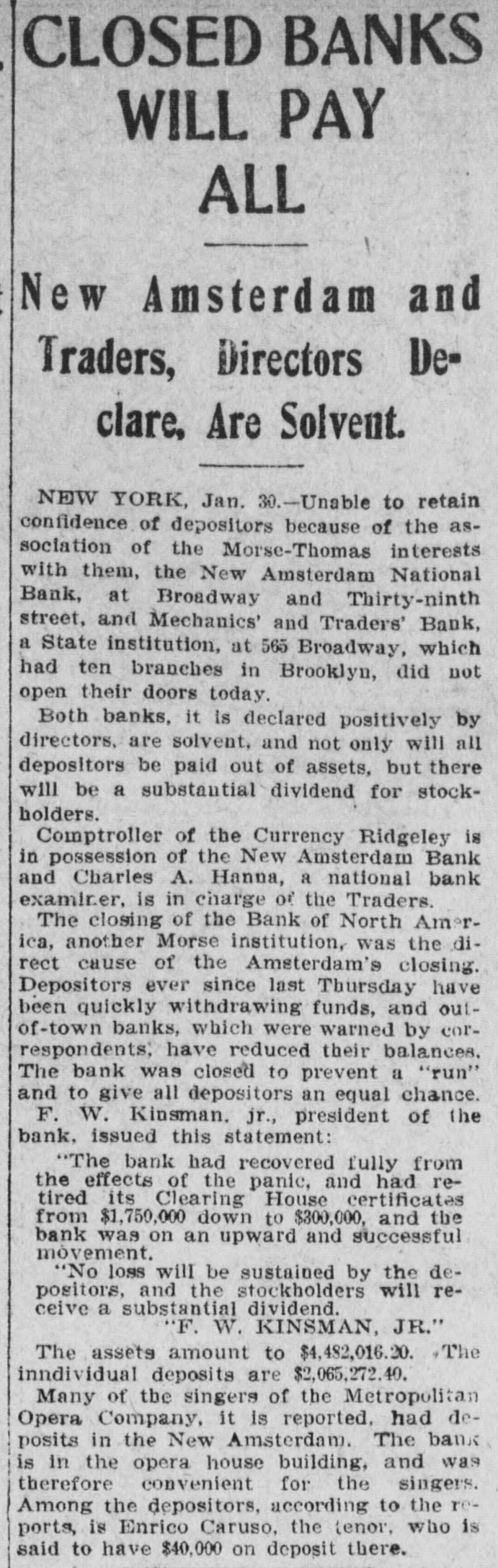
CLOSED BANKS WILL PAY ALL New Amsterdam and Traders, Directors Declare, Are Solvent. NEW YORK, Jan. 30.-Unable to retain confidence of depositors because of the association of the Morse-Thomas interests with them, the New Amsterdam National Bank, at Broadway and Thirty-ninth street, and Mechanics' and Traders' Bank, a State institution, at 565 Broadway, which had ten branches in Brooklyn, did not open their doors today. Both banks, it is declared positively by directors, are solvent, and not only will all depositors be paid out of assets, but there will be a substantial dividend for stockholders. Comptroller of the Currency Ridgeley is in possession of the New Amsterdam Bank and Charles A. Hanna, a national bank examiner, is in charge of the Traders. The closing of the Bank of North America, another Morse institution, was the direct cause of the Amsterdam's closing. Depositors ever since last Thursday have been quickly withdrawing funds, and outof-town banks, which were warned by correspondents, have reduced their balances. The bank was closed to prevent a "run" and to give all depositors an equal chance. F. W. Kinsman. jr., president of the bank. issued this statement: "The bank had recovered fully from the effects of the panic, and had retired its Clearing House certificates from $1,750,000 down to $300,000, and the bank was on an upward and successful mΓ²vement. "No loss will be sustained by the depositors, and the stockholders will receive a substantial dividend. "F. W. KINSMAN, JR." The assets amount to $4,482,016.20. The inndividual deposits are $2,065,272.40. Many of the singers of the Metropolitan Opera Company, it is reported, had deposits in the New Amsterdam. The bank is in the opera house building, and was therefore convenient for the singers. Among the depositors, according to the reports, is Enrico Caruso, the tenor, who is said to have $40,000 on deposit there.


Article from The Cairo Bulletin, January 30, 1908

Click image to open full size in new tab

Article Text

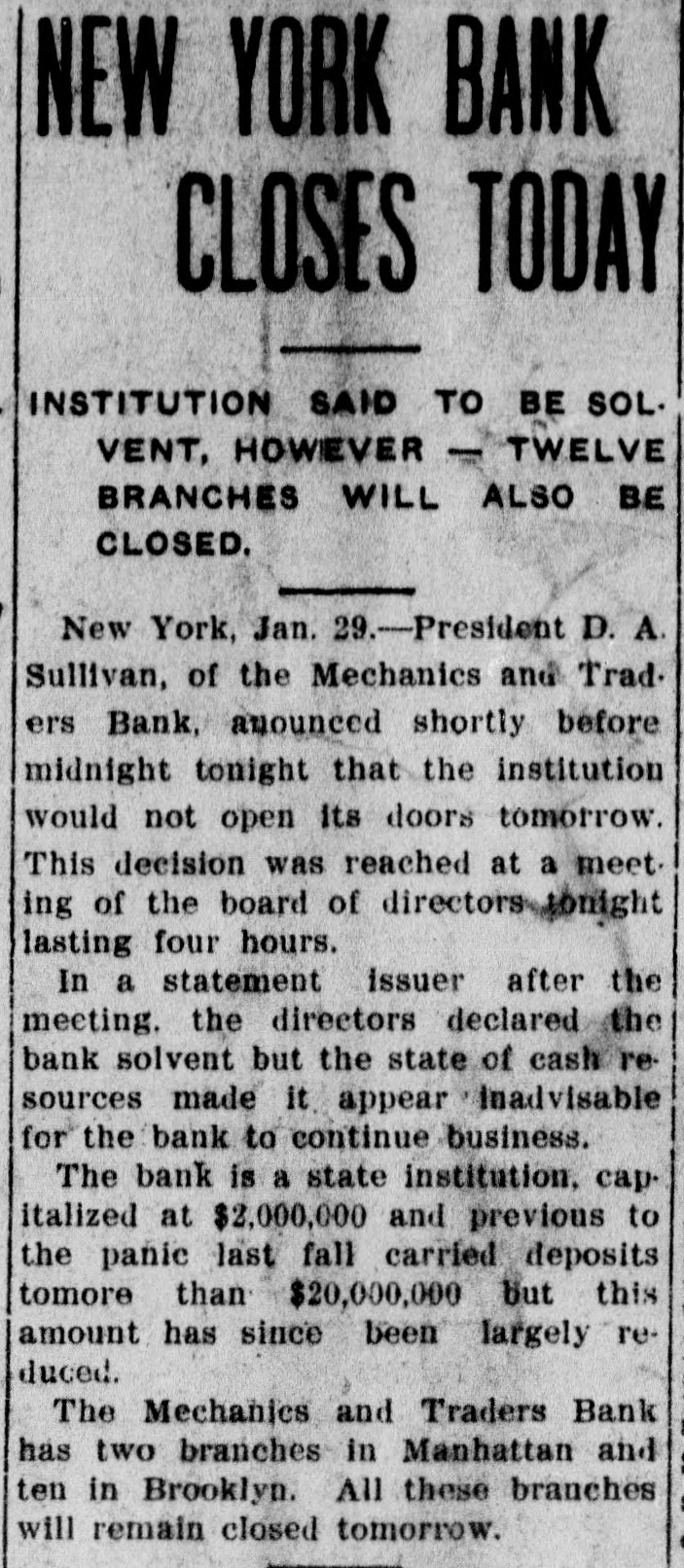
NEW YORK BANK CLOSES TODAY INSTITUTION SAID TO BE SOL. VENT, HOWEVER - TWELVE BRANCHES WILL ALSO BE CLOSED. New York, Jan. 29.-President D. A. Sullivan, of the Mechanics and Traders Bank, auounced shortly before midnight tonight that the institution would not open its doors tomorrow. This decision was reached at a meet. ing of the board of directors tonight lasting four hours. In a statement issuer after the meeting. the directors declared the bank solvent but the state of cash re sources made it appear Inadvisable for the bank to continue business. The bank is a state institution, cap. italized at $2,000,000 and previous to the panic last fall carried deposits tomore than $20,000,000 but this amount has since been largely reduced. The Mechanics and Traders Bank has two branches in Manhattan and ten in Brooklyn. All these branches will remain closed tomorrow.


Article from The Billings Gazette, January 31, 1908

Click image to open full size in new tab

Article Text

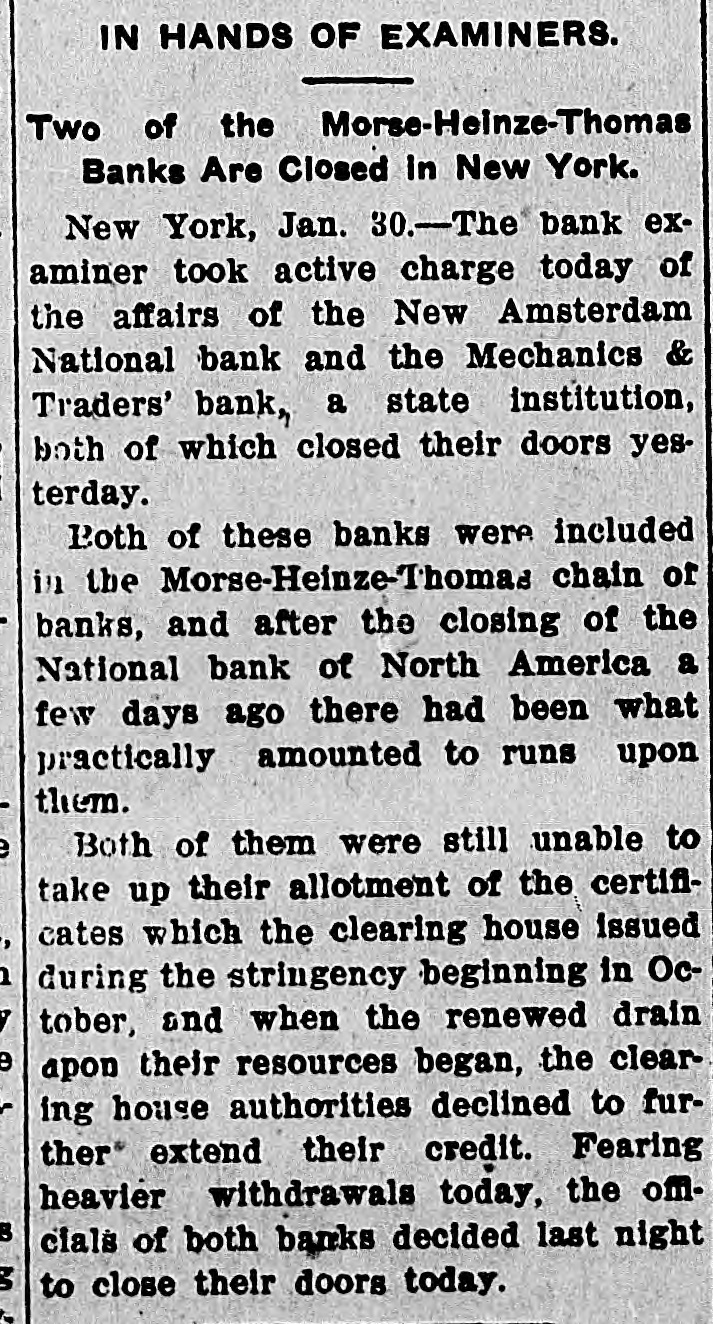
IN HANDS OF EXAMINERS. Two of the Morse-Heinze-Thomas Banks Are Closed in New York. New York, Jan. 30.-The bank examiner took active charge today of the affairs of the New Amsterdam National bank and the Mechanics & Traders' bank, a state institution, both of which closed their doors yesterday. Both of these banks were included in the Morse-Heinze-Thomas chain of banks, and after the closing of the National bank of North America a few days ago there had been what practically amounted to runs upon them. Both of them were still unable to take up their allotment of the certificates which the clearing house issued during the stringency beginning in October, and when the renewed drain 9 apon their resources began, the clearing house authorities declined to further extend their credit. Fearing heavier withdrawals today, the offiB cials of both banks decided last night M. to close their doors today.


Article from New-York Tribune, January 31, 1908

Click image to open full size in new tab

Article Text

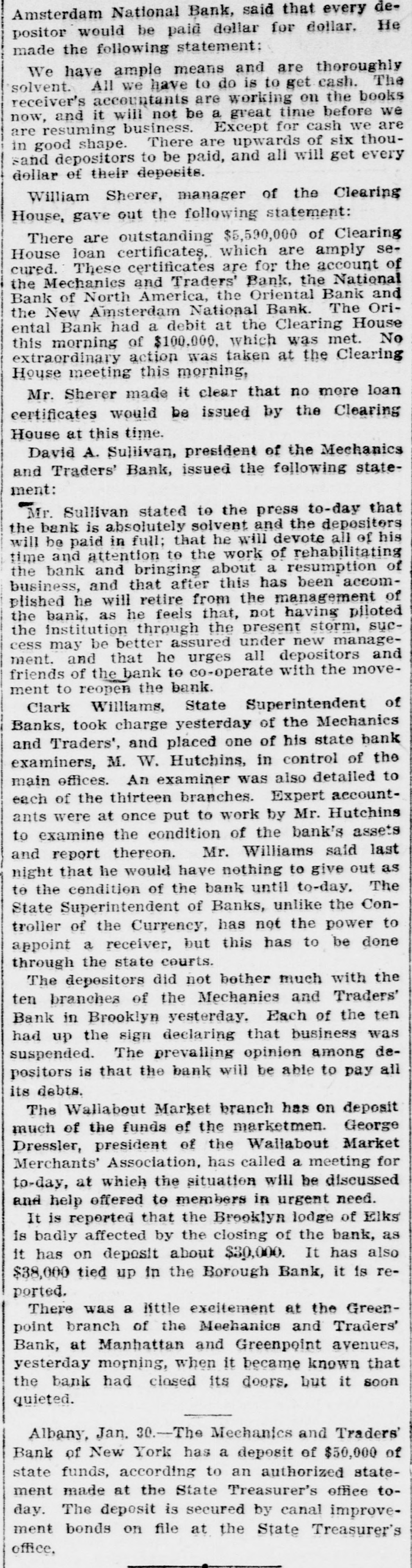
made the following We have ample means and are thoroughly solvent. All we have to do is to get cash. The receiver's accountants are working on the books now, and it will not be a great time before we are resuming business. Except for cash we are in good shape. There are upwards of six thousand depositors to be paid, and all will get every dollar of their deposits. William Sherer, manager of the Clearing House, gave out the following statement: There are outstanding $5,590,000 of Clearing House loan certificates, which are amply secured. These certificates are for the account of the Mechanics and Traders' Bank, the National Bank of North America, the Oriental Bank and the New Ainsterdam National Bank. The Oriental Bank had a debit at the Clearing House this morning of $100.000, which was met. No extraordinary action was taken at the Clearing House meeting this morning, Mr. Sherer made it clear that no more loan certificates would be issued by the Clearing House at this time. David A. Sujilvan, president of the Mechanics and Traders' Bank, issued the following statement: Mr. Sullivan stated to the press to-day that the bank is absolutely solvent and the depositors will be paid in full; that he will devote all of his to the work time and attention of rehabilitating the bank and bringing about a resumption of and that after this has been accomwill retire from the business, plished he management of the bank. as he feels that, not having piloted the institution through the present storm, success may be better assured under new management. and that he urges all depositors and friends of the bank to co-operate with the movement to reopen the bank. Clark Williams, State Superintendent of Banks, took charge yesterday of the Mechanics and Traders', and placed one of his state bank examiners, M. W. Hutchins, in control of the main offices. An examiner was also detailed to each of the thirteen branches. Expert accountants were at once put to work by Mr. Hutchins to examine the condition of the bank's assets and report thereon. Mr. Williams said last night that he would have nothing to give out as to the condition of the bank until to-day. The State Superintendent of Banks, unlike the Controller of the Currency, has not the power to appoint a receiver, but this has to be done through the state courts. The depositors did not bother much with the ten branches of the Mechanies and Traders' Bank in Brooklyn yesterday. Each of the ten had up the sign declaring that business was suspended. The prevailing opinion among depositors is that the bank will be able to pay all its debts. The Wallabeut Market branch has on deposit much of the funds of the marketmen. George Dressler, president of the Wailabout Market Merchants' Association, has called a meeting for to-day, at which the situation will be discussed and help offered to members in urgent need. It is reported that the Brooklyn lodge of Elks is badly affected by the closing of the bank, as it has on deposit about $30,000. It has also $38,000 tied up in the Borough Bank, it is reported. There was a little excitement at the Greenpoint branch of the Mechanics and Traders' Bank, at Manhattan and Greenpoint avenues, yesterday morning, when it became known that the bank had closed its doors. but it soon quieted. Albany, Jan. 30.-The Mechanics and Traders' Bank of New York has a deposit of $50,000 of state funds, according to an authorized statement made at the State Treasurer's office today. The deposit is secured by canal improvement bonds on file at the State Treasurer's office,


Article from The Bemidji Daily Pioneer, January 31, 1908

Click image to open full size in new tab

Article Text

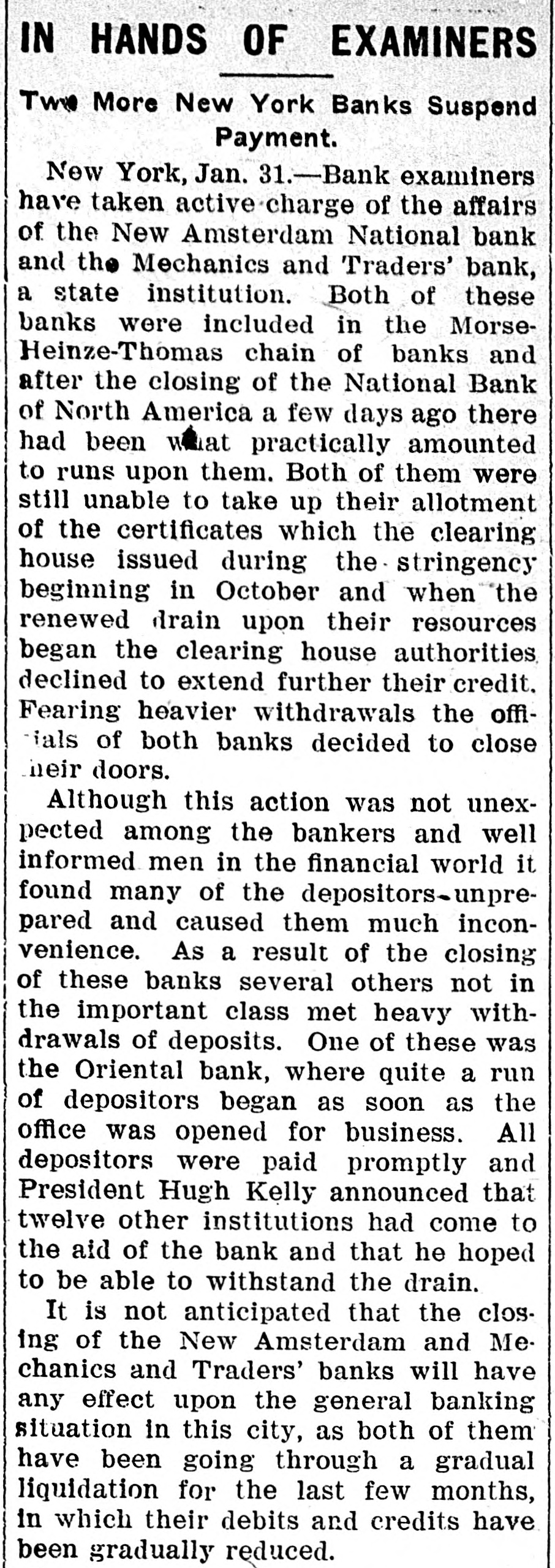
IN HANDS OF EXAMINERS Two More New York Banks Suspend Payment. New York, Jan. 31.-Bank examiners have taken active charge of the affairs of the New Amsterdam National bank and the Mechanics and Traders' bank, a state institution. Both of these banks were included in the MorseHeinze-Thomas chain of banks and after the closing of the National Bank of North America a few days ago there had been what practically amounted to runs upon them. Both of them were still unable to take up their allotment of the certificates which the clearing house issued during the stringency beginning in October and when the renewed drain upon their resources began the clearing house authorities declined to extend further their credit. Fearing heavier withdrawals the offiials of both banks decided to close heir doors. Although this action was not unexpected among the bankers and well informed men in the financial world it found many of the depositors-unprepared and caused them much inconvenience. As a result of the closing of these banks several others not in the important class met heavy withdrawals of deposits. One of these was the Oriental bank, where quite a run of depositors began as soon as the office was opened for business. All depositors were paid promptly and President Hugh Kelly announced that twelve other institutions had come to the aid of the bank and that he hoped to be able to withstand the drain. It is not anticipated that the closing of the New Amsterdam and Mechanics and Traders' banks will have any effect upon the general banking situation in this city, as both of them have been going through a gradual liquidation for the last few months, in which their debits and credits have been gradually reduced.


Article from The Washington Times, February 1, 1908

Click image to open full size in new tab

Article Text

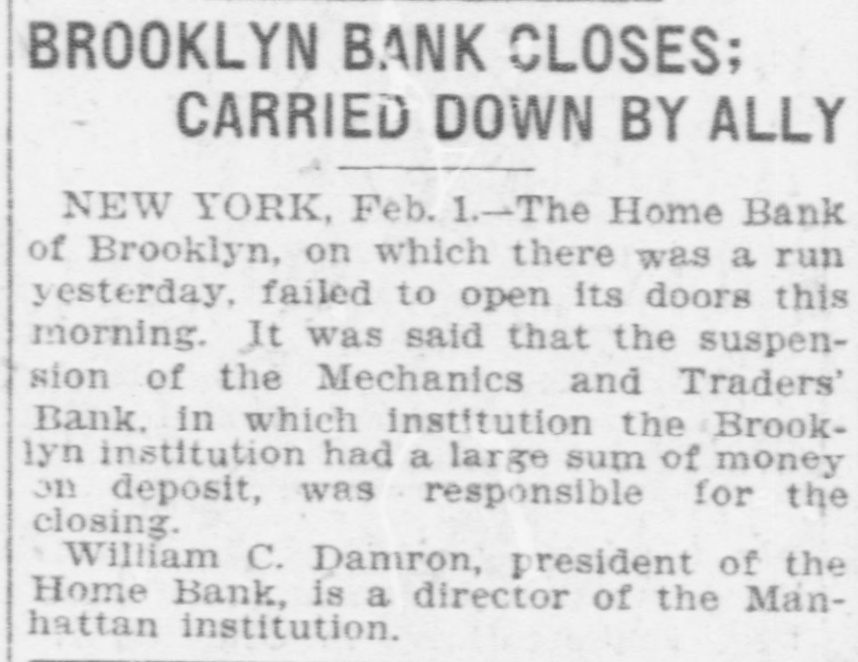
BROOKLYN BANK CLOSES; CARRIED DOWN BY ALLY NEW YORK, Feb. 1.-The Home Bank of Brooklyn, on which there was a run yesterday, failed to open its doors this morning. It was said that the suspension of the Mechanics and Traders' Bank. in which institution the Brooklyn institution had a large sum of money on deposit, was responsible for the closing. William C. Damron, president of the Home Bank, is a director of the Manhattan institution.


Article from The Brandon News, February 6, 1908

Click image to open full size in new tab

Article Text

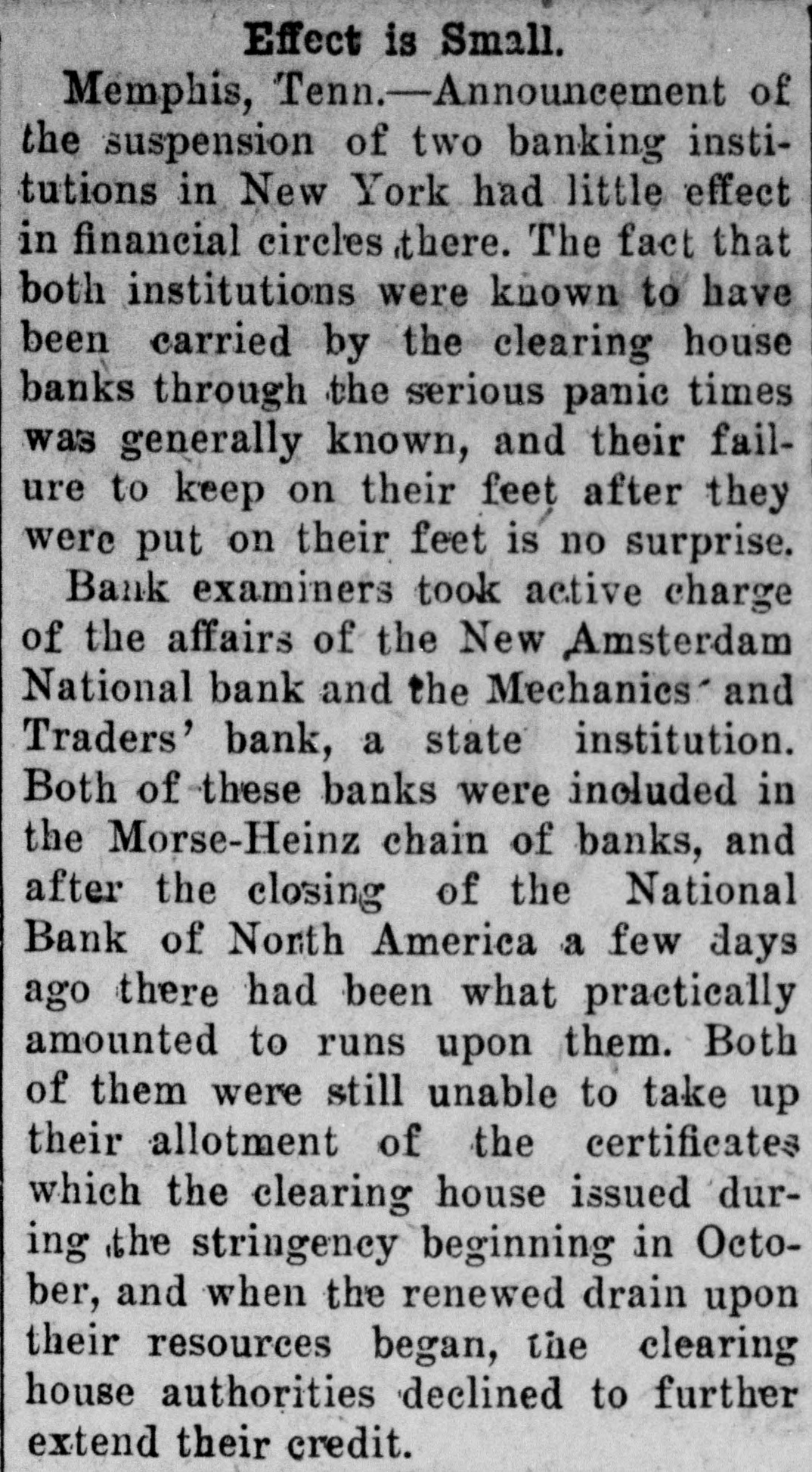
Effect is Small. Memphis, Tenn.-Announcement of the suspension of two banking institutions in New York had little effect in financial circles there. The fact that both institutions were known to have been carried by the clearing house banks through the serious panic times was generally known, and their failure to keep on their feet after they were put on their feet is no surprise. Bank examiners took active charge of the affairs of the New Amsterdam National bank and the Mechanics and Traders' bank, a state institution. Both of these banks were included in the Morse-Heinz chain of banks, and after the closing of the National Bank of North America a few days ago there had been what practically amounted to runs upon them. Both of them were still unable to take up their allotment of the certificates which the clearing house issued during the stringency beginning in October, and when the renewed drain upon their resources began, the clearing house authorities declined to further extend their credit.


Article from The Spokane Press, February 18, 1908

Click image to open full size in new tab

Article Text

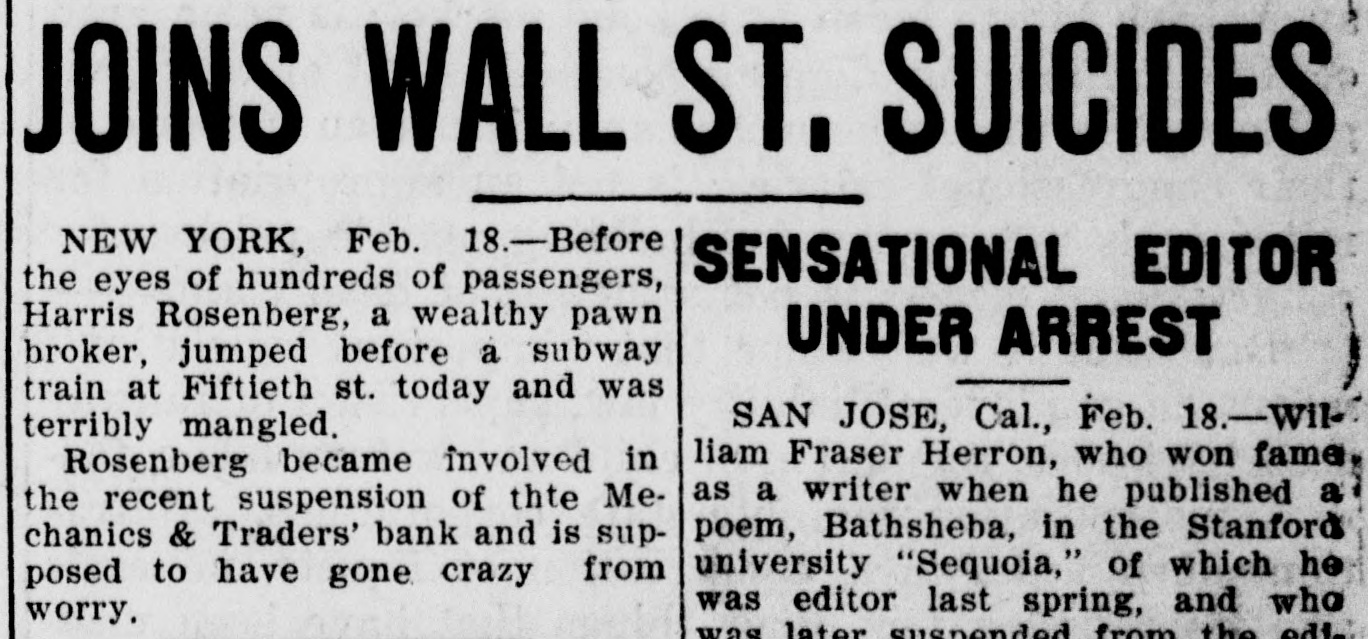
JOINS WALL ST. SUICIDES NEW YORK, Feb. 18.-Before SENSATIONAL EDITOR the eyes of hundreds of passengers, Harris Rosenberg, a wealthy pawn UNDER ARREST broker, jumped before a subway train at Fiftieth st. today and was SAN JOSE, Cal., Feb. 18.-Wilterribly mangled. liam Fraser Herron, who won fame Rosenberg became involved in as a writer when he published a the recent suspension of thte Mepoem, Bathsheba, in the Stanford chanics & Traders' bank and is supuniversity "Sequoia," of which he posed to have gone crazy from was editor last spring, and who worry. was later suspended from the edi-


Article from New-York Tribune, February 25, 1908

Click image to open full size in new tab

Article Text

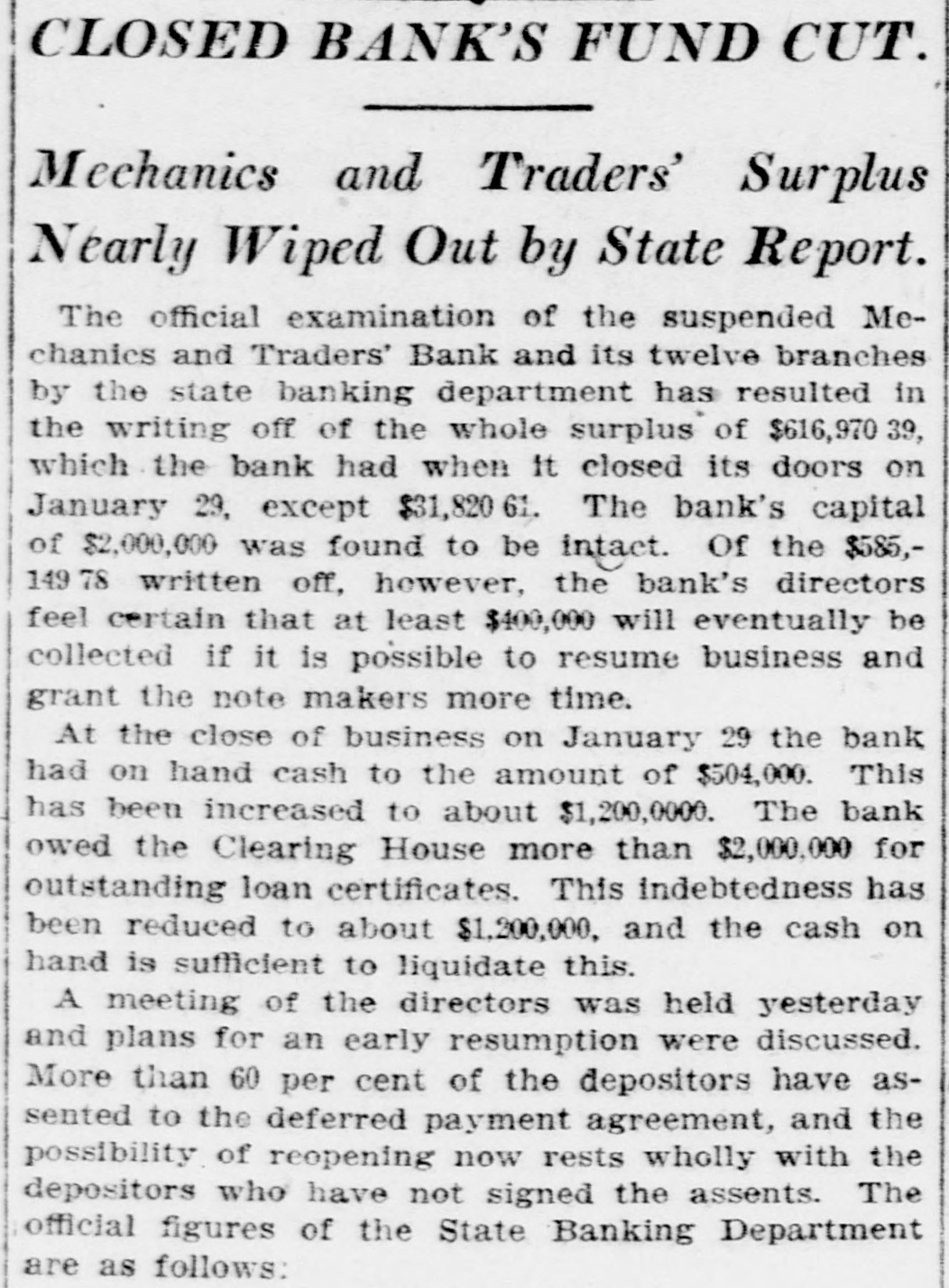
CLOSED BANK'S FUND CUT. Mechanics and Traders' Surplus Nearly Wiped Out by State Report. The official examination of the suspended Mechanics and Traders' Bank and its twelve branches by the state banking department has resulted in the writing off of the whole surplus of $616,970 39, which the bank had when It closed its doors on January 29, except $31,820 61. The bank's capital of $2,000,000 was found to be intact. Of the $585,149 78 written off, however, the bank's directors feel certain that at least $400,000 will eventually be collected if it is possible to resume business and grant the note makers more time. At the close of business on January 29 the bank had on hand cash to the amount of $504,000. This has been increased to about $1,200,0000. The bank owed the Clearing House more than $2,000,000 for outstanding loan certificates. This indebtedness has been reduced to about $1,200,000, and the cash on hand is sufficient to liquidate this. A meeting of the directors was held yesterday and plans for an early resumption were discussed. More than 60 per cent of the depositors have assented to the deferred payment agreement, and the possibility of reopening now rests wholly with the depositors who have not signed the assents. The official figures of the State Banking Department are as follows:


Article from The Washington Herald, March 1, 1908

Click image to open full size in new tab

Article Text

JACKSON WINS BANK FIGHT New York Attorney General Has Receivers Named. Politicians Claim to See in Move Bid for Support of Tammany Hall. New York, Feb. 29.-Having blocked the plan of the Oriental Bank's directors for the immediate payment of the depositors in full and got his receivers seated in the saddle, Attorney General Jackson turned his attention to-day to the Mechanics and Traders Bank, which has assets of about $14,000,000. His application for receivers in this case, as in the case of the Oriental Bank on Friday, was made to Justice Platzek, who named J. Henry Haggerty and Joseph B. Ford. Mr. Haggerty is an oil merchant, of 50 South street, and a brother-in-law of ex-Judge Morgan J. O'Brien. Mr. Ford, up to the time of his appointment, was the attorney general's private secretary. Before that he was a reporter on a Buffalo paper. The application for receivers for the Mechanics and Traders, like that in the case of the Oriental, was filed without the knowledge of the State superintendent of banks. As a matter of fact, Supt. Williams had under consideration a plan which the directors had proposed for the rehabilitation of the bank, and it was said to-day that the superintendent had made no final report in regard to the attorney general or anybody else. The directors of the Mechanics and Traders believed that the plan would be accepted. and that the bank would be allowed to reopen. The appointment of receivers came. therefore, as a complete surprise to them. In political circles to-night a good many persons thought they could see in the appointments of the last two days a bid on the attorney general's part for Tammany and other Democratic support for his gubernatorial aspirations. Tammany influences were brought to bear on the attorney general, when the Knickerbocker Trust Company closed its doors, to get him to name receivers who would be acceptable to Leader Murphy and Fingy Conners, but apparently Bourke Cockran got in first. Jackson refused even to make his application in the Knickerbocker case, and in most of the subsequent receivership proceedings, to a New York County justice. Now, however, things seem to be different. Henry Schneider, who was appointed joint receiver of the Oriental Bank with the Carnegie Trust Company, is a member of Tammany Hall, and is said to belong also to Charles F. Murphy's club.


Article from The Morning Journal-Courier, March 4, 1908

Click image to open full size in new tab

Article Text

CLOSED BANKS MAY OPEN. Mechanics and Traders' String Hopes to Be Revived in Month. New York, March 3.-By virtue of Justice O'Gorman's order modifying that part of Justice Platzek's receivership decision which restrained the Mechanics and Traders' Bank from exercising its corporate prerogatives, the stockholders of the bank met this afternoon and voted to reduce the capital stock from $2,000,000 to $1,000,000. Of the former capital stock $1,000,000 was transferred to the surplus, to be used in paying the bank's indebtedness. Justice O'Gorman's order was operative only to-day. The next step will be to obtain the consent of depositors to the system of deferred payments already announced. If success attends this effort, counsel for the bank will be in a position to go to the superintendent of banks with the request that the receivership be vacated. Lawyers Interested in bank's affairs expressed


Article from The Billings Gazette, March 20, 1908

Click image to open full size in new tab

Article Text

attorney general under Attorney General Jackson and appointed by the latter as temporary receiver for the Hamilton bank, October 23 last, and Joseph Ford, formerly private secretary to Mr. Jackson and later receiver for the Mechanics & Traders' bank, were before the grand jury today. Both were questioned by District Attorney Jerome. As to what questions were put to the two men Mr. Jerome, Mr. White and Mr. Ford were equally reticent.


Article from New-York Tribune, April 15, 1908

Click image to open full size in new tab

Article Text

BANK WINS TEST CASE. Court Virtually Approves Mechanics and Traders' Resumption Plan. Justice Hendrick in the Supreme Court. handed down a decision yesterday in which he virtually approved of the deferred payment plan and agreement for the reorganization and reopening of the suspended Mechanics and Traders' Bank, which closed its doors on January 29 last. The decision was rendered on the application of Strauss & Anderson, counsel for the bank, for permission for Joseph Heidelberger, a depositor and an incompetent, to sign the deferred payment plan. The application stated that 84 per cent of the depositors had already assented to the plan, and that it was made in the nature of a test case, as over


Article from Goldsboro Weekly Argus, April 23, 1908

Click image to open full size in new tab

Article Text

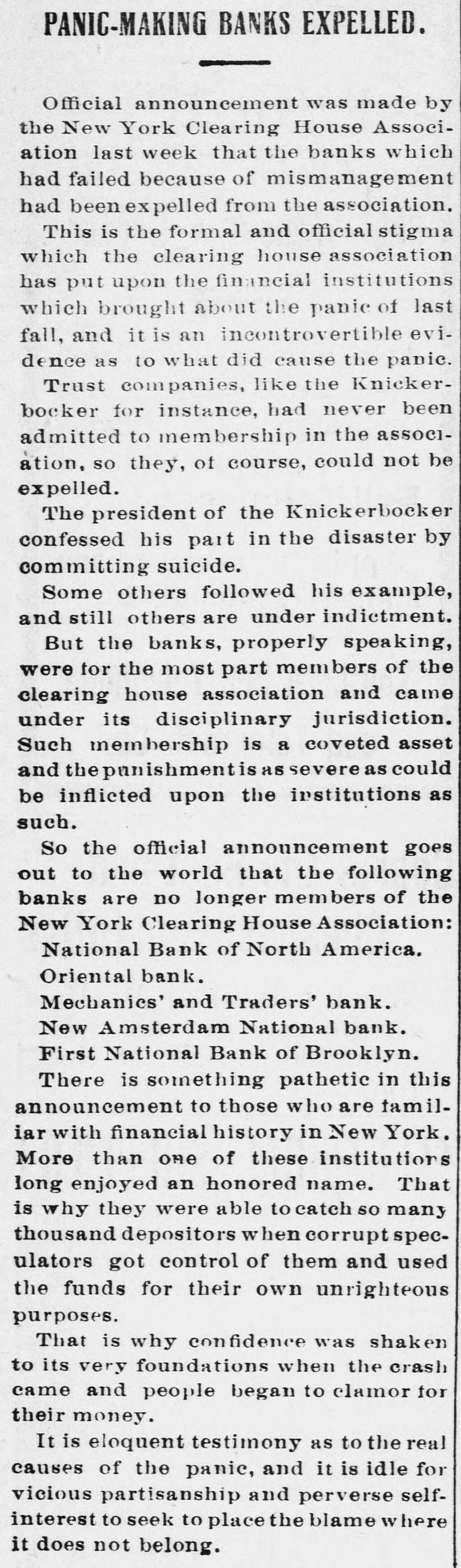
PANIC-MAKING BANKS EXPELLED. Official announcement was made by the New York Clearing House Association last week that the banks which had failed because of mismanagement had been expelled from the association. This is the formal and official stigma which the clearing house association has put upon the financial institutions which brought about the panic of last fall, and it is an incontrovertible evidence as to what did cause the panic. Trust companies, like the Knickerbocker for instance, had never been admitted to membership in the association, so they, of course, could not be expelled. The president of the Knickerbocker confessed his pait in the disaster by committing suicide. Some others followed his example, and still others are under indictment. But the banks, properly speaking, were for the most part members of the clearing house association and came under its disciplinary jurisdiction. Such membership is a coveted asset and thepunishmenti is as severe as could be inflicted upon the institutions as such. So the official announcement goes out to the world that the following banks are no longer members of the New York Clearing House Association: National Bank of North America. Oriental bank. Mechanics' and Traders' bank. New Amsterdam National bank. First National Bank of Brooklyn. There is something pathetic in this announcement to those who are familiar with financial history in New York. More than one of these institutions long enjoyed an honored name. That is why they were able to catch so many thousand depositors when corrupt speculators got control of them and used the funds for their own unrighteous purposes. That is why confidence was shaken to its very foundations when the crash came and people began to clamor for their money. It is eloquent testimony as to the real causes of the panic, and it is idle for vicious partisanship and perverse selfinterest to seek to place the blame where it does not belong.


Article from New-York Tribune, May 12, 1908

Click image to open full size in new tab

Article Text

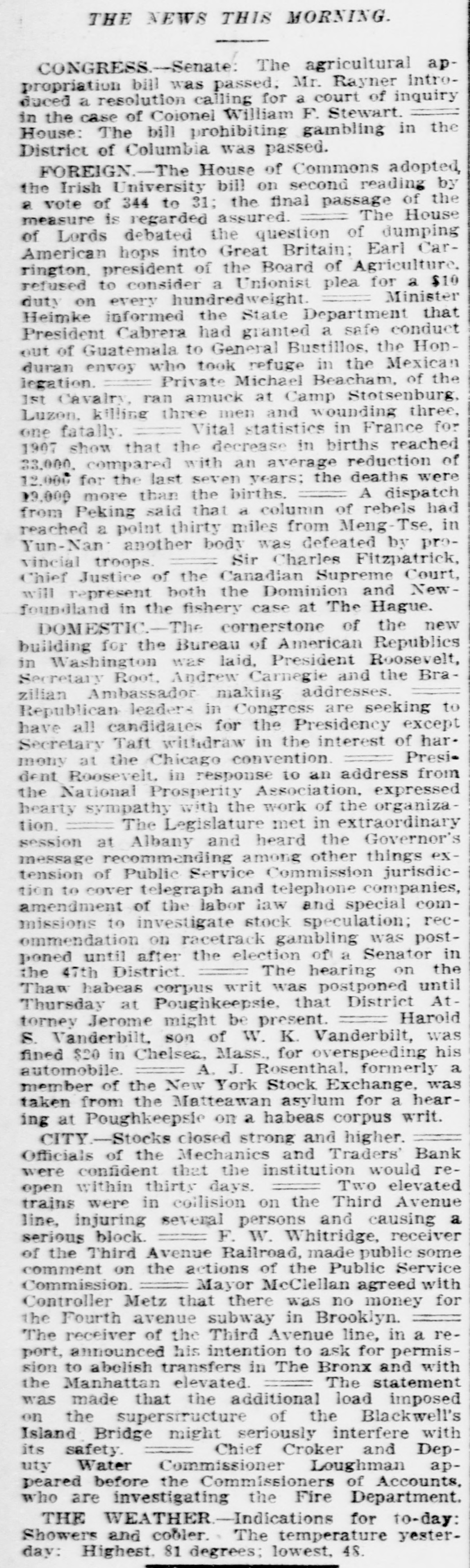
THE NEWS THIS MORNING. CONGRESS.-Senate: The agricultural appropriation bill was passed; Mr. Rayner introduced a resolution calling for a court of inquiry in the case of Coionel William F. Stewart. House: The bill prohibiting gambling in the District of Columbia was passed. FOREIGN.-The House of Commons adopted, the Irish University bill on second reading by a vote of 344 to 31; the final passage of the measure is regarded assured. The House of Lords debated the question of dumping American hops into Great Britain; Earl Carrington, president of the Board of Agriculture. refused to consider a Unionist plea for a $10 Minister duty on every hundredweight. Heimke informed the State Department that President Cabrera had granted a safe conduct out of Guatemala to General Bustillos, the Honduran envoy who took refuge in the Mexican legation. Private Michael Beacham, of the 1st Cavalry, ran amuck at Camp Stotsenburg, Luzon. killing three men and wounding three, one fatally. Vital statistics in France for 1907 show that the decrease in births reached 33,000. compared with an average reduction of 12.000 for the last seven years: the deaths were 19,000 more than the births. A dispatch from Peking said that a column of rebels had reached a point thirty miles from Meng-Tse, in Yun-Nan another body was defeated by provincial troops. Sir Charles Fitzpatrick, Chief Justice of the Canadian Supreme Court, will represent both the Dominion and Newfoundland in the fishery case at The Hague. DOMESTIC.-The cornerstone of the new building for the Bureau of American Republics in Washington was laid, President Roosevelt, Secretary Root, Andrew Carnegie and the Brazilian Ambassador making addresses. Republican leaders in Congress are seeking to have all candidates for the Presidency except Secretary Taft withdraw in the interest of har. Presimony at the Chicago convention. dent Roosevelt. in response to an address from the National Prosperity Association. expressed hearty sympathy with the work of the organization. The Legislature met in extraordinary session at Albany and heard the Governor's message recommending among other things extension of Public Service Commission jurisdiction to cover telegraph and telephone companies, amendment of the labor law and special commissions to investigate stock speculation; recommendation on racetrack gambling was postponed until after the election of a Senator in the 47th District. The hearing on the Thaw habeas corpus writ was postponed until Thursday at Poughkeepsie, that District Attorney Jerome might be present. Harold S. Vanderbilt. son of W. K. Vanderbilt, was fined $20 in Chelsea, Mass., for overspeeding his automobile. A. J. Rosenthal, formerly a member of the New York Stock Exchange, was taken from the Matteawan asylum for a hearing at Poughkeepsie on a habeas corpus writ. CITY.-Stocks closed strong and higher. Officials of the Mechanics and Traders' Bank were confident that the institution would reopen within thirty days. Two elevated trains were in coilision on the Third Avenue line, injuring several persons and causing a F. W. Whitridge, receiver serious block. of the Third Avenue Railroad, made public some comment on the actions of the Public Service Commission Mayor McClellan agreed with Controller Metz that there was no money for the Fourth avenue subway in Brooklyn. The receiver of the Third Avenue line, in a report, announced his intention to ask for permission to abolish transfers in The Bronx and with the Manhattan elevated. The statement was made that the additional load imposed on the superstructure of the Blackwell's Island Bridge might seriously interfere with its safety. Chief Croker and Deputy Water Commissioner Loughman appeared before the Commissioners of Accounts, who are investigating the Fire Department. THE WEATHER-Indications for to-day: Showers and cobler. The temperature yesterday: Highest. 81 degrees; lowest, 48.


Article from The Detroit Times, August 10, 1908

Click image to open full size in new tab

Article Text

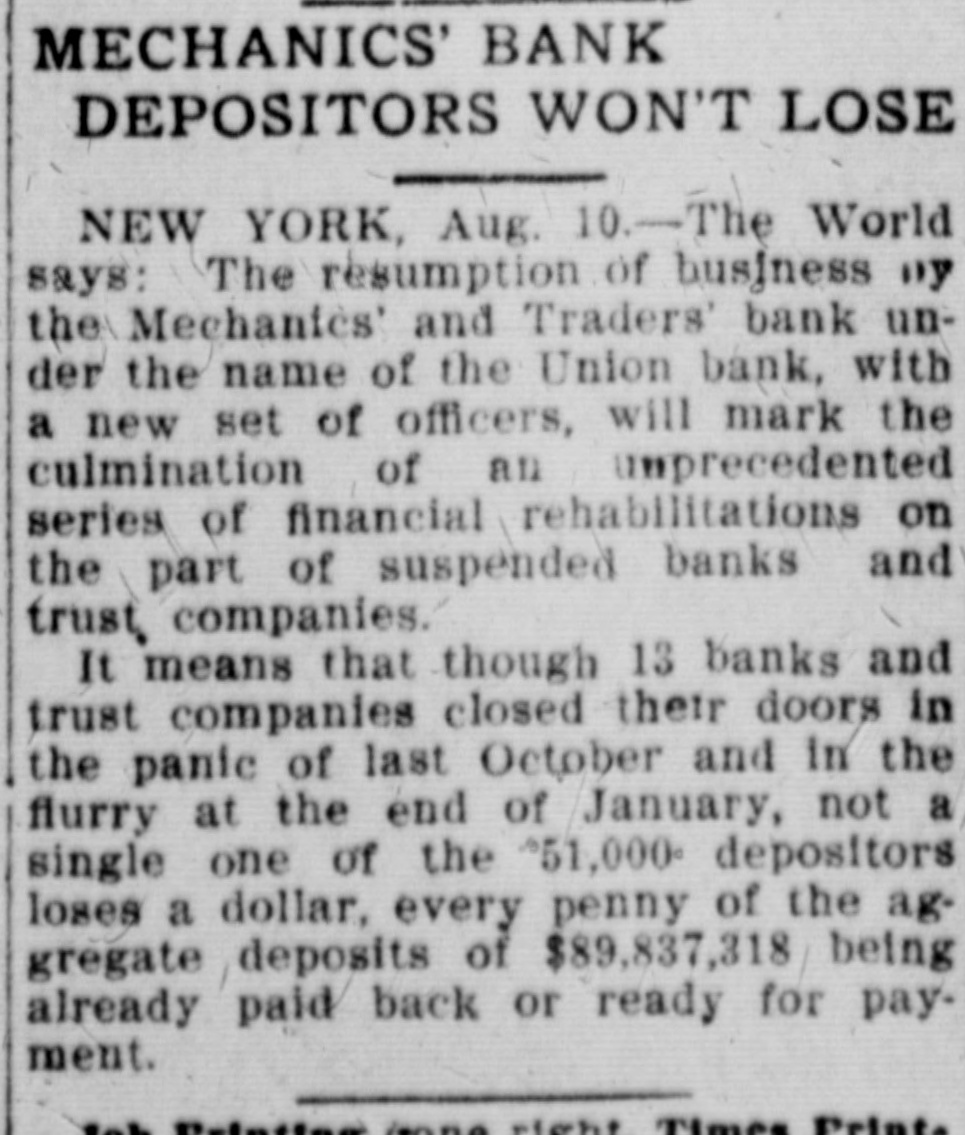
# MECHANICS' BANK # DEPOSITORS WON'T LOSE NEW YORK, Aug. 10. -The World says: The resumption of business by the Mechanics' and Traders' bank under the name of the Union bank, with a new set of officers, will mark the culmination of an unprecedented series of financial rehabilitations on the part of suspended banks and trust companies. It means that though 13 banks and trust companies closed their doors in the panic of last October and in the flurry at the end of January, not a single one of the 51,000 depositors loses a dollar, every penny of the aggregate deposits of $89,837,318 being already paid back or ready for payment.


Article from The Detroit Times, August 11, 1908

Click image to open full size in new tab

Article Text

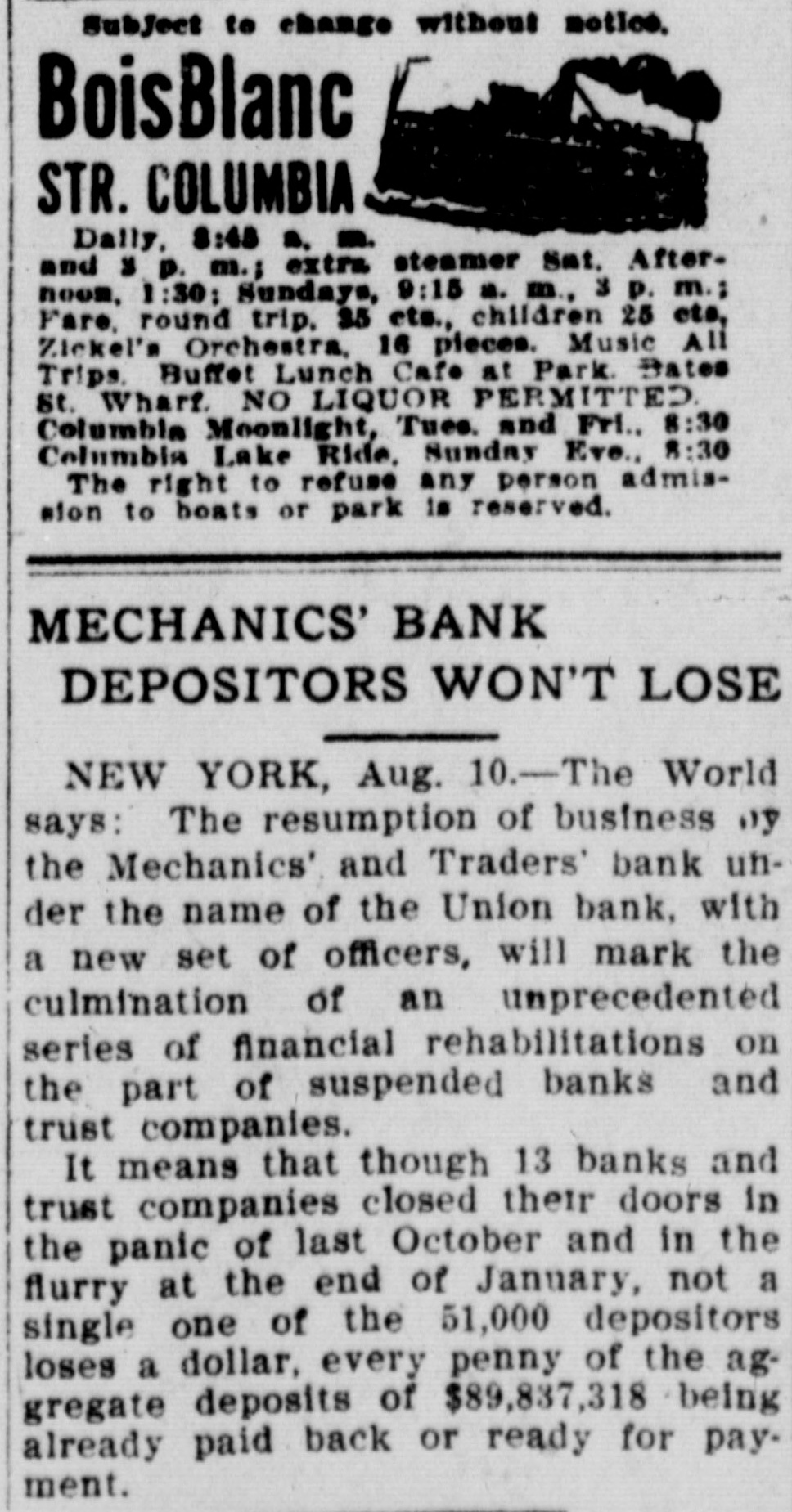
Subject to change without notice. # BoisBlanc ## STR. COLUMBIA Dally, 8:48 a. m. and 3 p. m.; extra steamer Sat. Afternoon, 1:30: Sundays, 9:15 a. m., 3 p. m.; Fare, round trip, 35 ets., children 25 ets, Zickel's Orchestra, 16 pieces. Music All Trips. Buffet Lunch Cafe at Park. Bates St. Wharf. NO LIQUOR PERMITTED. Columbia Moonlight, Tues. and Fri., 8:30 Columbia Lake Ride, Sunday Eve., 8:30 The right to refuse any person admission to boats or park is reserved. # MECHANICS' BANK ## DEPOSITORS WON'T LOSE NEW YORK, Aug. 10. -The World says: The resumption of business by the Mechanics' and Traders' bank under the name of the Union bank, with a new set of officers, will mark the culmination of an unprecedented series of financial rehabilitations on the part of suspended banks and trust companies. It means that though 13 banks and trust companies closed their doors in the panic of last October and in the flurry at the end of January, not a single one of the 51,000 depositors loses a dollar, every penny of the aggregate deposits of $89,837,318 being already paid back or ready for payment.


Article from New-York Tribune, August 18, 1908

Click image to open full size in new tab

Article Text

UNION BANK OPENS Old Mechanics and Traders' Now a Brooklyn Institution Solely. The Mechanics and Traders' Bank. which suspended on January 30 last as a result of the panic, tying up over $10,000,000 of deposits, was reopened yesterday as the Union Bank of Brooklyn. The main office. at No. 44 Court street, Brooklyn, was thronged all through banking hours by depositors who wished to deposit money, and there were few withdrawals. Edward M. Grout who succeeded David A. Sullivan as president, said that the day's deposits were over two and one-half times the amount of the withdrawals. Mr. Grout was well pleased with the opening day's business, both at the main office and at the seven branches, all of which are in Brooklyn. He said that he had received the promise of the hearty support of a large number of influential Brooklyn business men. The bank starts business with a capital of $1,000,000 and a surplus of over $800,000. When the Mechanics and Traders' Bank closed its doors its main office was at Broadway and Prince street, Manhattan, and it had two branches in this borough and eight in Brooklyn. Prior to the panic it had total deposits of over $24,000,000. but the heavy withdrawals of the panic period reduced the deposits by over one-half. The bank was a consolidation of the old Union Bank of Brooklyn and the Mechanics and Traders' Bank of this borough. Through the latter bank it had a membership in the New York Clearing House Association. The capital was increased to $2,000,000 at the time of the merger The depositors in the old Union Bank of Brooklyn did not like the idea of having the headquarters removed to Manhattan, and many left the bank After the suspension it was decided that the best thing to do would be to quit the Manhattan field altogether. and to this end the capital was reduced to $1,000,000. The mair. office at Broadway and Prince street was given up and the headquarters of the reorganized bank was transferred back to No. 44 Court street, Brooklyn, which was the old home of the Union Bank of Brooklyn before the merger. The old name was also restored. The branches at Times Square and Madison avenue and 59th street, this borough, were discontinued. as was one of the Brooklyn branches Manhattan depositors of the Mechance and Traders' Bank will not. however, be inconvenienced by the dropping of the Manhattan end of the bank's business. They will be paid off at the old main office and at the Times Square and Madison avenue branches, just as if the new bank were actually operating in this borough The plan under which the bank was reopened provides that depositors may withdraw 10 per cent on resumption of business, 15 per cent in four months, 20 per cent in eight months, 25 per cent in twelve months and the remaining 30 per cent in sixteen months. Prestdent Grout expects to be able to anticipate a number of these payments. The bank will now be conducted purely as a Brooklyn institution with no connections outside the borough. It is not a member of the Clearing House, the membership having been the property of the old Mechanics and Traders' Bank, and having been forfeited at the time the bank suspended. There has been an entire change of control and management. A majority of the stock is in the hands of three voting trustees-Morgan J. Brien, Mr. Grout and William H. English, vice-president of the Empire Trust Company. The new board of directors consists of Henry Albers, William F. Corwith, Barth S. Cronin, C. E. Donnellon, William H. English, E. A. Fitter, Jacob L Greatsinger, Edward M. Grout. Paul Grout, S. J. Harding, Samuel M. Jarvis, Nathaniel H. Levi, William H. Lynn. Thomas J. O'Donohue, Henry Ollesheimer, Edwin J. Stalker, James W. Stevenson, John R. Stine, William Strasser and Dr. Frank E. Wilson.


Article from Gilpin Observer, January 7, 1909

Click image to open full size in new tab

Article Text

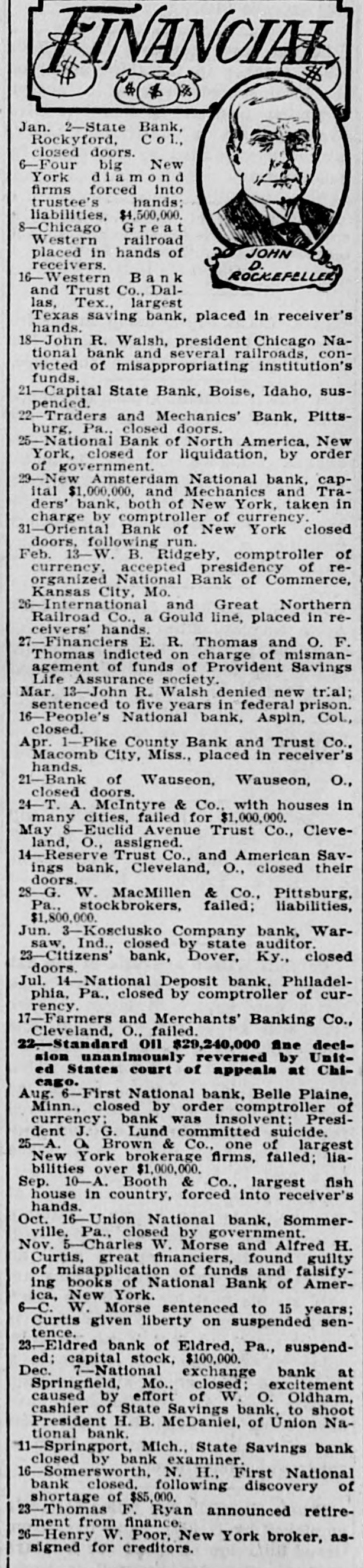
FINANCIAL $ $ Jan. 2-State Bank, Rockyford, Col., closed doors. Ka 6-Four big New York diamond firms forced into trustee's hands: liabilities, $4,500,000. 8-Chicago Great Western railroad JOHN placed in hands of D. receivers. ROCKEFELLER 16-Western Bank and Trust Co., Dallas, Tex. largest Texas saving bank, placed in receiver's hands. 18-John R. Walsh, president Chicago National bank and several railroads, convicted of misappropriating institution's funds. 21-Capital State Bank, Boise, Idaho, suspended. 22-Traders and Mechanics' Bank, Pittsburg. Pa.. closed doors. 25-National Bank of North America, New York, closed for liquidation, by order of government. 29-New Amsterdam National bank, capital $1,000,000, and Mechanics and Traders' bank, both of New York, taken in charge by comptroller of currency. 31-Oriental Bank of New York closed doors, following run. Feb. 13-W. B. Ridgely, comptroller of currency, accepted presidency of reorganized National Bank of Commerce, Kansas City, Mo. 26-International and Great Northern Railroad Co., a Gould line, placed in receivers' hands. 27-Financiers E. R. Thomas and O. F. Thomas indicted on charge of mismanagement of funds of Provident Savings Life Assurance society. Mar. 13-John R. Walsh denied new trial; sentenced to five years in federal prison. -People's National bank. Aspin. Col., closed. Apr. 1-Pike County Bank and Trust Co., Macomb City, Miss., placed in receiver's hands. 21-Bank of Wauseon. Wauseon, O., closed doors. 24-T. A. McIntyre & Co., with houses in many cities, failed for $1,000,000. May 8-Euclid Avenue Trust Co., Cleveland, O., assigned. 14-Reserve Trust Co., and American Savings bank, Cleveland, O., closed their doors. 28-G. W. MacMillen & Co., Pittsburg, Pa.. stockbrokers. failed; liabilities, $1,800,000. Jun. 3-Kosclusko Company bank, Warsaw, Ind., closed by state auditor. 23-Citizens' bank, Dover, Ky., closed doors. Jul. 14-National Deposit bank. Philadelphia, Pa., closed by comptroller of currency. 17-Farmers and Merchants' Banking Co., Cleveland, O., failed. 22-Standard on $29,240,000 fine declsion unanimously reversed by United States court of appeals at Chicago. Aug. 6-First National bank, Belle Plaine, Minn., closed by order comptroller of currency; bank was insolvent: President J. G. Lund committed suicide. 25-A. a Brown & Co., one of largest New York brokerage firms, failed; liabilities over $1,000,000. Sep. 10-A. Booth & Co., largest fish house in country, forced into receiver's hands. Oct. 16-Union National bank, Sommerville, Pa., closed by government. Nov. -Charles W. Morse and Alfred H. Curtis, great financiers, found guilty of misapplication of funds and falsifying books of National Bank of America, New York. 6-C. W. Morse sentenced to 15 years; Curtis given liberty on suspended sentence. 23-Eldred bank of Eldred, Pa., suspended: capital stock, $100,000. Dec. 7-National exchange bank at Springfield, Mo., closed: excitement caused by effort of W. O. Oldham, cashier of State Savings bank, to shoot President H. B. McDaniel, of Union National bank. 11-Springport, Mich., State Savings bank closed by bank examiner. 16-Somersworth, N. H., First National bank closed. following discovery of shortage of $85,000. 23-Thomas F. Ryan announced retirement from finance. 26-Henry W. Poor, New York broker, assigned for creditors.


Article from Perrysburg Journal, January 8, 1909

Click image to open full size in new tab

Article Text

Texas saving bank, placed in receiver's hands. 18-John R. Walsh, president Chicago National bank and several railroads, convicted of misappropriating institution's funds. 21-Capital State Bank, Boise, Idaho, suspended. 22-Traders and Mechanics' Bank, Pittsburg, Pa., closed doors. 25-N: ional Bank of North America, New Yor: closed for liquidation, by order of government. 29-New Amsterdam National bank, capital $1,000,000. and Mechanics and Traders' bank, both of New York, taken in charge by comptroller of currency. 31-Oriental Bank of New York closed doors, following run. Feb. 13-W. B. Ridgely, comptroller of currency, accepted presidency of reorganized National Bank of Commerce, Kansas City, Mo. 26-International and Great Northern Railroad Co., a Gould line, placed in receivers' hands. 27-Financiers E. R. Thomas and O. F. Thomas indicted on charge of mismanagement of funds of Provident Savings Life Assurance society. Mar. 13-John R. Walsh denied new trial; sentenced to five years in federal prison. 16-People's National bank, Aspin, Col., closed. Apr: 1-Pike County Bank and Trust Co., Macomb City, Miss., placed in receiver's hands. 21-Bank of Wauseon, Wauseon, O., closed doors. 24-T. A. McIntyre & Co., with houses in many cities, failed for $1,000,000. May 8-Euclid Avenue Trust Co., Cleveland, O., assigned. 14-Reserve Trust Co., and American Savings bank, Cleveland, O., closed their doors. 28-G. W. MacMillen & Co., Pittsburg, Pa., stockbrokers, failed; liabilities, $1,800,000. Jun. 3-Kosciusko Company bank, Warsaw, Ind., closed by state auditor. 23-Citizens' bank, Dover, Ky., closed doors. Jul. 14-National Deposit bank, Philadelphia, Pa., closed by comptroller of currency. 17-Farmers and Merchants' Banking Co., Cleveland, O., failed. 22-Standard Oil $29,240,000 flue decision unanimously reversed by United States court of appeals at Chicago. Aug. 6-First National bank, Belle Plaine, Minn., closed by order comptroller of currency: bank was insolvent: President J. G. Lund committed suicide. 25-A. O. Brown & Co., one of largest New York brokerage firms, failed; liabilities over $1,000,000. Sep. 10-A. Booth & Co., largest fish house in country, forced into receiver's hands. Oct. 16-Union National bank, Sommerville, Pa., closed by government. Nov. 5-Charles W. Morse and Alfred H. Curtis, great financiers, found guilty of misapplication of funds and falsifying books of National Bank of America, New York. 6-C. W. Morse sentenced to 15 years; Curtis given liberty on suspended sentence. 23-Eldred bank of Eldred, Pa., suspended; capital stock, $100,000. Dec. 7-National exchange bank at Springfield, Mo., closed; excitement caused by effort of W. O. Oldham, cashier of State Savings bank, to shoot President H. B. McDaniel, of Union National bank. 11-Springport, Mich., State Savings bank closed by bank examiner. 16-Somersworth, N. H., First National bank closed, following discovery of shortage of $85,000. 23-Thomas F. Ryan announced retirement from finance. 26-Henry W. Poor, New York broker, assigned for creditors.


Article from Little Falls Herald, January 8, 1909

Click image to open full size in new tab

Article Text

FINANCIAL Jan. 2-State Bank, Rockyford, Col., closed doors. -Four big New York diamond firms forced into trustee's hands; liabilities, $4,500,000. 8-Chicago Great Western railroad JOHN placed in hands of receivers. 16-Western Bank ROCKEPELLE and Trust Co., Dallas, Tex., largest Texas saving bank, placed in receiver's hands. 18-John R. Walsh, president Chicago National bank and several railroads, convicted of misappropriating institution's funds. 21-Capital State Bank, Boise, Idaho, suspended. 22-Traders and Mechanics' Bank, Pittsburg, Pa., closed doors. National Bank of North America, New York, closed for liquidation, by order of government. 29-New Amsterdam National bank, capital $1,000,000, and Mechanics and Traders' bank, both of New York, taken in charge by comptroller of currency. 81-Oriental Bank of New. York closed doors, following run. Feb. 13-W. B. Ridgely, comptroller of currency, accepted presidency of reorganized National Bank of Commerce, Kansas City, Mo. 26-International and Great Northern Railroad Co., a Gould line, placed in receivers' hands. 27-Financiers E. R. Thomas and O. F. Thomas indicted on charge of mismanagement of funds of Provident Savings Life Assurance society. Mar. 13-John R. Walsh denied new trial; sentenced to five years in federal prison. 16-People's National bank, Aspin, Col., closed. Apr. 1-Pike County Bank and Trust Co., Maoomb City, Miss., placed in receiver's hands. 21-Bank of Wauseon, Wauseon, O., closed doors. 24-T. A. McIntyre & Co., with houses in many cities, failed for $1,000,000. May 8-Euclid Avenue Trust Co., Cleveland, O., assigned. 14-Reserve Trust Co., and American Savings bank, Cleveland, O., closed their doors. 20-G. W. MacMillen & Co., Pittsburg. Pa., stockbrokers, failed; liabilities, $1,800,000. Jun. 3-Kosciusko Company bank, War saw, Ind., closed by state auditor. 23-Citizens' bank, Dover, Ky., closed doors. Jul. 14-National Deposit bank, Philadelphia, Pa., closed by comptroller of currency. 17-Farmers and Merchants' Banking Co., Cleveland, O., failed. Aug. 6-First National bank, Belle Plaine, Minn., closed by order comptroller of currency; bank was insolvent; President J. G. Lund committed suicide. 25-A. O. Brown & Co., one of largest New York brokerage firms, failed; liabilities over $1,000,000. Sep. 10-A. Booth & Co., largest fish house in country, forced into receiver's hands. Oct. 16-Union National bank, Sommerville, Pa., closed by government. Nov. 5-Charles W. Morse and Alfred H. Curtis, great financiers, found guilty of misapplication of funds and falsifying books of National Bank of America, New York. 6-C. W. Morse sentenced to 15 years; Curtis given liberty on suspended sentence. 23-Eldred bank of Eldred, Pa., suspended; capital stock, $100,000. Dec. 7-National exchange bank at Springfield, Mo., closed; excitement caused by effort of W. O. Oldham, cashier of State Savings bank, to shoot President H. B. McDaniel, of Union National bank. -Springport, Mich., State Savings bank closed by bank examiner.