13718. Broadway Trust Company (New York, NY)

Bank Information

Episode Type
Run Only
Bank Type
trust
Start Date
October 26, 1907
Location
New York, New York (40.714, -74.006)

Metadata

Model
gpt-5-mini
Short Digest
6588a880357a8414

Response Measures

None

Description

Multiple contemporary 1907 newspaper reports describe a run on the Broadway Trust Company during the Panic of 1907. Articles state the company met demands, paid many withdrawals, adopted a rule prioritizing payroll payments, and that the run abated and the company paid all comers. There is a 1909 item noting the company discontinued payments in 1907, but none of the provided 1907 articles explicitly report a formal suspension or closing of the Broadway Trust Company—rather they describe paying out and later resumption of normal business. Given the provided texts, classify as a run without documented suspension. Cause is taken as the broader 1907 financial panic (macro/systemic news).

Events (3)

1. October 26, 1907 Run
Cause
Macro News
Cause Details
Part of the wider Panic of 1907 financial crisis; runs and general loss of confidence following other trust/bank troubles in New York (Knickerbocker and related events).
Measures
Restricted payments for the day to payroll and urgent demands; prioritized withdrawals to pay employees; paid large sums ($2,400,000 reported paid out during the week) and officials declared the firm solvent.
Newspaper Excerpt
Frightened depositors in the Mechanics' and Traders bank ... and the Broadway Trust company made a run upon these banks. All demands were met by these concerns, however.
Source
newspapers
2. October 27, 1907 Run
Cause
Macro News
Cause Details
Continuation of the Panic of 1907; general nervousness and runs on multiple Manhattan trust companies and banks.
Measures
Announced paying only demands needed for payrolls for the day; officers said institution would meet every demand; large disbursements reported and later lines diminished.
Newspaper Excerpt
The run on the Broadway Trust Company ... began at the opening of business. An hour after the doors were opened the line contained three hundred and fifty patrons. ... 'We are solvent, but we must have time,' he said.
Source
newspapers
3. October 21, 1909 Other
Newspaper Excerpt
BROADWAY TRUST RESUMES DIVIDENDS. The directors of the Broadway Trust Company have declared a quarterly dividend ... This is the first dividend declared by the company since it discontinued payments in 1907. (news item noting later dividend and referencing 1907 discontinuation.)
Source
newspapers

Newspaper Articles (8)

Article from The Birmingham Age-Herald, October 27, 1907

Click image to open full size in new tab

Article Text

Bankers Arrange to Issue Clearing House Certificates to All Banks ARRIVAL OF GOLD IMPORTS GIVES SUBSTANTIAL AID Banks and Trust Companies Ride the Storm of Runs Without Impairment, and the Situation Is Now Well In Hand. New York, October 26.-(Special.)-With the unanimous decision of the New York Clearing House association to issue clearing house certificates, leading financiers believe that the final steps have been taken to restore conditions in financial circles to their usual state. Of scarcely less importance as tending to restore confidence was the introduction of a resolution in the meeting of the Clearing House association applying for the readmission of trust companies to membership in the association. The announcement of the early arrival of gold imports from Europe further improved the situation today. There is a balance of $60,000,000 in our favor in the trading between Europe and the United States, and an influx of the yellow metal from Europe at this time will serve to hasten the return to normal conditions. With all these things operating to restore confidence the reaction which seu in on Friday continued unabated today. The suspension of the Terminal bank in Brooklyn, a small institution, had no effect on the situation. The Trust Company of America, the Lincoln Trust company and the other institutions which were imperiled by runs rode the storm, and their officials announced at the close of the day that tneir concerns would resume business Monday in good shape. It is understod that for the reason that Europe might get the idea that the cone ditions in New York are worse than they really are, J. P. Morgan and bankers in friendly association with them, opposed the issuance of the clearing house cer tificates, but gave way to the minority after the matter had been thoroughly threshed out Arranging Details. A committee, headed by Vice President Cannon of the Fourth National bank. was appointed to arrange the details for the issue. The final act of the meeting of the Clearing House association was the adoption of a resolution thanking Secretary Cortelyou and J. P. Morgan for their services during the time of the crisis, The regular weekly bank statement is sued today showed that the surplus which the banks had at the close of last week was entirely wiped out by the panic and that a deficit of $1,233,300 was created instead. A surprising feature of the statement was an increase of loans of $10,864,700. 11 had been expected that the enormous liquidation during the week would have resulted in a considerable decrease in this item. Frightened depositors in the Mechanics' and Traders bank. with 12 branches in Manhattan and Brooklyn, and the Broadway Trust company made a run upon these banks. All demands were met by these concerns, however. In a run on the Northern bank of New York there was so much disorder that the police had to be called. The Broadway Trust company adopted a rule that those who were withdrawing funds to pay off employes should have the first call today. General approval was given to the action of the presidents of the saving3 banks, all of which today put into effect the rule which compels the filing of 60 days notice of an intention to withdraw funds. Cortelyou's Statement. Secretary of the Treasury Cortelyou caused the following statement to be given out tonight: "On the occasion of a call on him this morning by representatives of the New York clearing house, Secretary Cortelyou asked that they convey to the clearing house his deep appreciation on behalf of the government of the courageous and high-minded manner in which they had upheld the interests, not only of the people of this city but in a sense the people of the whole country.' " Later the secretary called upon J. P. Morgan and expressed in similar terms his appreciation of the services rendered by Mr. Morgan and all who had cooperated with him in meeting the emergency. The sub-committee of the directors of the Knickerbocker Trust company, which is hoping to bring about a resumption of business of the company, met in executive session today. After the meeting Mr. Davies, the counsel for the company, said: "The committee met and after a discussion decided upon a plan of reorganization, with the end in view of resumption of business. This plan will be advertised in detail as a paid advertisement in the Monday morning newspapers. This to insure its accuracy and also its authenticity."


Article from New-York Tribune, October 27, 1907

Click image to open full size in new tab

Article Text

MANHATTAN RUNS ABATE. Nearly All Demands Are Paid and Excitement Is Subsiding. With the exception of runs 8n the Broadway Trust Company and the Northern Bank of New York, yesterday morning, the latter attended by disorder at the close. and the continued but decreased run on the Lincoln Trust Company, the bank situation was much improved and there were no further suspensions reported in Manhattan The situation in Harlem and The Bronx showed improvement also. The reflex of the restored confidence in Wall Street was apparent in the reduced crowds at the Harlem Savings Bank and the Dollar Savings Bank in The Bronx, where there have been runs. The run on the Northern Bank at Broadway and 4th street, resulted in the arrest of two depositors who refused to leave the bank when It closed at 12 o'clock, as allowed by law. When Henry Dimse. president of the bank, closed the doors, he said: "This bank is solvent. but we cannot pay off any more to-day A line of four hundred depositors extended at that hour from the paying teller's window to the street. Henry A. Belden, the cashier. came out and asked the depositors to leave the building When some of them refused Mr. Dimse telephoned for the police. but the depositors were stubborn and the police had no easy work in dispersing them. Eventually all of them left except the two men who were atrested. The Northern Bank has a capitalization of $300,000 and surplus and undivided profits of $239,099 The run on the Broadway Trust Company, at No. 756 Broadway, not far from the Northern Bank began at the opening of business An hour after the doors were opened the line contained three hundred and fity patrons. As the line grew Frederick G. Lee. vice-president, announced that the company would honor for the day only demands that were needed for payrolls. 'We are solvent, but we must have time," he said. Many of those waiting were there to draw money to pay off employes of nearby factories. and the money was sent to them in the afternoon. M. M Belding, jr., president of the company, said that $2,400,000 had been paid out in the week. He added "Up this minute we have paid off every demand. The Broadway Trust Company is capitalized at $700,000 and has deposits of $4,057,444. More than two-thirds of the deposits have been withdrawn, Mr. Belding said. The Harlem Savings Bank continued paying all small accounts, having availed itself the day before of the sixty-day clause on accounts of more than $100. The closing of the doors at the usual hour left about one hundred depositors in line. The readiness with which the Dollar Savings Bank in The Bronx has met all demands since the run began on Wednesday had its good effect, and while not altogether checked the demand was much diminished. Men and women had remained all night in the line in front of the bank, and some of the latter were nearly exhausted. The bank did not close at noon at usual on yesterday. but remained open until 3 o'clock, up to which time one thousand accounts had been closed, representing half of the $600,000 cash on hand. The excitement of a few days ago in Wall street, caused by the run on the Trust Company of America, was altogether absent yesterday. The all night crowd was much smaller and the paying out went on with reasonable rapidity. The company received $500,000 in deposits. Oakleigh Thorne, president of the company, said: "The institution occupies a stronger position at the end of this day than it did before. Colonel Heman Dowd. the vice-president, said: "The number of withdrawals were fewer to-day than we expected, and the deposits greater than we expected.' The situation at the Colonial branch of the Trust Company of America was much the same as at the main office. At both the main office and the Colonial branch the payments were made up to the usual Saturday closing hour. There were two hundred in line when the Lincoln Trust Company closed its day's business Louis Stern, one of the directors, said the Institution would meet every demand. Some of those in line when the bank closed were still there last night, apparently with the intention of remaining until Monday. When the Empire City Savings Bank, at No. 231 West 125th street, opened its doors there were four women and one man ready to hand in their passbooks for withdrawals. The Hamilton Bank remains closed. as do the United States Exchange Bank and the Twelfth Ward Bank, all in 125th street. There was a small run on the Bank for Savings, at Fourth avenue and 22d street, but it was not as heavy as on the two previous days. The bank has demanded sixty days' notice of withdrawal for large accounts. At 1 o'clock this morning there were forty-five persons waiting outside the Lincoln Trust Company, in Fifth avenue. They had numbers to show their places in line, and for the most part walked to and fro to keep warm, for the night was cold and raw. Some of them said they had received promises of $20 apiece to wait for the opening of the trust company. Outside the Trust Company of America, in Wall street, were twelve men, with numbers in their hats, waiting for the opening of banking hours tomorrow. Some had blankets to keep out the cold. The Colonial branch of the Trust Company of America was deserted


Article from The Washington Times, October 27, 1907

Click image to open full size in new tab

Article Text

EARING HOUSE CERTIFICATES TO STRENGTHEN BANKS Association Decides to Adopt Strong Measures and Relief Is Certain. NEW YORK, Oct. 26. With the unan imous decision of the New York Clearing House Association today to issue clearing house certificates for the settlement of debit balances by the banks, leading financiers believe that the final steps have been taken to restore conditions in financial circles to their wonted calm. The issue of these certificates will release for general circulation a large sum of currency, and the scarcity of money new the only cloud that lingers on the horizon. s Of scarcely less importance as tending to restore confidence was the introduction of a resolution in the meeting of the Clearing House Association providing for the readmission of trust companies to membership in this assoclation. This will place the trust companies under the rules of the clearing house, and tend to prevent recurrence of the situation which brought about the slump last week. News of Gold Imports Aid. Announcement of the early arrival of gold imports from Europe further improved the situation today. There is a balance of $60,000,000 in our favor in the trading between Europe and the United States, and an influx of the yellow metal from Europe at this time will serve to hasten the return to normal conditions in the financial world. Heidelbach, Ikelheimer & Co., of 37 William street, today announced that the first of the gold imports, $1,500,000 in amount, will arrive here Wednesday. With all these agencies operating to restore confidence, the reaction set in Friday continued unabated today, and the sun began to shine on Wall Street again. Except for the suspension of the Terminal Bank, in Brooklyn, a small Jenkins institution, whose closing had no effect on the situation, every report that went out over the ticker was fa. vorable. Stock Market Firm. The stock market continued firm and money was comparatively easier. The Trust Company of America, the Lincoln Trust, and the other institutions which were imperiled by runs rode the storm and their officials announced at the close of the day that their concerns would resume business Monday in capital shape to meet any demands that might be made upon them. It is understood that for the reason that Europe might get the idea that conditions are worse in New York than they reall are. J. P. Morgan and bankers in friendly association with them, opposed the issue of clearing house cer tificates, but gave way to the majority after the matter had been thoroughly threshed out. A committee headed by Vice President Cannon, of the Fourth National Bank was appointed to arrange the details for the issue. Banks will be permitted to avail themselves of the certificates to the amount of 75 per cent of their debit balances Financial men almost without exception declared after the adjournment of the meeting that this measure will undoubtedly bring to the situation the relief that is needed to restore confidence and stability to the market The final act of the meeting of the clearing house association was the adoption of a resolution thanking Secretary of the Treasury Cortelyou and J. Pierpent Morgan for their services during the time of the crisis. Surplus Was Wiped Out. The regular weekly bank statement issued today showed that the surplus which the banks had at the close of last week was entirely wiped out by the flurry, and that a deficit of $1,233,300 was created instead. A surprising feature of the statement was an increase of loans of $10,864,700. It had been expected that the enormous liquidation in the market during the week would have resulted in a considerable decrease in this item. While the skles were clearing in Wali Street, frightened depositors in- the Mechanics and Traders' Bank, 565 Broadway, with twelve branches in Manhattan and Brooklyn, and in the Broadway Trust Company, Broadway and Eighth street, made a descent upon the two institutions, and there were lively withdrawals for some time. All demands were met by the two concerns however. In a run on the Northern Bank of New York, Broadway and Fourth street, there was so much disorder that the police had to be called. The Broadway Trust Company adopted a rule that those who were withdrawing funds to pay off employes should lave the first call today. General approval was given to the action of the presidents of the savings banks, all of which today put into effect the rule which compels the filing of sixty days' notice of an intention to withdraw funds.


Article from The Washington Times, October 28, 1907

Click image to open full size in new tab

Article Text

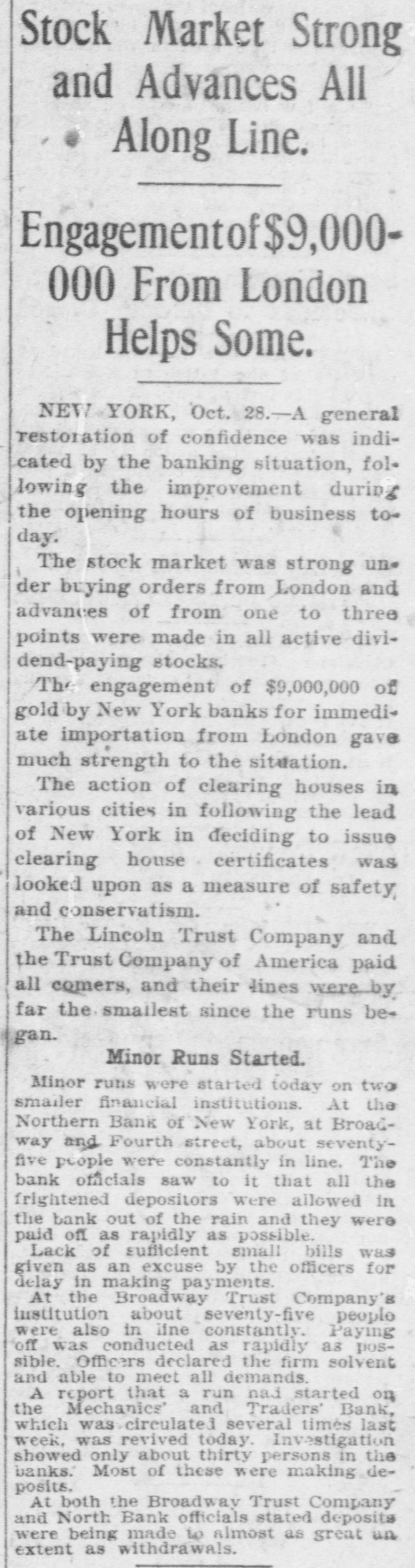
Stock Market Strong and Advances All Along Line. Engagementof$9,000000 From London Helps Some. NEW YORK, Oct. 28.-A general restoration of confidence was indicated by the banking situation, following the improvement during the opening hours of business today. The stock market was strong under buying orders from London and advances of from one to three points were made in all active dividend-paying stocks. The engagement of $9,000,000 of gold by New York banks for immedi< ate importation from London gave much strength to the situation. The action of clearing houses in various cities in following the lead of New York in deciding to issue clearing house certificates was looked upon as a measure of safety and conservatism. The Lincoln Trust Company and the Trust Company of America paid all comers, and their lines were by far the smailest since the runs began. Minor Runs Started. Minor runs were started today on two smailer financial institutions. At the Northern Bank of New York, at Broadway and Fourth street, about seventyfive people were constantly in line. The bank officials saw to it that all the frightened depositors Were allowed in the bank out of the rain and they were paid off as rapidly as possible. Lack of sufficient small bills was given as an excuse by the officers for delay in making payments. At the Broadway Trust Company's institution about seventy-five people were also in line constantly. Paying off was conducted as rapidly as pos= sible. Officers declared the firm solvent and able to meet all demands. A report that a run nad started on the Mechanics' and Traders' Bank, which was circulated several times last week, was revived today. Investigation shewed only about thirty persons in the banks. Most of these were making deposits. At both the Broadway Trust Company and North Bank officials stated deposits were being made to almost as great an extent as withdrawals.


Article from The Washington Times, October 28, 1907

Click image to open full size in new tab

Article Text

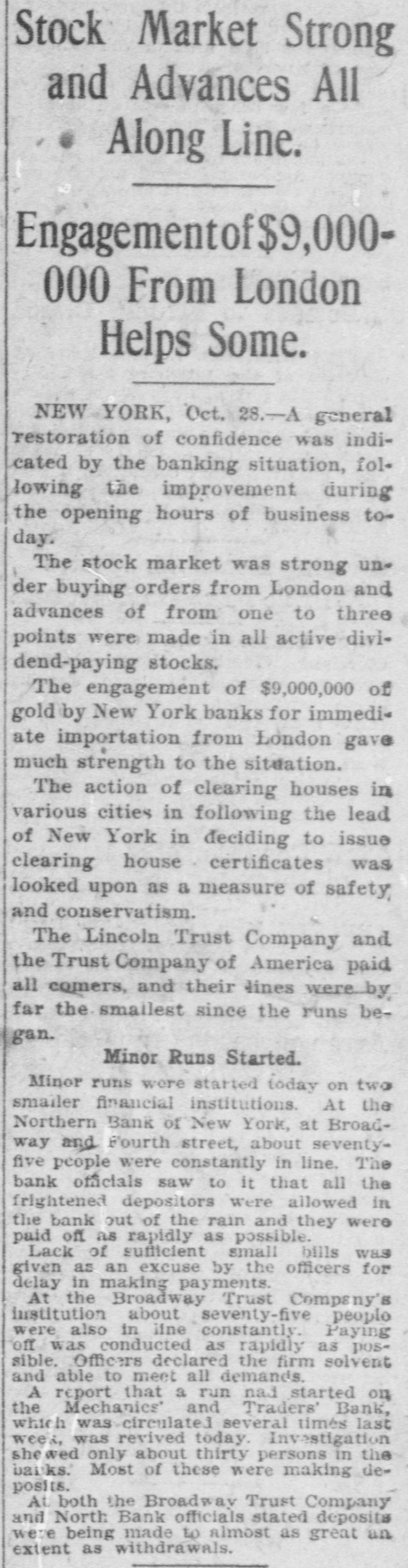
Stock Market Strong and Advances All Along Line. Engagementof$9,000000 From London Helps Some. NEW YORK, Oct. 28.-A general restoration of confidence was indicated by the banking situation, following the improvement during the opening hours of business today. The stock market was strong under buying orders from London and advances of from one to three points were made in all active dividend-paying stocks. The engagement of $9,000,000 of gold by New York banks for immediate importation from London gave much strength to the situation. The action of clearing houses in various cities in following the lead of New York in deciding to issue clearing house certificates was looked upon as a measure of safety and conservatism. The Lincoln Trust Company and the Trust Company of America paid all comers, and their lines were by far the smallest since the runs began. Minor Runs Started. Minor runs were started today on two smailer financial institutions. At the Northern Bank of New York, at Broadway and Fourth street, about seventyfive people were constantly in line. The bank officials saw to it that all the frightened depositors were allowed in the bank out of the rain and they were paid off as rapidly as possible. Lack of sufficient small bills was given as an excuse by the officers for delay in making payments. At the Broadway Trust Company's institution about seventy-five people were also in line constantly. Paying off was conducted as rapidly as possible. Officers declared the firm solvent and able to meet all demands. A report that a run nad started on the Mechanics' and Traders' Bank, which was circulated several times last week, was revived today. Investigation showed only about thirty persons in the banks. Most of these were making deposits. At both the Broadway Trust Company and North Bank officials stated deposits were being made to almost as great an extent as withdrawals.


Article from New-York Tribune, October 29, 1907

Click image to open full size in new tab

Article Text

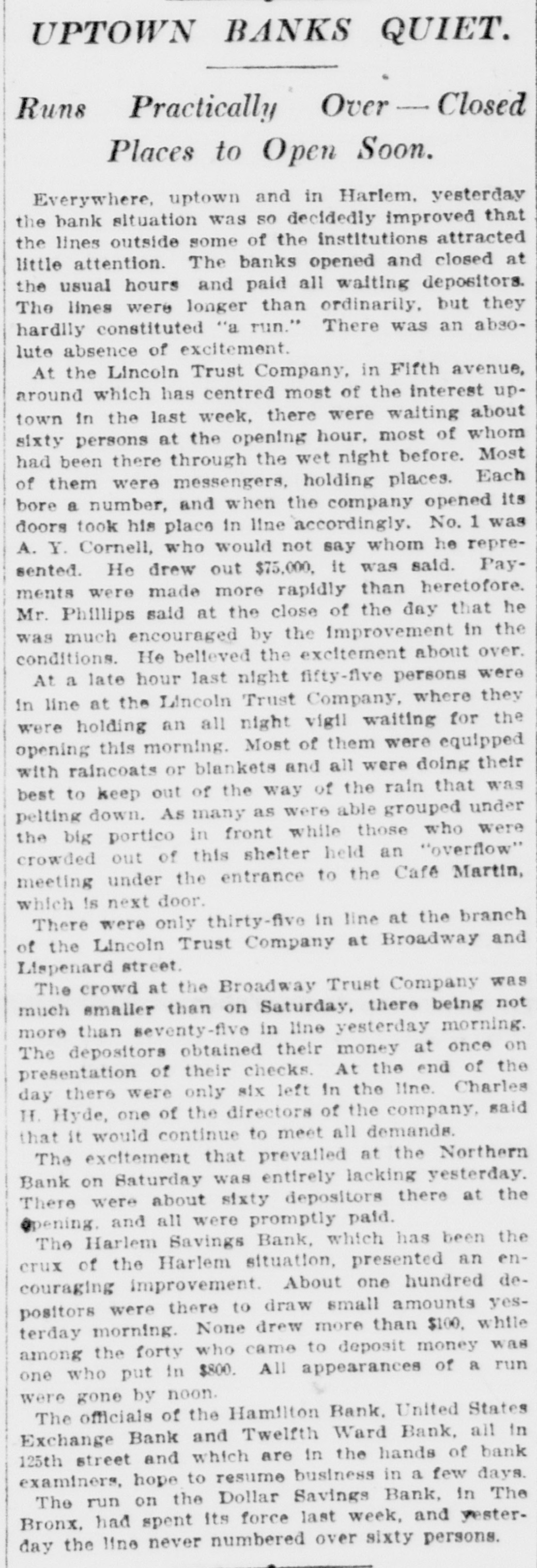
UPTOWN BANKS QUIET. Runs Practically Over - Closed Places to Open Soon. Everywhere, uptown and in Harlem. yesterday the bank situation was so decidedly improved that the lines outside some of the institutions attracted little attention. The banks opened and closed at the usual hours and paid all waiting depositors. The lines were longer than ordinarily, but they hardlly constituted "a run." There was an absolute absence of excitement. At the Lincoln Trust Company, in Fifth avenue, around which has centred most of the interest uptown in the last week, there were waiting about sixty persons at the opening hour, most of whom had been there through the wet night before. Most of them were messengers, holding places. Each bore a number, and when the company opened its doors took his place in line accordingly. No. 1 was A. Y. Cornell, who would not say whom he represented. He drew out $75,000. it was said. Payments were made more rapidly than heretofore. Mr. Phillips said at the close of the day that he was much encouraged by the improvement in the conditions. He believed the excitement about over. At a late hour last night fifty-flve persons were in line at the Lincoln Trust Company, where they were holding an all night vigil waiting for the opening this morning. Most of them were equipped with raincoats or blankets and all were doing their best to keep out of the way of the rain that was pelting down. As many as were able grouped under the big portico in front while those who were crowded out of this shelter held an "overflow" meeting under the entrance to the Cafe Martin, which is next door. There were only thirty-five in line at the branch of the Lincoln Trust Company at Broadway and Lispenard street. The crowd at the Broadway Trust Company was much emailer than on Saturday, there being not more than seventy-five in line yesterday morning. The depositors obtained their money at once on presentation of their checks. At the end of the day there were only six left In the line. Charles H. Hyde, one of the directors of the company, said that it would continue to meet all demands. The excitement that prevailed at the Northern Bank on Saturday was entirely lacking yesterday. There were about sixty depositors there at the pening. and all were promptly paid. The Harlem Savings Bank, which has been the crux of the Harlem situation, presented an encouraging improvement. About one hundred depositors were there to draw small amounts yesterday morning. None drew more than $100. while among the forty who came to deposit money was one who put in $800. All appearances of a run were gone by noon. The officials of the Hamilton Bank. United States Exchange Bank and Twelfth Ward Bank, all in 125th street and which are in the hands of bank examiners, hope to resume business in a few days. The run on the Dollar Savings Bank, in The Bronx. had spent its force last week, and yesterday the line never numbered over sixty persons.


Article from New-York Tribune, October 30, 1907

Click image to open full size in new tab

Article Text

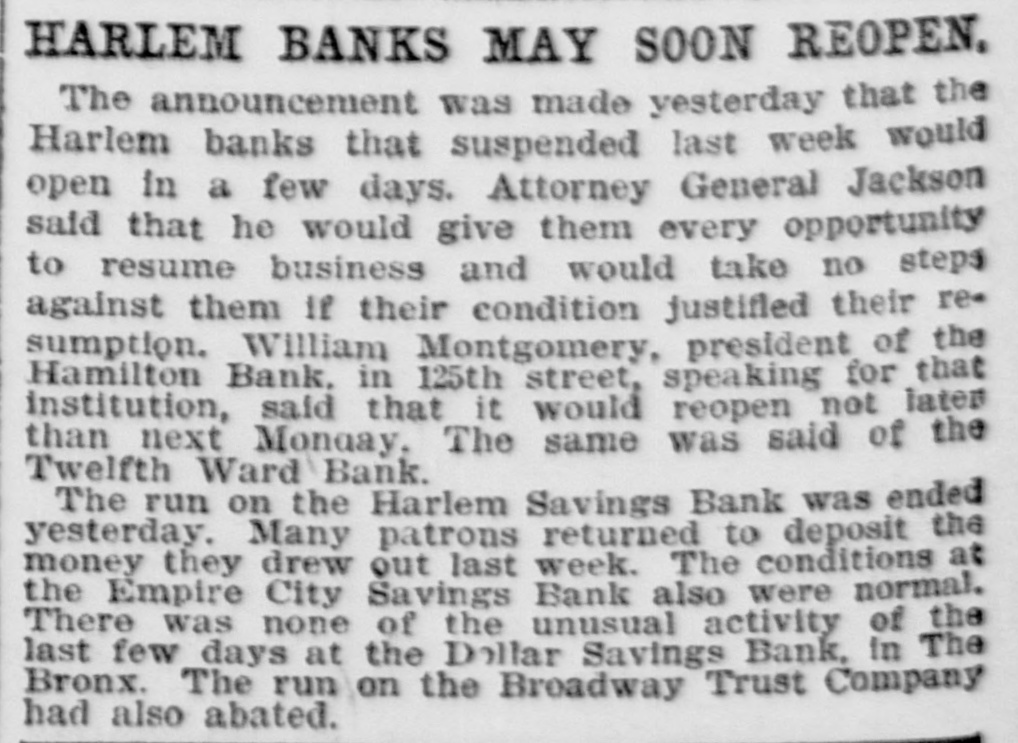
HARLEM BANKS MAY SOON REOPEN. The announcement was made yesterday that the Harlem banks that suspended last week would open in a few days. Attorney General Jackson said that he would give them every opportunity to resume business and would take no steps against them If their condition justifled their resumption. William Montgomery, president of the Hamilton Bank, in 125th street, speaking for that institution, said that it would reopen not later than next Monday, The same was said of the Twelfth Ward Bank. The run on the Harlem Savings Bank was ended yesterday. Many patrons returned to deposit the money they drew out last week. The conditions at the Empire City Savings Bank also were normal. There was none of the unusual activity of the last few days at the Dollar Savings Bank, in The Bronx. The run on the Broadway Trust Company had also abated.


Article from New-York Tribune, October 21, 1909

Click image to open full size in new tab

Article Text

TOPICS OF STREET FOREIGN TRADING.-Foreign houses sold 45,000 shares in the local market, United States Steel supplying the chief dealings. In the London market American stocks were heavy and the general list was weak, with consols at the lowest price of the year. Call money was in good demand at the British capital. Spot discounts were firm at 3½ to 4 per cent as the general quotation, but no business was done over 3/16 per cent. The India Council made thirty day loans at 3½ per cent. Paris advices confirm reports that French bank- ers are disinclined to accept American stocks as collateral in loans. Continental exchange on London was higher. AMERICAN STOCKS IN ENGLAND.- Answering an inquiry in reference to the manner of procedure in placing stock of an American corporation before English in- vestors, Consul General John L. Griffiths writes from London: "I am informed by a member of one of the leading firms of merchant bankers in London that if it is desired to create a market on the London Stock Exchange for American securities it would be necessary for the owners of the shares to conclude an arrangement with some English Stock Exchange house to purchase and sell to the public through the Stock Exchange a certain amount of the shares of the American corporation. After dealings had been carried on in the Stock Exchange to some extent, if the usual course were pursued, the brokers handling the American stock would then apply to the Stock Exchange committee for a settle- ment in the shares. The officials of the American company would then be asked by the committee to answer questions with reference to their corporation, the issuance of securities by it and to furnish such in- formation as would satisfy the committee of the financial responsibility and good faith of the American corporation. If everything is found to be in order, as re- quired under the Stock Exchange rules, a settlement is granted in the shares. Deal- ings in the shares would then naturally continue under the ordinary conditions of supply and demand, and settlements would be effected at the regular account days. LA ROSE MINES REPORT.-La Rose Consolidated Mines Company reports for the year ended May 31 a surplus, after charges, of $1,054,570. Sales of bullion were $1,183,042 and total earnings were $1.565,068. After all expenditures, interest charges and dividends there was a balance of $421,- 481. The general balance sheet shows value of properties, plants, etc., $7,530,412, and silver ore on hand and in transit, $376,278. J. McMartin, president of the company, in the report, says: "During the last twelve months, through systematic and vigorous management the company has continued to be one of the largest producers of silver in the Cobalt district. The net value of its product for the period under review was $1,820,148 and the cost of producing silver was 16.31 cents an ounce, while the average selling price was 51 cents an ounce. It is very gratifying to note that while almost the entire output of silver (about 3,000 ounces) was mined from La Rose mine, nevertheless the same ore reserves as were reported a year ago have been main- tained." DIVIDENDS DECLARED, - Dividends have been declared as follows: New Cen- tral Coal Company, regular semi-annual 2 per cent, payable November 1; Germania Bank, regular semi-annual 10 per cent and an extra 2½ per cent, payable November 1; Pacific Bank, regular quarterly 2 per cent, payable November 1; the H. B. Claflin Com- pany, regularly quarterly 1¼ per cent on the first preferred and quarterly 1¼ per cent on the second preferred, payable No- vember 1; American Gas and Electric Com- pany, regular quarterly 1½ per cent on the preferred, payable November 1; Pullman Company, regular quarterly 2 per cent, pay- able November 15; Corn Exchange Bank, regular quarterly 4 per cent, payable No- vember 1. INTERNATIONAL STEAM PUMP.- William Salomon, of William Salomon & Co., has been elected a director of the In- ternational Steam Pump Company. Benja- min Guggenheim, president of the company, accompanied by L. T. Feustman, vice- president, has completed an inspection tour of the Eastern factories of the company, in which plans were completed for extensions and new equipment, made necessary by the increased business. President Guggenheim says that nearly all plants are running at capacity. TO REEEM SEABOARD RECEIVERS' CERTIFICATES. The receivers of the Seaboard Air Line Railway have given notice to holders of the receivers' certifi- cates of indebtedness, series A, B and C, that, pursuant to a decree of October 18 of the federal court, the certificates have been called for payment, principal and interest, on November 6 next at the office of the Continental Trust Company, the fiscal agent of the receivers in Baltimore, or, at the option of the holders, at the office of Hair & Co., No. 24 Broad street, New York. Interest will cease on November 6. CRUCIBLE STEEL-Stockholders of the Crucible Steel Company of America adopt- ed the following amendments to the certifi- cates of incorporation of the company: "The corporation may also purchase of otherwise acquire, hold, sell, assign, con- serve or otherwise dispose of shares of its own capital stock." "Accumulated profits may be reserved and invested in shares of its own stock which the corporation has power to hold." MERGENTHALER LINOTYPE RE- PORT. The Mergenthaler Linotype Com- pany reports for the year ended September 30 a net gain in its business of $2,642,468, as against $2,426,716 in the preceding year. The balance sheet shows a surplus of $8,296,917, against $7,289,982 in 1908. In the year the company's machines were in- troduced into 662 offices. At the annual meeting of the company, Sir Joseph Law- rence, of London, was elected a director to succeed Andrew Devine, dead. PENNSYLVANIA PUBLICITY AGENT RESIGNS. Ivy L. Lee has resigned his position as head of the publicity bureau of the Pensylvania Railroad Company for the purpose of taking charge of the Euro- pean business of Harris, Winthrop & Co., bankers, of New York and Chicago. J. W. Lee, jr., formerly assistant to Ivy L. Lee, is now in charge of the Pennsylvania's publicity bureau. APPLICATION TO LAST.-Application has been made to the Stock Exchange to list the following securities: Wisconsin Central, $2,500,000 first and refunding 4 per cent mortgage bonds, due 1959; Illi- nois Central, $12,000,000 purchased lines first mortgage 3½ per cent bonds, due 1952. E. & O'S EARNINGS INCREASE.- Earnings of the Baltimore & Ohio Rail- road for September show an increase in gross of $1,099,424, and an increase in net of $470,326. From July 1 gross earnings have increased $2,578,244, and net earnings $511,411, comparison being made with the same time last year. BROADWAY TRUST RESUMES DIVI- DENDS. The directors of the Broadway Trust Company have declared a quarterly dividend of 1½ per cent, payable Novem- ber 1. This is the first dividend declared by the company since it discontinued pay- ments in 1907. REPUBLIC IRON AND STEEL-At the annual meeting of the Republic Iron and Steel Company John F. Harris, of Harris, Winthrop & Co., was elected a director to succeed H. S. Black. CHICAGO GREAT WESTERN-The third and last payment of $5 a share on the common and preferred B stocks of the Chi- cago Great Western is due to-day. GOLD EXPORTS.-The Bank of New York yesterday shipped $200,000 gold coin to Brazil and $100,000 gold coin to Canada.