South Ashland National Bank (Chicago, IL)

Episode Information

Episode UID
1325301590
Episode Type
Suspension โ†’ Closure
Bank Type
national
Bank ID
132530 national
Charter Number
13253
Start Date
June 25, 1932
Location
Chicago, Illinois (41.850, -87.650)

Metadata

Model
gpt-5-mini (chosen from majority vote of a three-model LLM ensemble)
Short Digest
1ab7ee339ecfa3f9

Response Measures

None

Receivership Details

Depositor recovery rate
100.0%
Date receivership started
1932-06-27
Date receivership terminated
1936-09-15
Share of assets assessed as good
22.0%
Share of assets assessed as doubtful
53.7%
Share of assets assessed as worthless
24.3%

Description

Articles list the bank among four Chicago banks that 'failed to open' June 25, 1932; no reopening reported in these items.

Events (3)

1. November 13, 1928 Chartered
Source
historical_nic
2. June 25, 1932 Suspension
Cause
Rumor Or Misinformation
Cause Details
Listed among banks that failed to open amid heavy withdrawals and alleged whispering/plot-driven runs in Chicago.
Newspaper Excerpt
The fourth was the South Ashland National Bank. These three together had about $1,000,000 deposits.
Source
newspapers
3. June 27, 1932 Receivership
Source
historical_nic

Newspaper Articles (12)

Article from The Cleveland Press, June 25, 1932

Click image to open full size in new tab

Article Text

FOUR MORE CHICAGO BANKS ARE CLOSED Total for Month Is 40; Loop With. drawals Are Heavy By United Press CHICAGO. June Four more Chicago and suburban banks failed to open for business today, one of them a Loop bank with $5,000,000 deposits. Heavy withdrawals continued the big Loop banks where all depositors who wanted their money were given it. Extra forces of tellers were on duty. The closings today shade a total of 40 this month The banks which closed today were: Chicago Bank of Commerce South Ashland National First Na. tional of Wilmette. and North Brook 1953


Article from Green Bay Press-Gazette, June 25, 1932

Click image to open full size in new tab

Article Text

FOUR MORE BANKS IN CHICAGO CLOSE DOORS CHICAGO Chicago and suburban banks failed to open for business today them loop bank with deposits The banks which closed Chicago Bank Commerce (State) capital deposits. South National (South. side) capital National of Wilmette ital capital $50,000; deposits, $140,000.


Article from The Knoxville News-Sentinel, June 25, 1932

Click image to open full size in new tab

Article Text

FOUR CHICAGO BANKS CLOSED One Is Big Loop Institution, Heavy Run on Others. By United Press Four more Chicago and suburban banks failed to open for business Saturday one of them Loop bank with 000 posits. Heavy withdrawals continued the Loop banks where all depositors who wanted their money were given Extra forces tellers duty The closings a total of 40 month The banks which closed Saturwere Chicago Bank Commerce capital South Ashland National (SouthFirst National of Wilmette, ital deposits unavailNorthbrook State (Suburban capital deposits $


Article from Evening Star, June 26, 1932

Click image to open full size in new tab

Article Text

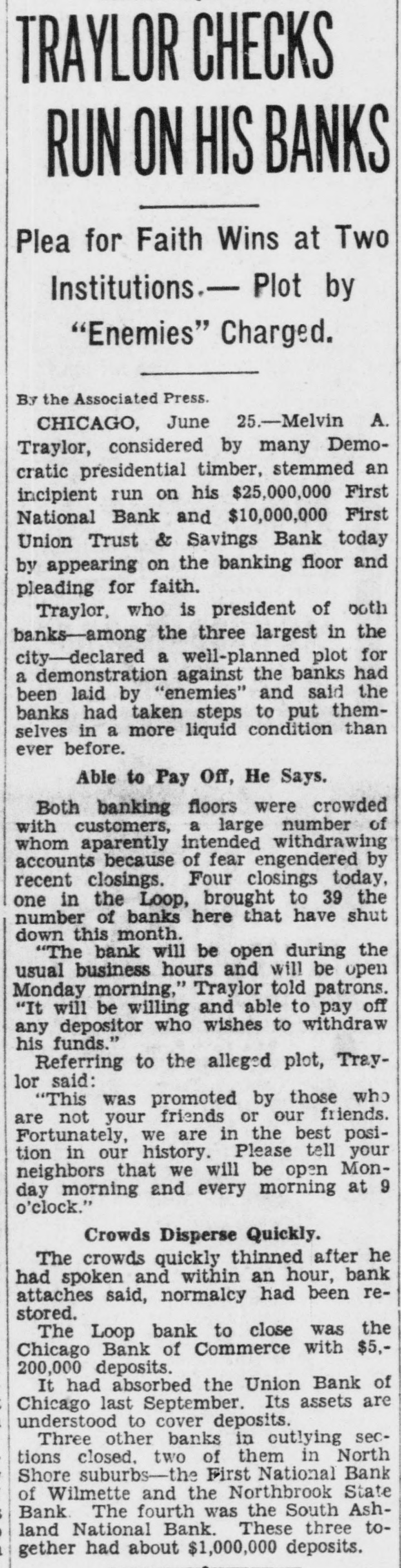
TRAYLOR CHECKS RUN ON HIS BANKS Plea for Faith Wins at Two Institutions.- Plot by "Enemies" Charged. By the Associated Press. CHICAGO, June 25.-Melvin A. Traylor, considered by many Democratic presidential timber, stemmed an incipient run on his $25,000,000 First National Bank and $10,000,000 First Union Trust & Savings Bank today by appearing on the banking floor and pleading for faith. Traylor, who is president of ooth banks-among the three largest in the city-declared a well-planned plot for a demonstration against the banks had been laid by "enemies" and said the banks had taken steps to put themselves in a more liquid condition than ever before. Able to Pay Off, He Says. Both banking floors were crowded with customers, a large number of whom aparently intended withdrawing accounts because of fear engendered by recent closings. Four closings today, one in the Loop, brought to 39 the number of banks here that have shut down this month. "The bank will be open during the usual business hours and will be open Monday morning," Traylor told patrons. "It will be willing and able to pay off any depositor who wishes to withdraw his funds." Referring to the alleged plot, Traylor said: "This was promoted by those who are not your friends or our friends. Fortunately, we are in the best position in our history. Please tell your neighbors that we will be open Monday morning and every morning at 9 o'clock." Crowds Disperse Quickly. The crowds quickly thinned after he had spoken and within an hour, bank attaches said, normalcy had been restored. The Loop bank to close was the Chicago Bank of Commerce with $5,200,000 deposits. It had absorbed the Union Bank of Chicago last September. Its assets are understood to cover deposits. Three other banks in outlying sections closed. two of them in North Shore suburbs-the First National Bank of Wilmette and the Northbrook State Bank The fourth was the South Ashland National Bank. These three together had about $1,000,000 deposits.


Article from Corpus Christi Caller-Times, June 26, 1932

Click image to open full size in new tab

Article Text

Run on Chicago Bank Stemmed as Melvin Traylor Pleads for Faith Chicago, June 25.-(P)-Melvin A. Traylor, considered by many as Democratic presidential timber, stemmed an incipient run on his $25,000,000 First National bank and $10,000,000 First Union Trust and Savings bank today by appearing on the banking floors and pleading for faith. Traylor, who is president of both banks-among the three largest in the city-declared well-planned plot for demonstration against the banks had been laid by "enemies" and said the banks had taken steps to put themselves in a liquid condition than ever before. Both banking floors were crowd. ed with customers, large number of whom apparently intended withdrawing accounts because of fear engendered by recent closings. Four closings today. one in the loop. brought to 39 of banks here that have shut down this month. Referring alleged Traylor "This promoted by not your friends or our friends. tion in our history. Please tell neighbors that we will be open Monday morning and every morning at The crowds quickly thinned after he had spoken and within an hour. bank attaches said, normaley been The loop bank to close was the Chicago Bank of Commerce with $5,200,000 It had absorbed the Union Bank of Chicago last September. Its sets are understood to cover deThree other banks in outlying sections closed, two of them in North Shore suburbs-the First National Bank of Wilmette and the Northbrook State bank. The fourth was the South Ashland National These three together had about deposits.


Article from The Great Falls Leader, July 28, 1932

Click image to open full size in new tab

Article Text

FOSTER DENIES REDS BACKING BANK ATTACK CHICAGO, July 28.-(P)-Authors of communistic propaganda found in a Pontiac, Mich., hotel were sought today by the secret service and detectives everywhere as the directors of a nationwide campaign against the confidence of bank depositors. Chicago bankers, government officials and Michigan police unhesttatingly blamed the communist party for systematized attack on the Integrity of financial institutions in many large cities, particularly the runs which threatened every bank in Chicago last month. It was said by C. L. Smith, prosecuting attorney at Pontiac, to have been backed by sovlet Russia. William Z. Foster. communist candidate for president, denied his organization had sponsored whispering campaign against the First National bank of Pontiac. or that man known as George Rowland. in whose room seditious letters found. was member of the party. Illinois' drastic sedition law. providing 20 years' imprisonment and directed against "anyone who advocates reformation of the government by violence or any other unlawful means," was eyed as the handlest weapon should any radicals be caught (Continued on Page Two)


Article from The Merrill Daily Herald, July 28, 1932

Click image to open full size in new tab

Article Text

BLAMED CAMPAIGN Melvin Head, Believes Plot found were sought today by the everywhere directors against the confidence Chicago officials Michigan police blamed the Communist party for attack the integrity financial institutions in many large cities, particularly the runs which every bank Chicago last month It said by prosecuting attorney Pontiac, have been backed by Soviet Russia William Foster. Communist candidate for president, denied organization had sponsored whisagainst the First pering campaign National bank Pontiac, that man known George ist whose room seditious was member of the party. 'Rowland,' believed today to be really George E. once candidate for president Queens Borough New York City and with record for criminal Michigan since last in August. Illinois' drastic sedition law. 20 years imprisonment and directed against "anyone who advocates the violence or any other ernment by unlawful means, was eyed as the should any radihandiest weapon caught and connected be the Pontiac more than the caused ing two in citadels soundest store upwards of order to meet cash on hand in mands of longer The situation definitely acute, appeared the Pontiac let references from Chicago, advising sent "much that there and progress on jugs in president of Melvin National bank and the First American Bankers head of the association, er blamed the 'radicals, "plot to be he believed the he said that he had and cities that ports from many used in frightenilar system was teledepositors by anonymous ing messages. bankers told how Other Chicago 300 400 bank radicals opened withdrew them accounts and en spreading news simultaneously, the


Article from Finger Lakes Times, July 28, 1932

Click image to open full size in new tab

Article Text

Begun for Authors of Red Propaganda Chicago Bankers, Government Officials and Michigan Police Unhesitatingly Blame Communist Party for Systematized Attack on Integrity of Financial Institutions in Many Large Cities Chicago, July communistic propaganda found Pontiac, Mich., hotel were sought today by the secret service and detectives everywhere the directors of campaign against the confidence bank depositors. Chicago bankers, government ficials and Michigan police unhesitatingly blamed the communist party systematized attack the integrity financial institutions in many large cities, particthe runs which threatened every bank Chicago month. said by Smith, prosecuting attorney Pontiac, have been backed by Soviet RusWilliam Foster, communist candidate for president, denied his organization had sponsored whispering campaign against the first national bank of Pontiac, or that man known as George Rowland, in whose room seditious letters were found, was member the party. "Rowland," was believed today really to be George Powers, once candidate for president Queens borough in York City with record for criminal syndicalism in Michigan since last August. He escaped police trap his raided hotel room and became object national dragnet. Illinois' drastic sedition viding 20 years imprisonment and directed against "anyone advocates reformation of ment by violence any lawful means," eyed the handiest weapon should any radicaught and connected with the Pontiac literature For letters signed "Yours for the revolution," and some discussed bringing about the unrest which will lead Chicago's June bank runs closed more than 40 includtwo in the loop, and caused city's citato store upwards of $100,000,000 in cash hand in order meet demands of depositors. The situation here. no longer acute, appeared definitely linked with in the Pontiac letters sent from Chicago, advising "Rowland" that there was "much progress here" and "considerable runs jugs in Melvin Traylor, president of the First Bank formhead the American Bankers Association, blamed the "radicals He said believed the "plot and that he had reports from many cities that similar system was used frightening depositors by anonymous telephone messages. Rowland's letters told of plan, discussed but abandoned, simultaneous many key cities. Other Chicago bankers radicals opened 400 bank accounts and then withdrew them simultaneously, spreading news of the The American vigilant intellifederation identified rade H. Rowland's Cleveland correspondent, Harry Gannes, director agitation and propaganda for the New They said he in Chicaduring 1931 when bank runs first became serious. Rowland's Chicago formant, they said, Herbert Newton, alias Gilmer Brady, with offices communist headquarters in West Madison St indicted in Atlanta for criminal syndicalism and studying sociology the Univerof Chicago. The federal seditious conspiracy makes force essential to prosecution for attempts to overthrow the government. Federal the service has jurisdiction over rumors against banks but that most state laws make them crimes.


Article from St. Joseph News-Press, July 28, 1932

Click image to open full size in new tab

Article Text

BANK PLOTTERS SOUGHT. Widespread Search Made for Men Traced to Pontiac, Mich. CHICAGO. July of Communistic propaganda found in Pontiac, Mich., hotel were sought today by the secret service and everywhere as the directors of against the confidence of bank depositors. Chicago bankers, government officials and Michigan police unhesitatingly blamed the Communist party for systematized attack on the integrity of financial institutions in many large cities, particularly the runs which every bank in Chicago last month. It was said by prosecuting attorney at Pontac, to have been backed by soviet William Z. Foster, Communist candidate for president, denied his organization had sponsored pering against the First National Bank of Pontiac, or that man known as George Rowland, in whose room seditious letters were found, was a. member of the party.


Article from Los Angeles Evening Citizen News, July 28, 1932

Click image to open full size in new tab

Article Text

NET SPREAD RED BANK PLOT CHICAGO July 28 Authors of Communistic propaganda found sought today by the secret service and detactives everywhere as directors nationwide campaign against the confidence of bank depositors. Chicago bankers government of ficials and Michigan police unhesitatingly blamed the Communist party for systematized attack on the integrity of financial institutions many large cities. particularly the runs which threatened every bank in Chicago last month. It was said by C. L. Smith, pros ecuting attorney at Pontiac to have been backed by Soviet Rus William Z. Foster Communist candidate for President, denied that his organization had sponsored whispering campaign against the First National Bank of Pontiac, or that man known as George Row ters were found. was member of the party Illinois' drastic sedition law provides 20 years imprisonment for "anyone who advocates reformation of the government by violence or any other unlawful means." Chicago's June bank rons closed more than 40 institutions and caused the city's soundest financial citadels to store upwards of $100.000,000 in cash on hand in order to meet demands of depositors. The situation here. no longer acute, appeared definitely linked with references in the Pontiac let ters sent from Chicago, advising 'Rowland' that there was "much progress here" and runs on jugs in loop."


Article from The Evansville Journal, July 28, 1932

Click image to open full size in new tab

Article Text

BANK BREAKERS ARE SOUGHT BY U. S. AND STATE COMMUNIST INFLUENCE IS OPENLY H ARGED AS RING IS EXPOSED CHICAGO, July 28-(AP) of communistic propaganda found in Pontiac, Mich., hotel were sought today by the secret service and detectives everywhere as the directors of nationwide campaign against the confidence of bank depositors. Chicago bankers, government officials, and Michigan police unhesitatingly blamed the communist party for systematized attack on the integrity of financial institutions in many large cities, particularly the runs which threatened every bank in Chicago last month. It was said by C. Smith. prosecuting attorney at Pontiac, have been backed by soviet Russia. Foster Denies Connection William z. Foster, cominunist candidate for president, denied his organization had sponsored whispering campaign against the First National bank of Pontiac, or that man known as George Rowland, in whose room seditious letters were found, was member of the party "Rowland, was believed today to be really George E. Powers, once candidate for president of Queens borough in New York City and with record for criminal syndicalism Michigan since last August. He escaped police trap 20 Year Penalty Illinois' drastic sedition law, providing 20 years' imprisonment and directed against "anyone who advocates reformation of the government by violence or any other unlawful means,' was eyed as the handiest weapon should any radicals be caught and connected with the Pontiac literature Chicago's June bank runs closed more than 40 institutions, including two in the Loop, and caused the city's soundest financial citadels to store upwards of $100,000,000 in cash on hand in order to meet demands of depositors.


Article from Henryetta Daily Free-Lance, July 29, 1932

Click image to open full size in new tab

Article Text

NATION SCOURED FOR AUTHORS OF BANK RUN PLOT CHICAGO, July 20.--Authors of ommunistic propaganda found in a Pontiac, Mich., hotel are being sought by the secret service and detectives everywher as the directors of a nation-wide campaign against the confednce of bank depositors. Chicago bankers, government officials and Mi higan police unhesitatingly blamed the Communist party for systematized attack on the intgrity of finan instituions in many large cities. parti ularly the runs which threatened every bank in Chicago last month. It was said by C.L. Smith, prosecuting attorney at Pontiac to have been backed by Soviet Russia. Norman Z. Foster, communist candidate for president. denied his organiaztion had sponsored a whispering campaign against the First National bank of Pontiac. or that a man known as George Rowland, in whose room seditious letters were found, was member of the party Illinois's drastic sedition law. providing 20 years imprisonment and directed against "anyone who advocates reformation of the government by violence or any other unlawful means, was eyed as the handiest weapon should any radicals be caught and connected with the Pontiac literature. For the letters were signed "yours for the revolution.' and some disussed "bringing about the unrest which will lead to the revolution." Chicago's June bank runs closed more than 40 institutions, including two in the Loop. and caused the city's soundest financial citadels to store upward of $100,000,000 in cash on hand in order to meet demands of The situation here, no longer acute, appeared definitely linked with ref erences in the Pontia: letters sent from Chicago, advising "Rowland" that there was "much progress here" and "considerable runs on jugs in Loop." Rowland's letters told of a plan. discussed but abandoned, of starting simultaneous runs in many key cities.