12610. National Bank of New Jersey (New Brunswick, NJ)

Bank Information

Episode Type
Run → Suspension → Reopening
Bank Type
national
Bank ID
587
Charter Number
587
Start Date
September 6, 1884
Location
New Brunswick, New Jersey (40.486, -74.452)

Metadata

Model
gpt-5-mini
Short Digest
881685bf2c333437

Response Measures

Accommodated withdrawals, Borrowed from banks or large institutions, Public signal of financial health, Capital injected, Full suspension, Books examined

Description

Contemporary reports (early Sept 1884) describe a run and that the bank 'stopped payment' (12:45) after discovery of large cashier defalcations and suicides of cashier Charles S. Hill and president Mahlon Runyon. Losses/defalcations reported from ~$160k up to over $1,000,000, but later reporting narrows losses to about $250,000. Funds were brought from New York to pay demands; Comptroller (Cannon) authorized reopening and the bank was set to resume about Sept 22 with new officers. Classification: run → suspension (stopped payments) → reopening.

Events (4)

1. November 25, 1864 Chartered
Source
historical_nic
2. September 6, 1884 Run
Cause
Bank Specific Adverse Info
Cause Details
Discovery of large cashier embezzlement/defalcation by Cashier Charles S. Hill (reports variously $162,000–$260,000 initially; later investigations reported up to ~$250,000 or more and some stories claimed over $1,000,000). Hill committed suicide upon discovery.
Measures
Directors posted notice; payments continued while cash lasted; large sums (reported $200,000) were brought from New York to meet demands; Acting Cashier Campbell paid some demands before closing for the day.
Newspaper Excerpt
The ran began shortly after 10...the directors posted the following notice on the doors...the bank closed at 3 o'clock.
Source
newspapers
3. September 6, 1884 Suspension
Cause
Bank Specific Adverse Info
Cause Details
Bank stopped payments after the surplus/cash was exhausted following heavy withdrawals triggered by discovery of the cashier's defalcation and ensuing public alarm (and later the president's implicated suicide).
Newspaper Excerpt
The National Bank stopped payment at 12:45...All demands were met until 12.45 p. m., when the surplus was exhausted and the doors were closed.
Source
newspapers
4. September 22, 1884 Reopening
Newspaper Excerpt
Comptroller Cannon has authorized the reopening of the bank...will resume business on Wednesday with unimpaired capital. Lewis T. Howell has been elected President and E. S. Campbell Cashier. Every depositor will be paid in full.
Source
newspapers

Newspaper Articles (23)

Article from Fort Worth Daily Gazette, September 6, 1884

Click image to open full size in new tab

Article Text

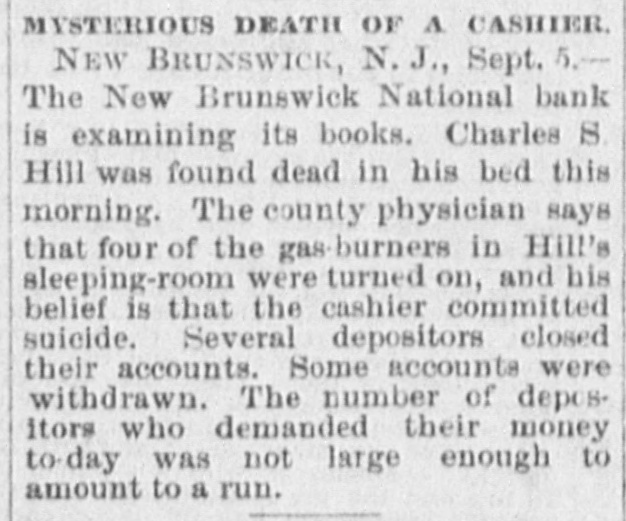
MYSTERIOUS DEATH OF A. CASHIER. NEW BRUNSWICK, N.J., Sept. 5.The New Brunswick National bank is examining its books. Charles S. Hill was found dead in his bed this morning. The county physician says that four of the gas-burners in Hill's sleeping-room were turned on, and his belief is that the cashier committed suicide. Several depositors closed their accounts. Some accounts were withdrawn. The number of depositors who demanded their money to-day was not large enough to amount to a run.


Article from New-York Tribune, September 7, 1884

Click image to open full size in new tab

Article Text

PRICE THREE CENTS. NO DOUBT OF HILL'S SUICIDE. A DEFICIENCY IN THE BANK ACCOUNTS. THE AMOUNT so FAR FOUND SAID TO BE $162,000RUN ON THE BANK. The people of New Brunswick were relnctantly forced to admit vesterday that Charles 8. Hill, cashier of the National Bank of New-Jersey, and one of their most prominent citizens, had committed suicide. They fought against the belief until a notice was posted at the bank signed by the directors, stating that a deficiency had been discovered. Nothing definite could be ascertained as to the amount of the dedeficiency, but from conversations with bank officials it is probable that the amount so far discovered is $162,000 in cash. A number of people who had invested their savings in bonds had left them in the care of Mr. Hill. Securities of the Ira C. Voorhees estate, of which Hill was trustee to the amount of $200,000, were also kept at the bank. Some of the heirs of the estate yesterday made anxious inquiries of Joseph Fisher, a co-trusttee of Hill. and he held a consultation with C. H. Mundy. the executor in the afternoon. They decided to make an examination on Monday to determine whether the securities were safe. Mr. Hill was also the executor of the estate of John N. Taylor, deceased. which is valued at $60,000. THE DEFICIENCY ANNOUNCED. The bank opened its deors at S:30 a. m., the usual time, and depositors began to present their checks The ran began shortly after 10. and the directors posted the following notice on the doors: undersigned find our surand every positor every dollar they have on deposit. The notice was signed by Mahlon Runyon. president. and DirectorsJohnson, Letson. W. C. Stock dard and Lewis T. lowell. There are three other directors. This appeared to give confidence to some and they went away without drawing their money. A large crowd, however, remained and it continued to grow until there were about 100 perwaiting when the bank closed at 3 o'clock. announcement was made that paywould be stopped until 2:15 when money from The people waited patiently and 2:18 Mahlon Martin came with large bundle of bills and payment was resumed. There was little excitement among the waiting depositors, and when Acting Cashier Campbell announced: o'clock and business is over for the day." they quietly dispersed. There were several deposits made by business who expressed the fullest confidence in the bank. The largest was by John N. Carpenter, treasurer o. the Norfolk and N Brunswick Hosiery Company and amounted to $7,500. Mr. Carpeuter satisfied from what [ know that the depositors are all safe. I have seven different accounts the bank, of them trustee, and feet more money in my pocket." Messrs Lockwood and Rockwell. bankers from Newark, went into the bank at 2 releck. One of them said, in reply question, that he was in entire readiness to formish any assistance that might be needed. William H. Frailey assistant treasurer of the Pennsylvania Railroad Company visited the bank shortly before closed to look after the company's deposits, which amounted to several thou. sands of dollars. After a consultation with the directors he returned to Philadelphia. It was said that he expressed himself as perfecely satisfied with the condition of affairs and had decided not to draw the money. MISSING Director Mart when asked. lined to say how he raised in where he raised the dion and that discounted or sold. pledged that the stopped at 1 the that detiPresident and covered by He the of deficiency the was will Tues= on hundred and thousand. made his asked Idou't the stock had from a dell. with the friend made of grains believe that thirty morphia would have been found in him. I not believe his death was due entirely to asphyxiation. In asphyxia the prominent signs distortion the limbs and features, a in hanging hours after his supe the appearance After rigor to down must be done But the restore natural mouth and the the distorted and that show the bed, most condition What the the general depositors but many attairs is to impaired least. of which notes Mr. the poor to regard the are there great number of to have thousands dollars, in the aggregate, invested in bonds, which, safe they have to home and of them at their in Mr. Hill, they have deposited


Article from Daily Los Angeles Herald, September 7, 1884

Click image to open full size in new tab

Article Text

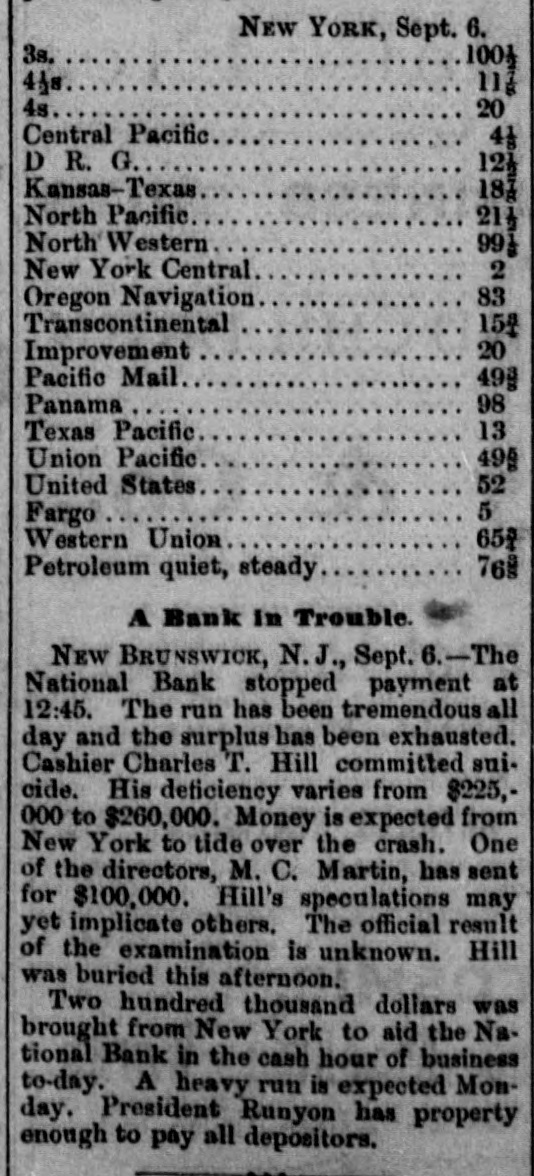
NEW YORK, Sept. 6. 3s. 1001 4 11₫ 4s 20 Central Pacific 4g D R. G. 12 Kansas-Texas 181 North Pacific 21 North Western 99 2 New York Central 83 Oregon Navigation Transcontinental 152 20 Improvement Pacific Mail 49g 98 Panama 13 Texas Pacific Union Pacific 495 52 United States 5 Fargo Western Union 652 76g Petroleum quiet, steady A Bank in Trouble. NEW BRUNSWICK, N.J., Sept. 6.-The National Bank stopped payment at 12:45. The run has been tremendous all day and the surplus has been exhausted. Cashier Charles T. Hill committed suicide. His deficiency varies from $225, 000 to $260,000. Money is expected from New York to tide over the crash. One of the directors, M. C. Martin, has sent for $100,000. Hill's speculations may yet implicate others. The official result of the examination is unknown. Hill was buried this afternoon. Two hundred thousand dollars was brought from New York to aid the Na. tional Bank in the cash hour of business to-day. A heavy run is expected Mon day. President Runyon has property enough to pay all depositors.


Article from St. Paul Daily Globe, September 7, 1884

Click image to open full size in new tab

Article Text

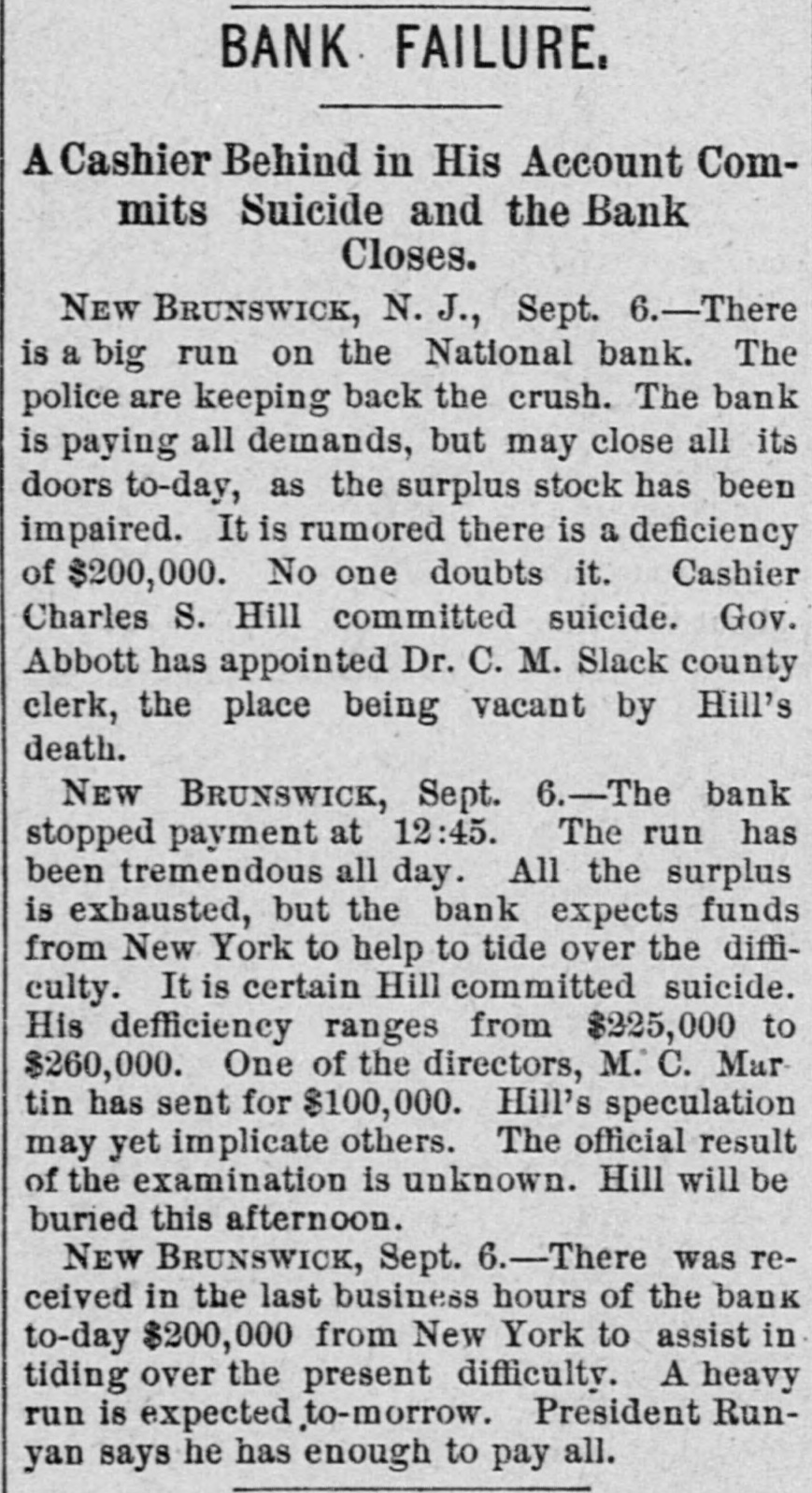
BANK FAILURE. A Cashier Behind in His Account Commits Suicide and the Bank Closes. NEW BRUNSWICK, N.J., Sept. 6.-There is a big run on the National bank. The police are keeping back the crush. The bank is paying all demands, but may close all its doors to-day, as the surplus stock has been impaired. It is rumored there is a deficiency of $200,000. No one doubts it. Cashier Charles S. Hill committed suicide. Gov. Abbott has appointed Dr. C. M. Slack county clerk, the place being vacant by Hill's death. NEW BRUNSWICK, Sept. 6.-The bank stopped payment at 12:45. The run has been tremendous all day. All the surplus is exhausted, but the bank expects funds from New York to help to tide over the difficulty. It is certain Hill committed suicide. His defficiency ranges from $225,000 to $260,000. One of the directors, M. C. Martin has sent for $100,000. Hill's speculation may yet implicate others. The official result of the examination is unknown. Hill will be buried this afternoon. NEW BRUNSWICK, Sept. 6.-There was received in the last business hours of the bank to-day $200,000 from New York to assist in tiding over the present difficulty. A heavy run is expected.to-morrow. President Runyan says he has enough to pay all.


Article from The Portland Daily Press, September 8, 1884

Click image to open full size in new tab

Article Text

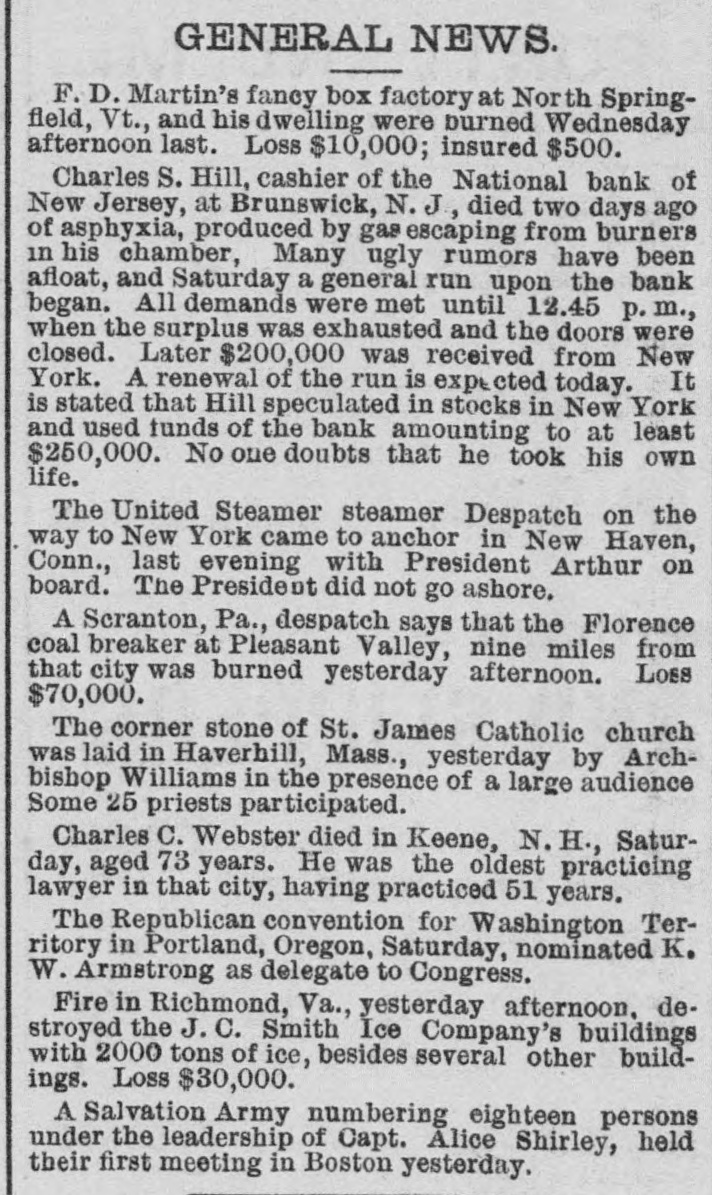
GENERAL NEWS. F. D. Martin's fancy box factory at North Springfleld, Vt., and his dwelling were burned Wednesday afternoon last. Loss $10,000; insured $500. Charles S. Hill, cashier of the National bank of New Jersey, at Brunswick, N. J, died two days ago of asphyxia, produced by gas escaping from burners in his chamber, Many ugly rumors have been afloat, and Saturday a general run upon the bank began. All demands were met until 12.45 p. m., when the surplus was exhausted and the doors were closed. Later $200,000 was received from New York. A renewal of the run is expt cted today. It is stated that Hill speculated in stocks in New York and used tunds of the bank amounting to at least $250,000. No one doubts that he took his own life. The United Steamer steamer Despatch on the way to New York came to anchor in New Haven, Conn., last evening with President Arthur on board. The President did not go ashore. A Scranton, Pa., despatch says that the Florence coal breaker at Pleasant Valley, nine miles from that city was burned yesterday afternoon. Loss $70,000. The corner stone of St. James Catholic church was laid in Haverhill, Mass., yesterday by Archbishop Williams in the presence of a large audience Some 25 priests participated. Charles C. Webster died in Keene, N. H., Saturday, aged 73 years. He was the oldest practicing lawyer in that city, having practiced 51 years. The Republican convention for Washington Territory in Portland, Oregon, Saturday, nominated K. W. Armstrong as delegate to Congress. Fire in Richmond, Va., yesterday afternoon, destroyed the J. C. Smith Ice Company's buildings with 2000 tons of ice, besides several other buildings. Loss $30,000. A Salvation Army numbering eighteen persons under the leadership of Capt. Alice Shirley, held their first meeting in Boston yesterday.


Article from Evening Star, September 8, 1884

Click image to open full size in new tab

Article Text

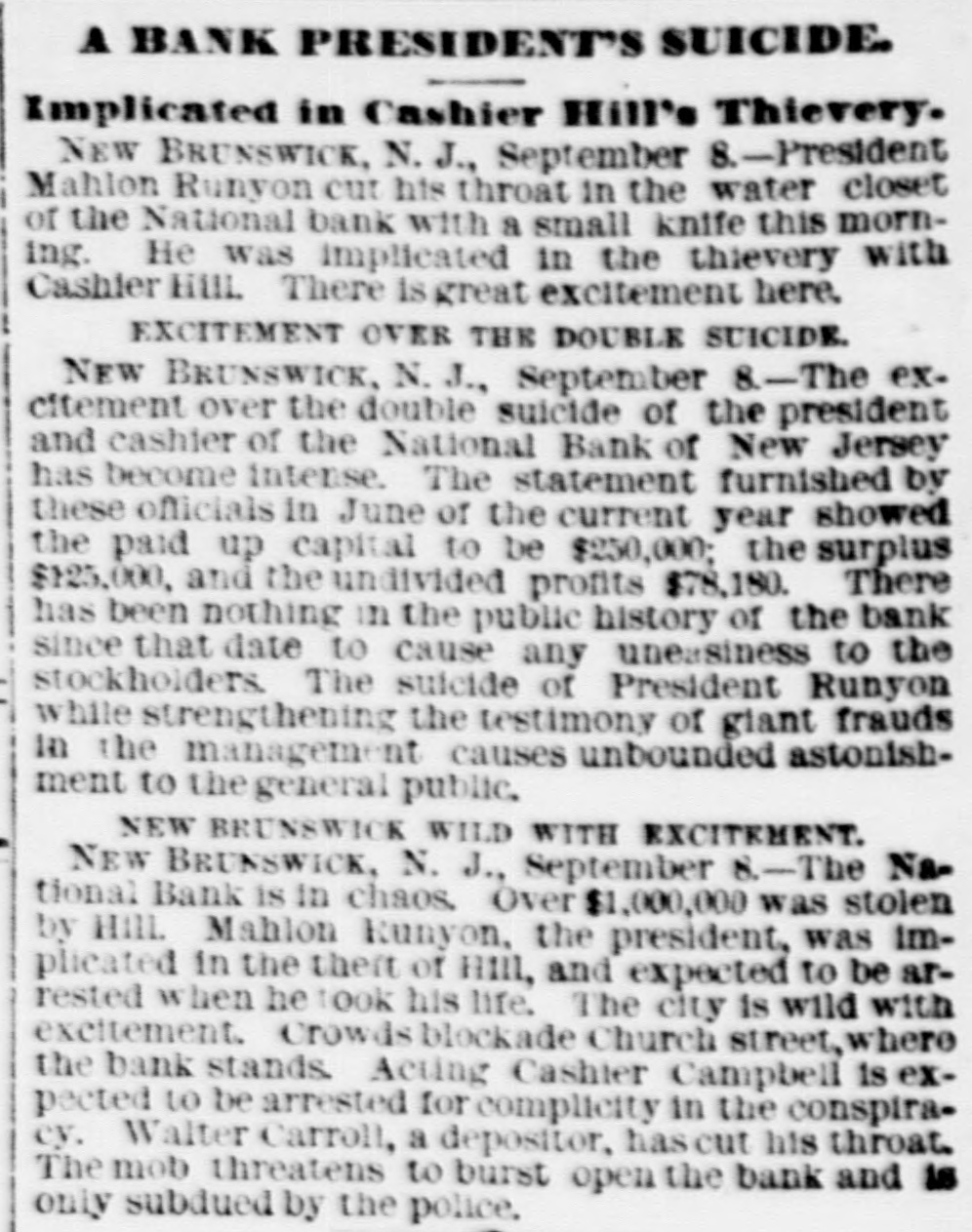
A BANK PRESIDENT'S SUICIDE. Implicated in Cashier Hill's Thievery. NEW BRUNSWICK, N. J., September 8.-President Mahlon Runyon cut his throat in the water closet of the National bank with a small knife this morning. He was implicated in the thievery with Cashier HIIL There is great excitement here. EXCITEMENT OVER THE DOUBLE SUICIDE. NEW BRUNSWICK, N. J., September 8. -The excitement over the double suicide of the president and cashier of the National Bank of New Jersey has become intense. The statement furnished by these officials in June of the current year showed the paid up capital to be $250,000; the surplus $125,000, and the undivided profits $78,180. There has been nothing in the public history of the bank since that date to cause any uneasiness to the stockholders. The suicide of President Runyon while strengthening the testimony of giant frauds in the management causes unbounded astonishment to the general public. NEW BRUNSWICK WILD WITH EXCITEMENT. NEW BRUNSWICK, N. J., September 8.-The National Bank is in chaos, Over$1,000,000 was stolen by HILL Mahlon Kunyon, the president, was implicated in the their of Hill, and expected to be arrested when he look his life. The city is wild with exettement. Crowds blockade Church street, where the bank stands. Acting Cashier Campbell is expected to be arrested for complicity in the conspiracy. Walter Carroll, a depositor, has cut his throat. The mob threatens to burst open the bank and is only subdued by the police.


Article from The Portland Daily Press, September 9, 1884

Click image to open full size in new tab

Article Text

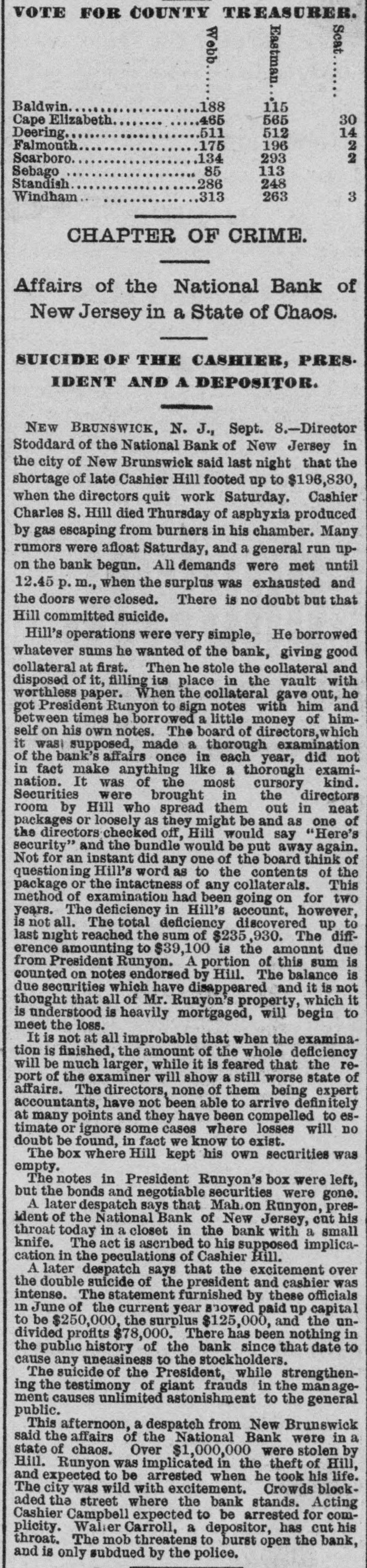
VOTE FOR COUNTY TREASURER. Scat Webb Eastman. Baldwin 188 115 30 565 465 Cape Elizabeth 511 14 512 Deering Falmouth 2 196 175 Scarboro 134 293 2 113 85 Sebago Standish 248 286 263 Windham 313 3 CHAPTER OF CRIME. Affairs of the National Bank of New Jersey in a State of Chaos. SUICIDE OF THE CASHIER, PRES. IDENT AND A DEPOSITOR. NEW BRUNSWICK, N. J., Sept. 8.-Director Stoddard of the National Bank of New Jersey in the city of New Brunswick said last night that the shortage of late Cashier Hill footed up to $196,830, when the directors quit work Saturday. Cashier Charles S. Hill died Thursday of asphyxia produced by gas escaping from burners in his chamber. Many rumors were afloat Saturday, and a general run upon the bank begun. All demands were met until 12.45 p. m., when the surplus was exhausted and the doors were closed. There is no doubt but that Hill committed suicide. Hill's operations were very simple, He borrowed whatever sums he wanted of the bank, giving good collateral at first. Then he stole the collateral and disposed of it, filling its place in the vault with worthless paper. When the collateral gave out, he got President Runyon to sign notes with him and between times he borrowed a little money of himself on his own notes. The board of directors, which it wasi supposed, made a thorough examination of the bank's affairs once in each year, did not in fact make anything like a thorough examination. It was of the most cursory kind. Securities were brought in the directors room by Hill who spread them out in neat packages or loosely as they might be and as one of the directors checked off, Hill would say "Here's security" and the bundle would be put away again. Not for an instant did any one of the board think of questioning Hill's word as to the contents of the package or the intactness of any collaterals. This method of examination had been going on for two years. The deficiency in Hill's account. however, is not all. The total deficiency discovered up to last night reached the sum of $235 930. The difference amounting to $39,100 is the amount due from President Runyon. A portion of this sum is counted on notes endorsed by Hill. The balance is due securities which have disappeared and it is not thought that all of Mr. Runyon's property, which it is understood is heavily mortgaged, will begin to meet the loss. It is not at all improbable that when the examination is finished, the amount of the whole deficiency will be much larger, while it is feared that the report of the examiner will show a still worse state of affairs. The directors, none of them being expert accountants, have not been able to arrive definitely at many points and they have been compelled to estimate or ignore some cases where losses will no doubt be found, in fact we know to exist. The box where Hill kept his own securities was empty. The notes in President Runyon's box were left, but the bonds and negotiable securities were gone. A later despatch says that Mah on Runyon, president of the National Bank of New Jersey, cut his throat today in a closet in the bank with a small knife. The act is ascribed to his supposed implicacation in the peculations of Cashier Hill. A later despatch says that the excitement over the double suicide of the president and cashier was intense. The statement furnished by these officials in June of the current year showed paid up capital to be $250,000, the surplus $125,000, and the undivided profits $78,000. There has been nothing in the public history of the bank since that date to cause any uneasiness to the stockholders. The suicide of the President, while strengthening the testimony of giant frauds in the management causes unlimited astonishment to the general public. This afternoon, a despatch from New Brunswick said the affairs of the National Bank were in a state of chaos. Over $1,000,000 were stolen by Hill. Runyon was implicated in the theft of Hill, and expected to be arrested when he took his life. The city was wild with excitement. Crowds blockaded the street where the bank stands. Acting Cashier Campbell expected to be arrested for complicity. Waler Carroll, a depositor, has cut his throat. The mob threatens to burst open the bank, and is only subdued by the police.


Article from Evening Star, September 9, 1884

Click image to open full size in new tab

Article Text

Ruin and Suicide. DETAILS OF THE TRAGIC DEATH OF BANK PRESIDENT RUNYON. The suicide of Cashier Hill, of the National Bank of New Brunswick, N. J.: and the impending ruin of the bank, was followed yesterday by the suicide of President Runyon, of the same institution, and consequent excitement in New Brunswick, N. J., as mentioned in yesterday's telegrams to THE STAR from that place. The story of the suicide in detail is as follows: Long before banking hours yesterday morning a crowd of men. women and children surrounded the bank and clamored wildly for their money. President Runyon drove up to the bank in his carriage. He was accompanied by his two daughters. "Good bye. papa," said Julia, the eldest, reaching out of the carryall as Mr. Runyon descended to the pavement, "I hope all will be well." "If you do not see me before night," he responded, "tell mamina I will stick to the bank." Twenty minutes later he sent Chief Fitzgerald, who was in charge of the bank, for a copy of the New York Times, in which a story was told of his complicity in the bank's downfall. Securing the paper, he went into the room occupied by the organizing directors and began to read. A deathly pallor spread over his face, and he exclaimed, "My God, what will my children do?" Passing a handkerchief over his brow, he threw the paper into the lap of Director Stoddard, and, excusing himself, went into the toilet-room of the bank. A minute later the sound of a fall was heard. The directors rushed to the closet, and discovered the body of Runyon on the floor. The blood was oozing from a gaping wound in his throat. Determined on suicide, he had cut his wrists deeply, the blood spurting against the wall and ceiling. Thousands of people outside were horrified. "Shall we raid the bank ?" was the question which agitated the agonized depositors. Farmers from the country joined the throng and shouted for their money. The police flanked the street, and with difficulty quelled the rising disturbance. The effect on the town was crushing. The wildest excitement prevailed. One hundred special policemen were sworn in by the mayor to surround the bank property. The coroner's jury in the case of Runyon's death returned the verdict, "Willful suicide." A business man of New Brunswick said in New York, when informed of the suicide of President Runyon: President Runyon has been president of the bank since the retirement of President Dayton, some four or five years since. He was a married man, and his wife and four children survive him. He was about sixty years of age and has been a farmer for many years, and resided on his homestead, about one mile from New Brunswick. His home is plain and comfortable. Mr. Runyon was not generally regarded as much of a financier, the late Cashier Hill being considered as running the institution pretty much his own way, and Mr. Runyon not appearing as of much consequence in its management.


Article from The Indianapolis Journal, September 9, 1884

Click image to open full size in new tab

Article Text

# CUT-THROAT BANKING. The suicide of the president and cashier of the broken National Bank at New Brunswick, N. J., has a significance. Both thereby acknowledged a guilt only too apparent from the condition of the bank's affairs. But it is an unusual thing for two bank officials to put an end to their lives because of even a criminal defalcation, as in this instance. Usually in such cases the offender either runs away or stays and stands trial, and by the employment of skillful attorneys and pleaders escapes anything like just punishment for the offense. But it has become proverbial that Jersey justice means more than "justice" as interpreted elsewhere. These delinquents, doubtless, realized this, and, fearing to face the consequences of their crime, took the only avenue open to them and ended their lives. The country at large needs the same wholesome restraining enactments and the same unswerving enforcement, that makes them a terror to evil-doers in New Jersey. There is too much of polite stealing, too much extravagant living, too much stock and grain gambling to raise money to keep up appearances. The bank at New Brunswick was literally stripped by two thieves—thieves beneath the honor of even burglars, in that they abused the confidence of their friends, and plundered them while occupying positions of honor and trust. A million dollars is gone, somewhere and somehow, and hundreds of honest and poor depositors are left without a dollar in the world. Embezzlements are becoming altogether of too frequent occurrence, so much so that a facetious press makes standard puns on the rascality of bank officials in general. The basis of this questionable humor has too much truth in it for the good of society and of commercial integrity. Banks are breaking in all parts of the country, and, with but few honorable exceptions, examination shows that the officials have literally stolen them poor. Public sentiment will yet compel a better order of things in this direction, and if the right kind of laws be not provided, the people will feel compelled to take the matter into their own hands. Genteel thieves deserve even less commiseration than those that resort to jimmy and drill. The latter may in a measure be guarded against; but how may the trusted official who has the money in his hand be held accountable if not by stringent enactment and rigid enforcement of penalties? The man who embezzles a half million is as fit subject for the penitentiary as he who vulgarly steals a hun-


Article from The Salt Lake Herald, September 9, 1884

Click image to open full size in new tab

Article Text

over the double suicide of the and cashier of the Bank of New Jersey. The furnished by these in June of the current year a paid up capital of $250,surplus $125,000; undivided $78,180. There has been in the public history of the since that date to cause any siness to stockholders. The of President Ranyon, while ogthening the testimony of frauds in the management, unbounded astonishment to general public. resident Runyon, who commitsuicide this morning, was a 60 years old. He leaves a and four children; he has been of the bank five years. National bank is in chaos the $1,000 000 stolen by Hill, Runyon, the president, Im. in the theft of Hill, expecto be arrested when he took his The city is wild. Crowds kade Church street, where the stands. Acting-Cashier Camp expected to be arrested for plicity. Other suicides are ic ed. A threatened to burst the bank, but was subdued by police. Walter Carrol, a deposicut his throats on account of Bronswick is shaken to its Bank examiner Shelly has overed a deficit of over $1,000,000. town is wild; men rush frantics to the doors of the National only to be told that the busiof this institution is suspended the present. Ira Hosibes' estate partially ruined. Cashier Hill left us custodian of this estate, of the bonds and securities he away with, all over $19,000 taken here. In the G. B Adrisn over $80,000 is gone, Runyon, who committed has $60,000 in governbonds; Hill had negotiated the sale of these and con-umit some three days before his Runyon knew nothing of doings, trusting him ims The crash in Wall Street 1sst took the bulk of Hill's Mings. Runyon, although quite was ignorant of Manc'al and was a willing tool in hands of the designing cashier. 945 a. m. President Runyon up the bank in his carriage; was accompanied by his two daughters. ' Good bye, said Juliet, the eldest, reach out of the cerriage as Mr. Run descended to the pavement; "I all will be well." "If you do see me before night," he rended, "tell mamm I will sti- k the b nk." Twenty minutes he sent clerk Fitzzerald, who in charge of the bank, for a of the morning paper which the story was told his complicity in the bank's vnfall. Securing the paper he


Article from Savannah Morning News, September 10, 1884

Click image to open full size in new tab

Article Text

COMMERCIAL CALAMITIES NEW BRUNSWICK'S EXCITEMENT NOT A WHIT ABATED. Payne, Viley & Co., of Louisville, Prove Most Unconscionable Villains, and Many Banks Heavy Victims-Denver Startled by Three Crashes in a Single Day-The Record in Other Places. NEW BRUNSWICK, N. J., Sept. 9.-The people have haunted the National Bank of New Jersey since early this morning. Payment of deposits is still refused. The rumor of Director Letson's death was false. He was overcome by heat, but is still alive. L. D. Jarrard, formerly Postmaster here, who is now in Trenton jail, was so affected by the occurrences of the past few days that he had a hemorrbage, but is recovering. The city is paralyzed. Work is suspended and stores closed. The directors of the bank are to be arrested. DEALINGS WITH HILL. NEW YORK, Sept. 9.-The manager of Hallgarten & Co., bankers and brokers, at No. 28 Broad street, said to-day with regard to rumors current about the firm's transactions with Cashier Hill: "We did next to no business with him and kept no account with him. A few times we bought some bonds to his order, which he paid for and took away." Mr. Kilborne, of A. W. Kilborne & Co., at No. 54 Wall street, said: "Our transactions with Mr. Hill were very few and were all for cash. When we executed an order for him we handed the securities over and were paid. It is a considerable time since we first made an investment for him. We believed that in a few investments he made through us he was acting merely as an agent for customers of his bank in the country. The money was not lost, anyhow."


Article from The Silver State, September 10, 1884

Click image to open full size in new tab

Article Text

TELEGRAPHIC NEWS. The anti-Mormon residents of Lewis county, Tennessee, have posted in conspicuous places a notice, warning all members of the Church of Latter-Day Saints to go elsewhere on the pain of death. The document, which is adorned with the picture of a coffin, is in these words: "Mormons leave. All members of the Church of LatterDay Saints are notified to leave this county, and thirty days are given for you all to go. An indignant and outraged people have said it, and go you shall. If you are found in this county after thirty days you will go like the others. Go peaceably if you will, but you must go." The Mormons are much alarmed, and it is believed some will leave within the time prescribed, while the rest will defy their persecutors and prepare for any attack that may be made upon them. Cleveland, Ohio, suffered from a severe fire Monday night. The entire fire department was in service, and telegrams to Akron, Youngstown, Paines. ville, Erie, Sandusky and Toledo brought assistance. The origin of the fire is unknown. Incendarism is supposed by some, but the most probable theory is that sparks from a tug set fire, early in the evening, to a pile of shavings, from which the flames spread until Perry & Co's extensive lumber yard was ablaze. The lumber yards of Potter, Birdsall & Co. and C. J. King & Co. were also consumed. The Variety Iron Works were destroyed. Stanley's candy factory was burned, and a part of Sherwin, Williams & Co's varnish works. The loss is estimated at from $2,000,000 to $2,500,000. The militia of the city were ordered to be in readiness, if necessary, to do police duty, but they were not ordered out. Tne National bank at New Brunswick, N. J. is in a chaos. Over a million was stolen by Hill. Mahlon Runyon, the President, is implicated in the theft of Hill, and expected to be arrested, when he took hislife. The city is wild. Crowds blockade Church street, where the bank stands. The acting cashier, Campbell, is expected to be arrested for complicity in the conspiracy. Other suicides are expected. The mob threatened to burst open the bank, but were subdued by the police. Yesterday was a gala day at Elmira, N. Y. It was estimated that 50,000 people were on the fair grounds. Gov. ernor Cleveland commenced speaking at 2:45. He spoke from a carriage in front of Manufacturers Hall, and was introduced by the President of the fair. Immediately after Cleveland arose a great cheer went up from the multitude-15,000 people shouting themselves hoarse. The remarks were listened to with great attention, and often interrupted with cheers. A New York Times' Portland (Me.) special says: It is beginning to be understood that Blaine's alliance with the Prohibitionists gave the Republican State ticket a larger majority than some have been figuring on. Blaine's bargain was complete. He agreed to throw the Republican vote as solidly as possible for the Prohibition Amendment to the Constitution in return for the Probibition vote given to the Republican State ticket. An attempt to murder occurred at the St. David's House, 775 Howard street, San Francisco. Thomas Green, a soldier from Alcatraz, shot Miss Ella McMahon three times, inflicting severe but not necessarily fatal wounds. The woman has been in the city about three months. Green claims to have been engaged to her for eleven years, and on her refusing to marry him he shot her. She was about to return to Boston. The New York Times says that John Sherman and Foster have had a meet. ing in Cleveland, and agreed, for the time being, to drop all past differences on an agreement that if Blaine is elect.


Article from The Evening Critic, September 10, 1884

Click image to open full size in new tab

Article Text

THE MORNING NEWS, ocal and General, Botled Worked Over and Fornished Fresh. ALWAYS busy while others are complain '00 *20 Brouth is injuring the tobacco crops outhern Mary land. The Columbia Railroad yesterday declare semi-annual dividend of six per cent. Clothing for school wear. Elseman, 7th & The Czar and Czarina have been receive 1 Warsaw with demonstrations of good Mr. Holton has decided to accept the ublican nomination in the Fifth Marylan Istrict. There were five deaths from the heat hiladelphia yesterday and a number of ) The Duke of Portland's colt Langwe on the Champagne stakes at the Doncaste meeting yesterday. The centennial celebration of the ation of Montgomery County, Pa., opened orristown yesterday. Fifty Russian Mormons arrived in ork yesterday and left for Beatrice, Nebrask where they will colonize. Col. D. O. Gebr. a prominent citizen Chambersburg, Pa., died Monday. He was ative of Washington County, Md. James Brown. of 1335 Cedar street, states 0 pus 10 esnoq B uro. orday and injured himself internally. The thirty-third semi-annual session he Homeopathic Medical Society of the f New York opened at Binghamton yester ay, The official bulletin shows 764 new f cholera and 341 deaths in Italy Ionday. King Humbert has given $20,000 he relief fund. A private letter from Cairo speaks of mpression there that Khartoum has falle General Wolseley and Lord Northbrook 10 unread The National Convention of Chief Engineers began in Chicago yesterda Nearly two hundred members of the assoct tion are in attendance. The son of Attorney-General Johnso of Liberia, formerly of Canandaigua, County, N. Y., has received news of father's murder in Liberia. Business has been paralyzed at Brunswick, N. J., by the failure of the tional Bank of New Jersey. The directors the bank are to be arrested. The twelfth annual prize meeting of National Rifle Aesociation of America yesterday at Creedmoor, L.I. About 200 men responded to the first call. Charles Carroll, colored, who recently saulted and offered indignities to a young In Howard County, Md., has been sentenced ten years in the penitentiary. The total loss by the great fire in Clev and Sunday night 18 one million dollars. Board of Trade has asked the City Council trengthen the fire department. The French Cabinet ministers will be ened to decide when the Chambers shall alled together. Government circles are urbed over the financial war prospect. Mr. Felix Draney has accepted the f Professor Prince, the bicyclist, to back orse for $200 to trot two miles against n his bicycle, at Athletic Park, Friday 'uoot In the Blaine-Sentinel libel suit at Hanapolis, yesterday, the defense served Ice on the plaintiff's attorney that they egin taking depositions in Kentucky on '1801 P& The Fourth District Republican tressional Convention at Marion, Ala., yeste lay nominated Jere Haralson, colored, Congress, over George H. Craig, white. 'OBID una TITAL The Democratic primary election in Eighth Congressional District of Kentucky sulted in the nomination of Governor B. McCreary, who defeated Hon Pate son, present member. 'op 2g SYUS'Y TO tij Ex-Judge Thomas S. Iglehart, of Annap 11s, metwith a painful accident Monday UB 01 sttached ujd полр us tirely through one of his feet. The Instrumer being blunt made a terrible gash. The telegraph and telephone compani in Philadelphia yesterday were notified to move all their wires and poles from the stree before January 1, 1885, in accordance the recent action of the councils. The Democratic campaign was opened the Fifth Congressional District of Marylar pus 1arge U 4114 14314 1681 18 thusiastic meeting, the speakers being T. Iglebart, Barnes Compton and Thomas Weeks. The West-bound train on the Memph and Charleston Railroad was thrown from track Monday night near Corinth, Miss. the passengers were more or less bruised. colored brakeman and a colored girl receive


Article from Delaware Gazette and State Journal, September 11, 1884

Click image to open full size in new tab

Article Text

IN GENERAL. Fifty Russian Mormons arrived in New York Tuesday and left for Beatrice, Nebraska, where they intend to colonize. A. J. Dietrich, the first recorder of the city of Williamsport, died at his home in Wilkesbarre Monday morning, at the age of 62. About 17,000 men are thrown out of employment by the Cleveland fire. The latest estimates of the losses still make them about $2,000,000. Stephen J. Townsend, for many years a well-known steamboat captain and owner B on the North river, died Monday at e Glenhead, Long Island, of apoplexy, at B the age of 74. At the 12.45 o'clock call at the Corn and Flour Exchange in Baltimore Mon0 day, 861 was bid for wheat and 86} to asked. This is the lowest point in prices 40 touched since 1851. ae The Rev. Father Brechard of Riviere d Ouelle, Canada, has received an appointhe ment in connection with the Canadian expedition to the Nile. He was for two in years a missionary in Egypt. The st veyagers for the Nile will leave Montreal 8, for England on Saturday next. It is ex8, pected that 500 men will be secured. The breaker of the Florence colliery at Pleasant Valley, nine miles from Pittston, Pa., was burned on Sanday afterial noon. The loss is about $40,000. The y, fire was started by the carelessness of the for pumpman, who tried to fill his lamp ed while it was lighted from a five gallon oil on can. The oil caught fire and exploded, as and the pumpman was severely burned. A letter has been received in Quebso from W. A. Ashe, a member of the Canadian exploring expedition to Hud. & son's Bay, showing that in the first week erof August the members of the expedition act were in good health and spirits and had by reached Nain, on the Labrador coast. en Nain is near Davis' Inlet, and about midia way between York Point, at the north. out easterly extremity of the Straits of Belle are Isle and Cape Chudlagh, at the eastern extremity of Hudson's straits. Patrick Egan, president of the Irish National League of America, has received : the following telegram from Mr. Parnell hat "RATHDRUM, Sept. 6.-To Patrick Egan, his Lincoln, Neb : I congratulate you upon he the result of the Boston convention and ity upon your election as president of the ay Irish National League I also congratulad late you upon your determination to hold he the League neutral in American politics. wn Charles S. Parnell, Avondale." ly; When the evening train on the Derby ors railroad stopped at West Haven, Conn., ady Monday night, three men were found ate riding on the truck. The train hands distes. lodged them, and & fight took place, the any tramps drawing revolvers and running be the train to Derby, where two were ar1088 rested and one escaped. Some of the hall passengers narrowly escaped being struck will by fiving bullets. The polic believe the ght men professional burglars, and suppose hall their intention was to rob the passengers. the hall During the celebration of the christeniore ing f a child of Friz Kram, in Ham. y of tramk, near D-troit, on Snuday night, Patrick Bouike was murdered and John deKrum dangerously stabbed. The trouble was caused by a girl refusing to dance 000 with Fritz Kernefiel. This stirred up a late fight batween Kernefiel, Bourke, Krum less and three others, in which Bourke was B. stabbed in the thigh and bled to death. owKrum was unconscious at last accounts, ndi how but wounded. improving. The others were slightly & Crowds of sadd-ned depositors conOWS omtinued Tuesday to gather around the National Bank of New Jersey, at New this Brunswick. Payment of deposits was by an refused. A telegram from New Brunsuch wick says: "The city 18 paralyzed, work ime is suspended, stores closed aud industry in at a stand still Band Examiner Shelrry. ley is reported to have said vesterday noh that the depositors will be paid in full mo. It is now said that the bank's losses will not exceed $300,000. nb New Mr Peixotto, United States Consul at Lyons, has made a report to the state deties partment in regard to the crops in France. ome He says: The wheat crop will amount to dieabout 316 000,000 bushels, which will tful surpass the harvest of 1883 by over nar30,000 000 bushels. The quality is reast. ported as bing in excellent condition. B of The rye crop will ial 77,000,000 fect bushels quality very superior. The Ind an corn crop will amount to gn. ing $3,000,000 bushels, and the potato crop eted to 412,000,000 bushels Reports from Its England and continental countries also show fine wheat crops. e of the The funeral of Secretary Folger took rity place Tuesday from his late residence, h a in Geneva, New York. It is estimated that 40,000 people thronged the del-

Article from The Aberdeen Examiner, September 11, 1884

Click image to open full size in new tab

Article Text

THE city of New Brunswick. New Jersey was thrown into wild excitement on the 8th by the announcement that President Runyan of the National Bank of New Jersey, whose cahier suicided last week, had followed suit by cutting his throat, and that more than a million of dollars was missing from the bank. The crash will prostrate the city and county.


Article from The Dallas Weekly Herald, September 11, 1884

Click image to open full size in new tab

Article Text

: phans' Funds Lost. gdog "I 'N MEN Mahion Runyon, President of the Tional bank, cufhis throat in the wate doset of the bank. He was implicat in the thieving of Cashier Hill. excitement prevails. The exciteme over the double suicide of the Preside and Cashier of the National bank New Jersey has become intense. statement furnished by these officia in June of the eurrent year show 'snjdans 1000'0973 capital dn-pred PUL *081'829 'signad pepisipun :000 has been nothing in the public histo of the bank since that date cause any uneasiness to stockhol ers. The suicide of President Runve while strengthening the testimony on III spuraj jurja unbounded astonishment to the gener public. President Runyon, who mitted suicide this morning, was a mer 60 years old. He leaves a wite four children. He has been Preside of the bank five years. He WHS not erally regarded as much of a financi The late cashier, Hill, has been sidered as running affairs pretty his own way and Runyon not appeari of much consequence in Wall Not much can begleaned concerning president. He appears to have known by few operators in Wall The National Bank of New affairs are in a chastie condition. $1,000,000 have been stolen DV Hill others. Mahlon Runyon, the Preside is implicated in the theft with Hill. was expected to be arrested when took his life. The city is wild. blockade Church street, where the stands. The acting cashier, Campb is expected to be arrested for compliel in the conspiracy. Millionaires trembling. More than two other suicio qom V perpoted 9.18 burst open the bank, and was subdu by the police. Walter Conoll, a tor, cut his throat on account of in the bank. New Brunswick is shaken to its ter. Bank Examiner Shelly has u! 000'000'1$ JOAO Jo definit R surplus and cash securities. The is wild. Men rush frantically to doors of the National bank only to told that business of this institution suspended for the present. Runyon. who committed suicide, II!H 'spuoq Government u! 000'09$ negotiated for the sale of these SAUP the emos 11 his death. Runyon knew nothing Hill's doings, trusting him implicit The crash in Wall Street in may took the bulk of Hill's stealings. yon, although quite popular. was norant of financial matters. He willing tool in the hands of the ing cashier. At9:45 a. m., President Runyon up to the bank in his carriage. He accompanied by his two young ters. "Good bye, papa," said Julia, the est, reaching out of the carriage as Runyon descended to the pavement. hope all will be well." "If you do not see me before he responded, "tell mama I will the bank." Twenty minutes later he sent Fitzgerald, who was in charge of bank, for a copy of the morning in which the story was told of his plicity in the bank's downfall. the paper he went into a room by the organizing directors, and to read. A deathly palor spread over face and he exclaimed: "My God, what will my childrer Passing his handkerehief over his he threw the paper into the Director Stoddard, and himself, went into the toilet of the bank. A minute later sound of a fall was heard. The tors rushed to the closet and discove the body of Runyon on the floor, oozing from a gaping wound in


Article from The Ottawa Free Trader, September 13, 1884

Click image to open full size in new tab

Article Text

Among the phenomenally large number of banks that have gone to the wall in the last few months through the dishonesty of their officers, none presents more sickening features than the ruin, a week ago, of the National Bank of New Brunswick, N. J. The bank was supposed to be in the soundest and healthiest condition, until suspicion was awakened by the sudden suicide of its cashier, Mr. Hill. Even then an investigation could discover nothing wrong, until the suicide of Hill was followed by that of Runyan, the president. Then a closer investigation revealed that the bank had been robbed by its officers of over a million of dollars, and that it was hopelessly swamped-not ten cents on the dollar left for creditors or depositors. A clerk of the bank has followed the example of his superiors and also cut his own throat: and now Walter Carroll, a depositor, through grief at his loss, has done the same thing.


Article from Dodge City Times, September 18, 1884

Click image to open full size in new tab

Article Text

SEVERAL SUICIDES. And All Caused by the Failure of the New Jersey National Bank Through the Serious Results of a Speculating Cashier. The New Jersey National Bank, of Brunswick, N. J., failed through the detalcation of its cashier, Hill. It was at first supposed that it would reach only to about $250,000, but on investigation it was ascertained that the bank had been fleeced of a cool million. As soon as the defalcation was discovered the cashier committed suicide. The directors immediately began an overhauling of the books whereupon it was learned that the President, Mahlon Runyen, was implicated. The morning following this discovery he went to the bank and securing a copy of the morning papers, he went into the room OCcupied by the organizing directors, and began to read. A deathly pallor overspread his face, and he exclaimed, "My God, what will my children do?" Passing a handkerchief over his brow, he threw the paper into the lap of a director, and excusing himself. went into the toilet room of the bank. A minute later the sound of a tall was heard. The directors rushed to the closet and discovered the body of Runyon on the floor, the blood gushing from the ghastly wound in his throat. Determined on suicide, he had cut his wrists deeply, the blood spurting against the ceiling. The dead bank president had $60,000 in Government bonds. Hill had negotiated for some of these and consummated the same three days before his death. Runyon knew nothing of Hill's doings, trusting him implicitly. The crush in Wall street in May last took the bulk of Hill's sterling. Runyon, although quite popular, was ignorant of financial matters, and was a willing tool in the hands of the cashier. Upon the announcement of the death of Runyon to the clamorous mob on the out. side of the bank demanding their money, the exitement was intense. Shall we raid the bank? was the question which agitated the agonized depositors. Farmers from the country joined the throng and shouted for their money. The police flanked the street and with difficulty quieted the rising disturbance. The scene at the bank beggared description. Blood had flo wed from the room out upon the marble floor, staining it at a distance of four feet. "My God," exclaimed one of the directors "the whole city will go under. The city debt is now nearly two millions and the bank holds it paper. The Savings' banks have gone under and we have their capital." President Runyen, who committed suicide, was a farmer 60 years old, and leaves a wife and four children. He has been president of the bank five years. Runyon was not regarded as of much consequence in Wall street and not much can be gleaned concerning the dead president. He appears to have been known by a few operators in Wall street.


Article from St. Johnsbury Caledonian, September 18, 1884

Click image to open full size in new tab

Article Text

The Maryland prohibitionists have decided to put a state and congressional ticket in the field. Ex-Governor Hendricks denounces prohibition as an infringement of the rights of the people. Gen. Bragg of Wisconsin has written a letter denying that he said in a recent Chicago speech "Let the Irish go." Congressman Finarty of Illinois has come out, in his paper, for Blaine on the strength of the latter's aggressive foreign policy. The cholera epidemic in Naples is decreasing. During the 24 hours ending Tuesday evening there were only 470 new cases and 167 deaths. It is believed that Postmaster General Gresham will accept the judgeship of the eighth circuit, which will leave two vacancies in the cabinet. A receivership of the Bankers and Merchants' Telegraph company is contemplated, as the company is unable to meet its obligations. A resident of Philadelphia accidentally hung himself while endeavoring to prove that Bill Sykes could have been hanged in the manner described by Dickens. At the wedding of S. D. Stoner and Mrs. M. J. Scott at Burnside, Ill., Thursday night, canned fruit poisoned seventeen persons, including the bride and minister. Three victims will die. The directors of the national bank of New Jersey at New Brunswick *ate full that every creditor will be paid in and the bank will resume business. They claim that the capital of the bank remains intact. Opium joints are becoming so common in Boston that the common council has appointed a committee to go to New York to learn how to suppress them. A fast express train is to be run from Boston to St. Louis, leaving Boston at 3.30 p. m., arriving in St. Louis on the second morning via Niagara Falls and Detroit. The boiler of a cotton compress exploded at Enfaula, Alabama, Monday destroying the building and 300 bales of cotton and killing from 25 to 30 persons. C. R. Milliken, proprietor of the Glen house at the White mountains, Monday arrested a man named F. E. Smith from Belgrade, Maine, for stealing $2,000 worth of jewelry and diamonds from a guest's room. The balance of opinion of the London press justifies the killing of the boy Parker by the survivors of the wrecked yacht Mignonette in order to keep themselves alive. William V. Messer, 74 years old, of Boonton, N. J., shot his wife and daughter Friday while laboring under a fit of insanity, and then killed himself. The recovery of the wife and daughter is doubtful. Two Philadelphia and Reading rail-


Article from Savannah Morning News, September 23, 1884

Click image to open full size in new tab

Article Text

FALLEN BUSINESS FIRMS. Clothier Stern, of Broom Street, Goes Under With $23,000 in Preferences. NEW YORK, Sept. 22.-Zacharia Stern to-day filed an assignment for the benefit of his creditors to Mcritz Fredenberg, with preferences amounting to $23,616. Mr. Stern is a clothing dealer. His failure is attributed to the late suspension of Rindskopf Bros. & Co., the Broadway clothiers. A BIG WHISKY FIRM FAILS. LOUISVILLE, Sept. 22.-An assignment was placed on record to-day by the great whisky corporation of Newcomb, Buchanan & Co., the largest house of the kind in the South and one of the largest in the Union. Other assignments for the benefit of creditors were filed by George C. Buchanan and Andrew Buchanan, members of the firm. The deeds of assignments are all very general in their terms, merely setting forth that the company's liabilities are more than their assets, and that, finding themselves unable to meet just demands upon them, they convey all their property, real and personal, for the benefit of their creditors. They except such property as is exempt under the statutes. George W. Morris is made the assignee of the company and of George C., & Andrew Buchanan. Newcome, Buchanan & Co. failed about two years ago, but succeeded in obtaining an extension from their creditors. Their liabilities were then about $1,500,000, while their nominal assets were $2,000,000. Since then they have paid off many of their old debts by contracting new ones and reducing the bulk of their assets. NOT CONSIDERED DISASTROUS. W. T. Ralph, Manager of the Mercantile agency of R. G. Dun & Co., was inclined to treat the whole affair lightly, as being merely the culmination of their failure of two years ago. "There is nothing sensational about it," he said. "They obtained an extension upon debts then, and finding themselves still unable to meet them have turned the job over to an assignee. There is no real assignment, for there is nothing to assign." Dealers generally took the same view of the matter. "It has been a question for two years," said of them, "whether they could pay up. It has been decided in the negative. This is all." "Hurt?" said another, "why should any one be hurt. This is an old tale. Since their failure and the extension their credit has been nominal only. No one holds their paper except men who were caught then and haye not been able to get out." There are rumors that the Buchanans have left town. The absence of the members of the firm from the city has aroused suspicions that something is wrong, but nothing is known to confirm them. NEW BRUNSWICK'S BROKEN BANK. NEW BRUNSWICK, N. J., Sept. 22.-It stated that the losses of the National Bank of New Jersey will amount to about $250,000, Cashier Hill's defalcations will probably cover $200,000, while the balance represents the over drafts of the President. Comptroller Cannon has authorized the reopening of the bank, which event will occur on Wednesday or Thursday next. Lewis T. Howell has been elected President and E. S. Campbell Cashier. WHOLESALE JEWELERS FAIL. CHICAGO, Sept. 22.-Confessions of judgment to the amount of $39,000 were filed to-day against S. Friedman & Co., wholesale jewelers, of this city. When a deputy sheriff attempted to make a levy on the stock of the firm C. Bachralt was found in possession. He stated that a foreclosure had been made in his favor by reason of a chattel mortgage for $31;000. He also declared that the value of the stock would not exceed $50,000. AN ONTARIO BANKER FAILS. LONDON, ONT., Sept. 22.-Thomas Fawcett, a banker of this city, who is also the head of several agencies in Western Ontario, has had his checks refused by the Bank of Montreal. His liabilities are between $800,000 to $1,000,000. A COLLAPSE IN OIL. The failure of A.S. Jones was announcat the New York Mining and National Petroleum Exchange this morning. About 250,000 barrels of oil were closed out for his account. A LACE MANUFACTORY FAILS. LONDON, Sept. 22.-Robert Towle, proprietor of a lace factory at Nottingham, has failed. His liabilities are heavy.


Article from The Daily Cairo Bulletin, September 23, 1884

Click image to open full size in new tab

Article Text

Will Resume With Capital Unimpaired. NEW BRUNSWICK, N.J., September 22. - -The National Bank of New Jersey will resume business on Wednesday with unimpaired capital. Every depositor will be paid in full. Director Lewis Howell will act as temporary President. The two vacancies in the directory have been filled by the election of John R. Russell and Peter Runyon.


Article from New-York Tribune, September 23, 1884

Click image to open full size in new tab

Article Text

A SUSPENDED BANK TO REOPEN. It is stated that the losses of the National Bank of New-Jersey, of New-Brunswick. will amount to about $250,000. Cashier Hill's defalcation will probably cover $200,000, while the balance represents the overdraft of the president. Controller Cannon has authorized the reopening of the bank to-morrow or Thursday. Lewis T. Howell has been elected president and E. S. Campbell cashier.


Article from Mower County Transcript, October 22, 1884

Click image to open full size in new tab

Article Text

GENERAL THE steamship Faraday has arrived off New York bar with the end of the Bennett-Mackey cable. HERDMEYER & STEIGLITZ'S woolen goods establishment at Chicago, is in the hands of the. sheriff. Judgments were confessed to the amount of $75,000. D. C. DEWFLL & ADAMS, grocers, Boston, have assigned. Liabilities $40,000. JAMES LEGG & Co., owners of the Mapleville mills, at Burrelsville, R. I., failed on the 15th, for $300,000. A DISPATCH of the 14th says smallpox has appeared at Argo, fifteen miles from Aurora, D. T. THE National Academy of Science began its session at Newport, R. I., on the 14th. LEWIS DICKINSON, one of the oldest residents of Racine, died on the 14th, aged 65 years. THE establishment of Davis, Atkinson & Co., pork packers, Chicago, has been seized by the sheriff to satisfy a debt of $25,000. G. H. CRAGG & Co., wholesale dealers in jewelry, New York City, failed on the 13th. S. S. DAVIS' private bank at Cincinnati, closed its doors on the 13th. Liabilities $60,000; assets $ 0,000. OWING to the decadence of cholera, the secretary of the treasury advises the discharge of the sanitary inspectors at London and Liverpool. THE United States grand jury has made a presentment against the New Brunswick National Bank of New Jersey. It says the bank's money was lost through fraud on the part of the cashier with the possible connivance of the president. It will be remembered that these two officers committed suicide,