Click image to open full size in new tab
Article Text
OF BANK OPENING
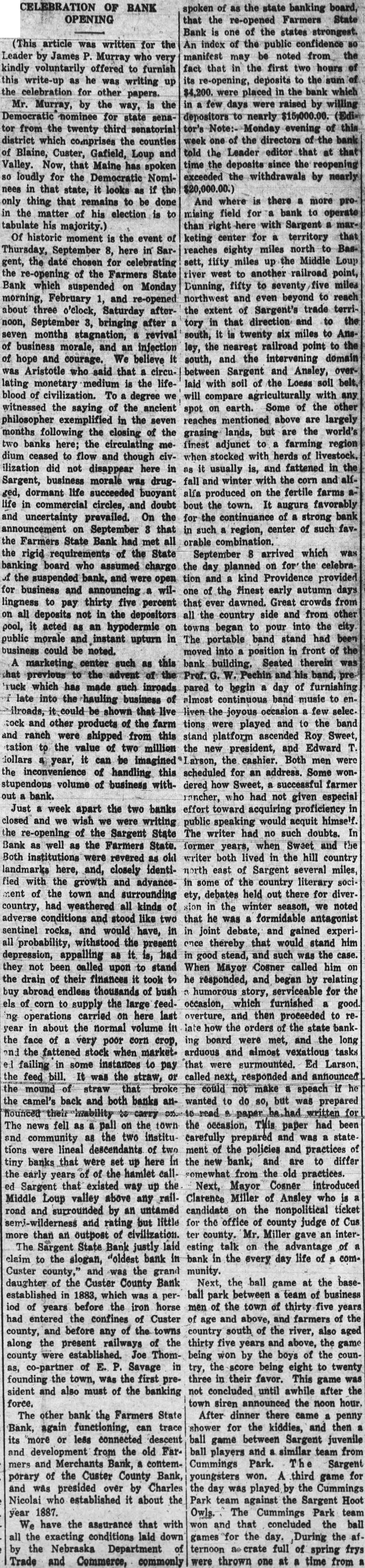
(This article was written for the An index of the public confidence Leader James Murray who manifest be noted from the may kindly voluntarily offered to furnish fact that in the first two hours of this he its re-opening, deposits to the was writing the celebration for other papers. $4,200. were placed in the bank which Mr. Murray, by the the days were raised by willing way, nominee for state depositors nearly tor from the twenty third senatorial evening district which the counties week one of the directors comprises of Blaine, Custer, Gafield, and told the Leader editor that at that Loup Valley. Now, that time the deposits since the reopening Maine has spoken loudly for the Democratic Nomi- exceeded the by nearly nees in that state, looks if the as only thing that remains to be done And where there more in the matter of his election to mising field bank to tabulate his than right with Sargent majority.) Of historic moment the event keting center for territory Thursday, here in reaches eighty miles north September the date miles up the Middle Loup chosen for celebrating sett, the re-opening of the Farmers State west to another railroad point, Bank which fifty to miles suspended on Monday Dunning, morning, and northwest and even beyond to reach February re-opened about three o'clock, after- the extent of Sargent's trade Saturday noon, September in that direction and bringing tory seven months revival south, twenty six miles to stagnation, of business morale, and injection the nearest railroad point to an hope and We believe and the intervening domain courage. south, was Aristotle who said that between Sargent and Ansley, lating monetary medium the life- with soil of the Loess soil blood of civilization. degree agriculturally with any compare witnessed the of the ancient earth. Some the other saying spot on philosopher exemplified in the seven reaches mentioned above are largely months the but the world's following the grazing lands, are banks here; the circulating finest adjunct farming region dium ceased to flow and though stocked with herds of livestock, ilization did not disappear here usually and fattened in the Sargent, business morale drug- fall and winter with the corn and dormant life succeeded buoyant produced on the fertile farms life in commercial circles, and doubt the town. It augurs favorably and uncertainty prevailed. On the continuance of strong bank announcement on September that such region, center of the Farmers State Bank had met all orable combination. the rigid requirements of the State arrived which was September banking board who assumed on for the celebracharge the day planned the suspended bank, and tion and kind Providence provided open for business and announcing wil- finest early autumn days one the lingness to thirty five percent that dawned. Great crowds from pay ever all deposits not in the depositors all the country side and from other pool, acted as an hypodermic towns began to into the city on pour public morale and instant upturn The portable band stand had business could be noted. moved position in front the marketing center such this bank building. Seated therein and band, which has made such inroads begin day of furnishing late into the business of almost continuous band music to be shown that the occasion few selec. tock and other products of the farm tions were played and to the band and ranch were shipped from this stand platform ascended Roy Sweet, tation the value of two million the and Edward new president, year, can be the cashier. Both men the inconvenience of handling this scheduled for an address. Some wonstupendous volume of business with- dered how Sweet, successful farmer bank. rancher, had not given especial Just week apart the two banks effort toward acquiring proficiency closed and we wish were writing public would acquit speaking the re-opening of the Sargent State The writer had no such doubts. Bank well as the Farmers State. former when Sweet and the years, Both institutions were revered old writer both lived in the hill country landmarks here, and, closely identi- north east of Sargent several miles, fied with the growth and advance- of the socisome country literary ment of the town and surrounding debates held out there for ety, country, had weathered all kinds in the winter season, noted we adverse conditions and stood like two that he formidable antagonist sentinel rocks, and would have, in in joint debate, and gained experiprobability, withstood the thereby that would stand him present depression, appalling as good stead, and such was the they not been called upon to stand When Mayor Cosner called him the drain of their finances it took he responded, and began by relating buy abroad endless thousands of bush humorous story, serviceable for the of corn to supply the large feed- occasion, which furnished good. operations carried here last overture, and then proceeded in about the normal volume in how the orders of the state bankyear the face of corn ing board met, and the long very poor crop, the fattened stock when arduous and almost vexatious tasks failing in some instances to that were surmounted. Ed pay feed the straw, called responded and announced mound straw that could speach the camel's back and both banks wanted to do but was prepared written The fell pall the town the occasion, had been news as on paper and the two institu- carefully prepared and community tions were lineal descendants of two ment of the policies and practices tiny banks that were set up here the new bank, and are differ the of of the hamlet from the old practices. early years ed Sargent that existed way the Next, Mayor Cosner introduced Middle Loup valley above Clarence Miller of Ansley who road and surrounded by an untamed candidate on the nonpolitical ticket and rating but little for the office of county judge of Cus more than an of civilization. ter county. Mr. Miller interoutpost gave State Bank justly laid esting talk on the advantage of Sargent claim to the slogan, "oldest bank in bank in the day life of comevery Custer county," and the grand munity. of the Custer Bank Next, the ball at the basedaughter County game established in 1883, which ball park between team of business iod of before the iron horse men of the town thirty five years years had entered the confines of Custer of and above, and farmers of the age county, and before of the towns south of the river, also aged any country along the present railways the thirty five years above, the game county were established. Joe Thom- being won by the boys of the counof Savage the score being eight to twenty co-partner founding the town, was the first three in their favor. This was game sident and also must of the banking not concluded until awhile after the force. town siren announced the noon hour The other bank the Farmers State After dinner there penny Bank, again functioning, can trace shower for the kiddies, and then more or less connected descent ball between Sargent juvenile game development from the old players and similar team from and Merchants Bank, contem- Cummings Park. Sargent of the Custer County Bank, youngsters won. third for porary game was presided over by Charles the day was played the Cummings Nicolai who established it about the Park team against the Sargent Hoot year 1887. Owls. The Cummings Park team We have the assurance that with and that concluded the ball the exacting conditions laid down for the day. During the games the Nebraska Department of ternoon crate full of frys spring Trade and Commerce, thrown one time spoken the state banking that the re-opened Farmers State Bank one of the states strongest.