11424. Bridgeport Bank (Bridgeport, NE)

Bank Information

Episode Type
Suspension โ†’ Closure
Bank Type
state
Start Date
May 1, 1925*
Location
Bridgeport, Nebraska (41.665, -103.099)

Metadata

Model
gpt-5-mini
Short Digest
e0c1b10a25a076bf

Response Measures

None

Description

Articles describe the Bridgeport bank being taken over by the Nebraska Guaranty Fund Commission in May 1925 (a government takeover / suspension of payments) and later placed in receivership (receiver appointed Sept. 8, 1927). There is reporting of large withdrawals while the commission operated the bank and a mass meeting of depositors in Dec. 1928, but no clear independent run prior to the commission takeover; sequence is suspension by government action followed by receivership/closure. Later litigation (1932) concerns funds collected/handled by the commission. OCR errors in articles were corrected (e.g., dates and names clarified from context).

Events (4)

1. May 1, 1925* Suspension
Cause
Government Action
Cause Details
State Guaranty Fund Commission took the bank over and operated it starting May 1925 (government/commission takeover of an insolvent state bank).
Newspaper Excerpt
taken over by the Guaranty Fund commission in May, 1925
Source
newspapers
2. September 8, 1927 Receivership
Newspaper Excerpt
receiver was appointed on Sept. 8, 1927; the bank went into receivership in September, 1927
Source
newspapers
3. December 1, 1928* Other
Newspaper Excerpt
a mass meeting of depositors was held in December, 1928, to against the results of the guaranty fund commission's handling of the bank; deposits had shrunk considerably during commission handling
Source
newspapers
4. January 11, 1932 Other
Newspaper Excerpt
Suit against the state department of trade and [commerce] for $29,755.14 filed ... E. Torgeson, receiver of the Bridgeport bank ... which failed and was taken over by the Guaranty Fund commission in May, 1925
Source
newspapers

Newspaper Articles (4)

Article from The Omaha Evening Bee-News, January 30, 1929

Click image to open full size in new tab

Article Text

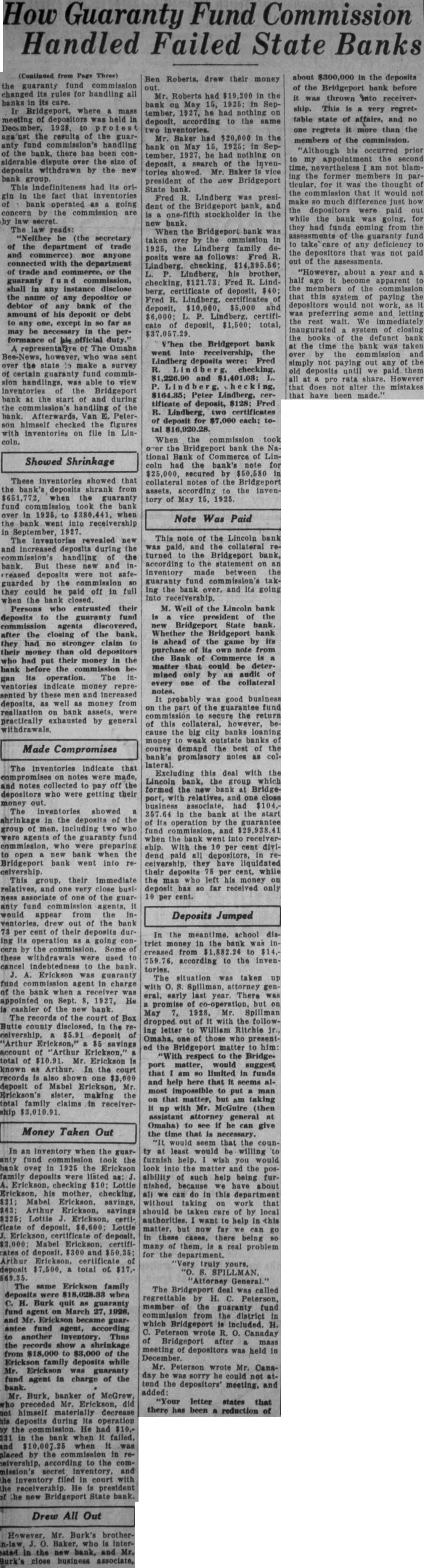
How Guaranty Fund Commission Handled Failed State Banks (Continued from Page Three) the guaranty fund commission changed its rules for handling all banks in its care. Ir Bridgeport, where a mass meeting of depositors was held in December, 1928, to against the results of the guaranty fund commission's handling of the bank, there has been considerable dispute over the size of deposits withdrawn by the new bank group This indefiniteness had its origin in the fact that inventories of bank operated as going concern by the commission are by law secret The law reads: "Neither he (the secretary of the department of trade and commerce) nor anyone connected with the department of trade and commerce, or the guaranty fund commission, shall in any instance disclose the name of any depositor or debtor of any bank of the amount of his deposit or debt to any one, except in so far as may be necessary in the performance of lake official duty.' A representative of The Omaha Bee-News, however, who was sent over the state to make survey of certain guaranty fund commission handlings, was able to view inventories of the Bridgeport bank at the start of and during the commission's handling of the bank. Afterwards, Van E. Peterson himself checked the figures with inventories on file in Lincoln. Showed Shrinkage These inventories showed that the bank's deposits shrank from $651,772. when the guaranty fund commission took the bank over in 1925, to $380,441. when the bank went into receivership in September, 1927. The inventories revealed new and increased deposits during the commission's handling of the bank. But these new and increased deposits were not safeguarded by the commission so they could be paid off in full when the bank closed. Persons who entrusted their deposits to the guaranty fund commission agents discovered, after the closing of the bank, they had no stronger claim to their money than old depositors who had put their money in the bank before the commission began its operation. The inventories indicate money represented by these men and increased deposits, as well as money from realization on bank assets, were practically exhausted by general withdrawals. Made Compromises The inventories indicate that compromises on notes were made, and notes collected to pay off the depositors who were getting their money out. The inventories showed shrinkage in the deposits of the group of men, including two who were agents of the guaranty fund commission, who were preparing to open new bank when the Bridgeport bank went into reThis group, their immediate relatives, and one very close business associate of one of the guaranty fund commission agents, It would appear from the inventories. drew out of the bank 73 per cent of their deposits during Its operation as a going concern by the commission. Some of these withdrawals were used to cancel indebtedness to the bank J. A. Erickson was guaranty fund commission agent in charge of the bank when receiver was appointed on Sept. 8, 1927, He is cashier of the new bank. The records of the court of Box Butte county disclosed, in the receivership, $5.91 deposit of "Arthur Erickson," $5 savings account of "Arthur Erickson, total of $10.91 Mr. Erickson is known as Arthur. In the court records is also shown one $3,000 deposit of Mabel Erickson, Mr. Erickson's sister. making the total family claims in receivership $3,010.91. Money Taken Out In an inventory when the guaranty fund commission took the bank over in 1925 the Erickson family deposits were listed as: A. Erickson, checking $10: Lottle $21; Mabel Erickson, savings, $63: Arthur Erickson, savings $225; Lottle J. Erickson, certificate of deposit, $6,600; Lottle J. Erickson, certificate of deposit, $3,000: Mabel Erickson, certificates of deposit. $300 and $50.35: Arthur Erickson. certificate of deposit $7,500. a total of $17,The same Erickson family deposits were $18,028.33 when C. H. Burk quit as guaranty fund agent on March 27, 1926, and Mr. Erickson became guarantee fund agent, according to another inventory. Thus the records show shrinkage from $18,000 to $3,000 of the Erickson family deposits while Mr. Erickson was guaranty fund agent in charge of the bank. Mr. Burk, banker of McGrew, who preceded Mr. Erickson, did not himself materially decrease his deposits during its operation by the commission. He had $10,231 in the bank when It failed, and $10,007.25 when It was placed by the commission in receivership, according to the commission's secret inventory, and the inventory filed in court with the receivership. He is president of the new Bridgeport State bank. Drew All Out However. Mr. Burk's brotherin-law. J. O. Baker, who is interested in the new bank, and Mr. Burk's close business associate, Ben Roberts. drew their money out. Mr. Roberts had $19,200 in the bank on May 15, 1925: in September, 1927, he had nothing on deposit, according to the same two inventories. Mr. Baker had $20,000 in the bank on May 15, 1925: in September, 1927, he had nothing on deposit, search of the inventories showed. Mr. Baker is vice president of the new Bridgeport State bank. Fred R. Lindberg was president of the Bridgeport bank, and is one-fifth stockholder in the new bank. When the Bridgeport bank was taken over by the ommission in 1925, the Lindberg family deposits were as follows: Fred R. Lindberg. checking, $14,395.56; L. Lindberg, his brother, checking, $121.73; Fred R. Lindberg, certificate of deposit, $40: Fred R. Lindberg, certificates of deposit, $10,000, $5,000 and $6,000; L. P. Lindberg. certificate of deposit, $1,500; total, $37,057.29. V'hen the Bridgeport bank went into receivership, the Lindberg deposits were: Fred R. checking, $1,226.90 and $1,401.03; L. P. k ng, $164.35; Peter Lindberg, certificate of deposit, $128: Fred R. Lindberg, two certificates of deposit for $7,000 each; total $16,920.28. When the commission took over the Bridgeport bank the National Bank of Commerce of Lincoln had the bank's note for $25,000, secured by $50,580 in collateral notes of the Bridgeport assets, according to the inventory of May 15, 1925. Note Was Paid This note of the Lincoln bank was paid, and the collateral returned to the Bridgeport bank, according to the statement on an inventory made between the guaranty fund commission's taking the bank over, and its going into receivership. M. Well of the Lincoln bank is vice president of the new Bridgeport State bank. Whether the Bridgeport bank is ahead of the game by its purchase of Its own note from the Bank of Commerce is matter that could be determined only by an audit of every one of the collateral notes. It probably was good business on the part of the guarantee fund commission to secure the return of this collateral, however. because the big city banks loaning money weak outstate banks of course demand the best of the bank's promissory notes as colExcluding this deal with the Lincoln bank, the group which formed the new bank at Bridgeport, with relatives, and one close business associate, had $104,357 in the bank at the start of its operation by the guarantee fund commission. and $29,938.41 when the bank went into receivership. With the 10 per cent dividend paid all depositors, in receivership, they have liquidated their deposits 75 per cent, while the man who left his money on deposit has so far received only 10 per cent. Deposits Jumped In the meantime. school district money in the bank was increased from $1,882 to $14,759.76, according to the inventories. The situation was taken up with o. S. Spillman, attorney general. early last year. There was promise of co-operation, but on May 7. 1928, Mr. Spillman dropped. out of It with the following letter to William Ritchie jr., Omaha, one of those who presented the Bridgeport matter to him: "With respect to the Bridgeport matter, would suggest that am so limited in funds and help here that It. seems almost impossible to put man on that matter, but am taking If up with Mr. McGuire (then assistant attorney general at Omaha) to see If he can give the time that is necessary. "It would seem that the county at least would be willing to furnish help. wish you would look into the matter and the possibility of such help being furnished, because we have about all we can do in this department without taking on work that should be taken care of by local authorities. want to help in this matter. but now far we can go in these cases, there being so many of them, is a real problem for the department. 'Very truly yours. 'Attorney General.' The Bridgeport deal was called regrettable by H. C. Peterson, member of the guaranty fund commission from the district in which Bridgeport is included. H. C. Peterson wrote R. O. Canaday of Bridgeport after a mass meeting of depositors was held in December. Mr. Peterson wrote Mr. Canaday he was sorry he could not attend the depositors' meeting. and added: "Your letter states that there has been a reduction of about $300,000 in the deposits of the Bridgeport bank before it. was thrown Into receivership. This is a very regrettable state of affairs, and no one regrets it more than the members of the commission. "Although his occurred prior to my appointment the second time, nevertheless am not blaming the former in particular, for it was the thought of the that it would not make so much difference just how the depositors were paid out while the bank was going. for they had funds coming from the of the guaranty fund to take care of any deficiency to the depositors that was not paid out of the assessments. "However, about year and a half ago it become apparent to the members of the commission that this system of paying the depositors would not work, as It was preferring some and letting the rest wait. We immediately inaugurated system of closing the books of the defunct bank at the time the bank was taken over by the commission and simply not paying out any of the old deposits until we paid them all at pro rata share. However that does not alter the mistakes that have been made.'
Article from Lincoln Journal Star, January 11, 1932

Click image to open full size in new tab

Article Text

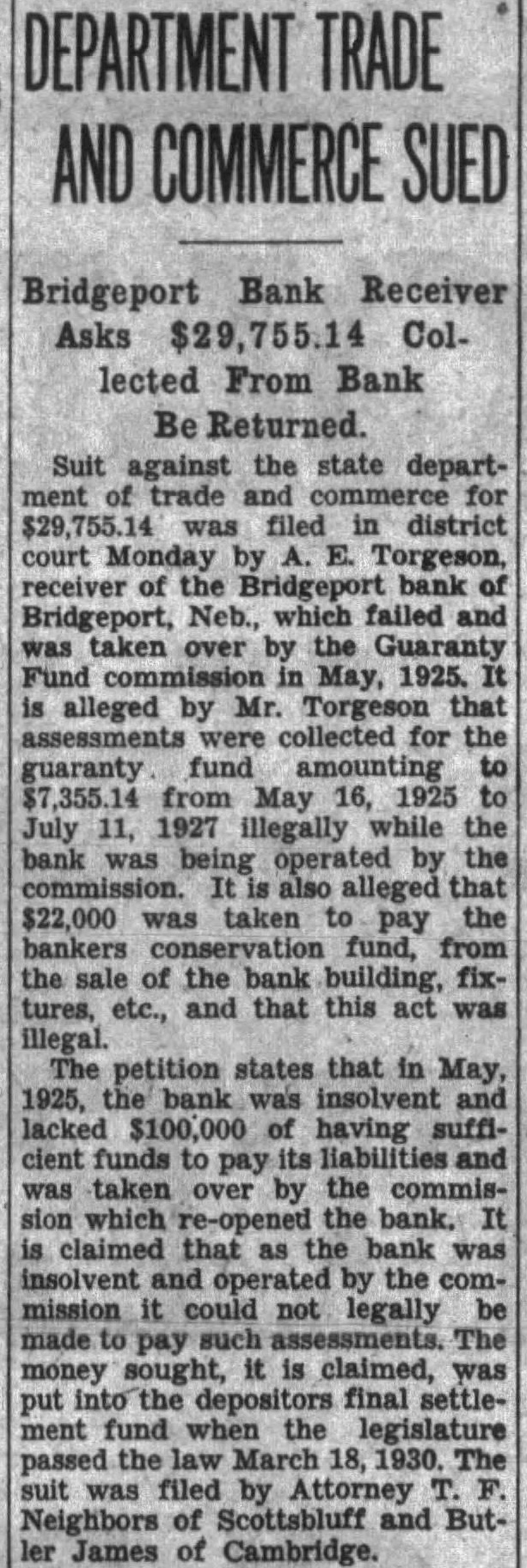
DEPARTMENT TRADE AND COMMERCE SUED Bridgeport Bank Receiver Asks $29,755.14 Collected From Bank Be Returned. Suit against the state department of trade and for $29,755.14 filed in district court Monday E. Torgeson, receiver of the Bridgeport bank of Bridgeport, Neb., which failed and was taken over by the Guaranty Fund commission in May, 1925. It is alleged by Mr. Torgeson that collected for the guaranty fund amounting to 355. from May 16, 1925 July 11, 1927 illegally while bank was being operated by commission. alleged $22,000 was taken to pay the bankers fund, the sale of the building, fixtures, etc., and that this act was The petition states that in May, 1925, the bank was insolvent and lacked $100,000 of having sufficient funds to pay its liabilities was taken by the commission which the bank. It is claimed that as the bank was insolvent and operated by the commission it could not legally made to pay The money sought, it is claimed, was put into the depositors final settlement fund when the legislature passed the law March 18, 1930. The suit was filed by Attorney T. F. Neighbors of Scottsbluff and Butler James of Cambridge.


Article from Lincoln Journal Star, January 12, 1932

Click image to open full size in new tab

Article Text

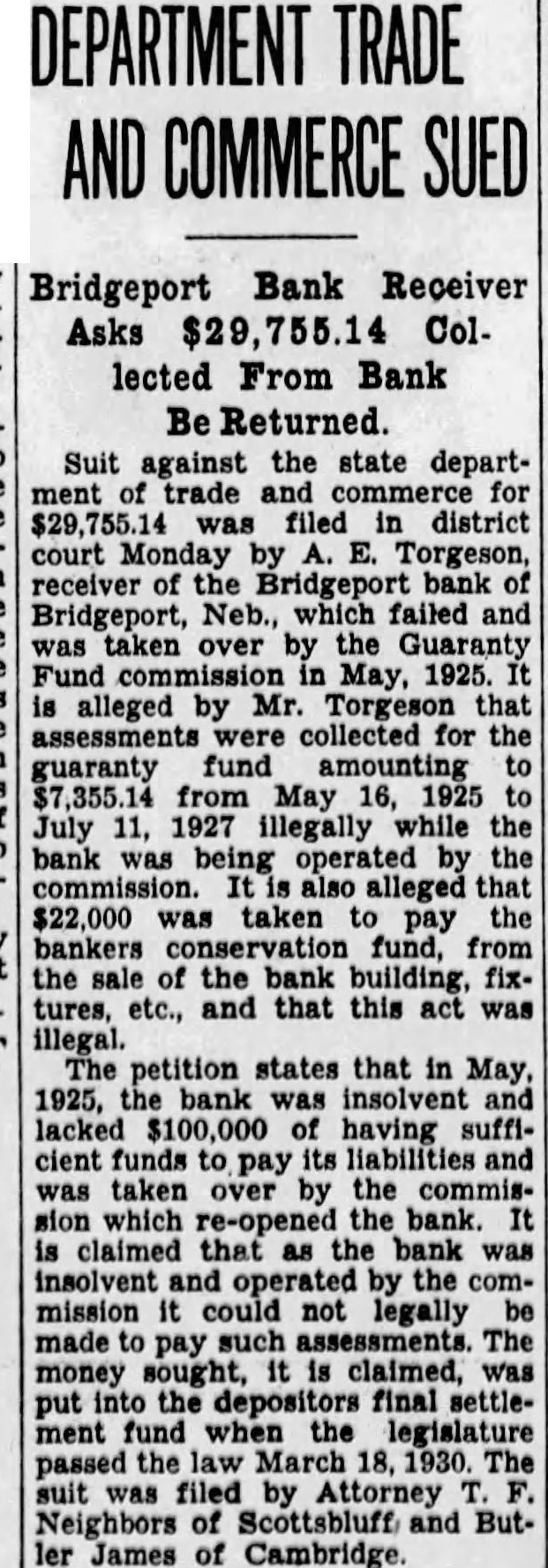
DEPARTMENT TRADE AND COMMERCE Bridgeport Bank Receiver Asks $29,755.14 Collected From Bank Returned. Suit against the state department trade commerce for $29,755.14 was filed in district court Monday E. Torgeson, receiver the Bridgeport bank of Bridgeport, Neb., which failed and was taken over by the Guaranty Fund commission May, 1925. alleged by Mr. Torgeson that assessments were collected for the guaranty fund amounting from May 16, 1925 July 11, 1927 illegally while bank was being operated by the commission. also alleged that $22,000 taken to pay the bankers fund, from the of the fixtures, etc., and that this was illegal. The petition states that in May, 1925, the bank was insolvent and lacked of having sufficient funds to pay liabilities and was taken over by the commission which the bank. is claimed that as the bank was insolvent and by the commission could not legally be made pay such The money sought, it is claimed, was put into the depositors final settlement fund when the legislature passed the law March 1930. The suit was filed by Attorney Neighbors of Scottsbluff and Butler James of Cambridge


Article from The Plainview News, January 21, 1932

Click image to open full size in new tab

Article Text

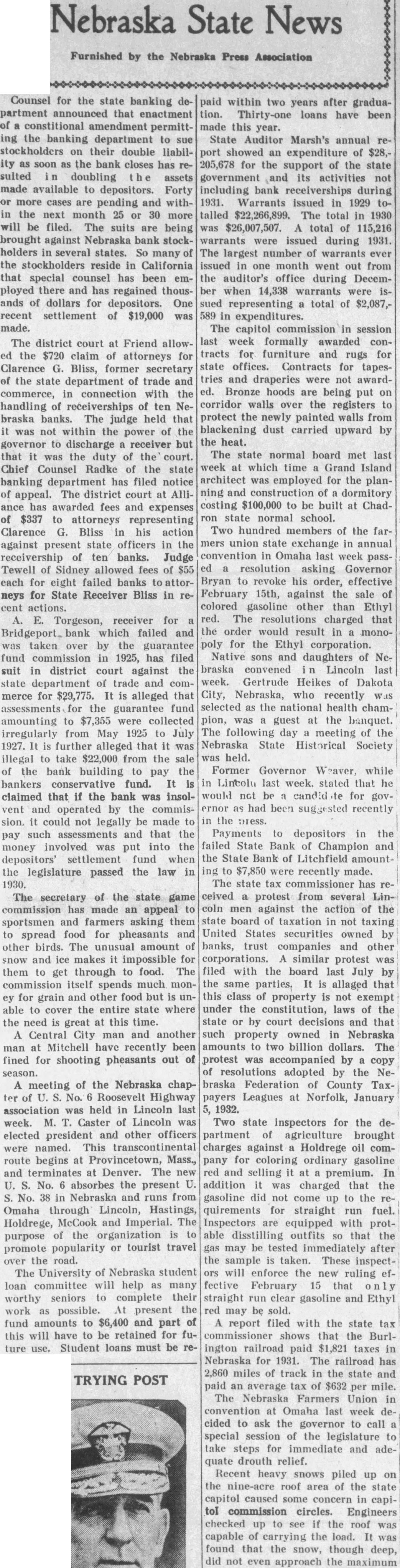
Nebraska State News Furnished by the Nebraska Press Association Counsel for the state banking department announced that enactment of a constitional amendment permitting the banking department to sue stockholders on their double liability as soon as the bank closes has resulted in doubling the assets made available to depositors. Forty or more cases are pending and within the next month 25 or 30 more will be filed. The suits are being brought against Nebraska bank stockholders in several states. So many of the stockholders reside in California that special counsel has been employed there and has regained thousands of dollars for depositors. One recent settlement of $19,000 was made. The district court at Friend allowed the $720 claim of attorneys for Clarence G. Bliss, former secretary of the state department of trade and commerce, in connection with the handling of receiverships of ten Nebraska banks. The judge held that it was not within the power of the the heat. governor to discharge a receiver but that it was the duty of the court. Chief Counsel Radke of the state banking department has filed notice of appeal. The district court at Alliance has awarded fees and expenses ron state normal school. of $337 to attorneys representing Clarence G. Bliss in his action against present state officers in the receivership of ten banks. Judge Tewell of Sidney allowed fees of $55 each for eight failed banks to attorneys for State Receiver Bliss in recent actions. A. E. Torgeson, receiver for a Bridgeport, bank which failed and was taken over by the guarantee fund commission in 1925, has filed suit in district court against the state department of trade and commerce for $29,775. It is alleged that assessments for the guarantee fund amounting to $7,355 were collected irregularly from May 1925 to July 1927. It is further alleged that it was was held. illegal to take $22,000 from the sale of the bank building to pay the bankers conservative fund. It is claimed that if the bank was insolvent and operated by the commission. it could not legally be made to in the press. pay such assessments and that the money involved was put into the depositors' settlement fund when the legislature passed the law in 1930. The secretary of the state game commission has made an appeal to sportsmen and farmers asking them to spread food for pheasants and other birds. The unusual amount of snow and ice makes it impossible for them to get through to food. The commission itself spends much money for grain and other food but is unable to cover the entire state where the need is great at this time. A Central City man and another man at Mitchell have recently been fined for shooting pheasants out of season. A meeting of the Nebraska chapter of U. S. No. 6 Roosevelt Highway association was held in Lincoln last 5, 1932. week. M. T. Caster of Lincoln was elected president and other officers were named. This transcontinental route begins at Provincetown, Mass., and terminates at Denver. The new U. S. No. 6 absorbes the present U. S. No. 38 in Nebraska and runs from Omaha through Lincoln, Hastings, Holdrege, McCook and Imperial. The purpose of the organization is to promote popularity or tourist travel over the road. The University of Nebraska student loan committee will help as many worthy seniors to complete their work as possible. At present the red may be sold. fund amounts to $6,400 and part of this will have to be retained for future use. Student loans must be re- paid within two years after graduation. Thirty-one loans have been made this year. State Auditor Marsh's annual report showed an expenditure of $28,205,678 for the support of the state government and its activities not including bank receiverships during 1931. Warrants issued in 1929 totalled $22,266,899. The total in 1930 was $26,007,507. A total of 115,216 warrants were issued during 1931. The largest number of warrants ever issued in one month went out from the auditor's office during December when 14,338 warrants were issued representing a total of $2,087,589 in expenditures. The capitol commission in session last week formally awarded contracts for furniture and rugs for state offices. Contracts for tapestries and draperies were not awarded. Bronze hoods are being put on corridor walls over the registers to protect the newly painted walls from blackening dust carried upward by The state normal board met last week at which time a Grand Island architect was employed for the planning and construction of a dormitory costing $100,000 to be built at ChadTwo hundred members of the farmers union state exchange in annual convention in Omaha last week passed a resolution asking Governor Bryan to revoke his order, effective February 15th, against the sale of colored gasoline other than Ethyl red. The resolutions charged that the order would result in a monopoly for the Ethyl corporation. Native sons and daughters of Nebraska convened n Lincoln last week. Gertrude Heikes of Dakota City, Nebraska, who recently was selected as the national health champion, was a guest at the banquet. The following day a meeting of the Nebraska State Historical Society Former Governor Weaver, while in Lincoln last week. stated that he would not be a candid te for governor as had been suggested recently Payments to depositors in the failed State Bank of Champion and the State Bank of Litchfield amounting to $7,850 were recently made. The state tax commissioner has received a protest from several Lincoln men against the action of the state board of taxation in not taxing United States securities owned by banks, trust companies and other corporations. A similar protest was filed with the board last July by the same parties, It is allaged that this class of property is not exempt under the constitution, laws of the state or by court decisions and that such property owned in Nebraska amounts to two billion dollars. The protest was accompanied by a copy of resolutions adopted by the Nebraska Federation of County Taxpayers Leagues at Norfolk, January Two state inspectors for the department of agriculture brought charges against a Holdrege oil company for coloring ordinary gasoline red and selling it at a premium. In addition it was charged that the gasoline did not come up to the requirements for straight run fuel. Inspectors are equipped with protable disstilling outfits so that the gas may be tested immediately after the sample is taken. These inspectors will enforce the new ruling effective February 15 that only straight run clear gasoline and Ethyl A report filed with the state tax commissioner shows that the Burlington railroad paid $1,821 taxes in Nebraska for 1931. The railroad has 2,860 miles of track in the state and paid an average tax of $632 per mile. The Nebraska Farmers Union in convention at Omaha last week decided to ask the governor to call a special session of the legislature to take steps for immediate and adequate drouth relief. Recent heavy snows piled up on the nine-acre roof area of the state capitol caused some concern in capitoI commission circles. Engineers checked up to see if the roof was capable of carrying the load. It was found that the snow, though deep, did not even approach the maximum