13247. Union Bank (Brooklyn, NY)

Bank Information

Episode Type
Suspension → Closure
Bank Type
state
Start Date
January 30, 1908
Location
Brooklyn, New York (40.660, -73.951)

Metadata

Model
gpt-5-mini
Short Digest
925f4d7a6f4d770d

Response Measures

None

Description

The institution was the Mechanics & Traders' Bank that suspended in late January and was reorganized/reopened in August 1908 as the Union Bank of Brooklyn. It then closed and was taken into the custody of the State Superintendent of Banks on 1910-04-05 and placed in liquidation. No contemporaneous article describes a depositor run causing the final suspension; closure is attributed to slow/illiquid assets inherited from earlier management. Dates and OCR-corrections: I use 1908-01-30 for the earlier suspension (as described in the 1908 reopening articles) and 1910-04-05 for the final closing (numerous April 5–6, 1910 articles).

Events (5)

1. January 30, 1908 Suspension
Cause
Macro News
Cause Details
Suspended in the wake of the financial panic (1907-era panic effects) which tied up deposits and led to closure of the Mechanics and Traders' Bank prior to reorganization.
Newspaper Excerpt
The Mechanics and Traders' Bank, which suspended on January 30 last as a result of the panic
Source
newspapers
2. August 18, 1908 Reopening
Newspaper Excerpt
The Mechanics and Traders' Bank ... was reopened yesterday as the Union Bank of Brooklyn. The main office ... was thronged all through banking hours by depositors who wished to deposit money, and there were few withdrawals.
Source
newspapers
3. April 5, 1910 Other
Newspaper Excerpt
Decision to place the Union bank of Brooklyn in liquidation made an unpleasant impression ... the decision to place the Union bank of Brooklyn in liquidation made an unpleasant impression, although no other institution is supposed to be directly involved in the affair.
Source
newspapers
4. April 5, 1910 Suspension
Cause
Government Action
Cause Details
State Superintendent of Banks took possession after examination found the bank in an unsafe condition due to slow/illiquid assets (real estate, deferred claims, collateral problems) and inability to realize assets in time to meet demands.
Newspaper Excerpt
The Union Bank of Brooklyn ... closed its doors today and was taken in charge by the State banking department.
Source
newspapers
5. July 14, 1911 Other
Newspaper Excerpt
State Banking Department hearings and subpoenas in inquiry into affairs of the Union Bank; investigation of alleged irregularities and missing records after the bank closed.
Source
newspapers

Newspaper Articles (23)

Article from New-York Tribune, August 6, 1908

Click image to open full size in new tab

Article Text

UNION BANK DIRECTORS. New Members of Board Announced -To Open Next Week. The names of the new directors of the Union Bank, formerly the Mechanics and Traders', were announced yesterday. Announcement also was made that the rehabilitated institution, which has been in suspension since last January, positively would be reopened next week, although the day has not been definitely set. The new directors are Bridge Commissioner Stevenson, Nathaniel H. Levi, president of the Broadway (Brooklyn) Board of Trade: ex-Representative Frank L. Wilson; Jacob L. Greatsinger, former president of the Brooklyn Rapid Transit Company; John R. Stine, president of the New York Leather Belting Company: Thomas J. O'Donohue, William H. Lynn, E. J. Stalker, formerly cashier of the Chase National Bank, and William H. English, vice-president of the Empire Trust Company. The five directors elected in January, who took office a few days before the bank closed, will continue as members of the directorate. They are C. E. Donnellon, of the Chauncey Real Estate Company; S. J. Harding, E. A. Fitter, Paul Grout and Edward M. Grout. Of the old board the following, who represent various branches of the bank, are to remain: Henry Albers, Barth S. Gronin, W. F. Corwith, William Strasser and Charles Straus. The directorate is thus cut down from twenty-four members to twenty. Edward M. Grout, president of the reorganized bank, said that the banking interests from whom the credit of $1,000,000 was obtained without commission or bonus are the Metropolitan Bank and the Empire Trust Company. At the meeting yesterday steps were taken in compliance with the report of Clark Williams, Superintendent of State Banks, to change the name of the institution to the "Union Bank of Brooklyn" and to change its place of business to the present Union branch, at No. 44 Court street.
Article from New-York Tribune, August 12, 1908

Click image to open full size in new tab

Article Text

NEW BANK INQUIRY HELPS CLARK WILLIAMS. Kings District Attorney's Office Probing Pre-Panic Troubles. At the suggestion of Clark Williams, State Banking Superintendent, the District Attorney's office of Kings County within the last few days has been making an investigation into the conditions which led up to the recent financial troubles in the Mechanics and Traders' Bank. The institution temporarily closed up while David A. Sullivan was president, five months ago. It is now back on its feet, and on Monday it will reopen as a strictly Brooklyn concern under the presidency of ex-Controller Edward M. Grout. It will be known henceforth as the Union Bank. Mr. Williams, it is understood, did not ask the co-operation of the District Attorney earlier, as the bank was being reorganized and the announcement of an investigation at that time would perhaps have been injurious to the concern. Now it is again on the highway to health. Assistant District Attorney Francis X. McCaffry has been placed in charge of the investigation. and has examined several witnesses as to the transactions that preceded the closing of the bank. What he has learned he will lay before the next grand jury, which will have its first session on August 25. It is said that he has discovered several forgeries that will involve important persons in banking circles. When asked last night to tell what he had been requested to do by Mr. Williams and what he had 80 far discovered, Mr. McCaffry said: "Mr. Williams asked the District Attorney's office to investigate the conditions that led up to the suspension of the bank. The investigation was not directed against any particular person. It does not affect the bank 2S it is now organized in any way. There is no reason for any one interested in the Union Bank to be alarmed by the investigation into the affairs of the Mechanics and Traders Bank Mr. Williams discovered certain transactions which he thought should be looked into by the District Attorney's office of this county." Mr. McCaffry said he had the power of tracing into New York County or any other county of the state any transaction which had begun in Kings County, but he spoke as though he had not found It necessary to cross the river.


Article from New-York Tribune, August 18, 1908

Click image to open full size in new tab

Article Text

UNION BANK OPENS Old Mechanics and Traders' Now a Brooklyn Institution Solely. The Mechanics and Traders' Bank. which suspended on January 30 last as a result of the panic, tying up over $10,000,000 of deposits, was reopened yesterday as the Union Bank of Brooklyn. The main office. at No. 44 Court street, Brooklyn, was thronged all through banking hours by depositors who wished to deposit money, and there were few withdrawals. Edward M. Grout who succeeded David A. Sullivan as president, said that the day's deposits were over two and one-half times the amount of the withdrawals. Mr. Grout was well pleased with the opening day's business, both at the main office and at the seven branches, all of which are in Brooklyn. He said that he had received the promise of the hearty support of a large number of influential Brooklyn business men. The bank starts business with a capital of $1,000,000 and a surplus of over $800,000. When the Mechanics and Traders' Bank closed its doors its main office was at Broadway and Prince street, Manhattan, and it had two branches in this borough and eight in Brooklyn. Prior to the panic it had total deposits of over $24,000,000. but the heavy withdrawals of the panic period reduced the deposits by over one-half. The bank was a consolidation of the old Union Bank of Brooklyn and the Mechanics and Traders' Bank of this borough. Through the latter bank it had a membership in the New York Clearing House Association. The capital was increased to $2,000,000 at the time of the merger The depositors in the old Union Bank of Brooklyn did not like the idea of having the headquarters removed to Manhattan, and many left the bank After the suspension it was decided that the best thing to do would be to quit the Manhattan field altogether. and to this end the capital was reduced to $1,000,000. The mair. office at Broadway and Prince street was given up and the headquarters of the reorganized bank was transferred back to No. 44 Court street, Brooklyn, which was the old home of the Union Bank of Brooklyn before the merger. The old name was also restored. The branches at Times Square and Madison avenue and 59th street, this borough, were discontinued. as was one of the Brooklyn branches Manhattan depositors of the Mechance and Traders' Bank will not. however, be inconvenienced by the dropping of the Manhattan end of the bank's business. They will be paid off at the old main office and at the Times Square and Madison avenue branches, just as if the new bank were actually operating in this borough The plan under which the bank was reopened provides that depositors may withdraw 10 per cent on resumption of business, 15 per cent in four months, 20 per cent in eight months, 25 per cent in twelve months and the remaining 30 per cent in sixteen months. Prestdent Grout expects to be able to anticipate a number of these payments. The bank will now be conducted purely as a Brooklyn institution with no connections outside the borough. It is not a member of the Clearing House, the membership having been the property of the old Mechanics and Traders' Bank, and having been forfeited at the time the bank suspended. There has been an entire change of control and management. A majority of the stock is in the hands of three voting trustees-Morgan J. Brien, Mr. Grout and William H. English, vice-president of the Empire Trust Company. The new board of directors consists of Henry Albers, William F. Corwith, Barth S. Cronin, C. E. Donnellon, William H. English, E. A. Fitter, Jacob L Greatsinger, Edward M. Grout. Paul Grout, S. J. Harding, Samuel M. Jarvis, Nathaniel H. Levi, William H. Lynn. Thomas J. O'Donohue, Henry Ollesheimer, Edwin J. Stalker, James W. Stevenson, John R. Stine, William Strasser and Dr. Frank E. Wilson.


Article from New-York Tribune, August 23, 1908

Click image to open full size in new tab

Article Text

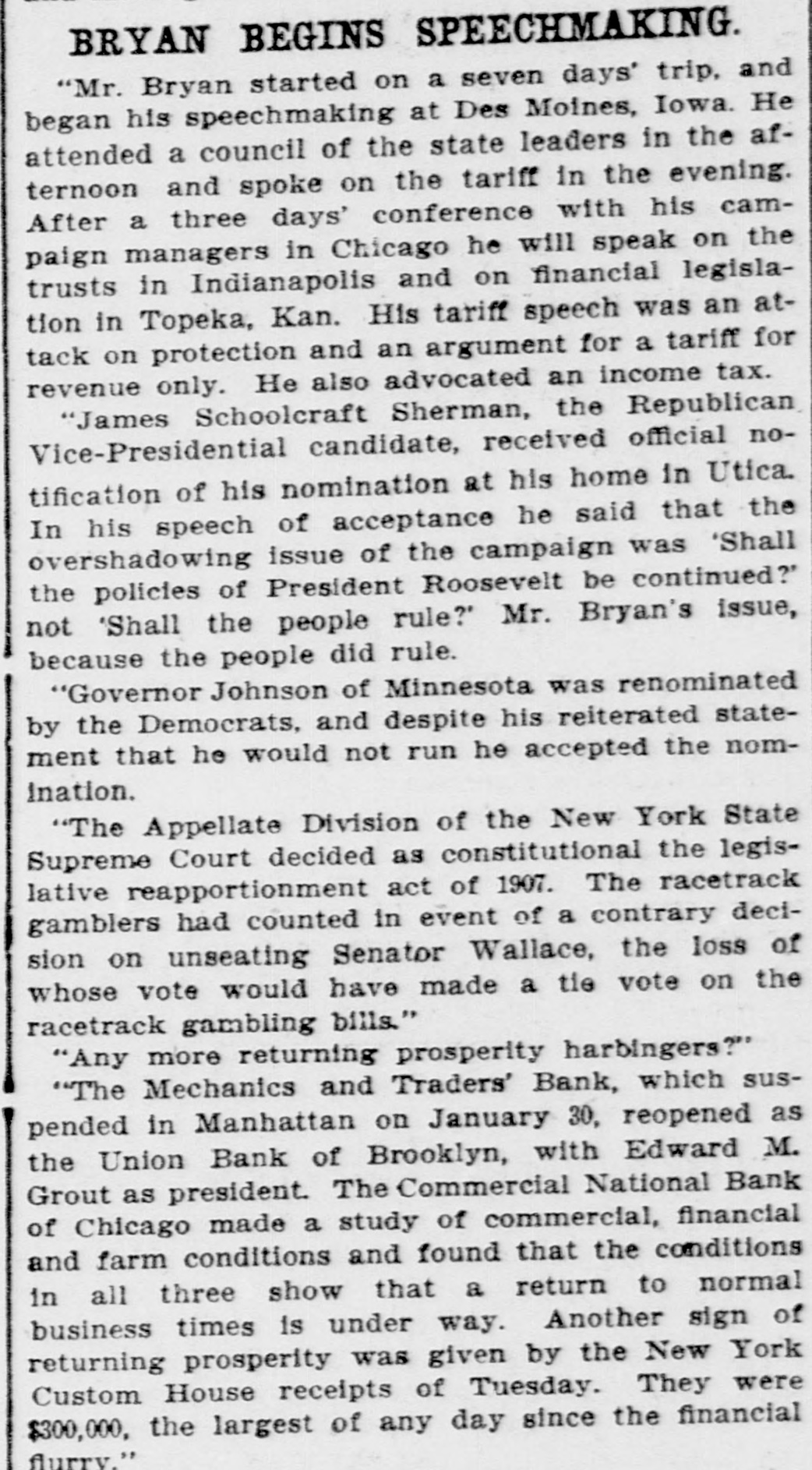
BRYAN BEGINS SPEECHMAKING. "Mr. Bryan started on a seven days' trip, and began his speechmaking at Des Moines, Iowa. He attended a council of the state leaders in the afternoon and spoke on the tariff in the evening. After a three days' conference with his campaign managers in Chicago he will speak on the trusts in Indianapolis and on financial legislation in Topeka, Kan. His tariff speech was an attack on protection and an argument for a tariff for revenue only. He also advocated an income tax. "James Schoolcraft Sherman, the Republican Vice-Presidential candidate, received official notification of his nomination at his home in Utica. In his speech of acceptance he said that the overshadowing issue of the campaign was 'Shall the policies of President Roosevelt be continued?' not 'Shall the people rule?' Mr. Bryan's issue, because the people did rule. "Governor Johnson of Minnesota was renominated by the Democrats, and despite his reiterated statement that he would not run he accepted the nomInation. "The Appellate Division of the New York State Supreme Court decided as constitutional the legislative reapportionment act of 1907. The racetrack gamblers had counted in event of a contrary decision on unseating Senator Wallace, the loss of whose vote would have made a tie vote on the racetrack gambling bills." "Any more returning prosperity harbingers?" "The Mechanics and Traders' Bank, which suspended in Manhattan on January 30, reopened as the Union Bank of Brooklyn, with Edward M. Grout as president. The Commercial National Bank of Chicago made a study of commercial, financial and farm conditions and found that the conditions in all three show that a return to normal business times is under way. Another sign of returning prosperity was given by the New York Custom House receipts of Tuesday. They were $300,000, the largest of any day since the financial flurry."


Article from Newark Evening Star and Newark Advertiser, April 5, 1910

Click image to open full size in new tab

Article Text

BROOKLYN BANK, WITH $5,000,000 DEPOSITS, CLOSES Former Comptroller Grout, of New York City, President of Institution. NEW YORK, April 5.-The Union Bank of Brooklyn, a State institution with seven branches in various parts of Brooklyn borough, closed its doors today and was taken in charge by the State banking department. Edward M. Grout, former comptroller of New York city, is president of the institution, which has a capital of $1,000,000 and deposits, according to its last report, of more than $6,000,000. Inability to realize upon assets in time to meet the demands of the bank's business is assigned by President Grout as the reason for the closing. The bank was organized in 1908 and took over the business of the Mechanics and Traders' Bank, which closed during the 1907 financial panic. Causes which ante-date the present management and were beyond its control made it impossible to reestablish the bank, President Grout declared in a statement today. He added his belief that the assets were ample to pay depositors in full. It is not believed that the closing of the Union Bank will adversely affect any other financial institution. Its difficulties were internal and related to its affairs alone, it is officially declared. Superintendent Cheney has issued the following statement in regard to the closing of the bank: "As a result of an examination of the Union Bank of Brooklyn by the banking department a meeting of its directors was held Monday evening at the office of this department to consider whether the bank was not in an unsafe condition because of certain of its assets for the character of which the present management is not responsible. "After deliberation the board reached the conclusion that the bank should not continue its business. The board. accordingly requested the superintendent to take possession. Pursuant to that request and provisions of the banking law the superintendent has taken possession of the corporation." The Union Bank of Brooklyn was organized in 1908 and, according to its last official report, has a surplus of $669,300. deposits of $6,255,000, loans and discounts of $5,328,700 and cash holdings of $529,800. President Grant made the following statement: "The officers and directors of the Union Bank regret that they have found it impossible to reestablish the bank. They have spared no efforts to that end and believe that causes of their failure were beyond their control and antedated the period of the management. These causes, I ought to add. relate to this institution alone, and the closing of the Union Bank ought not to affect any other banks in any manner. "The trouble with us has been that assets are such that we have been unable to realize upon them in time to meet the demands of the business of the bank. I refer to the large amount of real estate, and the various claims whose payment is unavoidably deferred. These were all inherited by the present officers of the bank. The shortage of cash and a lot of assets expresses the situation briefly. "I have no doubt of the full payment of every deposit, as the assets are more than enough for that purpose."


Article from The Calumet News, April 5, 1910

Click image to open full size in new tab

Article Text

GAY & STURGIS GOSSIP. Calumet, Mich., Apr. 5.-The general list, while not very active, held firm and in the last hour advanced sharply. In the coppers, Amalgamated was strong all day and advanced over a point. In the early trading Lake sold off to 52 on the announcement of last month's mill run, which averaged 28 pounds of mineral to the ton. Indiana and North Lake also sold off in sympathy. In the last hour, however, prices advanced sharply, Lake advancing to 57, the balance of the list also showed considerable strength. Utah Consolidated was very weak, selling as low as 241/2, on rumors of passing of the next dividend. The curb list was very quiet and inactive with the exception of Bohemia and South Lake, which sold off in sympathy with the weakness in Lake. New York, April 5.-So far this morning four millions of gold have been engaged for export and it is expected that a million or two more will be taken during the day. Some of the foreign exchange bankers are now predicting that forty millions at least will go out on this movement. While this exporting of gold was expected, it will probably not cause any flurry in money rates. It will, on the other hand prevent rates from declining. The Union bank of Brooklyn was closed up this morning. This should have no effect on Wall street sentiment. Bad breaks in the Boston market, in Lake Copper, North Lake and Indiana, have caused considerable comment in New York this a. m., and are making for some hesitancy in trading in copper stocks here. There is a little gossip to the effect that the steel dividend will be increased, nobody believes this. Sentiment here this a. m. continues bearish, although it is a sort of languid bearish and I find no very positive bear tips out. However, it is in this sort of a drifting market that we get bad breaks in individual stocks.-J. W. Prentiss. Boston.-Jay P. Graves, vice president and general manager of the mines of the Granby Co., is understood to have left California Saturday for the east. While nominally in charge of the company's active operations, Mr. Graves, owing to illness, has not been to the property for about 18 months and consequently all of his information has been based on reports from the mine managers and A. B. W. Hodges, who recently resigned as superintendent,


Article from The Washington Herald, April 6, 1910

Click image to open full size in new tab

Article Text

New York, April 5.-Financial news today was not exceptionally notable, nor altogether favorable, but such as it was it was helpful to what Wall street speculators love to call "the constructive" side of the stock market. Announcement was made of the failure of the Union Bank, of Brooklyn, with deposits aggregating over $5,000,000. Five million dollars more gold was engaged for export, and the indications were that at least an equal sum might be further taken before the end of the week. Decided weakness again developed in various copper mining shares in the Boston market of the same general sort as that which has been exhibited in other directions for more than a fortnight past. On the other hand, the Brooklyn bank suspension was rightly regarded as being no more than an unavoidable result of the 1907 financial troubles, and one that has for a long time been considered inevitable in banking circles. It is believed that depositors will not experience any losses from the affair, and that the worst thing that will happen to them will be that their money will be tied up for a little while. Reduction for Time Money. Gold exports, present and prospective, were naturally regarded as being more or less of academic character, in view of an actual reduction to-day in rates for the use of time money and a distinctly easier tendency in call funds. Time money was quoted lower to-day than it has been at any time for several weeks, and the bulk of call money put out was below 3 per cent. The decline in copper stocks in Boston was looked upon as a marking down of values in many securities there that have hitherto been quoted altogether too high and for which there has been at no time recently other than a poor market. Interest in these stocks has been confined to a very few people, and has extended in only infinitesimal degree to the local financial community. Of all the occurrences of the day belonging to the usual class of stock market factors doubtless the one that excited speculative optimism more than anything else was an extreme break of fifty points in the price of some of the leading cotton options, due to the fact that last night and this morning there were heavy rains, snowstorms, and a general decided fall of moisture in the Southwest and in parts of Texas where drought conditions have lately been more severe than anywhere else in the country. As the wet weather extended considerably farther north, a good-sized break was also induced in the price of wheat. It goes without saying that anything that serves to increase the probability of large crops in the coming season is just now of the higest importance to the financial community. Later on to-day a partial recovery was made from the fall in cotton prices, but it is clear that indications for a big cotton crop, and, for that matter, for a large additions to the wheat crop, are much stronger now than they were a few days since.


Article from The San Francisco Call, April 6, 1910

Click image to open full size in new tab

Article Text

STOCK TRADERS REVIVE MARKET NEW YORK, April 5.-The relative activity in the first and last hours of today's stock market rescued it from what would otherwise have been the dullest day of the present year and converted the closing into decided animation. The orders whose execution shaped that episode came apparently from professional sources. The discussion in stock market circles showed a shift of opinion as to the likelihood of a prompt decision by the supreme court in the important cases involving the anti-trust question. Yesterday's expectation of immediate action was changed to growing resignation to a probable delay until the end of the present term of the court or even until the end of the fall term, to afford time for the assimilation of the American tobacco and Standard oil cases into one decision. The dimensions which the gold export movement is assuming were regarded as an effect rather than a cause of the stagnant speculation. The London money market was engaged today with the redemption of the $105,000,000 war loan. which was expected to mark the period of the most pressing government requirements. The continued urgent demand for our gold is attributed to preparation for the next stock market settlement in London. The decision to place the Union bank of Brooklyn in liquidation made an unpleasant impression, although no other institution is supposed to be directly involved in the affair. The incident is an aftermath of the panic of 1907 and is due to the inadequate measure of reorganization. The example of the Union bank carries suggestion that there are many corrections yet to be accomplished of the conditions holding over from that period. United States steel was a prominent figure in the day's market movement. The estimates of the corporation's earnings for the first quarter of the year had an influence on the stock and were made the basis for predictions of an increase in the dividend rate at the directors' meeting on the last Tuesday in the month. Rains in the winter wheat belt were a favorable influence on stocks, although the closing of the most important wheat markets on account of local election holidays left the effects in that market somewhat obscure. A break in cotton was considered with attentive interest in the financial district. The belief is widespread that important speculative liquidation in the commodities markets is a probable event of the not distant future. Bonds were irregular: total sales, par value, $2,107,000. United States 3s, registered, advanced 1/4 per cent on call.


Article from The Pensacola Journal, April 6, 1910

Click image to open full size in new tab

Article Text

BROOKLYNI BANK IS CLOSED DOWN STATE SUPT. OF BANKS TAKES OF UNION CHARGE BANK, WHICH HAS CAPITAL STOCK OF $1,000,000. By Associated Press. New York, April 5.-The doors of the Union Bank of Brooklyn were closed this morning. The institution has seven branches. O. H. Cheney, state superintendent of banks, has taken possession of the bank. The president of the bank is Edward M. Grout, former comptroller of the currency of New York. The bank has a capitalization of $1,000,000, with deposits of $6,500,000. The bank was organized in 1908 and took over the business of the Mechanics and Traders Bank, which closed during the 1907 financial panic. President Grout said he believed the assets were ample to pay depositors in full. It is not believed that the closing of the Union Bank will adversely affect any other financial institution.


Article from La Correspondencia De Puerto Rico, April 6, 1910

Click image to open full size in new tab

Article Text

500 mujeres provocaron un motin en una carniceria. El ejercito del Peru, esta preparado para in vadir a Chile. Las repúblicas de Ecuador y Colombia están dispuestas á some ter á arbitraje el litigio sobre la cuestion de fronteras. De nuestro servicio cablegrafico. no se encuentra preparado para inNew York, abril 6.-El Union vadir á Chile. La guarnición de AreBank de Brooklyn con siete surcurquipa ha sido reforzada con varios sales ha suspendido sus pagos. Esta resolución del gobierno de aquella regimientos. Varios trasportes se institución bancaria obedece á los ba encuentran en el puerto del Callao para conducir tropas á Pacocha y jos precios de la carne en cuyo trust tiene invertido cuantiosas sumas. Mollendo destinadas á resguardar lo puntos fronterizos. El gobierno Creese que procederá al pago de sus de Lima ha dictado ordenes para que acreencias tan pronto los precios de sean reforzadas las guarniciones en aquel articulo adquieran mayor prola frontera Norte, en previsión de un porción. La noticia de la suspensiónl atentado por las fuerzas del Ecador. de pago del Union Bank, no ha ocasionado hasta ahora pánico financieLos gabinetes de Bogotá y Santiaro. Algunos creen q ue este es el progo han propuesto al de Lima somelogo de un nuevo pánico semejante ter en Washington las proposiciones al provocado hace algunos años en de paz que ponga fin al litigio entre Walt Street, con el fin de amedrenlas tres republicas por cuestión de tar al gobierno en su persecución fronteras. En algunos circulos policontra las trusts. ticos centroamericanos se cree que New Yor, abril 6.-500 mujeres esta actitud de Chile yColombia es un provocaron ayer un gran motin en ardid para ganar tiempo en la orgavarios establecimientos de carne. El nización de sus ejércitos. Creese que el conflicto armado es inevitable. desorden hubiera revestido mayores proporciones á no haber intervenido New York, abril 6.-Un telegraoportunamente la policia, la cual loma de Milwaukee (Wisc.) da cuenta gró despues de grandes esfuerzos disdel resultado de las elecciones mupersar á la multitud. Un herido fué nicipales celebradas en dicha ciudad. curado en la sala de asistencia publiLos socialistas sacaron electo al alca. calde y concejales. En Chicago gaNew York, abril 6. - Despachos de naron los demócratas. Lima informan que el ejercito perua-


Article from Omaha Daily Bee, April 6, 1910

Click image to open full size in new tab

Article Text

NEW YORK STOCKS AND BONDS Market Opens Lively, Then Becomes Dull, Closes Active. STEEL A PROMINENT FIGURE Estimate of Corporation's Earnings show Influence and Predictions Point to Increase in Dividend Rate at End of Month. NEW YORK, April The relative activity in the first and last hours of today's stock market rescued it from what would been otherwise the dullest day of the present year and converted the closing into decided animation. The orders whose execution shaped that episode came, apparently, from professional sources. the discussion in stock market circles showed a shift of opinion as to the likely promptitude of a decision by the supreme court in the important cases involving the anti-trust.law Yesterday 8 anticipation of immediate action was changed to growing resignation to a probable delay until the end of the resent term of the court or even until the end of the fall term to afford time for the assimilation of the American Tobacco and Standard Oil cases into one decision. The dimensions which the gold export movement is assuming was regarded as an effect rather than a cause, of the stagnant speculation. The London money market was engaged today with the redemption of the $105,000,000 war loan, which was expected to mark the period of the most pressing government requiraments. The continued urgent demand for our gold is attributed to preparation for the next stock market settlement in London. The decision to place the Union bank of Brooklyn in liquidation made an unpleasant impression, although no other institution is supposed to be directly involved in the affair. The incident is an aftermath of the panic of 1907 and is due to the inadequate measure of reorganization. The example of the Union bank carries a suggestion that there may be corrections yet to be accomplished of the conditions nolding over from that period. United States Steel was a prominent figure in the day's market movement. The estimates of the corporations earnings for the first quarter of the year had an influence on the stock and were made the basis for predictions loft an increase in the dividend rate at the directors' meeting on the last Tuesday in the month. Rains in the winter wheat belt were a favorable influence on stocks, although the closing of some of the most important wheat markets on account of local election holidays left the effect in that market somewhat obscure. A break in cotton was considered with attentive interest in the financial district. The belief is widespread that important speculative liquidation in the commodities markets is a probable event of the not distant future. Bonds were irregular. Total sales, par value, $2,107,000. United States 3s registered advanced 1/4 per cent on call Number of sales and principal quotations on stocks were as follows: Hish Lem


Article from New-York Tribune, April 6, 1910

Click image to open full size in new tab

Article Text

UNION BANK SHUTS DOORS Banking Department Takes Charge of Brooklyn Concern. PAY IN FULL, SAYS GROUT Capital Impaired by Slow Assets and Some Remaining Thomas Loans. The Union Bank of Brooklyn, following a conference of its directors with the State Superintendent of Banks on Monday night, closed its doors yesterday, and. pursuant to the request of the board and the provisions of the banking law, Superintendent Cheney took possession of the bank's property and business, placing State Bank Examiner Edward L. Dodge in charge. The troubles of the institution are ascribed to its holdings of slow assets, including real estate in Brooklyn and Jamaica which cannot be advantageously sold at this time, and certain securities, among which is stock of the Knickerbocker Ice Company of Chicago, held as collateral for a loan of several hundred thousand dollars to E. R. and O. F. Thomas, who at one time controlled the bank. Ex-Controller Edward M. Grout, who has been president of the bank for more than two years, made the following statement yesterday: The officers and directors of the Union Bank regret that they have found it Impossible to re-establish the bank. They have spared no effort to that end and believe that the causes of the failure were beyond their control, and antedated the period of their management. These causes relate to this Institution alone. and the closing of the Union Bank ought not to affect any other bank in any manner. The trouble with us has been that the assets are such that we have been unable to realize upon them in time to meet the demands of the business of the bank. Reference is made to the large amount of real estate and to various claims hose payment is unavoidably deferred. These were all inherited by the present officers of the bank. Shortage of cash. not of assets, expresses the situation briefly. We have no doubt of the fuil payment of every deposit-the assets are more than enough for that purpose. President Grout denied the report that the bank had suffered heavy withdrawals of deposits within a few days, and said that on Monday the deposits were $113,000 larger than the withdrawals. The report of the condition of the Union Bank at the close of business on March 25 was: Resources-Loans and discounts, $4,954.163; overdrafts, $249; due from trust companies, banks and bankers not included in next item, $51,586; due from reserve depositaries, less amount of offsets, $328,627; real estate. $547,187; mortgages owned, $373,223; stocks and bonds. viz.: Public securities (book value. $1,000): market value, $1,000; other securities (book value. $339.434): market value. $339,434: specie, $237.401; legal tender notes and notes of national banks, $120,000; cash items, $119,503; other assets, viz.: Furniture and fixtures. $57,825: accrued interest not entered, $35,000; total. $7,165,201. Liabilities--Capital stock. $1,000,000; surplus, including all undivided profits. 503,699: preferred deposits, $93,099: deposits not preferred. $3,820,509; due trust companies, banks and bankers, $69,087; total deposits, $3,982,696: bills payable not maturing until December next, $1,562,885: other liabilities. viz : Certified checks. $62,481: cashier's checks, $26,002; unpaid dividends, $36.


Article from The Evening Statesman, April 6, 1910

Click image to open full size in new tab

Article Text

Activity in Final Hour Marks Trade NEW YORK, Aprol 5.-The relative activity in the first and last hours of today's stock market rescued it from what would otherwise have been the dullest day of the present year and converted the closing into decided animation. The orders whose execution shaped that episode came apparently from professional sources. The discussion in stock market circles showed a shift of opinion as to the likely promptitude of a decision by the supreme court in the important cases involving the anti-trust question. Yesterday's anticipation of immediate action was changed to growing resignation to a probable delay until the end of the present term of the court or even until the end of the fall term, to afford time for the assimilation of the American Tobacco and Standard Oil cases into one decision. The dimensions which the gold export movement is assuming was regarded as an effect rather than a cause, of the stagnant speculation. The London money market was engaged today with the redemption of the $105,000,000 war loan, which was expected to mark the period of the most pressing government requirements. The continued urgent demand for our gold is attributed to preparation for the next stock market settlement in London. The decision to place the Union bank of Brooklyn in liquidation made an unpleasant impression, although no other institution is supposed to be directly involved in the affair. The incident is an aftermath of the panic of 1907 and is due to the inadequate measure of reorganization. The example of the Union bank carries a suggestion that there may be corrections yet to be accomplished of the conditions holding over from that period. United States steel was a prominent figure in the day's market movement. The estimates of the corporations earnings for 0.00 first quarter of the year had an rence on the stock and were made the Lasis for predictions of an increase in the dividend raté at the directors meeting on the last Tuesday in the month Rain in the winter wheat belt was d favorable influence on stocks. although the closing of the most important wheat markets on account of local election holidays left the effects in that market somewhat obscure. A break in cotton was considered with attentive interest in the financial district. The belief is widespread that important speculative liquidation in the commodities markets is a probable event of the not distant future. Bonds were irregular. Total sales par value, $2,107,000. United States 3s registered advanced 1-4 per cent 0 neall.


Article from The Times Dispatch, April 6, 1910

Click image to open full size in new tab

Article Text

New York Stock Market Dr York, April 5.-The relative let/Dity in the first and last hours of he stock market rescued It from what could have been otherwise the dullest hay of the present year. and converted the closing into decided animation. The orders, whose execution shaped that episode came. apparently from professional sources. They reflected the effort of the hard pressed profesNonals to infuse some life into a marset which was falling into a condition hopeless for their purposes of daily rades on price fluctuations. The dimensions which the gold export movement is assuming was re. garded as an effect, rather than a cause. of the stagnant speculation. The languid demand for money is Albwing Interest rates to recede In spite the material inroads making on the tender surplus reserves of the banks, The London money market was on. laged to-day with the redemption of the 105,000.000 war loan, which was expected to mark the period of the most pressing government requirements. The continued urgent demand for our gold is attributed to preparation for the next stock market settlement in London. The tottering of rubber shares in that market to-day. in view of the excess of the previous rise. was considered ominous. An ultimate collapse of that speculation is considered mevitable. The decision to place the Union Bank of Brooklyn in liquidation made an unpleasant impression, although no other institution is supposed to be directly involved in the affair. The Incident Is an aftermath of the panic of 1907. and is due to the inadequate measure of reorganization. United States Steel was a prominent figure in the day's movement. The estimates of the corporation's earnings for the first quarter of the year had an influence on the stock and were made the basis for predictions of an increase in the dividend rate at the directors' meeting on the last Tuesday in the month. The leadership proved effective for the whole market. Rains in the winter wheat belt were 't favorable influence on stocks, although the closing of some of the most important wheat markets on account of local election holidays. left the effects in that market somewhat obscure. A break in cotton was considered with attentive interest in the financial district. The belief is widespread that important liquidation in the commodities markets is an important event of the not distant future. Bonds were irregular. Total sales, nar value. $2,107,000. United States 3's. registered. advanced 1-4 per cent. on call. Total sales of stocks to-day, 432.700 shares.


Article from Watertown Leader, April 8, 1910

Click image to open full size in new tab

Article Text

ANOTHER BANK CLOSES BOROUGH OF BROOKLYN IN CHARGE OF STATE OFFICIAL. Liabilities Carried from Panic of 1907 Are Too Heavy for the Present Management. NEW YORK, April 7.-The Borough bank of Brooklyn closed its doors today and the superintendent of banks has taken possession of the institution. The bank has a capital of $200,000 with deposits aggregating $2,000,000. E. R. Shears is president. This is the second bank failure in Brooklyn within a week, the first being the Union Bank of Brookyn. At the office of the state superintendent of banks, the following statement was given out today: "A meeting of the board of directors of the Borough bank of Brooklyn was held at the office of the banking department, 52 Broadway, at 6:30 o'clock Wednesday night, the meeting having been called by President Shears. "After a conference with the superintendent of banks regarding the unusual demands being made upon the institution at its Eighth Ward branch and considering the character of the assets, for which the present management is not responsible, the board decided to request the superintendent to take possession and thus preserve the best interests of all depositors. "Pursuant to the request and the provisions of the banking law, the superin:endent has taken possession of the property and business of the corporation. No further statement regarding the condition of the bank will be made until the inventories have been completed. There has been no withdrawal of deposits from any other institution.' Supt. Cheney said that the conditions attending the closing of the bank were almost identical with those which led to the closing of the Union bank. As was the case with the latter, the Borough was obliged to suspend during the panie of 1907, and was reorganized after the panic was over. The new management was obliged to assume liabilities which have been a heavy load. Suspension of the Union bank had a bad effect on the Borough, which was known to be in the same position.


Article from New-York Tribune, April 9, 1910

Click image to open full size in new tab

Article Text

BROOKLYN BANKER DEAD Stricken at Work After Suspension of Union Bank. Frederick Marble, manager of the Stuyvesant branch of the Union Bank, Brooklyn, died last night at his home, No. 647 Greene avenue. It is believed that the suspension of the bank was in part, at least, responsible for his death. He worked at the bank all day Tuesday preparing his books for the Superintendent of Banks, who took charge that morning. He returned to his desk on Wednesday morning and started his work. Shortly afterward he was seized with a cerebral hemorrhage. Dr. C. O. Tupper, of No. 1182 Dean street, was called in, and he ordered the man taken home at once, and there Dr. Frank E. Wilson, of No. 1242 Bushwick avenue, was called into consultation. At the time that Mr. Marble was taken ill his friends were planning for the organization of a new bank of which he was to be made the head. Mr. Marble was born in Poughkeepsie sixty-two years ago. He leaves a wife and two children.


Article from The Evening World, May 3, 1911

Click image to open full size in new tab

Article Text

DIX ASKED TO AID DEPOSITORS OF THE UNION BANK Fold Not a Dollar of $4,000,000 Held by Brooklyn Institution Has Been Paid Them. ALBANY, May 3.-Gov. Dix's aid was asked to-day by a large delegation of depositors of the collapsed Union Bank Brooklyn to use his inuuence to bring bout the passage of Assemblyman Gold'stein's bill appropriating $50,00 for a legislative investigation of the Union Bank and any other State bank or trust company in process of liquidation which would warrant investigation in the committee's judgment. Assemblyman Goldstein, as spokesman for the delegation, told the Governor of the failure of the bank during the panic of 1907, of its subsequent rehabilltation under the presirdency of Edward H. Grout, former Comptroller of New York City, and of its reopening with the consent of Clark Williams. who was then State Superintendent of Banks. When it again closed in April, 1910. 1t had on deposit about $4,000,000, and not a dollar has been received by the depositors. Clark Williams was criticised for permitting the bank to reopen and Superintendent of Banks Cheney for allowing it to continue, while District-Attorney Whitman of New York was praised for his "fearless and honest prosecution of the banking thieves that wrecked the Carnegie Trust Company and the Washington Bank." Supt. Cheney, who was president during the thearing, was asked by the Governor if some of the real estate loans made by the bank were not excessive. Mr. Cheney replied that they would have been under present laws, but were not illegal at the time they were made. When the Governor asked If the Banking Department ought not to have interfered and investigated matters complained of, the Superintendent declared that he was not at the head of the Banking Department at that time. The delegation attended a hearing on the Goldstein bill before the Assembly Ways and Means Committee later in the afternoon.


Article from New-York Tribune, July 14, 1911

Click image to open full size in new tab

Article Text

TELL OF UNION BANK Glbert Elliott and W. C. Damron Served with Subpœnas. INQUIRY STARTS MONDAY Thirty Witnesses To Be CalledDepartment Ready for Thorough Probe. Subpenas were served yesterday on GllElliott, of No. 44 Court street, Brooksert and W. C. Damron, of No. 291 Monm. street, Brooklyn, to appear before tague Tuyl, of the State on Monday, and tell they know about the affairs of the what Union Bank, of Brooklyn. Damron, closed was a director of the bank when it who known as the Mechanics and Traders' Bank. vsa and David A. Sullivan, was presihas unpaid notes in the bank to the mount dent. of $40,960. dating back to Septem17, 1908. He is also an indorser on dotes W of David A. Sullivan amounting to $150,000. Gilbert Elliott, who is a lawyer and real estate man of Brooklyn. was concerned in the Onslow & Moore Company. the Essex & Lee Company and the Camden ConstrucCompany, all of which were known as Sullivan tion companies and were, it is said, intimately connected with the bank under the Sullivan regime. Subpenas have been issued for David A. Sullivan and James T. Ashley. Ashley was vice-president of the bank under Sullivan, and when It was reorganized as the Union Bank and Edward M. Grout became its nresident, Ashley was made cashier. He was retained as one of the representatives of the State Banking Department when the bank closed for the last time in May, 1910. The Banking Department has discovered that many books and papers and leaves from ledgers have disappeared since the bank was closed. Sullivan is wanted to cell about some of the real estate operations in which he was concerned and in which the bank played a large part. nformation is especially wanted from him as to those operations that took place at about the time the bank was closed when he was at the head of it. Hearings Up to August 14. About thirty subpœnas have been issued altogether for hearings running up to August 14. Mitchell May, Assistant District Attorney of Kings County, who has been assigned to assist Asemblyman Louis Goldstein in the investigation. has secured the use of Part 6 of the Supreme Court of Kings County for the investigators. After the hearing on Monday there will be an adjournment for a week, as Assemblyman Goldstein has to be in Albany for the closing sessions of the Legislature. Mr. Goldstein will act as an assistant to the State Banking Department and W. E. Dodge, who has been in charge of the Union Bank for the State Banking Department, will preside at the hearings and represent Superintendent Van Tuyl. Beginning on July 24 It is intended to hold daily hearings until the investigation is finished. For the last ten days the State Banking Department has been making a search of the records of the office of the Attorney General in Albany, the office of the Secretary of State, the State Controller's office and the Insurance Department for evidence bearing on the closing of the bank. Evilence was sought in the office of the Secretary of State concerning the many incorporations in which Sullivan played a part and the bank was an important feature. The State Banking Department in the meantime has turned over Its records to Asemblyman Goldstein. who sought certain etters. having an important bearing on the dreumstances attending the reopening of the bank. It is this feature of the case that is exDected to receive the first attention at the public hearings. The bank was reopened by an order of the court and against the judgment of Clark Williams, who was then Superintendent of Banks. The representations that secured the permission for reopening will be a subject for minute inquiry. Mr. Goldstein and Mr. May will have a conference to-day to decide on the order in which witnesses will be called and (be general order of the inquiry. Mr. May to Co-operate. Mr. May will at that time turn over to Mr. Goldstein the large amount of information in regard to the closing of the bank that has been gathered by the District Attorney's office. Mr. May is desirous of CO-


Article from New-York Tribune, July 26, 1911

Click image to open full size in new tab

Article Text

BANK CLERK AN ACCUSER Head of Windsor Trust Company Admits Charges Are True. BIG MEN ARE INVOLVED Clark Williams Makes Revelations on Stand in Union Bank Inquiry. Clark Williams, president of the Windsor Trust Company, identified on the stand yesterday morning at the Union Bank inquiry in Brooklyn an anonymous letter he, as State Superintendent of Banking, had received in the summer of 1908 charging gross irregularities in the conduct of the bank before the panic of 1907 and successful attempts at concealment after the panic. James T. Ashley, vice-president of the old Mechanics and Traders' Bank, which became the Union Bank when it reopened following its failure at the time of the panic, and K. A. Southworth, assistant cashier, are the men particularly accused by the writer, who wrote that he was formerly in the employ of the Union Branch of the Mechanics and Traders' Bank, and who signed himself, "A Young but Honest Bank Clerk." Mr. Williams said he had never been able to identify the handwriting of the letter or to find out who the writer was, but he said he had investingated the charges the letter contained and_ found some of them to be true. That part of the letter embodying the charges follows: James T. Ashley has made false reports to the Banking Department for upward of three years, and has tampered with the books of the bank just prior to each examination by your department. As treasurer of the Orr Construction Company, a subsidiary company of the bank, Ashley was guilty of many irregularities. The books of that company were kept by Ashley and will show where the company was credited with several thousand dollars of sundry accounts charged off customers' ledgers. They will also show that certain profits of the Atlantic Branch were transferred to the Union Branch, and there credited to the Orr Contracting Company, who in turn paid it over to Mr. Sullivan, one entry of over $4,000 in particular. An examination of the ledger containing the three Cheeseborough accounts will show a temporary debit of $100,000 against one of the accounts last October for the purpose of concealing a certain transaction from Examiner Hatchins. Sullivan's account about that time will reveal a handsome overdraft unless Southworth or Ashley have since manipulated the books as has been their custom. When Mr. Hays made a special investigation of certain questionable transactions for the District Attorney last winter. Southworth, then assistant cashier, visited the Atlantic Branch at midnight, prepared certain debit and credit tickets in blue pencil to conceal the right channel through which certain profits had passed, involving Mr. Sullivan. All incriminating evidence was destroyed by Southworth that night. and the books falsified. As a result Mr. Hays's report contained nothing upon which the grand jury of Kings County could find an indictment. Southworth also forged some paper which found its way to the Home Bank, of Brooklyn, and later was taken up.


Article from New-York Tribune, August 25, 1911

Click image to open full size in new tab

Article Text

# MAY HALT BANK HEARING Cropsey Would Examine Grout Himself as to Union's Affairs. There is a possibility that to-day's hearing in the Union Bank investigation, which is being conducted at the Kings County courthouse by Assemblyman Louis Gold-stein, may be adjourned if Edward M. Grout does not appear in accordance with the subpœna served upon him a couple of days ago. Ex-Police Commissioner James C. Cropsey said yesterday that he did not intend to take up the conduct of the bank during Mr. Grout's presidency until he had a chance to examine him, as he did not wish to put the lawyer on his guard. At to-day's hearing, some witnesses may be examined as to the transactions under the Sullivan regime and at the time of the suspension, If Mr. Grout does not appear.


Article from The Evening World, August 28, 1911

Click image to open full size in new tab

Article Text

# CROPSEY PLANS # TO FORCE GROUT # ON THE STAND If Ex-Comptroller Doesn't Answer Wednesday Attorney Will Go to Court. # FOREMAN GOT STUNG. Signed a $50,000 Note and Union Bank Investigators Wanted the Money. Queer banking methods during the time when David A. Sullivan was running the Mechanics & Traders' Bank were revealed at the investigation into the failure of the Union Bank before Deputy Superintendent of Banks Dodge in Brooklyn to-day. The evidence taken once more brought into the affairs of the wrecked institution the name of Heinze, but whether it was F. Augustus Heinze or some other Heinze who figured in the transaction was not revealed. James C. Cropsey, counsel to Assemblyman Goldstein, who is running the investigation, announced that on Wednesday morning, unless Edward M. Grout changes his tactics before that time, an application will be made to Justice Putnam in the Supreme Court for a body attachment for Mr. Grout. The object of the move is to force Mr. Grout to testify as to affairs in the Union Bank while he was president of the institution. Mr. Cropsey has mapped out a plan whereby he believes he can have the legality of the investigation and the power of Mr. Dodge to compel witnesses to testify settled by the courts without much delay. Randolph Hulshart was an interesting witness in to-day's proceedings. He is a building foreman and some years ago was employed by Gilbert Elliott, whom he had known for many years. "Mr. Elliott came to me one day," said Hulshart, "and asked me to sign a note in blank. He said it was to go to the Mechanics and Traders' Bank to take up a note made by one Heinze and that it was merely a matter of form and I wouldn't have to worry about it. "After the Union Bank failed I was called upon to pay a note for $50,000. That was the first I knew of the amount of the note I had signed in blank. I couldn't pay $50,000 or a considerable part of that sum. I never got a cent of value for the note." John A. Sell, President of the People's Security Company, a Sullivan concern, from 1907 to 1910, and Charles M. Smith, manager of the Atlantic branch of the Mechanics and Traders' Bank, testified to transactions which they were ordered by Sullivan to carry out. Smith said Sullivan called him on the telephone on one occasion, told him the bank examiners would be around the next morning and directed him how to make entries covering up transaction which would not have passed the scrutiny of the State Department of Banking.


Article from The Evening World, September 2, 1911

Click image to open full size in new tab

Article Text

"Union Bank depositors of a hasty habit of mind have announced in publice places that they would like to have Mr. Grout tell - his bank did with their gavings and running accounts. of course they can't find out from Mr. Grout. A depositor in a defunct bank in Brooklyn has the same individual rights as a deaf and dumb man at a political convention. "After trying in various ways to get a peep at their money, or a smell of their money. to say nothing of a feel of it. a committee of depositors got Assemblyman Goldstein to roar for them. Mr. Goldstein solicited and obtained the aid of the State Banking Department and of Mr. James Cropsey, who is said by policemen to be one of the best lawyers they ever worked under. Mr. Goldstein and Mr. Cropsey set about a.scertaining from Mr. Grout if he knew whether the $4,000,000 deposited in hi; bank is still on the job. "Now Mr. Grout has attacked the inquiry and invoked the aid of the law and Martin W. Littleton. He sets forth that Assemblyman Goldstein is not a proper person to inquire about the Union Bank depositors' money and that Mr. Cropsey's motives are open to suspicion. In the meantime the statute of limitations is working twenty-four hours a day. Brooklyn people have always been


Article from The Salt Lake Tribune, October 12, 1911

Click image to open full size in new tab

Article Text

Charged With Falsifying Records. NEW YORK, Oct. 11.-Indictments charging misdemeanors in making false reports to the state banking department were found by the grand jury today against former City Comptroller Edward M. Grout and James T. Ashley, cashier of the suspended Union bank of BrookIsn. of which Grout was president. Both pleaded not guilty.