Accommodated withdrawals, Borrowed from banks or large institutions, Fed/other loan, Public signal of financial health, Capital injected, Full suspension, Books examined
Clearinghouse involved: Yes
(loan, examination, or other measures)
Receivership Details
Date receivership started
1901-06-27
Date receivership terminated
1901-11-12
OCC cause of failure
Excessive lending
Notes
Known receivership date (Comptroller ordered closing) is 1901-06-27 and matches articles.
Events (9)
1.April 11, 1865Chartered
Source
historical_nic
+36 years
2.June 26, 1901Run
Cause
Bank Specific Adverse Info
Cause Details
Heavy loans and over-certification related to Henry Marquand & Co.; failure of that firm and weak collateral triggered depositor withdrawals.
Measures
Directors and prominent financiers arranged funds/offers of assistance; bank made preparations overnight to meet demands; directors advanced cash to cover obligations.
Newspaper Excerpt
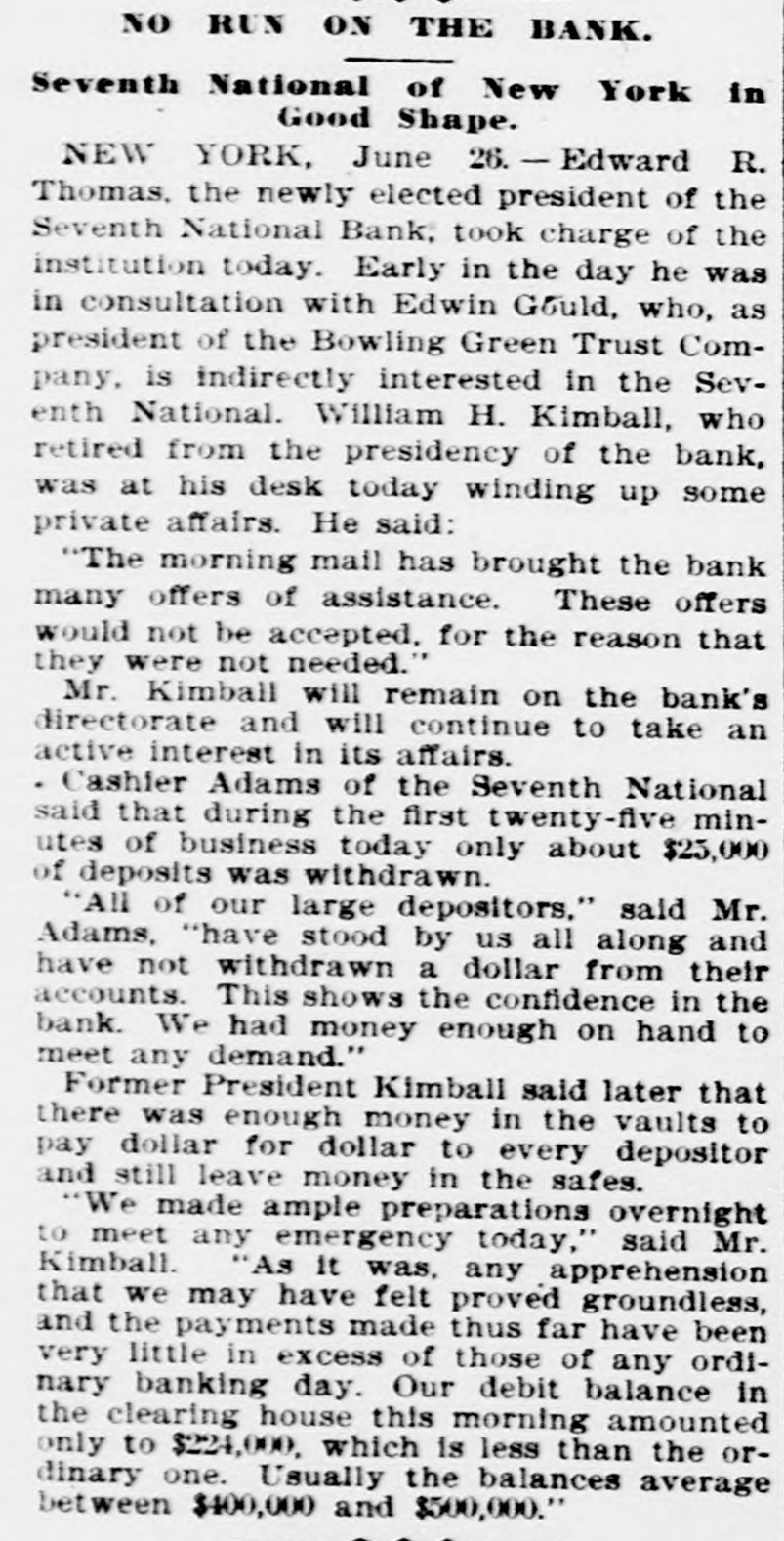
NO RUN ON THE BANK. Seventh National of New York in Good Shape. ... only about $25,000 of deposits was withdrawn. ...
Source
newspapers
+1 day
3.June 27, 1901Suspension
Cause
Government Action
Cause Details
Comptroller ordered suspension after heavy clearing-house debit ($644,108) and directors failed to give assurances about Marquand loans and weak collateral.
Newspaper Excerpt
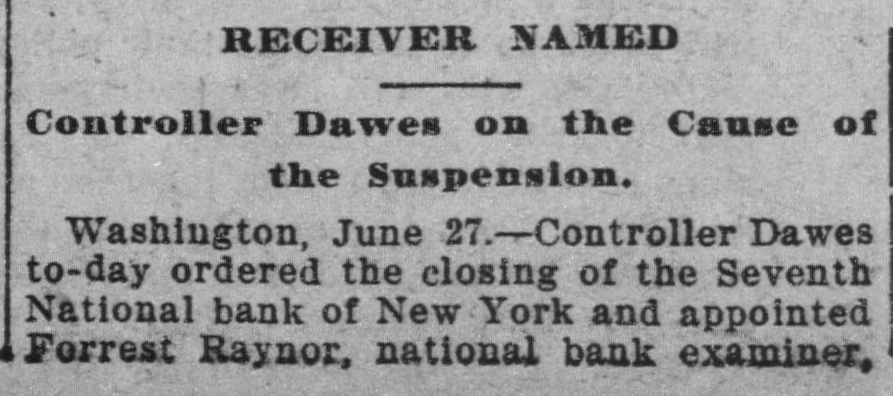
Controller Dawes today ordered the closing of the Seventh National bank of New York and appointed Forrest Raynor, national bank examiner, temporary receiver.
Source
newspapers
same day
4.June 27, 1901Receivership
Newspaper Excerpt
Controller Dawes to-day ordered the closing of the Seventh National bank of New York and appointed Forrest Raynor, national bank examiner, [temporary receiver],
Source
newspapers
same day
5.June 27, 1901Receivership
Source
historical_nic
+1 day
6.June 28, 1901Other
Newspaper Excerpt
Marquand & Co. failed this morning. ... The firm took $6,000,000 of the bonds ... and got $1,600,000 from the Seventh National bank which The bank's failed yesterday.
Source
newspapers
+5 months
7.November 12, 1901Reopening
Newspaper Excerpt
Comptroller Ridgely notified the New York clearing house ... the receiver will be discharged. The bank will be opened officially tomorrow.
Source
newspapers
same day
8.November 12, 1901Restored To Solvency
Source
historical_nic
+17 months
9.April 9, 1903Voluntary Liquidation
Source
historical_nic
Newspaper Articles (23)
1.June 26, 1901New-York TribuneNew York, NY
Click image to open full size in new tab
Article Text
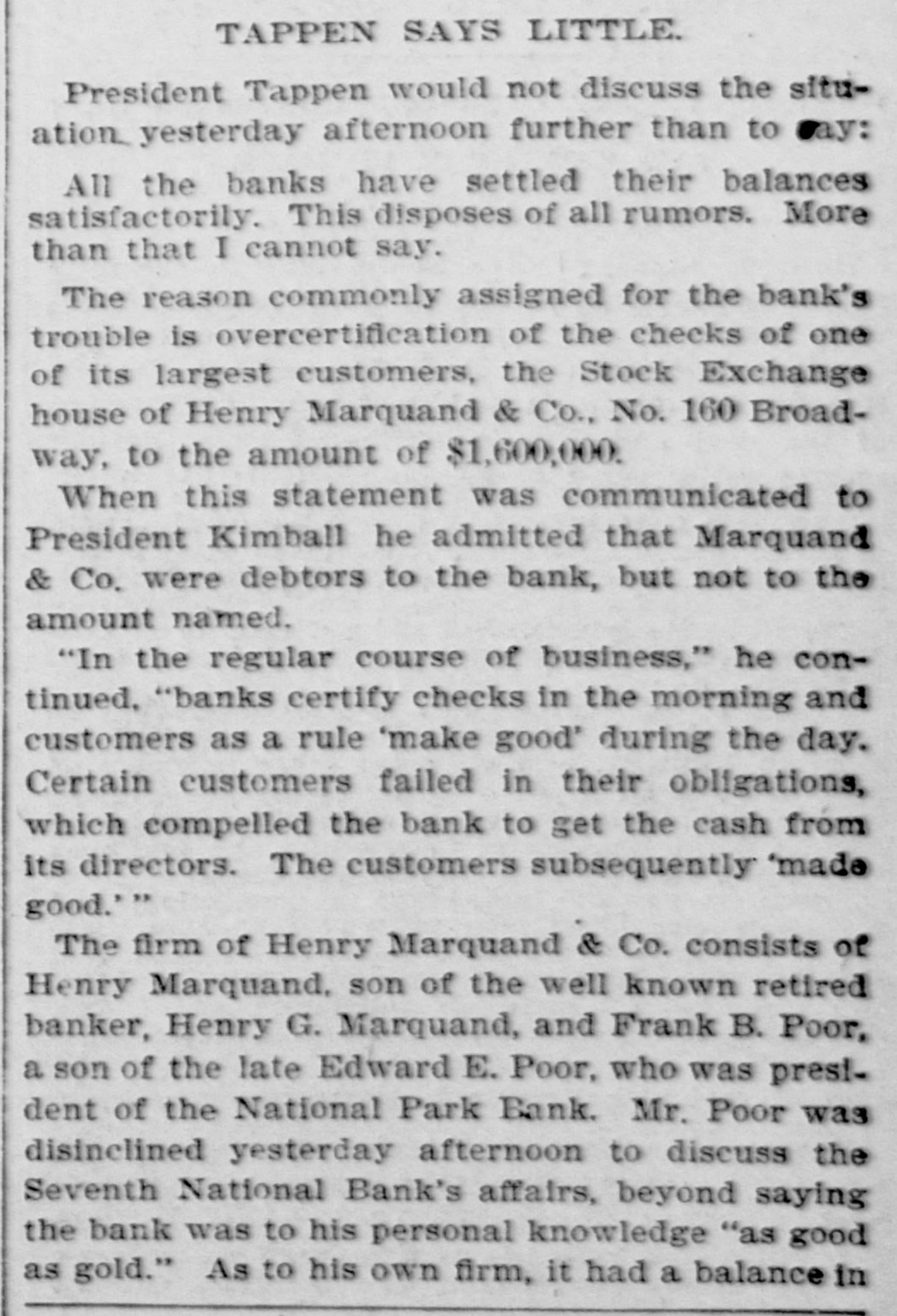
TAPPEN SAYS LITTLE
President Tappen would not discuss the situation yesterday afternoon further than to say: All the banks have settled their balances satisfactorily. This disposes of all rumors. More than that I cannot say. The reason commonly assigned for the bank's trouble is overcertification of the checks of one of its largest customers, the Stock Exchange house of Henry Marquand & Co., No. 160 Broadway, to the amount of $1,600,000. When this statement was communicated to President Kimball he admitted that Marquand & Co. were debtors to the bank, but not to the amount named. "In the regular course of business," he continued. "banks certify checks in the morning and customers as a rule 'make good' during the day. Certain customers failed in their obligations, which compelled the bank to get the cash from its directors. The customers subsequently 'made good.'' The firm of Henry Marquand & Co. consists of Henry Marquand, son of the well known retired banker, Henry G. Marquand, and Frank B. Poor, a son of the late Edward E. Poor, who was prestdent of the National Park Bank. Mr. Poor was disinclined yesterday afternoon to discuss the Seventh National Bank's affairs, beyond saying the bank was to his personal knowledge "as good as gold." As to his own firm, it had a balance in
2.June 26, 1901Evening StarWashington, DC
Click image to open full size in new tab
Article Text
NO RUN ON THE BANK
Seventh National of New York in Good Shape. NEW YORK, June 26. - Edward R. Thomas. the newly elected president of the Seventh National Bank, took charge of the institution today. Early in the day he was in consultation with Edwin Gould, who, as president of the Bowling Green Trust Company. is indirectly interested in the Seventh National. William H. Kimball, who retired from the presidency of the bank, was at his desk today winding up some private affairs. He said: "The morning mail has brought the bank many offers of assistance. These offers would not be accepted, for the reason that they were not needed." Mr. Kimball will remain on the bank's directorate and will continue to take an active interest in its affairs. Cashier Adams of the Seventh National said that during the first twenty-five minutes of business today only about $25,000 of deposits was withdrawn. "All of our large depositors," said Mr. Adams, "have stood by us all along and have not withdrawn a dollar from their accounts. This shows the confidence in the bank. We had money enough on hand to meet any demand." Former President Kimball said later that there was enough money in the vaults to pay dollar for dollar to every depositor and still leave money in the safes. "We made ample preparations overnight to meet any emergency today," said Mr. Kimball. "As It was, any apprehension that we may have felt proved groundless, and the payments made thus far have been very little in excess of those of any ordinary banking day. Our debit balance in the clearing house this morning amounted only to $224,000. which is less than the ordinary one. Usually the balances average between $400,000 and $500,000."
RECEIVER NAMED Controller Dawes on the Cause of the Suspension. Washington, June 27.-Controller Dawes to-day ordered the closing of the Seventh National bank of New York and appointed Forrest Raynor, national bank examiner,
4.June 28, 1901The Indianapolis JournalIndianapolis, IN
Click image to open full size in new tab
Article Text
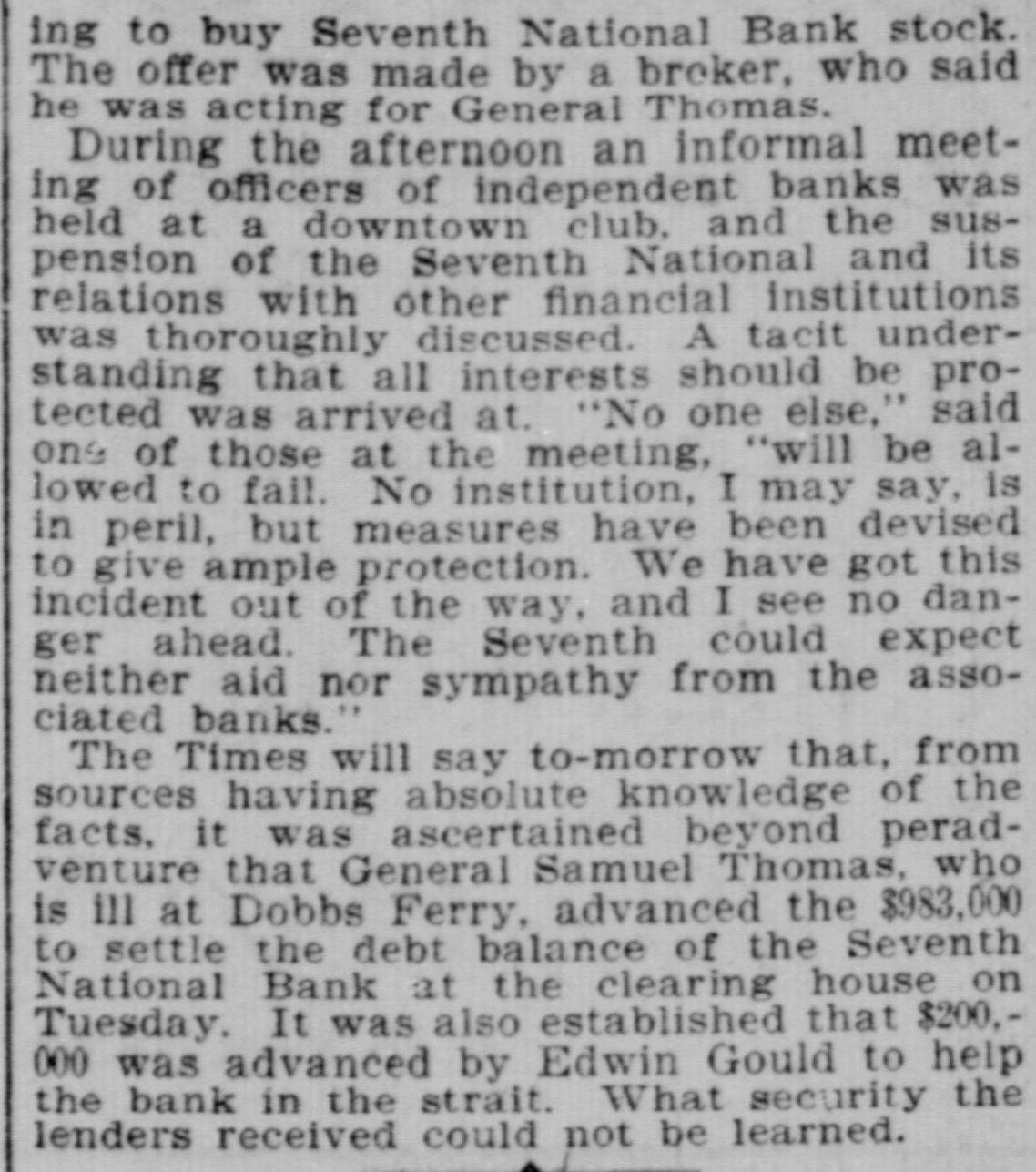
ing to buy Seventh National Bank stock. The offer was made by a broker, who said he was acting for General Thomas. During the afternoon an informal meeting of officers of independent banks was held at a downtown club. and the suspension of the Seventh National and its relations with other financial institutions was thoroughly discussed. A tacit understanding that all interests should be protected was arrived at. "No one else," said one of those at the meeting, "will be allowed to fall. No institution, I may say, is in peril, but measures have been devised to give ample protection. We have got this incident out of the way, and I see no danger ahead. The Seventh could expect neither aid nor sympathy from the associated banks." The Times will say to-morrow that, from sources having absolute knowledge of the facts. it was ascertained beyond peradventure that General Samuel Thomas, who is ill at Dobbs Ferry, advanced the $983,000 to settle the debt balance of the Seventh National Bank at the clearing house on Tuesday. It was also established that $200.000 was advanced by Edwin Gould to help the bank in the strait. What security the lenders received could not be learned.
5.June 28, 1901New-York TribuneNew York, NY
Click image to open full size in new tab
Article Text
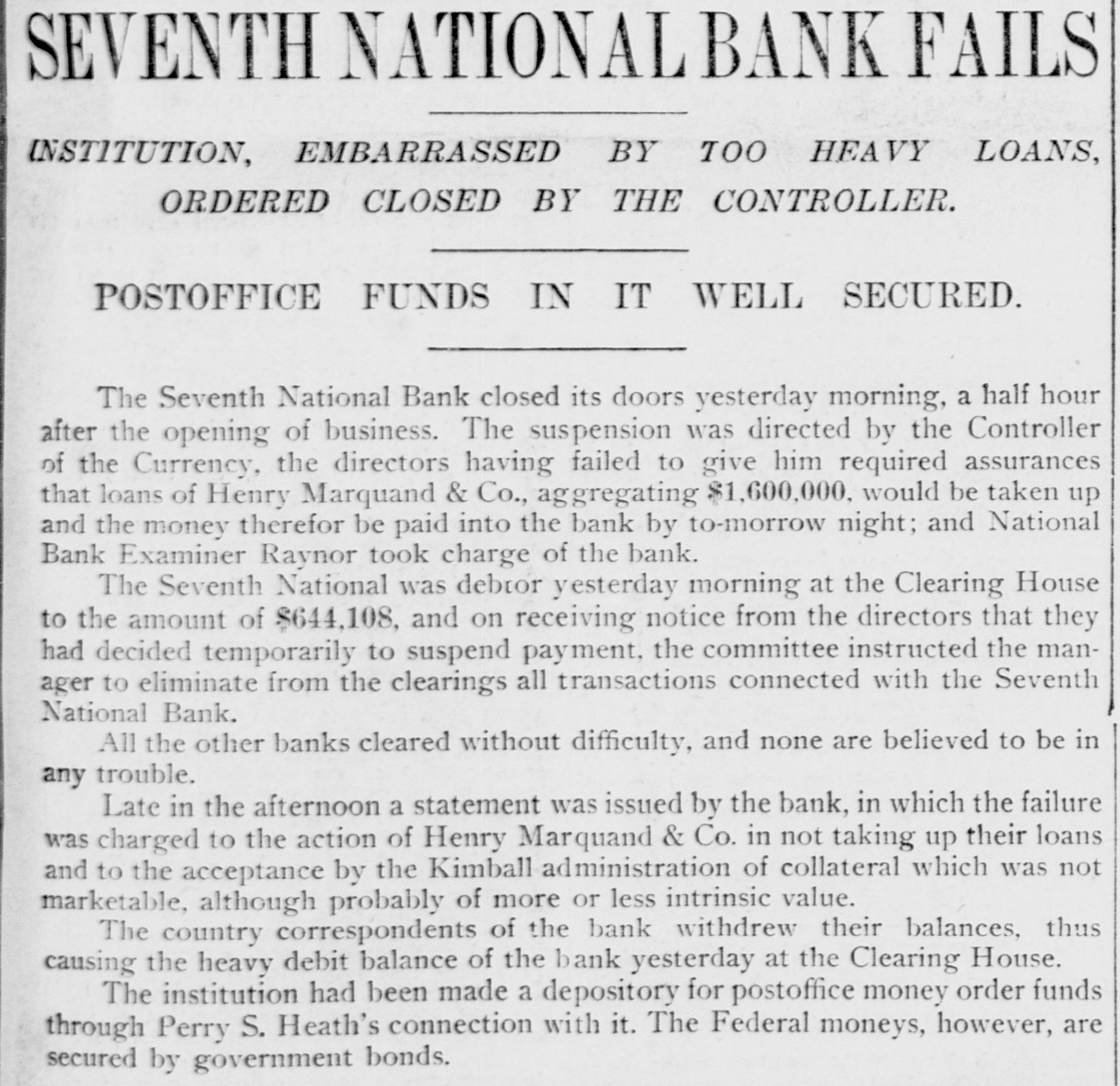
SEVENTH NATIONAL BANK FAILS HEAVY LOANS, INSTITUTION, EMBARRASSED BY TOO ORDERED CLOSED BY THE CONTROLLER. POSTOFFICE FUNDS IN IT WELL SECURED. The Seventh National Bank closed its doors yesterday morning, a half hour after the opening of business. The suspension was directed by the Controller of the Currency, the directors having failed to give him required assurances that loans of Henry Marquand & Co., aggregating $1,600,000, would be taken up and the money therefor be paid into the bank by to-morrow night; and National Bank Examiner Raynor took charge of the bank. The Seventh National was debtor yesterday morning at the Clearing House to the amount of $644,108, and on receiving notice from the directors that they had decided temporarily to suspend payment, the committee instructed the manager to eliminate from the clearings all transactions connected with the Seventh National Bank. All the other banks cleared without difficulty, and none are believed to be in any trouble. Late in the afternoon a statement was issued by the bank, in which the failure was charged to the action of Henry Marquand & Co. in not taking up their loans and to the acceptance by the Kimball administration of collateral which was not marketable, although probably of more or less intrinsic value. The country correspondents of the bank withdrew their balances, thus causing the heavy debit balance of the bank yesterday at the Clearing House. The institution had been made a depository for postoffice money order funds through Perry S. Heath's connection with it. The Federal moneys, however, are secured by government bonds.
6.June 28, 1901Daily CameraBoulder, CO
Click image to open full size in new tab
Article Text
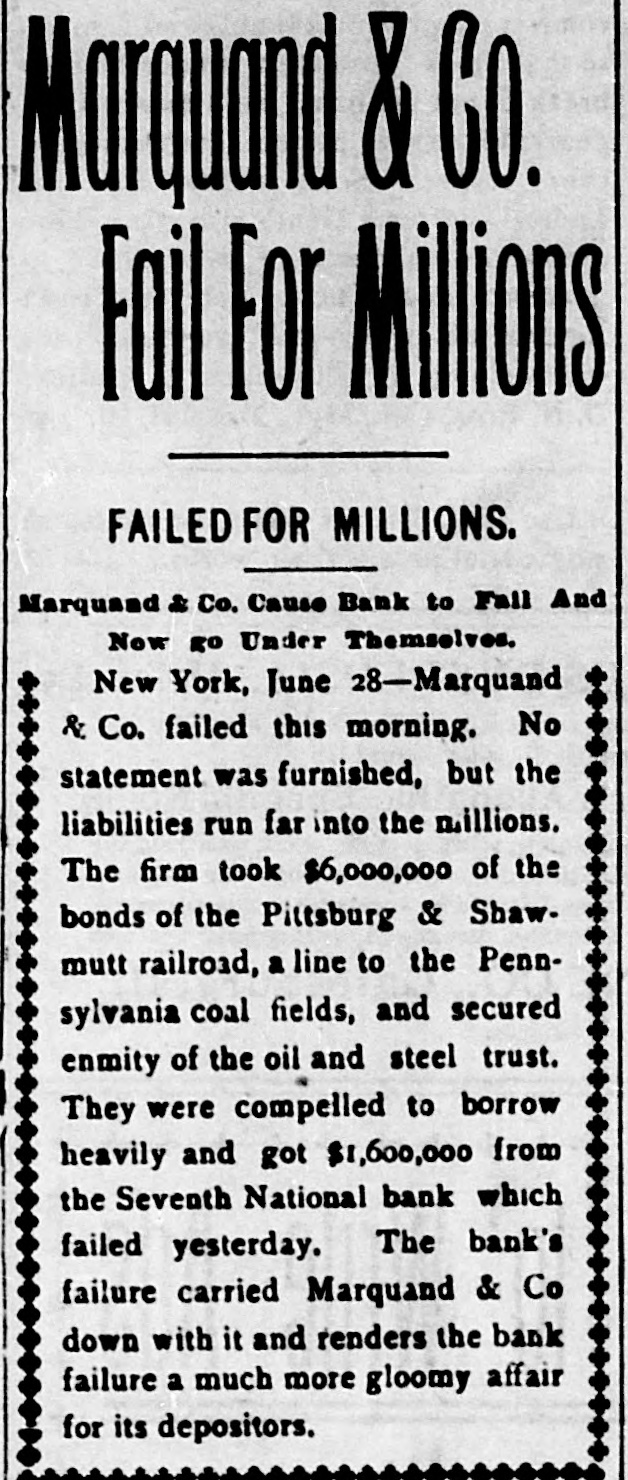
Morquand & CO
Fail For Millions FAILED FOR MILLIONS. Marquand & Co. Cause Bank to Fall And Now go Under Themselves. New York, June 28-Marquand & Co. failed this morning. No statement was furnished, but the liabilities run far into the millions. The firm took $6,000,000 of the bonds of the Pittsburg & Shaw. mutt railroad, a line to the Pennsylvania coal fields, and secured enmity of the oil and steel trust. They were compelled to borrow heavily and got $1,600,000 from the Seventh National bank which The bank's failed yesterday. failure carried Marquand & Co down with it and renders the bank failure a much more gloomy affair for its depositors.
7.June 28, 1901The Montgomery AdvertiserMontgomery, AL
Click image to open full size in new tab
Article Text
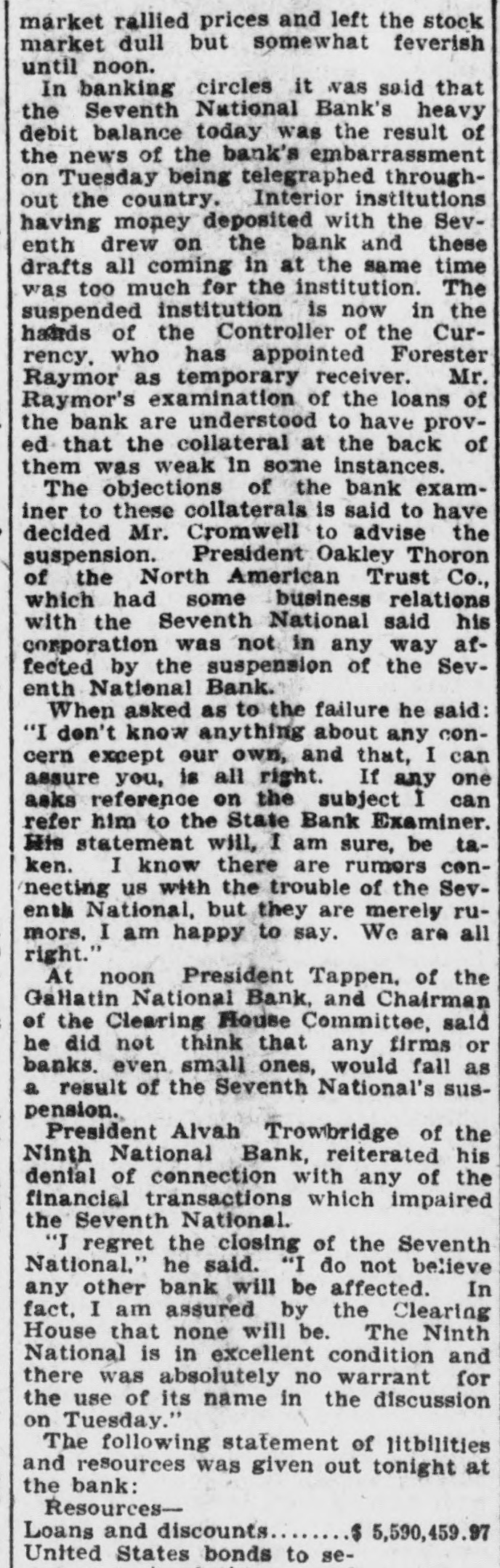
market rallied prices and left the stock market dull but somewhat feverish until noon. In banking circles it was said that the Seventh National Bank's heavy debit balance today was the result of the news of the bank's embarrassment on Tuesday being telegraphed throughout the country. Interior institutions having money deposited with the Seventh drew on the bank and these drafts all coming in at the same time was too much for the institution. The suspended institution is now in the hands of the Controller of the Currency, who has appointed Forester Raymor as temporary receiver. Mr. Raymor's examination of the loans of the bank are understood to have proved that the collateral at the back of them was weak in some instances. The objections of the bank examiner to these collaterals is said to have decided Mr. Cromwell to advise the suspension. President Oakley Thoron of the North American Trust Co., which had some business relations with the Seventh National said his corporation was not in any way affected by the suspension of the Seventh National Bank. When asked as to the failure he said: "I don't know anything about any concern except our own, and that, I can assure you, is all right. If any one asks reference on the subject I can refer him to the State Bank Examiner. His statement will, I am sure, be taken. I know there are rumors conneeting us with the trouble of the Seventh National, but they are merely rumors, I am happy to say. We are all right.' At noon President Tappen. of the Gallatin National Bank, and Chairman of the Clearing House Committee, said he did not think that any firms or banks. even small ones, would fall as a result of the Seventh National's suspension. President Alvah Trowbridge of the Ninth National Bank, reiterated his dental of connection with any of the financial transactions which impaired the Seventh National. "I regret the closing of the Seventh National," he said. "I do not believe any other bank will be affected. In fact, I am assured by the Clearing House that none will be. The Ninth National is in excellent condition and there was absolutely no warrant for the use of its name in the discussion on Tuesday." The following statement of litbilities and resources was given out tonight at the bank: ResourcesLoans and discounts $ 5,590,459.97 United States bonds to se-
8.June 28, 1901The Billings GazetteBillings, MT
Click image to open full size in new tab
Article Text
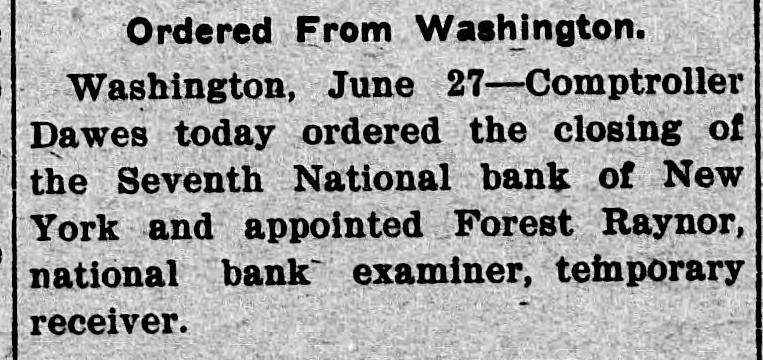
Ordered From Washington
Washington, June 27-Comptroller Dawes today ordered the closing of the Seventh National bank of New York and appointed Forest Raynor, national bank examiner, temporary receiver.
9.June 28, 1901The Madison Daily LeaderMadison, SD
Click image to open full size in new tab
Article Text
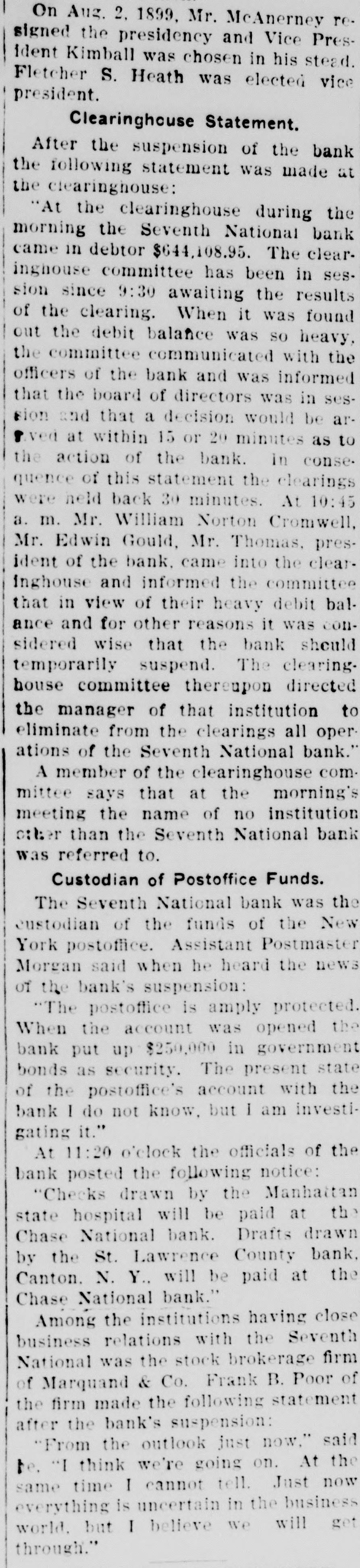
On Aug
2. 1899, Mr. McAnerney resigned the presidency and Vice President Kimball was chosen in his stead. Fletcher S. Heath was elected vice president. Clearinghouse Statement. After the suspension of the bank the following statement was made at the clearinghouse: "At the clearinghouse during the morning the Seventh National bank came in debtor $644,108.95. The clearinghouse committee has been in ses. sion since 9:30 awaiting the results of the clearing. When it was found out the debit balance was so heavy, the committee communicated with the officers of the bank and was informed that the board of directors was in session and that a decision would be arlived at within 15 or 20 minutes as to the action of the bank. in conse. quence of this statement the clearings were held back 30 minutes. At 10:45 a. m. Mr. William Norton Cromwell, Mr. Edwin Gould, Mr. Thomas, president of the bank. came into the clearinghouse and informed the committee that in view of their heavy debit balance and for other reasons it was considered wise that the bank should temporarily suspend. The clearing. house committee thereupon directed the manager of that institution to eliminate from the clearings all operations of the Seventh National bank." A member of the clearinghouse committee says that at the morning's meeting the name of no institution other than the Seventh National bank was referred to. Custodian of Postoffice Funds. The Seventh National bank was the custodian of the funds of the New York postoffice. Assistant Postmaster Morgan said when he heard the news of the bank's suspension: "The postoffice is amply protected. When the account was opened the bank put up $250,000 in government bonds as security. The present state of the postoffice's account with the bank I do not know. but I am investigating it." At 11:20 o'clock the officials of the bank posted the following notice: "Checks drawn by the Manhattan state hospital will be paid at th Chase National bank. Drafts drawn by the St. Lawrence County bank. Canton. N. Y.. will be paid at the Chase National bank." Among the institutions having close business relations with the Seventh National was the stock brokerage firm of Marquand & Co. Frank B. Poor of the firm made the following statement after the bank's suspension: "From the outlook just now." said be. "I think we're going on. At the same time I cannot tell. Just now everything is uncertain in the business world. but I believe we will get through."
10.June 28, 1901The Iola RegisterIola, KS
Click image to open full size in new tab
Article Text
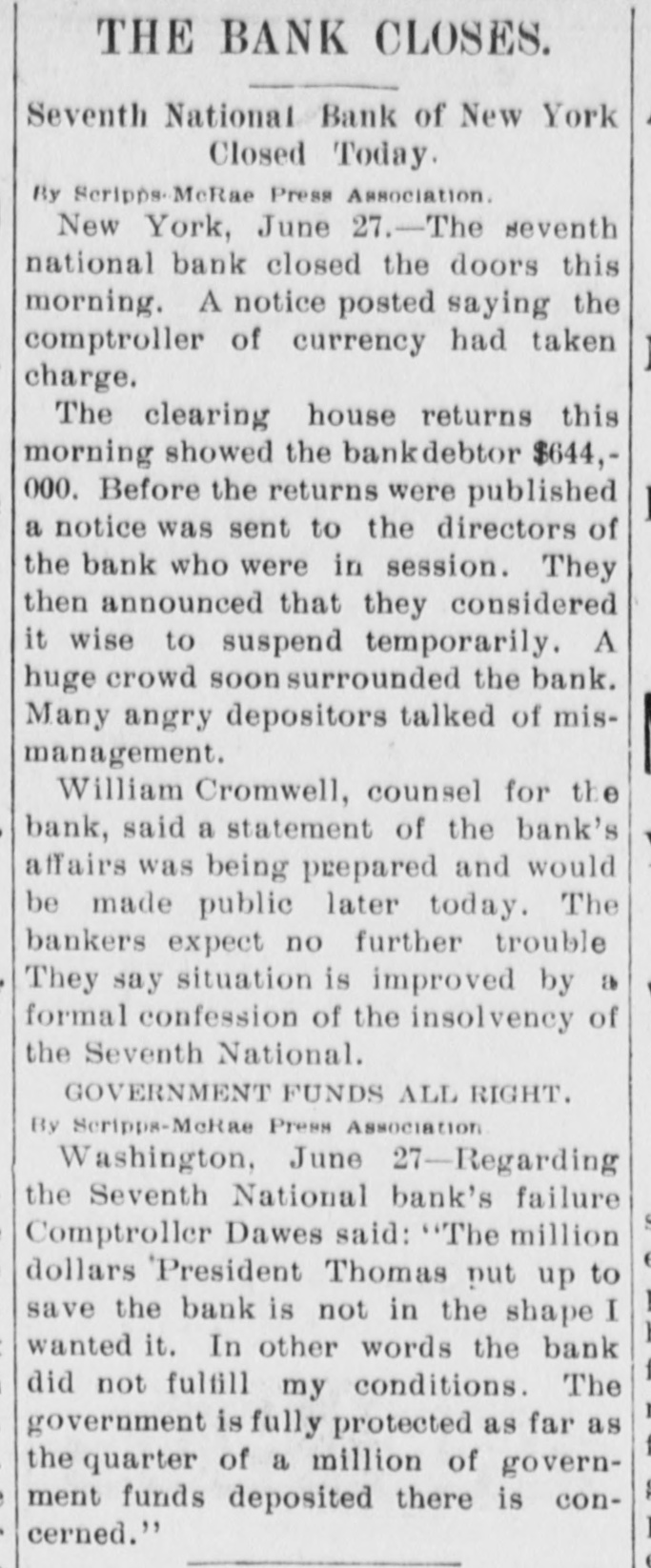
THE BANK CLOSES
Seventh National Bank of New York Closed Today. By Scripps-McRae Press Association New York, June 27.-The seventh national bank closed the doors this morning. A notice posted saying the comptroller of currency had taken charge. The clearing house returns this morning showed the bankdebtor $644,000. Before the returns were published a notice was sent to the directors of the bank who were in session. They then announced that they considered it wise to suspend temporarily. A huge crowd soonsurrounded the bank. Many angry depositors talked of mismanagement. William Cromwell, counsel for the bank, said a statement of the bank's affairs was being prepared and would be made public later today. The bankers expect no further trouble They say situation is improved by a formal confession of the insolvency of the Seventh National. GOVERNMENT FUNDS ALL RIGHT. By Scripps-McRae Press Association Washington, June 27-Regarding the Seventh National bank's failure Comptroller Dawes said: "The million dollars President Thomas put up to save the bank is not in the shape I wanted it. In other words the bank did not fulfill my conditions. The government is fully protected as far as the quarter of a million of government funds deposited there is concerned."
11.July 4, 1901The Black Hills UnionRapid City, SD
Click image to open full size in new tab
Article Text
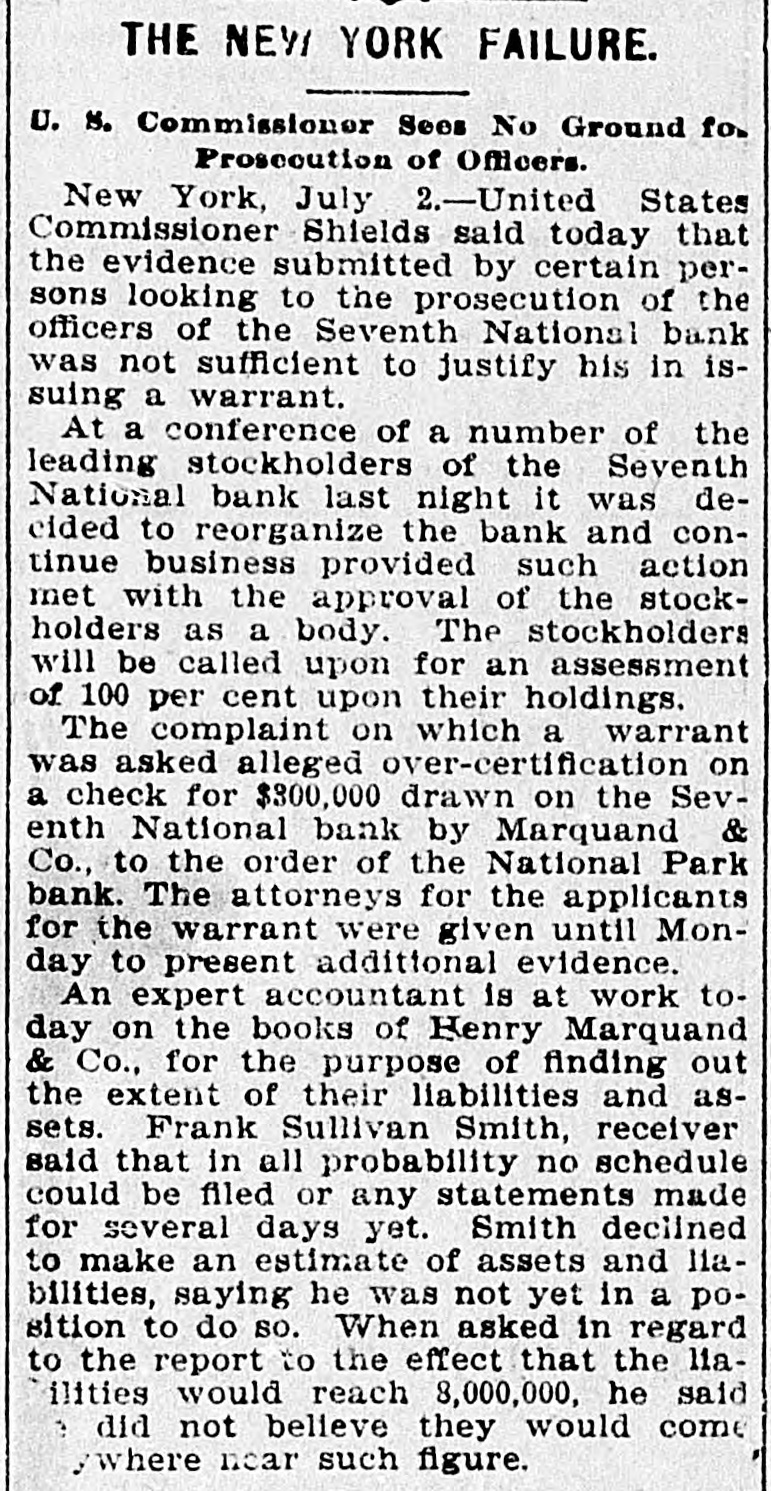
THE NEW YORK FAILURE
U. S. Commissioner Sees No Ground fo. Prosecution of Officers. New York, July 2.-United States Commissioner Shields said today that the evidence submitted by certain persons looking to the prosecution of the officers of the Seventh National bank was not sufficient to justify his in issuing a warrant. At a conference of a number of the leading stockholders of the Seventh National bank last night it was decided to reorganize the bank and continue business provided such action met with the approval of the stockholders as a body. The stockholders will be called upon for an assessment of 100 per cent upon their holdings. The complaint on which a warrant was asked alleged over-certification on a check for $300,000 drawn on the Seventh National bank by Marquand & Co., to the order of the National Park bank. The attorneys for the applicants for the warrant were given until Monday to present additional evidence. An expert accountant is at work today on the books of Henry Marquand & Co., for the purpose of finding out the extent of their liabilities and assets. Frank Sullivan Smith, receiver said that in all probability no schedule could be filed or any statements made for several days yet. Smith declined to make an estimate of assets and liabilities, saying he was not yet in a position to do SO. When asked in regard to the report to the effect that the liailities would reach 8,000,000, he said : did not believe they would come ywhere near such figure.
12.July 16, 1901New-York TribuneNew York, NY
Click image to open full size in new tab
Article Text
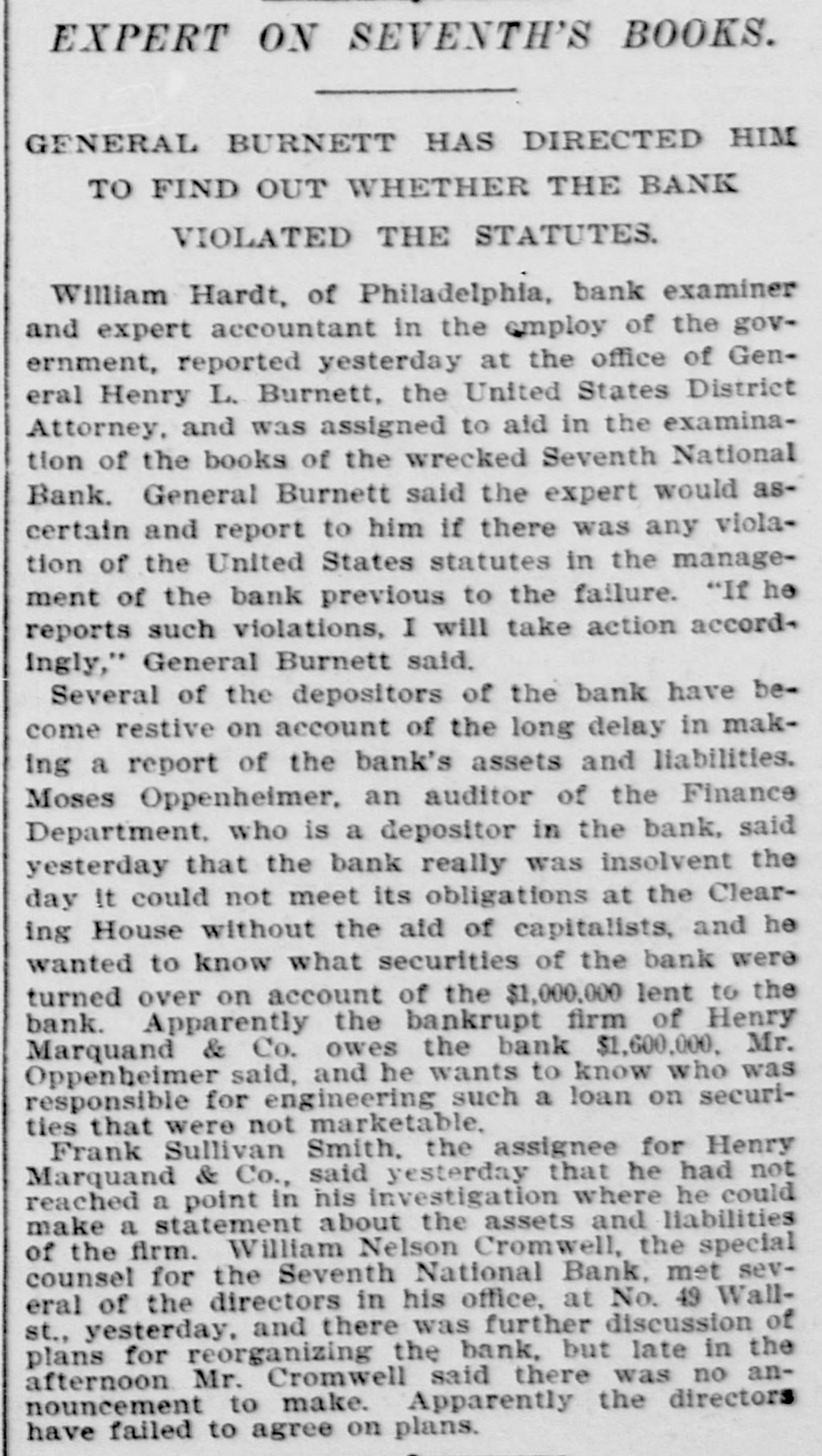
EXPERT ON SEVENTH'S BOOKS
GENERAL BURNETT HAS DIRECTED HIM TO FIND OUT WHETHER THE BANK VIOLATED THE STATUTES. William Hardt, of Philadelphia, bank examiner and expert accountant in the employ of the government, reported yesterday at the office of General Henry L. Burnett, the United States District Attorney, and was assigned to aid in the examination of the books of the wrecked Seventh National Bank. General Burnett said the expert would ascertain and report to him if there was any violation of the United States statutes in the management of the bank previous to the failure. "If he reports such violations, I will take action accord+ Ingly," General Burnett said. Several of the depositors of the bank have become restive on account of the long delay in making a report of the bank's assets and liabilities. Moses Oppenheimer, an auditor of the Finance Department, who is a depositor in the bank, said yesterday that the bank really was insolvent the day It could not meet its obligations at the Clearing House without the aid of capitalists, and he wanted to know what securities of the bank were turned over on account of the $1,000,000 lent to the bank. Apparently the bankrupt firm of Henry Marquand & Co. owes the bank $1,600,000. Mr. Oppenheimer said, and he wants to know who was responsible for engineering such a loan on securities that were not marketable, Frank Sullivan Smith, the assignee for Henry Marquand & Co., said yesterday that he had not reached a point in his investigation where he could make a statement about the assets and liabilities of the firm. William Nelson Cromwell, the special counsel for the Seventh National Bank, met several of the directors in his office, at No. 49 Wallst., yesterday. and there was further discussion of plans for reorganizing the bank, but late in the afternoon Mr. Cromwell said there was no announcement to make. Apparently the directors have failed to agree on plans.
13.July 17, 1901The Guthrie Daily LeaderGuthrie, OK
Click image to open full size in new tab
Article Text
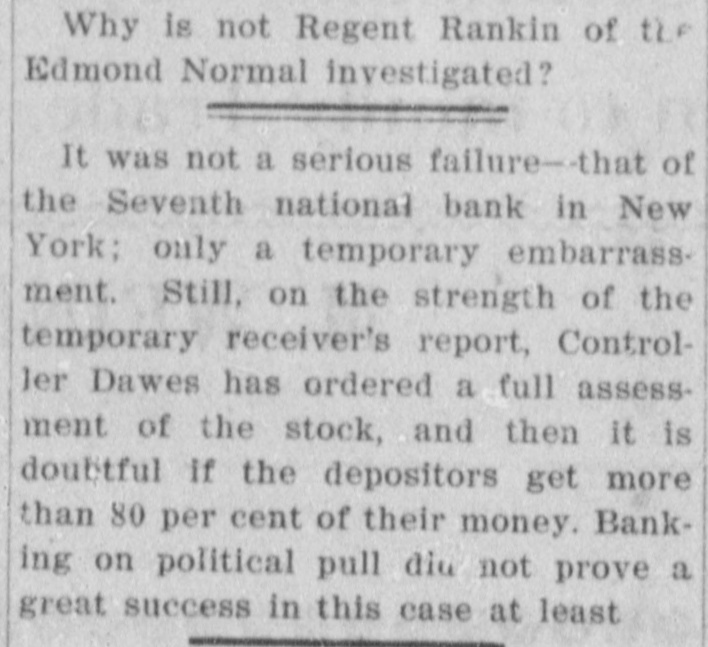
Why is not Regent Rankin of the Edmond Normal investigated?
It was not a serious failure—that of the Seventh national bank in New York; only a temporary embarrassment. Still, on the strength of the temporary receiver's report, Controller Dawes has ordered a full assessment of the stock, and then it is doubtful if the depositors get more than 80 per cent of their money. Banking on political pull did not prove a great success in this case at least
14.July 26, 1901The St. Louis RepublicSaint Louis, MO
Click image to open full size in new tab
Article Text
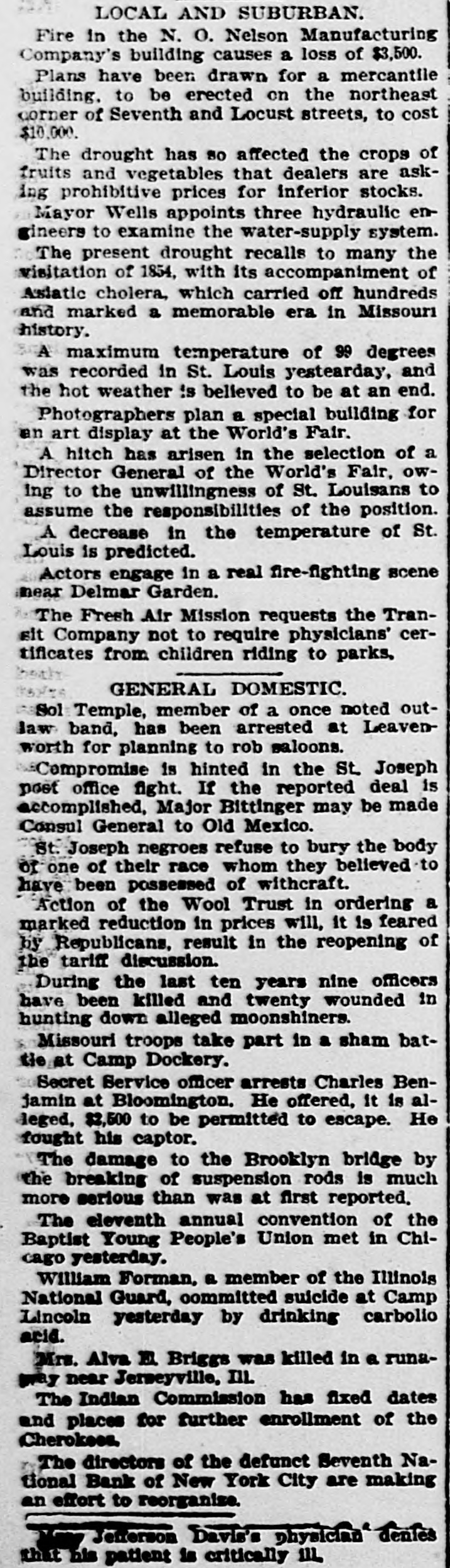
LOCAL AND SUBURBAN.
Fire in the N. O. Nelson Manufacturing Company's building causes a loss of $3,500. Plans have been drawn for a mercantile building, to be erected on the northeast corner of Seventh and Locust streets, to cost $10.000. The drought has so affected the crops of fruits and vegetables that dealers are asking prohibitive prices for inferior stocks. Mayor Wells appoints three hydraulic engineers to examine the water-supply system. The present drought recalls to many the visitation of 1854, with its accompaniment of Asiatic cholera, which carried off hundreds and marked a memorable era in Missouri history. A maximum temperature of 99 degrees was recorded in St. Louis yesterday, and the hot weather is believed to be at an end. Photographers plan a special building for an art display at the World's Fair. A hitch has arisen in the selection of a Director General of the World's Fair, owing to the unwillingness of St. Louisans to assume the responsibilities of the position. A decrease in the temperature of St. Louis is predicted. Actors engage in a real fire-fighting scene near Delmar Garden. The Fresh Air Mission requests the Transit Company not to require physicians' certificates from children riding to parks,
GENERAL DOMESTIC.
Sol Temple, member of a once noted outlaw band, has been arrested at Leavenworth for planning to rob saloons. Compromise is hinted in the St. Joseph post office fight. If the reported deal is accomplished, Major Bittinger may be made Consul General to Old Mexico. St. Joseph negroes refuse to bury the body of one of their race whom they believed to have been possessed of withcraft. Action of the Wool Trust in ordering a marked reduction in prices will, it is feared by Republicans, result in the reopening of the tariff discussion. During the last ten years nine officers have been killed and twenty wounded in hunting down alleged moonshiners. Missouri troops take part in a sham battle at Camp Dockery. Secret Service officer arrests Charles Benjamin at Bloomington. He offered, it is alleged, $2,500 to be permitted to escape. He fought his captor. The damage to the Brooklyn bridge by the breaking of suspension rods is much more serious than was at first reported. The eleventh annual convention of the Baptist Young People's Union met in Chicago yesterday. William Forman, a member of the Illinois National Guard, committed suicide at Camp Lincoln yesterday by drinking carbolio acid. Mrs. Alva E. Briggs was killed in a runaway near Jerseyville, Ill. The Indian Commission has fixed dates and places for further enrollment of the Cherokees. The directors of the defunct Seventh National Bank of New York City are making an effort to reorganise.
Jefferson Davis's physician denies that his patient is critically ill.
15.July 26, 1901The Houston Daily PostHouston, TX
Click image to open full size in new tab
Article Text
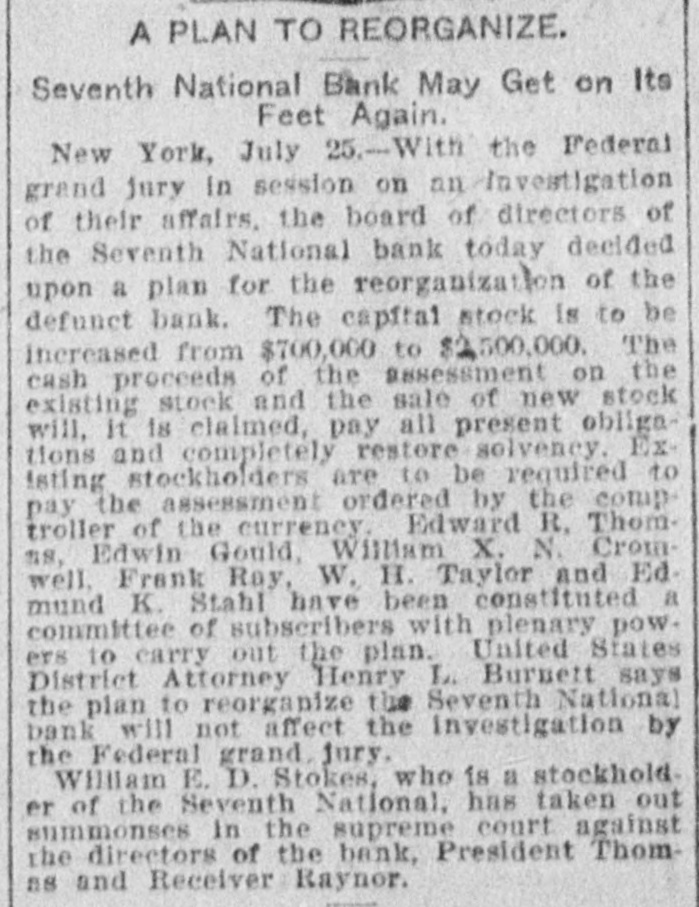
A PLAN TO REORGANIZE
Seventh National Bank May Get on Its Feet Again. New York, July 25.-With the Federal grand jury in session on an Investigation of their affairs, the board of directors of the Seventh National bank today decided upon a plan for the reorganization of the defunct bank. The capital stock Is to be increased from $700,000 to $2,500,000. The cash proceeds of the assessment on the existing stock and the sale of new stock will, It is claimed, pay all present obligations and completely restore solvency. ExIsting stockholders are to be required to pay the assessment ordered by the comptroller of the currency. Edward R, Thomns, Edwin Gould, William X. N. Cromwell. Frank Roy, W. H. Taylor and Edmund K. Stahl have been constituted a committee of subscribers with plenary pow. ers to carry out the plan. United States District Attorney Henry L. Burnett says the plan to reorganize the Seventh National bank will not affect the investigation by the Federal grand, jury. William E. D. Stokes, who 18 a stockhold. er of the Seventh National, has taken out summonses in the supreme court against the directors of the bank, President Thomns and Receiver Raynor.
16.July 29, 1901The Jersey City NewsJersey City, NJ
Click image to open full size in new tab
Article Text
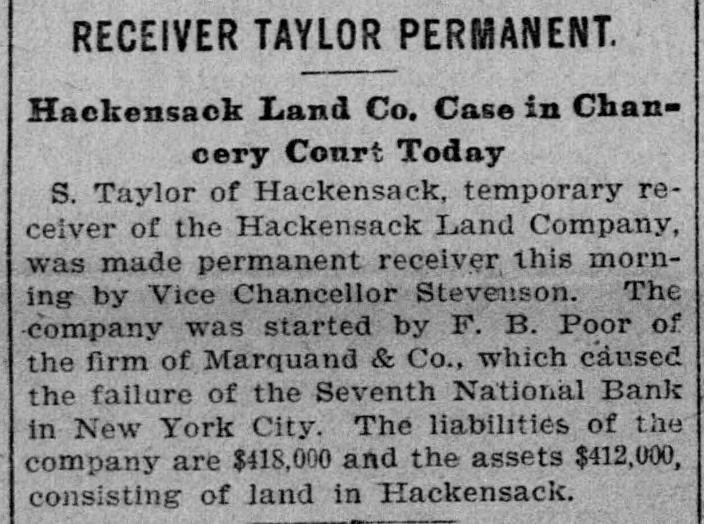
RECEIVER TAYLOR PERMANENT
Hackensack Land Co. Case in Chancery Court Today S. Taylor of Hackensack, temporary receiver of the Hackensack Land Company, was made permanent receiver this morning by Vice Chancellor Stevenson. The company was started by F. B. Poor of the firm of Marquand & Co., which caused the failure of the Seventh National Bank in New York City. The liabilities of the company are $418,000 and the assets $412,000, consisting of land in Hackensack.
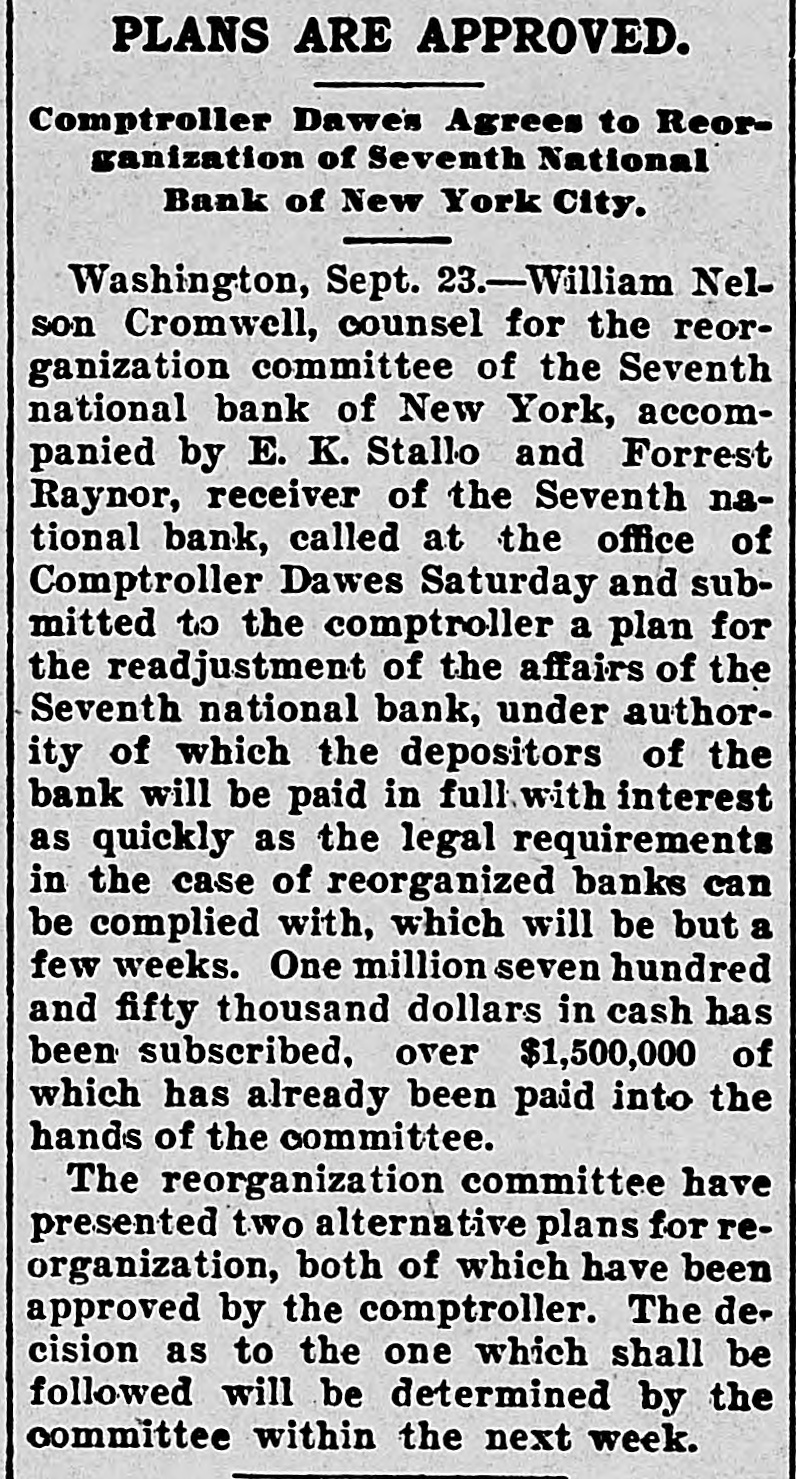
Comptroller Dawes Agrees to Reorganization of Seventh National Bank of New York City. Washington, Sept. 23.-William Nelson Cromwell, counsel for the reorganization committee of the Seventh national bank of New York, accompanied by E. K. Stallo and Forrest Raynor, receiver of the Seventh national bank, called at the office of Comptroller Dawes Saturday and submitted to the comptroller a plan for the readjustment of the affairs of the Seventh national bank, under authority of which the depositors of the bank will be paid in full with interest as quickly as the legal requirements in the case of reorganized banks can be complied with, which will be but a few weeks. One million seven hundred and fifty thousand dollars in cash has been subscribed, over $1,500,000 of which has already been paid into the hands of the committee. The reorganization committee have presented two alternative plans for reorganization, both of which have been approved by the comptroller. The decision as to the one which shall be followed will be determined by the committee within the next week.
18.November 12, 1901Arizona RepublicanPhoenix, AZ
Click image to open full size in new tab
Article Text
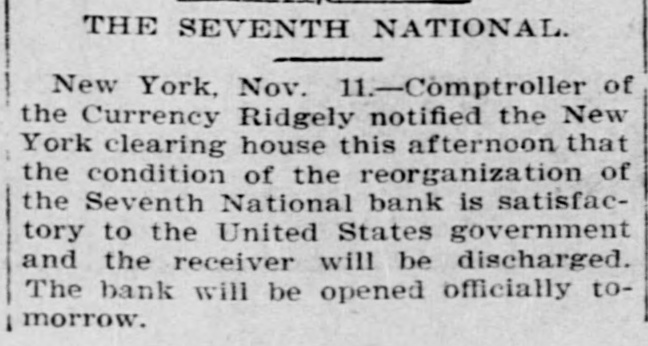
THE SEVENTH NATIONAL
New York, Nov. 11.-Comptroller of the Currency Ridgely notified the New York clearing house this afternoon that the condition of the reorganization of the Seventh National bank is satisfactory to the United States government and the receiver will be discharged. The bank will be opened officially tomorrow.
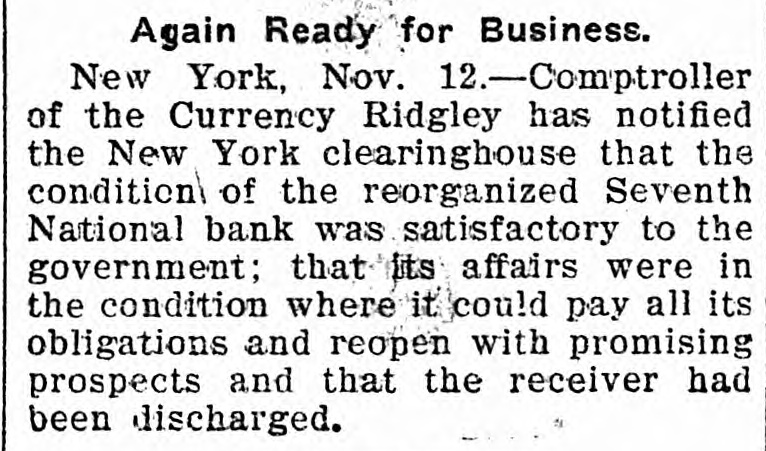
New York, Nov. 12.-Comptroller of the Currency Ridgley has notified the New York clearinghouse that the condition of the reorganized Seventh National bank was satisfactory to the government; that its affairs were in the condition where it could pay all its obligations and reopen with promising prospects and that the receiver had been discharged.
20.November 12, 1901The Seattle StarSeattle, WA
Click image to open full size in new tab
Article Text
PEN AGAIN Seventh National Bank Resumes Business New York, Nov. 12.-After a suspension of over four months, the Seventh National Bank opened for business this morning. While using' its old name the officials of the bank are entirely changed. Edwin Gould is the new president.
21.November 12, 1901The Butte Inter MountainButte, MT
Click image to open full size in new tab
Article Text
NEW YORK
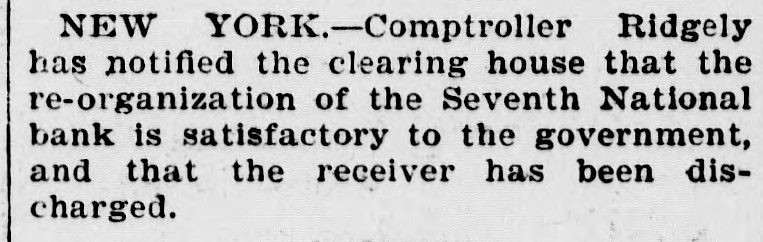
-Comptroller Ridgely has notified the clearing house that the re-organization of the Seventh National bank is satisfactory to the government, and that the receiver has been discharged.
22.November 12, 1901The Salt Lake HeraldSalt Lake City, UT
Click image to open full size in new tab
Article Text
Bank to Open Today
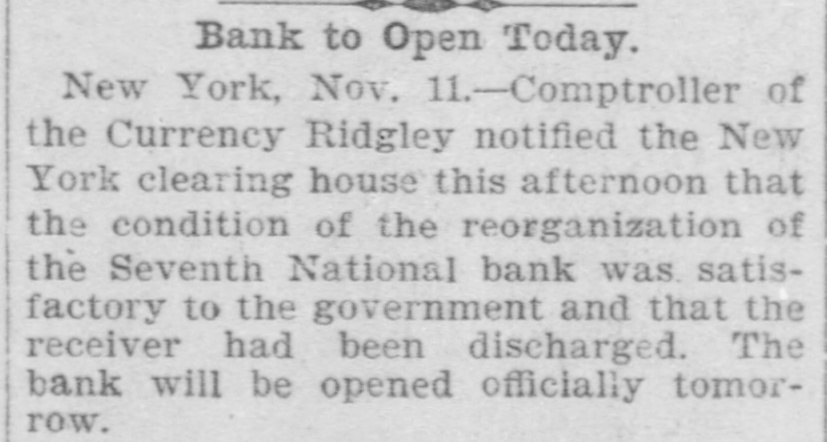
New York, Nov. 11.-Comptroller of the Currency Ridgley notified the New York clearing house this afternoon that the condition of the reorganization of the Seventh National bank was. satisfactory to the government and that the receiver had been discharged. The bank will be opened officially tomorrow.
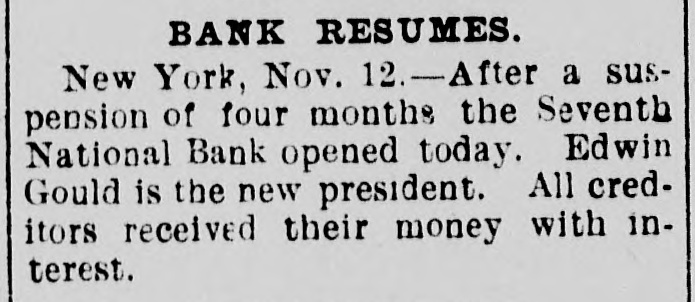
New York, Nov. 12.-After a suspension of four months the Seventh National Bank opened today. Edwin Gould is the new president. All creditors received their money with interest.
Bank runs are almost always and everywhere a deterioration of bank fundamentals.
But not for you.
You are the measure-zero exception: great fundamentals, solid bank, and yet the Diamond Dybvig fairy spread its rumor. Depositors woke up. Your collateral was not prepositioned. The Clearinghouse had it for you.
Do not pass Go. Do not collect $200. Go directly to jail… or worse.