9939. Minnesota Savings Bank (St Paul, MN)

Bank Information

Episode Type
Run → Suspension → Closure
Bank Type
savings bank
Start Date
January 4, 1897
Location
St Paul, Minnesota (44.944, -93.093)

Metadata

Model
gpt-5-mini
Short Digest
bffac04e

Response Measures

Partial suspension, Full suspension, Books examined

Other: Later criminal investigations and receivership/assigneeship with disputed assignee appointment.

Description

News in early January 1897 describes a run on the Minnesota Savings Bank (connected to failures of Germania/Allemania) and the bank initially taking advantage of the 60-day notice rule. Later reports (mid-Jan 1897) state the Minnesota Savings Bank suspended payment and an assignee/receivership followed; subsequent articles describe receivers, legal actions, and permanent winding up. Therefore sequence is run -> suspension -> permanent closure/receivership.

Events (3)

1. January 4, 1897 Run
Cause
Local Banks
Cause Details
Run triggered by panic from the suspension/closure of other St. Paul banks (Germania, Allemania, West Side); depositors rushed other banks including Minnesota Savings.
Measures
Invoked sixty-day (60-day) notice rule to delay withdrawals; required notice of withdrawals per by-laws.
Newspaper Excerpt
There was also a run on the Minnesota Savings bank, but the bank saved itself by means of the 60 day notice law.
Source
newspapers
2. January 5, 1897 Receivership
Newspaper Excerpt
The Minnesota Savings Bank ... assigned to William Bickel (assignee) / discussion of assigneeship and later receivers and receivers' actions described in subsequent reports and investigations into the bank's affairs and receivership testimony in April 1897 indicates formal receivership followed suspension and assignment issues were in dispute. (Articles Jan 5–Apr 7, 1897.)
Source
newspapers
3. January 18, 1897 Suspension
Cause
Local Banks
Cause Details
After runs and continued withdrawals and the general local banking panic following failures (Germania, Allemania, West Side), the bank suspended payments (liabilities reported ~ $230,000).
Newspaper Excerpt
At St. Paul the Minnesota savings bank suspended payment with liabilities of $230,000.
Source
newspapers

Newspaper Articles (22)

Article from Daily Camera, January 4, 1897

Click image to open full size in new tab

Article Text

Another St. Paul Failure. St. Paul, Jan. 4.-The West Side bank closed its doors today. Capital $100,000, assets $150,000, deposits $113,000. In the three St. Paul banks that closed today the state had deposited to the amount of $50,000, the county $42,000 and the city $221,000. There was also a run on the Minnesota Savings bank, but the bank saved itself by means of the 60 day notice law."


Article from New-York Tribune, January 5, 1897

Click image to open full size in new tab

Article Text

THREE ST. PAUL BANKS CLOSE. WEAKENED BY STEADY WITHDRAWALS. A RUN ON THE MINNESOTA SAVINGS BANK FORCED IT TO TAKE ADVANTAGE OF THE SIXTY-DAY NOTICE CLAUSE. St. Paul, Minn., Jan. 4.-The Germania Bank of this city closed its doors this morning. Its capital was $400,000 with a surplus of $50,000. December 17 the loans and discounts amounted to $975,000 and its deposits to $1,091,968. The announcement was made by the officers of the bank that the institution had been assigned to Peter M. Kerst, who for the last year or two has been the cashier of the bank. The announcement stated that the action was taken after full consideration of all the phases of the situation, the directors having decided it was best for all concerned that they should close. The bank stood a run for nearly two weeks, its depositors beginning to withdraw their accounts at the time the Bank of Minnesota closed. on December 22. The Allemania Bank of this city closed its doors at noon to-day. The capital of the bank is $400,000: surplus, $50,000. Its statement December 17 showed as follows: Loans and discounts, $706,842: cash on hand, and due from other banks, $192,068: deposits, $602,305. It held on January 1 St. Paul City funds to the amount of $51,000 and State funds aggregatIng $35,302. The West Side Bank of St. Paul also closed its doors to-day. It cleared through the Allemania Bank, and the latter failure compelled it to close. It is a small concern. There was a heavy run on the Minnesota Savings Bank, which is intimately connected with the Germania Bank. As a result of the run the Minnesota Savings Bank has taken advantage of the sixty-day notice, The Germania, the Allemania and the West Side banks all did business as State banks. Every one depositors. and of them all of Each was them literally of will the reorganize three, pulled however, down as soon by is the solvent, as the machinery for that purpose can be put into use. The directors of the Germania met this evening and appointed a committee on reorganization. The New-York correspondent of the Germania Bank of St. Paul was the Hanover National Bank, at which It was said that whatever amount might be due from the Germania was amply secured. The Germania had carried a fair account with the Hanover. The Germania also had an account with the Bank of America, of New-York, to which It owed nothing. The New-York correspondent of the Allemania Bank was the Mechanics' National Bank, where it had a balance of less than $1,000. Its account was always a small one. The New-York correspondent of the Minnesota State Savings Bank is the Bank of America, with which it has an unimportant account. The New-York correspondent of the West Side Bank was the Third National Bank, where it had a credit balance. Its account was small.


Article from The Wichita Daily Eagle, January 5, 1897

Click image to open full size in new tab

Article Text

formerly resident of the Germania bank joining forces with Albert Scheffer of the Commercial to organize the new bank. Its last official statement, made on December 17, showed: Loans and discounts, $62,881,40; capital stock paid in, $400,000; undivided profits, less expenses, $58,764.*0; individual deposits, $329,789.27; interest certificates, $187,253.23. President Sheffer of the Allemania said at noon that they had been suffering from the panic, the failure being due to combined hoarding, and withdrawing of deposits. A crowd of depositors soon gathered, demanding their money, and at 11 o'clock it was decided to close at once. Owing to the excitement caused by the closing of the Germania and Allemania banks today, many depositors started after their money in one or two of the other bonks, the Minnesota Savings bank being the center of excitement. The president of the 'bank, William Bickett, Jr., is the son of the first vice-president of the Allemania, and this fact seem ed to turn the minds of the people that way. This morning the bank was opened for business, but at 3 o'clock was taking advantage of the rule allowing sixty days' notice before allowing withdrawals of deposits. THEN THE WEST SIDE. At a few minutes before 2 o'clock the West Side bank, organized in 1886, with a capital of $100,000, closed its doors. The president, F. Staples, told the Associated Press representative that the bank cleared through the Allemania and had its clearings returned today because of the closing of that bank. The West Side bank from the general shaky condition of financial affairs, closed. The West Side bank has not closed its doors finally, but in view of the panic, pending action by the directors. The bank is considered a strong, though small, institution and loss to depositors is not thought possible. The official statement of the West Side bank, made to the state bank examiner on December 17, is as follows: Total assets, $217,024.17; of this $150,0000 was in loans and discounts and $28,000 in real estate. The total deposits were 113,546. The furniture and fixtures represented $2,200 and bills re-discounted, $1,500. Public funds were on deposit in all three of the closed banks. The state had $10,546.05 in the Germania; $35,302.54 in the Allemania, and $3,346.63 in the West Side bank. The county treasurer had deposited $9,635.35 in the Germania; $26,215.36 in the Allemania, and $7,564.84 in the West Side bank. City Treasurer Horst had on deposit funds in the Germania, $49,793.82; in the Allemania, $151,456.56, and in the West Side bank $21,894.50. New York, Jan. 4.-The Hanover National bank is the New York correspondent of the Germania bank of St. Paul. The latter has been in the habit of carrying a fair account here, but it is stated that whatever indebtedness may be due the Hanover bank is amply secured. FAILURES OF MINOR NOTE. Mason ity, Iowa, Jan. 4.-The First City bank of Nora Springs has failed. An assignment was made to Byron Gamming. Cincinnati, O., Jan. 4.-E. C. Bailess, commission merchant, assigned to C. W. Scott. Assets $21,000. Liabilities, $37,000. Quincy, III., Jan. 4.-The wholesale and retail crockery store of H. Ridder & Co. failed today. Assets, $40,000; liabilities, $30,000.


Article from The Saint Paul Globe, January 5, 1897

Click image to open full size in new tab

Article Text

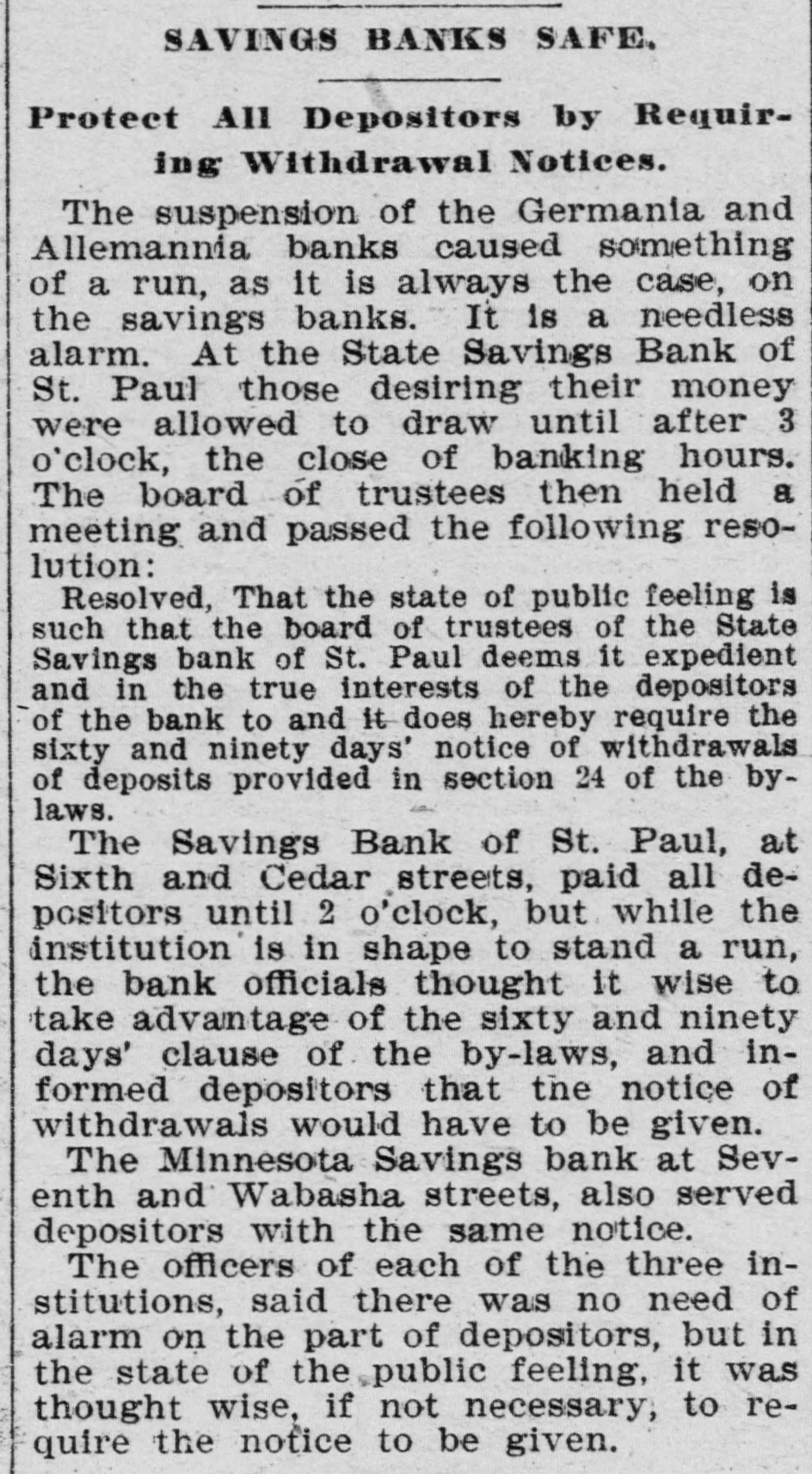
SAVINGS BANKS SAFE. Protect All Depositors by Requiring Withdrawal Notices. The suspension of the Germania and Allemannia banks caused something of a run, as it is always the case, on the savings banks. It is a needless alarm. At the State Savings Bank of St. Paul those desiring their money were allowed to draw until after 3 o'clock, the close of banking hours. The board of trustees then held a meeting and passed the following resolution: Resolved, That the state of public feeling is such that the board of trustees of the State Savings bank of St. Paul deems it expedient and in the true interests of the depositors of the bank to and it does hereby require the sixty and ninety days' notice of withdrawals of deposits provided in section 24 of the bylaws. The Savings Bank of St. Paul, at Sixth and Cedar streets, paid all depositors until 2 o'clock, but while the institution is in shape to stand a run, the bank officials thought it wise to take advantage of the sixty and ninety days' clause of the by-laws, and informed depositors that the notice of withdrawals would have to be given. The Minnesota Savings bank at Seventh and Wabasha streets, also served depositors with the same notice. The officers of each of the three institutions, said there was no need of alarm on the part of depositors, but in the state of the public feeling, it was thought wise, if not necessary, to require the notice to be given.


Article from Iowa State Bystander, January 8, 1897

Click image to open full size in new tab

Article Text

St. Paul Banks Closed. ST. PAUL, Jan. 5.-The Germania bank, with deposits of $1,091,968 and the Allemania bank. with deposits of $602,305. have suspended payment. The trouble was caused by runs. Later the West Side bank closed its doors, and when a run on the Minnesota Savings bank began the officials decided to take advantage of the rule requiring sixty days' notice before withdrawing deposits.


Article from Red Lodge Picket, January 9, 1897

Click image to open full size in new tab

Article Text

THREE MORE ST. PAUL BANKS. Two Were Large Institutions, the Other Was small. St. Paul, Minn., Jan. 4.-As a direct Minne- rethe closing of the Bank weeks ago, which sota, sult of two and created of started new distrust among depositors were a number of city banks not to be as strong as reputed runs on banks-the the that deposthree St. Paul the Allemania and of them national Germania, itors none wished, institutions, the doors Vest all Side, closely associated-closed their state today, one being in the hands of the asbank examiner and the others making signments. the time that had interv ened During closing of the Bank of Minne- to the Germania paid out sota, since the $225,000 today the frightened depositors, and early the directors concluded they would stop the drain and make an assignment to cashier, Peter M. Keerst. The Allemania bank, which, like the Germania, had a large clientage among and whose vice president the been vice president a the had Germans, formerly target of for Germania, then became the the run. Crowds gathered about the doors lively and fairly fought for a place window. in before the paying teller's such line bank officials realized fully what on The run meant, and promptly called a Bank Examiner Kenyon to take posses- now sion of the bank, and that official is in charge. The West Side bank, a small but possi- Alstronger bank, cleared through the rebly lemania, and today its clearings were turned by the latter institution. Follow~ this there was a decided run inaugu- this ing on the bank, and at 2 o'clock the rated the bank officials closed afternoon and called a meeting of the directors decisdoors decide what action to take. Their to was apparent late in the afternoon, to S. ion filed a deed of assignment H. president of the when Staples, they bank. tied Considerable public money is up m- in three institutions, but there is an in the ple the supply for all immediate needs other banks of the city. The assignment of the Germania and Side banks has brought up a laws some- of West new question in the banking called upwhat state, and the courts will be examiner the settle it. The state bank that on to their right to assign, holding turned doubts should have, under the law, they their assets to him. The attorney acover intimates that he will bring an general tion to test the matter as soon as papers be issued. of can the day numerous reports curDuring among the other banks were of trouble and a few banks suffered runs rent, or lesser intensity, but the that savings algreater were protected by the law before banks them to require 60 days' notice national lows out deposits; and the have no banks paying are in strong condition, and fear of anything of the sort. The Germania Bank. Germania bank was a state insti- The The and had a capital of $400,000. tution official statement of the condition and of last bank, December 21, gave loans resources, I discounts the as $975,420.53; total cap 1 Among the liabilities were undivided $1,625,788. stock, $400,000; surplus and subject ital $58,797; individual deposits certificates of 1 profits, check, $345,191; demand to deposit, $7899; time certificates of deposit, s 3633,019. Germania bank has been organized RamS The ex-Governor Alexander Wilmany being years, a long time president, and say Bickell, cashier. When the governor but liam Mr. Bickell became president, vice f retired, spring Bickell retired, becoming Alle2 last of the newly organized Gusmania president bank. He was succeeded by tav Willius. d Willius told an Associated President representative that the closing was and Press result of an unreasonable panic, the bank would be opened for business usua as the soon as the people regained their cool sense. it bank, as a result of the panicky in o The had paid the depositors $335,000 he fully 1 feeling, last nine days. Willius said by expected the to have the bank reopened the last of March. il The Allemania. r Allemania bank has a capital that of and a clientage similar to o The Allemania was $400,000, the The Germania. of the organ Com last year, as a successor G. ized mercial, William Bickell, formerly forces pres e ident of the Germania, joining Commercial with Albert Scheffer, of the last offl organize a new bank. The show y cial to statement made, December undivided 17, e loans and discounts, $706,842; individua e ed less expenses, $508,764; certificates profits, deposits, $329,789; interest cil n $187,253. President Scheffer, of the Allemania combine n the failure was due to of de twithdrawal said of deposits. A crowd the at positors gathered today demanding decide money, and at 11 o'clock it was to close. Runs on Other Banks. n, to the excitement caused by Alle th Owing of the Germania and the afte ht closing mania banks, many depositors went banks 'S. en their money in one or two other th the Minnesota Savings bank being
Article from The Seattle Post-Intelligencer, January 19, 1897

Click image to open full size in new tab

Article Text

BUSINESS TROUBLES. Heavy Real Estate Investments Ruin a Kentucky Bank. NEWPORT, Ky., Jan. 18.-The First National bank closed this morning. Heavy investments in real estate in this city is one cause given. The integrity of the officers is such that no suggestion of wrong found credence. Cashier T. B. Youtzey has been at the bank since its organization in 1875. President John Trapp, who was elected last fall, is a resident of Dayton, Ky., and one of the wealthiest men in the county. The directors were in session all day Saturday, on which day the bank opened with only $7,500 in its vaults. At the meeting Cashier Youtzey resigned and his resignation was promptly accepted. CINCINNATI, Jan. 18.-No excitement was created in Cincinnati by the Newport bank failure. Most of the banks here claim to have known that the bank has been in straightened circumstances for some time. It is said that President John Trapp, who was elected president Isat week, is sick at home in consequence of the failure and cannot be seen. Cashier Youtzey is also indisposed, and in fact, none of the officers can be seen. Mr. Trapp is said to have a deposit of $15,000, in the bank, to hold $11,000 of the stock and to be indorser for Cashier Youtzey to the amount of $60,000. Congressman Berry also has a large interest in the bank, being interested with the cashier in a land company. It is charged that heavy loans to Youtzey are among the causes of the failure. LOUISVILLE, Jan. 18.-The German National bank closed today. The capital stock is $261,500, with a surplus of $31,000. The bank has long been considered unsafe. President McKnight says depositors will be paid in full and the bank reorganized. BOSTON, Jan. 18.-The Boston stock and grain exchange has closed. ST. PAUL, Jan. 18.-The Minnesota Savings bank closed tais morning. The assets amount to about $250,000; liabilities, $230,000. The bank had on deposit $10,000 of the city of St. Paul and $2,200 of the funds of Ramsay county. NEW YORK, Jan. 18.-The failure of Louis Nielson has been announced through the Consolidated stock exchange. The suspension is considered unimportant and is attributed to short Sugar and St. Paul. CHICAGO, Jan. 18-The Illinois Paper Company went into the hands of a receiver today. The assets are about $65,000; liabilities, $60,000.


Article from River Falls Journal, January 21, 1897

Click image to open full size in new tab

Article Text

Off the New Orleans coast the steamship Eva, with a party of six aboard, was lost. At Ocala, Fla., the Merchants' national bank suspended with liabilities of $145,000. Republicans in the Oregon legislature nominated John H. Mitchell to succeed himself in the United States senate. Flames de: troyed the plant of the Fox Paper company at Crescentville. O., the loss being $150,000. Near Monterey, Ky., Jennie Browning, with her baby in her arms, jumped into the Kentucky river and both were drowned. Two farmers, Jonas Hackensmith and Punch Evans, living near Dover, Mc., shot each other fatally as the result of a family feud. Senator Sherman announces that he has accepted the state portfolio. In Wisconsin the semi-centennial plan of celebrating in 1898 the fiftieth anniversary of statehood has been shandoned. Fire destroyed a portion of the Buckner orphans' home in the suburbs of Dallas, Tex., and five boys peri hed and a number of others were injured Flames wiped out the business portion of Milan, Mo. Further advices say that 15 children perished in the fire that destroyed the Buckner orphans' home in Dallas, Tex. Crazed from cigarette smoking Benjamin L. Davis, proprieter of the Tabbard inn at Rugby, Tenn., cut his wife's throat with a razor and then shot himself to death. The Wheeling, Lake Erie & Pittsburgh Coal company failed in Cincinnati for $1,056,000. and the Wheeling & Lake Erie Railway company went into the hands of receivers with liabilities of $320,000. On the Iron Mountain & Texas Pacific route a train was thrown from the track by wreckers at Forest, Tex., and the engineer and express messenger were fatally injured. The doors of the Bank of Conway, Mo., were closed. In Indianapolis the Commercial Wheel company failed for $100,000. At their annual meeting in Columubs, 0., the United Mine Workers of Ameriea elected as president M. D. Batchford, of Ohio. At Flat Rock, W. Va., Lew Grim shot and fatally injured three outlaws W ho were trying to break upa dance. The only female national bank cashier in the United States, Mrs. Sarah Dick, was for the twenty-fourth consecutive time chosen to that position in the First national bank at Huntington, Ind. At Louisville, Ky., the doors of the German national bank were closed with liabilities of $260,000. The doors of the First national bank of Newport, Ky, were closed with liabilities of $200,000. Tillie Anderson made 41 miles 10 laps in two hours, which is a new world's record in the female six-day bicycle race at Indianapolis. At St. Paul the Minnesota savings bank suspended payment with liabilities of $230,000. At Garrett, Ind., H. N. Coffinberry, a banker, charged with forgery and em* bezzlement, fell dead from heart disease as the sheriff was about to arrest him. At Little Rock Dan W. Jones was inaugurated as governor of Arkansas. A windstorm at Huntington, Ind., blew the roof off the county infirmary and damaged other buildings. At Carson the Nevada legislature convened in eighteenth session. At Atlanta, Ga., Sam Palatka confessed that he caused the great Cahaba (Ala.) bridge disaster, which sent 35 persons to death and wounded a score more.


Article from The Saint Paul Globe, January 21, 1897

Click image to open full size in new tab

Article Text

CHANGE OR NO CHANGE? Minnesota Savings Bank Assigneeship Not Entirely Satisfactory. There seems to be a slight disagreement of opinion between the depositors of the suspended Minnesota Savings bank and William F. Bickel, the president of the institution as to the advisability of making a change in the person of the assignee. Mr. Bickel, who succeeded Congressman-elect Fred C. Stevens as president of the bank, about three days before the concern suspended, holds that his father, Willim Bickel, to whom the bank assigned, is just the person for the place. William F. Bickel argues that his father, being conversant with every phase of the banking business and having a wide acquaintance with the depositors, should not be custed, but allowed to wind up the affairs of the institution. He urges as another reason why his father should be retained that the appointment of a receiver for the bank would fritter away the assets needlessly, while under the direction of his father the administration of the assigneeship would cost little or nothing. The reason advanced by the president of the suspended institution for retaining the present assignee do not meet with the expressed views of a large number of the depositors. That the assignee is conversant with every phase of the banking business is admitted by the depositors, but this made the strongest point why a new man should be selected. They appreciate, or say they do, the interest taken by the president of the bank in not having the money of the depositors frittered away in high priced receivers. They fail, however, to see why a new assignee would have to be paid any more money for the discharge of the duties than the one incharge of the affairs of the bank. J. M. Hawthorne, who has been retained by a number of the depositors to look after their interests stated that he had no animus in the matter but was governed solely by the interests of his clients. He had nothing to urge against the honesty of William Bickel, and beleived him fair and square. His appointment as assignee, his son being one of the officers of the bank, was in his opinion certainly injudicious. It had been Mr. Bickel's misfortune to have been connected with several banks that had suspended and this fact had its effect on the public, and especially the depositors of the Minnesota Savings bank. The affairs of the suspended institution, he had been informed, were in bad shape financially and it would require the very best management in order that the depositors would secure their money. For these reasons the depositors, at least those he had consulted, were in favor of a change in the person of the assignee. The appointment of Gen. Moses E. Clapp as assignee, he thought would be satisfactory to all concerned. Mr. Clapp, he said, had called on him and stated that the books of the bank were open any time for his Inspection. This Mr. Hawthorne said was an extremely fair proposition. The meeting of the depositors to be held in his office this evening, he thought, would develop a line of proceedings looking toward an application to the court for the appointment of another assignee Intaddition to the meeting of depositors called for this evening at Mr. thorne's office, notice of another meeting to be held at the office of M. J. in the Washburn building, ait this afternoon is also announced Costello said yesterday


Article from The Ely Miner, January 27, 1897

Click image to open full size in new tab

Article Text

DOMESTIC. The visible supply of grain in the United States on the 18th was: Wheat, 52,459,000 bushels; corn, 21,522,000 bushels; oats, 13,621,000 busbels; rye, 3,443,000 bushels; barley, 3,877,000 bushels. Mrs. Sarab Dick, the only female national bank cashier in the United States, was for the twenty-fourth consecutive time chosen to that position in the First national bank of Iluntington, Ind. The doors of the German national bank at Louisville, Ky., were closed with liabilities of $260,000. The First national bank of Newport, Ky., closed its doors with liabilities of $200,000. In the female six-day bicycle race at Indianapolis Tillie Anderson made 41 miles 10 laps in two hours, which is a new world's record. H. N. Coffinberry, a banker at Garrett, Ind., charged with forgery and em bezzlement, fell dead from heart disease as the sheriff was about to arrest him. Fire destroyed the business portion of the village of Staffordville, Conn. A heavy windstorm at Huntington, Ind., blew the roof off the county infirmary and damaged other buildings. The Minnesota savings bank at St. Paul suspended payment with liabilities of $230,000. It is announced authoritatively that ex-Gov. Long, of Massachusetts, has been tendered and has accepted the secretaryship of the navy in Mr. McKinley's cabinet. Arthur Palmer, of Mamaroneck, N. Y., during a fit of insanity shot his mother, his sister Gertrude and his brother Leonard, and all were in a critical condition. The Nevada legislature convened in eighteenth session at Carson. The Boston stock and grain exchange, with offices in nearly all the principal New England cities, has closed up business. Sam Palatka has confessed at AtJanta, Ga., that he caused the great Cahaba (Ala.) bridge disaster, which sent 35 persons to death and wounded a score more. A distinct earthquake shock was felt at Red Bud, III. Hunters on private shooting grounds near Crown Point, Ind., were fired into by a watchman and Theodore Prott, Frank Kosti,Alvin Bothwell and Charles Prott were fatally wounded. The third session of the Fourteenth parliament of the Victorian era opened in London by royal commission with the usual formality. S. E. Carothers, aged 52, proprietor of the National hotel at McKeesport, Pa., was found drowned in a shallow well. Fred A. Kueh, of Arlington, S. D., freshman at the University of Wisconsin in Madison, was drowned while ice boating on Lake Mendota. Rev. Thomas J. Conaty, D. D., was installed as rector of the Catholic University of America in Washington. North and east Texas had their first snow of the present winter and the fall was the heaviest for years.


Article from The Saint Paul Globe, February 5, 1897

Click image to open full size in new tab

Article Text

REPORT THAT A CLOUD HANGS OVER THE MINNESOTA SAVINGS BANK. # FRED STEVENS DENIES IT. WILLIAM F. BICKEL ALSO DE- CLARES THE CHARTER IS WHOLE AND ENTIRE. TELLS WHEREIN THE VALUE LIES. Has Had Offers From St. Paul Bankers for It-Officers Have Plans for Reorganization. A number of the depositors of the Minnesota Savings bank, who are not at all friendly to the present assignee or the officers of the suspended bank, claim that the charter of the institution has been clouded and that other than the bank officers have a claim on part of it. Otto Silberman, who has been connected with meetings of the depositors, at which charges have been made against the manner in which affairs of the bank were conducted, is the authority that in 1895 the charter under which the Minnesota Savings bank was operated had been sold. Mr. Silberman gave the name of a prominent attorney as his authority for the statement, and this gentleman was interviewed as to the truth of the story. He was not at all talkative about the matter, but said that a client of his had secured a haf interest in the charter of the bank. Just what amount had been paid for the half interest, or whether it was in the nature of a loan the attorney refused to say. He intimated, however, that at the proper time the matter would be made public, and until that time he had nothing to say regarding the transaction. William Bickel, the assignee, was out of the city, engaged, so it said, in affairs relating to the bank. Congressman F. C. Stevens, who, until recently, was president of the Minnesota Savings bank, and who is one of the trustees of the concern, was interviewed at his home in Merriam Park last night concerning the alleged transfer of an interest in the bank's charter. He denied that there was any truth in the story, and said that the report was a serious injustice to the officers of the bank. "Such a step has never been taken to my knowledge," he said, "and, as I am an officer of the bank, I should be aware of any such transaction. Until a few weeks ago I was president of the bank, but resigned to give all of my time to my public duties in Washington. My resignation as a trustee was also handed in some time ago, and was accepted, but, as my successor failed to properly qualify by filing a bond with the secretary of state, I am still an officer of the bank. The assignment of all of the bank's charter, all or any portion of it, would not be done except with the knowledge and consent of the trustees. It would be necessary to go before the supreme court to complete such a transaction, and I am certain nothing of the kind has ever been done. I am confident that the rumor is false. Certainly, I never heard anything of it, if there was any sale or transfer of the charter to any one by Mr. Bickel or any one else." William F. Bickel, vice president and cashier of the bank, said last night when seen by a reporter for the Globe, at the residence of his father, William Bickel, 231 West Ninth street. the charter was all right. It had never been sold, nor any part of it, and talked at length on its value. It is valuable, he said, for the reason that it allowed the officers of the bank to divide the profits among themselves instead of the depositors. The charters under which the present savings banks operate limits the salaries of officers to not more than $5,000, and the surplus profits are divided for the benefit of the depositors. That is the big difference in charters. Several St. Paul bankers, he said, had endeavored to purchase the charter of the Minnesota Savings bank, but without avail. He himself purchased the charter from Senator Daniels, of Rochester, Minn.,


Article from The Saint Paul Globe, February 12, 1897

Click image to open full size in new tab

Article Text

TWO TO PICK FROM CHOICE OF PLANS FOR THE REORGANIZATION OF MINNESOTA SAVINGS BANK TO BE OFFERED DEPOSITORS. PRESENT OFFICERS THINK THEY CAN REOPEN THE INSTITUTION VERY SOON. COMMITTEE'S REPORT HANGS FIRE. May Not Be Ready for a Week Yet0. Silberman Is Heard From. A report was circulated yesterday that the officers of the Minnesota Savings bank were taking steps with a view of reorganizing the bank. Will1am F. Bickel seen last evening said the report was correct, and that signatures of depositors were being secured with this end in view. The officers of the bank, he said, had prepared two plans, both of which were being submitted to depositors. The plan which first received the signatures of 100 of the depositors would be regarded as the more acceptable and would be taken as the one to submit to the depositors for their approval. Nothing, he said, would be determined upon until a conclusion, such as outlined above, had bsen reached. Mr. Bickel stated that his father, the present assignee of the bank, was ready and willing to step down and out as soon as his successor had been agreed upon by the de positors. Notwithstanding statements to the contrary, Mr. Bickel said the charter of the bank was still whole and entire, and was a valuable part of the assets of the suspended institution. The committee of seven appointed at a general meeting of the depositors to investigate as to the condition of the assets of the bank are still at work, and hard at work. A member of the committee seen yesterday said no one could have any idea of the mass of detail that had to be gone through in order to make an accurate and full report as to the condition of affairs. The report, the gentleman said, would probably be ready in about a week, and would be submitted at a general meeting of the depositors. Otto Silberman, who has taken great interest in the matter of securing the removal of the present assignee, writes to the Globe from Dubuque, Io., at which point he has been called on busi. ness. The following is Mr. Silberman's epistle: As Mr. George C. Lambert, chairman of the committee elected at the first meeting of the Minnesota Savings bank depositors, who wished the removal of Mr. William Bickel, is only working in the opposite direction, personally and through an evening paper and by bringing depositors to the assignee's office to sign for retaining William Bickel as assignee, I would like to call Mr. Lambert's attention that he personally and unsolicited had his name for himself also as trustee for the Ramsev County Abstract company the


Article from New-York Tribune, April 8, 1897

Click image to open full size in new tab

Article Text

'TWAS A NEST OF BANK WRECKERS. SOME UNPLEASANT REVELATIONS IN THE TWIN CITIES. St. Paul, April 7.-The joint legislative committee investigating insolvent banks has made public the testimony secured during the last two months. The committee investigated banks in St. Paul and Minneapolis, and some of the disclosures are sensational in the extreme. As to the Bank of Minnesota, W. H. Lightner, one of the receivers, said that on October 7 $135,606 was due the bank from the Fort Dearborn National Bank, of Chicago. This balance was Incorrect. The accounts between these two banks were falsified to the extent of $100,000. At the time of the failure of the bank there was owing to it by the bank officials the following sums: William Dawson, sr., about $90,000; William Dawson, Jr., $59,950; R. A. Smith. $50,000. has since paid $35,000. William Dawson, jr., was guarantor of $53,000. of which $30,000 was overdrawn. As to the cause of the failure of the bank. it was testified that William Dawson, sr., owed it $281,000. As to the Scandia Bank, of Minneapolis, the committee says that its failure, according to the evidence, was honest, and it may yet pay in full. Taking up the case of the Washington Bank. of Minneapolis, the committee says that It went under for want of paid-up capital, direct and indirect loans to its officers and from a lack of supervision. Dwelling upon the affairs of the Allemania Bank, of St. Paul, the report says that the assets or a large portion of them are worthless. The directors were heavy borrowers and were guilty of misstatements. Of the affairs of the Minnesota Savings Bank, of St. Paul, directly or incirectly the committee says the officers were borrowers to an amount more than double the capital stock. The schedules of assets and liabilities of William Dawson, jr., insolvent cashier of the Bank of Minnesota, whose failure started the crash in financial circles here three months ago, have been filed in the District Court. The assets are placed at $239.168 78, and the liabilities $868,452 47. The face value of the assets is much higher. By far the largest portion of Mr. Dawson's direct liabilities consists of individual notes. A few of these notes are secured. but the larger portion of them are either unsecured or secured only by the indorsement of William Dawson, sr., ex-president of the defunct bank.


Article from The Times, April 8, 1897

Click image to open full size in new tab

Article Text

SENSATIONAL DISCLOSURES MADE A Legislative Committee Investigating Bank Failures. St. Paul, Minn., April 7.-The jointlegislative committee investigating insolvent banks in this city and Minneapolis has made public the testimony secured during the past two months. Some of the disclosures are highly sensational. As to the Bank of Minnesota, of which William Dawson, Sr., was the president, and William Dawson, jr., cashier, W. H. Lightner, one of the receivers, stated that on October 7 $135,606 was due to the bank from the Fort Dearborn National Bank of Chicago. The balance, he said, was incorrect, accounts between these two banks being falsified to the extent of $100,000. At the time of the failure of the bank there was owing to it by the officials the following sums: William Dawson, sr., about $90,000; William Dawson, jr., $59,950: R. A. Smith, $50,000, of which he has since paid $35,000. In addition to that, William Dawson, jr., was guarantor of $53,000, of which $30,000 was overdrawa. As to thecause of the failure of the bank, it was testified that William Dawson, sr., owed it $281,000. The schedules of assets and liabilities of William Dawson, jr., have been filed in the district court. The assets are placed at $239,168.78, and the liabilities, $868,452.47. The face value of the assets is much higher. By far the largest portion of Mr. Daw. son's direct liabilities consists of in dividual notes. A few of these are secured, but most of them only by the indorsement of William Dawson, sr. As to the Scandia Bank, of Minneapolis, the committee states that its failure, according to the evidence, was honest, and it may yet pay in full. The committee says that the Washington Bank, of Minneapolis, went under for want of paid-up capital, direct and indirect loans to its officers, and from a lack of supervision. Dwelling upon the affairs of the Allemania Bank, of St. Paul, the report says that the assets, or a large portion of them, were worthless. The directors, it states, were heavy borrowers, and were guilty of misstatements. As to the affairs of the Minnesota Savings Bank, of St. Paul, the committee states the officers were borrowers. directly or indirectly. to an amount more than double the capital stock.


Article from The Madison Daily Leader, May 1, 1897

Click image to open full size in new tab

Article Text

Failed to Secure Bondsmen. Sr. PAUL, May 1. - William F. Bickel, president of the suspended Minnesota Savings bank, was arrested on a charge of grand larceny. This is the third time Rickel has been arrested since the bank failed and as he did not secure the necessary bond he was locked up.


Article from The Saint Paul Globe, May 8, 1897

Click image to open full size in new tab

Article Text

NOTES MARKED PAID REPORTED THAT THE GRAND JURY WAS INVESTIGATING SOME PAPER OF MINNESOTA SAVINGS BANK. ONE NOTE SAID TO HAVE FOUND ITS WAY TO MANKATO. HAS NOT YET BEEN TAKEN UP. Other Matters Which the Body Now Examining Bank Affairs Are Said to Have Considered. It was reported last night that the grand jury spent most of its time yesterday investigating the course of a number of notes which were held by the Minnesota Savings bank. One of these notes, it was reported, was for $150, and had been drawn payable in ninety days. It was said that the grand jury was told that the books of the bank showed the note had been marked paid, but Clarence Saulspaugh, who is said to have been a witness, told the grand jury that he had seen the note in Mankato, and that it was sent there to raise money at a bank at that place. It was also said the grand jury was told that, if they found a note had been marked paid and that it had not been actually paid but sent out for the purpose of raising money, or otherwise disposed of, that the crime of marking the note "paid" was an act of forgery on the part of somebody. Two other notes were reported to have gone the same way, but they did not find their way to Mankato. The grand jury convened promptly at 2:15 p. m. yesterday and remained in session until 4:30, when they adjourned until 2:15 p. m. Monday. In addition to Mr. Saulspaugh, P. D. Street, the Minnesota Savings bank note teller, was called in before, the jury. Considerable attention was also bestowed upon the Bank of Minnesota, as Receiver Frank A. Seymour was in attendance as was also Assistant State Bank Examiner Lonegren. MICHAELS' BAIL MONEY. Judge Kelly Says Clerk Conroy Is Responsible for It. The clerk of the municipal court and the sureties on his bond are liable absolutely for public moneys deposited with the clerk the


Article from The Sauk Centre Herald, May 27, 1897

Click image to open full size in new tab

Article Text

# OVERDOING IT. THE fact that the machinery of the criminal law has not been so frequently or actively set in motion against offenders in high places, and especially against those who have taken criminal advantage of their opportunities as officers of banking intitutions to defraud those whose confidence they have enjoyed, does not justify such previous activity as is being shown at present in Ramsey county. For years past fraudulent relations of law have been treated as matters personal between the bank and its depositors. Under the pressure of public opinion outraged by the extent and frequency of there "irregularities" prosecuting officers and investigating juries have been spured into an activity more aggressive than wise. They have taken the extreme view that all bank officers are thieves, and have sought whomthey might indict, with the result of defeating their own purpose. They are creating a sympathy by their excessive methods, which will lead many if not most of the people to believe that the grand jury is an instrument for persecution rather than prosecution, and the guilty will get an undeserved share of this sympathy so awakened. The last case in St. Paul is to the point: Congressman F. C. Stevens on ex parte bestowing, and in face of the fact that the prosecuting attorney had been pointedly advised of the true state of affairs which he could easily have verified, was indicted for embezzling $8,046 from the Minnesota Savings Bank, the amount being fixed by adding together all apparent overdrafts for years, ignoring credits which overbalance them. The books of the bank show an overdraft of $400 only, and Mr. Stevens claims credits of more than $5000, and felt assured that his account stood nearly that sum to his credit when the bank assigned. And when notified of the apparent overdraft by the receivers he forthwith made the account good awaiting the fuller investigation by the receivers when the true condition of affairs would be ascertained, and he claims, and the claim is not disputed, that the bank owes him about $5,000. But this does not seem suficient persecution. Mr. Stevens declined to set up any techinical defense to the indictment, but demands immediate trial upon the merits of the case, and the courts was inclined to set the case for immediate trial, but the county attorney has succeeded in getting it postponed. All who knew Mr. Stevens to be the high minded man that he is, wili share in his indignance at the outrageous treatment accorded him. As a whole, St. Paul has reason to be proud of the condition of her streets in the residence districts. For instance, Summit Ave., and many other handsome thoroughfares on the hill are delightfully if not ideally excellent. But one has not to go far from the "most beautiful avenue in the world," to find conditions different. For instance, if one attempted to get to Summit by even crossing Laurel Ave., to say nothing of traversing it, it is a question whether life would have sufficient attraction to enable him to appreciate the beautiful. A few loads of boulders judiciously distributed would help the ground some-certainly could make it no worse. There isn't a tamerack swamp corduroy road in the state that would be willingly exchanged for that stretch of wood pavement.


Article from The Saint Paul Globe, June 19, 1897

Click image to open full size in new tab

Article Text

STILL AFTER BICKEL GRAND JURY MAKES FURTHER IN- QUIRIES INTO MINNESOTA SAVINGS BANK AFFAIRS. RUMOR OF PERJURY CHARGED. THE CASHIER SMILES WHEN HE HEARS THE REPORT GOING THE ROUNDS, ALLEMANNIA WITNESSES, ALSO. Session Will Be Held This Afternoon When the County Attorney Will Finish His Work. The grand jury resumed its investigation of the finances of the Allemannia bank yesterday afternoon. The first witness called in was Carl Siebold, one of the bookkeepers of the bank. Then the grand jury summoned Ed. Devitt, the assistant cashier and teller of the Allemannia. It is understood that these two witnesses were questioned as to the financial dealings between the bank and Albert Scheffer, its president. The grand jury then turned its attention once more to the Minnesota Savings bank and William F. Bickel. Receiver Sheehan was first called in, and then Ed. Heinlein, the cashier, went before the grand jury. The last witness to enter the grand jury room yesterday was Hulda Peterson, whose $218 William F. Bickel was originally charged with converting to his own use, a charge that the state failed to prove. It was reported that the grand jury is seeking evidence upon which to indict Mr. Bickel of the crime of the larceny of the $213 from the bank itself. It was learned that the grand jury spent considerable time yesterday inquiring into the testimony Mr. Bickel gave in the garnishment proceedings instituted against the Minnesota Savings bank by a creditor of E. J. Lucius. In those proceedings Mr. Bickel swore that Mr. Lucius had withdrawn his deposit before the bank was garnished, and it is understood that the grand jury is seeking to ascertain whether there is ground to indict Mr. Bickel of the crime of perjury. When informed by a reporter for the Globe that this matter was being investigated, Mr. Bickel smiled blandly, as he remarked: "So they want to indict me for perjury now, eh? Well, that doesn't worry me. I cannot recall just what I testified in the garnishment proceedings, but I do know that I did not swear to anything but what the records show to be true." Shortly after 5 p. m. the grand jury ceased investigating bank affairs and proceeded over to the county jail and asked to see Anthony McDonough, the man who was arrested on the West side and beaten by Police Sergeant Martin and Patrolman Ryder. After seeing McDonough and taking note of his injuries, the grand jury adjourned until 2 p. m. today. Ordinarily, the grand jury has not convened on Saturdays, but will do so today at the request of County Attorney Anderson, who expects to finish his share of the work today. Mr. Anderson expressed the opinion that the grand jury would submit its final report Monday.


Article from The Saint Paul Globe, December 15, 1897

Click image to open full size in new tab

Article Text

iam Bickel. It all depends on the value of the real estate and loans if the assets are sufficient to pay the deposits in full, and it is impossible to give any correct valuation of the same. Respectfully, (Signed.) -"Oscar Lonegren, 'Assistant Bank Examiner." Mr: Head-In that statement does it show that Kittson and Baker were owing the bank on their joint notes $22,000? Mr. Temple-In a detailed statement accompanying Mr. Lonegren's report of the examination, under the title bills receivable, is shown an item or note A. S. Kittson and J. F. Baker, $22,410.75. The submission of this report is as follows, in a letter from Mr. Kenyon to Gov. Clough, dated Feb. 6, 1897: 'Gov. D. M. Clough, Capitol'Sir: I have the honor to enclose herewith report of examination of Minnesota Savings Bank of St. Paul. Respectfully, (Signed.) -"M. D. Kenyon, "Bank Examiner. Mr. Head-That report was not filed with the governor as the law required. Mr. Temple-The report was made in October, 1895, and not filed in the governor's office until February, 1897, and no examination of this was made by the examiner between October, 1895, and the date of its suspension. Thus the testimony adduced at that .examination shows the report of October, 1895, is kept under cover and away from the governor until February, 1897; that the report which throws a doubt on the soundness of the bank formulated by Mr. Kenyon's assistant is practically suppressed and no further attention paid to the matter, although Mr. Kenyon's representative finds that It all depends on the value of the real estate and loans if the assets are sufflcient to pay the deposits in full, and it is impossible to give any correct valuation of same. These dates, it will be seen, also show that during at least a part of the time that this report of the assistant bank examiner is hidden away in Bank Examiner Kenyon's office, this very bank has in its possession as collateral for Mr. Bickel's $1,250 note of note of Bank Examiner Kenyon himself for $1,000the one referred to simply and unostentatiously on Exhibit No. 122 as "Note for $1,000-M. D. K." The bank had presumably favored Bank Examiner Kenyon by handling his paper. Did Bank Examiner Kenyon favor the Minnesota Savings bank by neglecting to file his assistant's report in a reasonable time? The readers of the Globe can each, have one guess. Mr. Kenyon will probably say not. In fact in his testimony given before the same committee appears the following: Mr. Feig asked: "Mr. Kenyon, the time of the embarrassment of the Minnesota Savings bank, was it under your advice that they discounted sixty days' notice?' Mr. Kenyon-No, sir. Mr. Sheehan-Did you know the Minnesota Savings bank was embarrassed? Mr. Kenyon-I supposed it was. Mr. Sheehan-Did you or any of your men, know anything-about its condition. Mr. Kenyon-No, we had four banks on our hands at that time. Mr. Head-Mr. Kenyon, in that examination of the Minnesota Savings bank in 1895, is it not a fact that the examination was not filed with the governor for over a year? Mr. Kenyon-It was not. We were very busy at the time. I trust the committee will reálize the position I am in now. We have banks that we are discussing the question of assessment ot capital, and until I get that adjusted I don't want to turn that over to the governor without saying so. Thus Mr. Kenyon excuses the delay of a year and four months in submitting a report of an institution the insolvenCV of which was questioned by his own assistant by saying: "We were busy at the time." Bank Examiner Kenyon's office, at the very outside, is not more than 100 feet from that of the governor, and yet it took him a year and four months to find time to dictate a two-line note and submit a report which, it is claimed, the governor should have had at once, "Note for $1,000-M. D. K."


Article from The Saint Paul Globe, May 17, 1898

Click image to open full size in new tab

Article Text

# ST. PAUL BREVITIES. -Scarlet fever is reported at 661 Audubon and 852 Rice street. -A lamp explosion in F. L. Smith's paint shop, 1029 West Seventh street, caused a loss of about $50. -Eight permits aggregating a value of $2,250 were issued from the office of the building inspector yesterday. -Patrolman Oscar Skoog has volunteered his services as a musician in the Thirteenth regiment of Minnesota volunteers. -Secretary A. W. Guthridge, of the Associated Charities, left last evening for New York to attend the national conference. -In the case of P. J. Giesen against the Turnverein Germania findings were ordered for the plaintiff in the district court yesterday. -In the case of the receivers of the Minnesota Savings Bank against James Duryea a verdict for the plaintiff was rendered by Judge Brill. -In the case of Policeman Baumgartner against the City Railway Company Judge Kelly ordered a verdict for the defendant at the close of the testimony for the plaintiff. -The board of public works yesterday agreed to make adverse reports on the proposed paving of Minnesota street from Third to Tenth street, and on the paving of Nelson avenue. -Nellie Sullivan, a rather frisky young lady, was gathered in by the police Sunday night with a male companion. In the police court yesterday she was charged with being drunk and disorderly. She entered a plea of not guilty, and had the case continued to today.


Article from The Saint Paul Globe, May 27, 1898

Click image to open full size in new tab

Article Text

ASSIGNED IT TO DEPOSITORS. What Bickel Hopes to Get From the Receivers. The following letter explains the motive of William F. Bickel in bringing an action against the receivers of the Minnesota Savings bank for half of their fees: Mrs. C. M. Bailey, Miss Lillian Crandall, Mrs. George W. Burden, C. Bombach, P. J. Hoefer, John Lindquist, Joseph F. Cox, Patrick Murray and C. F. Dressel, Committee in Charge of Minnesota Savings Bank, City-Ladies and Gentlemen: The columns of the daily newspapers inform me that you, as depositors, have started a movement seeking to do away with the expensive conditions surrounding the receivership of the Minnesota Savings bank, and to devote every dollar collected in payment of dividends to depositors, and that you constitute the authorized committee to be entrusted with all matters pertaining to that institution. I desire at this time to say, when the agreement was made with T. C Shocban and F. N. Dickson (proof of which I have wit-


Article from The Saint Paul Globe, June 17, 1900

Click image to open full size in new tab

Article Text

FRAUD IN BICKEL BANK so JUDGE BROOKS CHARACTERIZES THE KELLY-NUSSER TRANSACTION HENNEPIN COURT DECISION It Awards the Kelly Estate $240 and the Nusser Heirs the Rest of Mortgaged Property. Judge Brooks yesterday handed down a decision in the case of Jacob J. Eseh, special administrator of the estate of James J. Kelly, against John B. St. Aubin, Max Nusser, adminstrator of the estate of John Nusser, and others. The central figure of the case, which has been tried several times, is W. F. Bickel, of the defunct Minnesota Savings Bank of St. Paul. The validity of several notes and receipts given by Nusser to Bicket were attacked. While the face of this paper showed loans amounting to $8,000, it was contended that Nusser received but $240.02, and this contention is upheld by the court. The defendants claimed the notes were altered after they were given Bickel or the bank. There were four claimants to the notes, which were secured by mortgages on valuable property, which Nusser assigned to Bickel and which he in turn, in August, 1899, assigned to Kelly, who died a month later. Suit was brought by the administrator of Kelly and the main issue was the amount of money loaned Nusser by Bickel. The plaintiff, the receiver of the bank, and Hazel Bickel claimed that the face value of the receipts was loaned to Nus. ser, while the heirs of the latter and the judgment creditors claimed that only $240.02 was received by him. The court takes this view of the case and held that the latter sum and no more was loaned. Judgment is ordered for plaintiff in the sum of $240.02 and the Nusser heirs are given the residue and