Brooklyn Bank (New York, NY)

Episode Information

Episode UID
9836340891294
Episode Type
Suspension β†’ Reopening
Bank Type
state
Bank ID
983634089 hash
Start Date
October 25, 1907
Location
New York, New York (40.714, -74.006)

Metadata

Model
gpt-5-mini (chosen from majority vote of a three-model LLM ensemble)
Short Digest
a8a96c8d772da01a

Response Measures

None

Description

Receivers were appointed in November 1907 and the bank reorganized and resumed by June 1908.

Events (3)

1. October 25, 1907 Suspension
Cause
Macro News
Cause Details
Closed during the Panic of 1907 amid widespread runs and a general money stringency; suspended to avoid or because of pressure from the panic.
Newspaper Excerpt
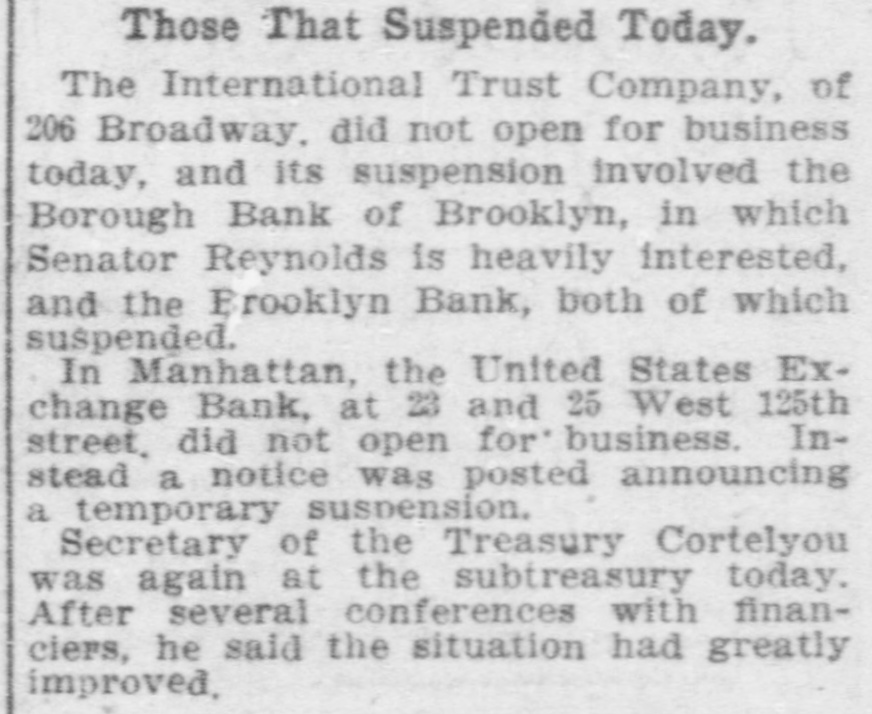
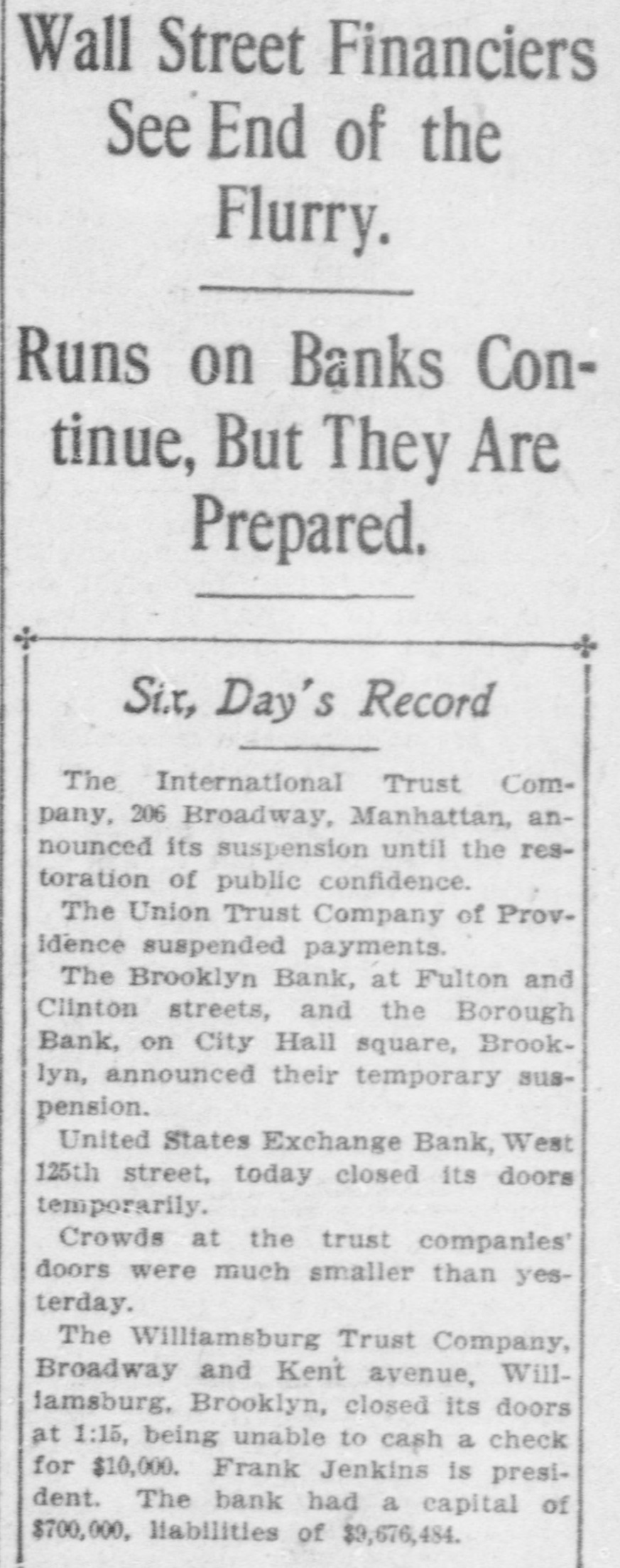
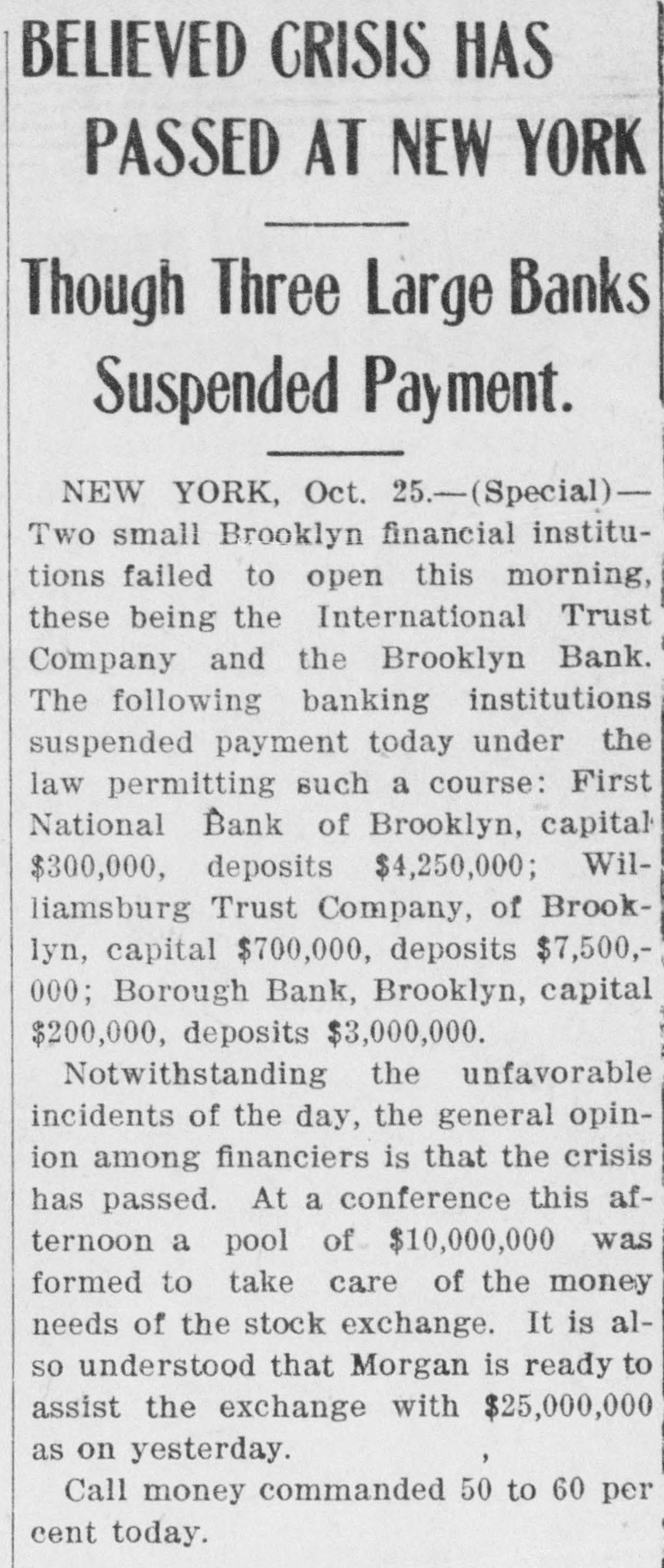
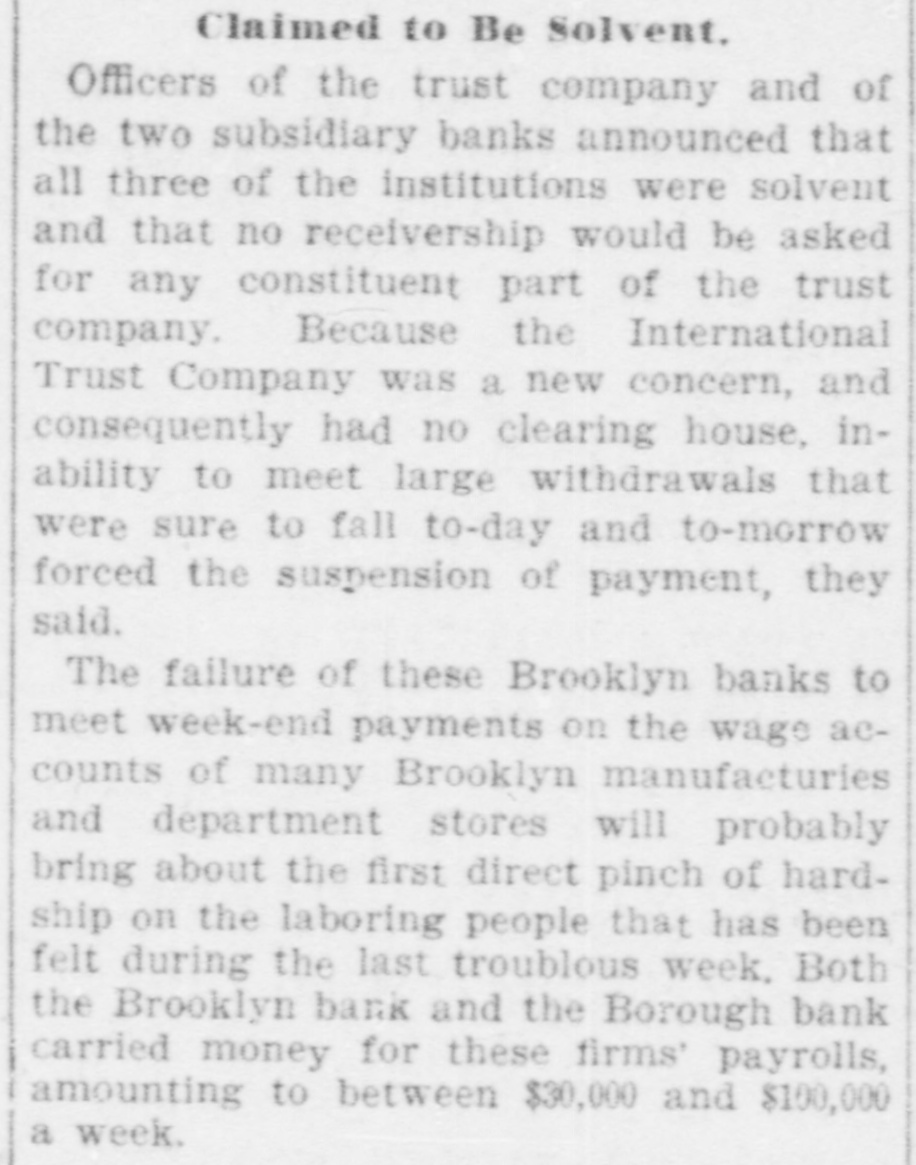
The Brooklyn Bank at Fulton and Clanton street did not open today.
Source
newspapers
2. November 16, 1907 Receivership
Newspaper Excerpt
temporary receivers for six suspended banks and trust companies ... Brooklyn Bank - Bruyn Hasbrouck, $150,000.
Source
newspapers
3. June 22, 1908 Reopening
Newspaper Excerpt
Brooklyn bank of New York reopens its doors, marking another step toward obliterating traces of the panic.
Source
newspapers

Newspaper Articles (24)

Article from The Roswell Daily Record, October 25, 1907

Click image to open full size in new tab

Article Text

New York, Oct. 25.-A much cooler tone was apparent in the business district this morning. The success of relief measures undertaken yesterday by J. P. Morgan, John D. Rockefeller and other prominent financiers together with the promptness with which the officials of the Trust Company of America met the run of depositors, gave great encouragement to bankers and business mea generally that no further trouble was to be feared. A pool of twenty-four million 'ollars made up by a pool headed by J. P. Morgan, which went into the stock market yesterday afternoon is believed to have given permanent relief to brokers in need of funds to carry stock bought and sold on margins for customers. In an address at a dinner last night Secretary Cortelyou referred to the financial situation:: "We are having a trying experience, but with all embarrassments I feel my faith in the general stability of business strengthened by the examples I have seen of high courage and splendid devotion to the public shown by many men of great influence in the commercial and and industrial affairs of this city. The weak places have been fortified, but what is better those of evil influences have been scourged from their positions, and the determination to carry this work forward will have a far reaching influence in restoring the public confidence." The announcement was made this morning that the United States Exchange Bank, a small institution in Harlem, would not open for business today. The bank has little more than $500,000 on deposit, and its suspension was evidently without effect on the general situation. There were lines of depositors waiting this morning at daylight in front of the Trust Company of America. The line was maintained all night and a woman declined to leave her place, even when the men behind her promised to restore the place to her in the morning. The International Trust Company, one of the small and inconspicuous companies, closed its doors at 10:40. This company had business connections with the Borough Bank of Brook lyn which suspended today. The Brooklyn Bank at Fulton and Clanton street did not open today. It has capital stock of $300,000 and owes about one million five hundred thousand dollars. The Borough Bank of Brooklyn, a state institution with capital of $200.000 and deposits of about three millions did not open for business today. Its business was not very large, and no prominent financiers were connected with it. One of its principal connections was the Kniekerbocker Trust company. The Lincoln Trust Company resumed payment to depositors today as usual. Big Failure at Providence. Providence, R. I., Oct. 25.-The Union Trust Company, on which there was a run yesterday, did not open for business today. At nine o'clock, the usual hour of opening, the following notice was posted: "This bank will not open today, owing to the stringency of the money market." There were several hundred people in line who wished to get their money According to the statement issued June 29th last, this bank had resources aggregating $28,238,335. The liabilities included besides $500,000 capital stock a surplus of $2,250,000 and deposits of $25,445,625. East Greenwich, R. I., Oct. 25.-The East Greenwich branch of the Union Trust Company of Providence, did not open this morning. A notice was posted saying the bank was closed for the protection of depositors. Central Falls, R. I., Oct. 25.-The Central Falls branch of the Union Trust Company closed today after a run started. It is the only bank in the city and the depositors are mainly


Article from The Daily Morning Journal and Courier, October 26, 1907

Click image to open full size in new tab

Article Text

MORGAN'S POOL AGAIN TURNS TIDE $15.000.000 Sent to Stock Exchange to Meet Demands For Immediate Necessities. NINE MORE BANKS CLOSE THEIR DOORS Believed to Be Solvent But Temporarily Suspend to Avoid Possible Runs. New York, Oct. 25.- -Another nerve-racking day has passed, but the financial institutions of New York have shown extraordinary power of resistance to the pressure put upon them. While it is true that sΓ©veral minor institutions have been forced to close their doors, yet two things should be said about them-first, that the amount involved was not so great as to exert any marked influence on the general situation, as these banks were located in residential quarters and did not come into touch with the larger financial institutions of the metropolis, and, second, that there is every reason to believe that these banks and trust companies are entirely solvent and their difficulties will prove to be only temporary. The institutions which closed their doors to-day, with the sums due depositors, were: The United States Exchange bank, Harlem, $600,000; International Trust company, about $100,000; the Borough Bank of Brooklyn, $4,000,000; the Brooklyn bank, $2,300,000; Willamsburg Trust company, Brooklyn, $7,500,000; and the First National bank of Brooklyn, $3,500,000 The First National bank of Brooklyn, the Williamsburg Trust company and the International Trust company were allied institutions. None of these companies had any important business connections with the larger banks which are representative of the city's financial affairs. Favorable Features. On the other hand, a number of favorable features marked the day. The Trust Company of America and the t Lincoln Trust company, the two org ganizations which have suffered most f from runs, have been slowly paying out to their depositors and closed tog day with all demands having been S met. In the case of the Trust Comf pany of America the run has welly nigh spent its force, as the great bulk of the depositors have been paid off. r At the close of business there were a e good many in line at the Lincoln Trust n company, but there also was a marked il (Continued on Second Page Y


Article from The Times Dispatch, October 26, 1907

Click image to open full size in new tab

Article Text

Another Nerve Racking Dayon Stock Exchange and Several Failures. SAVINGS BANKS HAD TO SUSPEND / Larger Institutions Withstand Runs Upon Them, and Clearing-House Certificates Will Be Issued To-Day, Permitting Bettlements Without Cash. NEW YORK, October 25.-Another nerve-racking day has passed, but the financial institutions of New York have shown extraordinary power of resistance to the pressure put upon them. While it .8 true that several minor institutions have been forced to close their doors. yet two things should be said about them: first, that the amount involved was not so great as to exert any marked influence on the general situation, as those banks were located In residential quarters and did not come into touch with the larger financial institutions of the metropolis; and second, that there is every reason to believe that these banks and trust companies are entirely solvent, and that their difficulties will prove to be only temporary, and due entirely to inability to secure ready cash on giltedge securities in their vaults. Notice In Required. In the light of the general excitement the savings banks thought it wise to put into effect the rule requiring thirty to sixty days' notice for the withdrawal of deposits, and this will prevent the withdrawal of money which would otherwise be put in safety deposit boxes. The savings banks, if they continued to make payments, would be obliged to withdraw funds from the national banks, thereby causing an additional strain on the general banking situation. There was not the slightest hint that any of the savings Institutions was in anything but the soundest condition, as it was pointed out that the savings banks of this State are so restricted by laws as to investing their money that there can be no question that all of the securities in their possession are of good value and readily salable in normal times. Those Which Suspended. The institutions which closed their doors to-day with the sums due depositors. were: The United States Exchange Bank, Harlem, $600,000. International Trust Company, about $100,000. The Borough Bank of Brooklyn, $4,000,000. The Brooklyn Bank, $2,300,000. Williamsburg Trust Company, Brooklyn, $7,500,000. The First National Bank of Brooklyn, $3,500,000. The First National Bank of Brooklyn. the Williamsburg Trust Company and the International Trust Company were allied institutions. None of these companies had any important business connections with the larger banks, which are representative of the city's financial affairs. Many Favorable Features. On the other hand, a number of favorable features marked the day. The Trust Company of America and the Lincoln Trust Company, the, two organizations which have suffered most from runs, have been slowly paying out their depositors, and closed to-day with all demands having been met. In the case of the Trust Company of America the run has well-nigh spent its force, as the great bulk of the dopositors have been paid off. At the close of business there were a good many in line at the Lincoln Trust Company, but also there was a marked reduction in the number of anxious depositors. Had Plenty of Money.


Article from The Marion Daily Mirror, October 26, 1907

Click image to open full size in new tab

Article Text

CLEARING HOUSE. TRIES TO STEM TIDE OF FINANCIAL DISASTER BY ISSUING CERTIFICATES. AN ACTION SELDOM .TAKEN. Six Banks and Trust Companies in Brooklyn and Vicinity Suspended Payment Friday-Savings Banks Enforce 60-Day Rule. New York. Oct. 26.-Friday was another nerve racking day, but the financial institutions of New York showed extraordinary power of resistance to the pressure put upon them. While several minor Institutions were forced to close their doors, yet two things should be said about them-first. that the amount involved was not so great as to exert any marked influence on the general situation, as these banks were located in residential quarters and did not come in touch with the larger financial institutions of the metropolis; second, that there is every reason to believe that these banks and trust companies are entirely solvent and their difficulties will prove to beconly temporary and due entirely to inability to secure ready cash. In the light of the general excitement the savings banks put into effect the rule requiring 30 to GO days' notice for the withdrawal of deposits, and this will prevent the withdrawal of money which would otherwise be put in safety deposit boxes, The savings banks, if they continued to make. payments, would be obliged to withdraw funds from the national banks, thereby causing an additional strain on the general banking situation. /There was not the slightest hint that any of the savings institutions was, in anything but the soundest condition. The institutions which closed their doers Friday, with the sums due denositors, were: The United States Exhange bank. Hariem, $600,000. International Trust Co., about $100,100. $ The Borough bank. of Brooklyn, $4,00.000. The Brooklyn bank. $2,300,000. Wflliamsburg Trust Co., Brooklyn, $7,500,000. The First National Bank of Brooklyn, $3,500,000. The First National Bank of Brookyn, the Williamsburg Trust Co. and he International Trust Co. were allied Institutions. None of these companies had any important business connecions with the larger banks. On the other hand a number of avorable features marked the day. The Trust Company of America and the Lincoln Trust Co., the two organications which have suffered most from runs, closed the day with all demands having been met. The most favorable incident of the day was that the stock exchange was provided with funds ample to meet its immediate necessities by a money pool headed by J. P. Morgan, which bott 000 to the exchange


Article from Waterbury Evening Democrat, October 26, 1907

Click image to open full size in new tab

Article Text

SAVES THE SITUATION Clearing House of New York Will Issue Loan Certificates. SAVINGS BANKS TAKE ACTION Will Take Advantage of Law Requiring Sixty Days' Notice From Depositors-Crisis Is Over, Cortelyou, Morgan and Leading Financiers Declare. New York, Oct. 26.-J. Pierpont Morgan, Secretary Cortelyou and leading financiers of this city were a unit in declaring that the financial crisis is practically over. Many things occurred to clear and improve the situation. The most important of these was the action of the Clearing House Association of Banks in issuing certificates redeemable in currency and the agreement made by the presidents of savings banks throughout the city to take advantage of the law requiring sixty days' notice from their depositors before withdrawing funds. Money for all legitimate purposes in the Wall street district was provided by the alliance created by Mr. Morgan and shared in by the Washington government and leading bankers. Ten millions of dollars was used to relieve the condition on the stock exchange. The probable importation of $5,000,000 in gold by the National City bank was another factor that contributed to the feeling of restored confidence and inspired Secretary Cortelyou, Mr. Morgan and other men who have been striving to relieve the strained conditions to express the opinion that the worst of the financial trouble is over and that only common sense on the part of the people will be required to prevent serious disaster. President Satisfied With Situation. So encouraging a view did President Roosevelt and his cabinet at Washington take .of the situation that a semiofficial announcement was authorized expressing satisfaction with the steps taken by the government, acting in conjunction with Mr. Morgan, to bring about a return to normal conditions. There were no failures of banking institutions, though eight of those doing business in Greater New York closed their doors to prevent runs inspired by the fear of the people. These institutions were the United States Exchange bank. the International Trust company and the Guardian Savings bank of Manhattan; the Borough bank of Brooklyn, the Brooklyn bank, Williamsburg Trust company, the First National bank of Brooklyn and the Jenkins Trust comt pany of Brooklyn, holding deposits ag gregating $22,000,000. There is little or no question of the h solvency of these institutions. Like many other banks, trust companies and savings institutions. they are merely short of ready money and hold B securities representing an actual value W of more than double their obligations. d Closed to Prevent Spread of Panic. f The action of the officers of these banks was due entirely to their desire ti to prevent a spread of the senseless ti panic which has threatened for several days. The closing of these inspired the presidents of all the savings banks in Greater New York to apply the six ty day rule, beginning this morning. This action was taken to prevent possible disaster to both the banks and pr their depositors. a State officials and officers of the savgo ce ings banks unite in the statement that 00 there is not the slightest question of th the solvency of those institutions, and 60 as soon as the frenzy of fear among the people passes away the sixty day rule will be ignored. So confident are the officers of the an savings banks of their ability to meet L every legitimate demand that they fic have decided to make exceptions to the ve operation of the rule wherever it is he found actually necessary. W The savings banks of the city hold on deposit $1,052,663,000. which is represented by actual cash or gilt edged securities that can be turned into cash under normal conditions. $4. Wall Street Regains Courage. ter A much calmer feeling prevailed in 5.2 Wall street than the day before. Values on the stock exchange were higher an than at any time during the week. In bu The loaning of $10,000,000 by Mr bu Morgan and his associates at normal cet rates of interest dispelled the alarm ( which existed for an hour or two dur bet cer Ing the morning. and exchange leaders expressed the opinion that the calampor ty which threatened Thursday had been averted. 271 The issuance of clearing house cer271 ificates which was ordered today will fai in the opinion of bankers do more to ext 21a elieve the Wall street situation than C anything else. Certificates of this charore eter were last issued fourteen years am go. 16c. The subtreasury assisted in the work Sep of helping out the banks by turning ver to them $8,000,000 in gold. taking government securities in exchange. pot a12 The Trust Company of America was 72/60 gain the storm center of the troubles E sel n Wall street, and the run inauguehr ated on it on Wednesday continued 34a. throughout the day. Every demand ext resented to the paying tellers met che ed. with prompt payment. The Lincoln T Trust company also withstood the run 6a6 rhich began on Thursday H s Officials of both institutions united position


Article from The Spanish Fork Press, October 31, 1907

Click image to open full size in new tab

Article Text

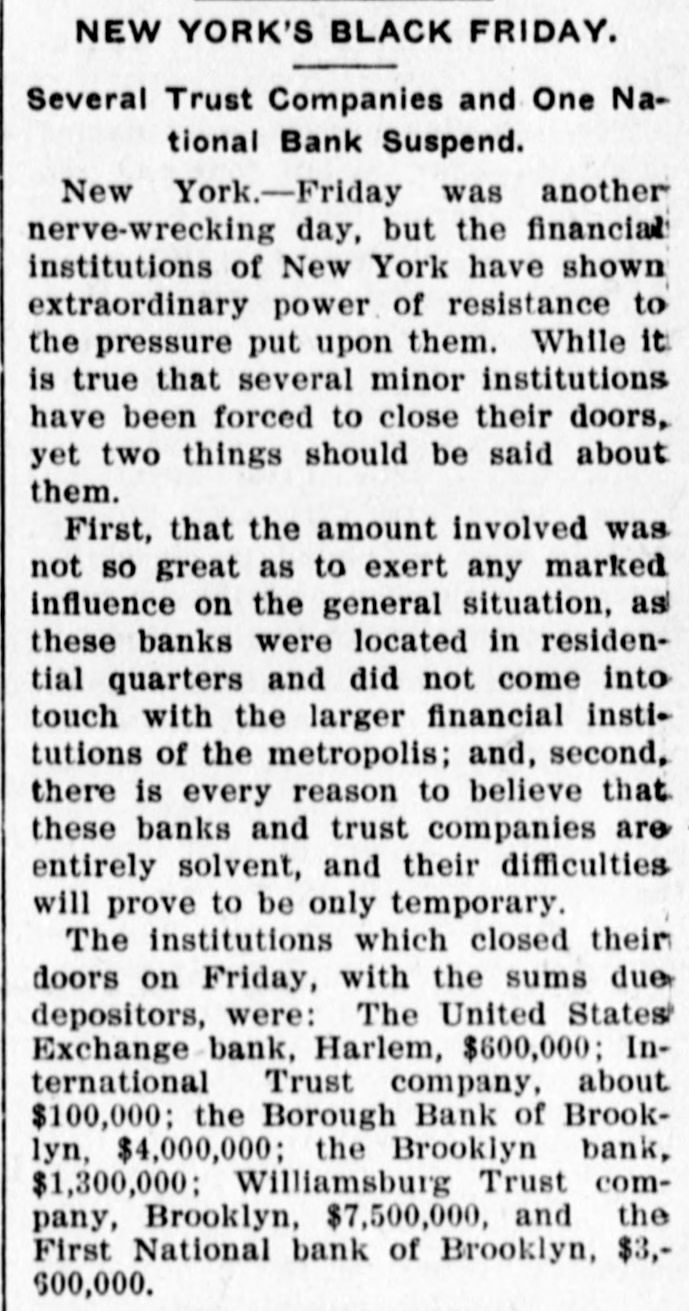
NEW YORK'S BLACK FRIDAY. Several Trust Companies and One National Bank Suspend. New York.-Friday was another nerve-wrecking day, but the financial institutions of New York have shown extraordinary power of resistance to the pressure put upon them. While it is true that several minor institutions have been forced to close their doors, yet two things should be said about them. First, that the amount involved was not so great as to exert any marked influence on the general situation, as these banks were located in residential quarters and did not come into touch with the larger financial institutions of the metropolis; and, second, there is every reason to believe that these banks and trust companies are entirely solvent, and their difficulties will prove to be only temporary. The institutions which closed their doors on Friday, with the sums due depositors, were: The United States Exchange bank, Harlem, $600,000; International Trust company, about $100,000; the Borough Bank of Brooklyn, $4,000,000; the Brooklyn bank, $1,300,000; Williamsburg Trust company, Brooklyn, $7,500,000, and the First National bank of Brooklyn, $3,600,000.


Article from The Washington Herald, November 17, 1907

Click image to open full size in new tab

Article Text

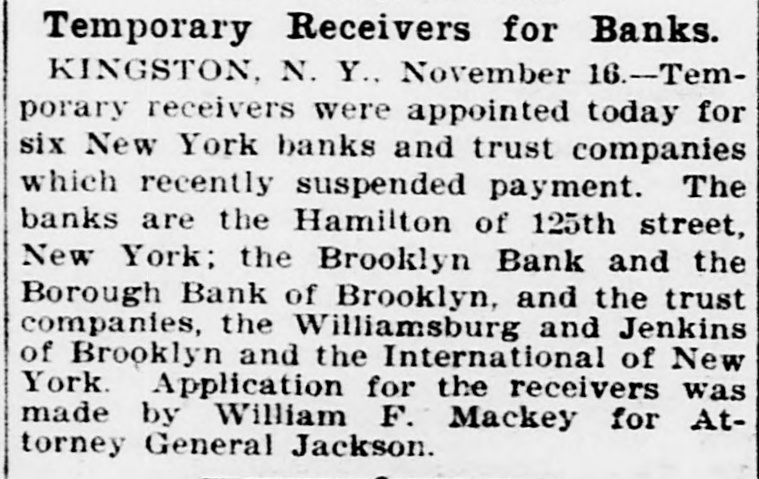
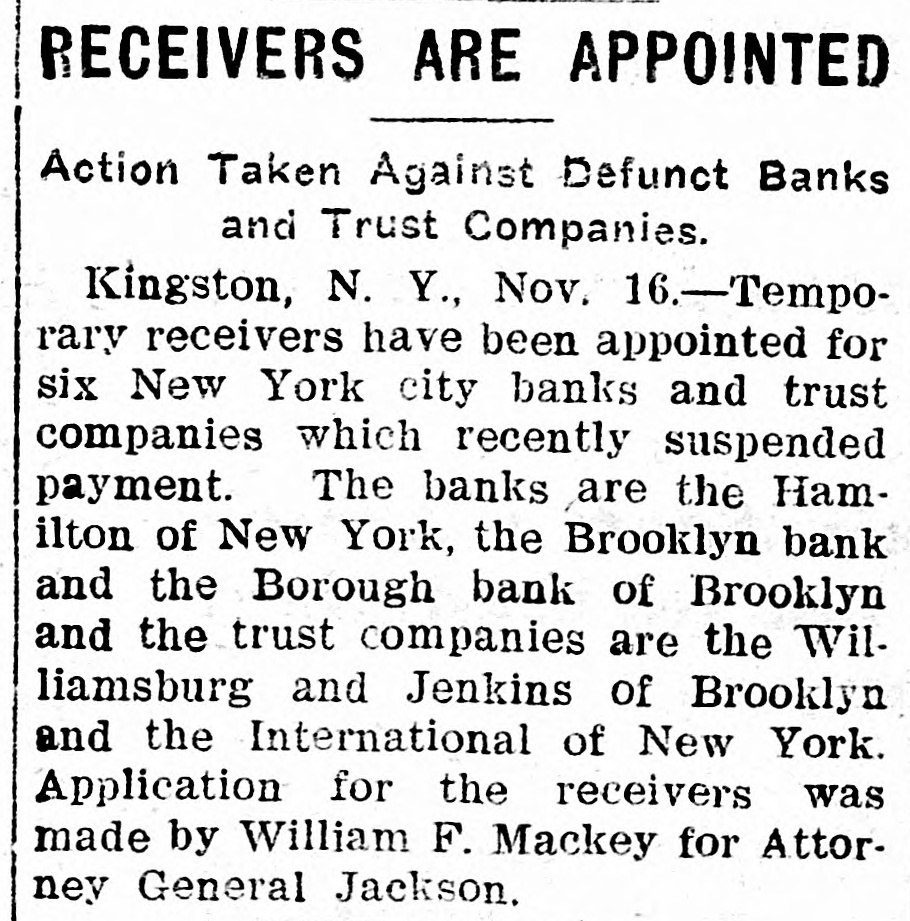
BANKING FRAUDS UNEARTHED Examination Discloses Irregularity in Five Financial Concerns. Jenkins Trust Company's Books Show Overloans Amounting to $500,000. New York, Nov. 16.-Charging that the president of the Jenkins Trust Company, of Brooklyn, borrowed illegally $557,000 from that institution, and that evidence of civil and criminal liability had been found in the Borough Bank of Brooklyn, as well. Attorney General Jackson startled jaded financial circles late this afternoon by obtaining temporary receivers for six suspended banks and trust companies. He announced that disclosures made by experts will be placed before the grand jury. Only two of the institutions have been inspected, but all the State institutions which have shown signs of trouble will be subjected to close scrutiny. Attorney General Jackson says: "In the Jenkins Trust Company there have been found evidences of illegal overloans. For instance, the records show overloans to the president aggregating $557,000. The banking law prohibits loans to any officer or director of more than 10 per cent of the capital stock and surplus, and also prohibits any loan to any officer or director without the approval of a majority of the trustees. The capital stock of the Jenkins Trust Company is but $550,000, and its surplus $197,000. It is claimed by the trustees that they knew nothing about these loans to the president." Temporary receivers were appointed as follows: Williamsburg Trust Company, of Brooklyn; Brooklyn Bank, Hamilton Bank, of New York: Jenkins Trust Company. of Brooklyn; Borough Bank, of Brooklyn: International Trust Company. Last Thursday Supt. Williams, of the State banking department, reported to the attorney general that the institutions were unable to meet the situation, and suggested that receivers be named at once. Jackson then appointed experts to examine the books, with to-day's result. The attorney general's statement in part follows: "Evidence of both criminal and civil liability, in the opinion of the attorney general, has been unearthed. The investigation thus far has been confined to the Bprough Bank, of Brooklyn, and the Jenkins Trust Company, of Brooklyn. "In the Borough Bank, of Brooklyn, there has been found evidence of illegal overloans, overdrafts, forged paper, and other criminal transactions, all of which will be presented to the grand jury."


Article from The Morris County Chronicle, November 19, 1907

Click image to open full size in new tab

Article Text

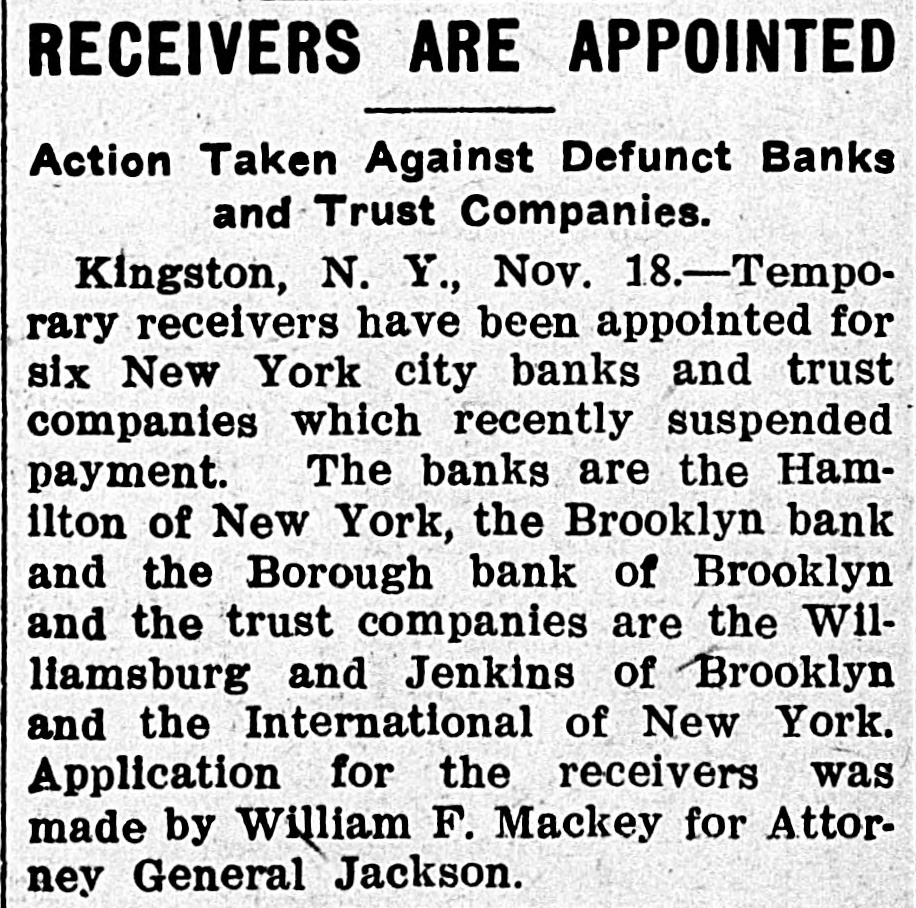
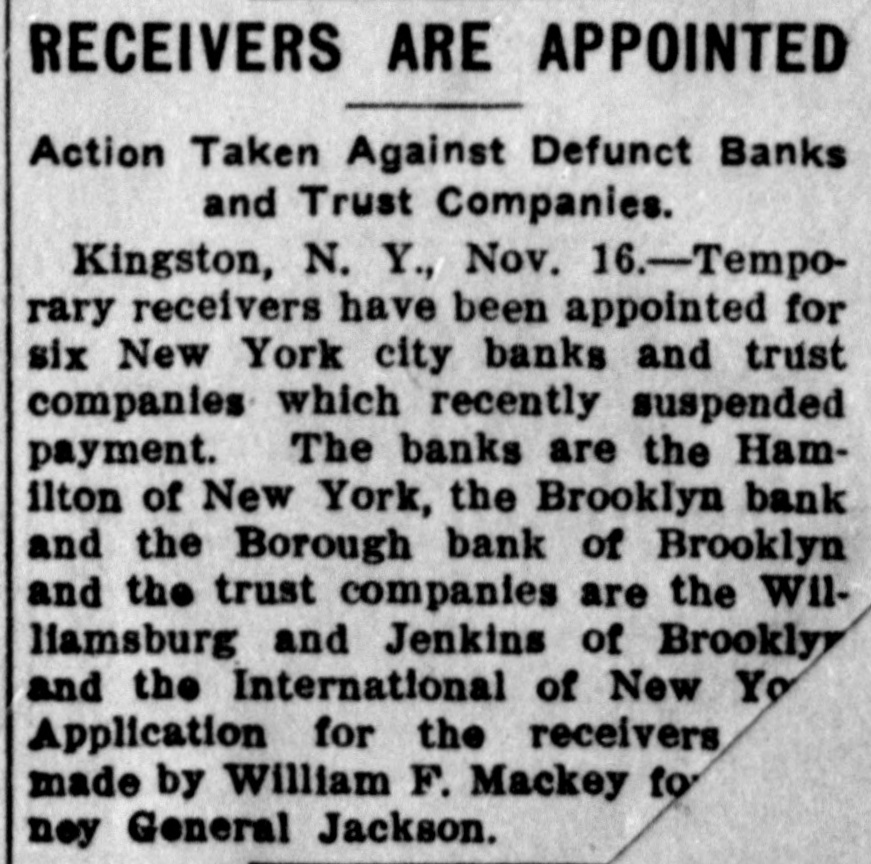
RECEIVERS NAMED FOR SIX BANKS Criminal Proceedings Likely Against Officers of Two Brooklyn Institutions. New York City.-On application of Attorney-General Jackson temporary receivers were appointed for three banks and three trust companies in Manhattan and Brooklyn, and the Attorney-General, in making the announcement, stated that criminal proceedings would be begun in connection with the affairs of two of the Brooklyn concerns, the Borough Bank and the Jenkins Trust Company. In the Jenkins Trust Company, Mr. Jackson said, there were evidences of illegal overloans, one to John G. Jenkins, Jr., the president, being for $557,000. The Attorney-General made his application for the appointment of receivers to Supreme Court Justice Betts, in Kingston, N. Y. The banks and trust companies, with the receiver for each and the amounts of the bonds, are as follows: Williamsburg Trust CompanyFrank L. Bapst, $300,000. Hamilton Bank-Frank White, $200,000. Borough Bank, of BrooklynHenry A. Powell and Isaac Cox, $100,000 each. Jenkins Trust Company-John Mulhall, $200,000. Brooklyn Bank - Bruyn Has brouck, $150,000. International Trust CompanyGoodwin Brown, $100,000. It is asserted by the trustees of the Jenkins Trust Company that they were ignorant of the loans to Mr. Jenkins, which were in the category of brokers' loans to Jenkins Brothers, stockbrokers.


Article from New-York Tribune, December 9, 1907

Click image to open full size in new tab

Article Text

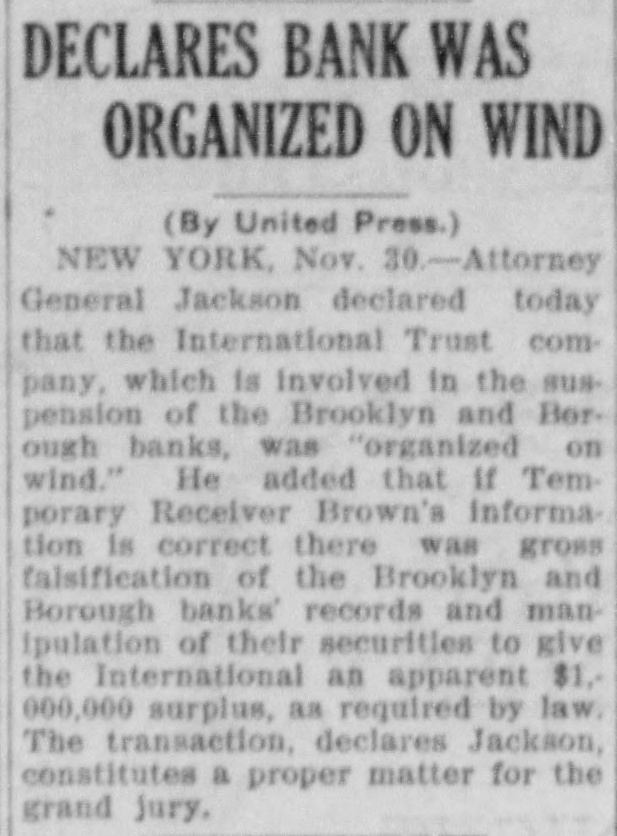
INDICTMENTS THIS WEEK. Brooklyn Bank Inquiry May Show Results To-day. Two separate sets of indictments have been prepared by the Kings County grand jury as a result of its investigation of closed Brooklyn banking institutions last week. One of the sets will be handed down to-day. it is thought, and it was said yesterday that some of the men already indicted are those against whom some of the new indictments are drawn. The first set of indictments was prepared as a result of the investigation of the affairs of the Williamsburg Trust Company. of which Frank Jenkins, already under indictment, is the deposed president. The secend set was prepared as a result of the preliminary investigation of the Brooklyn Bank and conjointly with it of the International Trust Company. Brooklyn branch. of which William Gow. already facing five indictments, was the organizer The grand jury this week will prosecute a searching and thorough investigation of the last named institutions. It was only a few weeks before the International Trust Company closed its doors that it was announced the Brooklvn Bank had been merged with it. As a result of the failure of the International Trust Company, the appointment of receivers and of counsel for the depositors and the directors as well. and their investigations of the affairs of the two banks, a poculiar situation has arisen. The depositors are opposing the merger. They assert that it was never legally consummated, and they have announced their intention to fight any twelfth hour attempt to make the merger legal. On the other hand. the directors of the two institutions express themselves as favorable to the merger. although acknowledging that it may not have been legally brought about. They will use every effort to make it legal. The transactions of the Brooklyn Bank and the International Trust Company are interesting the grand jury, and will be carefully looked into by that body. These are The alleged "shaving of collateral." The transfer of $254,000 of stocks and bonds of the Borough Bank to the International Trust Company. which deposited said stocks and bonds with the First National Bank of Manhattan to secure 2 loan of $150,000 from that institution. From information obtained from the District Attorney's office it would appear that good collateral was put up to secure certain loans made by the Brooklyn Bank and that later. through the alleged connivance of certain persons in the bank. this collateral was removed and replaced by poorer collatteral, the "good" collateral being used, presumably. as security for more loans from other sources. This is the transaction referred to as "shaving collateral." S. S. Menken. of counsel for the Brooklyn Bank and the International Trust Company, has been working with directors of both institutions to prepare a plan to make the merger legal. It is understood that the so called merger was never really legal, because notice of the proposed merger was not published in two newspapers in Brooklyn and Manhattan at least two weeks before the stockholders voted on the question of the merger. as required by law. and because no application was made to a justice of the Supreme Court, as is also required by law. In talking of the merger Mr. Menken said: "According to the plan, the International Trust Company was to buy the assets of the Brooklyn Bank, including $1,300,000 of the depositors' money and $300,000 capital stock. It was to take over the accounts of the depositors. It should have set to pay the stockholders. but money paid to the over not aside done. $300,000 The Borough this Bank, was $500,000. was principally depositors' money. All that is necessary is to legalize the merger. Then if we get back what the Borough Bank owes US we will have $900,000 over and above all liabilities. The International Trust Company is not hampered by any bad loans. Gow has paid his $25,000 is all realizable, and have promised to loan. of both The institutions collateral directors advance money to put the plan through. W. R. Jones, jr., deposed president of the Oriental, has two small loans." It was learned yesterday that of the depositors' Sparks. chairman Frederick committee W. of twenty-five of the Borough Bank, had given Howformer president of the to the purchase of four ard help Maxwell. finance bank. hundred a note lots at Holliswood, Queens County. Both of these men were members of a syndicate formed to speculate in these lots, and each had a sixth interest in the speculation. Mr. Sparks made out a note in favor of the Borough Bank, and this note Mr. Maxwell discounted. Mr. Maxwell in his confession to the directors told them the note was good and would be paid when it fell due. Title to the lots was taken in Mr. Sparks's name and he signed a declaration of trust acknowledging that each member of the syndicate had a sixth interest in the property, Subsequently he transferred his Interest either to Mr. Maxwell or Mr. Doolittle, Mr. Gow's secretary. for at any rate Maxwell and Doolittle conveyed a third interest in the property to the bank. and this, by appraisal, will net the bank $20. 000 or $25.000 over and above the mortgage liens that are on the property, which amount to about $50,000 at least. The District Attorney's office is still receiving daily reports of the physical condition of W. R. Jones. jr., and as soon as he is well enough to testify he will appear before the grand jury. The depositors' committee of twenty-five of the Borough Bank met at the Assembly, Brooklyn, last night and discussed the report of the experts who have been examining the books of the bank during the last week. Plans were arranged for a mass meeting to-morrow night of depositors at the Columbia Theatre. THE mann arean


Article from New-York Tribune, February 9, 1908

Click image to open full size in new tab

Article Text

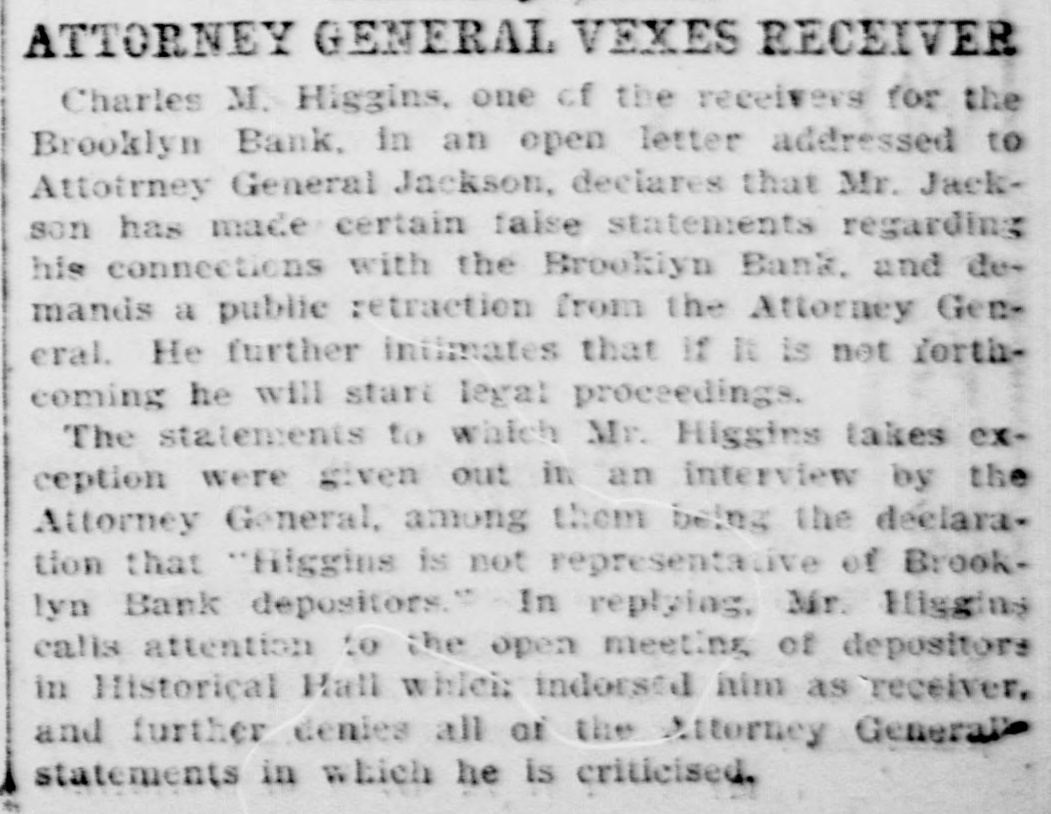
ATTORNEY GENERAL VEXES RECEIVER Charles M. Higgins, one of the receivers for the Brooklyn Bank, in an open letter addressed to Attotrney General Jackson, declares that Mr. Jackson has made certain false statements regarding his connections with the Brooklyn Bank. and demands a public retraction from the Attorney General. He further intimates that If it is net forthcoming he will start legal proceedings. The statements to walch Mr. Higgins takes exception were given out in an interview by the Attorney General, among them being the declara. tion that "Higgins is not representative of Brooklyn Bank depositors." In replying, Mr. Higgins calls attention to the open meeting of depositors in Historical Hall which indorsed him as receiver, and further denies all of the Attorney Generally statements in which he is criticised.


Article from New-York Tribune, March 2, 1908

Click image to open full size in new tab

Article Text

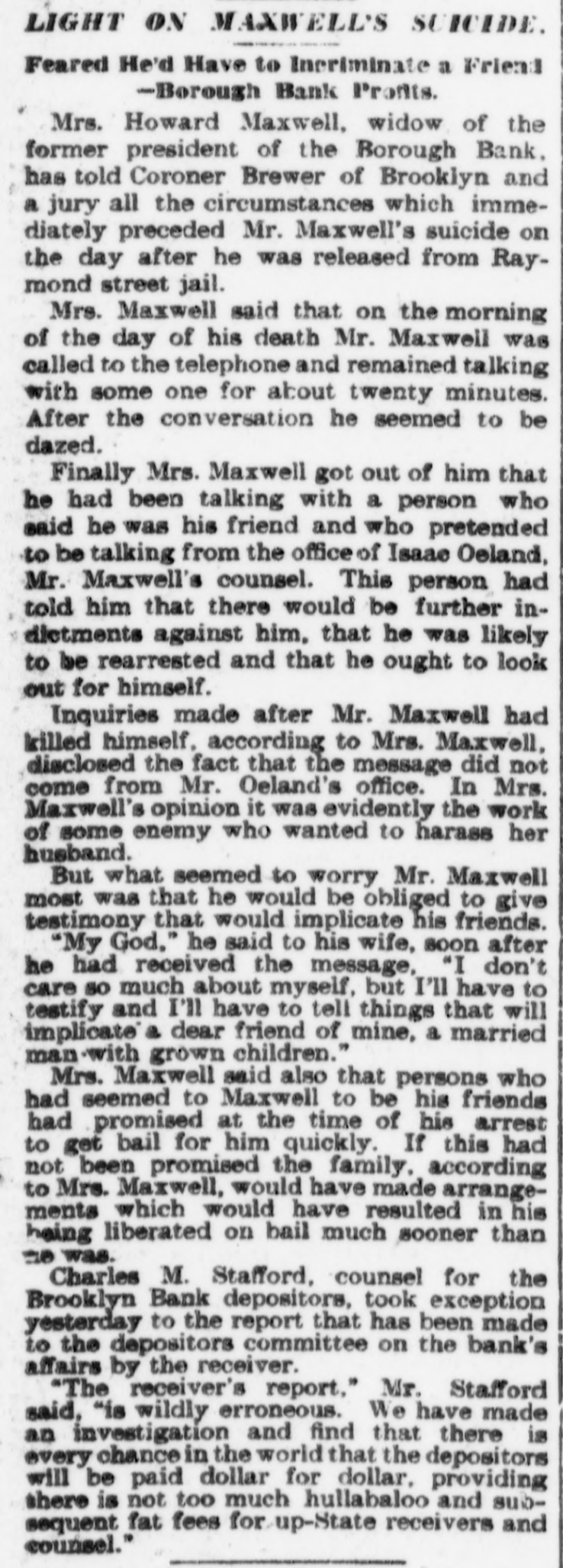
receivership and obtaining the consent of the courts to the merger with the Metropolitan Trust Company. Bankers were greatly amused yesterday at Attorney General Jackson's statement that the "powers of the State Superintendent of Banks were too great as it is," and at his criticism of the banking legislation which is at present pending at Albany. Mr. Jackson called the bill which contemplates giving the State Superintendent of Banks the right to appoint a deputy to look after suspended banks, and relieves him of the necessity of calling in the Attorney General, "a most dangerous and ridiculous piece of legislation and almost infamous in its nature." This bill in particular has received the entire support of bankers and financial experts all over the state, as it gives to the State Superintendent of Banks powers similar to those exencised by the Controller of the Currency over national banks. When a federal bank suspends the Controller of the Currency has the power to at once a receiver at a fixed salary, cannot be more than a year, appoint which $25,000 is much and in the case of all save the largest banks below the maximum figure. In the case of suspended state institutions, however, the State Superintendent of Banks-must ask the Attorney General to apply to the courts when he dereceivers for a bank. The fees of the reso are fixed by ceivers sires appointed the court, the fed- and are usually much-greater than under eral system. The temporary receiver for the Hamilton Bank. for example, received $15,000 for one month's work. while counsel received $10,000. Under the proposed legislation all this would be done away with. DIRECTORS TO ACT WITH RECEIVERS. Paul Grout. counsel for the Mechanics and Traders' Bank, said last night that the directors of the bank would act with the temporary receivers in getting the bank on its feet and open again for business as soon as possible. He said he had no intention of opposing the action of the Attorney General in having receivers appointed. Attorney General Jackson, with several of his assistants, went to Albany on Saturday night, but he is expected back at his office here this morning Charles M. Higgins, one of the receivers for the Brooklyn Bank, said yesterday he did not know there was any movement actually started to draw Governor Hughes's attention to the close personal and official association existing between Attorney General Jackson and many of the receivers for banks and trust companies in this city whom the Attorney General has been instrumental in having appointed. Mr. Higgins wasn't a bit surprised. though, at the announcement that charges might be made against M Jackson for helping his friends to good berths and fees and salaries at the expense of depositbanks and trust companies. "There's enough for such ors certainly in the material charges," just said Mr. Higgins. "The Oriental is getting about the same dose we got in the Brooklyn Bank when Bruyn Hasbrouck, of New Paltz, a friend of Jackson, was appointed a co-receiver It was bad enough to have a receiver from upstate, but, despite my protest and against the wishes of the depositors, we have had an upstate counsel, Dolson, a Jackson deputy, of course, foisted upon us. Mr. Jackson is supposed to represent the depositors of the bank, but he never uttered a word of protest against Mr. Hasbrouck handing over a contract to Dolson for $80,000 for the latter's services. I got only a snap notice of a day about this fat contract. and Attorney General Jackson got no more. although according to law he should have had eight days. Yet he has no protest So far as the Brooklyn Bank goes, Mr. Jackson's conduct certainly demands investigation."


Article from New-York Tribune, May 1, 1908

Click image to open full size in new tab

Article Text

C. M. HIGGINS SUES CO.-RECEIVER. Asks for Fees Paid in Brooklyn Bank Fight Over Counsel. Suit was begun yesterday by Charles M. Higgins, one of the receivers of the Brooklyn Bank, to recover from his co-receiver, Bruyn Hasbrouck, $2,724 55. the amount of the fees paid to Higgins's lawyers in the fight which Higgins made to put Charles M. Stafford in the place of Charles A. Dolson as counsel to the receivers. Higgins says that Hasbrouck appointed Dolson counsel without his consent, thus making the contract void. Higgins also says that the 2 per cent of the assets of the bank which Hasbrouck agreed to pay Dolson as his fee was a wasteful and extravagant use of the trust funds. Dolson was later replaced by former Surrogate James C. Church and former Borough President J. Edward Swanstrom.


Article from New-York Tribune, May 13, 1908

Click image to open full size in new tab

Article Text

BROOKLYN BANK AGAIN : TO OPEN WITH OLD NAME. At Least Plan of International Trust Company Seems Assured. The initial steps were taken yesterday to carry out a plan which provides for the immediate reopening of the Brooklyn Bank, the payment in full of all the depositors of that bank and the depositors of the Brooklyn branch of the International Trust Company, and the acquisition of the Brooklyn Bank by the International Trust Company through purchase by that company of all the stock of the bank. Under this plan the Brooklyn Bank, the oldest banking institution in that borough, will be completely reorganized, and will reopen with a capital stock of $300,000 and approximately $450,000 surplus. A meeting of stockholders representing $496,000 of the capital stock issue of $500,000 of the International Trust Company was held yesterday afternoon in the offices of S. Stanwood Menken, of the law firm of Philbin. Beekman & Menken, to discuss the plan which was originated by Mr. Menken and is being put through by him. These stockholders voted unanimously to adopt it, and as they own 70 per cent of the stock of the Brooklyn Bank, all that remains to be done now before it goes into effect is to have stockholders representing 30 per cent of the stock of the Brooklyn Bank approve it and vote its adoption. A meeting of these stockholders for this purpose will be held in Mr. Menken's office to-morrow. The capital stock of the Brooklyn Bank is $300,000, of which 70 per cent. or $210,000, is owned by the International Trust Company. Under the provisions of the plan the remaining stock of the Brooklyn Bank, amounting to about $90,000. is to be purchased by the trust company on a deferred payment plan. Mr. Menken has already made arrangements for the immediate resumption of business by the Brooklyn Bank under its old name and not under the name of the International Trust Company, by which it went after its supposed merging with that institution last September. The Brooklyn Bank, or the Brooklyn branch of the International Trust Company (the courts have to decide which is the proper name), closed in the early part of the late panic, owing depositors something over $1,800,000. Mr. Menken said yesterday arrangements had been made to borrow a quarter of a million dollars as soon as the resumption plan was adopted. Therefore, upon reopening the Brooklyn Bank would have, he said, the following amounts of cash to begin business and pay depositors with: $800,000 Cash on hand. approximately 250.000 Cash from proposed loan 350,000 Cash from trust company $1,400,000 Total Besides this, the bank has in its vaults over $850,000 of bills receivable, and will get through the deferred payment plan in the course of the next eighteen months over $400,000 which the Borough Bank owes the Brooklyn branch of the International Trust Company The receivers for the Brooklyn Bank have expressed their willingness to assent to and help put through this plan. "If the Brooklyn Bank stockholders agree," said Mr. Menken yesterday, "I believe we will have the bank open and doing business within two weeks." Little difficulty is expected in getting the consent of the Brooklyn Bank stockholders, as under the provisions of the plan they will receive par value for their stock although in deferred payment, while, if they force the bank's liquidation, according to one of its receivers, they will be lucky if they get anything at all for it. Under the provisions of the plan both the depositors of the Brookiyn Bank and of the Brooklyn branch of the International Trust Company will be paid in full. This will settle all question as to the legality of the so-called merger of the Brooklyn Bank with the trust company last year, which has been the subject of bitter dispute since the bank closed its doors, and is scheduled to be argued before Justice Betts, in Kingston, May 23. The consents of the depositors are unnecessary to carry out the plan, as it provides for their immediate payment in full. The receivers do not purpose to extend the stockholders indefinite time for reopening. Unless they consent to Mr. Menken's plan, one of the receivers said yesterday, it is probable that the latter will declare a 40 per cent dividend to depositors the latter part of this month, and thus settle forever the question of resumption. "Even if we are forced to liquidate the bank," said this receiver yesterday, "the depositors will get 100 cents on every dols but it will be some time before they get it all."


Article from New-York Tribune, May 13, 1908

Click image to open full size in new tab

Article Text

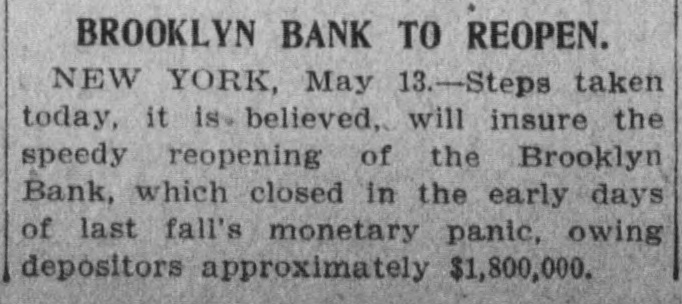
THE NEWS THIS MORNING. CONGRESS-Senate: The Postoffice appropriation bill, carrying $229,027,367, was passed; Mr. Rayner spoke on his resolution directing the President to order a court of inquiry into charges against Colonel William F. Stewart. House: The conference report on the naval appropriation bill was agreed to and it was announced that the currency bill would be considered on Thursday. FOREIGN.-Two schooners engaged in tortoise fishing off the Isle of Pines have been seized, a revenue cutter firing a shot into one Secreof them before she would heave to. tary Taft left Colon for Charleston on the Prairie, having concluded a successful trip as Inhabitants peacemaker on the isthmus. of the village of Belleghem, near Courtrai, attacked and killed a man caught robbing a chapel Ambassador Reid presided at a luncheon given by the Pilgrims in London in Russian prishonor of Edwin A. Abbey. oners at Simferopol killed four officials and Judge Rodey dismissed the suit escaped. of the American Railway Company to get possession of lands occupied by army, navy and lighthouse services in Porto Rico. Great Britain, Russia. France and Italy have decided to withdraw their troops from Crete, peaceful Prince conditions prevailing in the island. Ito, in an interview at Seoul. said that Japan's object in reforming the system of government in Corea was to make that country an independent ally of Japan. DOMESTIC.-The men of the Atlantic fleet were entertained at a reception and ball by the exclusive California Club of San Francisco. Governor Hughes was welcomed by a crowd at Washington, where he went to attend the conference of Governors and the President's dinner The body of George Clinton, first Governor of New York, was exhumed in Washington and will be reburied in Kingston, N. Y. The welfare committee closed its conference by effecting a reorganization as the Woman's Department of the National Civic Federation; Mrs. Medill McCormick. of Chicago, was A resolution presented elected president. at the Methodist Episcopal General Conference at Baltimore provides for a twelve-year term Two robfor bishops and no re-election. bers, dressed as brakemen, attacked the express messenger on a Great Northern train between Seattle and Vancouver, and looted the strong box of a sum estimated at between $1,000 and $10,000 Gustave CITY.-Stocks were weak. Lindenthal, under whose directions the original plans for the Blackwell's Island Bridge were made. said he would not have approved the changes made. Governor Hughes said he could not serve even were he elected VicePresident The initial steps were taken in a plan to reopen the Brooklyn Bank under its old name, but as the property of the International Trust Company. The floor sagged beneath one hundred petitioners in Queens BorNew York ough Hall and caused a panic. Life records showed contributions of $15,000 to the Merchants' Association at the insistence of William F. King. The Knickerbocker Trust Company announced it would pay depositors two instalments. falling due later, under the resumption agreement, on June 1. President Hepburn of the Chase National Bank said he looked for a period of unprecedented prosperity. The Denver & Rio Grande sold $15,000,000 three-year notes to local bankers to finish the Western Pacific construction work. THE WEATHER-indications for to-day: Fair and cooler. The temperature yesterday: Highest, 81 degrees: lowest, 64.


Article from New-York Tribune, May 23, 1908

Click image to open full size in new tab

Article Text

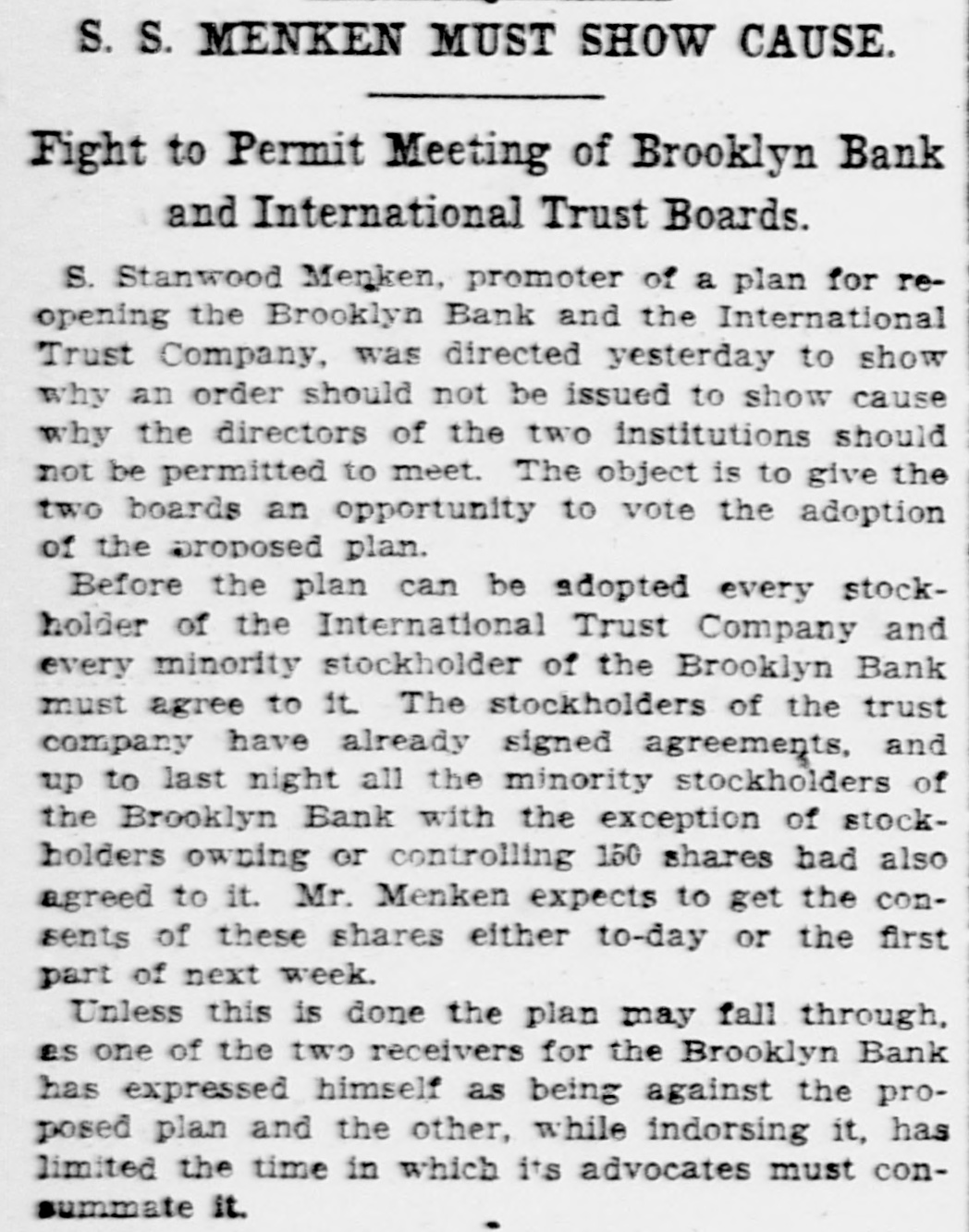
S. S. MENKEN MUST SHOW CAUSE. Fight to Permit Meeting of Brooklyn Bank and International Trust Boards. S. Stanwood Menken, promoter of a plan for reopening the Brooklyn Bank and the International Trust Company, was directed yesterday to show why an order should not be issued to show cause why the directors of the two institutions should not be permitted to meet. The object is to give the two boards an opportunity to vote the adoption of the proposed plan. Before the plan can be adopted every stockholder of the International Trust Company and every minority stockholder of the Brooklyn Bank must agree to it. The stockholders of the trust company have already signed agreements, and up to last night all the minority stockholders of the Brooklyn Bank with the exception of stockholders owning or controlling 150 shares had also agreed to it. Mr. Menken expects to get the consents of these shares either to-day or the first part of next week. Unless this is done the plan may fall through, es one of the two receivers for the Brooklyn Bank has expressed himself as being against the proposed plan and the other, while indorsing it, has limited the time in which its advocates must consummate it.


Article from New-York Tribune, June 13, 1908

Click image to open full size in new tab

Article Text

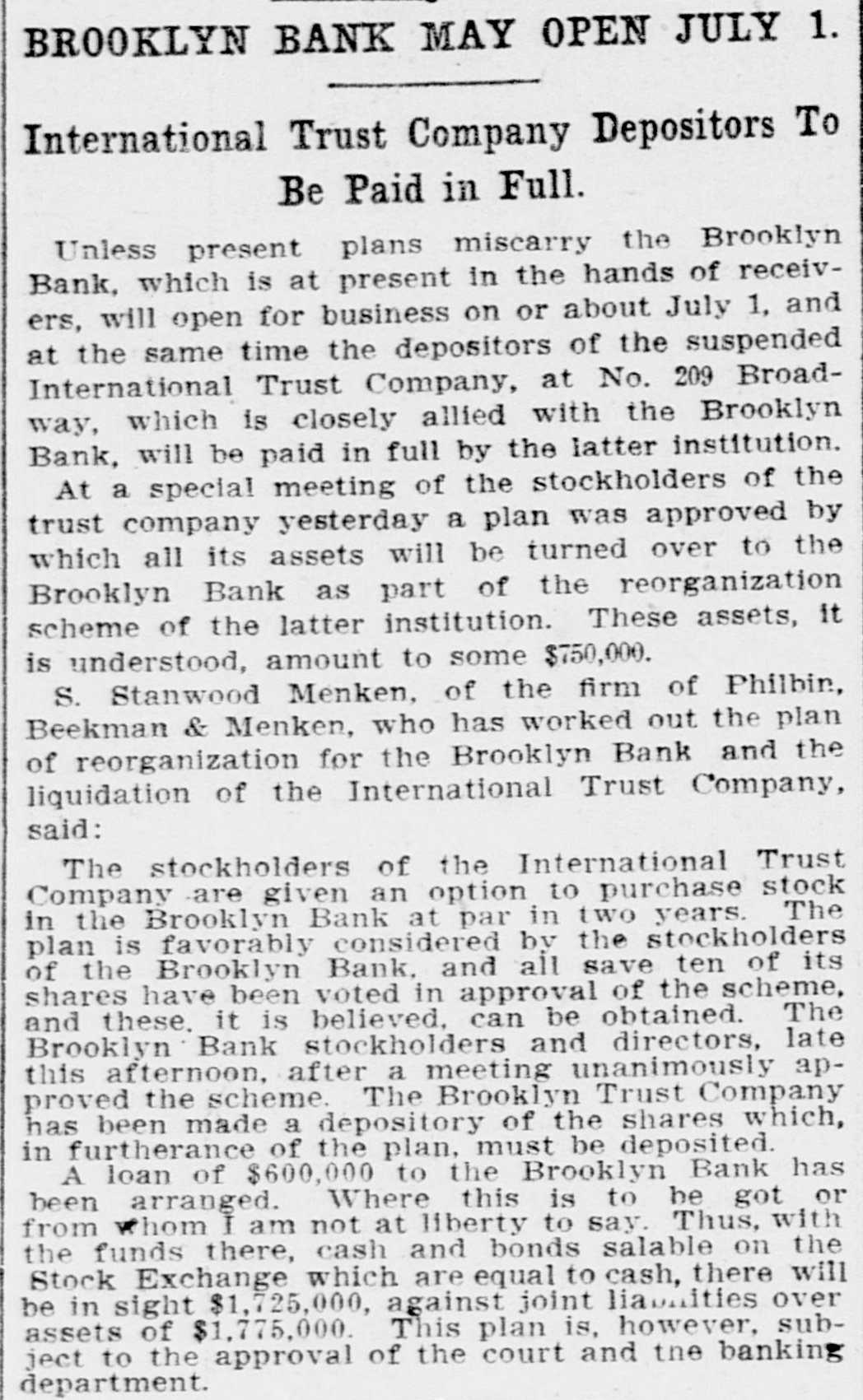
BROOKLYN BANK MAY OPEN JULY 1. International Trust Company Depositors To Be Paid in Full. Unless present plans miscarry the Brooklyn Bank, which is at present in the hands of receivers, will open for business on or about July 1, and at the same time the depositors of the suspended International Trust Company, at No. 209 Broadway, which is closely allied with the Brooklyn Bank, will be paid in full by the latter institution. At a special meeting of the stockholders of the trust company yesterday a plan was approved by which all its assets will be turned over to the Brooklyn Bank as part of the reorganization scheme of the latter institution. These assets, it is understood, amount to some $750,000. S. Stanwood Menken, of the firm of Philbin, Beekman & Menken, who has worked out the plan of reorganization for the Brooklyn Bank and the liquidation of the International Trust Company, said: The stockholders of the International Trust Company are given an option to purchase stock in the Brooklyn Bank at par in two years. The plan is favorably considered by the stockholders of the Brooklyn Bank, and all save ten of its shares have been voted in approval of the scheme, and these. it is believed, can be obtained. The Brooklyn Bank stockholders and directors, late this afternoon, after a meeting unanimously approved the scheme. The Brooklyn Trust Company has been made a depository of the shares which, in furtherance of the plan, must be deposited. A loan of $600,000 to the Brooklyn Bank has been arranged. Where this is to be got or from 'hom I am not at liberty to say. Thus, with the funds there, cash and bonds salable on the Stock Exchange which are equal to cash, there will be in sight $1,725,000, against joint liabilities over assets of $1,775,000. This plan is, however, subject to the approval of the court and the banking department.


Article from New-York Tribune, June 20, 1908

Click image to open full size in new tab

Article Text

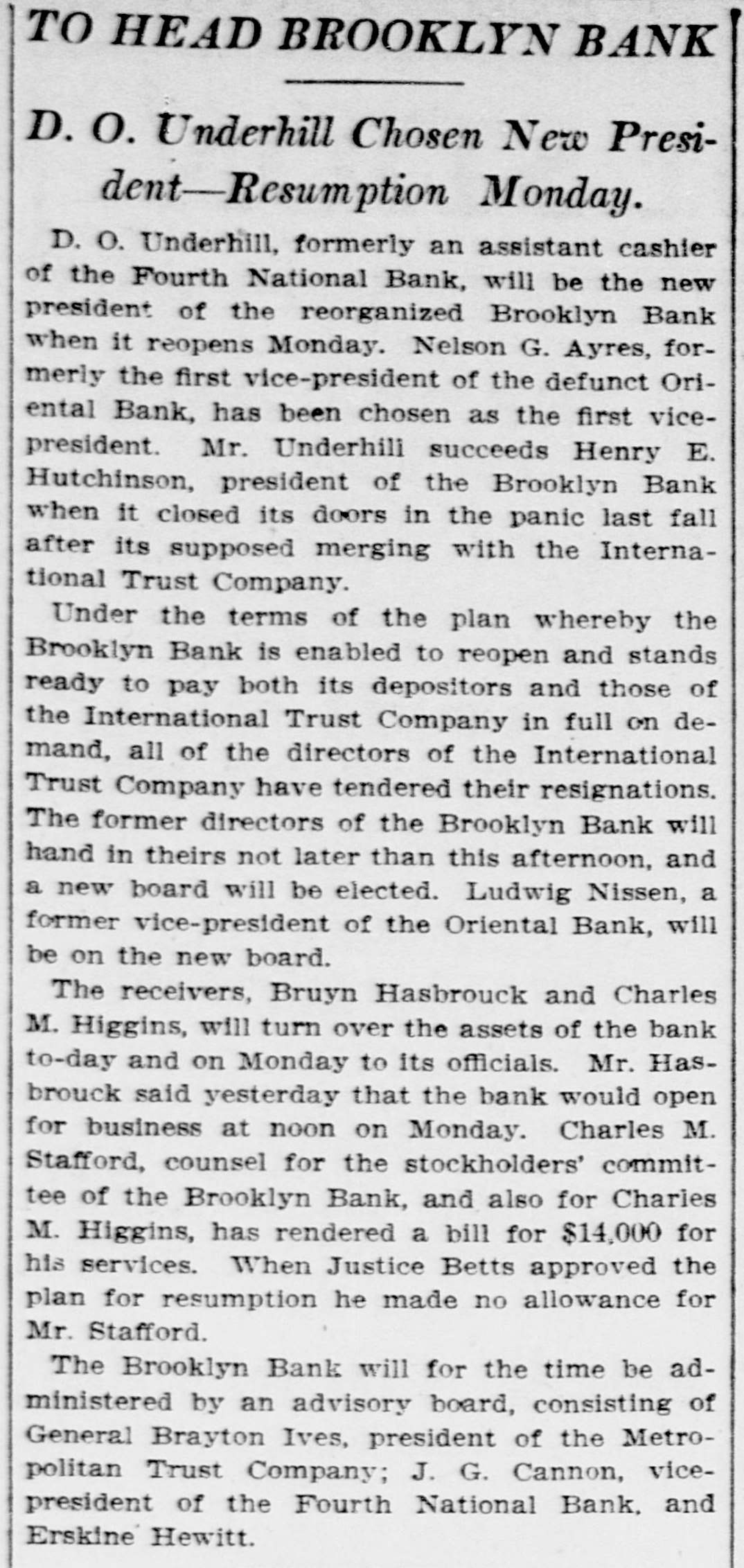
TO HEAD BROOKLYN BANK D. O. Underhill Chosen New President-Resumption Monday. D. O. Underhill, formerly an assistant cashier of the Fourth National Bank, will be the new president of the reorganized Brooklyn Bank when it reopens Monday. Nelson G. Ayres, formerly the first vice-president of the defunct Oriental Bank, has been chosen as the first vicepresident. Mr. Underhill succeeds Henry E. Hutchinson, president of the Brooklyn Bank when it closed its doors in the panic last fall after its supposed merging with the International Trust Company. Under the terms of the plan whereby the Brooklyn Bank is enabled to reopen and stands ready to pay both its depositors and those of the International Trust Company in full on demand, all of the directors of the International Trust Company have tendered their resignations. The former directors of the Brooklyn Bank will hand in theirs not later than this afternoon, and a new board will be elected. Ludwig Nissen, a former vice-president of the Oriental Bank, will be on the new board. The receivers, Bruyn Hasbrouck and Charles M. Higgins, will turn over the assets of the bank to-day and on Monday to its officials. Mr. Hasbrouck said yesterday that the bank would open for business at noon on Monday. Charles M. Stafford, counsel for the stockholders' committee of the Brooklyn Bank, and also for Charles M. Higgins, has rendered a bill for $14,000 for his services. When Justice Betts approved the plan for resumption he made no allowance for Mr. Stafford. The Brooklyn Bank will for the time be administered by an advisory board, consisting of General Brayton Ives, president of the Metropolitan Trust Company; J. G. Cannon, vicepresident of the Fourth National Bank, and Erskine Hewitt.


Article from The Lake County Times, June 24, 1908

Click image to open full size in new tab

Article Text

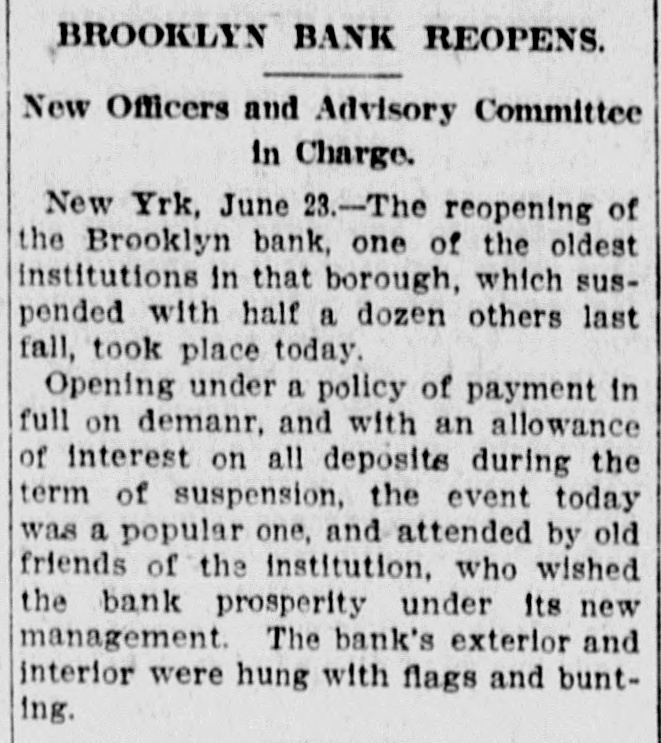
THE CREAM OF THE Morning News Second day of intense heat claims an increased toll of details and postrations, but relief is promised today. Several arrests are near in the federal grand jury's investigation of corporations controlled by Rhodus brothers. Late Michael C. McDonald's estate tied up by a restraining order issued by Judge Landis. Juror in Northwestern Railroad sondemnation suit tells court of remark attributed to foreman of the jury that some one might get a job if a favorable verdict was returned. Householders are puzzled by the news system of street numbering adopted by the council. James S. Sherman, republican nominee for vice president, taken to Cleveland hospital for treatment, improves and operation is deemed unnescessary. Secretary Taft attends the Yale-Harvard ball game and is given an enthusiastic reception by the alumni. Hitcheock declined to be considered for national committee chairman to save Taft from embarrassment because of Vory's petition. W. J. Bryan Cays the republican platform is a silent repudiation of President Roosevelt's policies and is a victory for the standpatters. Georgia delegation to national convention starts a boom for Colonel J. Hamilton Lewis for vice president. William B. Leeds, former president of the Rock Island railroad, dies suddenly in Paris. Brooklyn bank of New York reopens its doors, marking another step toward obliterating traces of the panic. Grain values have a slight backset under the leadership of wheat; provisions steady to firm; cattle and hogs higher; sheep strong. American Car and Foundry company's report due tomorrow is expected to show big profits. Western railroads decide to cancel passes issued to steamship officials. Illinois state board of fire underwriters in session at Delavan, Wis. Charles Evans jr. of Evanston Academy is elected president of Western Inter-scholastic association. Meets Gordon Yule in finals at Skokie today.


Article from Lewiston Evening Teller, July 2, 1908

Click image to open full size in new tab

Article Text

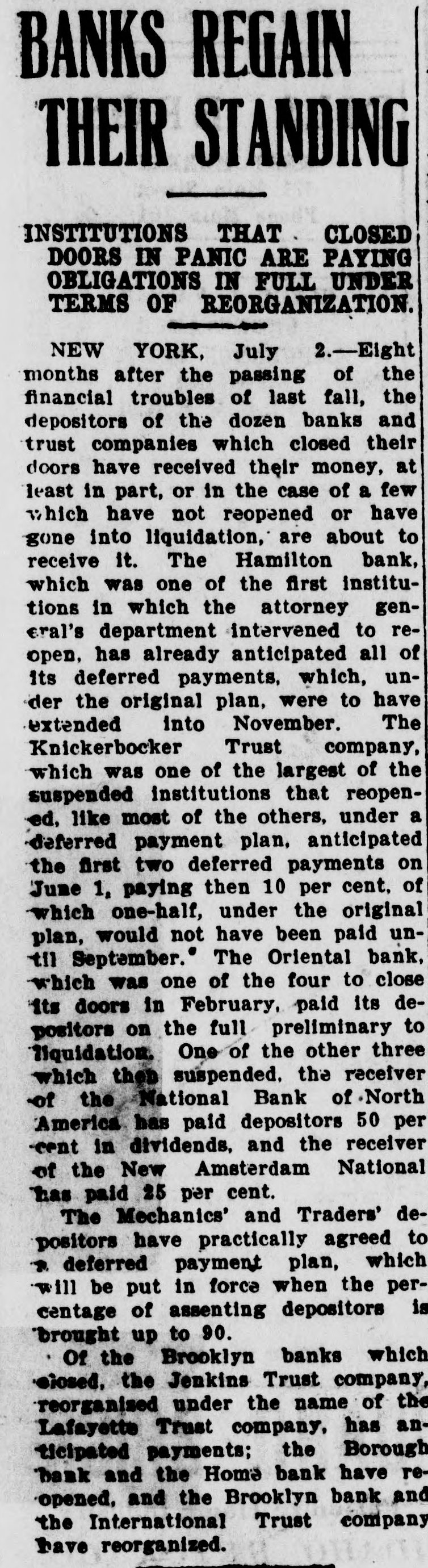
BANKS REGAIN THEIR STANDING INSTITUTIONS THAT CLOSED DOORS IN PANIC ARE PAYING OBLIGATIONS IN FULL UNDER TERMS OF REORGANIZATION. NEW YORK, July 2.-Eight months after the passing of the financial troubles of last fall, the depositors of the dozen banks and trust companies which closed their doors have received their money, at least in part, or in the case of a few which have not reopened or have gone into liquidation, are about to receive it. The Hamilton bank, which was one of the first institutions in which the attorney general's department intervened to reopen, has already anticipated all of its deferred payments, which, under the original plan, were to have extended into November. The Knickerbocker Trust company, which was one of the largest of the suspended institutions that reopened, like most of the others, under a deferred payment plan, anticipated the first two deferred payments on June 1, paying then 10 per cent, of which one-half, under the original plan, would not have been paid until September. The Oriental bank, which was one of the four to close its doors in February, paid its depositors on the full preliminary to liquidation. One of the other three which then suspended. the receiver of the National Bank of -North America has paid depositors 50 per -cent in dividends, and the receiver of the New Amsterdam National has paid 25 per cent. The Mechanics' and Traders' depositors have practically agreed to s deferred payment plan, which will be put in force when the percentage of assenting depositors is brought up to 90. Of the Brooklyn banks which elosed, the Jenkins Trust company, reorganized under the name of the Lafayette Trust company, has anticipated payments; the Borough 'hank and the Homa bank have reopened, and the Brooklyn bank and the International Trust company have reorganized.


Article from Lewiston Evening Teller, July 2, 1908

Click image to open full size in new tab

Article Text

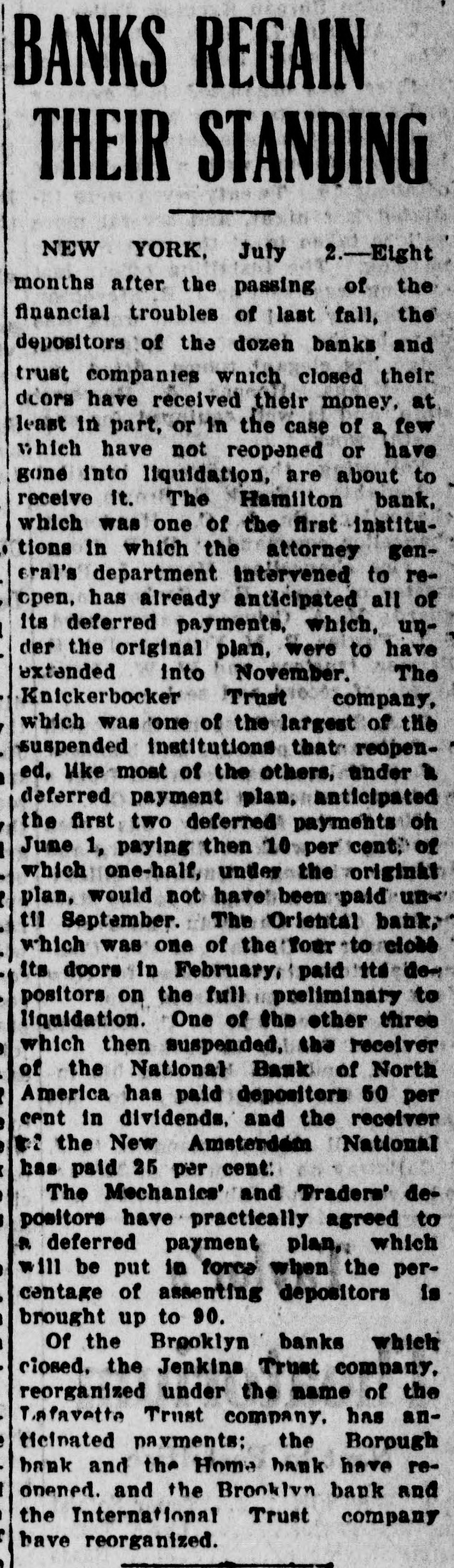
BANKS REGAIN THEIR STANDING NEW YORK, July 2.-Eight months after the passing of the financial troubles of last fall, the depositors of the dozen banks and trust companies which closed their doors have received their money, at least in part, or in the case of a few which have not reopened or have gone into liquidation, are about to receive it. The Hamilton bank, which was one of the first institutions in which the attorney general's department Intervened to reopen, has already anticipated all of its deferred payments, which, under the original plan, were to have extended into November. The Knickerbocker Trust company, which was one of the largest of the suspended institutions that reopened, like most of the others, under in deferred payment plan, anticipated the first two deferred payments oh June 1, paying then 10 per cent, of which one-half, under the original plan, would not have been paid until September. The Oriental bank, which was one of the four to close its doors in February, paid its de-: positors on the full preliminary to liquidation. One of the other three which then suspended, the receiver of the National Bank of North America has paid depositors 50 per cent in dividends, and the receiver to: the New Amsterdam National has paid 25 per cent: The Mechanics' and Traders' depositors have practically agreed to R. deferred payment plan, which will be put in force when the percentage of assenting depositors is brought up to 90. Of the Brooklyn banks which closed. the Jenkins Trust company, reorganized under the name of the T.afavette Trust company. has anticinated payments: the Borough bank and the Home bank have reonened. and the Brooklyn bank and the International Trust company have reorganized.


Article from The Julesburg Grit-Advocate, July 3, 1908

Click image to open full size in new tab

Article Text

Splendid Recovery of Banks Forced to Close by Panic 1 New York. June 30.-Eight months t after the passing of the financial troubles of last fall, the depositors of the dozen bank and trust companies which closed their doors have received their money at least in part, or in the case of the few which have not yet reopened or have gone into liquidation are about to receive it. The Hamilton bank, which was one of the first of the institutions in which the attorney general's department intervened to reopen, has already anticipated all of its deferred payments, which under the orginal plan were to have extended into November. The Knickerbocker Trust company, e which was the largest of the suspended institutions and reopened like 1 most of the others under a deferred payment plan, anticipated the first two deferred payments on June 1, paying then 10 per cent, of which one-half, under the orginal plan, would not have been paid until September. The Oriental bank, which was one of the four to close its doors in February, paid its depositors in full preliminary to liquidation. Of the other three which then suspended, the receiver of the National Bank of North America has paid depositors 50 per 1 dent in dividends and the receiver of the New Amsterdam National has paid 25 per cent. The Mechanics and Traders depositors have practically agreed to a de1 ferred payment plan, which will be put in force when the percentage of assenting depositors is brought up to 90. Of the Brooklyn banks which closed, the Jenkins Trust company, reorganized under the name of the Lafayette Trust company, has anticipated payments; The Borough bank and the Home bank have reopened, and the Brooklyn bank and the International Trust company have reorganized.


Article from The Sun, December 20, 1908

Click image to open full size in new tab

Article Text

C. M. HIGGINS RETURNS $4,000 PART OF HIS FEES AS RECEIVER OF BROOKLYN BANK. He Says That the Receivers Were Paid $11,581 In Excess, of the Legal Limit and That Their Counsel Received $5,000 In Excess of Their Contract. KINGSTON, N. Y., Dec. 19.-In an application made before Supreme Court Justice Betts to-day by Charles M. Higgins for his final discharge as receiver of the Brooklyn Bank and cancellation of his bond Mr. Higgins asks the Court to review the order heretofore granted fixing the fees of receivers and counsel, which he considers excessive. Mr. Higgins says in his affidavit that he returned $4,000 of the $15,000 received by him as coreceivership fees. Bruyn Hasbrouck of New Paltz was the other receiver and J. Edward Swanstrom and James C. Church the counsel for the receivers, $42,000 being allowed the receivers when the bank resumed business, and the counsel fees were $22,000. During the period of suspension the two receivers converted into cash securities amounting to $929,591.42. The expenses of the receivership were $141,128.17, which included $48,772.91 of preferred claims which were paid by court order. The total amount collected and disbursed was $1,216,734.60, and the maximum statutory fees would have been $30,418.86. He contends that the amount received was $11,581.64 in excess of the legal limit. Mr. Higgins figured his own excess at $4,000, which he returned to the bank, I according to his affidavit. He sets up a contract the receivers had with their counsel whereby the counsel were to do the legal work for twelve months for $14,000, their fees to be proportionately less in case the contract or receivership I should terminate sooner. The contract, t known only to counsel, was never mentioned by them, they accepting $22,000 as I counsel fee. Mr. Higgins alleges that counsel violated their duties, that the payments were irregular and improper and that he would be unfaithful to his trust should he fail to call the Court's attention to the illegal and excessive payments, and he asks the Court to review them. Charles M. Stafford of Brooklyn represented Mr. Higgins. He said Attorneyt General Jackson was critically ill in h Albany, but failed to understand why / James C. Church and J. Edward Swanstrom, counsel for the receivers. failed to appear and answer to the charges. A representative of the legal firm of Philbin, Beekman & Menkin of New York city, attorneys for the bank. asked that H sufficient time be allowed the bank's exT perts to examine the accounts of the reh ceivers. The matter was adjourned B until December 28, permission being given T to examine the books of the bank while tl in charge of the receivers, such examiLA nation to begin Monday. S


Article from New-York Tribune, December 31, 1908

Click image to open full size in new tab

Article Text

FEW EXCISE CONVICTIONS. Witness Tells Kings County Investigators of Magistrates' Courts. Magistrates of Kings and Queens counties will be called to testify before Governor Hughes's special commission for the investigation of the lower courts, because of testimony placed before that body in Brooklyn yesterday. William K. Van Mater, counsel for the state's excise commission in those counties, under a cross-fire of questions from ex-Attorney General Julius M. Mayer, who conducted the examination, said that conditions in the Magistrates' Courts and the Court of Special Sessions made convictions for excise violations a rarity, resulting in a big unlicensed liquor trade in Brooklyn and the subarbs of Queens. An affidavit by ex-Receiver Hasbrouck reviewed his work. his disagreements with Mr. Higgins. and took credit for originating the plan under which the Brooklyn Bank has resumed business. For the bank. Morton G. Rogue. of Philbin, Beekman and Menkin. said the bank took no position in the matter, but would accept any money returned. Mr. Stafford, in reply. said he alone was entitled to credit for the resumption plan. and deprecated the harsh language used during the hearing. Everybody thereupon deprecated the strong language used and advised the court to impose censure, but none of the statements made was withdrawn. Justice Betts extended the bank's time to examine the receivers' accounts until January 9. and reserved decision on Mr. Higgins's application.


Article from Evening Journal, April 7, 1910

Click image to open full size in new tab

Article Text

Financial and Commercial F.D. Lackey & Co. states to-day: "After the strength displayed during yesterday's market, the recession that occurred in this morning's early dealing was somewhat surprising, but the bulk of the selling came from the professional plungers who were working for a break. The market at this writing has partially recovered its early losses and with public sentiment improving, and the larger interests willing to buy stocks on recessions, it looks as if the turn for the better marketwise had been started. Such stocks as Steel, Reading. Union and Southern Pacific are all in strong hands and on any buying of importance the whole market will quickly advance." C. I. Hudson, and Co. stated at noon: "Various considerations suggest caution. The Brooklyn Bank suspension so soon after the previous one, was something of a factor in stocks. This matter is purely local and need not be taken very seriously. We are not yet out of the woods on labor matters. but an early adjustment is likely. Crop news is generally reassuring and the government report is expected to eb-fairly good. It is now generally believed that something important is pending in conection with Great Northern. perhaps the long expected bond issue, to take over Northern Pacific's half interest in Burlington. But we have no facts yet."