First National Bank (New York, NY)

Episode Information

Episode Type
Suspension โ†’ Reopening
Start Date
October 25, 1907
Location
New York, New York (40.714, -74.006)
Bank Type
national
Charter Number
29

Metadata

Notes

This First National is the Williamsburg (Broadway & Kent Ave.) branch in New York City and was placed in receivership Oct 25, 1907 then reopened Feb 1908.

Events (4)

1. July 21, 1863 Chartered
Source
historical_nic
2. October 25, 1907 Suspension
Cause
Bank Specific Adverse Info
Cause Details
Forced into the hands of a receiver (closure due to failure/insolvency during 1907 panic).
Newspaper Excerpt
It closed on October 25, when it was forced into the hands of a receiver.
Source
newspapers
3. October 25, 1907 Receivership
Newspaper Excerpt
It closed on October 25, when it was forced into the hands of a receiver.
Source
newspapers
4. February 10, 1908 Reopening
Newspaper Excerpt
After being closed for more than three months, the First National Bank ... reopened yesterday morning.
Source
newspapers

Newspaper Articles (4)

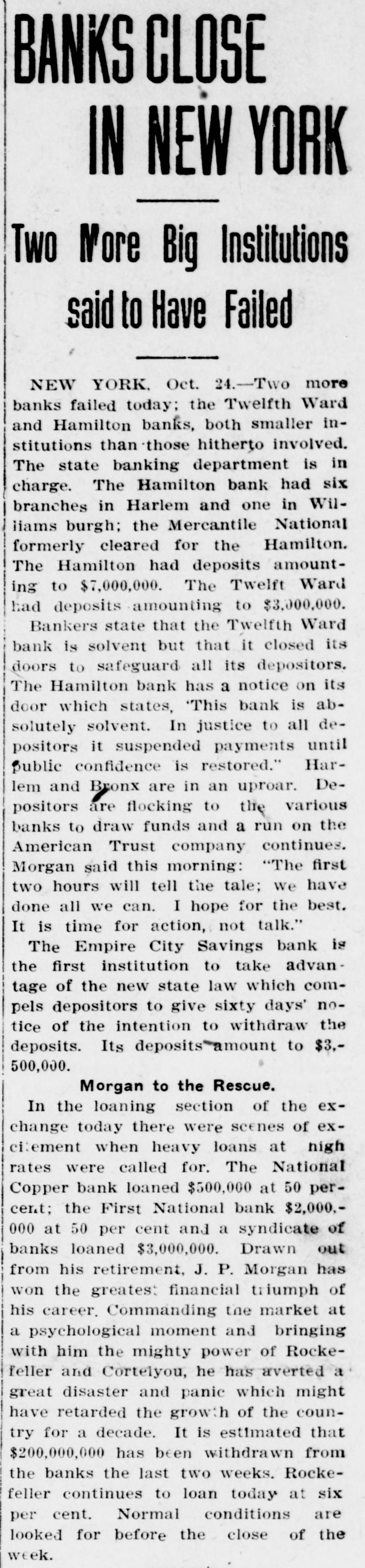
Article from The Evening Statesman, October 24, 1907

Click image to open full size in new tab

Article Text

BANKS CLOSE IN NEW YORK Two More Big Institutions said to Have Failed NEW YORK. Oct. 24.-Two more banks failed today; the Twelfth Ward and Hamilton banks, both smaller institutions than those hitherto involved. The state banking department is in charge. The Hamilton bank had six branches in Harlem and one in Wiliiams burgh; the Mercantile National formerly cleared for the Hamilton. The Hamilton had deposits amounting to $7,000,000. The Twelft Ward had deposits amounting to $3,000,000. Bankers state that the Twelfth Ward bank is solvent but that it closed its doors to safeguardo all its depositors. The Hamilton bank has a notice on its door which states, 'This bank is absolutely solvent. In justice to all depositors it suspended payments until public confidence is restored." Harlem and Bronx are in an uproar. Depositors are flocking to the various banks to draw funds and a run on the American Trust company continues. Morgan said this morning: "The first two hours will tell the tale; We have done all we can. I hope for the best. It is time for action, not talk." The Empire City Savings bank is the first institution to take advantage of the new state law which compels depositors to give sixty days' notice of the intention to withdraw the deposits. Its deposits"amount to $3.500,000. Morgan to the Rescue. In the loaning section of the exchange today there were scenes of excitement when heavy loans at high rates were called for. The National Copper bank loaned $500,000 at 50 percent; the First National bank $2,000.000 at 50 per cent and a syndicate of banks loaned $3,000,000. Drawn out from his retirement, J. P. Morgan has won the greates: financial triumph of his career. Commanding the market at a psychological moment and bringing with him the mighty power of Rockefeller and Cortelyou, he has averted a great disaster and panic which might have retarded the growth of the country for a decade. It is estimated that $200,000,000 has been withdrawn from the banks the last two weeks. Rockefeller continues to loan today at six per cent. Normal conditions are looked for before the close of the week.
Article from New-York Tribune, February 11, 1908

Click image to open full size in new tab

Article Text

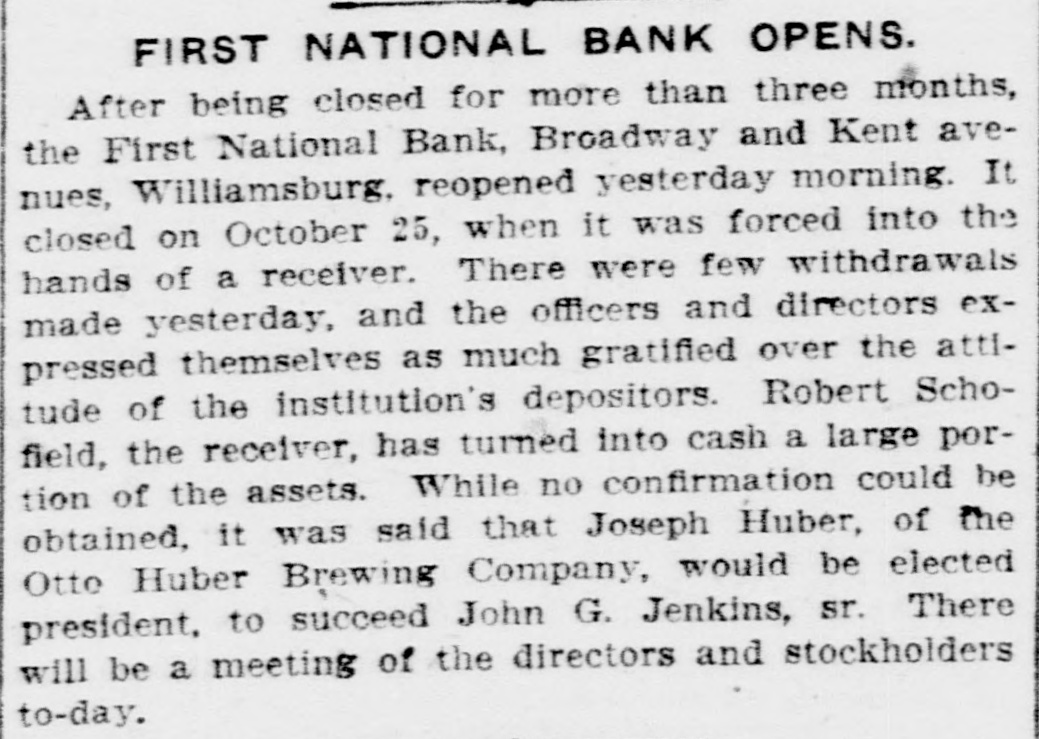
FIRST NATIONAL BANK OPENS

After being closed for more than three months, the First National Bank, Broadway and Kent avenues, Williamsburg. reopened yesterday morning. It closed on October 25, when it was forced into the hands of a receiver. There were few withdrawals made yesterday, and the officers and directors expressed themselves as much gratified over the attitude of the institution's depositors. Robert Schofield, the receiver, has turned into cash a large portion of the assets. While no confirmation could be obtained, it was said that Joseph Huber, of the Otte Huber Brewing Company, would be elected president, to succeed John G. Jenkins, sr. There will be a meeting of the directors and stockholders to-day.


Article from The Detroit Times, June 14, 1912

Click image to open full size in new tab

Article Text

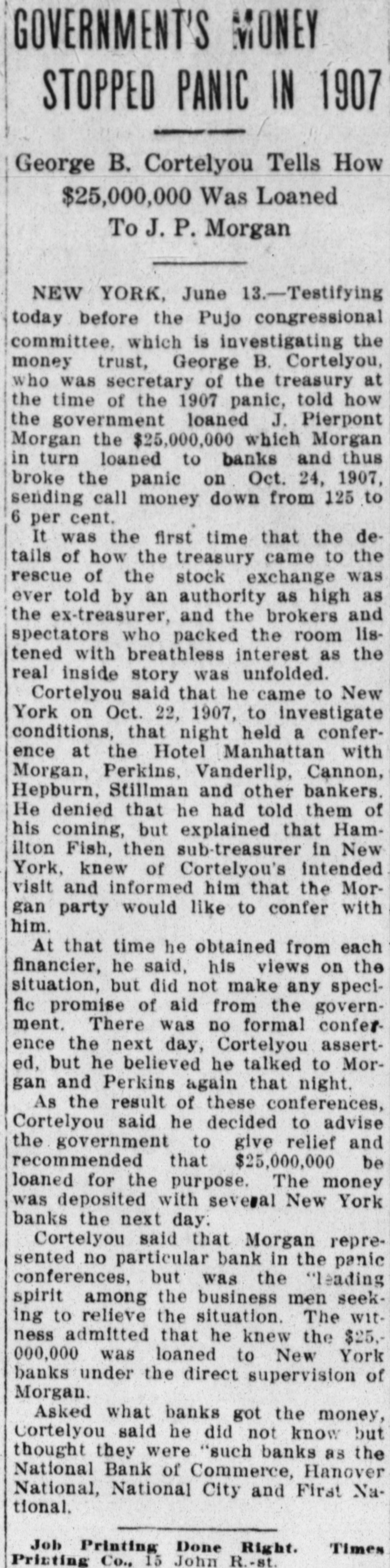
GOVERNMENT'S MONEY STOPPED PANIC IN 1907 George B. Cortelyou Tells How $25,000,000 Was Loaned To J. P. Morgan NEW YORK, June 13.-Testifying today before the Pujo congressional committee. which is investigating the money trust, George B. Cortelyou, who was secretary of the treasury at the time of the 1907 panic, told how the government loaned J. Pierpont Morgan the $25,000,000 which Morgan in turn loaned to banks and thus broke the panic on Oct. 24, 1907, sending call money down from 125 to 6 per cent. It was the first time that the details of how the treasury came to the rescue of the stock exchange was ever told by an authority as high as the ex-treasurer, and the brokers and spectators who packed the room listened with breathless interest as the real inside story was unfolded. Cortelyou said that he came to New York on Oct. 22, 1907, to investigate conditions, that night held a conference at the Hotel Manhattan with Morgan, Perkins, Vanderlip, Cannon, Hepburn, Stillman and other bankers. He denied that he had told them of his coming, but explained that Hamilton Fish, then sub-treasurer in New York, knew of Cortelyou's intended visit and informed him that the Morgan party would like to confer with him. At that time he obtained from each financier, he said, his views on the situation, but did not make any specific promise of aid from the government. There was no formal conference the next day, Cortelyou asserted, but he believed he talked to Morgan and Perkins again that night. As the result of these conferences, Cortelyou said he decided to advise the government to give relief and recommended that $25,000,000 be loaned for the purpose. The money was deposited with several New York banks the next day: Cortelyou said that Morgan represented no particular bank in the panic conferences, but was the "leading spirit among the business men seeking to relieve the situation. The witness admitted that he knew the $25,000,000 was loaned to New York banks under the direct supervision of Morgan. Asked what banks got the money, Cortelyou said he did not know but thought they were "such banks as the National Bank of Commerce, Hanover National, National City and First National. Job Printing Done Right. Times Printing Co., 15 John R.-st.


Article from The Washington Times, December 9, 1913

Click image to open full size in new tab

Article Text

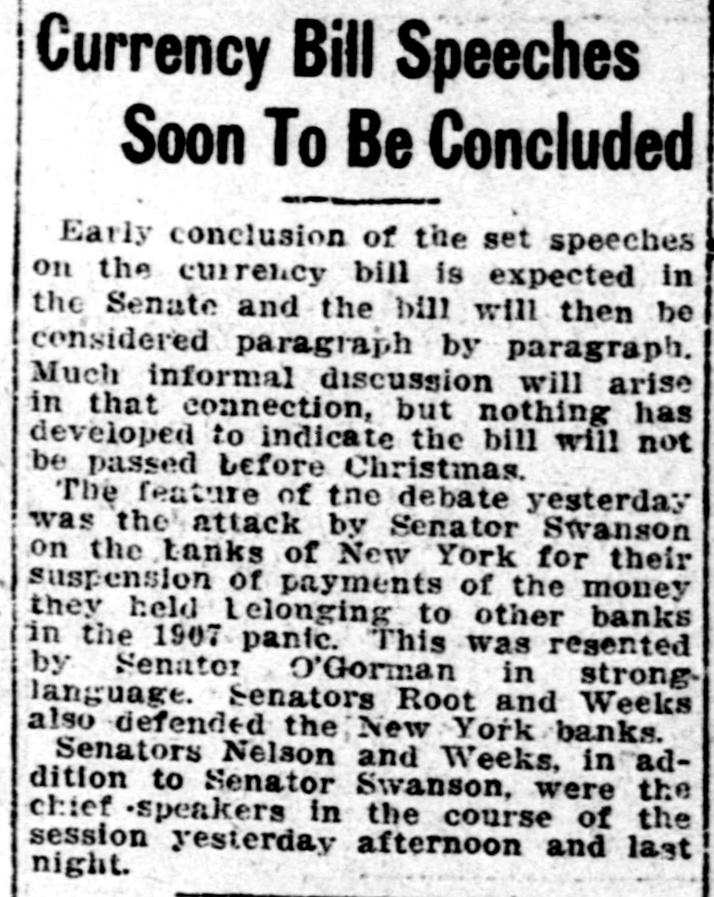
Currency Bill Speeches Soon To Be Concluded

Early conclusion of the set speeches on the currency bill is expected in the Senate and the bill will then be considered paragraph by paragraph. Much informal discussion will arise in that connection, but nothing has developed to indicate the bill will not be passed before Christmas.

The feature of the debate yesterday was the attack by Senator Swanson on the banks of New York for their suspension of payments of the money they held belonging to other banks in the 1907 panic. This was resented by Senator O'Gorman in strong language. Senators Root and Weeks also defended the New York banks. Senators Nelson and Weeks, in addition to Senator Swanson, were the chief speakers in the course of the session yesterday afternoon and last night.