Click image to open full size in new tab
Article Text
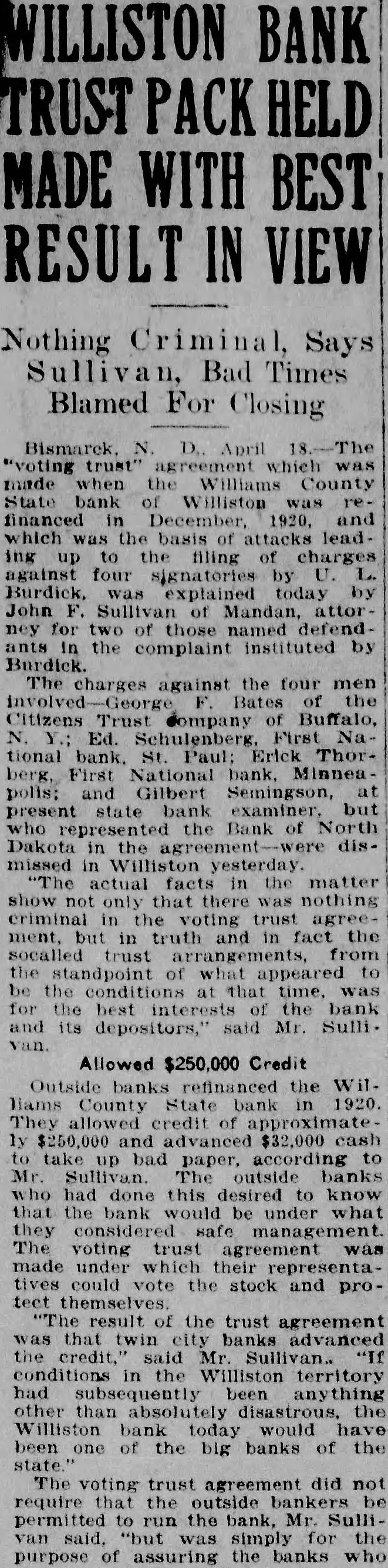
WILLISTON BANK TRUST PACK HELD MADE WITH BEST RESULT IN VIEW
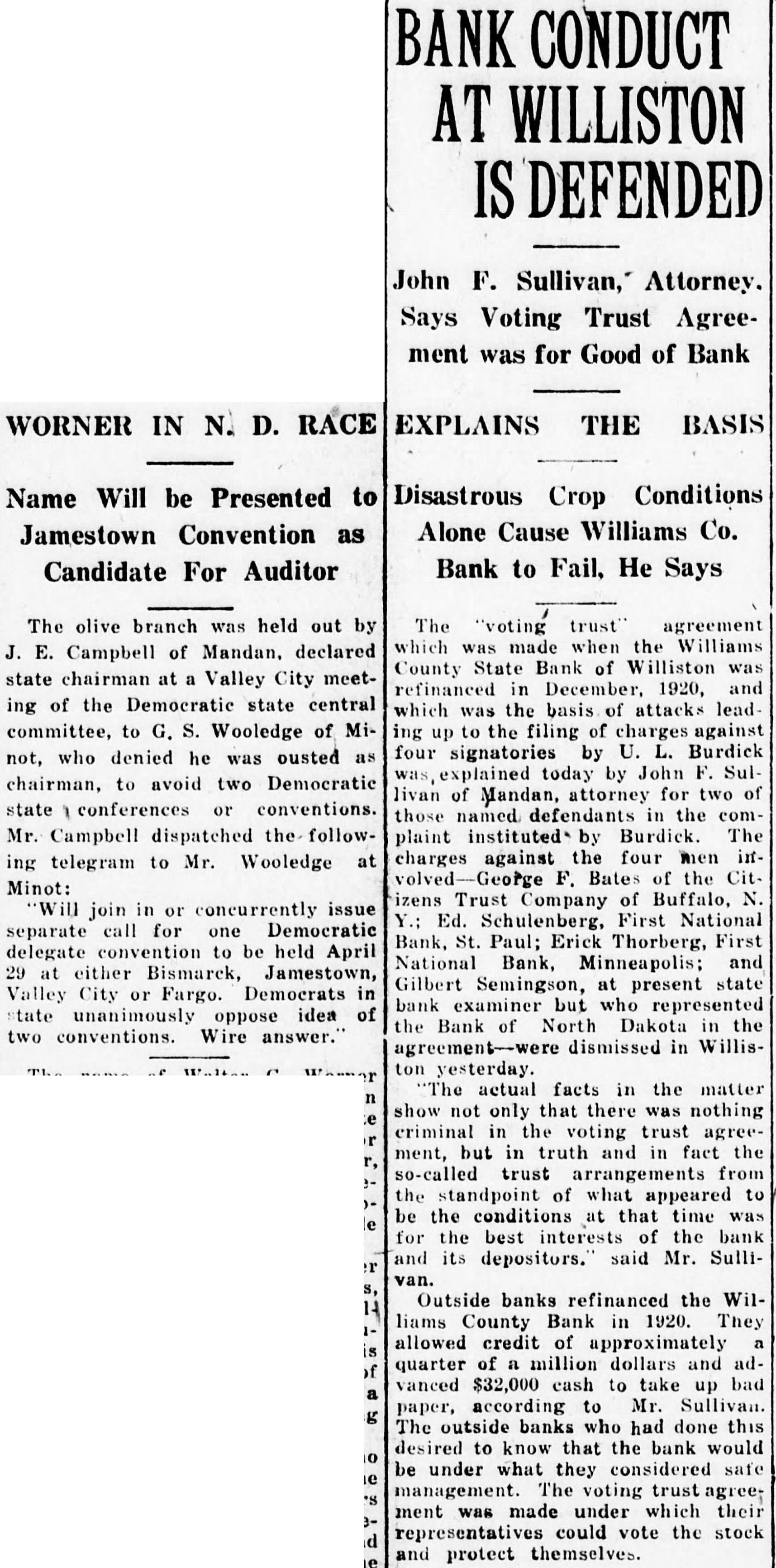
Nothing Criminal, Says Sullivan, Bad Times Blamed For Closing
Bismarck, N. D., April 18.—The "voting trust" agreement which was made when the Williams County State bank of Williston was refinanced in December, 1920, and which was the basis of attacks leading up to the filing of charges against four signatories by U. L. Burdick, was explained today by John F. Sullivan of Mandan, attorney for two of those named defendants in the complaint instituted by Burdick.
The charges against the four men involved—George F. Bates of the Citizens Trust company of Buffalo, N. Y.; Ed. Schulenberg, First National bank, St. Paul; Erick Thorberg, First National bank, Minneapolis; and Gilbert Semingson, at present state bank examiner, but who represented the Bank of North Dakota in the agreement—were dismissed in Williston yesterday.
"The actual facts in the matter show not only that there was nothing criminal in the voting trust agreement, but in truth and in fact the so-called trust arrangements, from the standpoint of what appeared to be the conditions at that time, was for the best interests of the bank and its depositors," said Mr. Sullivan.
Allowed $250,000 Credit
Outside banks refinanced the Williams County State bank in 1920. They allowed credit of approximately $250,000 and advanced $32,000 cash to take up bad paper, according to Mr. Sullivan. The outside banks who had done this desired to know that the bank would be under what they considered safe management. The voting trust agreement was made under which their representatives could vote the stock and protect themselves.
"The result of the trust agreement was that twin city banks advanced the credit," said Mr. Sullivan. "If conditions in the Williston territory had subsequently been anything other than absolutely disastrous, the Williston bank today would have been one of the big banks of the state."
The voting trust agreement did not require that the outside bankers be permitted to run the bank, Mr. Sullivan said, "but was simply for the purpose of assuring the banks who