gemini-3-flash-preview (chosen from majority vote of a three-model LLM ensemble)
Short Digest
01bb75f6991d13ee
Response Measures
Capital injected, Full suspension, Books examined
Other: The bank attempted to reorganize from a national bank to a state trust and savings bank to avoid federal oversight and hide insolvency. It also used a 'scrap of paper' check for $1,250,000 from the Central Trust Co. to deceive state examiners into believing it had sufficient capital.
Clearinghouse involved: Yes
(loan, examination, or other measures)
Description
The bank operated as a national bank until October 1912, when it reorganized as the La Salle Street Trust and Savings Bank to avoid federal oversight; the final failure occurred under the state charter following a run.
Events (6)
1.May 7, 1910Chartered
Source
historical_nic
2.October 21, 1912Other
Newspaper Excerpt
the bank forfeited its national charter and became a state institution.
Source
newspapers
3.October 21, 1912Voluntary Liquidation
Source
historical_nic
4.June 11, 1914Run
Cause
Bank Specific Adverse Info
Cause Details
A scandal involving State Auditor James J. Brady and allegations of political contributions from the bank triggered a loss of confidence.
Newspaper Excerpt
The run following the Brady scandal forced the action.
Source
newspapers
5.June 12, 1914Suspension
Cause
Bank Specific Adverse Info
Cause Details
The bank was forced to close due to a run and the discovery of significant 'dead' or worthless assets and improper loans to Lorimer's enterprises.
Newspaper Excerpt
late last week, when the institution closed its doors, believed their savings had been swept away.
Source
newspapers
6.June 19, 1914Receivership
Newspaper Excerpt
W. C. Niblack, vice president of the Chicago Title and Trust Company, was named as receiver for the LaSalle Street Bank this morning
Source
newspapers
Newspaper Articles (22)
1.June 17, 1914The Day BookChicago, IL
Click image to open full size in new tab
Article Text
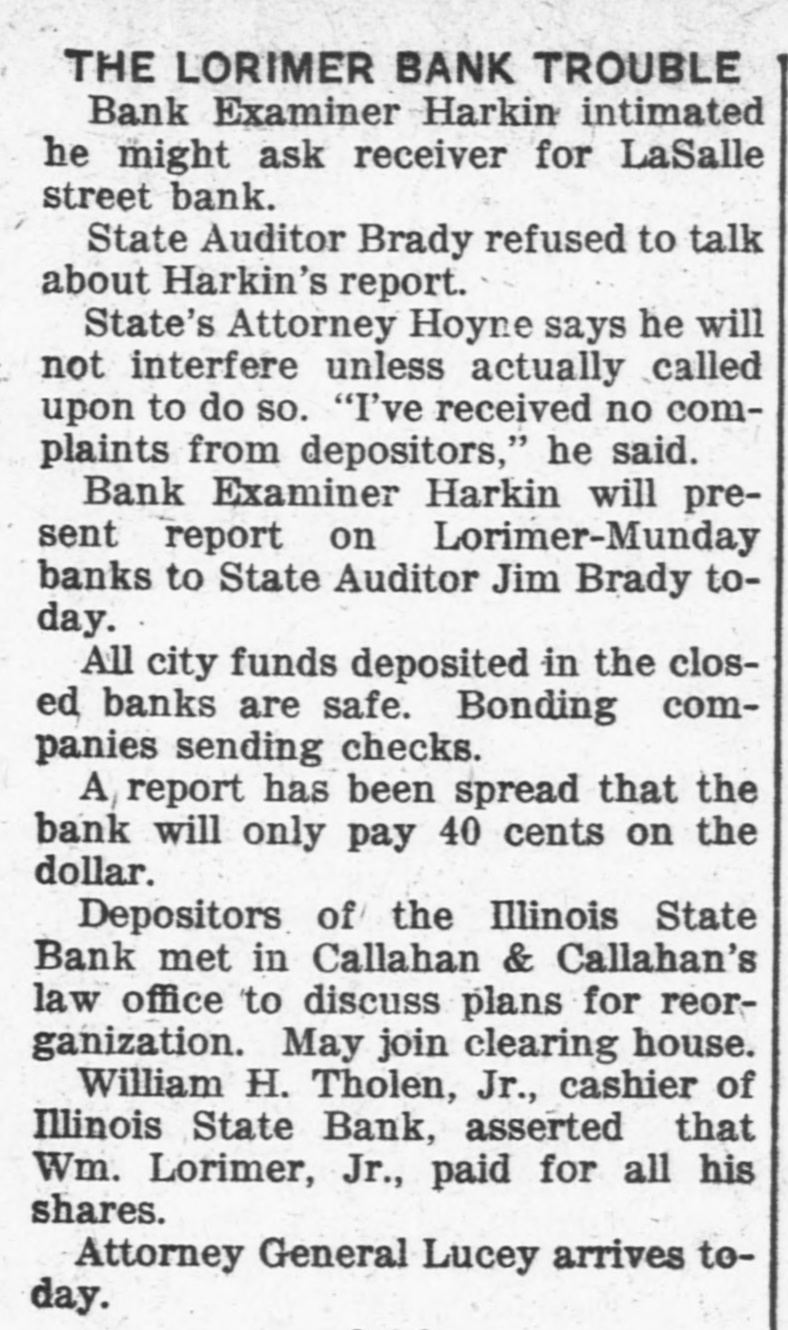
THE LORIMER BANK TROUBLE Bank Examiner Harkin intimated he might ask receiver for LaSalle street bank. State Auditor Brady refused to talk about Harkin's report. State's Attorney Hoyne says he will not interfere unless actually called upon to do so. "I've received no complaints from depositors," he said. Bank Examiner Harkin will present report on Lorimer-Munday banks to State Auditor Jim Brady today. All city funds deposited in the closed banks are safe. Bonding companies sending checks. A report has been spread that the bank will only pay 40 cents on the dollar. Depositors of the Illinois State Bank met in Callahan & Callahan's law office to discuss plans for reorganization. May join clearing house. William H. Tholen, Jr., cashier of Illinois State Bank, asserted that Wm. Lorimer, Jr., paid for all his shares. Attorney General Lucey arrives today.
2.June 17, 1914Rock Island ArgusRock Island, IL
Click image to open full size in new tab
Article Text
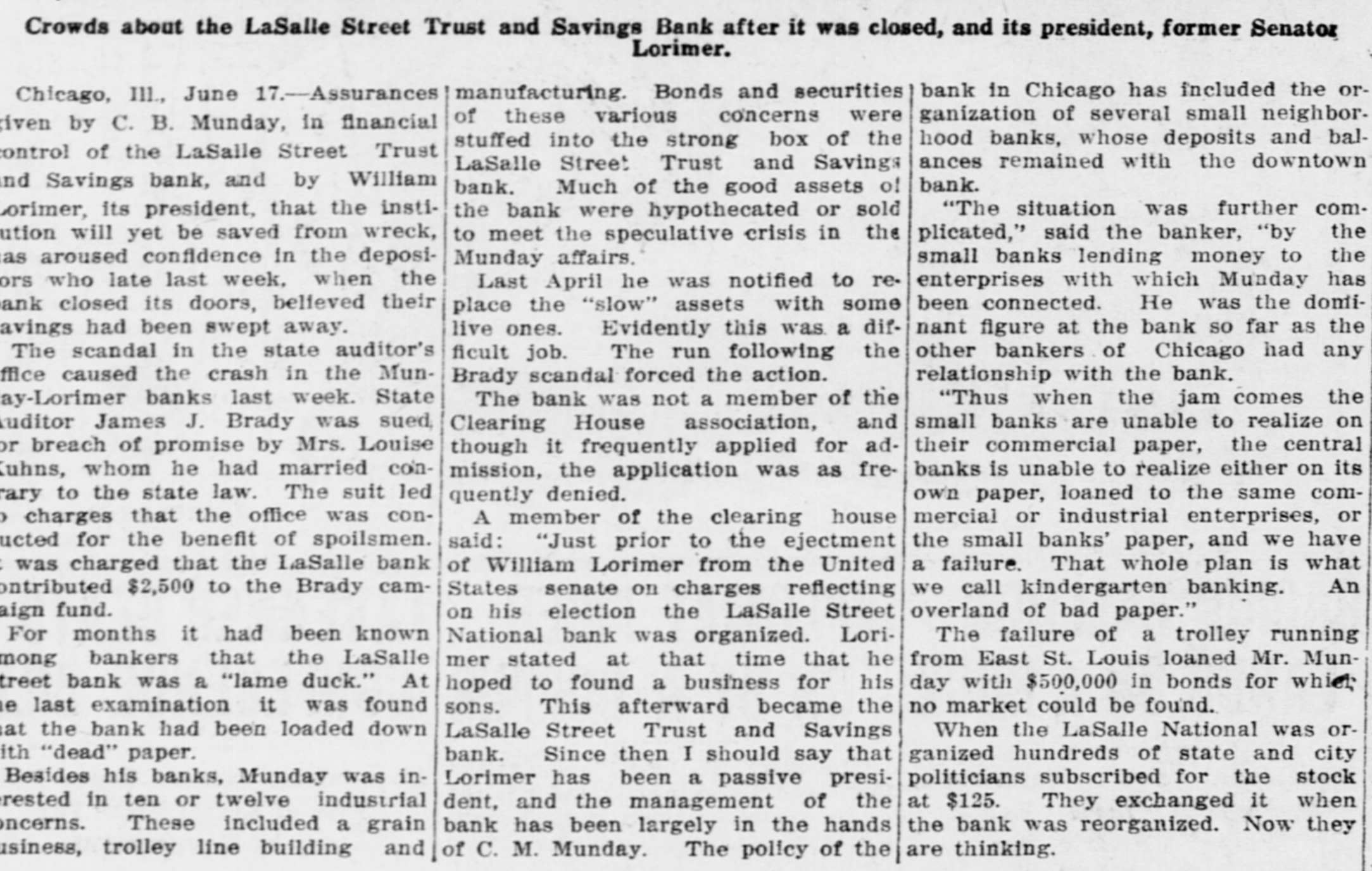
Crowds about the LaSalle Street Trust and Savings Bank after it was closed, and its president, former Senator Lorimer. bank in Chicago has included the ormanufacturing. Bonds and securities Chicago, Ill., June 17.-Assurances of these various concerns were ganization of several small neighborby C. B. Munday, in financial hood banks, whose deposits and balstuffed into the strong box of the ontrol of the LaSalle Street Trust ances remained with the downtown LaSalle Street Trust and Savings Savings bank, and by William bank. bank. Much of the good assets of "The situation was further comLorimer, its president, that the instithe bank were hypothecated or sold ution will yet be saved from wreck, plicated," said the banker, "by the to meet the speculative crisis in the aroused confidence in the deposismall banks lending money to the Munday affairs. who late last week, when the enterprises with which Munday has Last April he was notified to rebeen connected. He was the domiiclosed its doors, believed their place the "slow" assets with some nant figure at the bank so far as the avings had been swept away. live ones. Evidently this was a difThe scandal in the state auditor's other bankers of Chicago had any ficult job. The run following the ffice caused the crash in the Munrelationship with the bank. Brady scandal forced the action. The bank was not a member of the "Thus when the jam comes the ay-Lorimer banks last week. State small banks are unable to realize on auditor James J. Brady was sued, Clearing House association, and their commercial paper, the central breach of promise by Mrs. Louise though it frequently applied for adbanks is unable to realize either on its Kuhns, whom he had married coinmission, the application was as freto the state law. The suit led own paper, loaned to the same comquently denied. mercial or industrial enterprises, or charges that the office was conA member of the clearing house ucted for the benefit of spoilsmen. the small banks' paper, and we have said: "Just prior to the ejectment of William Lorimer from the United was charged that the LaSalle bank a failure. That whole plan is what ontributed $2,500 to the Brady camwe call kindergarten banking. An States senate on charges reflecting fund. on his election the LaSalle Street overland of bad paper." For months it had been known The failure of a trolley running National bank was organized. Lorifrom East St. Louis loaned Mr. Munmer stated at that time that he mong bankers that the LaSalle treet bank was a "lame duck." At day with $500,000 in bonds for which hoped to found a business for his last examination it was found no market could be found. sons. This afterward became the the bank had been loaded down When the LaSalle National was orLaSalle Street Trust and Savings "dead" paper. ganized hundreds of state and city bank. Since then I should say that Besides his banks, Munday was inLorimer has been a passive presipoliticians subscribed for the stock rested in ten or twelve industrial at $125. They exchanged it when dent, and the management of the oncerns. These included a grain the bank was reorganized. Now they bank has been largely in the hands usiness, trolley line building and are thinking. of C. M. Munday. The policy of the
3.June 18, 1914Bryan Daily Eagle and PilotBryan, TX
Click image to open full size in new tab
Article Text
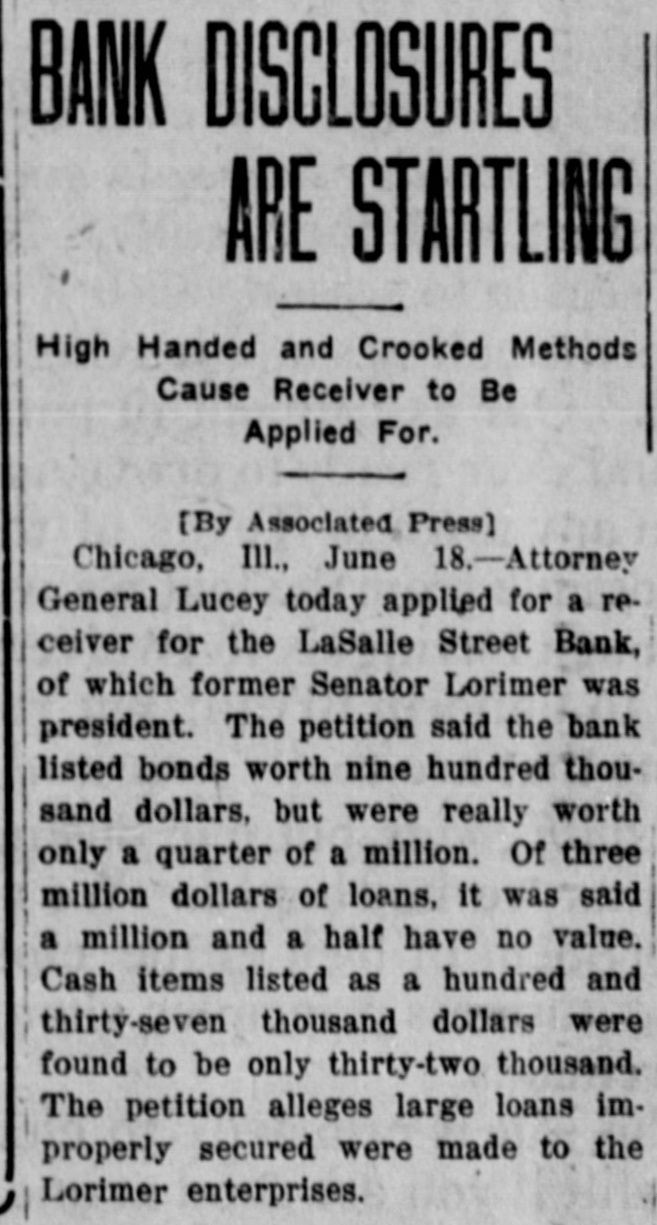
BANK DISCLOSURES ARE STARTLING High Handed and Crooked Methods Cause Receiver to Be Applied For. [By Associated Press] Chicago, III., June 18.-Attorney General Lucey today applied for a receiver for the LaSalle Street Bank, of which former Senator Lorimer was president. The petition said the bank listed bonds worth nine hundred thousand dollars, but were really worth only a quarter of a million. Of three million dollars of loans, it was said a million and a half have no value. Cash items listed as a hundred and thirty-seven thousand dollars were found to be only thirty-two thousand. The petition alleges large loans improperly secured were made to the Lorimer enterprises.
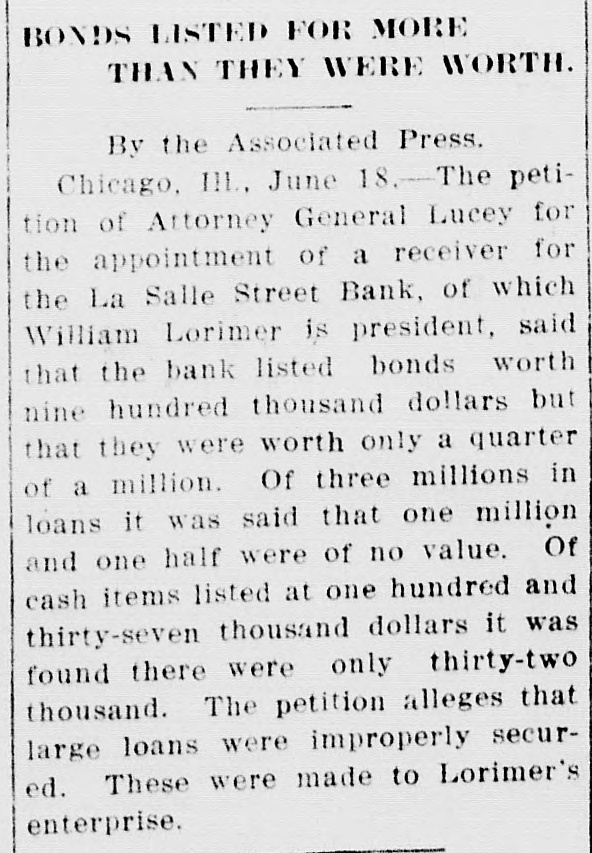
BONDS LISTED FOR MORE THAN THEY were WORTH. By the Associated Press. Chicago, III., June 18.-The petition of Attorney General Lucey for the appointment of a receiver for the La Salle Street Bank, of which William Lorimer is president, said that the bank listed bonds worth nine hundred thousand dollars but that they were worth only a quarter of a million. Of three millions in loans it was said that one million and one half were of no value. Of cash items listed at one hundred and thirty-seven thousand dollars it was found there were only thirty-two thousand. The petition alleges that large loans were improperly secured. These were made to Lorimer's enterprise.
5.June 18, 1914The Chickasha Daily ExpressChickasha, OK
Click image to open full size in new tab
Article Text
ASKS FOR RECEIVER B United Press. Chicago June 18.-Attorney General Lucey today formally applied for the appointment of a receiver for the LaSalle Street bank. He charged that the officials apropriated deposits for speculation and for their personal uses outside of their powers and that such action resulted in the bank becoming insolvent. Lucey made no allegation of criminal wrong-doing but asked that the receiver be given full power to investigate and liquidate the bank. No receiver was appointed today. In his petition Lucey stated that large loans had been made to Ex-Sentor Lorimer and his son on worthless security.
6.June 19, 1914The Daily ArdmoreiteArdmore, OK
Click image to open full size in new tab
Article Text
W. C. NIBLACK PUT IN CHARGE OF CLOSED INSTITUTION THIS MORNING. UNDER A HEAVY BOND Receiver Gives Bond of Two and AHalf Million Dollars. Lorrimer's Secretary on Note for Hundred SixtyNine Thousand. Chicago, III., June 19.-W. C. Niblack vice president of the Chicago Title & Trust Company, was named as receiver for the LaSalle Street bank this morning, and is now under two and one-half million dollars bond. Among the bank's assets found today was an unsecured personal note for one hundred and sixty-nine thousand dollars signed with the name of Charles E. Ward. Ward today said he never borrowed a cent. Ward was the private secretary of Lorimer, when the latter was United States Senator. Lorimer was president of the LaSalle bank.
7.June 19, 1914Bryan Daily Eagle and PilotBryan, TX
Click image to open full size in new tab
Article Text
MORE CROOKEDNESS IN LA SALLE BANK Bank of Which the "Blonde Boss" Was President Was Looted to a Finish. . [By Associated Press] Chicago, III., June 19.-W. C. Niblack, vice president of the Chicago Title and Trust Company, was named as receiver for the LaSalle Street Bank this morning under a $2,500,000 bond. Among the bank's assets was found an unsecured personal note for $169,000 signed with the name of Charles E. Ward. Ward today said he never borrowed any money. Ward was the private secretary of Lorimer when he was United States Senator. Lorimr was president of the LaSalle Street Bank.
8.June 19, 1914The Day BookChicago, IL
Click image to open full size in new tab
Article Text
LA SALLE STREET BANK MESS Att'y Gen. Lucey will probably call special grand jury to investigate La Salle Street Bank crash. Lorimer and Munday will have chance of testifying before this jury if they waive immunity. Lucey's application for receivership will be heard today. In his petition he called bank "insolvent" and intimated fraud. The Tribune is already boosting a couple of men for job of receiver. Lucey says he has no choice. Three more receivers named for Chas. B. Munday enterprises. State will investigate all surety companies. Munday resigned as treasurer of Rosehill Cemetery.
9.June 20, 1914The Day BookChicago, IL
Click image to open full size in new tab
Article Text
ACTION SOON IN BANK MESS Ass't State's Attorneys Chas. C. Case, Jr., and George C. Bliss have been appointed by Hoyne to handle Lorimer bank case. Receiver $2,500,000 bond approved approved by Judge Windes. It is rumored that evidence has been found by Hoyne that will show bank took deposits two days after becoming insolvent. C. B. Munday predicted LaSalle street bank would re-open. Hoyne will investigate withdrawal of $374,000 by Marquette National Fire Insurance Co. from bank three days before the closing. Munday is interested in company. State's attorney will ask County Board for $20,000 special appropriation for this case. Lorimer quit Southern Traction Company. Receiver appointed for firm of C. B. Munday of Litchfield, Ill.
10.June 27, 1914The Seattle StarSeattle, WA
Click image to open full size in new tab
Article Text
ELSEWHERE Women lawyers of Illinois organize bar association. Battleship Kansas will carry body of Senor Don P. Ezequiel Rojas, minister of Venezuela, who died at Atlantic City, to La Guayra. Final conference report authorizIng sale of battleships Idaho and Mississippi to Greece, filed in senate. Maj. Gen. Leonard Wood will go to New York, to assume command of the Eastern department of the army. Special U.S. grand Jury will probe affairs of defunct La Salle Street National bank, at Chicago. Work of reorganizing the dry goods firm of H. B. Claflin Co., which went into receivers' hands at New York, under way. Merchants and jobbers promise support Gen. G. N. Whistler, who invented smokeless powder, died at Pensacola, Fla. America's exports exceeded its Imports in the past year by $653,000,000. President will appoint I. N. Morris, Chicago packer, minister to Sweden or Denmark. Diving, George L. Clark, formerly well-known athlete, struck his head on a rock and was killed at Willets, Cal.
11.June 28, 1914Evening StarWashington, DC
Click image to open full size in new tab
Article Text
PROBE OF CLOSED BANK Chicago Institution Accused of Profiting From Use of Worthless Paper. CHICAGO. June 27.-Investigation of events preceding the change of La Salle Street National Bank to a state institution will be the keynote of the government's inquiry into the closed bank's affairs, District Atterney Wilkerson said tonight. Charges have been made. to federal offi-. cials that good securities were substituted for worthless paper in the vaults of the national bank to enable It to pass the last inspection of government exam-. iners. These securities were withdrawn. as soon as the examiners left the bank, it is alleged. Before time for another examination the bank forfeited its national charter and became a state institution. Uneasiness caused by the failure of the five Lorimer-Munday banks is believed to be the cause of a run late today on the North Avenue State Bank. By 9 o'clock about $15,000 in small accounts had been withdrawn. Business men in the neighborhood expressed confidence in th institution and endeavored to reassure depositors lined up in front of the paying teller's window.
12.July 2, 1914The Tabor IndependentTabor, SD
Click image to open full size in new tab
Article Text
RECORDS IN BANK SCANDAL MISSING Chicago, June 29.-United States District Attorney Wilkerson and State's Attorney Hoyne are today searching for important documentary evidence bearing on the failure of the LaSalle Street Trust & Savings bank which are said to have disappeared from the office of the State Auditor James J. Brady. One of the documents is a report of a state bank examiner alleged to show that the Lorimer-Munday bank was in a shaky condition. The missing documents are wanted for use before grand juries. Chicago, June 29.-Federal grand jury inquiry into the conduct of the LaSalle Trust & Saving bank while it was a national institution, was set today for July 13, it was announced at the office of the United States district attorney. Depositors of the four small state banks in this city which were affiliated with the LaSalle Street bank and which closed at the same time as the Main Lorimer-Munday institution will all be paid in full, it was made known today by Daniel V. Harkin state bank examiner. The vault of the LaSalle State bank was scheduled to be opened today by the receiver. It was closed since it was sealed by Harkin when he ordered the bank to suspend. In the vault are about $40,000 in currency, it is said, and about the same sum in memoranda of cash withdrawn by Lorimer and Munday on their personal marker slips.
13.July 3, 1914The Birmingham Age-HeraldBirmingham, AL
Click image to open full size in new tab
Article Text
LASALLE BANK VIOLATED LAWS Chicago, July 2.-Government accountants today reported they had discovered the LaSalle Street National bank violated the national banking laws in September, 1912, by not having the required amount of deposits on hand. In that month, the accountants said, deposits were approximately $3,000,000 and the books show the cash on hand was $230,000. The law requires that the bank keep 25 per cent of deposits in its vaults. It is expected receivers will be appointed Monday for the four neighborhood banks which failed with the LaSalle street institution.
14.July 7, 1914The Daily Gate CityKeokuk, IA
Click image to open full size in new tab
Article Text
75 Cents on the Dollar. [United Press Leased Wire Service.) CHICAGO, July 7.-With a special federal grand jury called by Judge Landis for July 13 to consider the failure of the LaSalle Street bank so far as its career as a national bank was concerned, its depositors were cheered today by the statement from Receiver Niblack that the bank's depositors would receive at least 75 cents on a dollar. This statement was far more optimistic than earlier statements had admitted.
15.July 21, 1914Wausau PilotWausau, WI
Click image to open full size in new tab
Article Text
Name Receiver for School. Muncie, Ind., July 13.-The Muncie Normal institute, having an enrollment of 1,200 students, passed into the hands of a receiver as a result of the failure of the LaSalle Street bank of Chicago.
16.September 27, 1915The Madison Daily LeaderMadison, SD
Click image to open full size in new tab
Article Text
Files Suit for $1,250,000. Chicago, Sept. 27.-The present re. celver of the defunct La Salle street bank, the institution of which William Lorimer was president, has filed suit for the recovery of $1,250,000 alleged to have been manipulated in an improper manner. The suit is against the Central Trust company and ten men.
17.November 4, 1915Wood County ReporterWisconsin Rapids, WI
Click image to open full size in new tab
Article Text
FORGAN STOOD BY MUNDAY. Chicago Financier Says He Did All in Power to Avert Failure. Morris, III., Oct. 29.-James B. Forgan, president of the First National bank of Chicago, in testifying at the trial of Charles B. Munday, charged with bank wrecking, declared he did all in his power to avert the financial ruin of William Lorimer and Munday while the LaSalle Street National bank was on the road to destruction. Forgan warned them several times, he testified, and even when this advice was unheeded he stood by them and succeeded in prolonging their affiliation with the Chicago Clearing House association. Forgan went so far as to say that his bank might help liquidate the Lorimer-Munday institution and thus save the depositors' money. Forgan proved a valuable witness for the prosecution; despite efforts of the defense to show he was responsible for a "run" on the Lorimer-Munday bank just before it failed.
18.November 5, 1915Northern Wisconsin AdvertiserWabeno, WI
Click image to open full size in new tab
Article Text
FORGAN STOOD BY munday. Chicago Financier Says He Did All in Power to Avert Failure. Morris, Ill., Oct. 29.-James B. Forgan, president of the First National bank of Chicago, in testifying at the trial of Charles B. Munday, charged with bank wrecking, declared he did all in his power to avert the financial ruin of William Lorimer and Munday while the LaSalle Street National bank was on the road to destruction. Forgan warned them several times, he testified, and even when this advice was unheeded he stood by them and succeeded in prolonging their affiliation with the Chicago Clearing House association. Forgan went so far as to say that his bank might help liquidate the Lorimer-Munday institution and thus save the depositors' money. Forgan proved a valuable witness for the prosecution, despite efforts of the defense to show he was responsible for a "run" on the Lorimer-Munday bank just before it failed.
19.November 6, 1915The L'anse SentinelL'anse, MI
Click image to open full size in new tab
Article Text
FORGAN STOOD BY MUNDAY Chicago Financier Says He Did All in Power to Avert Failure of LaSalle Street Bank. Morris, III., Oct. 29.-James B. For. gan, president of the First National bank of Chicago, in testifying at the trial of Charles B. Munday, charged with bank wrecking, declared be did all in his power to avert the financial ruin of William Lorimer and Munday while the LaSalle Street National bank was on the road to destruction. Forgan warned them several times, he testified, and even when this advice was unheeded he stood by them and succeeded in prolonging their affiliation with the Chicago Clearing House association. Forgan went so far as to say that his bank might help liquidate the Lorimer-Munday institution and thus save the depositors' money. Forgan proved a valuable witness for the prosecution, despite efforts of the defense to show he was responsible for a "run" on the Lorimer-Munday bank just before it failed.
20.December 3, 1915The Jasper Weekly CourierJasper, IN
Click image to open full size in new tab
Article Text
FORGAN STOOD BY MUNDAY Chicago Financier Says He Did All in Power to Avert Failure of LaSalle Street Bank. Morris, III., Oct. 28.-James B. Forgan, president of the First National bank of Chicago, in testifying at the trial of Charles B. Munday, charged with bank wrecking, declared he did all in his power to avert the financial ruin of William Lorimer and Munday while the LaSalle Street National bank was on the road to destruction. Forgan warned them several times, he testified, and even when this advice was unheeded he stood by them and succeeded in prolonging their affiliation with the Chicago Clearing House association. Forgan went so far as to say that his bank might help liquidate the Lorimer-Munday institution and thus save the depositors' money. Forgan proved a valuable witness for the prosecution, despite efforts of the defense to show he was responsible for a "run" on the Lorimer-Munday bank just before it failed.
21.September 15, 1924St. Louis Post-DispatchSt. Louis, MO
Click image to open full size in new tab
Article Text
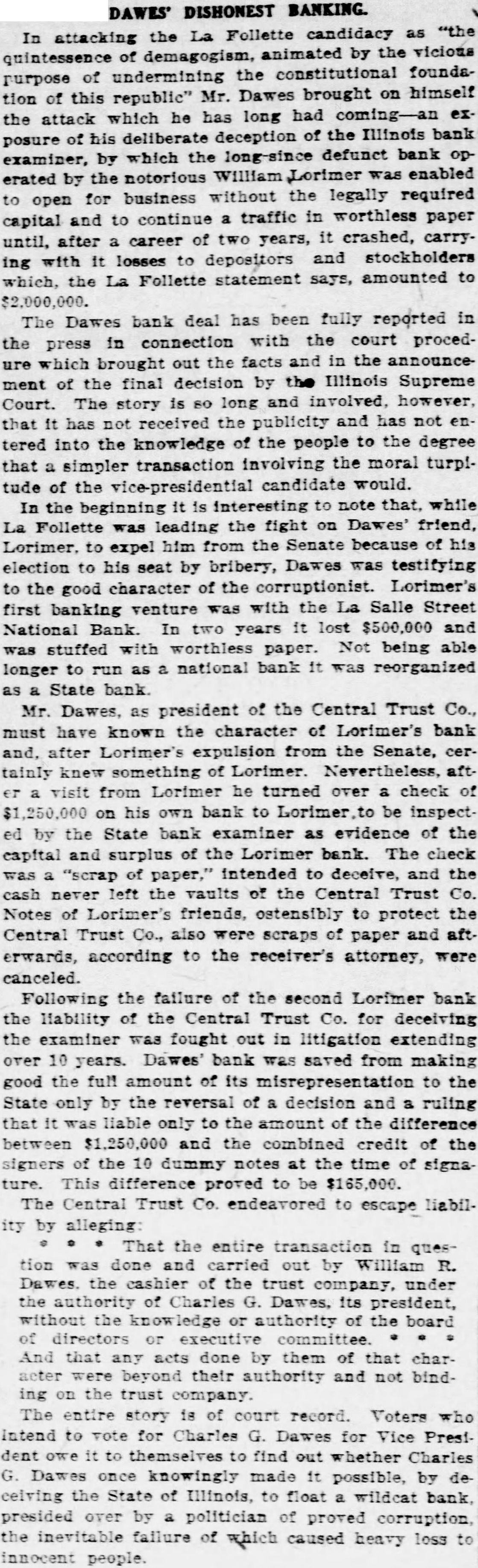
DAWES' DISHONEST BANKING.
In attacking the La Follette candidacy as "the quintessence of demagogism, animated by the vicious purpose of undermining the constitutional foundation of this republic" Mr. Dawes brought on himself the attack which he has long had coming—an exposure of his deliberate deception of the Illinois bank examiner, by which the long-since defunct bank operated by the notorious William Lorimer was enabled to open for business without the legally required capital and to continue a traffic in worthless paper until, after a career of two years, it crashed, carrying with it losses to depositors and stockholders which, the La Follette statement says, amounted to $2,000,000.
The Dawes bank deal has been fully reported in the press in connection with the court procedure which brought out the facts and in the announcement of the final decision by the Illinois Supreme Court. The story is so long and involved, however, that it has not received the publicity and has not entered into the knowledge of the people to the degree that a simpler transaction involving the moral turpitude of the vice-presidential candidate would.
In the beginning it is interesting to note that, while La Follette was leading the fight on Dawes' friend, Lorimer, to expel him from the Senate because of his election to his seat by bribery, Dawes was testifying to the good character of the corruptionist. Lorimer's first banking venture was with the La Salle Street National Bank. In two years it lost $500,000 and was stuffed with worthless paper. Not being able longer to run as a national bank it was reorganized as a State bank.
Mr. Dawes, as president of the Central Trust Co., must have known the character of Lorimer's bank and, after Lorimer's expulsion from the Senate, certainly knew something of Lorimer. Nevertheless, after a visit from Lorimer he turned over a check of $1,250,000 on his own bank to Lorimer, to be inspected by the State bank examiner as evidence of the capital and surplus of the Lorimer bank. The check was a "scrap of paper," intended to deceive, and the cash never left the vaults of the Central Trust Co. Notes of Lorimer's friends, ostensibly to protect the Central Trust Co., also were scraps of paper and afterwards, according to the receiver's attorney, were canceled.
Following the failure of the second Lorimer bank the liability of the Central Trust Co. for deceiving the examiner was fought out in litigation extending over 10 years. Dawes' bank was saved from making good the full amount of its misrepresentation to the State only by the reversal of a decision and a ruling that it was liable only to the amount of the difference between $1,250,000 and the combined credit of the signers of the 10 dummy notes at the time of signature. This difference proved to be $165,000.
The Central Trust Co. endeavored to escape liability by alleging:
* * * That the entire transaction in question was done and carried out by William R. Dawes, the cashier of the trust company, under the authority of Charles G. Dawes, its president, without the knowledge or authority of the board of directors or executive committee. * * *
And that any acts done by them of that character were beyond their authority and not binding on the trust company.
The entire story is of court record. Voters who intend to vote for Charles G. Dawes for Vice President owe it to themselves to find out whether Charles G. Dawes once knowingly made it possible, by deceiving the State of Illinois, to float a wildcat bank, presided over by a politician of proved corruption, the inevitable failure of which caused heavy loss to innocent people.
22.September 22, 1924Daily Kennebec JournalAugusta, ME
Click image to open full size in new tab
Article Text
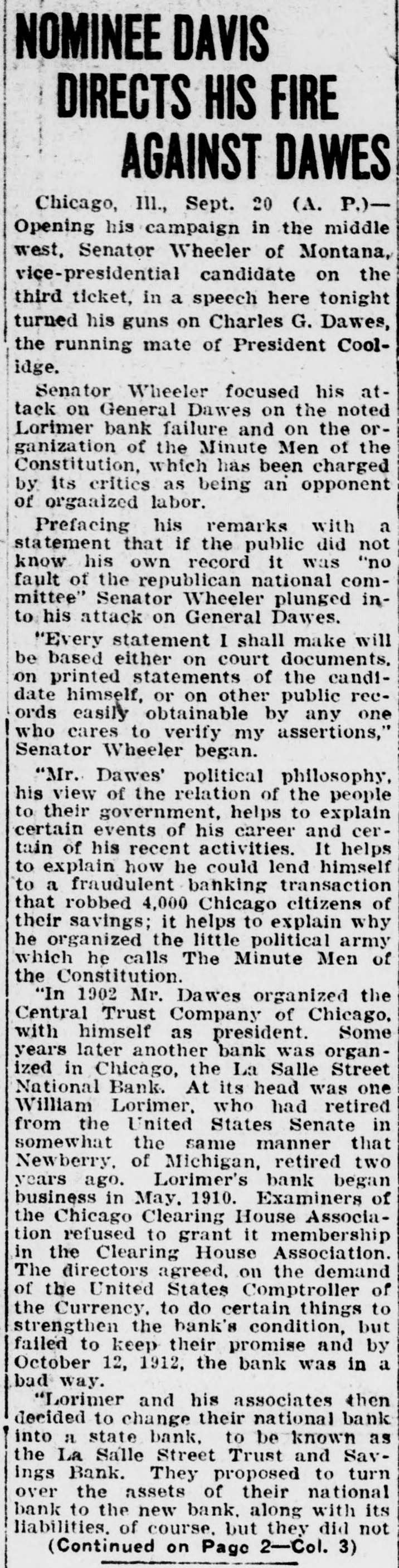
NOMINEE DAVIS DIRECTS HIS FIRE AGAINST DAWES Chicago, III., Sept. 20 (A. P.)Opening his campaign in the middle west, Senator Wheeler of Montana, vice-presidential candidate on the third ticket, in a speech here tonight turned his guns on Charles G. Dawes, the running mate of President Coolidge. Senator Wheeler focused his attack on General Dawes on the noted Lorimer bank failure and on the organization of the Minute Men of the Constitution, which has been charged by its critics as being an opponent of organized labor. Prefacing his remarks with a statement that if the public did not know his own record it was "no fault of the republican national committee" Senator Wheeler plunged into his attack on General Dawes. "Every statement I shall make will be based either on court documents. on printed statements of the candidate himself, or on other public records easily obtainable by any one who cares to verify my assertions," Senator Wheeler began. "Mr. Dawes' political philosophy, his view of the relation of the people to their government, helps to explain certain events of his career and certain of his recent activities. It helps to explain how he could lend himself to a fraudulent banking transaction that robbed 4,000 Chicago citizens of their savings; it helps to explain why he organized the little political army which he calls The Minute Men of the Constitution. "In 1902 Mr. Dawes organized the Central Trust Company of Chicago. with himself as president. Some years later another bank was organized in Chicago, the La Salle Street National Bank. At its head was one William Lorimer, who had retired from the United States Senate in somewhat the same manner that Newberry. of Michigan, retired two years ago. Lorimer's bank began business in May. 1910. Examiners of the Chicago Clearing House Association refused to grant it membership in the Clearing House Association. The directors agreed, on the demand of the United States Comptroller of the Currency. to do certain things to strengthen the bank's condition, but failed to keep their promise and by October 12, 1912, the bank was in a bad way. "Lorimer and his associates then decided to change their national bank into a state bank, to be known as the La Salle Street Trust and Savings Bank. They proposed to turn over the assets of their national bank to the new bank. along with its liabilities. of course. but they did not (Continued on Page 2-Col. 3)
Bank runs are almost always and everywhere a deterioration of bank fundamentals.
But not for you.
You are the measure-zero exception: great fundamentals, solid bank, and yet the Diamond Dybvig fairy spread its rumor. Depositors woke up. Your collateral was not prepositioned. The Clearinghouse had it for you.
Do not pass Go. Do not collect $200. Go directly to jail… or worse.