La Salle Street Trust & Savings Bank (Chicago, IL)

Episode Information

Episode UID
5985424791354
Episode Type
Suspension → Closure
Bank Type
trust
Bank ID
598542479 hash
Start Date
October 21, 1912
Location
Chicago, Illinois (41.850, -87.650)

Metadata

Model
gpt-5-mini (chosen from majority vote of a three-model LLM ensemble)
Short Digest
7acc9b082d828b4b

Response Measures

None

Description

Bank converted from a national to a state trust & savings bank and was later closed with a receiver appointed.

Events (3)

1. October 21, 1912 Other
Newspaper Excerpt
On the afternoon of October 21, 1912, Dawes turned over to Lorimer's new bank the required $1,250,000. The agent of the state auditor of public accounts counted it and issued a certificate authorizing Lorimer's bank to do business. Then the $1,250,000 was handed back to Dawes' Central Trust company. All in one afternoon.
Source
newspapers
2. June 12, 1914 Receivership
Newspaper Excerpt
On June 12, 1914 the Lorimer state savings bank ... was closed by the state auditor. A receiver was appointed and after full hearing the court found the bank insolvent and dissolved it.
Source
newspapers
3. June 12, 1914 Suspension
Cause
Bank Specific Adverse Info
Cause Details
Bank insolvent due to loans to officers/directors, impaired assets and fraudulent capitalization scheme; state auditor closed the bank.
Newspaper Excerpt
On June 12, 1914 the Lorimer state savings bank ... was closed by the state auditor.
Source
newspapers

Newspaper Articles (11)

Article from Dziennik Chicagoski, March 28, 1919

Click image to open full size in new tab

Article Text

mitetu wykonawczego. Biuro mie ści się pnr. 120 West Adams ul. W komitecie sa reprezentanci różnych organizacyi, jak np.: prof. Graham Taylor, od organizacyi pracy społecznej, H. H. Merrick od Chic. Stow. Handlowego, pani E. P. Johnson od klubów kobiecych i G. J. Thompson od unii robotniczych. - G. Ischida, członek sekty ,,Holy Roller". aresztowany zostal wczoraj W misyi sekty przy ul. Congress blisko ul. State. Aresztowany został pod zarzutem naprzykrzania się pani C. E. Britton. Z pnr. 1518 S. Wabash ave., która jest takze czlonkiem sekty. - William Lorimer będzie znów milionerem. a bank zbankru towany La Salle Street Trust and Savings Bank straci $1,200,000, jeśli Najwyższy Trybunal pod-trzyma decyzyę sądu dystrykto-wego w Danville, I11. W sprawie kompanii kontraktorskiej Lori-mer and Gallagher, która procesuje komp. Southern Traction Co. Ostatnia znajduje się także W rekach receivera", tak jak wspomniany bank. Sąd uznaje Lorimera i Gallaghera jako wierzycieli banku La Salle. - J. Ferguson, zam. pnr. 3106 Fullerton ave., zastrzelił się WCZO raj W wyszynku J. Celli, pnr. 3936 N. Cicero ave., dlatego, ze żona jego. nie chciala się z nim pogodzić. Wytoczyła mu proces, 0skarżając go 0 okrutne Z nią się obchodzenie. - Komitet finansowy Z tona rady miejskiej wczoraj uchwalit rekomendować, aby miasto wzięto W dzierzawę za $200,000 budynek dziennika Herald". Mają


Article from The Spokesman-Review, September 21, 1924

Click image to open full size in new tab

Article Text

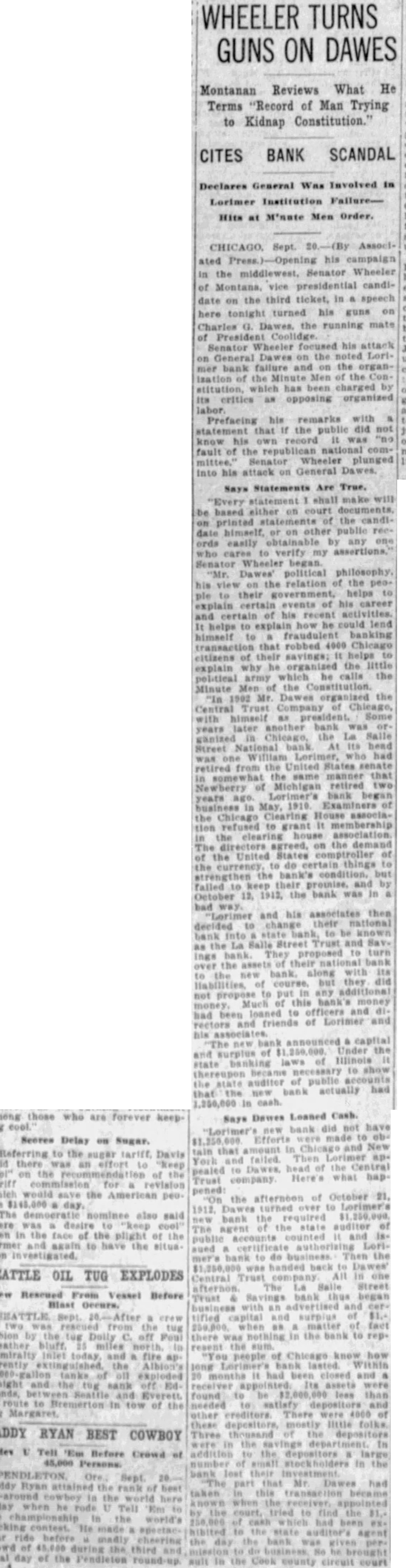
WHEELER TURNS GUNS ON DAWES Montanan Reviews What He Terms "Record of Man Trying to Kidnap Constitution." CITES BANK SCANDAL Declares General Was Involved in Lorimer Institution Failure—Hits at Minute Men Order. CHICAGO, Sept. 20.—(By Associated Press.)—Opening his campaign in the middlewest, Senator Wheeler of Montana, vice presidential candidate on the third ticket, in a speech here tonight turned his guns on Charles G. Dawes, the running mate of President Coolidge. Senator Wheeler focused his attack on General Dawes on the noted Lorimer bank failure and on the organization of the Minute Men of the Constitution, which has been charged by its critics as opposing organized labor. Prefacing his remarks with a statement that if the public did not know his own record it was "no fault of the republican national committee," Senator Wheeler plunged into his attack on General Dawes. Says Statements Are True. "Every statement I shall make will be based either on court documents, on printed statements of the candidate himself, or on other public records easily obtainable by any one who cares to verify my assertions," Senator Wheeler began. "Mr. Dawes' political philosophy, his view on the relation of the people to their government, helps to explain certain events of his career and certain of his recent activities. It helps to explain how he could lend himself to a fraudulent banking transaction that robbed 4000 Chicago citizens of their savings; it helps to explain why he organized the little political army which he calls the Minute Men of the Constitution. "In 1902 Mr. Dawes organized the Central Trust Company of Chicago, with himself as president. Some years later another bank was organized in Chicago, the La Salle Street National bank. At its head was one William Lorimer, who had retired from the United States senate in somewhat the same manner that Newberry of Michigan retired two years ago. Lorimer's bank began business in May, 1910. Examiners of the Chicago Clearing House association refused to grant it membership in the clearing house association. The directors agreed, on the demand of the United States comptroller of the currency, to do certain things to strengthen the bank's condition, but failed to keep their promise, and by October 12, 1912, the bank was in a bad way. "Lorimer and his associates then decided to change their national bank into a state bank, to be known as the La Salle Street Trust and Savings bank. They proposed to turn over the assets of their national bank to the new bank, along with its liabilities, of course, but they did not propose to put in any additional money. Much of this bank's money had been loaned to officers and directors and friends of Lorimer and his associates. "The new bank announced a capital and surplus of $1,250,000. Under the state banking laws of Illinois it thereupon became necessary to show the state auditor of public accounts that the new bank actually had 1,250,000 in cash. Says Dawes Loaned Cash. "Lorimer's new bank did not have $1,250,000. Efforts were made to obtain that amount in Chicago and New York and failed. Then Lorimer appealed to Dawes, head of the Central Trust company. Here's what happened: "On the afternoon of October 21, 1912, Dawes turned over to Lorimer's new bank the required $1,250,000. The agent of the state auditor of public accounts counted it and issued a certificate authorizing Lorimer's bank to do business. Then the $1,250,000 was handed back to Dawes' Central Trust company. All in one afternoon. The La Salle Street Trust & Savings bank thus began business with an advertised and certified capital and surplus of $1,250,000, when as a matter of fact there was nothing in the bank to represent the sum. "You people of Chicago know how long Lorimer's bank lasted. Within 20 months it had been closed and a receiver appointed. Its assets were found to be $2,000,000 less than needed to satisfy depositors and other creditors. There were 4000 of these depositors, mostly little folks. Three thousand of the depositors were in the savings department. In addition to the depositors a large number of small stockholders in the bank lost their investment. "The part that Mr. Dawes had taken in this transaction became known when the receiver, appointed by the court, tried to find the $1,250,000 of cash which had been exhibited to the state auditor's agent the day the bank was given permission to do business. So he brought suit in the Cook county circuit court"


Article from The Oklahoma News, September 23, 1924

Click image to open full size in new tab

Article Text

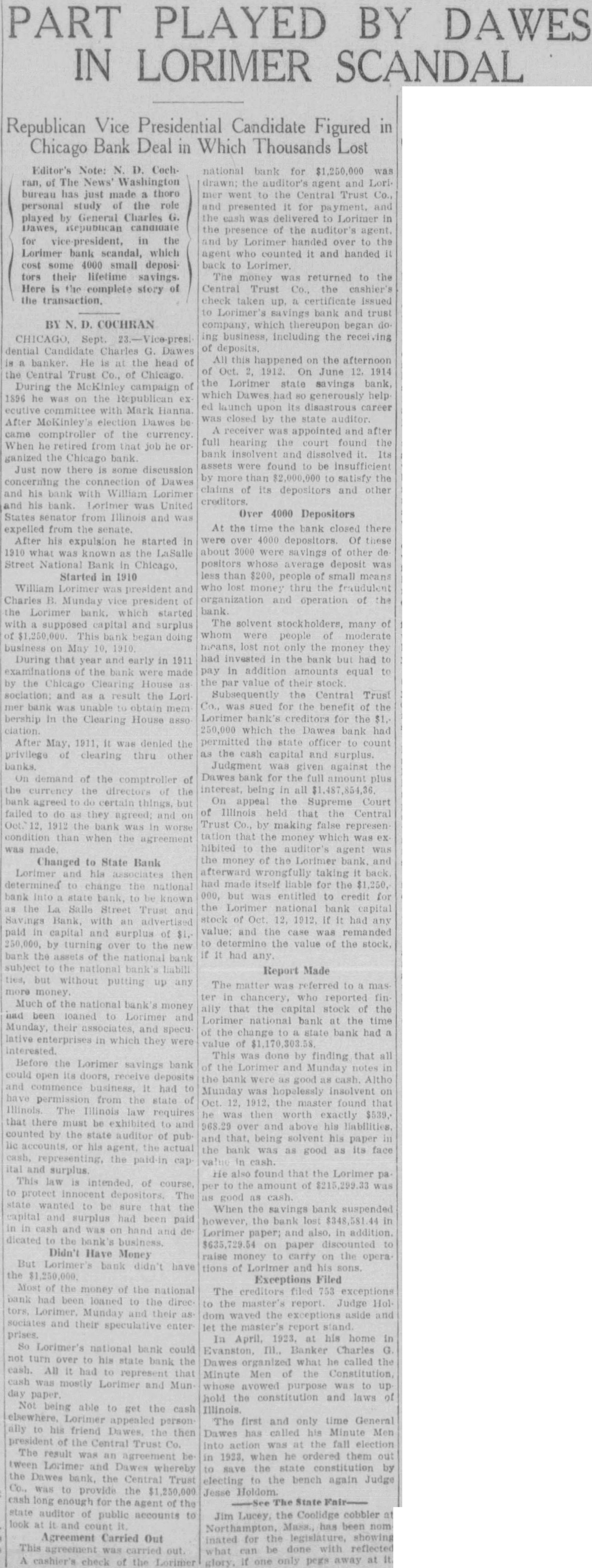
PART PLAYED BY DAWES IN LORIMER SCANDAL Republican Vice Presidential Candidate Figured in Chicago Bank Deal in Which Thousands Lost Editor's Note: N. D. Cochran, of The News' Washington bureau has just made a thoro personal study of the role played by General Charles G. Dawes, Republican candidate for vice-president, in the Lorimer bank scandal, which cost some 4000 small depositors their lifetime savings. Here is the complete story of the transaction. BY N. D. COCHRAN CHICAGO, Sept. 23.—Vice-presidential Candidate Charles G. Dawes is a banker. He is at the head of the Central Trust Co., of Chicago. During the McKinley campaign of 1896 he was on the Republican executive committee with Mark Hanna. After McKinley's election Dawes became comptroller of the currency. When he retired from that job he organized the Chicago bank. Just now there is some discussion concerning the connection of Dawes and his bank with William Lorimer and his bank. Lorimer was United States senator from Illinois and was expelled from the senate. After his expulsion he started in 1910 what was known as the LaSalle Street National Bank in Chicago. Started in 1910 William Lorimer was president and Charles B. Munday vice president of the Lorimer bank, which started with a supposed capital and surplus of $1,250,000. This bank began doing business on May 10, 1910. During that year and early in 1911 examinations of the bank were made by the Chicago Clearing House association; and as a result the Lorimer bank was unable to obtain membership in the Clearing House association. After May, 1911, it was denied the privilege of clearing thru other banks. On demand of the comptroller of the currency the directors of the bank agreed to do certain things, but failed to do as they agreed; and on Oct. 12, 1912 the bank was in worse condition than when the agreement was made. Changed to State Bank Lorimer and his associates then determined to change the national bank into a state bank, to be known as the La Salle Street Trust and Savings Bank, with an advertised paid in capital and surplus of $1,250,000, by turning over to the new bank the assets of the national bank subject to the national bank's liabilities, but without putting up any more money. Much of the national bank's money had been loaned to Lorimer and Munday, their associates, and speculative enterprises in which they were interested. Before the Lorimer savings bank could open its doors, receive deposits and commence business, it had to have permission from the state of Illinois. The Illinois law requires that there must be exhibited to and counted by the state auditor of public accounts, or his agent, the actual cash, representing the paid-in capital and surplus. This law is intended, of course, to protect innocent depositors. The state wanted to be sure that the capital and surplus had been paid in in cash and was on hand and dedicated to the bank's business. Didn't Have Money But Lorimer's bank didn't have the $1,250,000. Most of the money of the national bank had been loaned to the directors, Lorimer, Munday and their associates and their speculative enterprises. So Lorimer's national bank could not turn over to his state bank the cash. All it had to represent that cash was mostly Lorimer and Munday paper. Not being able to get the cash elsewhere, Lorimer appealed personally to his friend Dawes, the then president of the Central Trust Co. The result was an agreement between Lorimer and Dawes whereby the Dawes bank, the Central Trust Co., was to provide the $1,250,000 cash long enough for the agent of the state auditor of public accounts to look at it and count it. Agreement Carried Out This agreement was carried out. A cashier's check of the Lorimer national bank for $1,250,000 was drawn; the auditor's agent and Lorimer went to the Central Trust Co., and presented it for payment, and the cash was delivered to Lorimer in the presence of the auditor's agent, and by Lorimer handed over to the agent who counted it and handed it back to Lorimer. The money was returned to the Central Trust Co., the cashier's check taken up, a certificate issued to Lorimer's savings bank and trust company, which thereupon began doing business, including the receiving of deposits. All this happened on the afternoon of Oct. 2, 1912. On June 12, 1914 the Lorimer state savings bank, which Dawes had so generously helped launch upon its disastrous career was closed by the state auditor. A receiver was appointed and after full hearing the court found the bank insolvent and dissolved it. Its assets were found to be insufficient by more than $2,000,000 to satisfy the claims of its depositors and other creditors. Over 4000 Depositors At the time the bank closed there were over 4000 depositors. Of these about 3000 were savings of other depositors whose average deposit was less than $200, people of small means who lost money thru the fraudulent organization and operation of the bank. The solvent stockholders, many of whom were people of moderate means, lost not only the money they had invested in the bank but had to pay in addition amounts equal to the par value of their stock. Subsequently the Central Trust Co., was sued for the benefit of the Lorimer bank's creditors for the $1,250,000 which the Dawes bank had permitted the state officer to count as the cash capital and surplus. Judgment was given against the Dawes bank for the full amount plus interest, being in all $1,487,854.36. On appeal the Supreme Court of Illinois held that the Central Trust Co., by making false representation that the money which was exhibited to the auditor's agent was the money of the Lorimer bank, and afterward wrongfully taking it back, had made itself liable for the $1,250,000, but was entitled to credit for the Lorimer national bank capital stock of Oct. 12, 1912, if it had any value; and the case was remanded to determine the value of the stock, if it had any. Report Made The matter was referred to a master in chancery, who reported finally that the capital stock of the Lorimer national bank at the time of the change to a state bank had a value of $1,170,303.58. This was done by finding that all of the Lorimer and Munday notes in the bank were as good as cash. Altho Munday was hopelessly insolvent on Oct. 12, 1912, the master found that he was then worth exactly $539,968.29 over and above his liabilities, and that, being solvent his paper in the bank was as good as its face value in cash. He also found that the Lorimer paper to the amount of $215,299.33 was as good as cash. When the savings bank suspended however, the bank lost $348,581.44 in Lorimer paper; and also, in addition, $635,729.54 on paper discounted to raise money to carry on the operations of Lorimer and his sons. Exceptions Filed The creditors filed 753 exceptions to the master's report. Judge Holdom waved the exceptions aside and let the master's report stand. In April, 1923, at his home in Evanston, Ill., Banker Charles G. Dawes organized what he called the Minute Men of the Constitution, whose avowed purpose was to uphold the constitution and laws of Illinois. The first and only time General Dawes has called his Minute Men into action was at the fall election in 1923, when he ordered them out to save the state constitution by electing to the bench again Judge Jesse Holdom.


Article from Twin City Review, October 3, 1924

Click image to open full size in new tab

Article Text

eth to his own hurt yet changeth not.' When his part in the Lorimer bank incident is cited, as it is eited by the State Federation of Labor, Mr. Dawes might truthfully say, "I still continue to stand for and by the courts though I haven't fared particularly well at their hands." For the rest the incident is not to Mr. Dawes' credit. The facts as stated in the declaration adopted by the state federation are correct. It contains the thought, if not the language of the supreme court. What the Central Trust Co., Mr. Dawes' bank did, was o furnish William Horace Lorimer $1,250,000 which was counted by a state bank examiner as the property of the La Salle Street Trust and Savings bank which Lorimer organized when his La Salle Street National bank was going on the rocks. The law requires that to begin business a state bank must have capital stock and surplus on hand with no liabilities. Mr. Lorimer did not have the money to he resorted to the simple expedient of getting it from Mr. Dawes, Taking with him Rife, the bank examiner r the state auditor and one of the directors of the new institution Lorimer, went to the Central Trust company. The supreme court record tells the rest: There $1,250,000 in currency was delivered to Lorimer by the cashier of the Central Trust Co. Rife counted the money and returned it to Lorimer together with the auditor's certificate authorizing the trust and savings bank to commence business as a bank. Lorimer handed the money back to the cashier, who returned the enshier's check, indorsed by the Cen. ral Trust Co. without recourse. When the La Salle Street Trust & Savings bank was closed by the state auditor, as it was two years later, with assets insufficient by $2,000,000 o meet the claims of depositors and creditors the receiver brought suit gainst the Central Trust Co., Mr. Dawes' bank, on the grounds that it ad received funds belonging to the lefunct institution and retined them without authority of law. The case went to the circuit court which found the Central Trust Co. lable to the amount of $1,487,854.16. The defense set un the plea that the whole transaction was done and carred out by William R. Dawes, casher of the Trust company under the authority and direction of Charles G. Dawes without the knowledge of the oard of directors and that the acts lone by them, the Daweses, were be ond their authority. The Supreme court took a different iew, and held the Trust company responsible. It swept away the technial defense that the auditor had counted the money and had satisfied himesif that it was all there, the drily remarking that "of agent was there to satisfy pinion course, rought the auditor's himself that not here was that much money in some ank in Chicago, and of course noody thought so.' However, the supreme court held hat the Central Trust Co. was only iable for the amount to which the capital stock of the National bank vas impaired at the time of the transer to the state bank and the case vent to a master in chancery for a determination of the value of assets. The only possible moral defense hat Mr. Dawes could offer was that e did not know the law of the state, i plea that the court said was immaterial, or that he did not know the it condition of the Lorimer bank, and would be a libel on Mr. Dawes ability as a banker to say that he did lot know what everybody knew. can be of fascism harge Mr. Dawes which relieved him. the of state His the federation brings against mniute men's" organization was, as e explained it, an attempt by nonartizan effort to get good men into unions conceived it to be in to establish open ffice. attempt The the disclaimed. shop, thing which Mr. Dawes i Dawes enjoys no As a candidate munities. But Mr. reciting special he must im- the attacks, and in fedbank incident the Lorimer expect vulnerable state ration has hit him in a return Decatur Herald.


Article from The Connecticut Labor News, October 25, 1924

Click image to open full size in new tab

Article Text

Dawes' Defenders Protest Overmuch Their Hero's Innocence By FRANK E. WOLFE Trust Company and asked General Defenders of Dawes are protesting Dawes, then its president, whether the rmuch. They are scrambling the Central Trust Company would cash the ole defense with their loud cries cashier's check of the La Salle Street ut the innocence of their hero. National Bank for $1,000,000. The Title : is admitted by the most earnest and Trust Company as receiver handed testants that Dawes broke the it to the auditor, who counted 250,000, stating that the bank had adequate king laws of Illinois in the matter assets in the form of notes and other compounding an unlawful act with lliam Lorimer when the candidate securities, but did not, of course, keep on hand the entire amount of its capvice-president supplied the La ital and surplus in currency, and to le Street Trust and Savings Bank h funds of the Central Trust Comcall in cash would require the calling in of notes and an annoyance to the y to the amount of $1,250,000 banks' customers. ch was used as a "dummy" fund convince the state auditor that the "General Dawes replied that he would cash the check with pleasure. k had an adequate supply of capMr. Lorimer asked what would be the and surplus to lawfully permit the itution to change over from a nacharge. General Dawes replied, "Nothal to a state bank. ing," that he would do it as an act of courtesy. A cashier's check of the according to statement issued by National bank was thereupon drawn, n Barton Payne, in apologizing the auditor and Mr. Lorimer- came the illegal acts of Dawes, the latwith the check to the Central Trust did something that many other Company, presented the same for paykers have done in the past-in fact, indicates it is a common custom! ment, and the cash was delivered to Mr. Lorimer in the presence of the le says it is practiced frequently that it was not an "intentional auditor and by and by Lorimer handed to the auditor, who counted it and ation of the law." handed it back to Mr. Lorimer. Vhen the Lorimer bank busted no bt Mr. Lorimer did not intention"The money was returned to the Central Trust Company, and the bust it, but it was just as busted, cashier's check of the national bank far as the depositors were contaken up. A certificate was issued, ed, as if the act was intentional. certifying that the La Salle Street h fact the depositors did not conr Mr. Lorimer's inadvertent and Trust and Savings Bank was duly organized." Intentional acts as entirely blameQuite so. Precisely, that and noth. They got action. The Chicago ing else. Mr. Dawes knew what the e and Trust Company as receiver the Lorimer bank and The Cenlaw was. He willingly and knowingly violated the state laws. To credit him Trust Company (Mr. Dawes' with ignorance of the law is to brand k) for $1,000,000, charging that him as stupid and guileless. Mr. Dawes supplying the dummy capital it had is not that. lated the state banking laws, and It was not a technical violation of refore should be held responsible the law. It was a real, deliberate and the creditors. Recently the case intentional act on the part of both I decided in favor of the plaintiff Lorimer and Dawes and the depositors Mr. Dawes' bank must pay someand the judges who. have just, said so g like $100,000. in their decision and Mr. Lorimer and et us have some of Mr. Payne's Mr. Dawes know it. 1. words by way of explanation So does any sane man who will give When application was made to orit a minute's thought. ize the state institution, the auThe contention that Mr. Dawes had r stated to Mr. Lorimer that it was not the slightest intention to aid a practice to require the actual cash fraud is not even specious. It is inital and surplus of the proposed sincere and unconvincing and despite anization to be presented and nted. Mr. Payne's former high standing, Mr. Lorimer went to the Central does not carry weight.


Article from The Connecticut Labor News, October 25, 1924

Click image to open full size in new tab

Article Text

Defenders of Dawes are protesting overmuch. They are scrambling the whole defense with their loud cries about the innocence of their hero. It is admitted by the most earnest protestants that Dawes broke the banking laws of Illinois in the matter of compounding an unlawful act with William Lorimer when the candidate for vice-president supplied the La Salle Street Trust and Savings Bank with funds of the Central Trust Company to the amount of $1,250,000 which was used as a "dummy" fund to convince the state auditor that the bank had an adequate supply of capital and surplus to lawfully permit the institution to change over from a national to a state bank. According to statement issued by John Barton Payne, in apologizing for the illegal acts of Dawes, the latter did something that many other bankers have done in the past-in fact, he indicates it is a common custom! He says it is practiced frequently and that it was not an "intentional violation of the law." When the Lorimer bank busted no doubt Mr. Lorimer did not intentionally bust it, but it was just as busted, SO far as the depositors were concerned, as if the act was intentional. In fact the depositors did not consider Mr. Lorimer's inadvertent and unintentional acts as entirely blameless. They got action. The Chicago Title and Trust Company as receiver for the Lorimer bank and The Central Trust Company i (Mr. Dawes' Bank) for $1,000,000, charging that by supplying the dummy capital it had violated the state banking laws, and therefore should be held responsible to the creditors. Recently the case was decided in favor of the plaintiff and Mr. Dawes' bank must pay something like $100,000. Let us have some of Mr. Payne's own. words by way of explanation : "When application was made to organize the state institution, the auditor stated to Mr. Lprimer that it was the practice to require the actual cash capital and surplus of the proposed organization to be presented and counted. "Mr. Lorimer went to the Central


Article from Chicago Tribune, December 3, 1924

Click image to open full size in new tab

Article Text

FEE $275,000 IN BANK CASE; ASKS FOR $35,000 MORE No further fees should be allowed to Hiram T. Gilbert, attorney in charge of the La Salle Street Trust and Savings bank receivership, who already has received fees aggregating $275,000 in the last ten years, it was argued before Circuit Judge Hugo M. Friend yesterday. Mr. Gilbert's plea for an additional $35,000 should not be allowed, the court was told by counsel for the bank's receiver, the Chicago Title and Trust company. The attorney, however, produced a voluminous affidavit covering his work on the Lorimer bank in the last decade, and declared further that the creditors' committee had approved the allowance of the fee he requested. Judge Friend declared he would examine the affidavit and then fix the fee.


Article from The Pantagraph, December 3, 1924

Click image to open full size in new tab

Article Text

DEFUNCT CHICAGO BANK CASE IS NOW IN COURT Chicago, Dec. 2.—The tangled affairs of the defunct La Salle Street Trust and Savings bank whose officials were former Senator William Lorimer and Charles B. Monday, were brought into court for a final rearrangement today. The question of paying a final four per cent dividend to stockholders who have already received 35 cents on the dollar, was continued until the fees of an attorney are fixed. He is Hiram T. Gilbert and admits that he has received $275,000 for legal services extending over a ten year period, but claims he is entitled to $45,000 more. Attorneys representing the bank's receiver protested against allowing the additional $45,000 fees. The matter was taken under advisement.


Article from The Daily Herald, December 12, 1924

Click image to open full size in new tab

Article Text

ILLINOIS BREVITIES Springfield.—In the official canvass of the November 4 vote, completed here, it is shown that the proposal to lease the right of way of the Illinois and Michigan canal and the gateway amendment to the constitution, have been defeated. The proposal on the canal lease failed by 259,000 votes, while the constitutional amendment failed of ratification by 585,000 votes. The $100,000,000 road bond issue was carried by a majority of 465,572. A net gain of one vote was made by the Democrats in the two houses of the general assembly. In the next state senate they will have 14 members, a gain of five, while their representation in the house will be 59, a loss of four members in that body. The Republicans will have 37 senators and 94 representatives. The Illinois delegation in congress will consist of 22 Republicans and 5 Democrats. In the vote for President, Coolidge came within 10,000 votes of the record plurality achieved by President Harding. The President's plurality over John W. Davis was 876,364. Marion.—State's Attorney Arlie Boswell and Coroner George Bell, assumed office in Williamson county and promised an administration of impartial law enforcement. With the exception of Sheriff George Galligan, who has two years to serve, virtually a new corps of officers went into power. Boswell denied he would nolle prosse indictments growing out of the rioting in Herrin last February, when the hospital was riddled with bullets by alleged klansmen. Peoria.—Elopement has been made an offense punishable by expulsion at Bradley Polytechnic institute here, under new regulations laid down by the faculty. Students who desire to marry must not only obtain the consent of their parents, but must announce their intentions to their deans or the director of the institute. The new regulations were made as a result of difficulties encountered when several students eloped and were married last year. Chicago.—A woman was killed and 25 other persons, including children, were hurt when two passenger trains of the Pennsylvania railroad collided. One of the trains, No. 109, known as an "immigrant train," was coming from Columbus and the other, No. 205, was arriving from Cincinnati and Pittsburgh. The engine of the Cincinnati train plowed half way through the rear coach of the stalled train before it could be stopped. Chicago.—No further fees should be allowed to Hiram T. Gilbert, attorney in charge of the La Salle Street Trust and Savings bank receivership, who already has received fees aggregating $275,000 in the last ten years, it was argued before Circuit Judge Hugo M. Friend. Mr. Gilbert's plea for an additional $35,000 should not be allowed, the court was told by counsel for the bank's receiver, the Chicago Title and Trust company. Chicago.—Only one person in every three arraigned in the municipal court on criminal charges in the year ended November 30, was convicted, according to figures made public by Charles H. Krimbill, clerk of the municipal criminal courts. Of the 279,960 cases disposed of 156,161 were dismissed. There were 56,017 fined, 14,186 were sent to the bridewell, 74 to the county jail, 4,768 placed on probation and 3,686 held to the grand jury. Lincoln.—Lincoln college here and Millikin university, Decatur, will receive equal shares in a $74,000 real estate gift presented to them jointly by United States Senator William B. McKinley. The properties include 40 town lots and 261 acres of farm land near Westville, valued at $36,993, and land in and around Danville worth about $37,049. Eureka.—Construction of an athletic field near the campus of Eureka college is one of the items in the program of improvement which President Wilson has placed before the board of trustees. Amboy.—Lem B. Searls, seventy, was fined $500 on each of two counts for the manufacture and sale of liquor. Because of Searls' age the state's attorney recommended the waiver of a jail sentence. Springfield.—John E. George, Springfield's hanker-chief of police, sent his resignation to Mayor Bullard. Chief George has served for a year without pay. Mattoon.—Capt. C. E. Henneke was installed as commander of the American Legion post here. He has been in military service 29 years. Mode.—Waverly Brown, seventeen, died in the hospital from wounds from his shotgun. It was accidentally discharged while he was hunting. Seward.—A. A. Jones, local nimrod, killed a snowy owl in timberland near here. It is an arctic bird rarely found in this region. Havana.—The new gymnasium of the Havana high school was dedicated. The structure cost $40,000. Lincoln.—Thirty scantily attired hotel guests were forced to flee for their lives when fire caused by a cigarette butt carelessly thrown in an adjoining dance hall destroyed the Home hotel building and for a time threatened the heart of the business section. Total loss was estimated at $40,000. Cairo.—Charles Walker, thirty-eight, president of the Walker Coal company, and F. R. Morris, thirty-nine, proprietor of the Morris hat shop here, were instantly killed when their car, which was being towed by a truck, was struck by the Panama limited.


Article from The Daily Herald, December 12, 1924

Click image to open full size in new tab

Article Text

Springfield.—In the official canvass of the November 4 vote, completed here, it is shown that the proposal to lease the right of way of the Illinois and Michigan canal and the gateway amendment to the constitution, have been defeated. The proposal on the canal lease failed by 259,000 votes, while the constitutional amendment failed of ratification by 585,000 votes. The $100,000,000 road bond issue was carried by a majority of 465,572. A net gain of one vote was made by the Democrats in the two houses of the general assembly. In the next state senate they will have 14 members, a gain of five, while their representation in the house will be 59, a loss of four members in that body. The Republicans will have 37 senators and 94 representatives. The Illinois delegation in congress will consist of 22 Republicans and 5 Democrats. In the vote for President, Coolidge came within 10,000 votes of the record plurality achieved by President Harding. The President's plurality over John W. Davis was 876,364. Marion.—State's Attorney Arlie Boswell and Coroner George Bell, assumed office in Williamson county and promised an administration of impartial law enforcement. With the exception of Sheriff George Galligan, who has two years to serve, virtually a new corps of officers went into power. Boswell denied he would nolle prosse indictments growing out of the rioting in Herrin last February, when the hospital was riddled with bullets by alleged klansmen. Peoria.—Elopement has been made an offense punishable by expulsion at Bradley Polytechnic institute here, under new regulations laid down by the faculty. Students who desire to marry must not only obtain the consent of their parents, but must announce their intentions to their deans or the director of the institute. The new regulations were made as a result of difficulties encountered when several students eloped and were married last year. Chicago.—A woman was killed and 25 other persons, including children, were hurt when two passenger trains of the Pennsylvania railroad collided. One of the trains, No. 109, known as an "immigrant train," was coming from Columbus and the other, No. 205, was arriving from Cincinnati and Pittsburgh. The engine of the Cincinnati train plowed half way through the rear coach of the stalled train before it could be stopped. Chicago.—No further fees should be allowed to Hiram T. Gilbert, attorney in charge of the La Salle Street Trust and Savings bank receivership, who already has received fees aggregating $275,000 in the last ten years, it was argued before Circuit Judge Hugo M. Friend. Mr. Gilbert's plea for an additional $35,000 should not be allowed, the court was told by counsel for the bank's receiver, the Chicago Title and Trust company. Chicago.—Only one person in every three arraigned in the municipal court on criminal charges in the year ended November 30, was convicted, according to figures made public by Charles H. Krimbill, clerk of the municipal criminal courts. Of the 279,960 cases disposed of 156,161 were dismissed. There were 56,017 fined, 14,186 were sent to the bridewell, 74 to the county jail, 4,768 placed on probation and 3,686 held to the grand jury. Lincoln.—Lincoln college here and Millikin university, Decatur, will receive equal shares in a $74,000 real estate gift presented to them jointly by United States Senator William B. McKinley. The properties include 40 town lots and 261 acres of farm land near Westville, valued at $36,993, and land in and around Danville worth about $37,049. Eureka.—Construction of an athletic field near the campus of Eureka college is one of the items in the program of improvement which President Wilson has placed before the board of trustees. Amboy.—Lem B. Searls, seventy, was fined $500 on each of two counts for the manufacture and sale of liquor. Because of Searls' age the state's attorney recommended the waiver of a jail sentence. Springfield.—John E. George, Springfield's banker-chief of police, sent his resignation to Mayor Bullard. Chief George has served for a year without pay. Mattoon.—Capt. C. E. Henneke was installed as commander of the American Legion post here. He has been in military service 29 years. Mode.—Waverly Brown, seventeen, died in the hospital from wounds from his shotgun. It was accidentally discharged while he was hunting. Seward.—A. A. Jones, local nimrod, killed a snowy owl in timberland near here. It is an arctic bird rarely found in this region.


Article from The Kinmundy Express, December 18, 1924

Click image to open full size in new tab

Article Text

ILLINOIS State News Miss Catherine Bradley, fifty-six, superintendent for 22 years of the Alice Home hospital in Lake Forest, died of pneumonia after an illness of four days. Suffering intense pain from an injured hip, covered from head to foot with cuts and bruises, sustained in an auto crash near Pontiac, Gov. Len Small will be confined to bed for ten days, Dr. W. A. Spoker, attending physician, announced at Kankakee. Neither Leslie Small, the governor's son, nor Mrs. A. E. Inglesh, his daughter, who were in the coach, is severely injured. No further fees should be allowed to Hiram T. Gilbert, attorney in charge of the La Salle Street Trust and Savings bank receivership at Chicago, who already has received fees aggregating $275,000 in the last ten years, it was argued before Circuit Judge Hugo M. Friend. Mr. Gilbert's plea for an additional $85,000 should not be allowed, the court was told by counsel for the bank's receiver, the Chicago Title and Trust company. Illinois' first woman senator will assume her chair in the deliberations of the general assembly at Springfield "with an open mind, always conscious of the fact that she is representing men and women of the entire Twenty-sixth district, not just one group or one sex in this district." Mrs. Florence Fifer Bohrer of Bloomington, who holds that distinction, said she made no election promises and consequently is free to follow the dictation of her judgment. Convicted for contempt of court in applying the term "traitors" to two union men who returned to work in the Vulcan Detinning company plant at Streator after their local had gone on strike, J. N. St. Clair, president of the union and former Streator Chief of police, has appealed to the Supreme court at Springfield. Should the higher court uphold the decision of the La Salle county Circuit judge, St. Clair will face a $500 fine or serve six months in jail. The community of Buda is the original home for good roads boosters. At an election held at the schoolhouse in French Grove precinct, Bureau county, on August 4, 1845, the original copy of the poll book shows there were 25 votes cast. Votes were cast for county commissioner, school commissioner, county surveyor, and "for or against the road at Hennepin." All 25 votes cast on the "road at Hennepin" were cast for the road and the result is so noted on the original copy. A balance of $20,960,555 on December 1 is shown by the report of State Treasurer Oscar Nelson, issued at Springfield. Interest earned and credited to the revenue fund since the last report amounts to $65,917, bringing Nelson's total of interest earned since January, 1923, to $1,543,829. The cash account shows cash and monies in state depositories: Inactive, $15,267,700; active reserve or outstanding, $5,644,319; cash in vault, $31,808; coupons, $4,569; federal funds, $12,858. The outstanding bonded indebtedness of the state December 1 amounted to $112,071,100.