Click image to open full size in new tab
Article Text
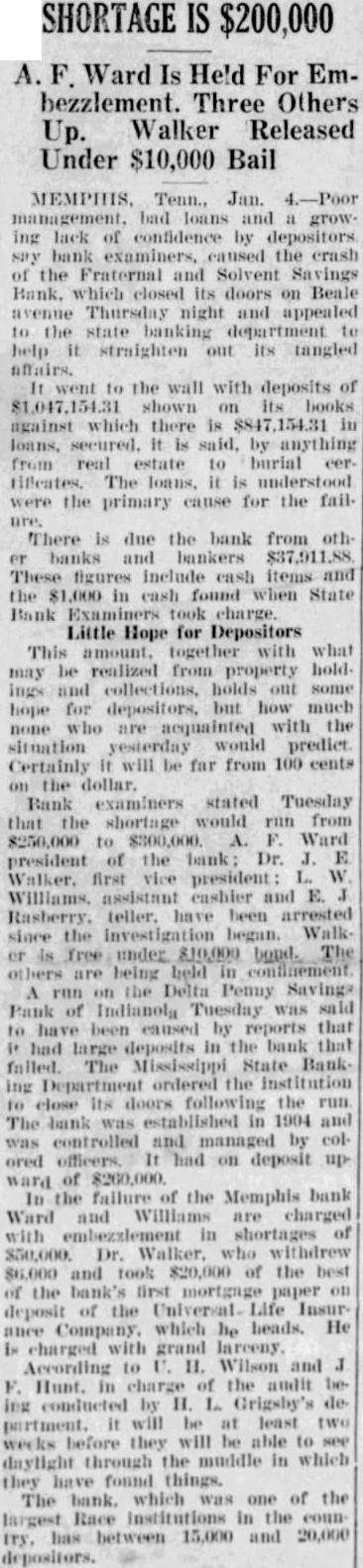
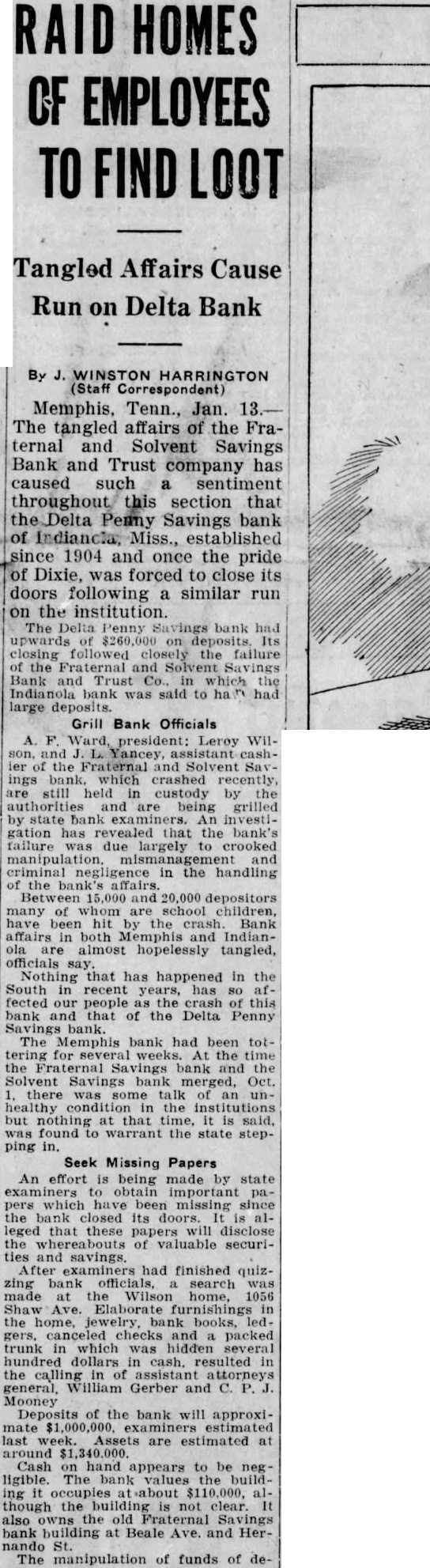
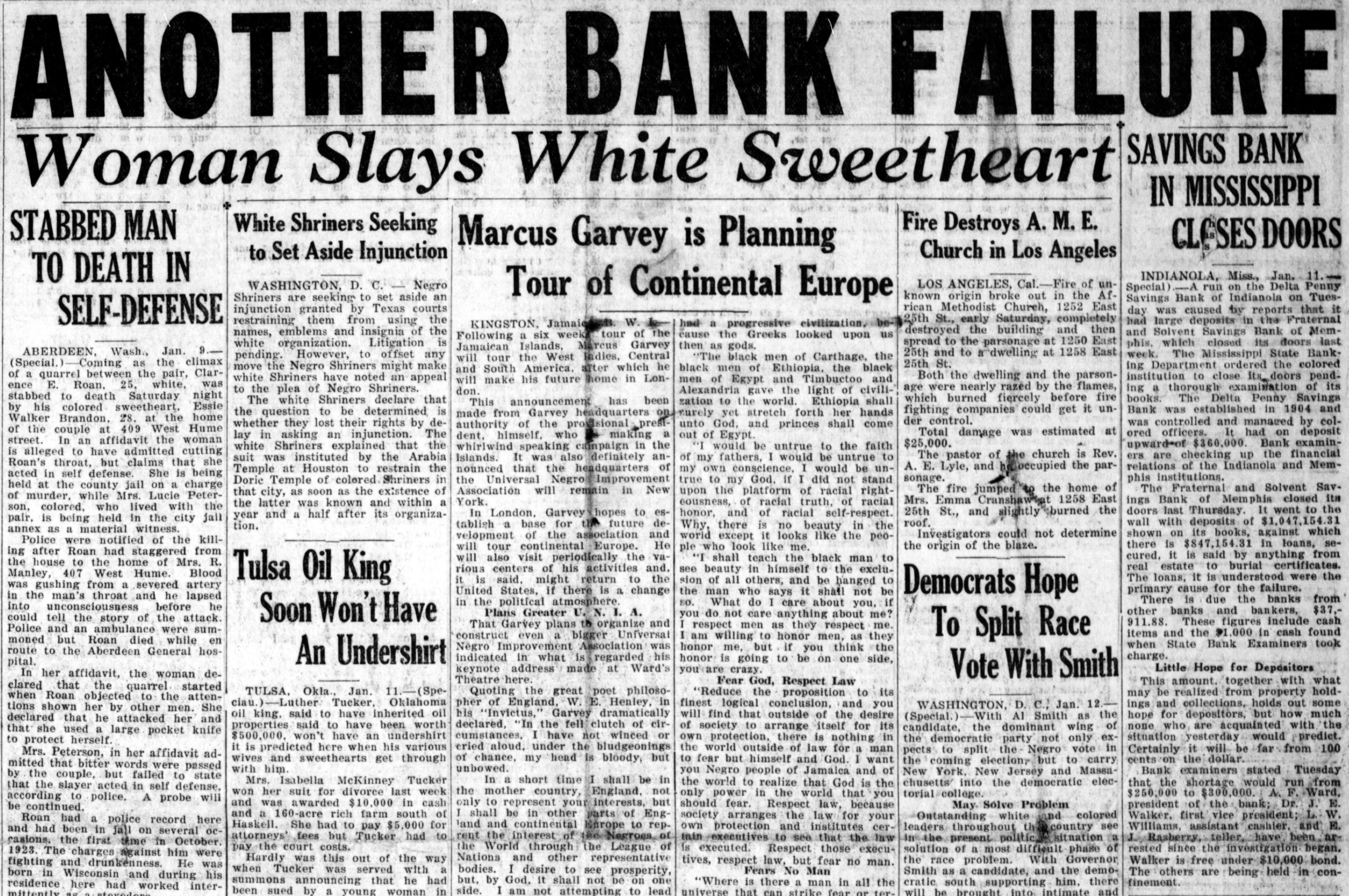
ANOTHER BANK FAILUR BANK Woman Slays White Sweetheart SAVINGS IN MISSISSIPPI Fire Destroys A. M. E. White Shriners Seeking STABBED MAN CLOSES DOORS Marcus Garvey is Planning Church in Los Angeles to Set Aside Injunction INDIANOLA, Miss., Jan. 11. TO DEATH IN unLOS ANGELES, of WASHINGTON, D. C. Negro Special) run on the Delta Penny known origin broke out in the AfShriners are seeking to set aside an Savings Bank of Indianola on TuesTour of Continental Europe rican Methodist Church, 1252 East injunction granted by Texas courts day was caused by reports that it 25th St., early Saturday, completely restraining them from using the had large deposits in the Fraternal SELF-DEFENSE beW a had civilization, progressive KINGSTON, destroyed the building and then and Solvent Savings Bank of Memnames, emblems and insignia of the cause the Greeks looked upon us Following a six week tour of the spread to the parsonage at 1250 East phis, which closed its doors last white organization. Litigation is then as gods. Jamaican Islands, Marcus Garvey ABERDEEN, Wash., Jan. week. The Mississippi State Bank 25th and to a dwelling at 1258 East pending. However, to offset any will tour the West Indies, Central The black men of Carthage, the 25th St. (Special.) Coming as the climax ing Department ordered the colored move the Negro Shriners might make black men of Ethiopia, the black and South America, after which he of a quarrel between the pair, Clarinstitution to close its doors pendBoth the dwelling and the parsonwhite Shriners have noted an appeal will make his future home in Lonmen of Egypt and Timbuctoo and ence E. Roan, 25, white, was age were nearly razed by the flames, ing a thorough examination of its to the plea of Negro Shriners. don. Alexandria gave the light of civilistabbed to death Saturday night books. The Delta Penny Savings which burned fiercely before fire The white Shriners declare that This announcement has been zation to the world. Ethiopia shall by his colored sweetheart, Essie Bank was established in 1904 and fighting companies could get it unthe question to be determined is surely yet stretch forth her hands made from Garvey headquarters on Walker Brandon. 28, at the home der control. was controlled and managed by colwhether they lost their rights by deunto God. and princes shall come authority of the provisional prest of the couple at 409 West Hume ored officers. It had on deposit Total damage was estimated at lay in asking an injunction. The dent. himself, who making out of Egypt. street. In an affidavit the woman $25,000. upward-of $360,000. Bank examinwould be untrue to the faith white Shriners explained that the whirlwind speaking campaign in the is alleged to have admitted cutting ers are checking up the financial The pastor of the church is Rev. of my fathers, I would be untrue to Islands. It was also definitely ansuit was instituted by the Arabia Roan's throat, but claims that she relations of the Indianola and MemA. E. Lyle, and occupied the parmy own conscience, I would be unnounced that the headquarters of Temple at Houston to restrain the acted in self defense. She is being phis institutions. sonage. the Universal Negro Improvement true to my God. if I did not stand Doric Temple of colored Shriners in held at the county jail on a charge The Fraternal and Solvent SavThe fire jumped the home of Association will remain in New upon the platform of racial rightthat city, as soon as the existence of of murder, while Mrs. Lucie Peterings Bank of Memphis closed its Mrs. Emma Cranshawing 1258 East York the latter was known and within a cousness, of racial truth, of racial son, colored, who lived with the doors last Thursday It went to the 25th St., and slightly burned the In London, Garvey hopes to eshonor, and of racial self-respect. year and a half after its organizapair, is being held in the city jail roof. wall with deposits of $1,047,154.31 tablish a base for future detion. Why, there is no beauty in the annex as a material witness. shown on its books, against which Investigators could not determine velopment of the association and world except it looks like the peoPolice were notified of the killthere is $847,154.31 in loans. sewill tour continental Europe. He ple who look like me. the origin of the blaze. ing after Roan had staggered from cured, it is said by anything from shall teach the black man to will also visit periodically the vathe house to the home of Mrs. R. real estate to burial certificates. rious centers of his activities and, see beauty in himself to the excluManley, 407 West Hume. Blood The loans, it is understood were the it is said, might return to the sion of all others, and be hanged to Tulsa Oil King was gushing from a severed artery primary cause for the failure. United States, if there is a change the man who says it shall not be Democrats Hope in the man's throat and he lapsed There is due the banks from in the political atmosphere so. What do I care about you, if into unconsciousness before he other banks and bankers, $37, Plans Greater U. N. I. A. you do not care anything about me? Soon Won't Have could tell the story of the attack. 911.88. These figures include cash That Garvey plans to organize and I respect men as they respect me. Police and an ambulance were sumitems and the $1,000 in cash found construct even a bigger Universal am willing to honor men, as they To Split Race moned but Roan died while en when State Bank Examiners took Negro Improvement Association was honor me, but if you think the route to the Aberdeen General hoscharge. indicated in what is regarded his honor is going to be on one side, An Undershirt pital. keynote address made at Ward's Little Hope for Depositors you crazy In her affidavit, the woman deVote With Smith Theatre here. This amount. together with what Fear God, Respect Law clared that the quarrel started Quoting the great poet philosoTULSA, Okla. Jan. (SpeReduce the proposition to its may be realized from property holdwhen Roan objected to the attenpher of England, W. E. Henley, in ciau.)-Lather Tucker, Oklahoma ings and collections, holds out some finest logical conclusion, and you WASHINGTON, D. C.) Jan. 12.tions shown her by other men. She his "Invictus," Garvey dramatically will find that outside of the desire oil king, said to have inherited oil hope for depositors, but how much (Special.) With Al Smith as the declared that he attacked her and declared, "In the fell clutch of cirproperties said to have been worth none who are acquainted with the of society to arrange itself for its candidate, the dominant wing of that she used a large pocket knife cumstances, I have not winced or $500,000. won't have an undershirt situation yesterday would predict. own protection, there is nothing in the democratic party not only exto protect herself eried aloud, under the bludgeonings it is predicted here when his various the world outside of law for a man Certainly it will be far from 100 pects to split the Negro vote in Mrs. Peterson, in her affidavit adof chance, my head is bloody, but cents the dollar to fear but himself and God. I want wives and sweethearts get through the coming election, but to carry mitted that bitter words were passed unbowed. with him. you Negro people of Jamaica and of Bank examiners stated Tuesday New York, New Jersey and Massa by the couple, but failed to state In a short time I shall be in Mrs. Isabella McKinney Tucker chusetts into the democratic electhat the shortage would run from the world to realize that God is the that the slayer acted in self defense, won her suit for divorce last week the mother country, England, not $250,000 to $300,000. A. Ward, torial college. only power in the world that you according to police. A probe will and was awarded $10,000 in cash only to represent your interests, but president of the bank; Dr. E. should fear. Respect law, because May Solve Problem be continued. and a 160-acre rich farm south of I shall be in other parts of EngWalker, first vice president; L W. Outstanding white and colored society arranges the law for your Roan had a police record here !and and continental Eprope to repHaskell. She had to pay $5,000 for Williams, assistant cashier, and E. own protection and institutes cerleaders throughout th country see and had been in jali on several ocrent the interest of the Negroes of attorneys fees but Tucker had to Rasberry, teller, have been artain executives to see that the law the present politic, sitnation casions. the first time in October. pay the court costs. the World through the League of rested since the investigation began. solution of a most difficult phase of is executed. Respect those execu1923. The charges against him were Nations and other representative Hardly was this out of the way the race problem. With Governor Walker is free under $10,000 bond. tives, respect law, but fear no man. fighting and drunkenness. He was when Tucker was served with a Fears No Man bodies. I desire to see prosperity, Smith as a candidate, and the demoThe others are being held in conborn in Wisconsin and during his but, by God, it shall not be on one summons announcing that he had finement. Where is there a man in all the cratic south supporting him. there residence here had worked intermittently been sued by a young woman in will be brought into intimate and universe that can strike fear or terside. I am not attempting to lead