9730. First National Bank (Minneapolis, MN)

Bank Information

Episode Type
Run Only
Bank Type
national
Bank ID
1830
Charter Number
1830
Start Date
October 1, 1873
Location
Minneapolis, Minnesota (44.980, -93.264)

Metadata

Model
gpt-5-mini
Short Digest
6f52cc06

Response Measures

Partial suspension

Other: Later articles show a receiver (McNeir) and embezzlement by a cashier (P. F. Pratt) leading to bank failure; chronology ambiguous whether later suspension/receivership was caused by earlier runs.

Description

Multiple articles report runs on the First National Bank of Minneapolis. The most prominent episode is Oct 1–2, 1873: a multi-hour/three-day run triggered largely by a mistaken report of a suspension (misinformation) about another First National (Memphis), but the bank paid out, limited currency payments to $100, and remained open. A later isolated run occurred May 12, 1884 related to a car company failure; it was checked. Although one dispatch (St. Cloud Journal) briefly states the bank suspended on Oct 1, 1873, contemporaneous reports (including a special dispatch) indicate the bank safely stood a three days' run and reopened/payments continued. Overall the bank experienced runs but did not permanently suspend in these episodes.

Events (4)

1. May 31, 1871 Chartered
Source
historical_nic
2. October 1, 1873 Run
Cause
Rumor Or Misinformation
Cause Details
Run appears to have started from German and Scandinavian papers mistakenly announcing its suspension (confused with First National of Memphis).
Random Run
Yes
Random Run Snippet
mistaken papers announced its suspension (confused with Memphis bank)
Measures
Banks agreed to limit currency payments to $100; the bank paid out large sums but received deposits and public confidence was restored.
Newspaper Excerpt
There was a run here to-day on the First National bank, which lasted for several hours.
Source
newspapers
3. January 31, 1881 Voluntary Liquidation
Source
historical_nic
4. May 12, 1884 Run
Cause
Local Shock
Cause Details
Run triggered by complications/failure of the Car Company (local business failure) that spooked depositors.
Measures
Demands were met; only about $25,000 were paid out and the run was checked.
Newspaper Excerpt
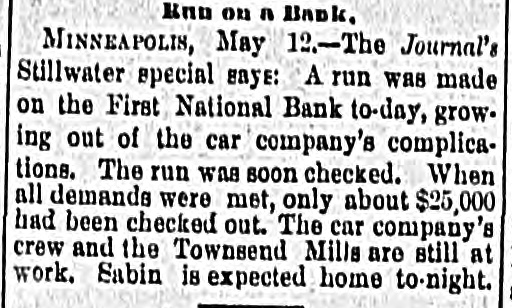
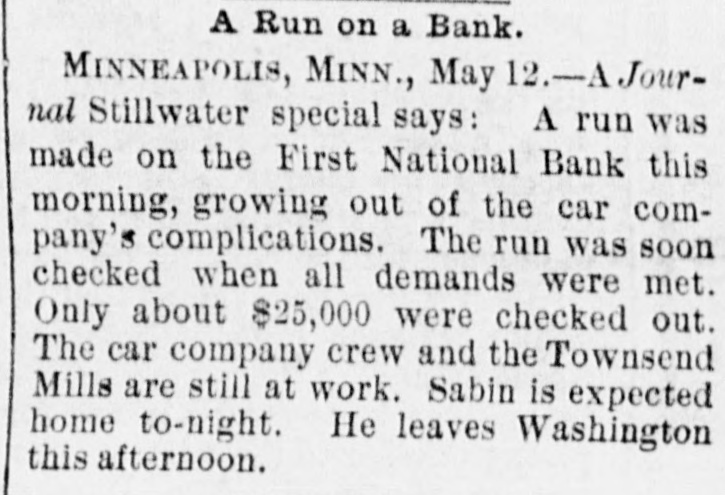
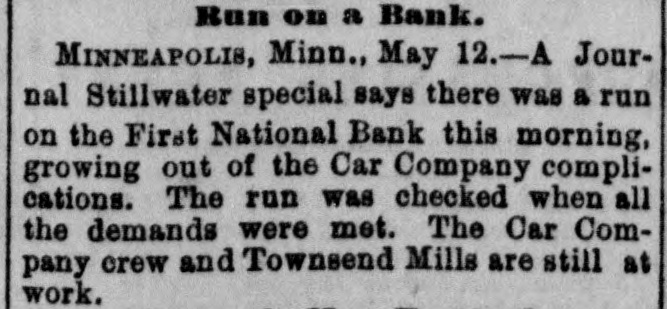
A run was made on the First National Bank this morning, growing out of the car company's complications. The run was soon checked.
Source
newspapers

Newspaper Articles (16)

Article from The Bismarck Tribune, October 1, 1873

Click image to open full size in new tab

Article Text

MINNEAPOLIS The Panic Among the Banks There. Mendenhall Goes Down-Others All Right. MINNEAPOLIS, Sept. 80.-Mendenhall's Bank suepended yesterday. A fearful run was (made on the First National, but it is coming through all right. A run was commenced on the State National, but way C. A.L. soon checked. Other banks all right.


Article from Memphis Daily Appeal, October 2, 1873

Click image to open full size in new tab

Article Text

MINNEAPOLIS, October 1.-There was a run here to-day on the First national bank, which lasted for several hours. The bank, in accordance with an agree ment made between the banks, declined to pay currency in sums over one hundred dollars. This is a practice made and adopted by all the national and savings banks, with the exception of the North western national, which is paying everything. Business men accept the decision of the bank, and confidence in their solvency is well assured. R. J. Mendenhall, private banker, and State savings institution, has closed his doors, having made an assignment. He is a wealthy man, and pledges his personal property to satisfy depositors. His assets are more than his liabilities. Our manufacturers and business men do not anticipate anything more than temporary embarrassment. Business prospeets are excellent, owing to heavy crop of wheat. No wheat is coming to market on account of the panic.


Article from The Wheeling Daily Intelligencer, October 2, 1873

Click image to open full size in new tab

Article Text

MINNEAPOLIS. Run on 1st National Bank--General Situation Good. MINNEAPOLIS, Oct. 1.-There was a run here to-day on the 1st National, which lasted for several hours. The bank, in accordance with an agreement made between the banks, declined to pay currency in sums over $100, This is the practical mode adopted by all the National and Savings Banks, with the exception of the North western National, which is paying everything. The business men accept the decision of the banks, and confiden in their solvency is well assured. R J. Mendenball, private banker, and President of the State Savings Institution, has closed his doors, having made an assignment. He is a wealthy man and pledges his personal property to satisfy the depositors. His assets are more than his liabilities. Our manufacturers and business men do not anticipate anything more than a temporary embarrassment, and business prospects are excellent, owing to the heavy crop of wheat. No wheat is coming into the market now on account of the panic


Article from The Cairo Bulletin, October 2, 1873

Click image to open full size in new tab

Article Text

FROM MINNEAPOLIS FIRST NATIONAL BANK MINNEAPOLIS, September 1.-There was a run here to-day on the First National bank which lasted several hours. The bank, in accordance with an agreement made between the banks, declined to pay currency in sums over $100. This is the practical mode adopted by all the national and savings banks, with the exception of the Northwestern National which is paying everything. Business men accept the decision of the bank, and confl. dence in their solvency is well assured. R. J. MENDENHALL a private banker and state's savings institution, has closed his doors, having made an assignment He is a wealthy man, and pledges personal property to satisfy depositore. His assets are more than his liabilities. MANUFACTURERS. Our manufacturers and business men do not anticipate anything more than a temporary embarraesment Business prospects are excellent owing to the good crops of wheat. There is no wheat coming into market on account of the panic.


Article from The St. Cloud Journal, October 2, 1873

Click image to open full size in new tab

Article Text

IT is rumored that R. J. Mendenhall, a banker of Mioneapolis, has suspended. The First National Bank of Minneapolis suspended yesterday, and the other banks in the city have partially suspended.


Article from Chicago Daily Tribune, October 2, 1873

Click image to open full size in new tab

Article Text

MINNEAPOLIS. MINNEAPOLIS, Minn., Oct. 1.-There was a run here to-day on the First National Bank, which lasted for Heveral hours. The bank, in accordance with an agreement made between the banks, declined to pay currency in sums over 8100. This is the practical modo adopted by all the National and savings banke, with the exception of the Northwestern National, which is paying everything. Business-mon accept the decision of tlio banks, and confidence in their solvency is well assured. R. J. Mendenball, private banker and State Bavings Institution, line closed his doorn, having made an assignment. He is u wealthy man, and pledges his personal property to entisty dopositors. His unweth 810 more than his liabilities. Our manufacturers and business-men do not anticipate anything more than a temporary embarrassment. Business prospects are excellent, owing to the heavy crop of wheat. No whent is coming to market now, on account of the panic.


Article from Chicago Daily Tribune, October 3, 1873

Click image to open full size in new tab

Article Text

MINNEAPOLIS. Special Dispatch to The Chicago Tribune. MINNEAPOLIS, Minn., Oct. 2.-The First National Bank of Minneapolis has safely stood a three days' run. ending yesterday forenoon. It paid out $92,000 Tuesday, but received more on deposit. It is supposed that the run started from the German and Scandinavian papers announcing its suspension, by mistako, for the First National Bank of Momphis. Including the First National, all the Minneapolis banks are safe. with public confidence restored, except a private bank, which has suspended. Its linbilities are few, and all secured. Other banks agreed Tuesday evening to limit checks to the 8100 rulo, not applying it to new deposits.


Article from The Wheeling Daily Intelligencer, May 13, 1884

Click image to open full size in new tab

Article Text

Knn on n Bank. MINNEAPOLIS, May 12.-The Journal's Stillwater special saye: A run was made on the First National Bank to-day, grow. ing out of the car company's complications. The run was soon checked. When all demands were met, only about $25,000 had been checked out. The car company's crew and the Townsend Mills are still at work. Sabin is expected home to-night.


Article from The Daily Cairo Bulletin, May 13, 1884

Click image to open full size in new tab

Article Text

A Run on a Bank. MINNEAPOLIS, MINN., May 12.-AJournal Stillwater special says: A run was made on the First National Bank this morning, growing out of the car company's complications. The run was soon checked when all demands were met. Only about $25,000 were checked out. The car company crew and the Townsend Mills are still at work. Sabin is expected home to-night. He leaves Washington this afternoon.


Article from Eureka Daily Sentinel, May 13, 1884

Click image to open full size in new tab

Article Text

Run on a Bank. MINNEAPOLIS, Minn., May 12.-A Journal Stillwater special says there was a run on the First National Bank this morning, growing out of the Car Company complications. The run was checked when all the demands were met. The Car Company crew and Townsend Mills are still at work.


Article from The Salt Lake Herald, May 13, 1884

Click image to open full size in new tab

Article Text

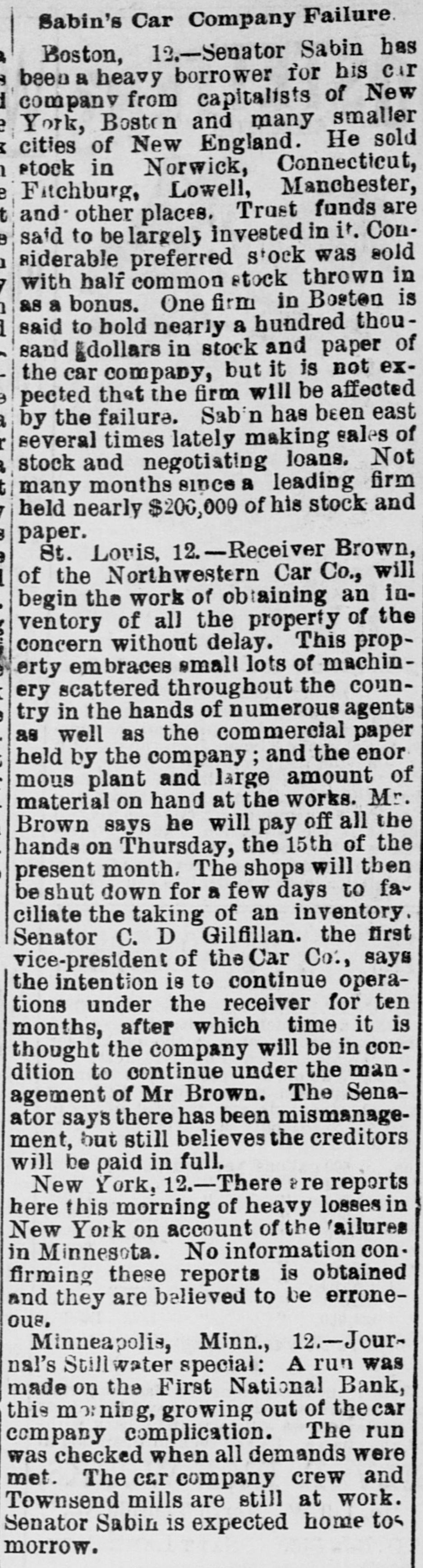
Sabin's Car Company Failure. Boston, 12.-Senator Sabin has been a heavy borrower for his car company from capitalists of New York, Boston and many smaller cities of New England. He sold stock in Norwick, Connecticut, Fatchburg, Lowell, Manchester, and other places, Trust funds are said to belargely invested in it. Considerable preferred stock was sold with half common stock thrown in as a bonus. One firm in Boston is said to bold nearly a hundred thousand Adollars in stock and paper of the car company, but it is not expected that the firm will be affected by the failure. Sabin has been east several times lately making sales of stock and negotiating loans. Not many months since a leading firm held nearly $200,000 of his stock and paper. St. Louis, 12.-Receiver Brown, of the Northwestern Car Co., will begin the work of obtaining an inventory of all the property of the concern without delay. This property embraces small lots of machinery scattered throughout the country in the hands of numerous agents as well as the commercial paper held by the company; and the enor mous plant and large amount of material on hand at the works. Mr. Brown says he will pay off all the hands on Thursday, the 15th of the present month. The shops will then be shut down for a few days to faciliate the taking of an inventory. Senator C. D Gilfillan. the first vice-president of the Car Co., says the intention is to continue operations under the receiver for ten months, after which time it is thought the company will be in condition to continue under the management of Mr Brown. The Senaator says there has been mismanagement, but still believes the creditors will be paid in full. New York, 12.-There are reports here this morning of heavy losses in New York on account of the Vailures in Minnesota. No information confirming these reports is obtained and they are believed to be erroneous. Minneapolis, Minn., 12.-Journal's Stillwater special: A run was made on the First National Bank, this moning, growing out of the car company complication. The run was checked when all demands were met. The car company crew and Townsend mills are still at work. Senator Sabin is expected home tos morrow.


Article from Pullman Herald, November 30, 1889

Click image to open full size in new tab

Article Text

Mrs. Nell's Property. A dispatch dated Anoka, Minn., November 19 says that Mrs. Maria B. Nell has turned over all her property to secure the creditors of the First National bank of Minneapo is, for the sum of over $40,000, for the notes she signed for P. F. Pratt. She has signed over all her property, with the exception of her homestead in Dayton, to Judge Seagrave Smith, to hold in trust for her creditors. This property consist of a 40 acre tract in Minneapolis, and another tract of the same size in St. Paul, the two being worth probably $200,000. Both pieces are now in litigation, suit having been brought some time ago by her son in the district courts of Minneapolis and St. Paul. In both courts Mrs. Nell secured verdicts in her favor. The son has taken an appeal from the Minneapolis court and the matter will have to go before the supreme court before the property can be sold. No appeal has yet been taken from the decision of the St. Paul court, and those familiar with the nature of the case say there is not more than one chance in a thousand of Mrs. Nell being defeated. The receiver of the bank, Mr. McNeir, after much hard work, was enabled to get Mrs. Nell's consent to this arrangement. As soon as the suits are decided, and if in Mrs. Nell's favor, the property will be sold, or enough of it to pay the notes, which will amount to something over $50,000 all told. This will enable the receiver to close up the accounts of the bank, and will probably relieve the stockholders from an assessment to pay depositors of the bank. In case the suits go against Mrs. Nell the bank will have to stand the loss of the paper indorsed by her. Mrs. Nell is over 80 years of age and is entitled to a great deal of sympathy in this matter. Of this large sum of money which she is called upon to pay she had never received a dollar, it all going 80 P. F. Pratt, the ab. sconding cashier of the bank, in whom Mrs. Nell had the utmost confidence, and who made a will leaving all her property to Pratt. The raseal overreached himself, losing more by his dishonesty than he could have had and remain an honest and respected citizen. The trust deed was given by Mrs. Nell some two weeks ago, but was kept secret by the bank officers at Mrs. Nell's request. The matter was divulged by the lady herself while on & visit to Elk River and was fully confirmed by Receiver McNeir, when interviewed.


Article from Iowa County Democrat, December 6, 1894

Click image to open full size in new tab

Article Text

The forest and prairie fires in the Okaw River bottoms have finally been got under control. Fire caused by a defective flue destroyed a block of dwellings in Kansas City. The loss will reach $100,000. Public meetings of all kinds have been prohibited in Sandwich, III., owing to the prevalence of smallpox. Three-fourths of the winter wheat sown in the western third of Kansas has been ruined by the drought. A new plot of General Manigat to overthrow the Haytian government was discoverd by President Hippolyte. Burglars blew open and robbed safes in Buttsville, N. J., and Ridgefield, Conn. Ferryboat Netherlands crashed into a ship in New York harbor and twenty of her passengers were injured. Five students of a medical college at Kansas City, Mo., were arrested while robbing a grave in a neighboring town. Henry G. Sidle ex-president of the First National bank of Minneapolis, has made an assignment. Robert McCullough, Frank Bleshenship and Charles Patton are under arrest at Ashley, III., for postoffice robberies. The salary of General Master Workman Sovereign of the Knights of Labor was reduced at his own request from $3,500 to $2,500. The application for a receiver of the St. Joseph, Mo., Loan and Trust company has been granted. The liabilities are about $135,000; assets $195,000. Charles F. Atkinson, theatrical manager and lessee of the Bowdoin Square thea v, Poston, filed an insolvency per tition. McNeary, Tenn, 11 small town on the Mobile and Ohio railroad, was wiped out by fire. The total loss is about $75,000. Seven business houses and one dwelling were destroyed at Swayzee, Ind. It is feared a woman lost her life. Four candidates are in the field for the short term senatorship in Michigan. It is predicted that the real fight will be between Olds and Burrows. Republican managers of Nebraska decided to abandon the proposed contest of the election of Holcomb, dem.pop. R. F. Nedrow, who committed a mur derous assault on Edgar Scott at Peoria, was freed by a jury and citizens are indignant. A Dubuque, lowa, jury set at naught the testimony of medical experts and gave the widow of Joseph Brunskill a verdiet in a damage suit. Antitrust distillers believe President Greenhut's trip east is for the purpose of securing funds to fight the independents. According to Rev. C. W. Blodgett, the ratio of divorces to marriages is greater in Galesburg, III., than in any city in the country. Alderman Madden, who is manage ing Joseph Medill's senatorial cam paign, Illinois, says there is little doubt of his nomination. Carleton B. Hutchins, inventor of a refrigerator car and a large manufacturer, died in Detroit of heart fail ure. John 11. Sickles, inventor of a hand fire engine, died at his home in Port Chester, N. Y., of paralysis, aged 76 years. University of Illinois football eleven defeated the Wesleyan University eleven at Bloomington by a score of 12 to 5. It is stated that the members of the cabinet are divided on the method for beginning reform in the country's finances. General Casey, chief of engineers of the war department, urges the secur-


Article from The Representative, May 1, 1895

Click image to open full size in new tab

Article Text

THE STATE GETS BACK $3,000 BOBLETER COUGHS UP AND IS CAHSVMSLIHM The committee appointed in QJanuary last, has after over three months of silence made its report and as was to be expected brought forth a mouse. With ample powers and a broad field to work on it has deliberately scorned the aid of these who would and could lend assistance in hatching a scheme of villaincy to plunder the state, that has been practiced for years past. The committee has found that Bobletter took gifts for lending state money, but whether the committee would have seen fit to so find had they been certain the evidence had not been seen by others we cannot say, but they did have the grace to collect from Bobleter a part of that which he had taken from the state, even if they do tell what a kind, good, clean, generous, honest fellow Bob is. The committe say: "Our investigations have been "limited to an enquiry, first into the "financial condition of banks having on "deposit funds." The committe then give a list of the banks with amount deposited in each -and closes by stating that "we believe them all to be of good financial standing." We know not from what source the committee has received its information bat evidently from no very reliable source Indeed it seems highly probable that the committe did not seek very diligently after any witnesses who could give the facts, but whether this failure was owing to a premeditaed desire to make a whitewash report or from jealous fear that some witness might secure a part of the lustre to attending the work of the committee we do not attempt to state, but we do say that as the result of our labors the state is over $3,000 better off, for Bobletter, ex-state treasurer, found that we had seen checks bearing his endorsement which he had fraudulently gotten as a rake off for depositing state funds in certain broken banks: hence being caught in the act, Bobletter makes a virtue of necessity and coughs up $3,000, but not until he is caught. Nor until every effort has been made to defeat an investigation. Whereupon the committee gave Bob a clean bill of health and certificate of good moral character. It is well known that we drew the resolution, reader, which the committee voted, yet we were not given a chance to go before the committee at any session, neither was another gentleman who possessed many facts. We furnished-to two members of the committee printed data covering two sides of a newspaper showing the management of certain financial concerns, hence it seems that the committee could have had information if it so desired; hence it is to blame for its whitewahsing report. The committee finds that the state has assets in certain banks, which banks they believe to be in good condition, and convey to them following, to which your attention is asked, in order that you may have certain facts which were or could have been known to the committee: In State Bank Minneapolis $75,445.76 In Bank of New England, Min11.208.35 neapolis In the Farmers' and Merchants Bank, Minneapolis In American Exchange Bank, 18003.91 Minneapolis Total In banks that are busted and are now in the hands of a receiver: In National Geman American, Paul 78 68'629'42 In Commercial, St. Paul In Northern Trust Co., MinneapSII Total In concerns that have failed but later said to have resumed: In First National, Minneapolis. $33,647.09 In October, 1893, this bank made a false statement to the comptroller that it had a capital, surplus and profits of $1,409,101.13, yet today its surplus and profits are gone, and the stockholders have been assessed $800,000 to make good the capital; hence the bank's statement was true minus $1,209, 101.13, while soine DATE 01 pels eq pinom sit JO its stock away. In Union National, Min89 $64,465.68 neapolis This bank reported capital surplus of $579,048 68, which is true lacking $329,048.68, since they have had to levy an assessment of $250,000. In Flour City, Minneapolis. $17,110.36 This bank reported capital and surplus $1,167,017.31, and later from some cause is reported to have reduced its capital $500,000, showing a shrinking in say .10 pay 11 000'009$ J3A0 JO capital some very doubtful mortgages assigned to it by the Metropolitan Trust Co., and we would like to ask whether it is not the holder of considerable of the stock of said Trust company, and which even Kenyon finds to he valueless. We would also like to enquire how much of Tom Walker's unsecured paper it holds, and paper of like value. $57,820.77 Communia, uj A charge was made both to a state official and the legislature that this bank loaned money on Germania Bank stock, though said stock had had no money paid in on it. In view of the fact that this bank is run by Bobletter and Kettelson, one if not both of whom have admitted they got a rake off on state funds, we would like to enquire how much rake off they demand from the bank of which they are officials? Also how much of their own notes have been discounted by said bank? If Bobletter for $3,000 will deposit $131,000 of state funds in busted banks he would hardly seem to be a safe man to entrust with the funds of a bank as cashier. Brown County Bank, New Ulm 1011111'01$ Boon County Bank. New Ulm $10,111
Article from The Minneapolis Journal, December 27, 1904

Click image to open full size in new tab

Article Text

FIRE WRECKAGE DEEP IN SNOW Sioux City's Streets Still Blocked -Heroism of Two Saved Heavier Loss. Special to The Journal. Sioux City, Iowa, Dec. 27.-Driven by a relentless forty-mile gale from the northwest a blizzard raged here all night. The snow was preceded by sleet which coated the streets and made traveling and street car traffic very difficult. The ice also put most of the telegraph and telephone wires out of commission. A 7-below-zero temperature was hammered into the air this forenoon by the wind and it is as bad a blizzard as the city has had for five years. The storm stopped suddenly the work of removing the ruins of last Friday's fire, and, altho three days have passed, five streets are yet blocked, street cars being compelled to run on irregular routes. Yesterday was devoted to recovering safes, nearly all of which were found to contain well-preserved books and money. The City National and First National banks recovered all their goods, together with about $90,000 in cash, and have reopened for business in new quarters. The walls of the seven-story Toy building were pulled down by ropes at 6 o'clock last evening, filling fourth street with great heaps of debris which will require days for removal. It was Minneapolis' disastrous experience with fire walls that induced Mayor Sears to take immediate steps to have all walls torn down at once. The most remarkable story of heroism in Friday night's fire was made public only today and as a result a subscription paper is being circulated for Gus Berg, a fireman, and Addis Bell, an elevator boy. The two dragged a hose to the roof of the seven-story Metropolitan block when its outside woodwork had been ignited. One sat on the other's legs for two hours so the hose could be held out and the front drenched. This alone saved the block from burning, which would have carried the fire across Fourth street and probably doubled the loss.


Article from The Minneapolis Journal, February 13, 1905

Click image to open full size in new tab

Article Text

itors nor stockholders will lose a farthing. Raises Legal Question. An interesting legal question has been raised with regard to certain notes now held by Judge Buckham, which were discounted at the First National bank. It appears that about a year ago Mr. Clement approached Judge Buckham, and representing to him that the bank had several perfectly good notes that for one reason or another it was not in a position to carry induced him to purchase them. Some of these notes were made by depositors who recently in expectation of their maturing had been accumulating money with which to pay them and putting it in the bank, supposing it still held them. When the bank suspended the note makers approached the receiver with the request that their deposits be regarded as an offset against their notes and then learned for the first time that the notes had been disposed of, and that deposits made could not apply upon them. Is Director an Innocent Holder? The paper is, of course, negotiable, and the bank had an undoubted right to sell it, and it is not questioned that it would be collectable in the hands of a third person not connected with the bank. But whether a director under the circumstances can be considered an innocent holder is the question that is now raised. It is argued that the mere fact that the president of the bank attempted to dispose of paper held by it and which was its principal source of income should have been a warning to the director and that it should at least have sufficiently aroused his suspicions to induce him to make such an investigation as could not have failed to reveal the fact that the bank was in desperate straits. It is further argued that where a director fails to direct the affairs of the bank he should not be permitted to profit from his own negligence, and that notwithstanding the fact that Judge Buckham paid the full value of the notes they must still be held to be in possession of the bank at least to such S an extent that any deposits held by the bank must be regarded as an offset to them. Holding this view it is stated that makers of notes now in the hands of Judge Buckham will refuse to pay them unless they are credited on them with the amount of their deposits in the suspended bank. e Resigns a Trusteeship. p Mr. Clement has resigned the trusteeship of the Polar Star Electric company. At the suggestion of the president of e the First National ban of Minneapolis, which holds the company's bonds to the par value of $29,000, the Minnesota d Loan & Trust company has been named as Mr. Clement's successor. L-