9642. Scott County Bank (Jordan, MN)

Bank Information

Episode Type
Run → Suspension → Closure
Bank Type
private
Start Date
November 1, 1903
Location
Jordan, Minnesota (44.665, -93.640)

Metadata

Model
gpt-5-mini
Short Digest
e38408db

Response Measures

Full suspension

Other: Bank later made voluntary assignment in bankruptcy and had a receiver/trustee appointed (1904). Indictments followed in 1905.

Description

Newspaper accounts from Nov 1903 report heavy withdrawals following failures of two neighboring private banks and the Scott County Bank closed its doors 'temporarily' on inability to realize securities. A receiver and then a trustee were later appointed and the partners made a voluntary assignment in bankruptcy (reported later), indicating permanent closure. Dates inferred from article publication (Nov 1903 closure; receiver/trustee and assignment reported subsequently).

Events (3)

1. November 1, 1903 Run
Cause
Local Banks
Cause Details
Withdrawals were prompted by failures of two private banks in neighboring towns that caused unrest and gradual large withdrawals over prior three weeks.
Measures
None mentioned in articles (depositors' funds 'tied up'; bank posted notice of temporary closing).
Newspaper Excerpt
The failure of two private banks in neighboring towns caused a feeling of unrest among conservative people and a large total was withdrawn gradually by certain depositors during the past three weeks.
Source
newspapers
2. November 1, 1903 Suspension
Cause
Bank Specific Adverse Info
Cause Details
Bank closed because it was unable to realize on its securities (illiquid assets/insolvency concerns) and thus suspended payments.
Newspaper Excerpt
The Scott County bank ... closed its doors Saturday and a notice tells that it has closed temporarily on account of not being able to realize on its securities.
Source
newspapers
3. January 1, 1904* Receivership
Newspaper Excerpt
Strait and Schreiner ... made a voluntary assignment in bankruptcy last year. First a receiver for the bank was appointed and then a trustee, Fred Habegger.
Source
newspapers

Newspaper Articles (3)

Article from The Minneapolis Journal, November 2, 1903

Click image to open full size in new tab

Article Text

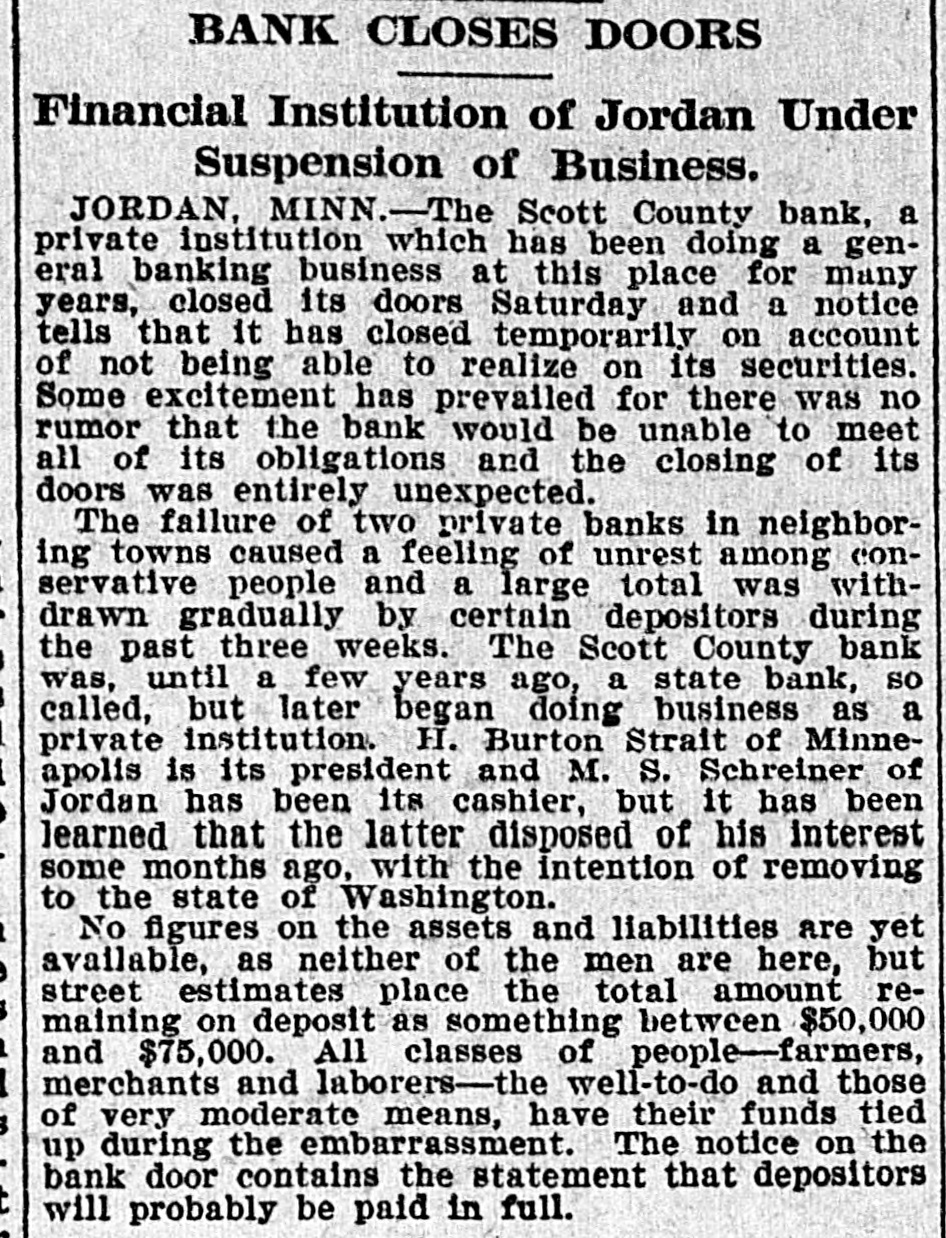
BANK CLOSES DOORS Financial Institution of Jordan Under Suspension of Business. JORDAN, MINN.-The Scott County bank, a private institution which has been doing a general banking business at this place for many years, closed its doors Saturday and a notice tells that it has closed temporarily on account of not being able to realize on its securities. Some excitement has prevailed for there was no rumor that the bank would be unable to meet all of its obligations and the closing of its doors was entirely unexpected. The failure of two private banks in neighboring towns caused a feeling of unrest among conservative people and a large total was withdrawn gradually by certain depositors during the past three weeks. The Scott County bank was, until a few years ago, a state bank, so called, but later began doing business as a private institution. H. Burton Strait of Minneapolis is its president and M. S. Schreiner of Jordan has been its cashier, but it has been learned that the latter disposed of his interest some months ago, with the intention of removing to the state of Washington. No figures on the assets and liabilities are yet available, as neither of the men are here, but street estimates place the total amount remaining on deposit as something between $50,000 and $75,000. All classes of people-farmers, merchants and laborers-the well-to-do and those of very moderate means, have their funds tied up during the embarrassment. The notice on the bank door contains the statement that depositors will probably be paid in full.


Article from The Mankato Free Press, November 6, 1903

Click image to open full size in new tab

Article Text

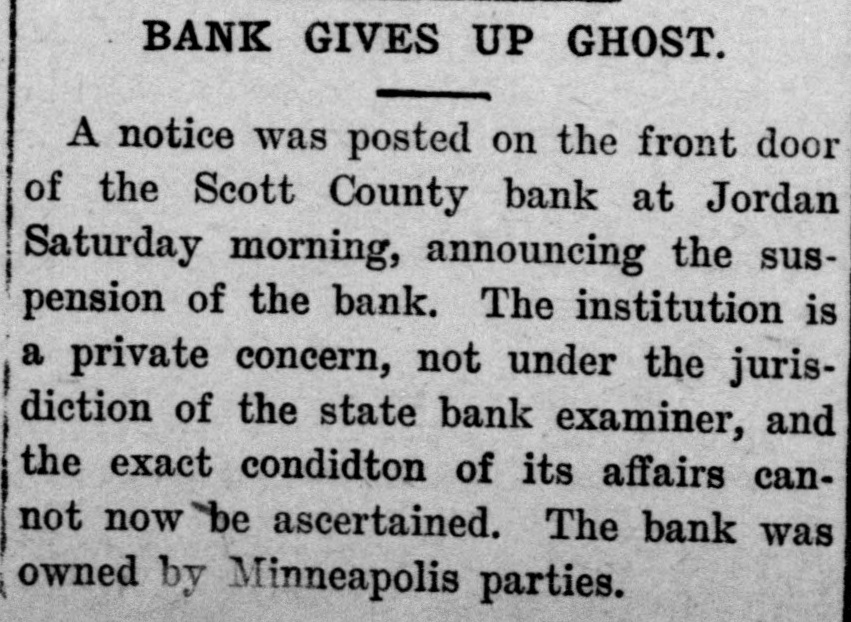
BANK GIVES UP GHOST. A notice was posted on the front door of the Scott County bank at Jordan Saturday morning, announcing the suspension of the bank. The institution is a private concern, not under the jurisdiction of the state bank examiner, and the exact condidton of its affairs cannot now be ascertained. The bank was owned by Minneapolis parties.


Article from The Mankato Free Press, March 31, 1905

Click image to open full size in new tab

Article Text

Constitutional Point Involved in Defendants' Appeal. Say Messrs. Start and Schreiner Regularly Indicted. Accepted Deposits When the Institution Was Insolvent. From Saturday's Daily. County Attorney S. B. Wilson is interested in the decision rendered by the supreme court in the case of H. Burton Strait and Henry Schreiner, the Scott county bankers. Mr. Wilson assisted in the prosecution. The supreme court defines the nature of the guarantees provided by the state constitution for the security of the people's "papers and books" against "search and seizure." The decision also refuses to set aside the indictment found against the defendants for accepting deposits when their bank was insolvent. Strait and Schreiner, partners in the Scott county bank, at Jordan, made a voluntary assignment in bankruptcy last year. First a receiver for the bank was appointed and then a trustee, Fred Habegger. Afterwards, in October, an investigation of the bank's affairs was begun by the Scott county district court and grand jury. Neither Strait nor Schreiner was summoned, but the trustee was subpoenaed and examined. He also exhibited his books and papers at the request of the county attorney. The result was indictments against Strait and Schreiner for having received deposits after their bank was insolvent. But the defendants moved that the assignments be set aside on the ground that the use of the books and papers before the grand jury violated the constitutional provision that "the right of the people to be secure in their person, house, papers and books against search and seizure shall not be violated." The motions presenting these and other objections to the indictments were denied by Judge Francis Cadwell, of Scott county from whom an appeal was taken. Reviewing its previous decisions in allied cases, the supreme court declares that a defendant in a criminal case cannot be compelled to go before the grand jury and give evidence, directly or indirectly, against himself. Any indictment so secured would be invalid. The only case the court was able to discover interpreting the safeguards afforded by American jurisprudence to protect private papers from search or seizure was that of Boyd vs. the United States (116 U. S. 616). Here the federal judges had held that it was an unconstitutional exercise of authority to require the claimants of goods said to have been fraudulently imported to produces an invoice in court. "But," continues Judge Lovely, "the objection, to be of potential force, must directly involve the action of the court in using compulsory means to obtain evidence. In the case at bar no process to produce the books of the bank was directed to the defendants or authority exerted to obtain their possession from the person in whom their custody was originally held. "No objection appears to have been made to the delivery of the books to the receiver or trustee in bankruptcy. "If there was any immunity attached to the books, the accused were not interogated or under the control of any court or compulsory process to produce them for use." Besides, as the court, pointed out, "the books and papers were, to a certain extent, of a public nature," and the immunity assured to the defendant is personal. The objection is also considered that the grand jury returning the indictment was illegally constituted, inasmuch as the court had excused several jurors from service for reasons not laid down in the statute of 1894 (section 7181). That statute, Judge Lovely insists, is not mandatory; "the trial court is clothed with reasonable judicial discretion." The syllabus is: "State of Minnesota, plaintiff, VS. R. Burton Strait defendant State of Min.