Article Text
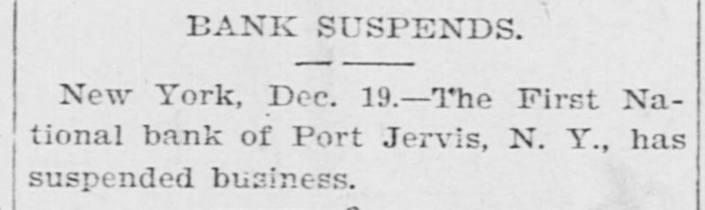
BANK SUSPENDS.
New York, Dec. 19.—The First National bank of Port Jervis, N. Y., has suspended business.
Click image to open full size in new tab
New York, Dec. 19.—The First National bank of Port Jervis, N. Y., has suspended business.

Click image to open full size in new tab
as to invite considerable profit-taking by the traders in the final dealings, but the undertone continued strong until the close, which showed substantial net gains all through the list. The early hours of the trading witnessed very heavy liquidation in continuance of yesterday's process of recuperation, but there was no approach to the panic conditions of yesterday at any time. The extensive and elaborate preparations made to meet the crisis were evident at the opening, and prices were opened at large advances all through the list. This result was helped by the higher quotations sent over from London, where the Stock Exchange had a false rumor of a partial retrieval by General Buller of his recent disaster. The high prices for Americans in the London market were doubtless due in part to manipulation orders cabled from this side, in furtherance of the general plan to sustain and protect the market. The opening advance was met by an avalanche of liquidating sales, which promptly drove down prices. in spite of the utmost efforts to sustain them. Not a few stocks showed evidences of positive weakness, and the first two hours of trading were given up to furious activity and indescribable c/nfusion of sentiment. The steady absorptive power of the buying was bound to have a reassuring effect, and the manner in which the liquidation was brought to a standstill was highly impressive. Even before noon sufficient stability had been established to face the report of a failure by a brokerage house in Boston, which would have been sufficient to demoralize yesterday's market. With the subsidence of the panic conditions a saner and quieter view developed. A study of the facts in connection with the trust company which came to grief yesterday, and of the securities with which it was involved, showed them to be unique, and not to be taken as justifying the wholesale fear and distrust which was felt yesterday, not only of all trust companies, but all industrial securities. Nevertheless, there was abundance of precaution and discrimination shown to-day against many of the industrials, and especially in the placing of loans. They were not acceptable as collateral, and money was not easily procured for the purpose of supporting them in the market. It was reported that the financial powers concerting measures of relief were not altogether in agreement as to the length it was desired to go, some of them holding the opinion that no real benefit would accrue from sustaining some of the industrial securities. But the danger disclosed by yesterday's events on the whole fabric of values carried the day in favor of the relief measures. The decision of-the banks was to place all their available resources at the disposal of borrowers, without regard to the effect on the surplus reserve. The knowledge of this determination had much to do with allaying the apprehension. The higher rates for money made during the day were due to discrimination on account of the charter collateral where industrials were included. The clearing house commission was in session during the day, but by the time the market closed had come to the conclusion not to call a meeting for to-morrow, though further sessions can be had at need. Yesterday's unprecedented events on the Stock Exchange attracted immense throngs to the financial district this morning. The galleries were inadequate to meet the demands on them, and great crowds of all sorts and conditions of men and women surrounded the approaches. The strain upon the brokers and operators was a severe one, and the scramble and turmoil upon the floor of the exchange made scenes of inextricable confusion. A FAILURE AT BOSTON. BOSTON, Dec. 19.-Dillaway & Starr, bankers and brokers of this city have assigned. The assets and liabilities have not yet been computed. The firm is one of the most prominent in the city, and is composed of Charles W. Dillaway, George H. Flint and A. W. Lawrence. The firm, it is understood, with two other houses, carried a large quantity of mining stocks. The embarrassment of the Globe National Bank and the subsequent flurry in the stock market is said to have been the reason for the assignment, as the firm was a heavy loser. Assignee Hovey at noon said that no statement would be given out to-day. ANOTHER AT PORT JARVIS. NEW YORK, Dec. 19.-The (First National Bank of Port Jarvis, N. Y., did not open its doors for business today. A notice signed by President Francis Marvin and Vice President Sharp was posted, saying that temporary suspension was necessitated by the stringency in the New York money market. The suspension is attributed primarily to the recent defalcation of L. E. Goldsmith, the Assistant Cashier.