Fourth National Bank (Cincinnati, OH)

Episode Information

Episode UID
9300885
Episode Type
Suspension → Reopening
Bank Type
national
Bank ID
930 national
Charter Number
93
Start Date
September 25, 1873
Location
Cincinnati, Ohio (39.103, -84.515)

Metadata

Model
gpt-5-mini (chosen from majority vote of a three-model LLM ensemble)
Short Digest
7df03fb0a4b1c45d

Response Measures

None

Events (4)

1. September 28, 1863 Chartered
Source
historical_nic
2. September 25, 1873 Suspension
Cause
Macro News
Cause Details
Precautionary partial suspension adopted by the Cincinnati Clearing House in response to the nationwide financial panic originating in New York (Sept. 1873).
Newspaper Excerpt
The Cincinnati clearing house association has just adopted the following resolution: Resolved, That for the protection of our commercial interests ... they will not pay out currency on the checks except for small sums ... but they will certify checks ... payable through the clearing house only.
Source
newspapers
3. October 13, 1873 Reopening
Newspaper Excerpt
Every bank and banker in the Clearing House Association ... commenced full and unequivocal resumption. There was no excitement. There was nothing about the appearance of the banks that indicated a run.
Source
newspapers
4. November 17, 1923 Voluntary Liquidation
Source
historical_nic

Newspaper Articles (17)

Article from Evening Star, September 25, 1873

Click image to open full size in new tab

Article Text

LATER. More Good News! CONFIDENCE FULLY RESTORED. YORK, Sept. 25-1.10 p. m -A tour among New the banking firms and Sroker's offices, shows and a visit to the sub-treasury this p. m., Constill further improvement in feeling. fidence a is much restored, and the belief is that matters will soon assume a decided improvement. There is considerable activity in stocks, the and they are bought and sold now for first time in four days on certified checks. The following are the quotations at this hour: Union Pacific, 19a20; Western Union 58; Paci York Mail, 29a30; Wabash, 40%a42 New fic Central, 89a90; Ohio and Mississippi, 28 bid, North Western, 39a40; Lake Shore, offered at 75: Rock Island, 85a86; Harlem, 108 bid; St. Paul, offered at 32. Everything is quiet up town. The runonthe savings banks is subsiding. A Better Feeling in Philadelphia. PHILADELPHIA, Sept. 25 -There is a more the hopeful feeling among merchants, and Third prices of goods continue very steady. street is quiet. All the national banks, savings banks, and such of the state banks as did not suspend pursue business in the usual manner. and The board of brokers continue in session adopted the following resolution: Resolved, That until otherwise ordered certified checks or due bills on any of the associated banks will be received in settlement of contracts between the members of the board. Precautionary Measures in the West IN CINCINNATI. CINCINNATI, Sept. 25. The Cincinnati clearing house association has just adopted the following resolution: Resolved, That for the protection of our commercial interests and for the purpose of preventing a drain of currency from the banks and bankers of this city, we do hereby agree New to adopt substantially the plan adopted in York, viz. They will not pay out currency on the checks except for small sums to be optional with the banks upon whom they are drawn, but they will certify checks drawn on balance in their hands payable through the clearing house only. IN CHICAGO. CHICAGO, Sept. The Clearing House Association held an important meeting last night an to consider the financial situation. After animated discussion, which lasted till near one o'clock this morning, the following resolution was Resolved, adopted: That until further action, and in in view of the disturbed condition of affairs New York and other cities, and the difficulty in converting balances into currency, and on allvice of the bank examiner, our members be recommended and authorized to suspend made currency payments on any large demands over upon their, either from country banks or their OWE counters. Salt Lake City Out of the Storm. SALT LAKE, Sept. 24.-The financial crisis in New York has not affected the situation here; but, in view of possibilities, several English companies have offered assistance. The Situation Abroad. LONDON, Sept. 25,3.30 p. m.-The bullion in the Bank of England has decreased €376,000 during the past week. The amount gone Erie into the bank on balance to-day is £12,000. railway shares active. Last sales at 44% LONDON, CLOSING Sept. 25, RATES 5 p. IN m.-The LONDON. rate of discount in open market for three months' bills is 4 per cent. The rate for money at the Stock Exchange on government securities is 21/6 per cent. Consols, 92% for both; bonds of 1865,old, 95%; 1865,95 10-40's, 90%; new fives, 91% THE PANIC THE ROAD TO SPECIE PAYMENT. LONDON, Sept.25.-The Daily News believes that the financial panic in New York will lead to the resumption of specie payment. THE MEETING CALLED BY MR. WATSON to consider the affairs of the Erie railroad company, took place to-day, and was attended by one thousand persons. The meeting was described as stormy. A resolution of thanks to Mr. Watson was unanimously adopted. The names of Bischoflshein & Henry were greeted with a storm of mingled hisses and cheers. Mr. Watson, in the explanation of the affairs of the company, said there was some apparent dubiousness about accounts, but he believed they were correct. They wanted $30,000,000 immediately to finish improvements already commenced, and to lay a third rall. The meeting was attended by many Americans. MORE SPECIE FOR NEW YORK. LONDON, Sept. 25--185,000 pounds of bullion was shipped from Liverpool for New York today. The steamship City of Brussels took 15,000 pounds, the Adriatic 35,000. Another Ocean steamer Wrecked. OFFER Sant with The

Article from The Wheeling Daily Intelligencer, September 26, 1873

Click image to open full size in new tab

Article Text

MEASURES ADOPTED BY THE BANKS THE LEADING CITIES OF THE WEST AND SOUTH. Expedients and Suggestions at New York and Washington. Improved Feeling In Philadelphia. Conference at Washington. The Legal Reserve not to be Touched. Afternoon Dispatches. INTERVIEW WITH A SUSPENDED BANKER -WHAT MR. HOWES HAS TO SAY. NEW YORK, Sept. 25.-Mr. Howes, of the firm Howes & Macy, suspended, says "We have not borrowed a dollar and do not intend to borrow one: We have plenty of money and the best of securities, but we do not propose to sacrifice them at the present current prices. The fact of the matter is that a general suspension of the large banking institutions has become a necessity, and the sooner it takes place the better. The small houses can afford to hold out. or, perhaps, go under The people who bring their money to us and expect to get three per cent interest, must not think that we put it into a corner to look at We invest it, and we can not convert our investments on the jump without great damage to ourselves. At any rate we do not propose to be the authors of our own ruin, so our depositors will have to wait. MR. M'CULLOUGH'S VIEWS OF THE FAILURE OF CLEWS CO. Mr. McCullough, ex Secretary of the Treasury, in the course of hisconversation said the only course to be pursued for safety now is a bold one, free alike from fear or excitement 'The suspension of Henry Clews & Co., I regard as very unfortunate. That firm I have understood to have been a very successful one, and doing a large business. In my judgment it would have been wise of its friends to have prevented such an occurrence at all hazards: The failure of a house of its prominence does incalculable harm by weakening the sense of security in the public mind Men get to that stage of uncertanty in which they say, to whom dare we lend now. PROPOSED PURCHASE OF FOREIGN EX CHANGE AS A MEASURE OF RELIEF. A number of foreign exchange bankers in this city have suggested to the government at Washington, the purchase of toreign exchange as a measure of relief for the stringency of the currency market. The suggestion is said to be now under consideration by the treasury officers. The following explanation of the terms of the suggestion is made The foreign bankers of New York offer on these terms to loan to the Committee of the Clearing House Association We will sell our day bills on London and take in pay ment loan certificates. We propose to take these certificates to our bank and place them to our credit. We will then buy the bills on Europe drawn against the shipment of produce, and draw checks therefor on your banks, payable through the clearing house. We thus obviate the necessity of having greenbacks in forwarding grain and produce now filling our market. Relief can be given in this without increasing the demand for greenbacks. About one hundred members of the Chamber of Commerce have joined in a request for a meeting of the Chamber this afternoon for a consultation relative to the condition of financial affairs and for such action may be deemed advisa. ble to re-establish the public confidence. ACTION OF THE CINCINNATI CLEARING HOUSE CINCINNATI, Sept. -The Cincinnati Clearing House have just adopted the fol lowing Resolved That for the protection of our commercial iterests, and for the purpose of preventing the drain on the currency from our banks and bankers, we do hereby agree to adopt substantially the plan adopted in New York, viz: That they will not pay out currency on checks except on small amounts, to be optional with the banks upon whom they are drawn, but they will certify to checks drawn on laborers, in their hands and payable through the Clearing House only e Each member of the Clearing House Association is required to deposit such's sum in approved security as will at all h times cover the amout of their clearings Government bonds are secured at their par value. Railroads and other stocks and bonds and bills receivable, are received at 75 per cent of the value fixed on them by y the committee. Loan certificates are issued by the Committee, which certificates can only be used in the settlement of balances between the banks, and are not negotiable. The Committee appointed to carry into effect and supervise its workings are Wm. Hooper, R. R. Springer, N. W. Scarborough, Jason Evans and other persons. ACTION OF THE HICAGO CLEARING HOUSE. CHICAGO, Sept. 25. - The Clearing House Association held an important meeting last night to consider the financial situation. After an animated discussion, which lasted till near one o'clock, the following resolution was offered by Mr. Coolbaugh, President of Union Naio tional Bank, and adopted nt Resolved, By the Chicago Clearing St. House Association of the city of Chicago, nd that until further action and in view of ot, the disturbed condition of affairs in New ed York and other cities, and the difficulty of converting balances into currency and on the advice of the Bank Examiner, its d. members be recommended and authorizirs ed to suspend currency payments of ed money for large demands made upon them, either from country banks or over ng their counters. for A number of bankers opposed such a nd course, claiming that the Chicago banks


Article from New-York Tribune, September 26, 1873

Click image to open full size in new tab

Article Text

New-York Daily Tribune. FOUNDED BY HORACE GREELEY. FRIDAY, SEPTEMBER 26, 1873. At a stormy Erie meeting in London, President Watson received a unanimous resolution of thanks, and announced that his road wanted $30,000,000 at once. The French Conservatives claim a majority of 20 in the Assembly in favor of a monarchical restoration; the Republican members threaten to resign in a body. The Spanish Government has demanded of England the release of the Vitoria and Almanza. = The U. steamer Tigress is still searching for the Polaris crew. Secretary Richardson, Attorney-General Williams, and other officials determined, it is said, after long consultation, that the Government should not use any portion of the legal-tender reserve for the purchase of additional bonds. The banks of Chicago, Cincinnati, Baitimore, Nashville, and New-Orleans have suspended the currency payment of large demands. In St. Louis the bank suspension appears to be total. Failures are reported in New-Brunswick, N.J., Selma, Ala., Indianapolis, MemThe schooner Whiting phis, Atlanta, and Augusta. was wrecked at Grand Haven, Mich., all the crew but one being Descued after a thrilling fight with the waves. = An Anti-Kellogg Convention has been called, to meet at New-Orleans Nov. 24. There were no further suspensions in Wall-st., although aid from the Government in the purchase of bonds was entirely withdrawn. The difficulty in getting foreign exchange has affected the export trade somewhat disastrously. The Stock Exchange endeavored, by the appointment of a Committee, to force settlements upon last week's transactions. The Bank Presidents did not favor the theory of the Stock Exchange 10 regard to the resumption of business. ==== Sprague's attorneys endeavored to show that the money for his investments was borrowed from the Brooklyn Trust Company. The Grand Jury issued a public call for testimony. The District-Attorney refused to announce his intentions concerning the jail frauds. The Committee on investigating department affairs or- The Liberal Republican General Commitganized. tees made arrangements for holding primaries, and listened to Gen. Coctrane's remarks on the issues of the campaign. The Kings County Democratic primaries were held. The Newark Democratic Convention made municipal nominations. = An effort to act on the Police Justice nominations falled in the Board of Aldermen. - The Protestant Episcopal Diocesan Convention was addressed by Bishop Potter. - Prominent delegates to the Conference of the Evangelical Alliance, and Wilkie Collins, arrived. Damaging testimony was adduced in the baby-farming examination. The Harlem Rowing Club's Fall races were pulled, and entries for the National Amateur Regatta were announced. = The New-Jersey section of the NewYork and Oswego Midland Railroad is to return to its


Article from The New York Herald, September 26, 1873

Click image to open full size in new tab

Article Text

The Latest from Cincinnati. CINCINNATI, Sept. 25-12 P. M. The all absorbing question to-day has been the action of the members of the Cincinnati Clearing House Association this morning, substantially following the action of the New York banks with reference to the payment of depositors. Com paratively few persons suspected the event was to transpire so soon, II at all. Many persons in commercial and financial circles were anxious about the future, but the larger portion were of the opinion that unles: the troubles in the East should become more aggravated, the banks here would be able to pull through. The consequence was there was no run on the banks that was visible to the public eye as to excite general apprehension, but depletion was, nevertheless, going on. Cincinnati was honoring all demands: all balances were promptly transmitted; but while this was proceeding the balances in her favor from elsewhere were not forthcoming. Besides this, occasional heavy depositors, apprehensive of prospective troubles, were quietly drawing out their deposits and placing them in the Safe Deposit Company or elsewhere, where they would be more available in the event of ultimate disaster. Under such circumstances the banks felt that without some change in the general situation it was only a question of time as to taking steps looking to self protection and to the protection or the business of the city. There was no reasonable prospect of the change hoped for, and it appeared only a question whether the precautionary step should be taken now, when the banks had strength to help carry on the industrial and commercial interests of the city, or WAIT with a strong probability that they would finally be compelled to take such action after they had submitted to a complete drain of currency and they be lett in a situation in which the interests of the community must have looked to them in vain for help. The decision was reached to take the step at once, and was publicly promulgated by 'Change hour. It was know by a large number of business men of the city. Business on 'Change, though the attendance was large, was in consequence substantially suspended. Neither buyers nor sellers cared to move until they had a clearer view of the situation, but there was nothing like a panicky feeling. The opinion prevailed that it was best to wait some days before doing much in general business. During the afternoon the action was freely discussed in commercial circles, and though there are some prominent business men who doubt the expediency of the act, a very much larger number approve the action. believing it was, under the circumstances, the best thing to do. A noticeable feature was the absence of excitement throughout the day. Bustness men commenced the work of adapting themselves to the changed circumstances, and towards the close of the day there was an improved feeling in almost all circles. The opinion prevails that the business interests of the city will be well served by the work of the day. The banks have paid out since Monday morning currency variously estimated at from $500,000 to $2,000,000. About $3,000,000,it is said, remain, and this with the judicious management promised by the banks. it 18 believed will enable them to meet the more pressing wants of business. There is some disposition to place future deposits of currency or exchange on a different footing from deposits made prior to to-day, and although no general action has been determined on some of the banks have signified their intention of paying their depositors of this sort in kindi. e., currency or exchange hereafter deposited to pay at the discretion of the depositor.


Article from Chicago Daily Tribune, September 26, 1873

Click image to open full size in new tab

Article Text

# THE SITUATION. A sensational and highly-colored statement was promulgated yesterday, that all the banks in Chicago had resolved to close their doors and suspend business. This vicious falsehood produced a temporary panic, both here and alsowhoro; but whon the hour came for oponing their doors, and it was found that they woro all transacting their business as usual, and that no excessivo demande were mado upon them by depositors, tho usual course of things was resumed in business circles. If thoro is to be a general susponsion throughout the country, it is inav-itable that the stronger and more fortunate banks will not consent to sacrifice thoir standing resources to carry the weaker ones much longer. An issue of clearing-house certificates, such as has been adopted in New York, Philadelphia, and other cities, may serve to avert the crisis here. Up to the present time, however, all the clearances in this city havo beon effected with currency, showing that the Chicago banks are botter provided with ready moans than those of Eastern citics. Tho day closed without any symptoms' of a panic, although great anxioty was felt to obtain news from other parts of the coun-try. On the Board of Trado a 1ather buoyant fooling prevailed in consequence of the arrival of purchasers from the East and from Canada, with supplies of currency, to take advantage of the low prices of grain. At the Union Stock-Yards, howover, it was found impossible to receive any more cattle, the yards being already full and no buyers to take away the existing stock. In New York, the day passed off quietly. The crowds which have assembled in Wall aud Broad stroots for some days past wore not visible. A feeling prevailed that a general suspension of the banks would be песеввагу, and & rumor prevailed that tho Socrotary of the Treasury had advised that courso. This rumor, however, WAB authoritatively contradicted, the Secrotary doclining to adviso the banks in any way. It transpired that the Sub-Treasury in New York had disbursed $25,000,000 in greenbanks in the purcha o of bonds, and that a portion of this had come out of the so-called resorvo of $44,000,000. At this point the purchase of bonds was stopped. It was also learned that a large amount of bonds were in transitu from country banks to New York for conversion into greenbacks, which, of course, cannot now be sold. It is evident that if the law permitted such conversion without limit, rolief would soon be obtained, since the ability of the country to hoard money is itself limited, and is far less than the amount of bonds which would be offered under tho stimulus of the present low prices of property. The difliculty of getting currency has caused & blockado of the breadstuffs, provision, and cotton trades in New York. Nevertholesв, large shipments of currency were made yesterday to the South and West by the various expговя lines. The banks of Baltimore, Cincinnati, St. Louis, New Orleans, and several other cities have followed the action of the Now York banks, and aro only paying out currency to meet the actual necessities of customers. In the present condition of things, it is not likely that this currency will be redeposited in the banks. Everything dependa on the next fow days. If tho banka succeed in maintaining their credit; if they can satisfy their customers, not of their ultimate solvoncy (for nobody doubts that), but that all reasonable demands upon them for currency will be met, the money now so relentlessly hoarded will be returned to them, and the crisis will bo past. A general suspension, however, would be an enormous calamity, since there is no place upon which business could rebuild itself. To provent this every effort should be strained. The banks are the channels through which the mighty exchanges of the continent aro adjusted. To adjust themselves to any other channels must be the work not meroly of days and weeks, but of years, and the losses incurred in the readjustment would be enor-mous. And these would be real and not imag-inary losses, since the construction of such cost-ly machinery must be paid for out of the prop-erty exchanged. The only place where anything like a panic occurred yesterday was at Memphis, where threo banks closed their doors. The Boston banks mot and resolved that thore was nothing in the situation calling for any change in their usual mode of doing business. About $700,000 in gold was shipped from Liv-erpool to New York yesterday for the purchase of breadstuffs, and this is likely to a followed by still larger shipments, since the price of ster-ling exchange has fallen to A merely nominal point. The London Daily News thinks that the present panic in the United States may cause a rosumption of specio payments. It is quite certain that any large sale of gold at tho present moment would force the price down to a much lower figure than it has reached at any time since the War, in spite of the new issue of greenbacks from the $44,000,000 reserve. # AN INCENDIARY PUBLICATION. Since Monday or Tuesday last, some of the banks of this city which have largo deposits from


Article from Burlington Weekly Free Press, October 3, 1873

Click image to open full size in new tab

Article Text

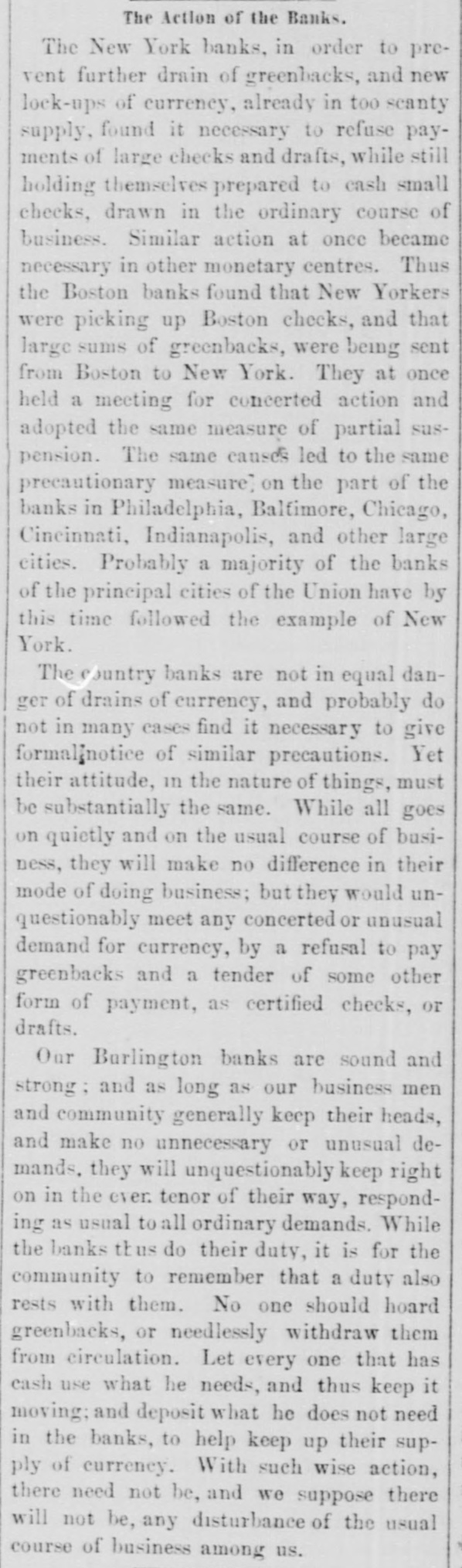
The Action of the Banks. The New York banks, in order to prevent further drain of greenbacks, and new lock-ups of currency, already in too scanty supply, found it necessary to refuse payments of large checks and drafts, while still holding themselves prepared to cash small checks, drawn in the ordinary course of business. Similar action at once became necessary in other monetary centres. Thus the Boston banks found that New Yorkers were picking up Boston checks, and that large sums of greenbacks, were being sent from Boston to New York. They at once held a meeting for concerted action and adopted the same measure of partial saspension. The same causes led to the same precautionary measure] on the part of the banks in Philadelphia, Baltimore, Chicago, Cineinnati, Indianapolis, and other large cities. Probably a majority of the banks of the principal cities of the Union have by this time followed the example of New York. The country banks are not in equal danger of drains of currency, and probably do not in many cases find it necessary to give formalinotice of similar precautions. Yet their attitude, in the nature of things, must be substantially the same. While all goes on quietly and on the usual course of business, they will make no difference in their mode of doing business; but they would unquestionably meet any concerted or unusual demand for currency, by a refusal to pay greenbacks and a tender of some other form of payment, as certified checks, or drafts. Our Burlington banks are sound and strong ; and as long as our business men and community generally keep their heads, and make no unnecessary or unusual demands. they will unquestionably keep right on in the ever. tenor of their way, responding as usual to all ordinary demands. While the banks tbus do their duty, it is for the community to remember that a duty also rests with them. No one should hoard greenbacks, or needlessly withdraw them from circulation. Let every one that has cash use what he needs, and thus keep it moving; and deposit what he does not need in the banks, to help keep up their supply of currency. With such wise action, there need not be, and we suppose there will not be, any disturbance of the usual course of business among us.


Article from Fayette County Herald, October 9, 1873

Click image to open full size in new tab

Article Text

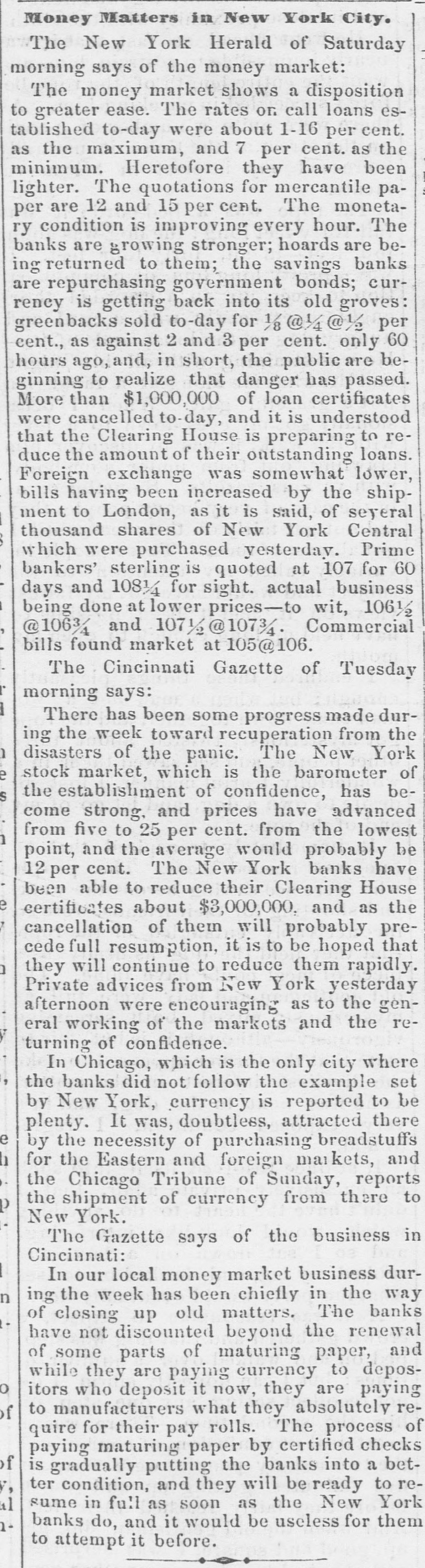
# Money Matters in New York City. The New York Herald of Saturday morning says of the money market: The money market shows a disposition to greater ease. The rates on call loans established to-day were about 1-16 per cent. as the maximum, and 7 per cent. as the minimum. Heretofore they have been lighter. The quotations for mercantile paper are 12 and 15 per cent. The monetary condition is improving every hour. The banks are growing stronger; hoards are being returned to them; the savings banks are repurchasing government bonds; currency is getting back into its old groves: greenbacks sold to-day for 1/8@¼@½ per cent., as against 2 and 3 per cent. only 60 hours ago, and, in short, the public are beginning to realize that danger has passed. More than $1,000,000 of loan certificates were cancelled to-day, and it is understood that the Clearing House is preparing to reduce the amount of their outstanding loans. Foreign exchange was somewhat lower, bills having been increased by the shipment to London, as it is said, of several thousand shares of New York Central which were purchased yesterday. Prime bankers' sterling is quoted at 107 for 60 days and 108¼ for sight. actual business being done at lower prices—to wit, 106½ @106¾ and 107½@107¾. Commercial bills found market at 105@106. The Cincinnati Gazette of Tuesday morning says: There has been some progress made during the week toward recuperation from the disasters of the panic. The New York stock market, which is the barometer of the establishment of confidence, has become strong, and prices have advanced from five to 25 per cent. from the lowest point, and the average would probably be 12 per cent. The New York banks have been able to reduce their Clearing House certificates about $3,000,000, and as the cancellation of them will probably precede full resumption, it is to be hoped that they will continue to reduce them rapidly. Private advices from New York yesterday afternoon were encouraging as to the general working of the markets and the returning of confidence. In Chicago, which is the only city where the banks did not follow the example set by New York, currency is reported to be plenty. It was, doubtless, attracted there by the necessity of purchasing breadstuffs for the Eastern and foreign markets, and the Chicago Tribune of Sunday, reports the shipment of currency from there to New York. The Gazette says of the business in Cincinnati: In our local money market business during the week has been chiefly in the way of closing up old matters. The banks have not discounted beyond the renewal of some parts of maturing paper, and while they are paying currency to depositors who deposit it now, they are paying to manufacturers what they absolutely require for their pay rolls. The process of paying maturing paper by certified checks is gradually putting the banks into a better condition, and they will be ready to resume in full as soon as the New York banks do, and it would be useless for them to attempt it before.


Article from New Orleans Republican, October 12, 1873

Click image to open full size in new tab

Article Text

MISCELLANEOUS. # A Church Robbed of Gold and Jewels. BALTIMORE, October 11.--St. Luke and St. Paul churches were robbed of their altar furniture. A golden chalice, set with diamonds and rubies, valued at $2000, was taken from St. Paul's. # Silk Mille Suspended. PATTERSON, N. J., October 11.-Only one silk mill in this city is running on full time, and several have entirely suspended. # Running on Half Time. PHILADELPHIA, October 11.-A number of the Frankford cotton mills are ruuning on halt time, in consequence of the falling off of orders and the difficulty in procuring currency to pay wages. Campbell's mill, at Manayunk, is closed, by a strike of the operators. At the other milis work continues at a reduction. # Southwark Foundry Closed. The Southwark foundry is closed, and 600 of the former employes are now idle, refusing to work at the proposed reduction of wages. # Fire in Detroit. DETROIT, October 11.-A tire broke out this morning, in the sash, door and blind factory of J. F. Weber & Co., on Sherman street, which rapidly spread and in a few minutes several buildings were in flames. A strong northwest wind was blowing at the time, and a great conflagration was imminent. Through great exertion the fire was stayed after twelve buildings were destroyed, mostly frame dwellings. Weber's factory and Mann's brewery were completely destroyed. Loss $50,000..insurance trifling. # Louisville Exposition Closed. LOUISVILLE, October 11.--The exposition has closed for the season. The result is reported by the managers to be a great financial success. The contributions from this city for the relief of Memphis and Shreveport foot up $12,000, and subscriptions are still going on. # Destructive Fire. TERRE HAUTE, Ind., October 11.--A destructive fire occurred at Waveland, Indiana, at two o'clock yesterday morning, destroying several business houses and dwellings. Loss $30,000-insurance $10,000. # Cincinnati Banks to Resume Payment on Monday. CINCINNATI, October 11.--The Cincinnati Clearing House Association passed a resolution that all banks and bankers rerume full currency payments on Monday, the thirteenth instant. # Kidnapping a Crew. SAN FRANCISCO, October 11. The United States authorities will institute proceedings against the ship Baltic, from New York, to recover penalties for having kidnapped a crew there, composed of tailors, shoemakers, carpenters, barbers, soldiers and firemen, who knew nothing about sailing, and who say they were forced on board the ship in New York, # Acquitted. The jury in the case of Thomas Curtin, tried for killing William Johnson, the seducer of his daughter, returned a verdict of acquittal. The judge told Curtin that he did not regret the verdict. # Rough Weather. PROVIDENCE, R. I., October 11.-The Monongahela has arrived. She encountered rough weather off Nantucket and lost ber starboard cutter and split her saile. # Cotton and Money at Memphis. MEMPHIS, October 11.--The cotton market was steady throughout the day with a moderate inquiry. Money quiet. The banks are doing what they can to aid their regular depositors who have paper maturing, and aside from the usual amount of depositing and checking with some little exchange buying and selling, there is little or nothing doing in the money market. The banks are purchasing currency from merchants and others having a surplus, wishing to settle accounts due in the East, at half a cent premium, and commercial bills are taken from cotton buyers and others at one per cent discount on New York and a little higher on points further East, with slight concessions from these rates in favor of Boston in special instances. No change to report in general trade circles. # From Little Rock. LITTLE ROCK, October 11.-The State Medical Association adjourned to-day. The State fair, which commences on Monday, promises well, there being more entries now than ever made before. Weather warm. # The Defaulting Cashier. BOSTON, October 11.--John N. Pierce, the defaulting cashier of the Merchants' National Bank, at Lowell, was brought before the United States commissioner to-day, and waiving an examination, was held in $25,000 bail for trial. Bail was given. # A Drunken Man Kills his Wife. NEW HAVEN, Conn., October 11.---William G. Haughkirk, while drunk, to day, struck his wife with a flat-iron, crushing in her skull, from the effects of which she will probably die. Haughkirk was arrested. # Biglin's Challange. October 11.-A telegram has received from Biglin, of New York, offering to row Brown another race in a


Article from The Wheeling Daily Intelligencer, October 13, 1873

Click image to open full size in new tab

Article Text

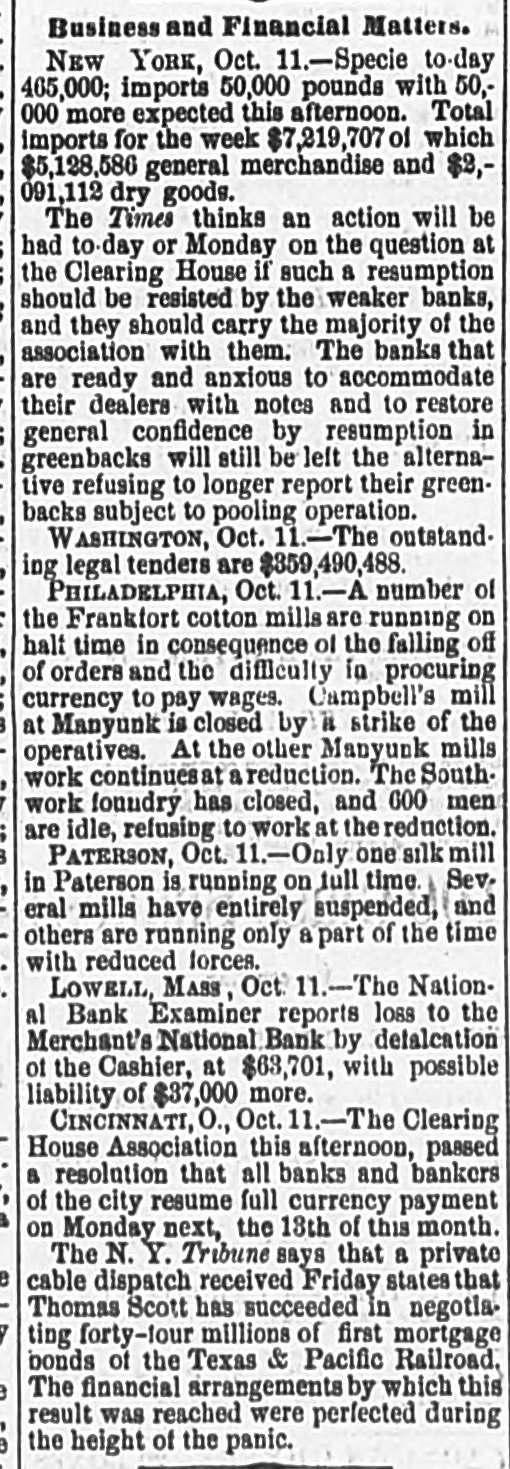
Business and Financial Matters. NEW YORK, Oct. 11.-Specie to-day 465,000; imports 50,000 pounds with 50,000 more expected this afternoon. Total imports for the week $7,219,707 of which $5,128,586 general merchandise and $2,091,112 dry goods. The Times thinks an action will be had today or Monday on the question at the Clearing House if such a resumption should be resisted by the weaker banks, and they should carry the majority of the association with them. The banks that are ready and anxious to accommodate their dealers with notes and to restore general confidence by resumption in greenbacks will still be left the alternative refusing to longer report their greenbacks subject to pooling operation. WASHINGTON, Oct. 11.-The outstanding legal tenders are $359,490,488. PHILADELPHIA, Oct. 11.-A number of the Frankfort cotton mills are running on half time in consequence of the falling off of orders and the difficulty in procuring currency to pay wages. Campbell's mill at Manyunk is closed by a strike of the operatives. At the other Manyunk mills work continues at a reduction. The South. work foundry has closed, and 000 men are idle, refusing to work at the reduction. PATERSON, Oct. 11.-Only one silk mill in Paterson is running on tull time. Sev. eral mills have entirely suspended, and others are running only a part of the time with reduced forces. LOWELL, MASS, Oct. 11.-The National Bank Examiner reports loss to the Merchant's National Bank by detalcation of the Cashier, at $63,701, with possible liability of $37,000 more. CINCINNATI, O., Oct. 11.-The Clearing House Association this afternoon, passed a resolution that all banks and bankers of the city resume full currency payment on Monday next, the 18th of this month. The N. Y. Tribune says that a private cable dispatch received Friday states that Thomas Scott has succeeded in negotia. ting forty-four millions of first mortgage bonds of the Texas & Pacific Railroad. The financial arrangements by which this result was reached were perfected during the height of the panic.


Article from The New York Herald, October 14, 1873

Click image to open full size in new tab

Article Text

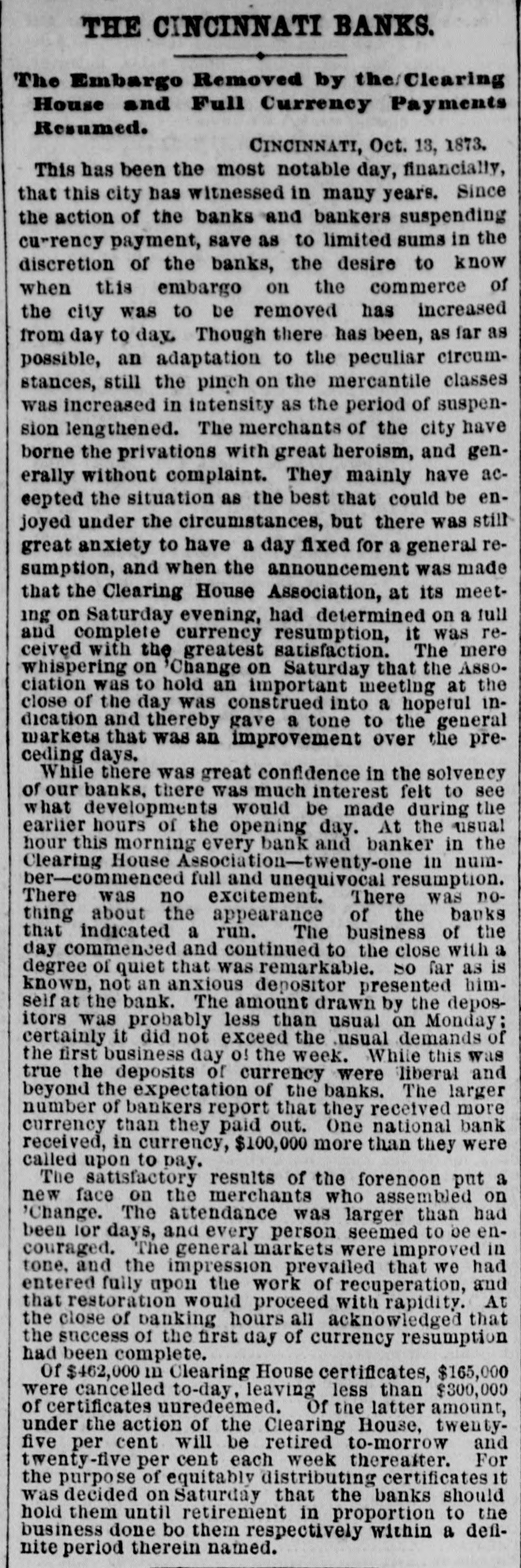
THE CINCINNATI BANKS. The Embargo Removed by the/Clearing House and Full Currency Payments Resumed. CINCINNATI, Oct. 13, 1873. This has been the most notable day, financially, that this city has witnessed in many years. Since the action of the banks and bankers suspending currency payment, save as to limited sums in the discretion of the banks, the desire to know when this embargo on the commerce of the city was to be removed has increased from day to day. Though there has been, as far as possible, an adaptation to the peculiar circumstances, still the pinch on the mercantile classes was increased in intensity as the period of suspension lengthened. The merchants of the city have borne the privations with great heroism, and generally without complaint. They mainly have accepted the situation as the best that could be enjoyed under the circumstances, but there was still great anxiety to have a day fixed for a general resumption, and when the announcement was made that the Clearing House Association, at its meeting on Saturday evening, had determined on a full and complete currency resumption, it was received with the greatest satisfaction. The mere whispering on Change on Saturday that the Association was to hold an important meeting at the close of the day was construed into a hopeful indication and thereby gave a tone to the general markets that was an improvement over the preceding days. While there was great confidence in the solvency of our banks, there was much interest felt to see what developments would be made during the earlier hours of the opening day. At the usual hour this morning every bank and banker in the Clearing House Association-twenty-one in number-commenced full and unequivocal resumption. There was no excitement. There was nothing about the appearance of the banks that indicated a run. The business of the day commenced and continued to the close with a degree of quiet that was remarkable. so far as is known, not an anxious depositor presented himself at the bank. The amount drawn by the depositors was probably less than usual on Monday: certainly it did not exceed the usual demands of the first business day o! the week. While this was true the deposits of currency were liberal and beyond the expectation of the banks. The larger number of bankers report that they received more currency than they paid out. One national bank received, in currency, $100,000 more than they were called upon to pay. The satisfactory results of the forenoon put a new face on the merchants who assembled on 'Change. The attendance was larger than had been for days, and every person seemed to be encouraged. The general markets were improved in tone, and the impression prevailed that we had entered fully upon the work of recuperation, and that restoration would proceed with rapidity. At the close of banking hours all acknowledged that the success of the first day of currency resumption had been complete. of $462,000 in Clearing House certificates, $165,000 were cancelled to-day, leaving less than $300,000 of certificates unredeemed. Of the latter amount, under the action of the Clearing House, twentyfive per cent will be retired to-morrow and twenty-five per cent each week thereafter. For the purpose of equitably distributing certificates it was decided on Saturday that the banks should hold them until retirement in proportion to the business done bo them respectively within a definite period therein named.


Article from The Daily Phoenix, October 14, 1873

Click image to open full size in new tab

Article Text

in his seventieth year. He was Auditor of the Circuit Court of Baltimore County, and, subsequently, of the Baltimore City Court, for nearly forty-seven years. All the Circuit Courts adjourned over to-day, without transacting any business, on account of the death of Judge Scott, and will stand adjourned till the day succeeding the funeral, which takes place at the Cathedral, on Wednesday. NEW YORK, October 13.—Foreign exchange dull. The failure of R. H. Stevens was announced. Nine jurors have been obtained for the Stokes trial. CHARLESTON, October 13.—Capt. Beveridge, of the schooner M. E. Mangham, from Barracoa, was lost overboard, and the vessel injured. PATTERSON, N. J., October 13.—Edward English, aged twenty, a native of Alexandria, Va., suicided to-day. Love affair. WASHINGTON, October 13.—Andrew Johnson is here, looking after his $73,000 deposit in the First National Bank of this city. The Star says: Secretary Richardson, in speaking of the use of the legal tender reserves, and the present amount of circulating notes, says he would oppose any bill for permanently increasing the legal tender circulation above the present standard, as well as a bill permanently fixing all the $356,000,000. The Secretary of the Treasury must, at all times, be able to pay the appropriations of Congress, or suspend payment until he can accumulate currency for that purpose. If the limit is fixed, then the department will be obliged to suspend payments on all warrants when the currency balance is exhausted. RALEIGH, October 13.—The thirteenth annual fair was opened to-day, by Gov. Caldwell. The trains are crowded with visitors. Dan Voorhees speaks on Friday. A gift concert will be given on Saturday. WASHINGTON, October 13.—The fall fairs throughout the country are devoting part of the proceeds to Memphis and Shreveport. Tom Allen challenges Joe Coburn for a fight; stakes to be $400 to $5,000. The Supreme Court has convened. Field and Davis are absent. The bar met and passed appropriate resolutions regarding Chase. Sherman and staff are gone to Toledo. Grant goes, after receiving the preachers to-morrow. Probabilities.—For the South Atlantic States, South-east and South-west winds, with generally clear weather. CINCINNATI, October 13.—The action of the Clearing House Association on Saturday was to the effect that all Cincinnati banks would resume currency payments to-day. The Common Council to-day appropriated $15,000 for the Memphis and Shreveport sufferers. TELEGRAPHIC-COMMERCIAL REPORTS. COLUMBIA, S. C., October 13.—Sales of cotton, yesterday, 73 bales—middling 15@15¾c. 126 bales were sold on Saturday, instead of 26, as reported. LONDON, October 13.—Eries 40¼. PARIS, October 13.—Rentes 57f. 95c. LIVERPOOL, October 13—Noon.—Cotton steady—uplands 9⅛@9¼; Orleans 9⅜@9½; sales 12,000 bales; speculation and export 2,000; sales of uplands, on the basis of low middling, to be delivered in November, 9 3-16; on the basis of good ordinary, shipped in October, 9 3-16. LIVERPOOL, October 13—Evening.—Cotton sales to-day 5,000 bales of American; sales of uplands, on the basis of good ordinary, shipped October and November, 8⅞; ditto, shipped in November and December, 8¾. NEW YORK, October 13—Noon.—Gold opened at 8⅛—low 8⅜. Stocks irregular. Money loaned at 1-16 and interest; 7 gold bid. Exchange—long 63¾; short 7¾. Governments dull. State bonds dull. Cotton quiet and lower; sales 493 bales—uplands 17⅞; Orleans 18⅝; futures opened as follows: October 17, 17 3-16; November 16⅞, 16 15-16; December 16⅞, 17; January 16 15-16, 17; February 17 1-16, 17⅛; March 17¼. Flour dull and drooping. Wheat dull and nominally 1@2c. lower. Corn dull and declining. Pork dull and nominal. Lard dull—old steam 8 3-16@8¼. Freights dull. 7 P. M.—Cotton weak and irregular; sales 1,524 bales, at 17¾@18½. Southern flour heavy and lower—6.50@7.15 for common to fair extra; 7.20@11.00 for good to choice extra. Whiskey lower, at 93½@94. Wheat 1c. lower—1.54@1.58 for winter red Western. Corn heavy and 1c. lower—59½@61 for steam Western mixed. Pork dull and lower—13.50. Beef dull. Lard firm.


Article from The Daily State Journal, October 14, 1873

Click image to open full size in new tab

Article Text

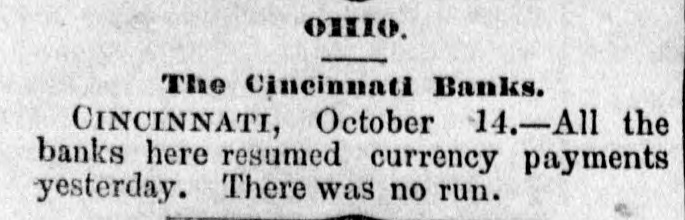
OHIO. ### The Cincinnati Banks. CINCINNATI, October 14.-All the banks here resumed currency payments yesterday. There was no run.


Article from New-York Tribune, October 14, 1873

Click image to open full size in new tab

Article Text

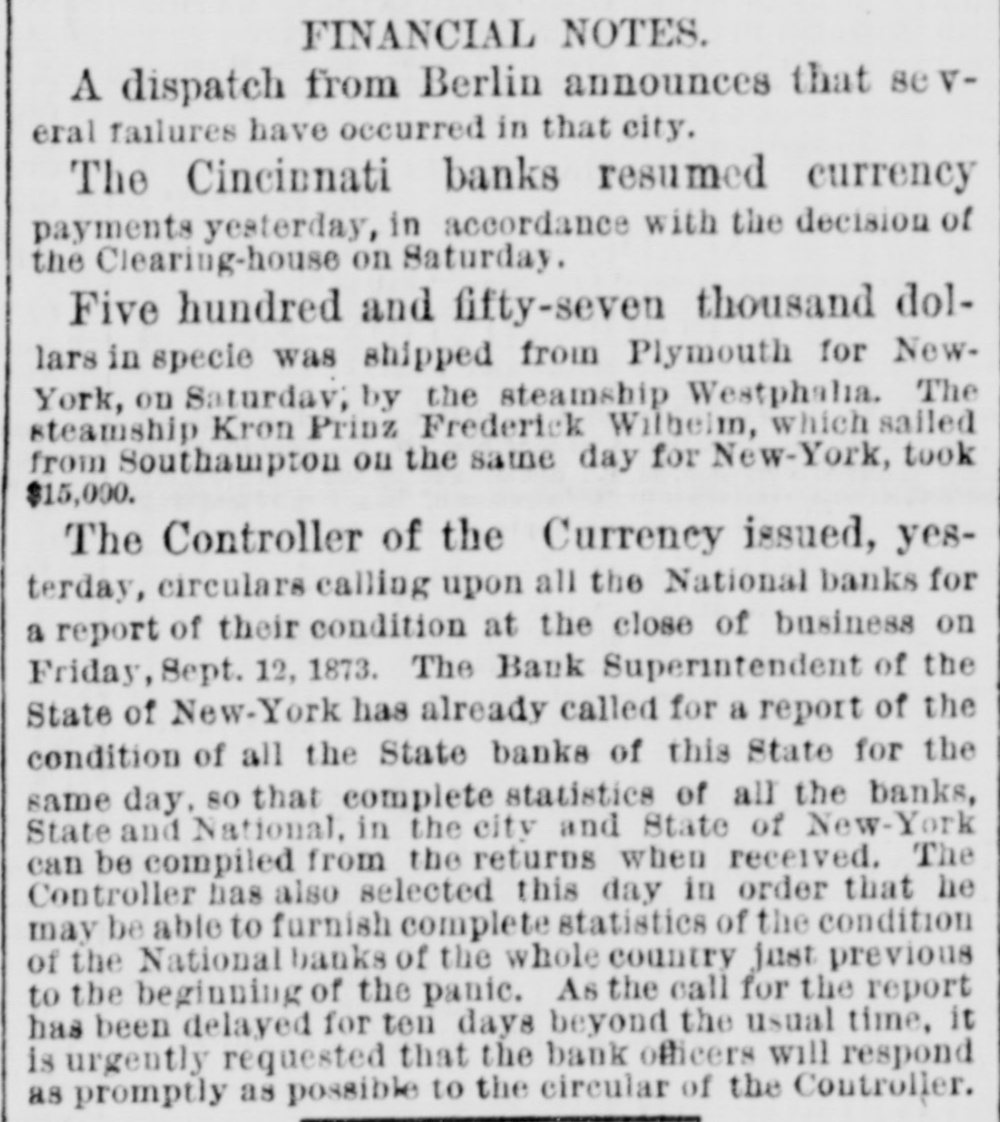
FINANCIAL NOTES. A dispatch from Berlin announces that several failures have occurred in that city. The Cincinnati banks resumed currency payments yesterday, in accordance with the decision of the Clearing-house on Saturday. Five hundred and fifty-seven thousand dollars in specie was shipped from Plymouth for New-York, on Saturday, by the steamship Westphalia. The steamship Kron Prinz Frederick Wilhelm, which sailed from Southampton on the same day for New-York, took $15,000. The Controller of the Currency issued, yesterday, circulars calling upon all the National banks for a report of their condition at the close of business on Friday, Sept. 12, 1873. The Bank Superintendent of the State of New-York has already called for a report of the condition of all the State banks of this State for the same day, so that complete statistics of all the banks, State and National, in the city and State of New-York can be compiled from the returns when received. The Controller has also selected this day in order that he may be able to furnish complete statistics of the condition of the National banks of the whole country just previous to the beginning of the panic. As the call for the report has been delayed for ten days beyond the usual time, it is urgently requested that the bank officers will respond as promptly as possible to the circular of the Controller.


Article from The Dallas Daily Herald, October 15, 1873

Click image to open full size in new tab

Article Text

[Press Report.] NEW ORLEANS, October 14.-All in- coming vessels report encountering a heavy hurricane on the 5th and 6th. The ship Carondelet, from Liverpool, lost all but her main mast, mizzen and mizzen topmast, but arrived at South- west Pass She was yesterday in com- pany with an unknown ship. The ship Bremen has arrived and reports having seen a bark with her main- mast carried away, and two full rigged ships with the loss of topmasts and yards. The New Orleans Clearinghouse as- sociation has established two per cent premium as the rate to be collected for exchange for the present upon bills and notes which are made payable with exchange on New York. MEMPHIS, October 14.-Latest news indicates a slight check in the fever. The new cases are less malignant. BALTIMORE, October 14. The jour- neymen tailors are preparing for a strike. MADRID, October 14. There were thirteen killed and forty-seven wound- ed in the naval battle off Carthagena, on the rebel tieet. PARIS, October 14. The council of war before which Rane was summoned to appear, has declared him guilty and passed sentence of death in contumacy. CINCINNATI, October 14. All the banks resumed currency payments yes- terday. There was no run. PARIS, October 14.-Journal de Paris declares that the recent elections de- monstrate the necessity for the restor- ation of a monarchy to prevent im- pending anarchy. The trial of Bazaine was resumed at noon to-day. The at- tendance larger than on any day since the opening. The President of the court began his examination of the ac- cused, stating that he should consider that the prisoner's responsibility com- menced with the 12th of August. He, however, put several questions in re- gard to events before that date. In reply to questions concerning the dis- aster of Forbach, Bazaine said he had no knowledge that orders were given to the Generals direct. He was pres- ent at the council of war held by the Emperor on the 9th of August. It was then resolved that his army should be brought to the walls of Metz, and the movement in that direction began on the 11th. After reaching the city he received no orders to obtain ammunition. He complained of the carelessness of the intelli- gence service. He did not receive precise information of McMahon's situation until the thirteenth, and the orders to throw a bridge across the Mo- selle reached him only the day before. He denied that he could be held re- sponsible for the delay and subsequent failure to destroy the bridges to pre- vent the enemey's pursuit. Telegraph dispatches were read showing taat Ba- zaine intended to counteract the flank movement of the Germans, but the Emperor prevented it. The Marshal in answer to further questions espe- cially concerning the 15th of August, stated that he agreed with the Empe- ror to march to Verdun, but delay was caused by battle and he was otherwise hindered. He was unaware that the Emperor left any special orders. It was well understood, how- ever, that in the event of a strong resistance the army was to remain at Metz a few days, and not go beyond Verdun in any case. After the battle of the 16th, Le Bouf and Canrobert agreed with him that it was impossible to advance. Responsible odicers in- formed him that his supplies were in- sufficient. He said that he gave Can- robert all the aid he asked at St. Per- vats. He blamed L'Admirault for not calling up the reserve. In justification of his conduct after the 18th of August, he cited the orders he had received to be cautious. The accused betrayed much excitement at the beginning of the examination, which was long and searching. NEW YORK, October 14. The Fire Department of this city has sent five thousand dollars to Memphis. George Francis Train Las returned. BOSTON, October 14. The Grange composed of grain and commission merchants having been ordered to disband by the Grand Master of the National Grange, on the ground that it was not a Farmers' Grange, has re- fused, and threatens to carry the mat- ter before the National Grange. The Grange retains its books and initiates its members upon the pass words and grips of the Order.


Article from Fayette County Herald, October 16, 1873

Click image to open full size in new tab

Article Text

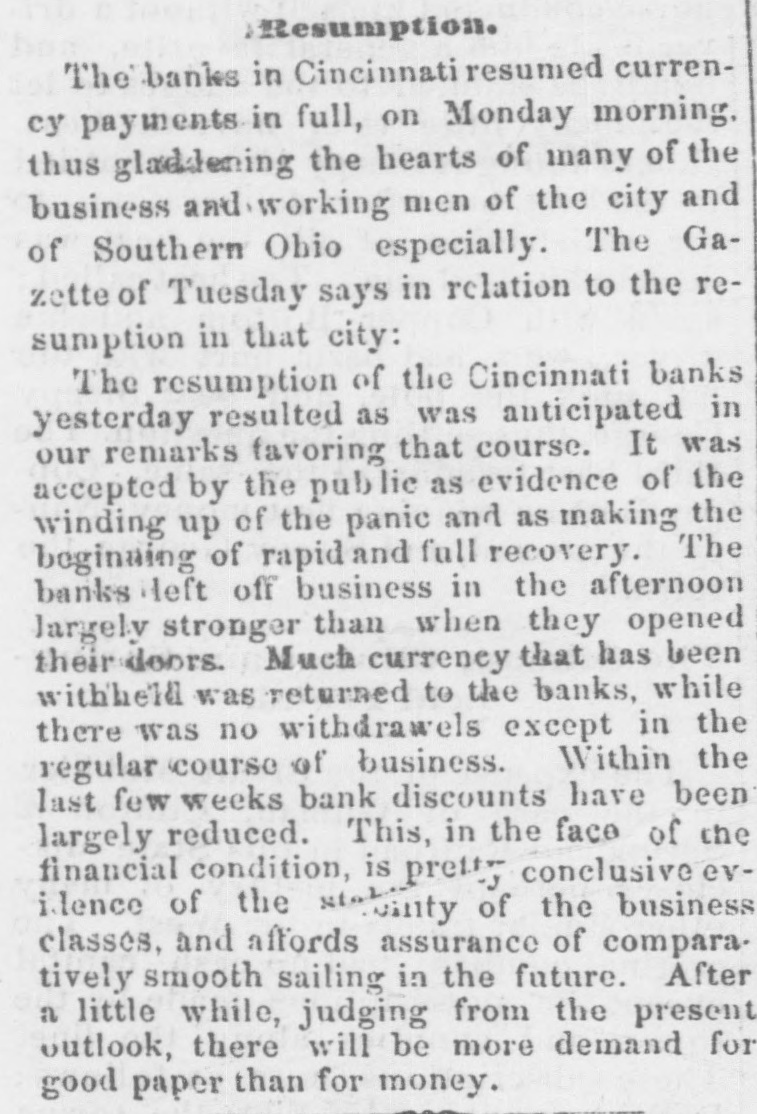
# Resumption. The banks in Cincinnati resumed currency payments in full, on Monday morning, thus gladdening the hearts of many of the business and working men of the city and of Southern Ohio especially. The Gazette of Tuesday says in relation to the resumption in that city: The resumption of the Cincinnati banks yesterday resulted as was anticipated in our remarks favoring that course. It was accepted by the public as evidence of the winding up of the panic and as making the beginning of rapid and full recovery. The banks left off business in the afternoon largely stronger than when they opened their doors. Much currency that has been withheld was returned to the banks, while there was no withdrawels except in the regular course of business. Within the last few weeks bank discounts have been largely reduced. This, in the face of the financial condition, is pretty conclusive evidence of the stability of the business classes, and affords assurance of comparatively smooth sailing in the future. After a little while, judging from the present outlook, there will be more demand for good paper than for money.


Article from The Portland Daily Press, October 16, 1873

Click image to open full size in new tab

Article Text

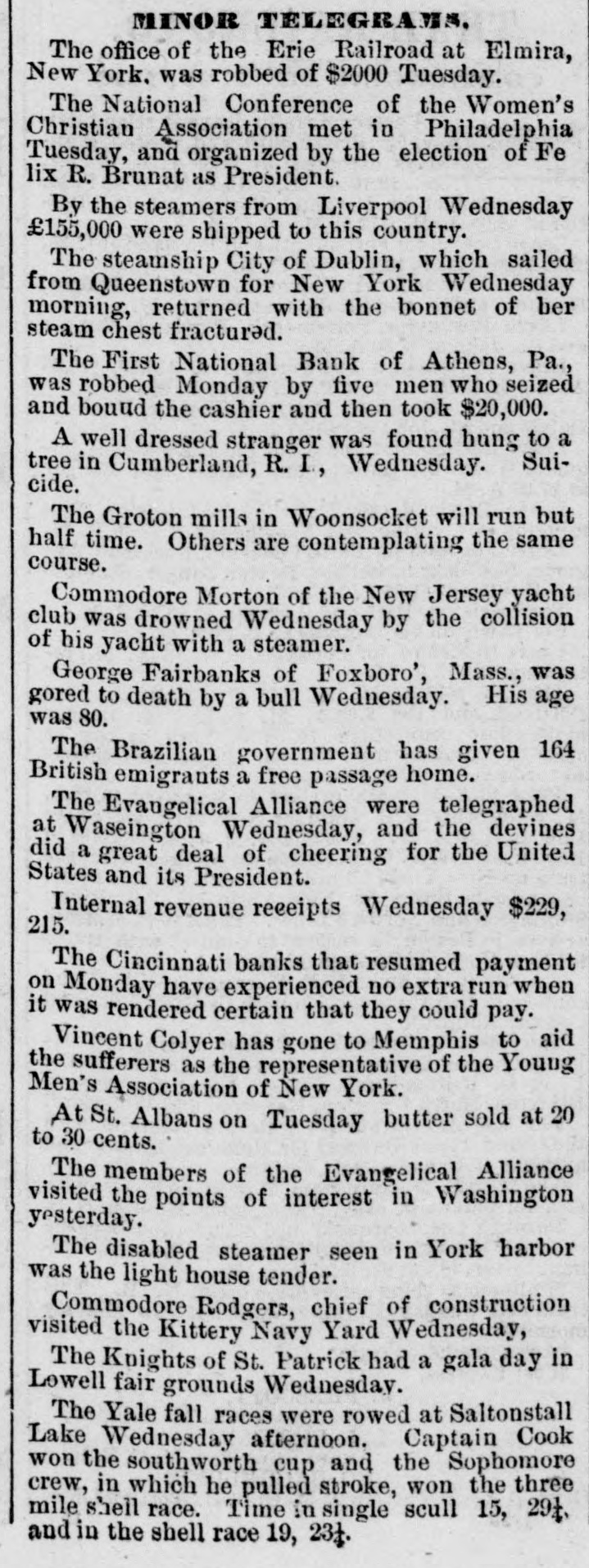
# MINOR TELEGRAMS The office of the Erie Railroad at Elmira, New York, was robbed of $2000 Tuesday. The National Conference of the Women's Christian Association met in Philadelphia Tuesday, and organized by the election of Felix R. Brunat as President. By the steamers from Liverpool Wednesday £155,000 were shipped to this country. The steamship City of Dublin, which sailed from Queenstown for New York Wednesday morning, returned with the bonnet of her steam chest fractured. The First National Bank of Athens, Pa., was robbed Monday by five men who seized and bound the cashier and then took $20,000. A well dressed stranger was found hung to a tree in Cumberland, R. I, Wednesday. Suicide. The Groton mills in Woonsocket will run but half time. Others are contemplating the same course. Commodore Morton of the New Jersey yacht club was drowned Wednesday by the collision of his yacht with a steamer. George Fairbanks of Foxboro', Mass., was gored to death by a bull Wednesday. His age was 80. The Brazilian government has given 164 British emigrants a free passage home. The Evangelical Alliance were telegraphed at Waseington Wednesday, and the devines did a great deal of cheering for the United States and its President. Internal revenue receipts Wednesday $229, 215. The Cincinnati banks that resumed payment on Monday have experienced no extra run when it was rendered certain that they could pay. Vincent Colyer has gone to Memphis to aid the sufferers as the representative of the Youug Men's Association of New York. At St. Albans on Tuesday butter sold at 20 to 30 cents. The members of the Evangelical Alliance visited the points of interest in Washington yesterday. The disabled steamer seen in York harbor was the light house tender. Commodore Rodgers, chief of construction visited the Kittery Navy Yard Wednesday, The Knights of St. Patrick had a gala day in Lowell fair grounds Wednesday. The Yale fall races were rowed at Saltonstall Lake Wednesday afternoon. Captain Cook won the southworth cup and the Sophomore crew, in which he pulled stroke, won the three mile shell race. Time in single scull 15, 29¼, and in the shell race 19, 23¼.


Article from Evening Star, November 8, 1873

Click image to open full size in new tab

Article Text

SPECIE FOR NEW YORK. $385,000 in specie were shipped from Liver-pool for New York to-day. CONSIDERING THE CAPTURE OF THE VIRGINIUS AT MADRID. MADRID, November 8. - President Castelar and Minister Sickles were in close conference for a considerable time yesterday. The subject of the capture of the Virginius is understood to have been under consideration. Resumption of Currency Payment by the Cincinnati Banks. CINCINNATI, November 8.- The clearing-house committee of banks of this city, to whom was entrusted the issuing of clearing-house certificates, have asked to be discharged, as the certificates have all been returned and by the committee canceled and destroyed, and the securities received have been returned to the parties depositing them. This closes up an arrangement by which the banks have made common cause to check the panic. In every way the management of the affair has been a success, not a bank here having failed, and only the sum of $450,000 clearing-house certificates having been necessary to tide over the period of the panic.