Heavy withdrawals during the Panic of 1907 led the non‑clearing‑house California Safe Deposit & Trust Co. to suspend (notice posted Oct 30, 1907). A run/withdrawal precipitated the temporary suspension; subsequent criminal charges, arrests and suits resulted in appointment of a receiver and the institution remained a defunct/suspended concern under receivership with reorganization attempts rather than a simple reopening. Thus sequence is run → suspension → closure/receivership.
Events (3)
1.October 30, 1907Run
Cause
Macro News
Cause Details
Heavy withdrawals driven by unsettled national financial conditions / 1907 panic and inability to obtain clearing house certificates; depositors withdrew funds in last few days.
Measures
Bank posted notice and closed for a few days; suspended payments (see suspension event).
Newspaper Excerpt
The closing of the bank was caused by heavy withdrawals of deposits in the last few days.
Source
newspapers
2.October 30, 1907Suspension
Cause
Macro News
Cause Details
Bank suspended because heavy withdrawals left it unable to meet demands in coin and it could not use clearing house certificates like member banks; suspension posted on door.
Newspaper Excerpt
A notice was posted on the door stating that 'owing to the fact that the bank was not a member of the Clearing House Association ... it would close for a few days.'
Source
newspapers
3.December 10, 1907Receivership
Newspaper Excerpt
Attorney General ... commenced proceedings in the superior court for the appointment of a receiver for the suspended California Safe Deposit and Trust company... (Dec. 9–10, 1907 reports).
Source
newspapers
Newspaper Articles (25)
1.May 23, 1906The Spokane PressSpokane, WA
Click image to open full size in new tab
Article Text
SAN FRANCISCO, May 23.This morning at 9 o'clock commercial banks opened their doors for the transaction of regular business unhampered by clearing house restrictions. Gold in plenty filled the vaults and there is as much money in the banks today as ever in the history of San Francisco. The stability of the financial situation is such that there is not the slightest evidence of a money panic and every bank in the city is now in a position to meet all obligations without undue strain. While the official date for the formal opening of saving banks is next Monday, many savings institutions opened this morning and mutual savings banks opened for unrestricted business with $20,000,000 in money and active securities in the vaults. The California Safe Deposit & Trust company opened in its old quarters, corner of California and Montgomery streets. This bank is the one to first have temporary quarters completed. The Humboldt bank opens tomorrow morning. About 30 percent of the Humboldt's loans were in the burned district and the bank announced it will return all insurance money to borrowers for rebuilding purposes. With no more rush or excitement than was usuual attending settling day before the fire the Hiberian bank, the city's largest saving inatitution, threw open its doors at 9 o'clock this morning. Every look and every action of hundreds in line before the doors opened betokened confidence. The line began to form at 6:45
2.October 31, 1907New-York TribuneNew York, NY
Click image to open full size in new tab
Article Text
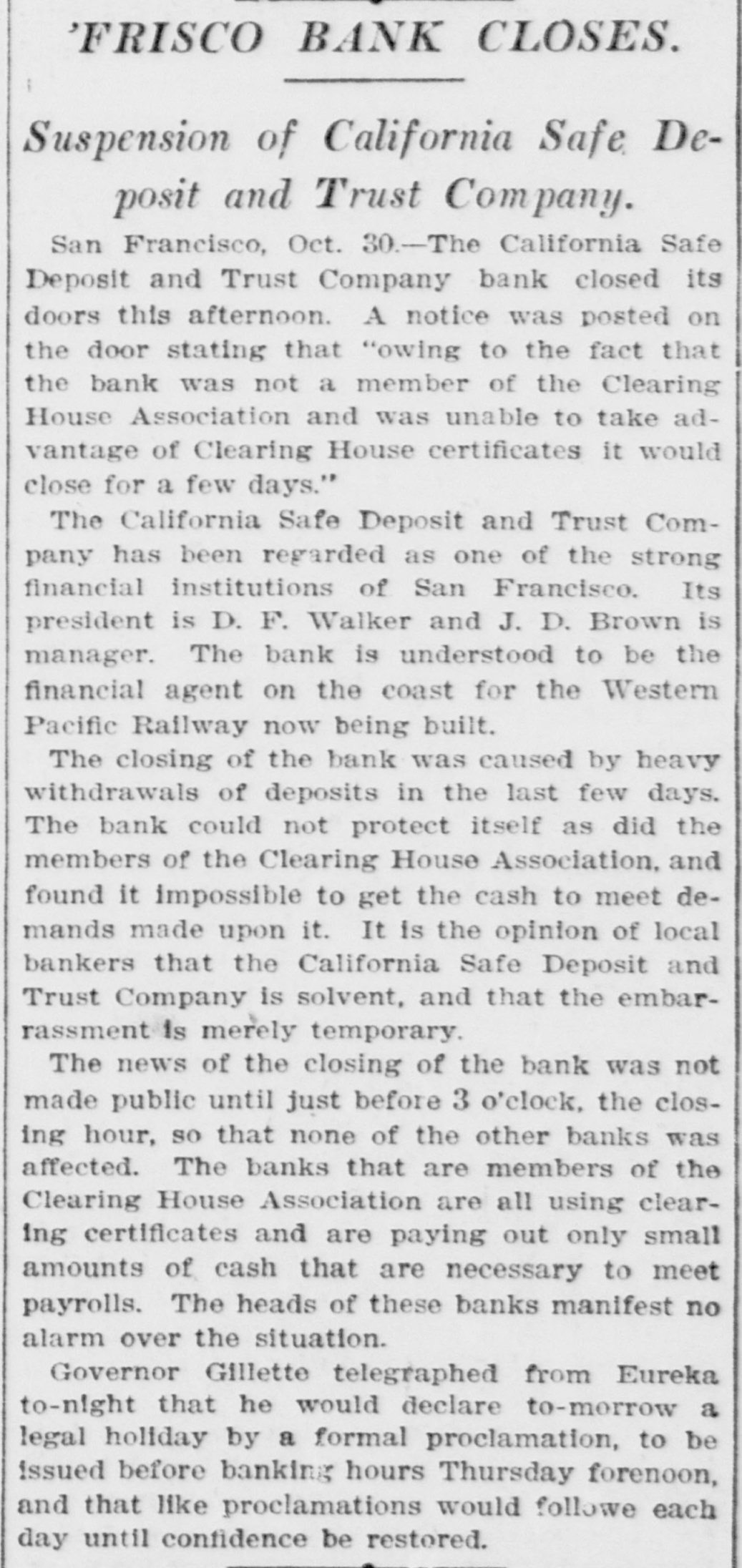
'FRISCO BANK CLOSES. Suspension of California Safe Deposit and Trust Company. San Francisco, Oct. 30.-The California Safe Deposit and Trust Company bank closed its doors this afternoon. A notice was posted on the door stating that "owing to the fact that the bank was not a member of the Clearing House Association and was unable to take advantage of Clearing House certificates it would close for a few days." The California Safe Deposit and Trust Company has been regarded as one of the strong financial institutions of San Francisco. Its president is D. F. Walker and J. D. Brown is manager. The bank is understood to be the financial agent on the coast for the Western Pacific Railway now being built. The closing of the bank was caused by heavy withdrawals of deposits in the last few days. The bank could not protect itself as did the members of the Clearing House Association, and found it impossible to get the cash to meet demands made upon it. It is the opinion of local bankers that the California Safe Deposit and Trust Company is solvent, and that the embarrassment Is merely temporary. The news of the closing of the bank was not made public until just before 3 o'clock, the closing hour, so that none of the other banks was affected. The banks that are members of the Clearing House Association are all using clearing certificates and are paying out only small amounts of cash that are necessary to meet payrolls. The heads of these banks manifest no alarm over the situation. Governor Gillette telegraphed from Eureka to-night that he would declare to-morrow a legal holiday by a formal proclamation, to be issued before banking hours Thursday forenoon, and that like proclamations would followe each day until confidence be restored.
3.October 31, 1907Arizona RepublicanPhoenix, AZ
Click image to open full size in new tab
Article Text
A CALIFORNIAN HOLIDAY. Sacramento, Oct. 30.-Governor Gillett this evening telegraphed from Eureka to Secretary Cooper that tomorrow will be declared a legal holiday by proclamation and that like proclamations will follow each day indefinitely until confidence, in case it be shaken by the failure of the California Safe Deposit and Trust company bank of San Francisco shall be restored. The proclamation will be formally issued in the morning before banking hours. In the proclamation the following reasons are given for its issuance: "Whereas, the unsettled financial conditions which prevail in many states of the union have extended to California: and "Whereas, it appears that balances due from the banks of eastern states are not being paid to banks in this state: and "Whereas, it further appears that this condition has resulted in a temporary lessening of the sources of supply of money to meet ordinary current payments due from California banks and that coupled thereto, there has arisen an extraordinary condition due to the withdrawal of deposits from such banks: and Whereas, it appears such withdrawal is not based on the financial weakness of our local banks but is induced through uneasiness caused by unsetileri financial conditions elsexacter and "Whereas, It appears that such e.n. ditions have already resulted in the temporary embarrassment of one of our largest financial institutions and unless restrained will the followed by the retirement from business of other banks and will most seriously affect the financial integrity of our state and entail enormous losses upon depositors in such banks: "Now, therefore, in order that our
4.October 31, 1907The Salt Lake HeraldSalt Lake City, UT
Click image to open full size in new tab
Article Text
SAN FRANCISCO BANK IS CLOSED California Safe Deposit & Trust Co. Not Affiliated With Clearing House. COMPELLED TO PAY CASH D. F. WALKER PRESIDENT OF THE INSTITUTION. Sacramento. Oct. 30.-At 5:40 p. m. Governor Gillett telegraphed from Eureka to Private Secretary Cooper that tomorrow will be declared a legal holiday by proelamation, and that like proclamations will follow each day indefinitely until confidence, in case It be shaken by the failure of the California Safe Deposit & Trust company bank of San Francisco, shall be restored. The proclamation will be formally issued in the morning before banking hours. San Francisco, Oct. 30.-The California Safe Deposit & Trust company bank closed its doors at 2:30 this afternoon. A notice posted on the door stating that owing to the fact that the bank was not a member of the Clearing House association and was unable to take advantage of clearing house certificates it would close for a few days. The California Safe Deposit & Trust company was regarded as one of the strong financial institutions of the city. Its manager is J. Dalzell Brown and the president is David F. Walker. The bank is understood to be the financial agent on the coast for the Western Pacific railway now being built. As soon as the notice was posted a curious crowd gathered in front of the bank building at the corner of California and Montgomery streets. The doors were closed, however, and no one was admitted. Heavy Withdrawals. The closing of the bank was caused by heavy withdrawals of deposits during the past few days. The bank could not protect itself as did the members of the Clearing House association and found it impossible to secure the cash to meet demands made upon it. It is the opinion of local bankers that the California Safe Deposit & Trust company is solvent and that the embarrassment is merely temporary The news of the closing of the bank was not made public until just before 3 o'clock. the closing hour, SO that none of the other banks were affected. The banks that are members of the Clearing House association are all using clearing house certificates and are paying out only small amounts of cash that are necessary to meet payrolls. The heads of these banks manifest no alarm over the situation. The notice on the door read as follows: "Not being a member of the San Francisco clearing house and not being able to obtain clearing house certificates or coin from the east, we deem It our duty to our depositors to suspend temporarily. "J. DALZELL BROWN. (Signed.) "Manager." The suspended bank was placed in a very peculiar position In Its relations with the other banks in this city and its suspension is attributed solely to that factnot to any embarrassment or drain upon Its resources. notwithstanding that there had been unusually heavy wtihdrawal of coin by depositors during the forenoon of today. Statement of an Official. One of the officials of the bank said: "Our bank is all right and this action is simply a step taken for the protection of our depositors. On account of our nonaffiliation with the Clearing House assoclation we have had to pay out cash on all demands because we were unable to secure the certificates utilized by the other banks. A distressing feature of this situation was that all of the other banks who drew on us were paid in coin while in our dealings with them we could get only certificates in return. We have ample money on hand to meet all reasonable demands and we are on firm basis financially. but of course we could not meet all of our demands If they were presented in a single day. I wish to emphasize that our closing has not been caused by any embarrassment but is simply for the protection of our depositors. We have communicated with the bank commissioner." June Financial Statement. The financial statement of the bank issued June 30 last shows Its assets and liabilities as follows: RESOURCES. $ 800,000.00 Real estate hores
5.November 10, 1907Los Angeles HeraldLos Angeles, CA
Click image to open full size in new tab
Article Text
BANK'S DEPOSITORS AGREE TO ACCEPT TIME CERTIFICATES By Associated Press. SAN FRANCISCO, Nov. 9.-One-third of the depositors of the Citizens State bank, the institution which took advantage of the bank holidays to suspend business temporarily, have already made stipulations to accept two, four and six months' time certificates for their deposits. President Ragland of the bank states that all the depositors accepted this method of placing the bank in good condition without protest or complaint. He further states that in another week the bank will be able to open in sound condition. J. C. Calvin Ewing, secretary of the bank commission, stated this morning that if the California Safe Deposit and Trust company resumes business the commission will issue no report on its condition beyond stating that it has complied with the provisions of the law and is in sound financial condition. The officers of the bank reiterate their intention of opening their doors within a short time. Gold to the total amount of $540,000 was transferred to the banks of this city from the east through the sub-treasury today. Ninety thousand one dollar clearing house certificates were issued to the commercial banks this morning. It is the intention of the clearing house committee to issue also certificates for two dollars. The issuance of the $1 and $2 certificates will increase the total output of clearing house paper by several hundred thousand dollars.
6.December 7, 1907The San Francisco CallSan Francisco, CA
Click image to open full size in new tab
Article Text
BONDS AND COIN GONE Trust Officials Accused of Shipping Securities Out of California Pending a thorough investigation into the affairs of the estate of the late Ellen M. Colton, widow of the late David D. Colton, the superior court of Santa Cruz county yesterday issued an order suspending Walter J. Bartnett, vice president and general counsel for the California safe deposit and trust company, as special administrator of that part of the estate which is in litigation. The order was granted on a petition filed by the lawyers for Helen M. B. Sacher, granddaughter of Mrs. Colton, and a contestant of her will, making allegations against Bartnett of breach of trust and attempting to deceive the court. These lawyers are Barclay Henley, J. F. Riley, Benjamin K. Knight and Crittenden Thornton. According to the petition, Bartnett and J. Dalzell Brown are guilty of concealing their knowledge of the impending failure of the California safe. deposit and trust company for some months before the crash came. It is alleged that they failed to give notice to the attorneys for the contestant of the coming trouble. The petition also recites that, despite the fact that the court of Santa Cruz county in which the estate is being administered, had ordered that the securities constituting the assets of the estate should be safeguarded in the vaults of the safe deposit company, Bartnett and J. Dalzell Brown admitted to the bank commissioners that $75,000 in money had been burned in the fire and that $200,000 in stocks and bonds had been sent to New York for safe keeping. SAFETY OF ASSETS : The petition goes on to say that seven after the fire of 1906, and Brown testified oath Bartnett months before April under 18, the superior court of Santa Cruz at that time there was deposited county that in the vaults of the deposit company the entire amount of sets the estate, consisting of of approx- the asimately $325,000 in bonds and stock and $75,000 in cash or negotiable paper of various kinds. At that time the court ordered that the entire assets of the estate be placed on deposit with the California safe deposit and trust company and constituted that company the official depository for such stock and bonds and cash as might come into the hands of Bartnett as special administrator. The order forbade of any of such assets from state under any whatever. the the sending pretext Following his as to disof the funds of the position Bartnett testimony the estate, gave bonds of $20,000. with David J. Walker and J. Dalzell Brown acting as sureties. Since the suspension company so petition declares, are "each the of the trust these sureties, of them utterly insolvent." In continuing the charges the order of suspension asserts that "the said California safe deposit and insolvent and pany pay its is likewise trust unable com- to debts and that its officers are not in possession of the stock and bonds as aforesaid receipted for by it, its officers have and transported said stock and embezzled that and concealed, the bonds out of the which amounts to a sion California, of state conver- of and an embezzlement of them, its officers have accounts of and and abouts inconsistent that given the where- false of the said stock and bonds, and said Walter J. Bartnett lack. that ing in the is integrity as to make him an unfit person to act as special administrator of the estate." TEMPORARILY SUSPENDED In acting on this petition the court issued a perfunctory order enjoining to show cause pension Bartnett why his susshould not be made permanent and suspending him until further order of the court. The officers of the trust company appear and show ordered that to cause why are company should not be displaced and removed from its position as depository of the funds of the estate, and it is ordered to deliver to the or 3. receiver appointed by to a full to the court, court. accounting of all its actions in regard to the estate and its on the part of the Santa I This Cruz action affairs. court of county scores a strong point for the contestants in the long fight for the estate of Mrs. Colton. which Continued on Page 3. Column
7.December 9, 1907The News-DemocratProvidence, RI
Click image to open full size in new tab
Article Text
BANKER CAUGHT FLEEING SOUTH FROM 'FRISCO San Francisco, Dec. 9.-David F. Walker, president of the California Safe Deposit and Trust company, was found speeding south on a Southern Pacific train last night when he was supposed to be at his San Mateo home. He was placed under arrest and taken from the train at Santa Barbara on instructions of Assistant District Attorney Francis J. Heney. Shortly after the arrest of Bankers Brown and Barnett last night, detectives were hurried to San Mateo to keep David F. Walker, president of the bank, under surveillance, but finding he had already left his home, trailed him down to Santa Barbara, where he was held by the police authorities. Though no warrant had been sworn out for Walker, it was thought best to keep him in sight. The detectives on reaching San Mateo, surrounded the house where he was supposed to be lying ill, but heard than a man answering Walker's description had been seen boarding a train for the south. A hasty investigation proved that their man had flown, but word was sent down the line and the police of Santa Barbara took him in charge. Heney telegraphed that Walker be held. Through the activity of the depositors" committee of the defunct California Sate Deposit and Trust company the developments were made possible in a few hours after the real work of criminal prosecution began. COMMITTEE'S WORK. The committee determined on Saturday to proceed with an investigation of the affairs of the Fillmore street branch of the California Safe Deposit and Trust company, looking toward the arrest of the officers for alleged embezzlement, Thereupon Gustave Chevasuss, an accountant of the Fillmore street branch, was examined at considerable length and his examination continued yesterday. The testimony of Teller Gabbs of the same branch was taken and the committee brought to light a startling series of reckless transactions, which the attorneys branded as misdemeanors. According to a statement issued last night by the committee and the attorneys, the officers of the bank took practically all the money deposited at the Fillmore street branch and loaned it to stockholders in large sums, to themselves and to mythical companies. It was intended to cause the arrest of the officials for these acts but, upon advice of Francis J. Heney, the minor charges were dropped for that of felonyembezzlement in connection with the misappropriation of the funds of the Colton estate. As a result of the committee's work, J. Dalzell Brown was arrested last night, a warrant was issued for the arrest of Walter J. Barnett on a charge of felony-embezzlement and a detective was dispatched to San Mateo to the home of David F. Walker, president of the bank. His departure from there led to his subsequent capture and arrest at Santa Barbara. BARNETT ARRESTED. W. J. Barnett was arrested at his home in Marin county last night and was held in custody there until today. Brown, who was arrested earlier in the day in this city, was locked up in jail. W. J. Barnett, who was arrested yesterday on charges growing out of the failure of the California Safe Deposit and Trust company, Is vice president and general attorney of the Wisconsin Pacific railway. Mr. Bennett yesterday telegraphed his resignation to President Jeffrey of the Western Pacific and of his own volition withdrew from the office of vice president and general attorney. "I shall also resign as special administrator of the Colton estate," Mr. Barnett said, "not that I am guilty of the
8.December 10, 1907The Birmingham Age-HeraldBirmingham, AL
Click image to open full size in new tab
Article Text
BANK OFFICIALS ARE UNDER ARREST JUDGE DUNNE PLACES THEIR BONDS AT $75,000 EACH-PRESIDENT WALKER DECLARES HE IS CLEAR OF ALL WRONG DOING. San Francisco, December 9.-Attorney General U. S. Webb late this afternoon commenced proceedings in the superior court for the appointment of a receiver of the suspended California Safe Deposoit and Trust company, whose president, vice president and general manager are arrested for embezzlement. The stockholders as well as the officials and directors were made defendants in the suits filed by the attorney general. Superior Judge Coffey issued a temporary restraining order, preventing officials and directors from disposing of the bank's assets in any manner pending the hearing for the appointment of a receiver. This action by Attorney General Webb, the reduction by Judge Frank H. Dunne of the bail fixed on the warrant for J. Dalzell Brown, general manager of the suspended institution, from $200,000 to $75.000, and of W. J. Bartnett, vice president, from $200,000 to $75,000; a run on the safe deposit vaults of the closed bank caused by a rumor that the boxes had been looted, a meeting this afternoon of some of the stockholders, at which committees were appointed to demand the resignation of the directors, examine the assets and confer with the depositors, and a meeting of the depositors tonight, were the developments of the day in connection with the failure of the California Safe Deposit and Trust company. After futile attempts all afternoon to secure bondsmen, Brown was returned to the city prison tonight. Bartnett was more successful and was released this evening. President David F. Walker is under arrest at Santa Barbara, and will leave there tomorrow morning for this city in custody of detectives of the local police department.
9.December 10, 1907The Lake County TimesHammond, IN
Click image to open full size in new tab
Article Text
RECEIVER ASKED FOR Attorney General Begins Action Against California Trust Concern. San Francisco, Cal., Dec. 10.-Attorney General U. S. Webb late yesterday afternoon commenced proceedings in the superior court for the appointment of a receiver for the suspended California Safe Deposit and Trust company, whose president, vice president, and general manager are under arrest for embezzlement. The stockholders as well as the officials and directors were made defendants in the suit filed by the attorney general. Superior Judge Coffey issued a temporary restraining order preventing the officials and directors from disposing of the bank's assets in any manner pending the hearing for the appointment of a receiver. This action by the attorney general, the reduction by Judge Frank H. Dunne of the bail fixed on the warrant for J. Dalzell Brown, general manager of the suspended institution, from $200,000 to $75,000 and of W. J. Bartnett, vice president, from $200,000 to $75,000; a run on the safe deposit vaults of the closed bank caused by a rumor that the boxes had been looted; a meeting yesterday afternoon of some of the stockholders, at which committees were appointed to demand the resignation of the directors, examine the assets and confer with the depositors, and a meeting of the depositors last night were the devolopments of the day in connection with the failure of the California Safe Deposit and Trust company. General Manager Still in Jail. After futile attempts all afternoon to secure bondsmen Brown was returned to the city prison last night. Bartnett was more successful and was released last night. President David F. Walker is under arrest at Santa Barbara and will leave there today for this city in custody of a detective.
10.December 17, 1907The News-DemocratProvidence, RI
Click image to open full size in new tab
Article Text
will be allowed each depositor. San Francisco, Dec. 17.-A complete reorganization of the defunct California Safe Deposit and Trust company was effected yesterday. The directors and officers tendered their resignations and a new set was promptly elected. B. P. Oliver, foreman of the late grand jury, was chosen president, The new directors include David F. Walker. Washington, Dec. 17.-George T. Cutts, National bank examiner of New York, has been annointed permanent receiver of the failed 1 tional Bank of Commerce of Kansas City. Charlton, Mass., Dec. 17.-Perry S. Howe, principal of the Charlton school, has been appointed to take charge of the department of English and public speaking in the high schools of Auburn, N. V. Mr. Howe will begin his new work, Jan. 2. Halifax, N. S., Dec. 17.-It was announced today that the official inquiry into the wreck of the Canadian Pacific railroad steamer Mount Temple at La Have Iron Bound island recently will be opened either on Friday next or on the Monday following. The inquiry will be conducted by Judge Wallace and the nautical assessors. Santiago, Chile, Dec. 17.-The Chilean congress has reduced the import tax on all kinds of sugar by 50 per cent. The workmen in the Tarapaca nitrate fields have gone out on strike. The movement is a serious one, no less than 8000 men having quit work and business is paralyed. The situation at Iquique is critical. Warships and troops have been sent to the troubled districts. Thus far there has been no violence.
11.December 22, 1907The Salt Lake HeraldSalt Lake City, UT
Click image to open full size in new tab
Article Text
GIVEN SEARCH WARRANT. Prosecuting Attorney Will Go Through Brown's Desk. San Francisco, Dec. 21.-Assistant District Attorney William Hoff Cook today obtained from Police Judge Cabanass a search warrant permitting him to search the private desk of 3. Dalzell Brown in the California Safe Deposit building for books, papers and correspondence bearing on the bank's failure. On Monday the grand jury will commence an investigation of the loans alleged to have been made by directors of the bank to themselves and corporations with which they are connected. Hugo D. Newhouse failed in an attempt today to get a receiver appointed by Judge Seawell for the California Safe Deposit & Trust company, which he sought in order to protect himself in a suit which he had joined the bank. The judge denied Newhouse's motion, and he decided against him in his suit to compel the specific performance of a lease which he claims to have had on the premises of the Fillmore street branch of the trust company.
12.January 10, 1908The Montgomery TribuneMontgomery City, MO
Click image to open full size in new tab
Article Text
# Faces Embezzlement Charge.
San Francisco, Cal.-James W. Treadwell, a director of the suspend-ed California Safe Deposit and Trust Co., who was indicted Monday by the grand jury charged with embezzlement, surrendered himself to the sheriff Tuesday evening and was taken to the county jail, being unable to furnish the necessary $50,000 cash bail or $100,000. As Wednesday is a holiday, Treadwell will be compelled to spend the day in jail.
13.March 13, 1908The San Francisco CallSan Francisco, CA
Click image to open full size in new tab
Article Text
DEPOSITORS TO SEE BOOKS Supreme Court Reverses Ruling of Judge Coffey for Receiver Under a ruling by the supreme court yesterday Superior Court Judge Coffey will have to permit an inspection of the California safe deposit and trust company's books by its depositors. In January, 1907, Julia Beltran deposited in the California safe deposit and trust company the sum of $448. which in January, 1908, she transferred to the Depositors' collection agency. February 14 of this year Charles C. Boynton, acting as the attorney of the agency, asked E. J. Le Breton, the receiver of the defunct banking institution. to let him examine the books of the bank. Le Breton refused and was sustained by Judge Coffey. The supreme court yesterday affirmed that the legal right of the Depositors' collection agency as a depositor in the California safe deposit and trust company to examine the books of the corporation was clear. "The court," it said, "being the custodian of the records of the corporation in the place of the officers of the corporation, has no more discretion to deny the privilege of inspection to a person possessing that right than had the officers of the corporation heretofore." The only speedy relief. the court added, lay in a writ of mandamus, which was ordered returnable Monday, March 16, at 10 o'clock a. m.
14.May 20, 1908Tonopah Daily BonanzaTonopah, NV
Click image to open full size in new tab
Article Text
BROWN AGAINST BARTNETT TESTIFIES BEFORE GRAND JURY IN EFFORT TO INDICT FELLOW OFFICIAL. (By Associated Press.) SAN FRANCISCO, May 19.--! Dalzell Brown, former general manager of the suspended California Safe Deposit and Trust Company, was brought over from San Quentin today to appear before the Grand Jury in connection with an effort to indict Walter J. Bartnett on a charge of perjury, growing out of his testimony regarding the affairs of the wrecked institution. Brown spent half an hour in the jury room. He wore a wig to conceal his shaven head. Dr. Allen Griffiths, brother-inlaw of Bartnett, and David Walker, former president of the defunct bank, were also witnesses. No indictments were returned.
15.June 23, 1908Los Angeles HeraldLos Angeles, CA
Click image to open full size in new tab
Article Text
W. J. BARTNETT FOUND GUILTY JURY RECOMMENDS MERCY OF COURT JUDGE TO PRONOUNCE SENTENCE JUNE 30 Main Attempt of Defense Is to Place Blame on J. Dalzell Brown, Who Is Serving Sentence for Similar Crime By Associated Press. SAN FRANCISCO, June 22.-Walter J. Bartnett, former vice president of the suspended California Safe Deposit and Trust company and administrator of the estate of Mrs. Ellen M. Colton, this afternoon was found guilty of embezzling securities and bonds owned by the estate to the value of $31,700. The jury was out less than fifty minutes and reached a verdict on the first ballot. Bartnett was recommended to the mercy of the court and Judge Conley fixed 10 a. m. Tuesday, June 30, as the time for pronouncing sentence. The greater part of the day was occupied with the closing arguments of the prosecution and defense. Assistant District Attorney William Hoff Cook spoke for the people during the morning and was followed by Attorney Oscar Cooper for Bartnett. Attorney Seary made the principal argument in the afternoon and Mr. Cook closed. Mr. Cook quoted from the second count in the indictment, charging Bartnett with embezzlement as bailee, saying it had not been proved, as Bartnett himself did not steal the money. Cook pictured Bartnett as a coward who carried on his nefarious dealings behind J. Dalzell Brown and his own brother-in-law, James Treadwell. The main attempt of the attorneys for the defense was to place the blame on Brown, the convicted manager of the institution. Jury Out Short Time Judge Conley concluded his charge at 5 o'clock and the jury retired a few minutes later. They had been out but twenty minutes when they sent into court for the letters written by Bartnett to J. Dalzell Brown in New York. As some portions lof the letters were not admitted in evidence it was necessary to copy the extracts, and ten minutes were required to do the work. When the jurors received the required evidence deliberations were again resumed and it was but a short time later when they filed into court to render their verdict. Foreman William Crocker announced that the jury found Bartnett guilty on the first count in the indictment and not guilty on the second. He concluded with a plea for leniency. Bartnett received the verdict coolly, showing little emotion. The court room had been thronged all day and many spectators lingered to await the action of the jury. Judge Conley asked Assistant District Attorney Cook to agree to the deferring of sentence until such time as action should be taken in the other indictments pending against Bartnett. Mr. Cook replied that as assistant district attorney he had no intention of further prosecuting Bartnett, and unless he received instructions to the contrary from the district attorney the indictments would take the same course as those against J. Dalzell Brown. There is no intention of proceeding with any other charges against Brown. As Judge Conley is called away Friday to try a case out of town, he set Tuesday as the time for passing sentence. Bartnett, who has been out on $200,000 bail, was allowed to continue his liberty. The convicted financier left the court room in the company of one of his sureties.
16.August 30, 1908The San Francisco CallSan Francisco, CA
Click image to open full size in new tab
Article Text
J. DALZELL BROWN SCORES LE BRETON Issues Statement Questioning Ability and Integrity of the Receiver Charging that Receiver Le Breton has maliciously and unwarrantedly attacked him in the report of the condition of the California safe deposit and trust company just published, former Manager J. Dalzell Brown of the defunct institution has retaliated by issuing from his cell at the county jail a statement that questions both the ability and integrity of the man to whom the affairs of the bank have been intrusted. Brown's statement is chiefly interesting in that it contains portions laying bare details of bank affairs that have never before been made public. These portions relate principally to the mysterious "Trustee No. 5" account, which Le Breton says was used by Brown as a clearing house for all kinds of corrupt transactions and which Brown retorts was used principally by Bartnett. BARTNETTS BIG EXPENSE Among other things which Brown alleges that this account contained was the account of Bartnett for personal expenses at the Waldorf-Astoria in New York, an account of $200 a month paid by Bartnett and John Treadwell to a confidential agent in New York, the bill for a piece of statuary given by Bartnett as a personal present to a high railroad official in New York, and $3,500 paid to an engineer for services in connection with the survey of a $50,000,000 railroad which Bartnett contemplated building from New York to Washington and a new transcontinental railroad which he considered financing as a rival to the Western Pacific. Brown asserts that Le Breton has at all times attempted to belittle Brown's services to him and charges that "for some hidden reason" the receiver has sought to shield John and James Treadwell and Waiter J. Bartnett. In this connection he quotes a letter written by his attorney, Hiram W. Johnson, to Assistant District Attorney Cook May 2 of this year, in which Johnson asserted to Cook that Le Breton was prejudiced against his client and that Brown's efforts to clear up the tangled mess of bank affairs had been of the utmost assistance to Le Breton, DID NOT OWE BANK A DOLLAR Brown insists, also, that he told Le Breton of assets controlled by Bartnett which the latter had utterly failed to disclose and denies that the charges that he appropriated large sums from the "Trustee No. 5" account are true. On the contrary, he says that he did not owe the bank a dollar at the time of its failure, having borrowed $300,000 or more on his iwn security from other banks and Udividuals and put this amount into the California safe deposit and trust company. In response to Le Breton's statement that the securities turned over to him by Brown for liquidation purposes were not worth $100, the convicted banker says he will get $10,000 for them within 15 days if Le Breton will make over the title to him. "I am not seeking either charity or commiseration at the hands of Receiver Le Breton," says Brown. "I am far less culnable then his
17.September 3, 1908Los Angeles HeraldLos Angeles, CA
Click image to open full size in new tab
Article Text
TREADWELL NOT HELD BY JURY DELIBERATES SEVEN HOURS FOR VERDICT Accused Declared He Did Not Understand Question Put to Him When Examined by Grand Jury By Associated Press. SAN FRANCISCO, Sept. 2.-After being out seven hours the jury which tried James Treadwell for perjury in connection with the examination by the grand jury into the affairs of the suspended California Safe Deposit and Trust company, returned a verdict late this afternoon of acquittal. Treadwell, according to the charge in the indictment returned by the grand jury, testified in denial of the fact that he had hypothecated the bonds known as the Colton securities. It developed from the testimony of other witnesses that the securities were hypothecated by him, and he now claims that at the time that the question was propounded to him he did not understand it, and disclaimed that he made the answer which constituted the alleged perjury.
18.September 3, 1908The Salt Lake HeraldSalt Lake City, UT
Click image to open full size in new tab
Article Text
# VERDICT OF NOT GUILTY.
San Francisco Jury Was Merciful to James Treadwell.
San Francisco, Sept. 2.-After being out seven hours the jury which tried James Treadwell for perjury in connection with the examination by the grand jury into the affairs of the suspended California Safe Deposit & Trust company returned a verdict late this afternoon of acquittal.
Treadwell, according to the charge in the indictment returned by the grand jury, testified in denial of the fact that he had hypothecated the bonds known as the Colton securities. It developed from the testimony of other witnesses that the securities were hypothecated by him, and he now claims that at the time that the question was propounded to him he did not understand it, and disclaimed that he made the answer which constituted the alleged perjury.
19.February 10, 1909The San Francisco CallSan Francisco, CA
Click image to open full size in new tab
Article Text
WRECKED BANK'S ASSETS INCREASED Jump in Western Pacific Stock Adds Nearly a Million to Holdings California Safe Deposit Concern Owned 42,500 Shares of Railroad's Paper Western Pacific common stock took a big jump yesterday both on the local and New York curbs. In the local stock and bond exchange two brokers bid it up to 26, while in the eastern market it touched 27, a rise of 9 points in a few days. This will be welcome news to the depositors of the California safe deposit and trust company, the defunct institution holding 42,500 shares of the common stock. Of this 25,000 shares is tied up by the holders of the Tesla coal mine bonds, who were to receive it in exchange for their paper, but, through the manipulations of J. Dalzell Brown, never received what was coming to them. Until the matter is settled by the courts this stock can not be sold. The 17,500 shares which can be sold by Receiver Le Breton was pledged by the Treadwells. Logan & Bryan, the eastern brokers, report that there is absolutely none of the common stock for sale either here or in New York, and though 27 has been shares than 18 bid have for recorded, no sales higher been which goes to show that the stock is very closely held. Brokers predict that this stock will touch $50 in a very short time. At the time Receiver Le Breton made his invoice of bank assets the common stock was valued at $5 a share, and as it has now advanced to $27, the assets have increased $924,000. Judah Boas and others, who bought up large quantities of the bank's accounts for as low as 12 cents on the dollar, will make good money on their investments. At one time deposits could not be sold at any price, whereas now they are worth from 35 to 50 cents on the dollar. The 5 per cent bonds of the Western Pacific have also been steadily advancing. Sidney L. Schwartz, a member ofthe stock and bond exchange, when interviewed by a Call representative said: "A little more than a year ago Western Pacific bonds were going a begging at 80, but the rapidity with which construction work has gone ahead in this state has caused a large number of both large and small investors to invest their money in these securities and they have now reached 961/2. The rumors that Harriman has obtained large holdings in the corporation have also tended to advance both the stocks and bonds."
20.July 22, 1909The San Francisco CallSan Francisco, CA
Click image to open full size in new tab
Article Text
Ready to Pay Dividend The depositors of the California safe deposit and trust company will receive their first dividend, amounting to about 10 per cent, the first week of next month, according to an announcement made yesterday by Receiver E. J. Le Breton. The receiver will meet with Walter J. Bartnett this morning and learn the details of Bartnett's plan for the rehabilitation of the defunct institution, and if the plan is not considered feasible by Le Breton he will immediately petition the court for permission to pay a dividend of 10 per cent. "Only the unusual number of preferred claims has prevented the filing of this petition," said Le Breton yesterday afternoon. "I have had sufficient money on hand for several months with which I could have paid the dividend. but the preferred claims kept pouring in, and I was compelled to postpone action. There is sufficient money on hand to pay a larger dividend than 10 per cent, but I would not recommend 8. larger dividend until all preferred claims have been disposed of." Walter J. Bartnett, who has been in the east in an effort to interest easterners in his plan for the rehabilitation of the bank, is due in San Francisco this morning, and will unfold his plan to the receiver and his attorney upon his arrival. Upon the opinion of Le Breton will probably rest the decision of Superior Judge Seawall to allow the bank to reopen. Even should the plan meet with favor with Judge Seawall, it will have to have the approval of Superintendent of Banks Alden Anderson before it will be allowed to reopen. It is possible that Bartnett may stay over in Salt Lake City a day or so, in order to confer with David F. Walker, the president of the defunct bank, who has promised to assist in the rehabilitation to the extent of more than $100,000.
21.July 22, 1909The San Francisco CallSan Francisco, CA
Click image to open full size in new tab
Article Text
REORGANIZERS OF BANK CONFIDENT Raphael Talks of Rehabilitation of California Safe Deposit and Trust Company Believes With Bartnett That Assets Will Yield Dollar for Dollar to Depositors [Special Dispatch to The Call] NEW YORK, July 21.-Walter J. Bartnett, who has been staying at the Hotel Wolcott for several months, left for San Francisco last Sunday, expecting to arrive in San Francisco Thursday evening, July 22. He will lay before the depositors' association of the California safe deposit and trust company full details of the plan of reorganization, an outline of which has been published in The Call. Julius Raphael, president of the depositors' association, will remain in New York for several weeks, or as long as necessary to consummate the reorganization plan. Raphael is at the Hotel Knickerbocker. Bartnett declares that a statement published in San Francisco quoting Cooper as saying, on his return from New York, that the relations between Raphael and himself are not entirely harmonious, is erroneous. Cooper and Bartnett are frequently in consultation in Raphael's apartments in the Knickerbocker hotel, and both are elated over the success of their efforts to reorganize the bank. PLAN TO PAY DOLLAR FOR DOLLAR When Bartnett left here he firmly believed that the depositors would agree to a plan of reorganization that would reimburse them dollar for dollar, the major portion in cash and the balance in certificates. Although both Raphael and Bartnett were willing enough to discuss the reorganization plan in general terms they firmly declined to name the financiers who are back of the reorganization. Raphael declared emphatically that E. R. Hawley was not connected with the Clear lake project, and also said that the estimate of $160,000 as the value of the interest that the California safe deposit and trust company has in the Clear lake project is mere guess work. At any rate, the interest of the bank in the Central Counties land company, acquired by the Clear lake land and irrigation company, is not included in the appraisement of assets of the closed bank, which appraisements total, in round numbers, $8,900,000, according to Raphael. RAPHAEL IS PLEASED "So you will see." said Raphael to The Call's correspondent today, "that the proceeds of a sale of the Central Counties land company to the Clear lake company will not be needed in order to place the reorganization on a basis that will repay dollar for dollar to the depositors." Raphael feels pleased over the fact that, whereas Receiver Le Breton estimated the assets at $2,600,000, they will be nearer nine millions: and referred to the fact that Receiver Le Breton would have sold the El Dorado lumber company for $670,000, whereas it is now appraised at $1,600,000. It was Raphael who held out hope to the depositors and urged them to hold on to their bank books. Le Breton's first estimate of the assets, said Raphael, was sufficient to pay only about 23 cents on the dollar: then he raised it to 26 cents and finally as high as 60 cents. When it became known to certain bankers that the receiver had raised his estimate so as to pay at least 50 per cent they quietly bought up the bank books of some 2,000 depositors, who sacrificed their claims for 15, 25 and 30 cents on the dollar. FINANCIERS HAVE FAITH The New York financiers who are back of the reorganization plan. said Raphael, have much faith in the future of the Western Pacific, which will, in effect, be part of the Goulds' trunk line reaching from Buffalo to San Francisco. They believe that its steady climb from $5 a share to about $30 augers well for its future advancement, and advance in price may swell the assets of the bank several millions more than the present appraisement of nine millions, made by representatives of the financiers who made careful examination of the various properties. James Treadwell is now in London negotiating with financiers for disposing of the Yukon property.
22.November 23, 1909The San Francisco CallSan Francisco, CA
Click image to open full size in new tab
Article Text
ONLY BRIEF TIME TO REOPEN BANK Rehabilitators of California Safe Deposit and Trust Company Get Last Delay Must Perfect Their Scheme by December 23 or Yield to Receiver's Dividend The rehabilitators of the California safe deposit and trust company obtained from Judge Seawell yesterday their last postponement for the purpose of perfecting their scheme. After a hearing, in which strong opposition to any further delay in the payment of a 10 per cent dividend by the receiver was expressed, the court granted a continuance to December 23, with the understanding that unless the reconstructors are then in a position to reopen the bank the dividend will be authorized. There was a dramatic moment in the proceedings when Charles Staehr, a depositor, charged that Attorney Oscar Cooper was working for the scheme in the interest of his client: Walter J. Bartnett, the convicted vice president of the bank. At the outset of the proceedings Attorney I. I. Brown, representing the reconstructors, read an affidavit by Oscar Cooper, secretary of the committee of rehabilitation, setting forth the following facts: Of the $3,000,000 to be contributed by stock holders of the insolvent bank $720,000 had been paid in. As to the outside capital, H. P. Wilson of 25 Broad street, New York. had for himself and associates agreed to furnish $1,000,000 promptly upon the other subscriptions being assured, and further had agreed to make good any deficiency existing in the $3,000,000 from the stock holders called for by the project. Of the $8,524,252 representing depositors' claims, proper assignments had been made of $7,411,950, leaving a balance of $1,112,302. Of this outstanding amount about $500,000 consisted of claims owned by persons the reconstructors had been unable to locate. The amount now to be assigned by depositors to complete the reorganization work was $412,202. ASKS THIRTY DAYS MORE Cooper said in this affidavit that with a further delay of 30 days it would be possible to present a definite, workable and tangible plan for reopening the doors of the bank. "Have you any reason to think you can reach the unlocated holders of the $500,000 of claims?" asked Judge Seawell. "Not all, but some of them," answered Brown. J. V. de Laveaga, attorney for Receiver Le Breton, opposed the motion for a continuance. "I do not see," he said. "how the payment of a 10 per cent dividend now can affect the reorganization scheme. "Why not pay 10 per cent now and 15 per cent when the bank opens, instead of 25 per cent all at once?" The court asked if there was enough money on hand now to pay more than 10 per cent, and the receiver replied in the negative. Attorney L. H. Jacobs of Frohman &
23.March 20, 1910New-York TribuneNew York, NY
Click image to open full size in new tab
Article Text
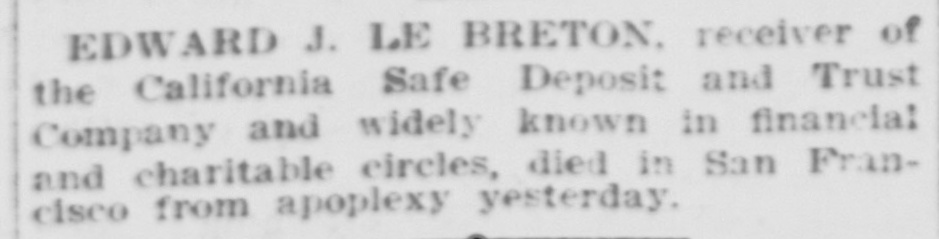
# EDWARD J. LE BRETON
EDWARD J. LE BRETON, receiver of the California Safe Deposit and Trust Company and widely known in financial and charitable circles, died in San Francisco from apoplexy yesterday.
24.May 26, 1910The San Francisco CallSan Francisco, CA
Click image to open full size in new tab
Article Text
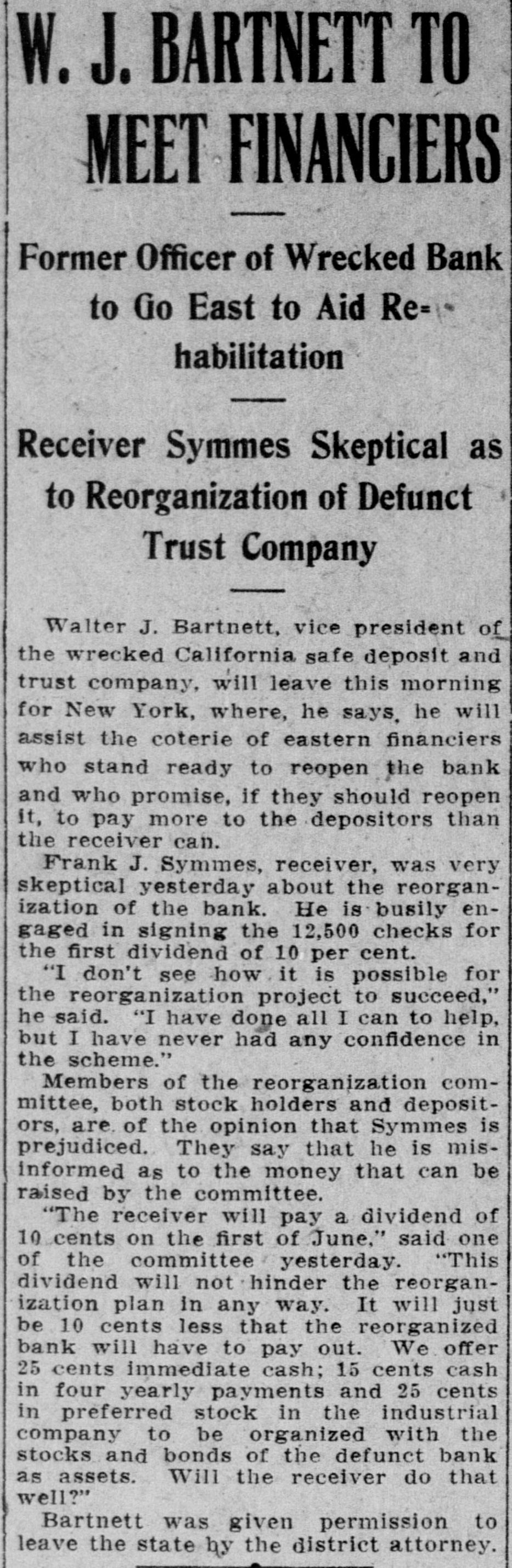
W. J. BARTNETT TO MEET FINANCIERS Former Officer of Wrecked Bank to Go East to Aid Re= habilitation Receiver Symmes Skeptical as to Reorganization of Defunct Trust Company Walter J. Bartnett, vice president of the wrecked California safe deposit and trust company, will leave this morning for New York, where, he says. he will assist the coterie of eastern financiers who stand ready to reopen the bank and who promise, if they should reopen it, to pay more to the depositors than the receiver can. Frank J. Symmes, receiver, was very skeptical yesterday about the reorganization of the bank. He is busily engaged in signing the 12,500 checks for the first dividend of 10 per cent. "I don't see how it is possible for the reorganization project to succeed," he said. "I have done all I can to help, but I have never had any confidence in the scheme." Members of the reorganization committee, both stock holders and depositors, are. of the opinion that Symmes is prejudiced. They say that he is misinformed as to the money that can be raised by the committee. "The receiver will pay a dividend of 10 cents on the first of June," said one of the committee yesterday. "This dividend will not hinder the reorganization plan in any way. It will just be 10 cents less that the reorganized bank will have to pay out. We offer 25 cents immediate cash; 15 cents cash in four yearly payments and 25 cents in preferred stock in the industrial company to be organized with the stocks and bonds of the defunct bank as assets. Will the receiver do that well?" Bartnett was given permission to leave the state by the district attorney.
25.June 3, 1910The San Francisco CallSan Francisco, CA
Click image to open full size in new tab
Article Text
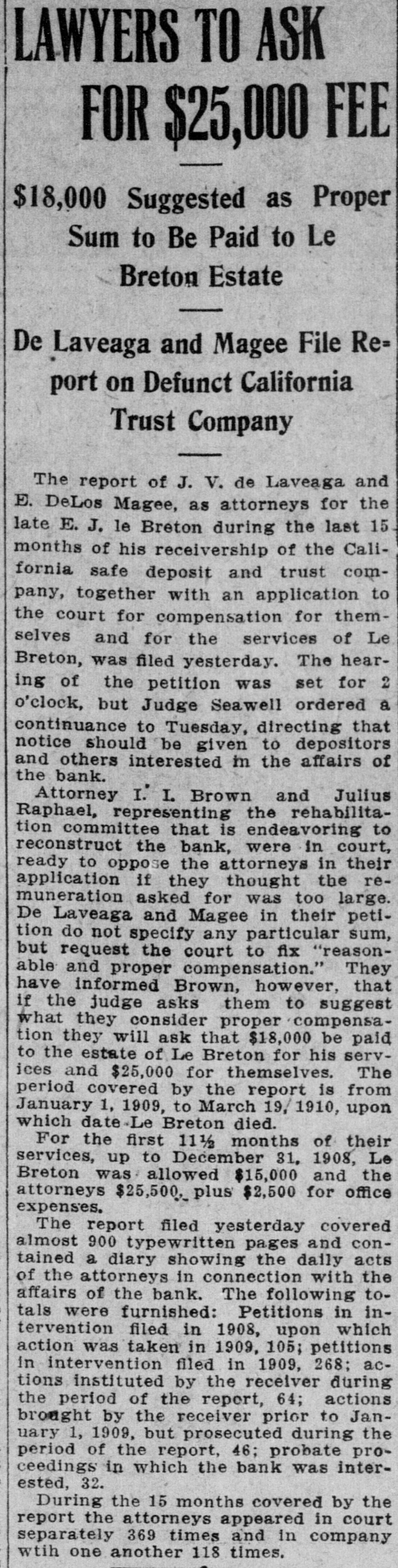
LAWYERS TO ASK FOR $25,000 FEE $18,000 Suggested as Proper Sum to Be Paid to Le Breton Estate De Laveaga and Magee File Re= port on Defunct California Trust Company The report of J. V. de Laveaga and E. DeLos Magee, as attorneys for the late E. J. le Breton during the last 15 months of his receivership of the California safe deposit and trust company, together with an application to the court for compensation for themselves and for the services of Le Breton, was filed yesterday. The hearing of the petition was set for 2 o'clock, but Judge Seawell ordered a continuance to Tuesday, directing that notice should be given to depositors and others interested in the affairs of the bank. Attorney I. I. Brown and Julius Raphael, representing the rehabilitation committee that is endeavoring to reconstruct the bank, were . in court, ready to oppose the attorneys in their application if they thought the remuneration asked for was too large. De Laveaga and Magee in their petition not the "reasonbut request do specify court any to particular fix sum, able and proper compensation." They have informed Brown, however, that asks them to consider if what the they judge proper compensa- suggest tion they will ask that $18,000 be paid to the estate of Le Breton for his services and $25,000 for themselves. The period covered by the report is from January 1, 1909, to March 19, 1910, upon which date-Le Breton died. of their services, For the first 11 1/2 months up to December 31, 1908, Le Breton was allowed $15,000 and the attorneys $25,500, plus $2,500 for office expenses. The report filed yesterday covered almost 900 cona the acts tained diary typewritten showing pages daily and of the attorneys in connection with the affairs of the bank. The following towere in tals tervention furnished: filed 1908, Petitions upon in which inaction was taken in 1909, 105; petitions in intervention filed in 1909, 268; actions instituted by the receiver during the period of the report, 64; actions brought by the receiver prior to January 1, 1909, but prosecuted during the period of the report, 46; probate proceedings in which the bank was interested, 32. During the 15 months covered by the report the attorneys appeared in court separately 369 times and in company wtih one another 118 times.