2738. First National Bank (Chariton, IA)

Bank Information

Episode Type
Suspension β†’ Closure
Bank Type
national
Bank ID
1724
Charter Number
1724
Start Date
October 30, 1907
Location
Chariton, Iowa (41.014, -93.307)

Metadata

Model
gpt-5-mini
Short Digest
898b5991835918a4

Response Measures

None

Receivership Details

Depositor recovery rate
47.9%
Date receivership started
1907-10-31
Date receivership terminated
1915-04-29
OCC cause of failure
Fraud
Share of assets assessed as good
59.5%
Share of assets assessed as doubtful
22.0%
Share of assets assessed as worthless
18.4%

Description

Cashier F. R. Crocker committed suicide at end of October 1907 after admitting over-loans; the National Bank Examiner took charge and the bank closed (Oct 30–31, 1907). The bank was placed in receivership (examiner temporary, Jamison later appointed) and never reopened as an operating bank; receivers paid dividends over ensuing years while winding up assets. Causes are bank-specific (speculation, embezzlement, forgeries, over-loans). Dates chosen from contemporaneous newspaper reports (Nov 1, 1907 reports suicide yesterday β†’ 1907-10-31; some items explicitly state Oct 30/31).

Events (8)

1. October 20, 1870 Chartered
Source
historical_nic
2. October 30, 1907 Other
Newspaper Excerpt
Cashier F. R. Crocker committed suicide rather than face impending trouble ... Crocker indicated that the bank had over-loaned, that is, exceeded the legal limitation upon loans.
Source
newspapers
3. October 31, 1907 Receivership
Source
historical_nic
4. October 31, 1907 Suspension
Cause
Bank Specific Adverse Info
Cause Details
Cashier's suicide after admitting over-loans and later discovery of massive speculative losses, forgeries and embezzlement by the cashier.
Newspaper Excerpt
In consequence, the First National Bank of Chariton is closed, and it will remain closed pending a thorough investigation of its affairs.
Source
newspapers
5. November 1, 1907 Receivership
Newspaper Excerpt
National Bank Examiner H. M. Bostwick is in charge of the First National bank of Charilton, Iowa, whose cashier, F. R. Croker, committed suicide yesterday.
Source
newspapers
6. February 29, 1908 Receivership
Newspaper Excerpt
Senator H. Jamison ... has named as receiver for the First National Bank of Chariton ... it means several years' settling up the affairs of the bank.
Source
newspapers
7. December 19, 1908 Other
Newspaper Excerpt
Receiver Jamison of the First National bank of Chariton will pay a 25 per cent dividend next week. The bank closed its doors October 31 1907.
Source
newspapers
8. June 27, 1912 Other
Newspaper Excerpt
Last Dividend Paid. The creditors of the defunct First National Bank received a 4 per cent dividend ... This is the third and last dividend ... It was on October 30, 1907, that F. R. Crocker ... committed suicide, and the bank was placed in the hands of a receiver.
Source
newspapers

Newspaper Articles (19)

Article from Albuquerque Citizen, November 1, 1907

Click image to open full size in new tab

Article Text

SUICIDE OF CASHIER CAUSES TWO BANKS TO CLOSE Nebraska Bank Had $50,000 In Iowa Institution--Examiner In Charge. Grand Island, Neb., Nov. 1.-The Commercial State bank of this city closed its doors today. Fifty thousand dollars of the funds of the bank were in the First National bank of Chariton, Iowa, whose cashier sulcided yesterday. The deposits of the Commercial State bank were $380,000. The local banks will assist and it is probable that a receiver will not be asked for. Cashier Lost His Nerve. National Bank Examiner H. M. Bostwick is in charge of the First National bank of Charilton, Iowa, whose cashier, F. R. Croker, committed suicide rather than face impending trouble last night. Before killing himself, Cashier Croker addressed a note to Examiner Bostwick, whose visit was expected. This note explained briefly that the bank had overloaned and requested the examiner to take immediate charge. The bank is capitalized for $60,000. and has a surplus of $50,000. It carries about $900,000 in deposits. The other banks of Chariton are entirely unaffected by the closing of the First National bank, and they did business all day as usual. The Bank of Russell, a private institution of Russell, Iowa, of which Croker was president, also closed its doors.


Article from Santa Fe New Mexican, November 1, 1907

Click image to open full size in new tab

Article Text

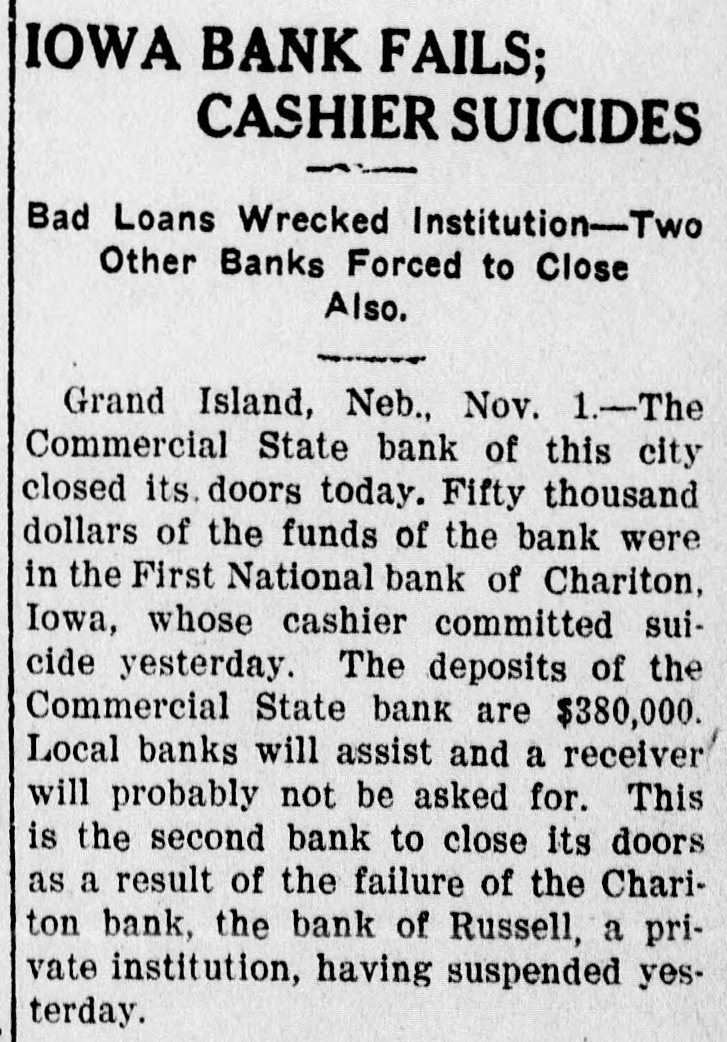
IOWA BANK FAILS; CASHIER SUICIDES Bad Loans Wrecked Institution-Two Other Banks Forced to Close Also. Grand Island, Neb., Nov. 1.-The Commercial State bank of this city closed its. doors today. Fifty thousand dollars of the funds of the bank were in the First National bank of Chariton, Iowa, whose cashier committed suicide yesterday. The deposits of the Commercial State bank are $380,000. Local banks will assist and a receiver will probably not be asked for. This is the second bank to close its doors as a result of the failure of the Chariton bank, the bank of Russell, a private institution, having suspended yesterday.


Article from Iowa State Bystander, November 1, 1907

Click image to open full size in new tab

Article Text

CHARITON CASHIER SUICIDE. Could Not Bear Up Under Threatened Disgrace. Chariton.-Rather than make a fight to carry his bank through a serious situation, or face the disgrace that might attend, Cashier F. R. Crocker of the First National bank of Chariton committed suicide at his residence. Among the various letters written by Mr. Crocker, while preparing to kill himself, was one addressed to National Bank Examiner H. M. Bostwick of whose coming he knew. This letter was delivered to Mr. Bostwick on the morning after the suicide; its contents are not known to the public, but it set forth briefly that the bank was in difficulty and asked the examiner to take charge at once. In consequence, the First National Bank of Chariton is closed, and it will remain closed pending a thorough investigation of its affairs. The Bank of Russell, a private institution with a capital of $25,000, of which Cashier Crocker was president, is also closed pending this investigation. However, the other banks of Chariton will continue in business as usual. Their affairs are in the best condition and they have not even adopted the rule of limiting the withdrawal of deposits or otherwise taking the precautions adopted by banks generally. They have enough money to take care of their needs. Business men and the large depositors here understand their complete solvency and there has been no interruption of business whatever. The Chariton Savings bank, which was closely connected with the First National bank, was likewise open all day and did business as usual. Its officers expect to continue business the same way, meeting all demands upon them. Just what the condition of the First National bank is has not yet been disclosed. Cashier Crocker gave an inkling that all was not well with him in conversation with different friends. He indicated that the bank had over-loaned, that is, exceeded the legal limitation upon loans. He declared that under existing conditions he could not meet any run on the bank that might follow the examiner's visit and that he would rather be dead than fail. It was stated here that should the examiner determine to wind up the affairs of the bank, it would be able to liquidate its deposits and other claims upon it. Crocker's death was discovered by his closest friend, C. R. Kirk. Late the previous day Crocker wrote a note asking Kirk to come to him early the next morning. This was given to a bank clerk with the request that it be delivered as soon as possible in the morning. Mr. Kirk feared some tragedy when he received the note, and he hastend to the Crocker residence, arriving before the children had arisen. Without disturbing them Mr. Kirk made his found the banker dead in bed with way to Crocker's room, where he an empty morphine bottle lying near by. On a dresser in the room were found notes for his wife and son, who were both in Chicago, and to othe members of the family. In these notes he said that he could not "carry his burden any longer." but what the burden was has not been disclosed. Crocker evidently contemplated suicide for several days at least. He spoke discouragingly with close friends and hinted that he faced some sort of disgrace which he had not the courage to meet. His friends, however sought to cheer him and thought nothing more of the matter then.


Article from The Havre Herald, November 8, 1907

Click image to open full size in new tab

Article Text

NEWS OF THE WORLD Important Events of the Week in Condensed Form. FINANCIAL AND INDUSTRIAL The restoration of public confidence Is indicated by the diminished interest taken in the financial situation, which continues to readjust itself to a mormal basis. Runs on New York banks have practically ended and the few institutions forced to close are arranging for resumption of business. A favorable feature of the situation is that investment buyers have taken 2,000,000 shares of stock out of the market within the last ten days. The average value is estimated at $50 a share, making a total investment of $100,000,000. There has been a mysterious transfer in Wall street of 200,000 shares of Union Pacific stock. Financiers who are familiar with the situation are positive in their belief that the new holders are J. P. Morgan and his associates. They further declare that the transfer foreshadows stupendous changes in the control and management of this great property. That permanent relief from the present monetary stringency can only be had through a system of credit cur#ency adequate to meet the requirements of trade and redeemable in gold 9a the opinion expressed by RepresenNative Charles Fowler of New Jersey, chairman of the house banking and Ourrency committee. The New York Airbrake company has issued notice that commencing at once and until further notice the salaries of all employes at Watertown, N. Y., from superintendent down will be reduced 10 per cent. The company employs 3,000 men. The executive council of the Iowa State Federation of Labor has adopted resolutions calling upon all members of labor unions to co-operate in every way with banks and business Interests during the present financial stringency. W. H. Bancroft, vice president and general manager of the Oregon Short Line, announces that all construction work now in progress on that road will be discontinued at onco. The Modern Woodmen of America had $350,000 on deposit in the First National bank of Chariton, Ia., which elosed its doors following the suicide of Cashier F. R. Crocker. Engagements of gold for import to the United States, necessitated by the recent period of money stringency in this country, are approaching the $35,000,000 mark. Declaring that the outlook for raising new capital next year is unsatisfactory the directors of the Pennsylvania Railroad company have decided to retrench. The Rock Island railroad system has laid off 2,500 men from its construction and track forces. The California Safe Deposit and Trust company bank of San Francisco has closed its doors.


Article from The Norfolk Weekly News-Journal, November 22, 1907

Click image to open full size in new tab

Article Text

Grand Island Bank Reopens. Grand Island, Neb., Nov. 21.-Spe cial to The News: The Commercial State bank of Grand Island, which has been closed for some weeks, opened today. At 1 o'clock this afternoon it was learned from officials of the bank that instead of the resumption of business being marked with ever a semblance of a run there were greater deposits than withdrawals. The Commercial State bank closed its doors as a result of its affairs being involved in the suspension of an Iowa bank. An examination found the affairs of the Grand Island bank perfectly solvent and it was stated that there had been no real necessity for the bank closing its doors. Since it closed, the bank has received $25,000 of the $50,000 deposited in the First National bank at Chariton, Iowa, which failed.


Article from Evening Times-Republican, December 5, 1907

Click image to open full size in new tab

Article Text

Mrs. Jessie Mallory Thayer Issues Statement Regarding Chariton Institution BEST METHODS OF SPRAYING Bank's Affairs and Those of Dead Cashier So Badly Involved That Business Must Be Wound Up-Mrs. Mallory Seriously III and Will Not Return to Chariton. Special to Thmes-Republican. Chariton, Dec. 5.-The Mallory estate is financially unable to put the failed Chariton bank on its feet again. This was revealed when Mrs. Jessie Mallory Thayer, who with her mother is one of the heaviest stockholders, issued a statement which was the first official word from the family. Mrs. Thayer and daughter have reached Batavia, III., on their way home from Europe. Mrs. Thayer said: "As far as we are informed of the situation, about the only thing that I can say is, that as to taking any steps towards reopening the bank or paying depositors out in full, to do either one of these things is entirely beyond our power. This indeed would be a very satisfactory thing to do, but it is simply useless for us to attempt the impossible. "We expect to meet our legal liabilities as far as same are known to us, but there seems to be a possible contingent legal liability, the amount of which we are now unable to determine, which makes it impossible to say anything further at this time." Mrs. Anna L. Mallory, president of the defunct First National bank, her daughter Mrs. Thayer, one of the directors, accompanied by Miss Polly Wolcott, arrived from their interrupted trip to Egypt and are in Batavia, III., at the home of Mrs. Mallory's brotherin-law, A. D. Mallory. As a result of


Article from Audubon County Journal, December 26, 1907

Click image to open full size in new tab

Article Text

VAST FORGERIES EXPOSED, Losses to Depositors in Chariton Bank Will Be Heavy. Chariton.-Not only did the late cashier, F. R. Crocker, of the failed First National bank, abstract and speculate with its funds, but it has been disclosed that he made false entries in its books and perpetrated systematic forgeris to such. an extent that it will be impossible for weeks to determne how much, if anything the bank's depositors will receive. Moreover, the belief is growing that Crocker's alleged surety bond to the Modern Woodmen of America to protect $250,000 of its funds loaned to him, was a forgery in part at least. The first report of the receiver of the defunct bank has not been made public in Chariton as yet, but it is in possession of the controller of the currency at Washington, who made known the above important facts in a letter to a depositors says it is impossible now to determine how much the depositors will receive but adds that the depositors will not be paid That their loss WITH be very


Article from Evening Times-Republican, February 29, 1908

Click image to open full size in new tab

Article Text

Senator Gets Fat Job and Take Charge of Failed Chariton Bank POLITICS IN APPOINTMEN Jamison the Choice of Senator Alliso and Named Over Several Wit Greater Claims to the PositionSoutheastern High School Oratoric Contest. Special to Times-Republican. Des Moines, Feb. 29.-Senator H. Jamison of Clarke county, has named as receiver for the First tional Bank of Chariton. which found to be in a bad way followin the suicide of Cashier Frank Crocke There thas been a spirited contest for the position of receiver of the bank. It means several years' settling up the affairs of the bank. a considerable of a fee for the wor Committeeman Copeland of the repul lican state central committee was candidate for appointment to the tion. Mr. Bostwick, the United bank examiner, was made temporar receiver following his examination the bank. He was very successful his work and pleased the creditors well that they asked that he be permanent receiver. When Congressman Hepburn was the state recently he said that tor Allison had a candidate for position, and expressed some doubts to whether anyone else could be lande for the position. Now comes the nouncement of the nomination of ator Jamison. Senator Jamison served several sessions of the legisla ture from the Warren-Clarke distric and during that time made the tation of being the most subservier tool of the corporations in the lature next to M. L. Temple, of same county, and Senator Molsberr of Louisa county. He voted agains the anti-pass bill and made a speec on the floor of the senate in which boasted that the carried railroad trans portation and thought it was all The high schools of the southeast ern quarter of the state will hold the oratorical contest in the Drake torium in this city March 6 and judges will be C. E. Reed. of wa: T. W. Else. of Oskaloosa, Miss Louise Smith, of Highland college in this city. The state is vided into four sections. There forty-eight high schools in the which belong to the association about twelve to each section. Later


Article from Audubon County Journal, May 21, 1908

Click image to open full size in new tab

Article Text

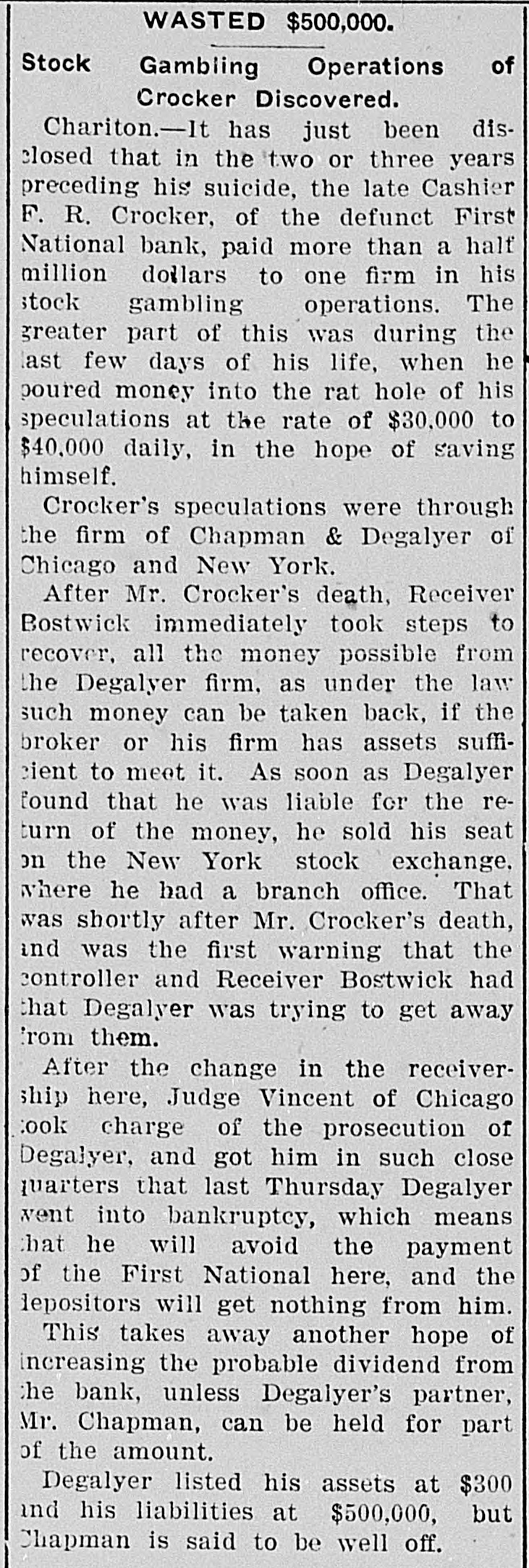
# WASTED $500,000. ## Stock Gambling Operations of Crocker Discovered. Chariton. It has just been disclosed that in the two or three years preceding his suicide, the late Cashier F. R. Crocker, of the defunct First National bank, paid more than a half million dollars to one firm in his stock gambling operations. The greater part of this was during the last few days of his life, when he poured money into the rat hole of his speculations at the rate of $30,000 to $40,000 daily, in the hope of saving himself. Crocker's speculations were through the firm of Chapman & Degalyer of Chicago and New York. After Mr. Crocker's death, Receiver Bostwick immediately took steps to recover, all the money possible from the Degalyer firm, as under the law such money can be taken back, if the broker or his firm has assets sufficient to meet it. As soon as Degalyer found that he was liable for the return of the money, he sold his seat on the New York stock exchange, where he had a branch office. That was shortly after Mr. Crocker's death, and was the first warning that the controller and Receiver Bostwick had that Degalyer was trying to get away from them. After the change in the receiver-ship here, Judge Vincent of Chicago took charge of the prosecution of Degalyer, and got him in such close quarters that last Thursday Degalyer went into bankruptcy, which means that he will avoid the payment of the First National here, and the depositors will get nothing from him. This takes away another hope of increasing the probable dividend from the bank, unless Degalyer's partner, Mr. Chapman, can be held for part of the amount. Degalyer listed his assets at $300 and his liabilities at $500,000, but Chapman is said to be well off.


Article from The Leon Reporter, May 21, 1908

Click image to open full size in new tab

Article Text

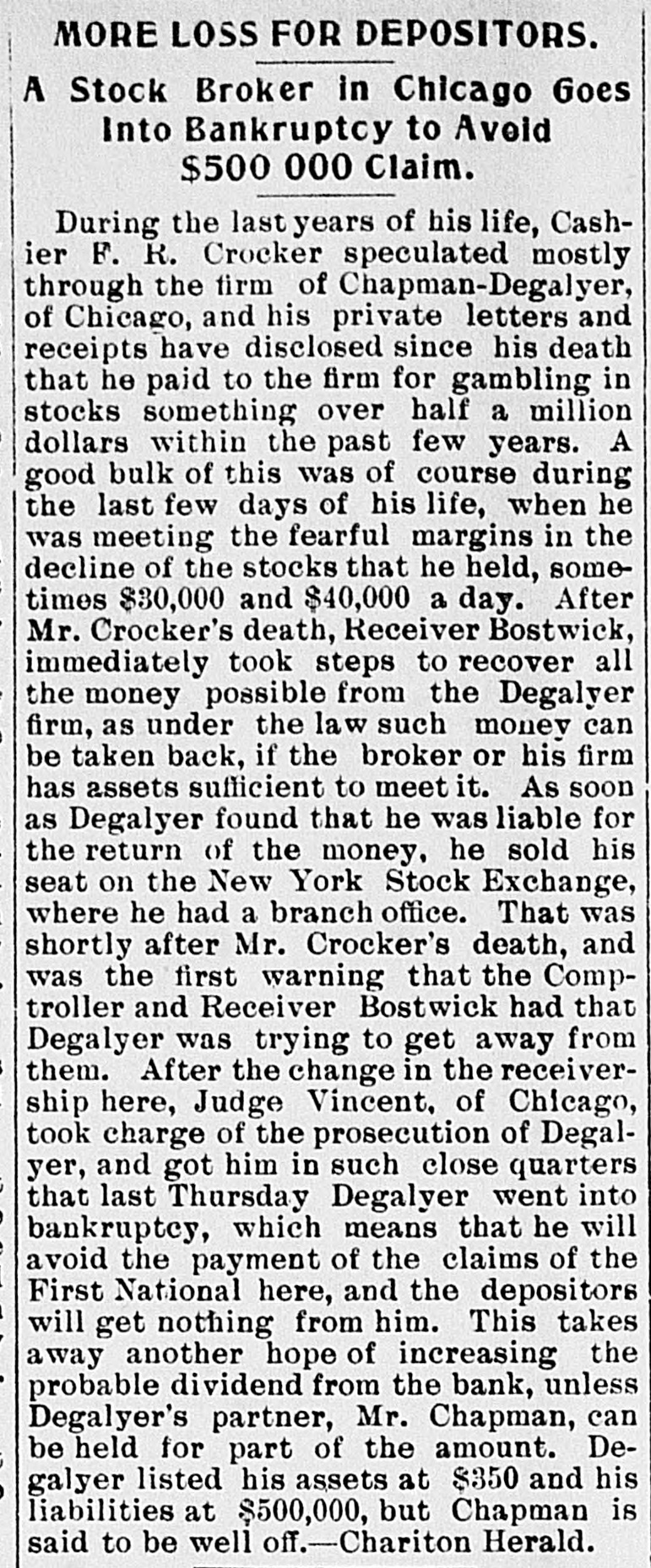
MORE LOSS FOR DEPOSITORS. A Stock Broker in Chicago Goes Into Bankruptcy to Avoid $500 000 Claim. During the last years of his life, Cashier F. R. Crocker speculated mostly through the firm of Chapman-Degalyer, of Chicago, and his private letters and receipts have disclosed since his death that he paid to the firm for gambling in stocks something over half a million dollars within the past few years. A good bulk of this was of course during the last few days of his life, when he was meeting the fearful margins in the decline of the stocks that he held, sometimes $30,000 and $40,000 a day. After Mr. Crocker's death, Receiver Bostwick, immediately took steps to recover all the money possible from the Degalyer firm, as under the law such money can be taken back, if the broker or his firm has assets sufficient to meet it. As soon as Degalyer found that he was liable for the return of the money, he sold his seat on the New York Stock Exchange, where he had a branch office. That was shortly after Mr. Crocker's death, and was the first warning that the Comptroller and Receiver Bostwick had that Degalyer was trying to get away from them. After the change in the receiver-ship here, Judge Vincent, of Chicago, took charge of the prosecution of Degalyer, and got him in such close quarters that last Thursday Degalyer went into bankruptcy, which means that he will avoid the payment of the claims of the First National here, and the depositors will get nothing from him. This takes away another hope of increasing the probable dividend from the bank, unless Degalyer's partner, Mr. Chapman, can be held for part of the amount. Degalyer listed his assets at $350 and his liabilities at $500,000, but Chapman is said to be well off. - Chariton Herald.


Article from Iowa State Bystander, May 22, 1908

Click image to open full size in new tab

Article Text

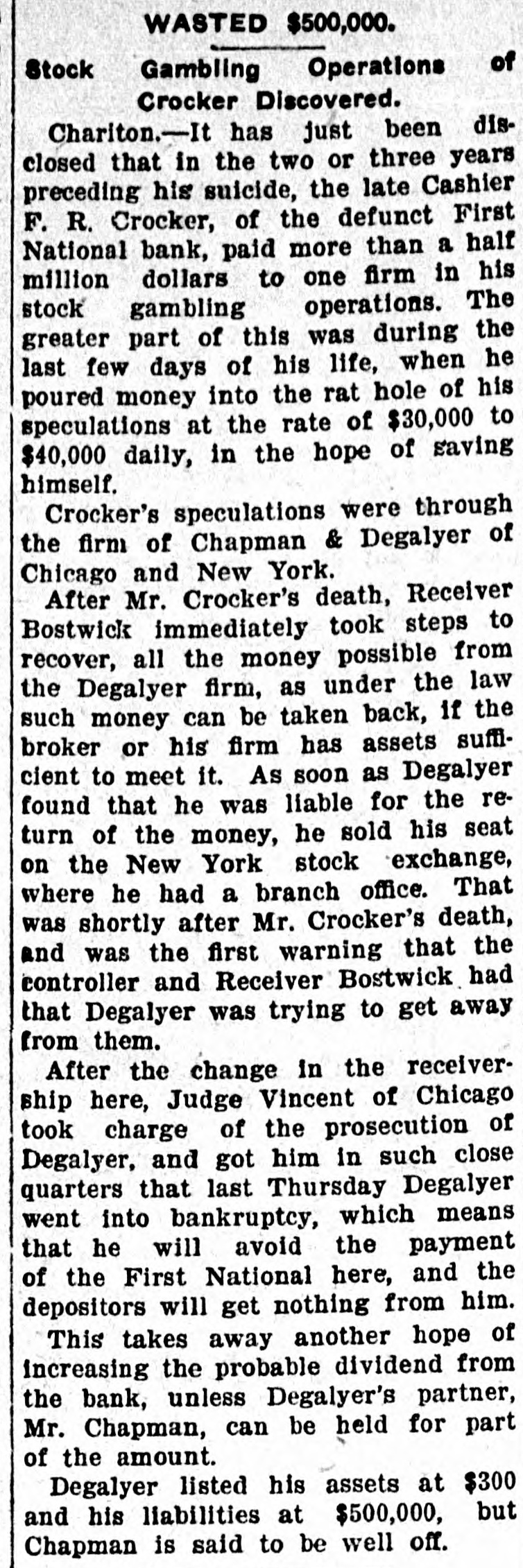
# WASTED $500,000. Stock Gambling Operations of Crocker Discovered. Chariton.β€”It has just been disclosed that in the two or three years preceding his suicide, the late Cashier F. R. Crocker, of the defunct First National bank, paid more than a half million dollars to one firm in his stock gambling operations. The greater part of this was during the last few days of his life, when he poured money into the rat hole of his speculations at the rate of $30,000 to $40,000 daily, in the hope of saving himself. Crocker's speculations were through the firm of Chapman & Degalyer of Chicago and New York. After Mr. Crocker's death, Receiver Bostwick immediately took steps to recover, all the money possible from the Degalyer firm, as under the law such money can be taken back, if the broker or his firm has assets sufficient to meet it. As soon as Degalyer found that he was liable for the return of the money, he sold his seat on the New York stock exchange, where he had a branch office. That was shortly after Mr. Crocker's death, and was the first warning that the controller and Receiver Bostwick had that Degalyer was trying to get away from them. After the change in the receiver-ship here, Judge Vincent of Chicago took charge of the prosecution of Degalyer, and got him in such close quarters that last Thursday Degalyer went into bankruptcy, which means that he will avoid the payment of the First National here, and the depositors will get nothing from him. This takes away another hope of increasing the probable dividend from the bank, unless Degalyer's partner, Mr. Chapman, can be held for part of the amount. Degalyer listed his assets at $300 and his liabilities at $500,000, but Chapman is said to be well off.


Article from Ottumwa Tri-Weekly Courier, May 26, 1908

Click image to open full size in new tab

Article Text

JAMISON FILES $700,000 CLAIM AGAINST CROCKER ESTATE Chariton.-Receiver Jamison, of the defunct First National bank, has filed a claim against the Frank R. Crocker estate, Guilford Crocker, administrator, for $700,000, for money which Cashier Crocker appropriated for the bank's funds for his speculations with brokerage firms. Receipts have been found in the bank showing that Mr. Crocker had spent a total of $1,162,000 within the last three or four year with various brokerage firms, as follows: Chapman DeGolyer & Co., $509,965,63. A. O. Slaughter & C., $16,000. Granger Farwell & Co., $62,500. Counselman & Day. $10,000. Counselman & Co., $35,300. Shearsen Hanmill & Co., $333,986.93. Chas. W. Gates & Co., $10,025. Harriman & Co., $20,000. Wolf Bros., & Co., $15,000. Russell Brewster & Co., $20,000. One of the other claims filed is that of Thos. Brandon of Russell, for $103.531.58, the full amount of the liabilities of the Russell bank, which Messrs. Crocker and Brandon owned jointly, and the failure of which was caused, according to Mr. Brandon, sorely by the failure of the First National bank of Chariton through Mr. Crocker's actions. The assets of the Russell bank are to be deducted from Mr. Brandon's big claim. Another claim of $5,000, for the G. J. Stewart note which Mr. Crocker left as a deposit with the Russell bank after it had been paid, is filed by Mr. Brandon. Other News of Interest. At a meeting of the city council last evening it was decided to make arrangements to pave South Grand street from the southeast corner of the square to Woodlawn avenue, a distance of three blocks. The council also let the contract for 500 street signs, to be painted black with white lettering to Johnson Bros. This is to comply with the requirements of the postoffice department for the establishment of free city mail delivery. Miss Maud Abernathy, who teaches the seventh and eigth grades at the Columbus school building. was given a pleasant surprise Wednesday evening by her pupils. Light refreshments were served and a jolly time was had. She was the recipient of a beautiful souvenir spoon. Principal R. B. Leland and Misses. Mary Moore and Margaret Aikin, who will not teach in the Chariton high school next year, were given a surprise Wednesday evening at the home of Miss Mary Lockwood by the tenth grade pupils. Delicious refreshments were served and some time was spent in an enjoyable manner. The ladies were each presented with a handpainted hat pin and Mr. Leland with a Jade stick pin. Miss Lydia Rahmgren was given a

Article from The Leon Reporter, June 11, 1908

Click image to open full size in new tab

Article Text

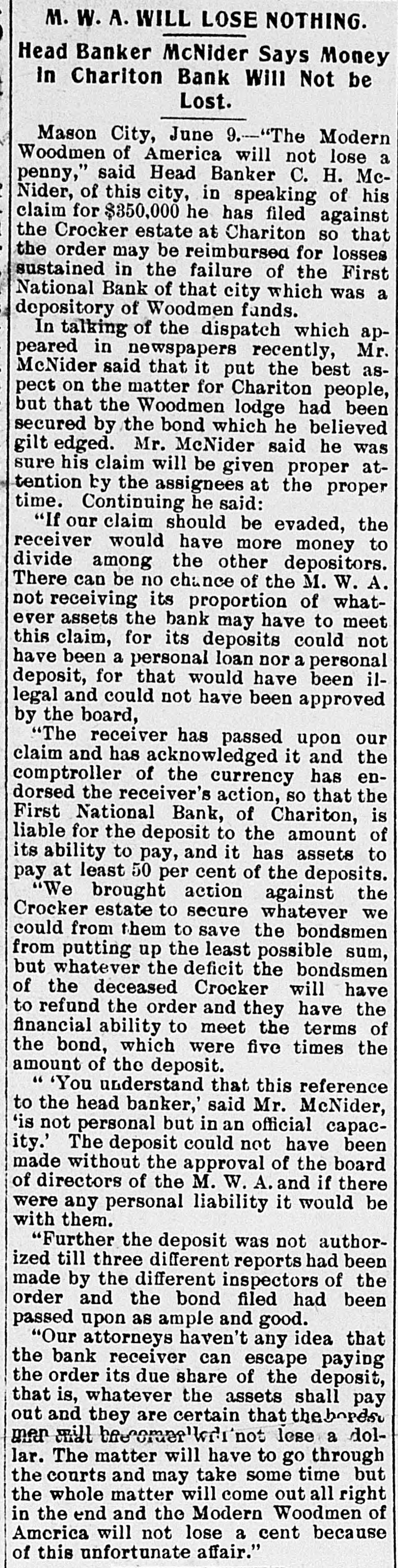
M. W. A. WILL LOSE NOTHING. Head Banker McNider Says Money In Chariton Bank Will Not be Lost. Mason City, June "-"The Modern Woodmen of America will not lose a penny," said Head Banker C. H. McNider, of this city, in speaking of his claim for $350,000 he has filed against the Crocker estate at Chariton so that the order may be reimbursed for losses sustained in the failure of the First National Bank of that city which was a depository of Woodmen funds. In talking of the dispatch which appeared in newspapers recently, Mr. McNider said that it put the best aspect on the matter for Chariton people, but that the Woodmen lodge had been secured by the bond which he believed gilt edged. Mr. McNider said he was sure his claim will be given proper attention by the assignees at the proper time. Continuing he said: "If our claim should be evaded, the receiver would have more money to divide among the other depositors. There can be no chance of the M. W. A. not receiving its proportion of whatever assets the bank may have to meet this claim, for its deposits could not have been a personal loan nor a personal deposit, for that would have been illegal and could not have been approved by the board, "The receiver has passed upon our claim and has acknowledged it and the comptroller of the currency has endorsed the receiver's action, so that the First National Bank, of Chariton, is liable for the deposit to the amount of its ability to pay, and it has assets to pay at least 50 per cent of the deposits. "We brought action against the Crocker estate to secure whatever we could from them to save the bondsmen from putting up the least possible sum, but whatever the deficit the bondsmen of the deceased Crocker will have to refund the order and they have the financial ability to meet the terms of the bond, which were five times the amount of the deposit. 'You understand that this reference to the head banker,' said Mr. McNider, 'is not personal but in an official capacity.' The deposit could not have been made without the approval of the board of directors of the M. W. A. and if there were any personal liability it would be with them. "Further the deposit was not authorized till three different reports had been made by the different inspectors of the order and the bond filed had been passed upon as ample and good. "Our attorneys haven't any idea that the bank receiver can escape paying the order its due share of the deposit, that is, whatever the assets shall pay out and they are certain that thebordsu mer mill lese a dollar. The matter will have to go through the courts and may take some time but the whole matter will come out all right in the end and the Modern Woodmen of America will not lose a cent because of this unfortunate affair."


Article from The Leon Reporter, July 23, 1908

Click image to open full size in new tab

Article Text

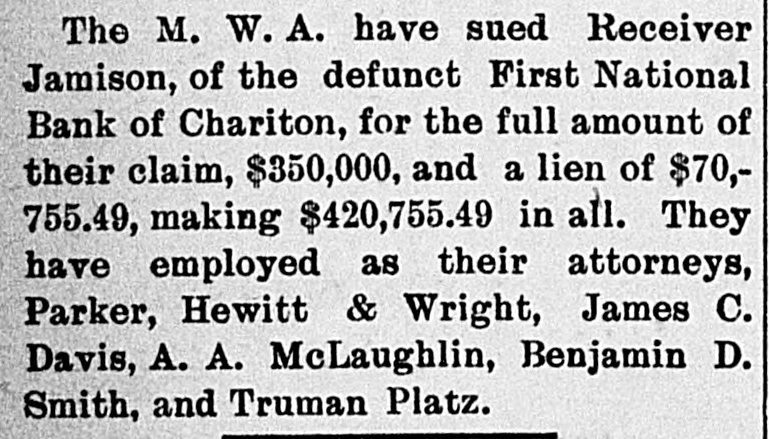
The M. W.A. have sued Receiver Jamison, of the defunct First National Bank of Chariton, for the full amount of their claim, $350,000, and a lien of $70,755.49, making $420,755.49 in all. They have employed as their attorneys, Parker, Hewitt & Wright, James C. Davis, A. A. McLaughlin, Benjamin D. Smith, and Truman Platz.


Article from Evening Times-Republican, August 8, 1908

Click image to open full size in new tab

Article Text

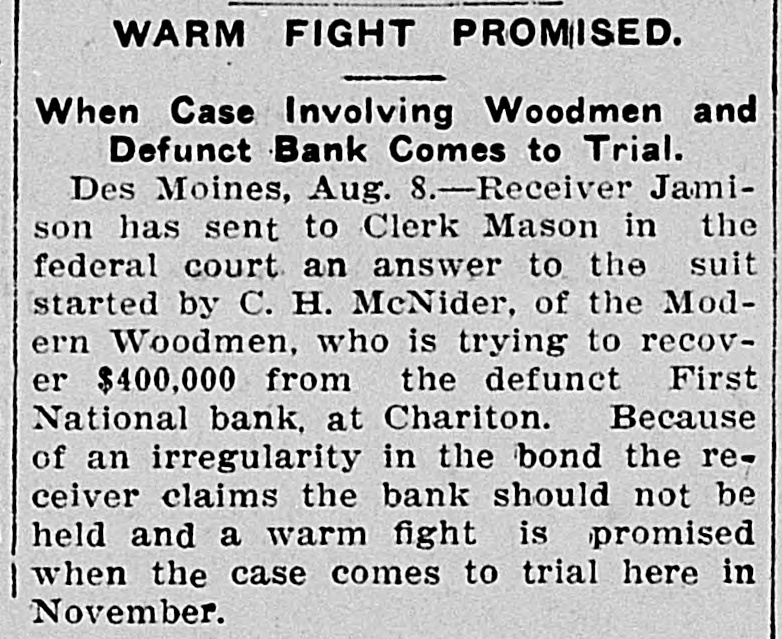
WARM FIGHT PROMISED. When Case Involving Woodmen and Defunct Bank Comes to Trial. Des Moines, Aug. 8.-Receiver Jamison has sent to Clerk Mason in the federal court an answer to the suit started by C. H. McNider, of the Modern Woodmen, who is trying to recover $400,000 from the defunct First National bank, at Chariton. Because of an irregularity in the bond the receiver claims the bank should not be held and a warm fight is promised when the case comes to trial here in November.


Article from The Topeka State Journal, October 29, 1908

Click image to open full size in new tab

Article Text

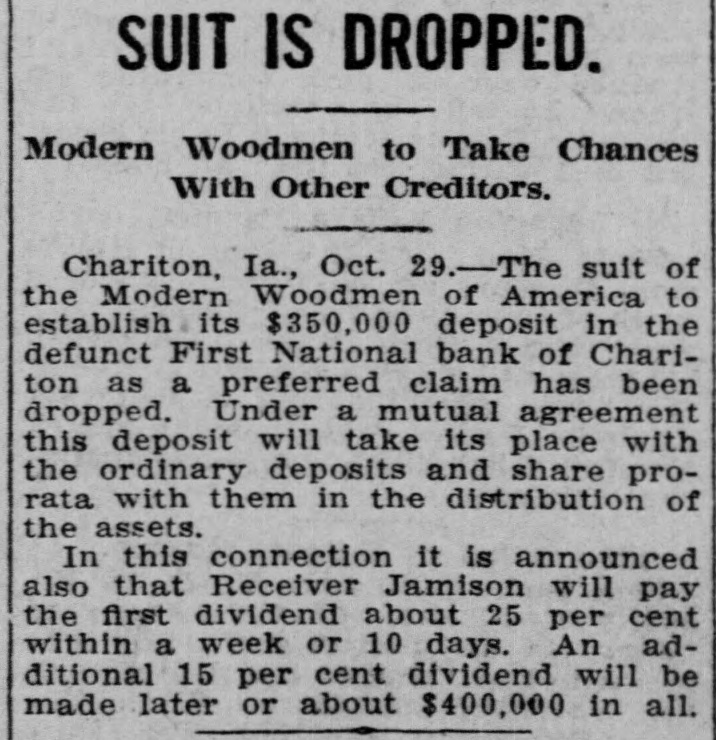
SUIT IS DROPPED. Modern Woodmen to Take Chances With Other Creditors. Chariton, Ia., Oct. 29.-The suit of the Modern Woodmen of America to establish its $350,000 deposit in the defunct First National bank of Chariton as a preferred claim has been dropped. Under a mutual agreement this deposit will take its place with the ordinary deposits and share prorata with them in the distribution of the assets. In this connection it is announced also that Receiver Jamison will pay the first dividend about 25 per cent within a week or 10 days. An additional 15 per cent dividend will be made later or about $400,000 in all.


Article from The Leon Reporter, November 5, 1908

Click image to open full size in new tab

Article Text

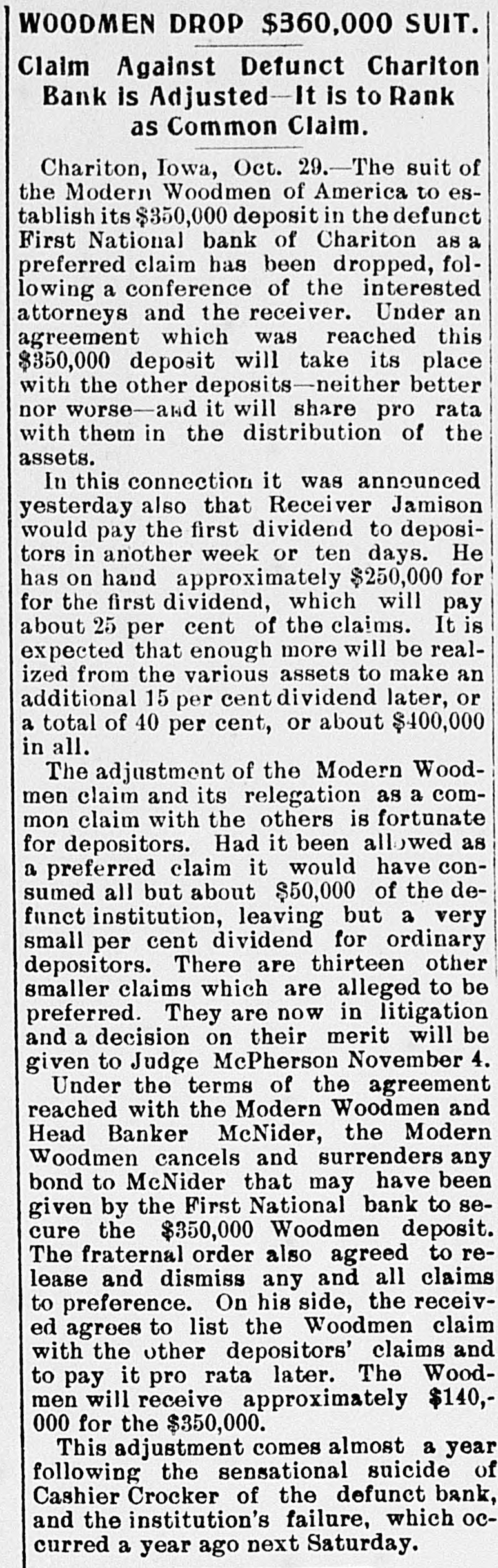
WOODMEN DROP $360,000 SUIT. Claim Against Defunct Chariton Bank is Adjusted-It is to Rank as Common Claim. Chariton, Iowa, Oct. 29.-The suit of the Modern Woodmen of America to establish its $350,000 deposit in the defunct First National bank of Chariton as a preferred claim has been dropped, following a conference of the interested attorneys and the receiver. Under an agreement which was reached this $350,000 deposit will take its place with the other deposits-neither better nor worse-and it will share pro rata with them in the distribution of the assets. In this connection it was announced yesterday also that Receiver Jamison would pay the first dividend to depositors in another week or ten days. He has on hand approximately $250,000 for for the first dividend, which will pay about 25 per cent of the claims. It is expected that enough more will be realized from the various assets to make an additional 15 per cent dividend later, or a total of 40 per cent, or about $400,000 in all. The adjustment of the Modern Woodmen claim and its relegation as a common claim with the others is fortunate for depositors. Had it been allowed as a preferred claim it would have consumed all but about $50,000 of the defunct institution, leaving but a very small per cent dividend for ordinary depositors. There are thirteen other smaller claims which are alleged to be preferred. They are now in litigation and a decision on their merit will be given to Judge McPherson November 4. Under the terms of the agreement reached with the Modern Woodmen and Head Banker McNider, the Modern Woodmen cancels and surrenders any bond to McNider that may have been given by the First National bank to secure the $350,000 Woodmen deposit. The fraternal order also agreed to release and dismiss any and all claims to preference. On his side, the received agrees to list the Woodmen claim with the other depositors' claims and to pay it pro rata later. The Woodmen will receive approximately $140,000 for the $350,000. This adjustment comes almost a year following the sensational suicide of Cashier Crocker of the defunct bank, and the institution's failure, which occurred a year ago next Saturday.


Article from Ottumwa Tri-Weekly Courier, December 19, 1908

Click image to open full size in new tab

Article Text

CHARITON. Chariton-J. H. Jamison, receiver of the First National bank of Chariton, will pay a 25 per cent dividend next week. They have been busy this week working over time at nights with an extra clerical force, making out the schedules. The bank closed its doors October 31 1907. This will be the first dividends paid. Oscar Clay and his bride arrived at Chariton Wednesday morning on No. 3 to visit his parents, Joseph Clay and family. They will stay only a short time, going to California to engage in business. Mr. Clay was born and raised in Chariton until the last 3 years, which he has spent in Marshalltown. Mrs. J. C. Flatt went to Yingley to attend the funeral of her brother. Will Galloway, who was killed at Cripple Creek, Colo., by a stone crusher. They had formerly lived at Tingley.


Article from The Leon Reporter, June 27, 1912

Click image to open full size in new tab

Article Text

Last Dividend Paid. The creditors of the defunct First National Bank received a 4 per cent dividend from the comptroller of the currency last Saturday. This is the third and last dividend to be paid, and makes a total of 45% per cent, one dividend of 25 per cent, and another of 16 2/3 per cent having been paid before. It was on October 30, 1907, that F. R. Crocker, cashier of the First National Bank, committed suicide, and the bank was placed in the hands of a receiver. It has taken four years and nearly nine months to wind up the affairs.-Chariton Herald-Patriot.