Article Text
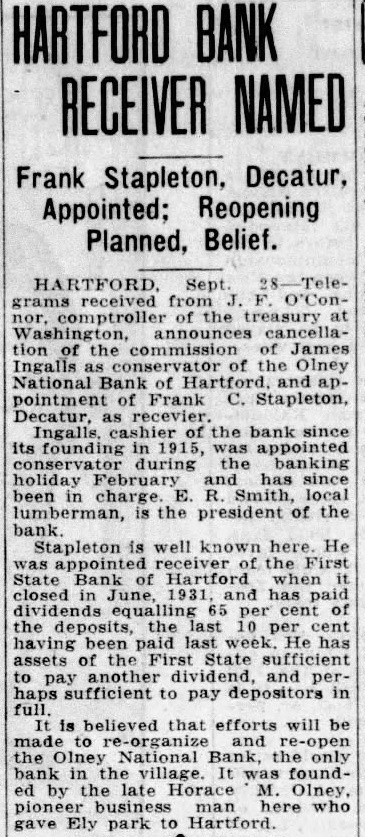
OLNEY NAT. PUT IN HANDS OF RECEIVER Government Orders Town's Only Bank To Be Liquidated HARTFORD, Sept. 27-Hartferd's only remaining bank, and its oldest, was placed in the hands of a receiver this morning. Frank Stapleton, of Decatur, was authorized by a telegram today from J. F. T. O'Connor, comptroller of the currency at Washington, D. take over receivership of the Olney National Bank and liquidate its assets. Town Without Bank This final closing the town's oldest institution deprives Hartford of any financial house. The First State bank of Hartford closed on June 29, 1931. Frank Stapleton, as receiver for the First State, appointed July 13 of that year, has paid out percent dividends to depositors of the closed bank. Its assets at closing were set at about $200,000. Half Million In Deposits The Olney National, organized in 1910, had capitalization of $25,000 and reserves of $20,000 more. Its combined savings and commerical deposits aggregated $500,000. Receivership the last chapter in the history of the Olney bank. The Olney National bank first closed its doors when the state moratorium ordered by Governor Comstock last February. Close on its heels, followed the federal bank moratorium on March reopened an acbasis to local on March 28, with Cashier James L Ingalls, who has been associated with the institution since its inception, as bank conservator. Although ostensibly operating under for the purpose of re-opening for active business, no effort was made to the bank. Will Liquidate Bank Receiver Stapleton, when interviewed by The this morning, said: our intention to liquidate the assets of the Olney National, and make return to its depositors.' His words mark the closing chapter in the career Hartford's last institution. Figures for the last financial stateof the bank were not available, but former cashier James L. Ingalls said total assets at time of closing in February were about one half million dollars. This amount was on deposit in combined accounts. Officers of the defunct Olney National bank were E. R. Smith, president; Frank Eagan, president; M. C. Mortimer, H. Myers. and James Ingalls, directors. Mr. Smith and Mr. Eagan were also directors of the bank.