915. Bank of California (San Francisco, CA)

Bank Information

Episode Type
Run → Suspension → Reopening
Bank Type
state
Start Date
January 1, 1875*
Location
San Francisco, California (37.780, -122.419)

Metadata

Model
gpt-5-mini
Short Digest
fb9256f51c9bf4ff

Response Measures

None

Description

Multiple articles (contemporary and retrospective) describe a heavy run on the Bank of California, its closing of doors and later rehabilitation. The accounts tie the run to the Ralston episode/Comstock conflicts and describe a mob, frantic depositors and the bank 'closed its doors'; later pieces mention the bank was rehabilitated and continued. I estimate the central run/closing episode around the 1870s (Ralston's death in 1875 is referenced). Dates are given where supported by the text; OCR artifacts in the excerpts were corrected for readability.

Events (5)

1. January 1, 1875* Other
Newspaper Excerpt
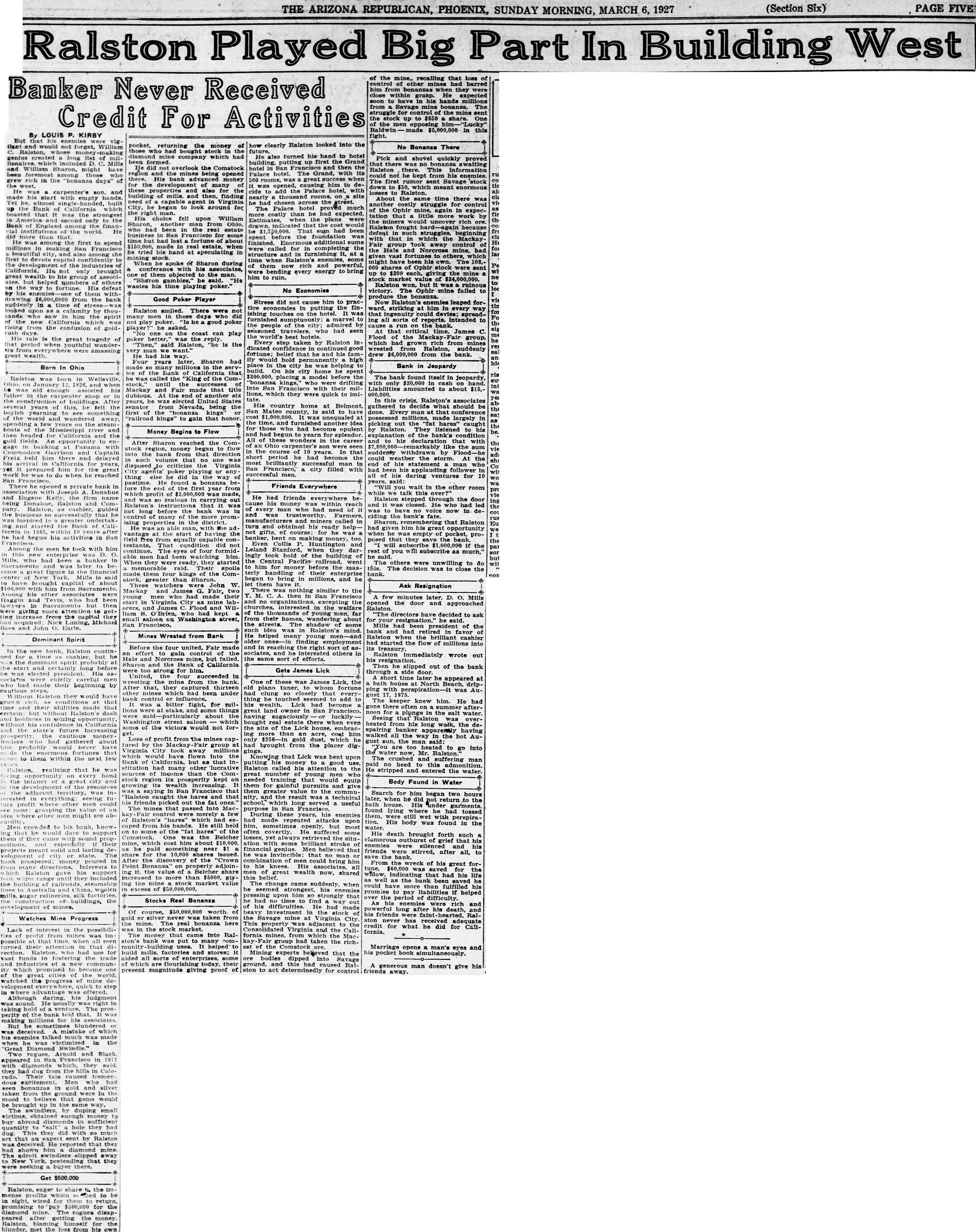
Ralston immediately wrote out his resignation... He stripped and entered the water. His body was found in the bay. ... From the wreck of his great fortune ... the bank was saved and rehabilitated but it had to take second place.
Source
newspapers
2. August 1, 1875* Run
Cause
Bank Specific Adverse Info
Cause Details
Aggressive actions by rival 'Bonanza' interests wresting mines and large withdrawals by influential operators (Flood, Fair, Mackay group) precipitated massive withdrawals; tied to revelations about failed mining ventures and heavy calls on the bank's resources.
Measures
Bank closed its doors; major capital contributions were later organized (guarantee fund / contributions by leading financiers) to protect depositors and enable continuation/rehabilitation.
Newspaper Excerpt
It was a wild day on California street, when the run began. A mob packed the thoroughfare from Montgomery to Sansome... The bank was unable to stem the tide and closed its doors.
Source
newspapers
3. August 1, 1875* Suspension
Cause
Bank Specific Adverse Info
Cause Details
Following the run and large withdrawals (including a reported $6,000,000 drawn by Flood and others) the bank was compelled to close temporarily; directors asked Ralston to resign and the bank shut to stem losses.
Newspaper Excerpt
The bank was unable to stem the tide and closed its doors.
Source
newspapers
4. May 10, 1906 Other
Newspaper Excerpt
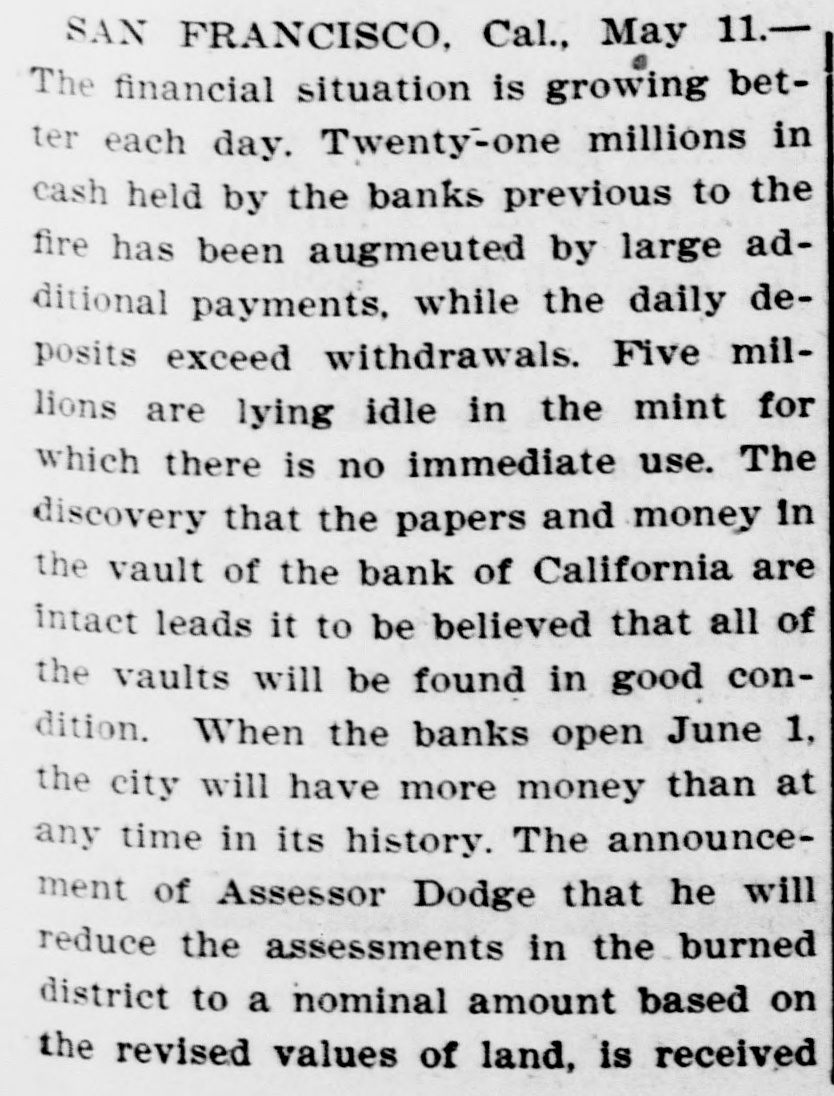
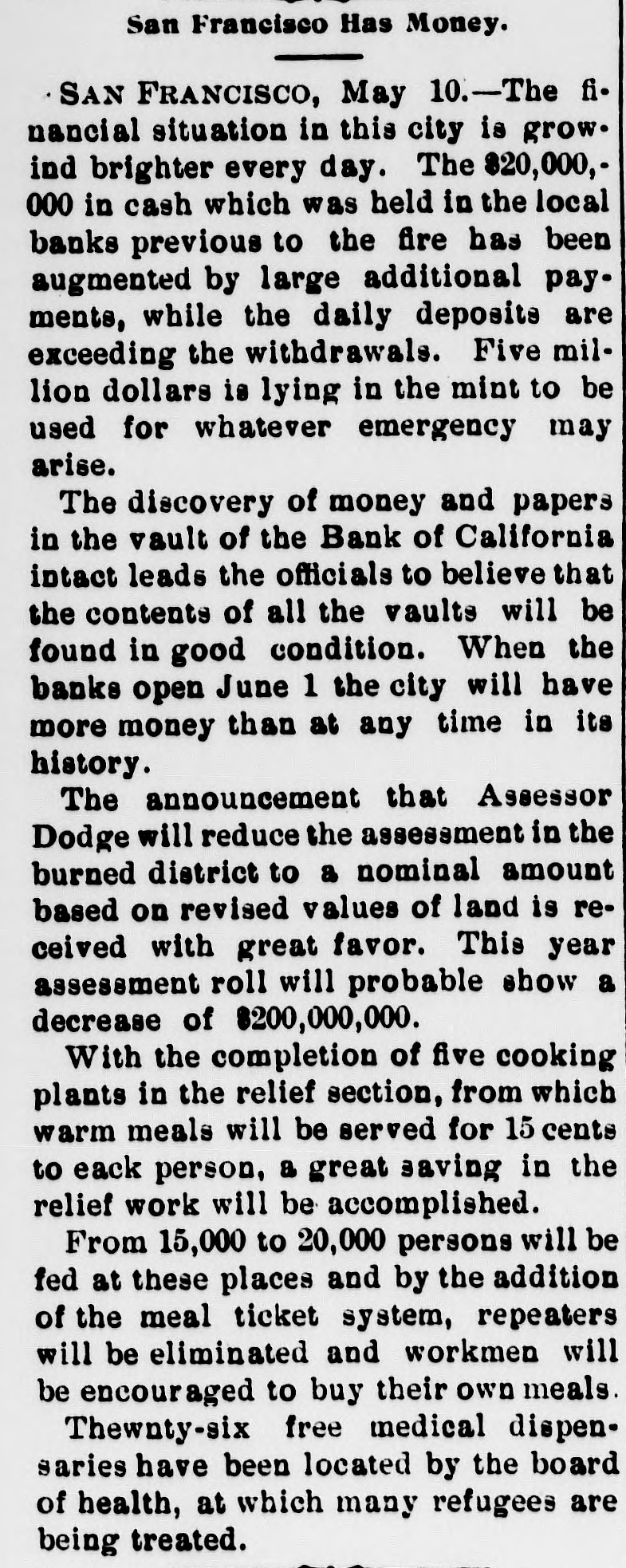
The discovery that the papers and money in the vault of the Bank of California are intact leads it to be believed that all of the vaults will be found in good condition. When the banks open June 1, the city will have more money than at any time in its history.
Source
newspapers
5. * Reopening
Newspaper Excerpt
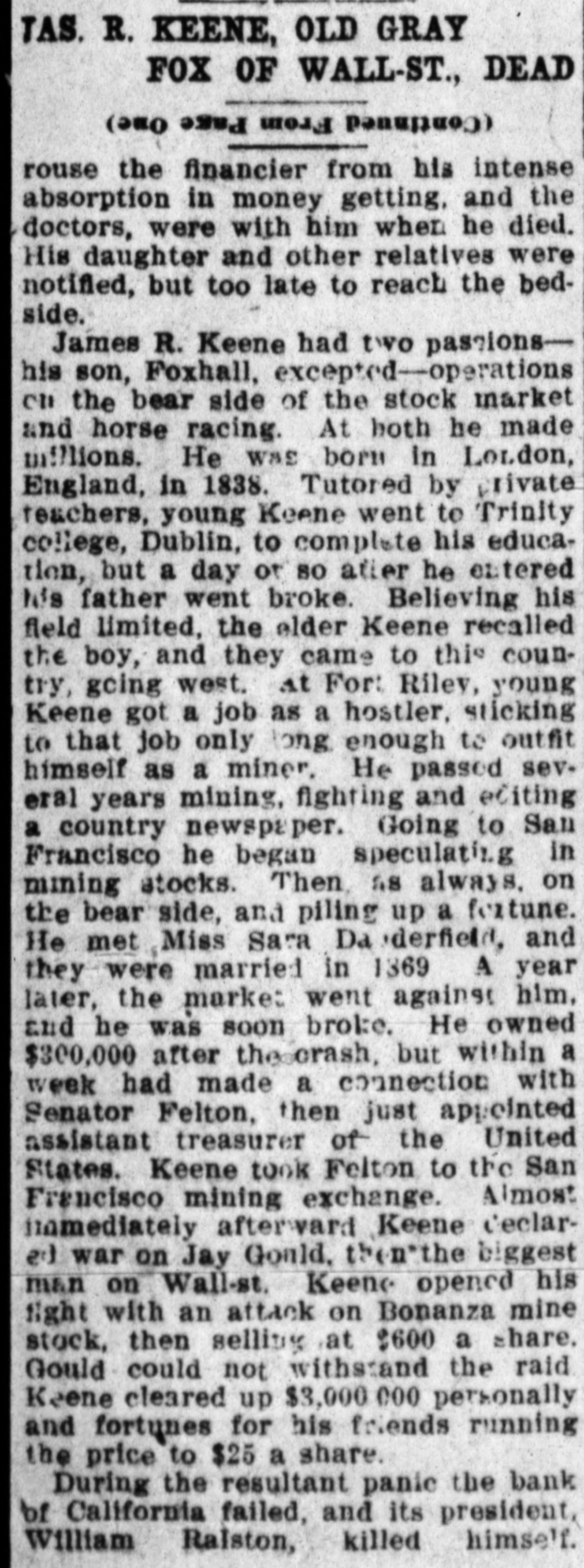
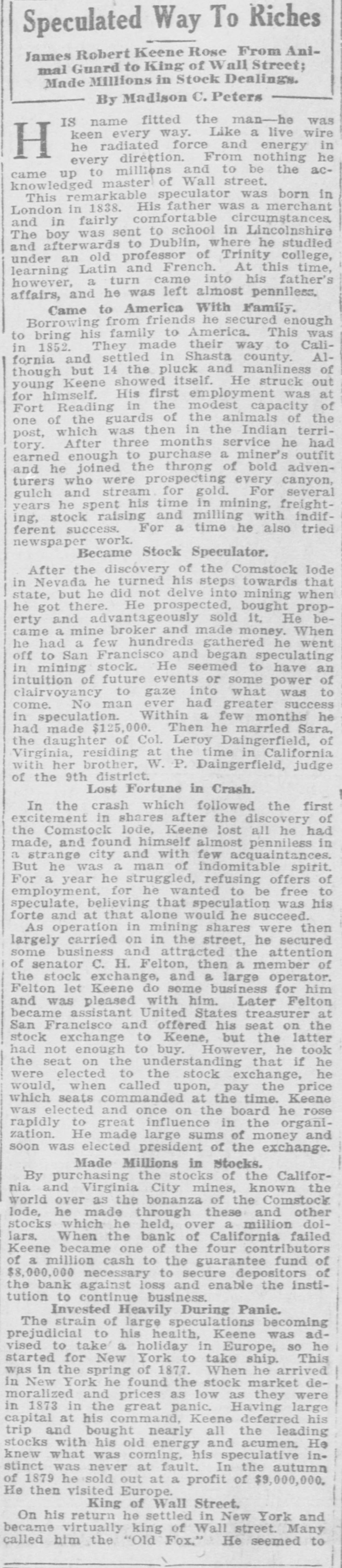
The Nevada bank then became the strong financial institution of the coast. The latter bank was rehabilitated but it had to take second place. ... Keene became one of the four contributors of a million cash to the guarantee fund of $8,000,000 necessary to secure depositors of the bank against loss and enable the institution to continue business.
Source
newspapers

Newspaper Articles (21)

Article from The Morning Call, May 16, 1893

Click image to open full size in new tab

Article Text

in and interest of on the a note directors were and affairs out were discussed, generally the bank Most during the day. but no regular meeton ing was hel held. spectator, who depositors is watching for An Interested behalf of his fellow up. was Justice of the believe something Harrington. to turn He does not directors Peace condition of the much more in the passive and thinks that a to those reaggressive the bank, policy in bank's regard rotten condition sronsible would be in for better the taste and more businessand like. utterly impossible to for say the yet, stateMr. It Knight is the authority loss will amount to. that ment, what in such the tangled shapevet mere guess, Things are give anything wide but a of the mark. is it How possible how which might be very when it will not of the be many known for some the time bank yet are forged the and direc- how notes held genuine? by As one of far too many are there has been nothing tors much said theorizing to-day, in figures. with to work upon. corretangible J. H. Dibble told from your Tueson, Director to-day that: banker in and conspondent prepared to step over all Arizona, the was bank's business. taking securities, the tinue the unquestionably met by good the shareholders. off His balance to there be was not enough idea to is pay to get of the local providing the depositors old in directors full. to join influence him if pos- and some sible, confidence. 80 as to He bring is said in to be worth from $200,000 to $300,000. to be decidedly round veering he that Popular opinion against appears President Pierce, knows and it is openly about asserted Leonard's transactions cares to adhad far with more the bank's funds also, than in granting he formed away mit. His action, the past year, after Company, he all his within P. Pierce standing in his the James except the five now It is being such an name. shares, is severely generally criticised. as to whether the discussed pretty considering with all the Mr. circumstances not in be declared illegal. toPierce was ank, could seen by your correspondent that "It was day and said: only last Tuesday condition, morning and had no suspicion I in was I first heard of the prior bank's to that time San Jose that reason anything was wrong business and had no particular Director first. that day for on visiting Santa Clara. I object most Franck knew to about the newspapers none referring of their emphatically my private affairs. this, It is however, that to will say James P. about business year 1 ago I At formed that time the divided Pierce shares Company. I held in the band. Company and my the *The James P. 1000 Pierce shares, 700 of Ralph that girls hold nearly in the name of James Francisco. number of the Bank being of California, P. Pierce. San I retained five as trustee of James qualify as director, two and sons to five shares to the name of my dieach enable were put them in also to qualify as of rectors." you any intention of crawling those out charged? "Had your liability by apportioning was asked. not. shares, as has been Mr. Franck, to whom that that ne expression made "I had use of is it. attributed. The shares denies are still in the about the $40,000 forged Knight note?' "What of it till Mr. to family.' "I never heard or two ago. It was used of told me of it a deficits, day but never knew from Sep- it. cover Why, up wasn't in Santa being Clara sick at home." tember till March. things looking at the bank up and nothing "How are are very much tangled The prinare "They definite is known in yet. Interest-bearing cipal defalcations which will amount to between to go for certificates, We will have ex back years $60,000 and $70,000. to find out their full tent.' As surmised, the foundation, rumor that as shown Leonard correhad fled had no statement. Your but Knight's Leonard's house this was morning, permission spondent Mr. called at to see him by Miss refused Leonard. gently yet that firmly her father was had somewhat given better She said to-day, but Dr. must Pierce not be spoken to strict orders tnat Hayward's he brother also better endeavored nor ragitated. him, but with no A was but success. meeting of Leonard's it creditors was secret. was well it was held this morning, attended. After an informal decided, discussion It of the situation of Attorney D. attor- W. on the suggestion Spencer & Burchard, of the Burchard Sheriff of Belinger, receiver order of sale neys for to file petition for an the Insolvent, consists 100 tons estate. of the personal property chiefly of of mining stocks of and which a half interest contention in regarding Leonhay. There is of some the mining stocks, Hayward's the ownership creditors claiming them, and the bank ard's also claiming them, of them. Owing heirs laying claim a portion to the value of these stocks, nothing the to the uncertainty definite as can be ascertained insolvent's erty as to that the amount can be sold of for the benefit of the your creditors. Burchard was seen meeting by adcorrespondent Attorney after the make any stateHe deelined to there will that journed. to what developments at the proper into be, mentas but he intimated of Leonard would and be brought strong time all the property the hands of the circumstances receiver the that there that were it was not not all so easy in the showing schedule. It was, one he said. would imagine, and for insolvent by drawn him hide property would doubtless account from the doors. various shortly 511 1118 before it closed its would be bank so doubt that Leonard of this compelled He had no to disclose the presence letters money. Hayward to-day applied for the special estate The F. E. of administration application upon was to of his brother. Judge Reynolds, number owing urgency. to belonging granted by It appears that a deceased of left since horses and in charge wagons of a man living Hayward's on the Los were Gatos road, and he haslett the country leit leaving death it is no said accounting that for the property in his charge. BROKEN WATER VALVES. Cause of the Delay the Alliance. in the Departure Alliance of May 15 The United The cause of States VALLEJO, here


Article from The Portland Daily Press, June 27, 1893

Click image to open full size in new tab

Article Text

consider the dismal, precarious life they lead in the government service, liable at any time to be turned out when the mob has altered its will, with the apparently substantial condition of the bank cashier, teller or president, who is never discharged except for cause, and who in old age is very apt to be pensioned by the bank. The most honest man ehad in the treasury department was Hamilton, for when he resigned he went to the law and made his living by hismind. Gallatin, who succeeded him under Jefferson, and a to liberty neverhad and the great fitness deal of things, say about theless became the stipendiary banker for old John Jacob Astor, until the panic of 1837 struck him, when he was retired, and he died at Astoria under Astor's nose, The United States bank, after its recharter, was preyed upon by the politicians, who afterward destroyed it, and the favor to them was made the point of accusation against it by Gen. Jackson, when he could no longer use it to push his favorites into its branch banks. My observation at the close of the civil war was that nearly all the state banks at the south which had failed had likewise been doing favors for politicians, and in cases their were unsetnever setdebts tled for years, upon and the bank finally many books tled. We do not know how much secession and disunion have to do with the despair of bankrupt individuals. The panic of 1857 was a panic of inexperience. Our people had never to subscriptions been called to upon anything make but popular the United States itself. Jay Cooke had taught them to behave like other people and bring their savings to the government and take bonds for the same. In spite of mean secretaries of the was Cooke, it, treasury, carried by of the the whom magnificence public Chase loans all of one, his through spir- Jay the war, and at the conclusion thereof was a well-established banker in several cities. Having large banking facilities, he pined for something to do equal to his resources. The Northern Pacific railroad was brought to him early in the seventies, or perhaps as early as 1869. We had then only the railroad across the plains, the Union & Central Pacific. Mr. Cooke undertook to build thatrailroad on a popular subscription. The American people had plenty of money to embark in the enterprise, for the war, while giving a public indebtedness, had made private wealth general, through a sound if inflated currency. Mr. Cooke, however, incurred the animosity of older bankers, who were willing to bring on a general panic rather than see him head the list of financial authorities from that old and somewhat reactionary city of Philadelphia. The Northern Pacific railway was systematically condemned and attacked. Coincident with it railroad undertake ings and extensions became general in other parts of the country. Finally the New York end of Mr. Cooke's banking house abruptly closed its doors. The chief banker has always insisted that there was not the slightest occasion for this. A general panic, however, ensued, which we were about four years in stemming. In the sequel, everybody who had faith in Jay Cooke got his money and interest back in the Northern Pacific investment The panic of 1857 operated with great rigor on the public because they had been living extravagantly upon an inflated currency and the altered habits of the civil war. Perhaps the suddenness was cora recting of that great panic many beneficial wild undertak- in nature which were as the sale ings in of being the Spanish hatched land of out, swindles grants. such The Bank of California, which had maintained specie payments against our greenbacks, went up among other things, and turned loose on the country a purely speculative element, led by Flood and O'Brien. But, if we new compare the heedless over railpanic road with have such the Northern cutthroat in the Pacific operations as we seen Reading railroad, in its frequent booms and bankers' reorganizations, we can wonder if the morals of 1893 are as good as they were in 1873. Yet the panic of 1878 had nearly destroyed Commodore Vanderbilt, who, to use the language of one of his family, "lay down and gave everything up for lost." But some of his coadjutors, with more pluck, asGATH sisted to better days. Overwork and Underwork.


Article from The San Francisco Call, July 5, 1895

Click image to open full size in new tab

Article Text

# AROUND THE CORRIDORS. Two weeks ago while in Cincinnati E. J. Baldwin submitted to an interview in which he is credited with describing how he won the appellation of "Lucky," by which he is most generally known. Speaking of this last night B. G. Lathrop, a well-known pioneer, said: "Back in the sixties, I was standing at the counter of Cantin & Everett, stockbrokers, when E. J. Baldwin, whom I know well, came in. He stated that he had just come from Virginia City. From his pocket-book he took two certificates of stock, one on Belcher and the other on Crown Point, each for 250 shares. Each share represented one foot of the mine, which was then selling at a very low figure. An assessment had just been levied on the shares, but Baldwin was practically penniless. His residence was mortgaged to Cantin & Everett for $14,000, about all it was worth. "Baldwin was much excited, because a friend, whom he said had given him this stock, had assured him that Belcher and Crown Point had struck a bonanza, and that in a few weeks the stock would make him rich-if he could only hold it. Cantin & Everett agreed to carry him through, and within ninety days the stock jumped from $1 per share to $2000. In that short time Baldwin, without investing a dollar, became a millionaire. Now if a minister had stood at the baptismal font and said, 'Name this child,' what could it have been but 'Lucky'? From that time to the present the name has followed him. "Within the same period that Baldwin was christened 'Lucky,' William C. Ralston was manipulating the Belcher mine, taking in D. O. Mills and William Sharon. They captured nine-tenths of the stock, and while Baldwin was making his lucky million they cleared over ten million dollars each. Mills and Sharon put theirs in solid property. Ralston spent his in building the Palace and Grand hotels, opening and building up New Montgomery street, helping Harpending build his block on Market street, and assisting in other improvements about the City. He also invested largely in the great diamond mine that Harpending had salted down in some desert in Nevada. Ralston sent trusty men who carefully examined the mine, bringing back many valuable jewels. He then organized a company, selling his friends large blocks of stock. Harpending gathered in the money and started a great bank in Kentucky. "Before preparations to work the diamond mine were perfected Ralston learned that Harpending had purchased the rough jewels in Europe, and he immediately took steps to make him disgorge sufficient to reimburse his friends. These matters brought about the sudden closing of the Bank of California, not any manipulation by 'Lucky' Baldwin." Judge Laidlaw was telling of an incident in yesterday's procession up at the Baldwin last night to some of the leaders of the Iroquois-Popper branch of the local Democracy. "I was standing on Market street while part of the procession passed. The crowds on both sides had closed in until there was barely room for the fours of Tom Barry's regiment to pass through. Pretty soon there were shouts down the street and along came Captain Waller's squad of cavalry spread across-" "Oh come, Judge, don't," piped in General Bamberger. "It was a troop of cavalry and not a squad, and they were deployed across the street," "Very well," began the Judge again, "I bow to superior authority. Any way the people spread out very lively. One of the troopers-I suppose you would call him a trooper general-lost his temper and backed his horse into the crowd. A policeman, who had been vainly trying to keep the crowd back, rushed up and cried out, 'See here, young fellow, you be careful what you're doing or I'll run you in.' Of course there was a cheer from the crowd, and the trooper went on, but I have been wondering ever since what would have been the result if the policeman had tried to run the guardsman in, and if he had succeeded what pretty complications would come up." Judge F. T. Baldwin of Stockton, one of the code commissioners, has taken up his residence at the Palace Hotel in this City. Speaking of the work of the commission yesterday, he said: "We have had but two meetings as yet, and, of course, cannot say much of the work before us. The commission was appointed for two years under the act of the Legislature, but it is probable that it will take from four to six years to do all the work that will be necessary to revise the codes. Our headquarters are in Sacramento. One or more of the commissioners will always be there. Mr. Daly is now at that place, and will remain two or three months, when I shall go up for a time. We have begun on the Political Code. In time we shall ask for suggestions from members of the bar and others, and shall probably hear arguments on the suggested changes."


Article from The Salt Lake Herald, December 1, 1895

Click image to open full size in new tab

Article Text

properties. When men invest large moneys in such enterprises and have merit to back it all, they are justly entitled to large returns. John Held, the cornetist, is issuing a very readable little monthly periodical called The Baton. Georgia Cayvan says: "I am willing to be interviewed, but I refuse to discuss the new woman." Daynes & Coalter have just published a new waltz song, "Love, I've Come to See You," by Ivor Ajax. George D. Pyper went to Provo last night to take part in a tabernacle concert there, given under the direction of Henry Giles. Julian Magnus has given up managing Marie Wainwright. Louis James could have furnished him pointers on that years ago. Hoff, former tenor of the Bostonians, is to have charge of a vocal department in the New York Empire theater's school of acting. Louis James sends us a bunch of flattering press comments on his starring repertoire this season. It includeh "Marmion," "Hamlet," "Othello" and "Virginius." A "Trilby" company playing in Texas happened at Tyler in that state on the day of the burning at the stake of a negro assailant, the manager wrote home that the "counter attraction" interfered with his matinee. Jessie Bartlett Davis will star next season, says a syndicate article. Nothing of the sort. She will continue with the Bostonians, with whom she has quite as much glory and prominence, and none of the vicissitudes that befall many light opera prima donna stars. Harry Corson Clarke has closed his Lyceum theater at Denver, Colo. Mr. Clarke informs a Mirror correspondent that he has not drawn a dollar for himself since he opened the theater, but that he leaves with every dollar of indebtedness paid. His plans for the present are not made, but early in the spring he will go to South Africa, whence he has received a proposition. The San Francisco Call said that Dazey's new play, "The War of Wealth," was the "best American melodrama ever brought to the coast." It seems to have set the usually critical Californians wild with enthusiasm for it is reported as doing a tremendous business everywhere there. The big bank run reminded the San Franciscans of the days of the old Bank of California failure, and they filled the California theater for two weeks to see the play.


Article from The Daily Morning Journal and Courier, May 20, 1896

Click image to open full size in new tab

Article Text

rooms, found the young man and bleeding on the first the parlor door. He had fallen over the banister from above, and with his skull crae ribs, arms and a leg fract picked up and his condi then has not allowed the glea him of any details of his mis Dr. P. A. Kearney has be attendant upon the pat the occurrence, just as he old Thomas Bell, when on night of October 15 he, too, the banister in his home and la the hard floor two stories be in a couple of hours, his seventy) militating against of recovery. excitement over the death Bell was intense. Few me had been closer identified , When quite a boy Bell country to go to Valpara he became a clerk in a la antile house, and it was as for that firm that he first vis Francisco early in 1850. He o to make California his home but first he returned to to sever his connection with there. In the latter par year he arrived here for time, and for thirty-two y resided constantly in San F Shortly after arriving here himself with two others, founded the firm of Bolton, Ba which after a few years bec & Co. Eustace and W.E. ] and Thomas Bell were the part latter firm, which for m was the leading broker, mi commission house on the Pa It was during these years laid the foundation for what a large fortune. There was deal in the great Comstock , he had not something to do , and his partners were the ag all the big European and S houses who did business fornia, and when the Barrons newhere in 1872 or 1873-the 1 all fell into the hands of Bell, George Staake into partners so created the present firn Bell & Co. was one of the originators porators of the first bank of ( a in 1864, and when that institu its doors years afterwards Bell who,with D. O. Mills, ca Rothschilds and got them to responsible for the bank's pa enabling it to resume busin besides his other multifarious connections, was also the qui magnate of the Pacific e rolling as he did the New Alma New Idria and the Standard qui mines. He was also the ou he Triumfo silver mine near Mexico, and when his estat it will be found that he o properties in many parts of It was Bell who built American railroad, which Guatemala, and which he four years ago to a syndi earlier days of Bell's life in he made the acquaintance Percy, whom he afterw Miss Percy's maid was known Mammy Pleasant, wh with her as a companion, and the staunch friend of Sarah Hill in the celebrated Sharon case. Mammy Pleasant to-da the advisor of Thomas Bell's and the purveyor to Sarah Al who is in the Stockton Asylum nsane. several millions of dollars lef Bell have been tied up George Staake and John W well, the old friends of the who acted as executors, ha collateral branches of the f who disputed the legitimacy of


Article from The San Francisco Call, November 1, 1896

Click image to open full size in new tab

Article Text

READY FOR INVESTMENT. Vast Sums of Money in the Banks of San FranC SCO. McKinley's E ection Will Cause the Cash to Be Investei in Business Enterprises Bankers and financial men of San Francisco assert that business plans and new enterprises wait on the result of the election next Tuesday. The amount of cap. ital awaiting investment is unusually large. Bankers do not care to give out definite statements regarding new enterprises in view, but they freely acknowledge that the reserves of money are extraordinary. William Alvord, president of the Bank of California, was asked to give an estimate of the amount of money waiting on the result of the election for investment in business plans and new enterprises. He replied that no one could accurately state the amount, and doubted if it could be approximated. He was sure that the announcement of McKinley's election would release a vast amount of money now on deposit in the commercial banks, and large sums locked up in the safe deposits. When contidence is restored the men who have locked up their coin will bring it out to get 6 per cent interest. Apart from the money going out to move the crops there is little doing. Plans and enterprises of a business character are held in suspense awaiting the result of the election. The same story is told at the London, Paris and American Bank. Charles Altschul, the manager, could not estimate how much money was waiting investment on the decision of the election next Tuesday, but he directed attention to the fact that the reserve on hand in his bank was 70 per cent of the deposits, although the usual accommodations had been extended. The bank would be well satisfied with a reserve of 40 per cent. There was some investment of money to move the crops, but apart from that there was littled mand from legitimate commercial enterprise. Philip N. Lillienthal, manager of the Anglo-Californian Bank, said to his know!edge business transactions involving the legitimate use of $1,000,000 had been turned down by reason of remote doubt as to the result of the Presidential election. He was of the opinion that if McKinley should be elected by an overwhelming or a decisive majority confidence would be restored in commercial circles. The money now held in reserve would be released for profitable investments. Adam Grant, president of the DonohoeKelly Banking Company, one of the ablest and best known of San Francisco merchants. entertains the belief that the election of McKinley would re-establish confdence in business circles and bring about a much better state of affairs. Samuel G. Murphy, president of the First National Bank, says that his institution has 70 per cent of its deposits in reserve. He acknowledges that there is little demand for money to invest in new and legitimate commercial enterprises. Bankers who do not care to be quoted mention that large sums in coin have been withdrawn from the banks and stored in the safe deposit boxes. Still the amount of idle coin held by the banks is prodigious. Depositors will not take any chances while there is the least danger of Bryan's election. Next Tuesday night when the returns begin to come over the wires announcing McKinley majorities and giving positive assurance of Republican triumph plans of investment will be proposed. The money now idle in the banks and vaults wili soon be brought out for investment in enterprises of industrial development.


Article from Virginia Gazette, November 13, 1897

Click image to open full size in new tab

Article Text

nothing, as he had lost hope of succeeding with it. We got the first Bullock perfecting press ever used in California, but just as we were starting a morning and Sunday edition the Bank of California failed and brought on a disastrous panic. "We were pressed for the money which had been borrowed to buy the press, and the sacrifices we were compelled to make determined me to retire. I held a small political office in San Francisco, by appointment for four years, and during this time wrote 'Progress and Poverty.' "In January, 1880, I came East after the Appletons had agreed to republish the book here. I came on borrowed money, and left my family in California, but 'Progress and Poverty' was a success from the start. I have no idea how many copies have been sold. I think considerably over half a million. There were three editions in German alone, and there have been editions in Dutch, Spanish, French, Italian and even in Japanese and Chinese. From many of these, of course, I have never received anything at all." When asked about the trip to England and Ireland which he made about the height of the Land League agitation, Mr. George recalled the fact that he was twice arrested as an enemy of the English Government. He was in Connemara when the first arrest took place. This was at Lochrea, and the second was at a miserable straggling village fifty miles further on. It was


Article from The Star, November 17, 1897

Click image to open full size in new tab

Article Text

got into bad financial straits and I returned to California. "It was during my stay in the East that I wrote for the New York Tribune an article headed 'The Chinese on the Pacific Coast' - the first article I ever wrote on political economy. "When I returned to San Francisco I found the Herald dying, and, as the printers were the only ones on it who could get money to live on, I went to work at the case. "After this I edited the Oakland Transcript, and made a friend of Professor William Swinton. Governor Haight, who was fighting the Pacific Railroad, offered me charge of a Democratic paper, the Recorder, and I took it. It prospered, and I used the money I made from it in starting a penny paper in San Francisco. "The articles I wrote, supporting Haight in his anti-monopoly fight, attracted attention, and about this time I also developed the idea which was afterward worked out in 'Progress and Poverty.' "I published it first in a pamphlet called 'Our Land and Land Policy,' of which a thousand copies were sold at twenty-five cents each. More might have been sold, but when the edition ran out I determined to wait until I could develop the idea in a way I thought more worthy of it. "Our penny paper was printed on a flat press of the old style, and we found we could not get off enough copies to supply the demand or to make it pay. A man was very anxious to buy and we sold to him. One of my partners went to Paris with the proceeds of his venture, but I remained in San Francisco and was finally induced by the purchaser of the paper to take an interest in it for nothing, as he had lost hope of succeeding with it. We got the first Bullock perfecting press ever used in California, but just as we were starting a morning and Sunday edition the Bank of California failed and brought on a disastrous panic. "We were pressed for the money which had been borrowed to buy the press, and the sacrifices we were compelled to make determined me to retire. I held a small political office in San Francisco, by appointment for four years, and during this time wrote 'Progress and Poverty.' "I could not find a publisher in the


Article from The San Francisco Call, November 14, 1898

Click image to open full size in new tab

Article Text

"BROWN AND HELLMAN DO NOT DARE LET ANYTHING HAPPEN TO OUR BANKS." astounding audacity letter of M. that H. The was shown in a on Sherman wrote to Frank V. McDonald day behe 1893, a month and a feeder, May the 21, Pacific Bank and its with a fore People's Bank, went down written the Frank McDonald had crash. Sherman telling him of the precari- and to of the institution ous for some road and his begging condition electric assistance. absorbed Phoenix Sherman's Mohawk ventures had to and money from the two banks East enough them. Sherman had traveled beruin the McDonalds into a to he was trying to lief he knew were not was approaching, had bonds tiable. The deceive that end which Sherman and negotiate Frank negofor his advice. banks for asked upon the McDonald advice he preyed two years, and the over back was most extraordinary. of San He sent that the other banks Pacideclared would not dare let the down, and could fic words threatened Sheror Bank with money. Mcthe that the ruin of the Francisco in Bank Pacific declared other go to be the in supply forced man Donalds would create a panic Brown and and that Hellman, up the State, local bankers would put McDonalds other rather than see the advice, funds under. Having given this for more go made another play The Sherman for his Phoenix venture. is as money letter is most interesting, and follows: ANGELES, May 21, 1893. LOS F. V.: It is such a time, busy My Dear rest, but toil, toil all the It and F. V. we that the worry life. has sometimes No do work seemed try, and oh, so annoyance hard. it seems constant just kill me, but when think would life was hard, then I going that my and of all you are knows of you Well, the good Lord have this through. I suppose we must San Frandiscipline. why. Then I think of cisco so much. F. V., those men, Brown, Hell- that and the others don't dare, man is the way it seems to me, let any- The thing happen to our banks. memory of the Bank of California their failure must be green in That failure brought down memory. others. If it should go abroad had this State that anything had in happened to the rich McDon- would alds think of what a panic it among depositors generally to and cause the other banks would have look out. V. And if you find I know you No, F. all about the situation, things; I know about the inside of the nothing only where I can help; must never ask in a hole. You banks are ever in time and Farnum and let us know brother-Farnum is on those very your friendly terms and with see many the other of San Mr. men-must men. go My idea is that of Francisco White would help. He and has get a pile help money idle Of I am course, told we must necessary. not do in season. unless absolutely tells this From what your brother much. I have me things are improving quite sure if he told me if never things felt to encourage me so or much these things were getting know what is better really best, in me better fact. for than Well, seeming I you can to mix tell to up do you. in in affairs Forgive as I may now have a seemed word as to the Phoenix this letter. levied Water And an Company. assessment We long But should ago, the have would not agree to it. much but Hine been growing so and so that city has to be put in in extensions now. has had absolutely necessary to a this is he has agreed to it, i. The e., inFinally assessment, $2000 each. due in nine terest $6000 on We the must bonds be comes prompt in If it, you it days. hurts so to have any will delay. pay in $2000. will then wire I will me does pay that the in you $2000 same. and Let's I will have into see it that agreed Hine B. that to be the. used $6000 to is pay paid interest, else, Sincerely, 1. e., P. H. pay S. coupons and for nothing M. H. eh. of M. H. Sherman to did core not The plots his boast of ability to end with Bank Commissioners and who rupt up" reputable citizens "stand fearful of the methods he to-morrow employwere Call will show adept, ed. The Sherman was also influencing an that assumed Mr. to be such, in of or through the assistance Pacific Legislatures his great ally, the Southern Company.


Article from Deseret Evening News, December 16, 1905

Click image to open full size in new tab

Article Text

(BY SAM P. DAVIS) "The Fig Four," John Mackay. James Flood, William O'Brien and himself. The stock was kleking about with no one, not even a California mud hen, to do R reverence. Mackay was already worth a few hundred thousands accumulated by honest mining in California. The other two ran a "bit" whisky mill somewhere along near the city front in Frisco. Fair took them in and thev soon bought a controlling interest in the Con. Virginia. The stock that had been selling for 15 cents never stopped until It had reached $800 a share. The mine began to yield $3,000,000 I month in dividends. One who lived there in these old bonanza days pauses and brushes the cobwebs from his memory. We all thought it would last forever, and governed ourselfes accordIngly. No one had any use for money except to seatter It. It was a time when the tramp of today might be king of the ledge ere another moon should wane. Sharon was irritated that in the race for prominence someone threatened to pass him. He spoke contemptuously of Mackay and said he would make "John pack his blankets over the Ginger grade," and Mackey sent back the retort: "I can pack a. pair of blankets over any grade, which is a d-d sight more than Sharen can do." Physically Mackay towered above his sarcastic rival. Sharon alluded to the other two as "bit whisky slingers." Flood, when he heard it, swore that he would sell "bit" whisky over the counter of the bank of California. Things were coming to a.crisis. It was "Night on the Numidian desert, and all the lions up." Disaster and Death. The Bonanza firm closed in on their play when they wrecked the bank of California. They slowly gathered in all the indebtedness and called on the bank to liquidate. It was a wild day on California street, when the run began. A mob packed the thoroughfare from Montgomery to Sansome. Frantic men. distracted women and squads of police battling with the mob. The bank was unable to steam the tide and closed its doors. The Bonanza firm had stormed what was considered an impregnable financial ettadel. and captured it. Flood, elated at his success attempted to sell whisky over the counter, to make good his threat but John Mackay, with a strong right hand and good horse sense, grabbed him by the collar and prevented him by main force. Raiston was unable to survive the blow and in a few days the waters of the bay closed over him. Sharon was brought to brook and compelled out of his private fortune to stem the tide of the bank's indebtedness. He did it with his usual flourish of trumpets and got in to the Time light when he made good, but it was the law that made him do it and no generous impulse of his own. Of the two men Ralston was the lion and Sharon the tiger off the partnership. Mackay and Fair were the two pythons that coiled around them in the deadly conflict of the stock jungle and crushed them to death. The Nevada bank then became the strong financial institution of the coast. It was erected as one might say upon the ruins of the Bank of California. The latter bank was rehabilitated but it had to take second place. "The Big Four." Menwhile the Bonanza firm were the lords of finance and lauded as the richest quartet in the world. This was more than a quarter of a century ago and it brings a smile to the faces of the financiers of the present day to think of such a combination as being regarded as heavy weights. Presently Fair got in such bad odor that the Ne. vada bank had to get rid of him. Nearly every crime in the catalogue was laid at his door. Fred Smith, the miner who helped him run the secret drift from the Curry to the Con Virginia, was killed by a man named Kosser, a prize fighter. Fair was openly charged with being behind the killing to get him out of the way and there were hundreds of capitalists who had been be. trayed by Fair and "done up to the queen's taste" as they put it. He was


Article from The Evening Statesman, May 10, 1906

Click image to open full size in new tab

Article Text

SAN FRANCISCO, Cal., May 11.The financial situation is growing better each day. Twenty-one millions in cash held by the banks previous to the fire has been augmeuted by large additional payments, while the daily deposits exceed withdrawals. Five millions are lying idle in the mint for which there is no immediate use. The discovery that the papers and money in the vault of the bank of California are intact leads it to be believed that all of the vaults will be found in good condition. When the banks open June 1, the city will have more money than at any time in its history. The announcement of Assessor Dodge that he will reduce the assessments in the burned district to a nominal amount based on the revised values of land, is received


Article from The Sun, May 11, 1906

Click image to open full size in new tab

Article Text

LIBERAL I e BROAD POLICY TO GOVERN SAV FRANCISCO SETTLEMENTS Please Pime to des mane 14ft without PORTING a Pante Hannine Redness - Normal , anditions is cent Weate for All Call May in The fant that are in around condition Inving inntit what the in nining intenti to de is new topic amond all claimed ment of fire I a broad adjustment of marthquake amilier affitide toward enamited properties in what in representatives of insurance bean promises have Funn to the ruction comthe under writers and are conreport made by William H. hairman of the sub-committee Ma struction on question of liability for damages denamiting and earthquales one of the by writers avid to-day impaties are not responsible for losses We do not insure eart homakes But you may has sure as impanies will be sufferers in this matter rather than policyholders If building was thrown downby the earthquake and then burned two days later its value at the time it was burned was not what was before the earthquake certain that polioyholders will or nearly that prove But 15 many almost all instances offered no damage They from their earthquake property will be ready with proofs and the companies cannot In this way area in the earthquaies combat their them burned most district of the must be paid There not the slightest doubt that the insurance companies will have to pay all JOANCH passed by the dynamiting of buildI to prevent the spread of the fire. that question to ing submitted must three lawyers just and they all agree that we pay if loss were caused by water from fire engines If the building in which we are was on fire and water used to put out that fire flooded the buildings next door we would have to pay the loss by water damage, though we do not say we will pay lesses by water In the matter of the general payment of insurance losses people must be patient If the insurance companies were forced to hrow all their securities on the market at once there would be a financial panic. My company could not stand a shrinkage of $1,000,000 or $2,000,000 just now on top of all its losses So the companies must have reasonable time to get their money in hand. The banking situation approaches nearer normal with each day that passes. One of the vaults of the Bank of California was opened yesterday and everything within wasfound as perfect as the day it was placed there It is believed that the vaults of the other banks may be opened without danger. From the informal discussion of several committees on structural plans it is safe to predict that there will be no limit placed the on the height of buildings within fire limits. The question has been a mooted one since the fire, but the members of the committees are almost unanimous in declaring in favor of an unlimited number of stories for a "Class A' structure San Francisco is to have a fifteen story steel building constructed after the manner of a steel ship. All the walls are to be of steel plates. It will be the first building of its kind in the world. It is the George Whittell building and its framework withstood the fire. The building will cost $275,000 and will be ready for tenants in six months. Twenty-one days have passed since the beginning of the fire, and still flames are leaping from ruined buildings near the waterfront Five large fires were counted yesterday in the vicinity of Spear and Beale streets. The most curious of these lingering fires was at Mission and Spear streets, where, on the site of the Brandenstein warehouse, huge piles of coffee are still roasting, though long since overdone. Several tons of tea are doing their best to add to the aroma. Another fire, which promises to outlast all the others, is in the premises of the Richmond Coal Company. where many carloads of coal are burring. Beginning to-morrow at noon, it is planned Major Fobiger to have five stations for by the distribution of hot meals. Meals will be furnished to all who apply at the uniform rate of 15 cents. Any person unable to pay the price of a meal will get a ticket at the relief station. The San Francisco that remains will soon have gas for illuminating and ook ing. In answer to an inquiry of Mayor Schmitz, W. H. Leaby said: 'The mains have been repaired at every point where it was in the least suspected that there might be a break and gas will be turned on probably on Monday. -


Article from The River Press, May 16, 1906

Click image to open full size in new tab

Article Text

San Francisco Has Money. SAN FRANCISCO, May 10.-The financial situation in this city is grow. ind brighter every day. The $20,000,000 in cash which was held in the local banks previous to the fire has been augmented by large additional payments, while the daily deposits are exceeding the withdrawals. Five million dollars is lying in the mint to be used for whatever emergency may arise. The discovery of money and papers in the vault of the Bank of California intact leads the officials to believe that the contents of all the vaults will be found in good condition. When the banks open June 1 the city will have more money than at any time in its history. The announcement that Assessor Dodge will reduce the assessment in the burned district to a nominal amount based on revised values of land is received with great favor. This year assessment roll will probable show a decrease of $200,000,000. With the completion of five cooking plants in the relief section, from which warm meals will be served for 15 cents to eack person, a great saving in the relief work will be accomplished. From 15,000 to 20,000 persons will be fed at these places and by the addition of the meal ticket system, repeaters will be eliminated and workmen will be encouraged to buy their own meals. Thewnty-six free medical dispensaries have been located by the board of health, at which many refugees are being treated.


Article from Los Angeles Herald, December 24, 1907

Click image to open full size in new tab

Article Text

HOLIDAYS END; BANKS ARE IN GOOD CONDITION By Associated Press. SAN FRANCISCO, Dec. 23.-The period of legal holidays declared by Governor Gillett to meet the recent at financial stringency having of expired the leadmidnight last Saturday all ing banks transacted business as usual today. Normal conditions prevailed, and there was no run nor crush of peopl anywhere. Many deposits were made, and the withdrawal of funds did not exceed the ar unt customary during a day's business. Clearing house certificates continued in circulation, but when coin was required it was readily obtainable. The principal bankers unite in declaring that the financial trouble, which for a time caused some inconvenience, is a thing of the past. "The public seems perfectly quiet the and calms" said R. M. Tobin of Hibernia Savings bank, the largest savings institution in the city. "We are doing the usual Christmas business to enable the depositors to make their holiday purchases. Beyond that there are practically no requests for withdrawals. Any withdrawals made at present mean the loss of six months' interest. The situation so far as the savings banks are concerned is excellent. We are not even enforcing the rule of requiring notices of thirty to ninety days and such notices as were given during the holidays have practically all been cancelled." Certificates were generally accepted and in only a few instances was coin demanded and insisted upon. The savings banks have the protection of from thirty to ninety days' notice required for withdrawals. Beyond the drawing of small sums with which to make Christmas purchases there were few requests for withdrawals from the savings banks. Irving S. Moulton, cashier of the Bank of California, said: "Business today is normal. I have not noticed any differences between today and any Monday during the past three weeks. "So far as this bank is concerned it has met all demands made upon it for several weeks." Little Demand for Coin "There has been little or no demand from country banks for shipments of coin, which indicates that they are in good shape to take care of their business," said Cashier King of the WellsFargo Nevada National bank. I. W. Hellman, jr., vice president and manager of the Union Trust company. declared that today was the quietest Monday his Institution had experienced for several weeks. E. W. Wilson, vice president of the American National bank. said: 'Business today is about the same with us as on any Monday during the past month, with a possible improvement. As a matter of fact the balances of the clients of nearly all the banks have been growing smaller since the holidays were declared because of the inability of merchants and others to make collections. I think the financial situation in this city would have been he'ter had the holidays been declared off three weeks ago." At the First Nationau bank it was stated that owing to the scarcity of gold certificates would continue in circulation for some weeks yet, but that the smaller denominations were being rapidly retired. Demands for money were met with half coin and half in certificates. President Homer S. King of the Clearing House association in an interview said: "There is no excitement and no uneasiness. Business is going along just as it has been going on for the past month. Patrons who need gold are getting it and have been gretting it for three weeks. If we think the applicants want to hoard it they do not get it. Whenever there is a need for gold we supply it." When asked as to what action would be taken in regard to the, retirement of clearing house certificates President King said: "We are retiring the certificates gradually, but it will take some time. Just how long I can't say. No more certificates are being issued. The total amount in circulation is about $5.000,000. Everybody realizes that they are as good as gold and they find ready acceptance." "The clearances today." he said,


Article from Charlevoix County Herald, May 23, 1908

Click image to open full size in new tab

Article Text

# CHAPTER XI. # The Den of the Wolf. The street had changed its appearance in the two or three hours since I had made my way from the Exchange through the pallid, panic stricken mob. There were still thousands of people between the corner of Montgomery Street and Leidesdorff and the little alley itself was packed full of shouting, struggling traders But there was an air of confidence, almost of buoyancy, in place of the gloom and terror that had lowered over the street at noon. Plainly the panic was over, and men were inspired by a belief that "stocks were going up." I made a few dispositions accordingly. Taking Doddridge Knapp's hint I engaged another broker as a relief to Eppner, a short fat man, with the baldest head I ever saw, a black beard and a hook-nose, whose remarkable activity and scattering charges had attracted my attention in the morning session. Wallbridge was his name, I found and he proved to be as intelligent as I could wish-a merry little man, with a joke for all things, and a flow of words that was almost overwhelming "Omega? Yes," chuckled the stout little broker, after he had assured himself of my financial standing. "But you ought to have bought this morning, if that's what you want. It was hell popping and the roof giving 'way all at once." The little man had an abundant stock of profanity which he used unconsciously and with such original variations that one almost forgot the blasphemy of it while listening to him. "You ought to have been there," he continued, "and watched the boys shell 'em out!" "Yes, I heard you had lively times.' "Boiling," he said with coruscating additions in the way of speech and gesture. "If it hadn't been for Decker and some fellow we havn't had a chance to make out yet the bottom of the market would have been resting on the roof of the lower regions.' The little man's remark was slightly more direct and forcible, but this will do for a revised version. "Decker!" I exclaimed, pricking up my ears. "I thought he had quit the market." As I had never heard of Mr. Decker before that moment this was not exactly the truth, but I thought it would serve me better. "Decker out of it!" gasped Wallbridge, his bald head positively glistening at the absurdity of the idea "He'll be out of it when he's carried out." "I meant out of Omega. Is he getting up a deal?" The little broker looked vexed, as though it crossed his mind that he had said too much. "Oh, no. Guess not. Don't think he is," he said rapidly. "Just wanted to save the market, I guess. If Omega had gone five points lower there would have been the sickest times in the Street that we've seen since the Bank of California closed and the shop across the way"-pointing his thumb at the Exchange-"had to be shut up. But maybe it wasn't Decker, you know. That's just what was rumored on the Street, you know." I suspected that my little broker knew more than he was willing to tell, but I forbore to press him further, and gave him the order to buy all the Omega stock he could pick up under fifty. In the Exchange all was excitement. and the first call brought a roar of struggling brokers. I could make nothing of the clamor, but my nearest neighbor shouted in my ear: "A strong market!" "It looks that way," I shouted back It certainly was strong in noise. I made out at last that prices were being held to the figures of the morning's session, and in some cases were forced above them. Forty-five-forty-seven-fifty-five- Omega was going up by leaps. I blessed the forethought that had suggested to me to put a limit on Wallbridge at fifty. The contest grew warmer. I could follow with difficulty the course of the proceedings, but I knew that Omega was bounding upward. (TO BE CONTINUED.) Abstemiousness Pays. The future is to the people who are strictly sober The Japanese offic


Article from The Jasper Weekly Courier, June 12, 1908

Click image to open full size in new tab

Article Text

# CHAPTER XI. # The Den of the Wolf. The street had changed its appear- ance in the two or three hours since I had made my way from the Ex- change through the pallid, panic- stricken mob. There were still thou- sands of people between the corner of Montgomery Street and Leidesdorff, and the little alley itself was packed full of shouting, struggling traders. But there was an air of confidence, al- most of buoyancy, in place of the gloom and terror that had lowered over the street at noon. Plainly the panic was over, and men were in- spired by a belief that "stocks were going up." I made a few dispositions according- ly. Taking Doddridge Knapp's hint I engaged another broker as a relief to Eppner, a short fat man, with the baldest head I ever saw, a black beard and a hook-nose, whose remarkable activity and scattering charges had attracted my attention in the morning session. Wallbridge was his name, I found, and he proved to be as intelligent as I could wish-a merry little man, with a joke for all things, and a flow of words that was almost overwhelming. "Omega? Yes," chuckled the stout little broker, after he had assured him- self of my financial standing. "But you ought to have bought this morn- ing, if that's what you want. It was hell popping and the roof giving 'way all at once." The little man had an abundant stock of profanity which he used unconsciously and with such original variations that one almost for- got the blasphemy of it while listen- ing to him. "You ought to have been there," he continued, "and watched the boys shell 'em out!" "Yes, I heard you had lively times." "Boiling," he said with coruscating additions in the way of speech and gesture. "If it hadn't been for Deck- er and some fellow we havn't had a chance to make out yet the bottom of the market would have been resting on the roof of the lower regions." The little man's remark was slightly more direct and forcible, but this will do for a revised version. "Decker!" I exclaimed, pricking up my ears. "I thought he had quit the market." As I had never heard of Mr. Decker before that moment this was not ex- actly the truth, but I thought it would serve me better. "Decker out of it!" gasped Wall- bridge, his bald head positively glist- ening at the absurdity of the idea. "He'll be out of it when he's carried out." "I meant out of Omega. Is he get- ting up a deal?" The little broker looked vexed, as though it crossed his mind that he had said too much. "Oh, no. Guess not. Don't think he is," he said rapidly. "Just wanted to save the market, I guess. If Omega had gone five points lower there would have been the sickest times in the Street that we've seen since the Bank of California closed and the shop across the way"-pointing his thumb at the Exchange-"had to be shut up. But maybe it wasn't Decker, you know. That's just what was rumored on the Street, you know." I suspected that my little broker knew more than he was willing to tell, but I forbore to press him further, and gave him the order to buy all the Omega stock he could pick up under fifty. In the Exchange all was excitement, and the first call brought a roar of struggling brokers. I could make nothing of the clamor, but my nearest neighbor shouted in my ear: "A strong market!" "It looks that way," I shouted back. It certainly was strong in noise. I made out at last that prices were being held to the figures of the morn- ing's session, and in some cases were forced above them. Forty-five- forty-seven -fifty-five- Omega was going up by leaps. I blessed the forethought that had sug- gested to me to put a limit on Wall- bridge at fifty. The contest grew warmer. I could follow with difficulty the course of the proceedings, but 1 knew that Omega was bounding up ward. (TO BE CONTINUED.) Abstemiousness Pays. The future is to the people who are


Article from The Montgomery Tribune, August 28, 1908

Click image to open full size in new tab

Article Text

# CHAPTER XI. # The Den of the Wolf. The street had changed its appea- ance in the two or three hours since I had made my way from the Ex- change through the pallid, panic stricken mob. There were still thou- sands of people between the corner of Montgomery Street and Leidesdorff, and the little alley itself was packed full of shouting, struggling traders. But there was an air of confidence, al- most of buoyancy, in place of the gloom and terror that had lowered over the street at noon. Plainly the panic was over, and men were in- spired by a belief that "stocks were going up." I made a few dispositions according- ly. Taking Doddridge Knapp's hint I engaged another broker as a relie to Eppner, a short fat man, with the baldest head I ever saw, a black beard and a hook-nose, whose remarkable activity and scattering charges had attracted my attention in the morning session. Wallbridge was his name, I found, and he proved to be as intelligent as I could wish-a merry little man, with a joke for all things, and a flow of words that was almost overwhelming "Omega? Yes," chuckled the stout little broker, after he had assured him- self of my financial standing. "But you ought to have bought this morn- ing, if that's what you want. It was hell popping and the roof giving 'way all at once." The little man had an abundant stock of profanity which he used unconsciously and with such original variations that one almost for- got the blasphemy of it while listen- ing to him. "You ought to have been there," he continued, "and watched the boys shell 'em out!" "Yes, I heard you had lively times." "Boiling," he said with coruscating additions in the way of speech and gesture. "If it hadn't been for Deck- er and some fellow we havn't had a chance to make out yet the bottom of the market would have been resting on the roof of the lower regions." The little man's remark was slightly more direct and forcible, but this will do for a revised version. "Decker!" I exclaimed, pricking up my ears. "I thought he had quit the market." As I had never heard of Mr. Decker before that moment this was not ex- actly the truth, but I thought it would serve me better. "Decker out of it!" gasped Wall- bridge, his bald head positively glist- ening at the absurdity of the idea. "He'll be out of it when he's carried out." "I meant out of Omega. Is he get- ting up a deal?" The little broker looked vexed, as though it crossed his mind that he had said too much. "Oh, no. Guess not. Don't think he is," he said rapidly. "Just wanted to save the market, I guess. If Omega had gone five points lower there would have been the sickest times in the Street that we've seen since the Bank of California closed and the shop across the way"-pointing his thumb at the Exchange-"had to be shut up. But maybe it wasn't Decker, you know. That's just what was rumored on the Street, you know." I suspected that my little broker knew more than he was willing to tell, but I forbore to press him further, and gave him the order to buy all the Omega stock he could pick up under fifty. In the Exchange all was excitement, and the first call brought a roar of struggling brokers. I could make nothing of the clamor, but my nearest neighbor shouted in my ear: "A strong market!" "It looks that way," I shouted back! It certainly was strong in noise. I made out at last that prices were being held to the figures of the morn- ing's session, and in some cases were forced above them. Forty-five- forty-seven -fifty-five- Omega was going up by leaps. I blessed the forethought that had sug- gested to me to put a limit on Wall- bridge at fifty. The contest grew warmer. I could follow with difficulty the course of the proceedings, but I knew that Omega was bounding up- ward.


Article from The Detroit Times, January 3, 1913

Click image to open full size in new tab

Article Text

# JAS. R. KEENE, OLD GRAY # FOX OF WALL-ST., DEAD rouse the financier from his intense absorption in money getting, and the doctors, were with him when he died. His daughter and other relatives were notified, but too late to reach the bedside. James R. Keene had two passions—his son, Foxhall, excepted—operations cu the bear side of the stock market and horse racing. At both he made millions. He was born in London, England, in 1838. Tutored by private teachers, young Keene went to Trinity college, Dublin, to complete his education, but a day or so after he entered his father went broke. Believing his field limited, the elder Keene recalled the boy, and they came to this country, going west. at For: Riley, young Keene got a job as a hostler, sticking to that job only long enough to outfit himself as a miner. He passed several years mining, fighting and editing a country newspaper. Going to San Francisco he began speculating in mining stocks. Then as always, on the bear side, and piling up a fortune. He met Miss Sara Daderfield, and they were married in 1369 A year later, the market went against him, and he was soon broke. He owned $300,000 after the crash, but within a week had made a connection with Senator Felton, then just appointed assistant treasurer of the United States. Keene took Felton to the San Francisco mining exchange. Almost immediately afterward Keene declared war on Jay Gould, then the biggest man on Wall-st. Keen opened his fight with an attack on Bonanza mine stock, then selling at $600 a share. Gould could not withstand the raid Keene cleared up $3,000 000 personally and fortunes for his friends running the price to $25 a share. During the resultant panic the bank of California failed, and its president, William Ralston, killed himself.


Article from El Paso Herald, March 7, 1914

Click image to open full size in new tab

Article Text

# Speculated Way To Riches James Robert Keene Rose From Animal Guard to King of Wall Street; Made Millions in Stock Dealings. By Madison C. Peters HIS name fitted the man he was keen every way. Like a live wire he radiated force and energy in every direction. From nothing he came up to millions and to be the ac- knowledged master of Wall street. This remarkable speculator was born in London in 1838. His father was a merchant and in fairly comfortable circumstances. The boy was sent to school in Lincolnshire and afterwards to Dublin, where he studied under an old professor of Trinity college, learning Latin and French. At this time, however, a turn came into his father's affairs, and he was left almost penniless. Came to America With Family. Borrowing from friends he secured enough to bring his family to America. This was in 1852. They made their way to Cali- fornia and settled in Shasta county. Al- though but 14 the pluck and manliness of young Keene showed itself. He struck out for himself. His first employment was at Fort Reading in the modest capacity of one of the guards of the animals of the post, which was then in the Indian terri- tory. After three months service he had earned enough to purchase a miner's outfit and he joined the throng of bold adven- turers who were prospecting every canyon, gulch and stream for gold. For several years he spent his time in mining, freight- ing, stock raising and milling with indif- ferent success. For a time he also tried newspaper work. Became Stock Speculator. After the discovery of the Comstock lode in Nevada he turned his steps towards that state, but he did not delve into mining when he got there. He prospected, bought prop- erty and advantageously sold it. He be- came a mine broker and made money. When he had a few hundreds gathered he went off to San Francisco and began speculating in mining stock. He seemed to have an intuition of future events or some power of clairvoyancy to gaze into what was to come. No man ever had greater success in speculation. Within a few months he had made $125,000. Then he married Sara, the daughter of Col. Leroy Daingerfield, of Virginia, residing at the time in California with her brother, W. P. Daingerfield, judge of the 9th district. Lost Fortune in Crash. In the crash which followed the first excitement in shares after the discovery of the Comstock lode, Keene lost all he had made, and found himself almost penniless in a strange city and with few acquaintances. But he was a man of indomitable spirit. For a year he struggled, refusing offers of employment, for he wanted to be free to speculate, believing that speculation was his forte and at that alone would he succeed. As operation in mining shares were then largely carried on in the street, he secured some business and attracted the attention of senator C. H. Felton, then a member of the stock exchange, and a large operator. Felton let Keene do some business for him and was pleased with him. Later Felton became assistant United States treasurer at San Francisco and offered his seat on the stock exchange to Keene, but the latter had not enough to buy. However, he took the seat on the understanding that if he were elected to the stock exchange, he would, when called upon, pay the price which seats commanded at the time. Keene was elected and once on the board he rose rapidly to great influence in the organi- zation. He made large sums of money and soon was elected president of the exchange. Made Millions in stocks. By purchasing the stocks of the Califor- nia and Virginia City mines, known the world over as the bonanza of the Comstock lode, he made through these and other stocks which he held, over a million dol- lars. When the bank of California failed Keene became one of the four contributors of a million cash to the guarantee fund of $8,000,000 necessary to secure depositors of the bank against loss and enable the insti- tution to continue business. Invested Heavily During Panic. The strain of large speculations becoming prejudicial to his health, Keene was ad- vised to take a holiday in Europe, so he started for New York to take ship. This was in the spring of 1877. When he arrived in New York he found the stock market de- moralized and prices as low as they were in 1873 in the great panic. Having large capital at his command, Keene deferred his trip and bought nearly all the leading stocks with his old energy and acumen. He knew what was coming, his speculative in- stinct was never at fault. In the autumn of 1879 he sold out at a profit of $9,000,000. He then visited Europe. King of Wall Street. On his return he settled in New York and became virtually king of Wall street. Many called him the "Old Fox." He seemed to


Article from The Arizona Republic, March 6, 1927

Click image to open full size in new tab

Article Text

(Section Six) PAGE THE ARIZONA REPUBLICAN, PHOENIX, SUNDAY MORNING, MARCH 1927 Ralston Played Big Part In Building West Banker Never Received Credit For Activities LOUIS P. KIRBY But vigand would not forget, William Ralston, genius long list of milwhich included Mills and William Sharon, might have been rich in the "bonanza days" of west. He was carpenter's son, and made his with empty almost built the Bank California which that was strongest second only Bank England the finaninstitutions the world. He did more than the first to spend making San city, among the first confidently the the industries California. He not only brought great wealth to his group of associbut helped numbers others way to His defeat them with$6,000,0000 bank suddenly time looked upon calamity by thouin him the spirit new California which rising the confusion of goldtale the great tragedy of that from were amassing great Born In Ohio born old enough his father the shop the buildings. After years this, he felt the yearning to something and wandered away, years the steamthe then headed for California and the gold fields. opportunity banking Panama with Garrison and Captain Fretz held him there and delayed years, to do when he reached There opened private bank in association Joseph Donahue and Eugene the firm name being Donahue, Ralston and Comguided business he inspired started the Bank of Callafter begun his activities in San Francisco. Among the men he took with him enterprise had been banker later figure financial New York. Mills said brought capital of about with him from Sacramento. Among his other associates were Haggin been then giving more attention ting increase from the they Nick Luning, Michael and John Earle. Dominant Spirit the Ralston continfor time but the spirit start and long before elected president His careful had made their beginning by they would that and their made that certain: but without Ralston's dash seizing without his confidence California future increasing moneygathered about probably never have that to them within the few Ralston. realizing that he hand infancy city the the the adjacent was interested seeing profit where other men could grasping the value where other men might see absurdity Men to his bank, knowwould support they sound proptheir meant solid and lasting city state. prospered: money poured directions. his support included building railroads. steamship Australia and China, wgolen sugar silk buildings, the of mines. Watches Mine Progress Lack of interest the possibiliwas imthat time, when turned their attention that rection. had use for funds in fostering the trade which the cities of world. watched the progress mine velopment quick where advantage offered. Although daring, his judgment usually in taking hold perity making millions for his But deceived. mistake of which his enemies talked much was made victimized in the "Great Diamond Two Arnold Francisco 1871 diamonds said, they had from the in Colorado. Their caused tremendous excitement. Men who bonanzas in and silver taken the in mood that gems would brought in the The swindlers, duping small victims. obtained enough money buy abroad diamonds sufficient quantity "salt" hole they had This they did with much He reported they had shown him diamond mine. The adroit swindlers slipped New York, pretending that they seeking buyer there. Get $500,000 Ralston. eager to share the mense sight, wired for them to return, promising $500,000 for diamond mine. The rogues disapafter the money. blunder, met the loss from his own pocket, returning the money those diamond company which had been formed. He overlook the Comstock region the mines opened there. His bank advanced money for the development of many these also the building mills, then, finding need Virginia City, he began to around for the His choice fell upon William Sharon, another man from Ohio, who been real estate some time had fortune about made real estate, when he tried his hand at speculating in mining stock. When he spoke of Sharon during conference his associates, one objected the he wastes his time playing poker." Good Poker Player Ralston smiled. There were many men those days who play poker. he good poker he asked. one on the coast can play poker better,' the said Ralston, "he is the man He had way. Four years later, Sharon had made many millions the servBank of that was called "King the stock," until Mackay and Fair that title dubious. end of six years, he was elected United States senator from Nevada, being the first of "bonanza kings' "railroad kings" to gain that honor. Money Begins to Flow After reached the Comstock money began flow into the bank from that direction in such volume that no one disposed criticize Virginia agents' poker or any thing else did in way before the end year from which of $2,000,000 made, and zealous in carrying out Ralston's that not long before bank was control many of the more promising properties in the district. of the field from equally testants. That condition did not continue. The eyes of four formidable men had been watching him. When they were ready, they started memorable Their spoils made them the Comstock, These watchers John W. Mackay and James G. Fair, young men who had made their start in Virginia City as mine laborers, and James Flood and william O'Brien, kept saloon on Washington street, Francisco. Mines Wrested from Bank Before the four united, Fair made effort control Hale mine, but failed. Sharon the California were strong for him. United, succeeded in wresting the mine from bank. After that, they thirteen other mines which been under bank control was bitter fight, for millions some street saloon some of the victors would not forLoss of profit from the mines tured by the Mackay group Virginia took away millions have flown into the Bank of that stitution many other sources than Comstock its prosperity kept wealth increasing saying in San Francisco "Ralston caught the hares and that his friends picked the fat ones. The that had caped from hands. some the hares' Comstock. One was the Belcher mine, which cost him about he paid something near share for the 10,000 issued. After the the Point adjoin Belcher than $5000, givthe mine stock market value of Stocks Real Bonanza Of course, $50,000,000 worth gold or taken here the market. The money that came into Ralbank put to many comhelped build mills, factories and stores; aided all of enterprises, some their present magnitude giving proof of how clearly Ralston looked into the turned his hand to hotel Pick putting first Grand hotel San then Palace hotel. The Grand, with its 500 rooms, was great The was opened, causing him to down cide to the Palace losses site About chosen the The Palace hotel much the than he expected. Estimates, the plans that the cost would That sum had been defeat spent the foundation was finished. additional were for completing the furnishing them rich and 000 bending every energy bring him ruin. No Economies Stress did not cause him to praceconomies in putting the finishing touches on the hotel. marvel the people of the city; admired by seasoned had seen the world's best hotels. Every step taken by Ralston indicated confidence continued good fortune: belief that he and his family hold permanently high in the was build. his city home he $300,000, placing model the "bonanza kings," were drifting into San Francisco their lions, which they were quick to imiHis country home at Belmont, San Mateo said to have the time, and another idea for those had opulent had begun yearn for splendor. these wonders in the career of Ohio carpenter's seen in the course of 10 years. In that short period had the most brilliantly man in San Francisco, city filled with successful men. Friends Everywhere He had friends everywhere be cause his money reach every who had need of and Farmers, turn and obtained his not gifts, of course: he banker, bent on making money, too. Even Collis and Leland Stanford, when they daringly took hold the building the Central Pacific railroad, went money before masterly their began bring in millions, and he let them have There was nothing similar to the M. then San Francisco and no the interested in the welfare of the young men, their about the streets. some idea was Ralston's mind. He helped many young older finding and in reaching the right sort of sociates, interested others in the same sort of efforts. Gets James Lick One of these was James Lick, the old piano tuner, whom fortune clung closely that thing he add Lick had become great land owner in San having luckily bought the the house, more than acre, cost him gold dust, which brought from the placer dig gings. Knowing that Lick was bent upon putting Ralston called his the young needed training equip them gainful pursuits and them greater value the nity, and the result was technical school, which long served useful purpose in San Francisco. his enemies had upon sometimes but most often covertly. He suffered some losses, retrieved the situation some brilliant stroke financial genius. that was invincible: that man men bring all great wealth now, shared belief. came suddenly, when he strongest, his pressing upon him that had to find his difficulties. He had made investment in the the at Virginia City. adjacent the Virginia and the Callfornia mines, from which the Macgroup had taken the richest the Comstock Mining experts believed that the bodies dipped into Savage ground, had Ralston to act determinedly for control of the mine,, recalling that loss of control other barred him from bonanzas when they were close within grasp. He expected soon to have his hands millions from Savage mine bonanza. The for the sent the stock up to $650 share. One the made $5,000,000 in this fight. No Bonanza There and shovel quickly proved was This information could not be kept from his enemies. first sent stock $50, which Ralston. time there was costly struggle control ash Ophir mine, again in expecthat little more Ralston fought such struggles, beginning that which the MackayFair group away control the Hale Norcross mine, had last vast to have his The 108,stock sent up $300 value of $34,000,000. Ralston won, but it was ruinous victory. The Ophir mine failed produce bonanza. Now Ralston's enemies leaped forward, striking him every that ing reports, to the bank. that critical time, James Flood of group, which had grown rich from mines wrested from Ralston, suddenly drew $6,000,000 from the bank. Bank in Jeopardy The bank found itself in jeopardy, with $30,000 Liabilities to about $15,In this crisis, Ralston's associates gathered decide what should be done. Every that conference largely picking out the hares" caught by Ralston. listened explanation of the bank's condition to his declaration that with like the sum suddenly withdrawn by could weather storm. At the of his statement man had all of his daring ventures for said: wait in the other room talk this over?" Ralston stepped through the door closed. He who had no voice now in deciding bank's fate. that Ralston had given him his when pocket, proposed bank. the will if the rest of you wfll as much," he said. but The others were to do with this. The decision was to close the bank. Ask Resignation A few minutes later, D. O. Mills opened the door and approached Ralston. directors have decided to ask for your resignation," Mills been of the Ralston the had started the flow of millions into its treasury. Ralston immediately wrote out his resignation. Then he slipped out of the bank through side door. time he appeared at North Beach, ping with was AuThe keeper knew him. He had gone there often afternoon for plunge in the salt water. Seeing that overheated his long walk, the despairing walked the hot August heated to go into water Mr. Ralston.' The crushed and suffering man no heed this He stripped and entered the water. Body Found in Water Search for him began two hours when he did the bath house. His under found lying where he had tossed them, were still wet with tion. His body was found in the His death brought forth such grief that his enemies were and his friends were stirred, after all, to the bank. From the wreck of his great fortune, $60,000 for the that had his life as the bank been saved could than fulfilled his helped the period of difficulty. As his enemies rich and long death, his friends were Ralston never has received adequate credit for what he did for Callfornia. Marriage opens man's eyes and his pocket book simultaneously. generous man doesn't give his friends away.



Article from Evening Star, September 4, 1937

Click image to open full size in new tab

Article Text

The story, indeed, might be incom- prehensible to the average reader if it were handled in any other way. For it deals with financial transac- tions of a highly complicated nature and, if these were given precedence in interest over the men involved, the life of the tale might easily be lost. But Mr. Lyman, whose reminiscences, through his father, run back to the personalities of the giants of those days, keeps human beings at all time in the forefront of his narrative. And so the story of the exploitation of the great gold mine, the building up and breaking of the Bank of Cali- fornia and the pushing through of the Sutro Tunnel, as he gives it to us, is a story of men playing a vast game with stakes of unimaginable wealth and power. Ralston is the hero of nis story, Sharon is the villain. Ralston was the man who put his faith in the great lode and brought all the re- sources of his bank to bolster it up- to the end that the gold might flow down into his beloved city, San Fran- cisco, and make it a spot of un- equaled prosperity and beauty. Sharon, embittered by a loss in Com- stock stock, swore to be revenged. The machinations of these men, as they tossed about millions and hun- dreds of millions-reads like the story of gods at play. A dozen incidents of Ralston's fan- tastic visionary quality are pictur- esquely told-how he built the Palace Hotel, how he bought the princely villa of Belmont, how he entertained there in the manner of a potentate, how he financed factories, mills and all manner of ventures in order that San Francisco should grow and flour- ish; and it makes a sort of Arabian Nights entertainment in its details of lavish spending. Along with this goes the story of the tunnel which Sutro pushed under Sun Mountain through an inferno of heat, rock, gas and spouting hot springs to bring drainage to the Comstock when its mines were flooded; also the story of the Irish Kings who found a se- cret vein and bought up stock enough to change them from bartenders to men of wealth overnight. Well, it is a heroic tale. Mr. Lyman tells it with no apologies for his sentimental feeling. He knew the men involved, or had heard their stories from his childhood, he says, until they had become part of his private mythology. And certainly there is a mythical quality about these ex- ploits. The book is recommended as a highly personal history of an im- portant period. ### 400 MILLION CUSTOMERS. By Carl Crow. New York: Harper & Bros. THIS is the reminiscences of an American business man who spent many years in trade with China. As such it is remindful of a work which came out late last year, "China Hand." Both books tell of the experiences into which Western business men go when they endeavor to sell their goods to John Chinaman. Both are, essentially, examinations of Chinese psychology as it relates to business and to for- eigners. "China Hand" was a highly interest- ing book. So is the present one. It is little more than a series of incidents designed to illustrate points in the Chinese mentality, but they are all entertaining incidents and Mr. Crow writes with acceptable smoothness. He was, he tells us, in an advertising agency which had, for the large part of its business, the accounts of West- ern companies which were endeavoring to build up a Chinese market. Thus Mr. Crow came into an acquaintance with a wide variety of Chinese buyers. He learned what the Oriental taste is in cigarettes-and why. He learned how Chinese women (and men) feel about the use of cosmetics. He learned of the utter unsuitability of the West- ern "sales talk" for Chinese customers. He learned about medicines, about the Chinese capacity to turn to some use every article, no matter how worthless it may be from our viewpoint. He learned a great many things. He tells them here in an utterly un- technical, completely human manner. The work is not one to take up if you are looking for information about the international political situation which is now figuring in the headlines, but it will do excellently to fill an hour or so of entertainment. Line drawings by G. Sapojnikoff illustrate the text and are delicate and humorous. ### THE FIRST REBEL. By Neil H. Swanson. New York: Farrar & Rinehart. THE first American rebel against British Colonial authority, accord- ing to Mr. Neil H. Swanson, was not one of those embattled farmers who faced the royal troops at Lexington, but a hitherto obscure Pennsylvanian named James Smith. James, says Mr. Swanson, faced the royal troops right enough, but he did it in the year 1765, which was 10 years before the Revolution. To put the story of this "first rebel" before his latter day compatriots is Mr. Swanson's purpose in his present work. The title of the story, however, would seem to be a little in excess of the facts which the narrative bears out. James Smith did lead an action against the Colonial troops of the English King, to be sure. But it was not an action which had sepa- ration from the crown for its aims. It was what might be called a family disagreement. As Mr. Swanson tells it, Smith lived in a group of settlements on the ex- treme edge of the Pennsylvania fron- tier. Merchants in the East were shipping guns West to sell to the In- dians. The settlers of Smith's locality objected to the trade, knowing that they themselves probably would be the targets which the savages would select. When protests went unnoted