Central Bank (Phoenix, AZ)

Episode Information

Episode Type
Suspension โ†’ Reopening
Start Date
March 21, 1921
Location
Phoenix, Arizona (33.448, -112.074)
Bank Type
state
Routing Number
91-0007

Metadata

Notes

The suspension was voluntary and the state auditor took charge; the bank was later reorganized/reopened and subsequently involved in receivership litigation.

Events (2)

1. March 21, 1921 Suspension
Cause
Voluntary Liquidation
Cause Details
Notice posted that the bank voluntarily suspended business and would go into the charge of the state auditor (State Superintendent of Banks).
Newspaper Excerpt
When patrons went to the Central Bank of Phoenix this morning they found a sign on the door saying the bank had voluntarily suspended business and would go into the charge of the state auditor.
Source
newspapers
2. July 1, 1921 Reopening
Newspaper Excerpt
Charles W. Fairfield, state superintendent of banks, today announced that the Central Bank of Phoenix ... would be reopened on July 1. ... the doors of The Bank of Phoenix ... were unlocked ... three months and nine days after ... business was suspended. (reopening announced/occurred July 1, 1921).
Source
newspapers

Newspaper Articles (24)

Article from The Seattle Star, March 21, 1921

Click image to open full size in new tab

Article Text

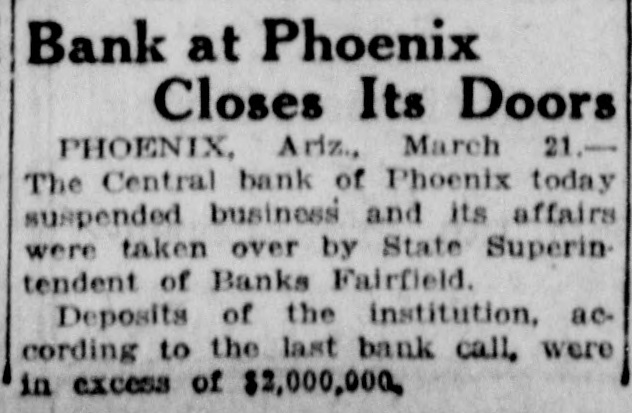
Bank at Phoenix Closes Its Doors PHOENIX, Ariz, March 21.The Central bank of Phoenix today suspended business and its affairs were taken over by State Superintendent of Banks Fairfield. Deposits of the institution, according to the last bank call. were in excess of $2,000,000.


Article from Grand Forks Herald, March 21, 1921

Click image to open full size in new tab

Article Text

BANK QUITS

Phoenix, Ariz., March 21.-When patrons went to the Central Bank of Phoenix this morning they found a sign on the door saying the bank had voluntarily suspended business and would go into the charge of the state auditor.


Article from Imperial Valley Press, March 21, 1921

Click image to open full size in new tab

Article Text

PHOENIX BANK SUSPENDS PHOENIX, Ariz., March 21.-When patrons went to the Central Bank of Phoenix this morning they found a sign on the door stating that the bank had voluntarily suspended business and would go into the charge of the state auditor.


Article from New-York Tribune, March 22, 1921

Click image to open full size in new tab

Article Text

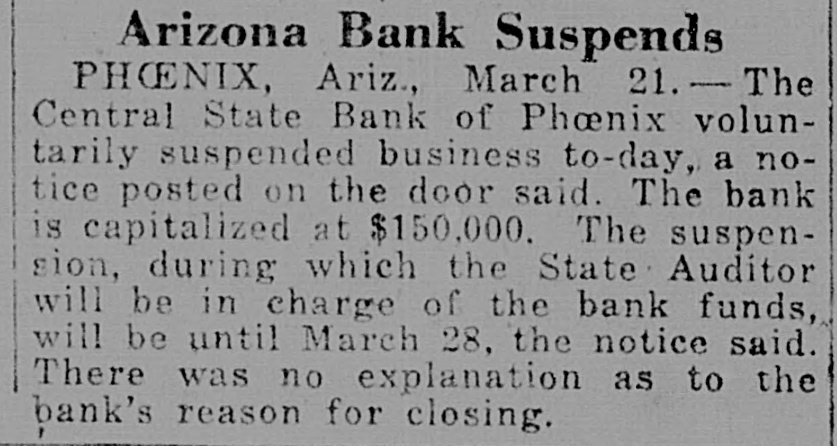
Arizona Bank Suspends PHOENIX, Ariz., March 21. - The Central State Bank of Phonix voluntarily suspended business to-day, a notice posted on the door said. The bank is capitalized at $150,000. The suspension, during which the State Auditor will be in charge of the bank funds, will be until March 28, the notice said. There was no explanation as to the bank's reason for closing. ,


Article from The New York Herald, March 22, 1921

Click image to open full size in new tab

Article Text

ARIZONA BANK SUSPENDS

PHOENIX, Ariz., March 21.-The Central State Bank of Phoenix voluntarily suspended business to-day until March 28. The bank is capitalized at $150,000. The State auditor will be in charge of the bank funds. There was no explanation as to the bank's reason for closing.


Article from Evening Star, March 22, 1921

Click image to open full size in new tab

Article Text

The Central State Bank of Phoenix. Ariz., has voluntarily suspended business until March 28. The bank is capitalized at $150.000.


Article from Bisbee Daily Review, March 25, 1921

Click image to open full size in new tab

Article Text

OMNIBUS BILL NOT WORTH A CENT,
SENATOR SIMS THINKS, BELIEVING
GOVERNOR, IN EFFECT, VETOED IT

That the net result of the passage of the omnibus bill, and its signature by the governor with the veto of paragraphs which eliminate appropriations totalling 320,000 will be about the same as if the bill had never been introduced, was the declaration of State senator W. P. Sims in an address yesterday noon before the Warren District Luncheon Club. Sims spoke on the subject of "State Finances."

"I am not a pessimist," said Sims, in part, "But I fully realize the financial condition of this state. Our troubles has been due probably to three things: First, the 60 cent tax rate of 1919 was cut to 47 cents in 1920; second, a delinquency of 30 percent throughout the state in the collection of taxes; third, unwillingness of banks to handle registered state warrants bearing only 5 per cent when they can get easily 8 or 10 per cent for their money. I am sorry that I could not impress upon the state senate the importance of the situation but a state legislature believes that all it has to do is to make appropriations and the money will be forthcoming from somewhere.

Mining Companies Punished "Cochise county and mining counties in general often are punished because they are able to pay their taxes. In 1920, 62 percent of the taxes were paid by mining companies and railroads, and 30 percent were delinquent, which left only 8 percent that were paid by other classes of property.

"What is the answer? The state has to run. Cut expenses? That is the last thing a state legislature ever does. The governor, the treasurer and the state auditor are, together, the loan board of the state. They called on banks for assistance, but the banks are not interested, even though state paper were at 8 percent insteead of 5. The situation was that one bank, the Central Bank of Phoenix, had about $500,000 of state finances on inactive deposit, and the other banks could not be interested because they were not carrying any large amounts of state money. The Central bank has since failed, but the state money is secured by surety bonds, and the state will not lose.

"Senator Woodward of Gila county introduced a bill to limit the amount of state funds deposited in any one bank, basing the amount on the combined surplus and capital stock of the bank. When the bill came to the senate for the second reading he asked the privilege of withdrawing it, declaring that he feared its passage would close several banks which had state money on deposit. Subsequent events have shown the wisdom of not passing the bill.

Bond House Offers Solution "A bond-house offered a solution in what are termed 'anticipatory' bonds. This means, in effect, putting a mortgage on future revenue to take care of immediate needs. The state is now behind in tax collections about $1,200,000. Also when we went to the semi-annual payment of taxes we fell behind six months, that is, the state gets the revenue six months after it is due. When this bond issue is sold it will turn over about one or one and a half millions to be used to pay outstanding warrants. The present situation is that of mortgaging six
Article from Tombstone Epitaph, April 3, 1921

Click image to open full size in new tab

Article Text

PHOENIX BANK TO REOPEN PHOENIX

March 29.-Announce ment was made here tonight by officers and depositors of the Citizens State Bank of Phoenix. which voluntarily suspended operations a week ago, that the institution will reopen its doors for business the latter part of this week or the first of next. This action was decided upon at a meeting of more than 600 of the depositors this afternoon. at which a plan of operation was agreed upon. A move has also been started by officers and depositors of the Central Bank of Phoenix, which voluntarily suspended March 2. to reopen that institution within the next few days, it developed at a meeting of the depositors tonight.


Article from Arizona Republican, April 29, 1921

Click image to open full size in new tab

Article Text

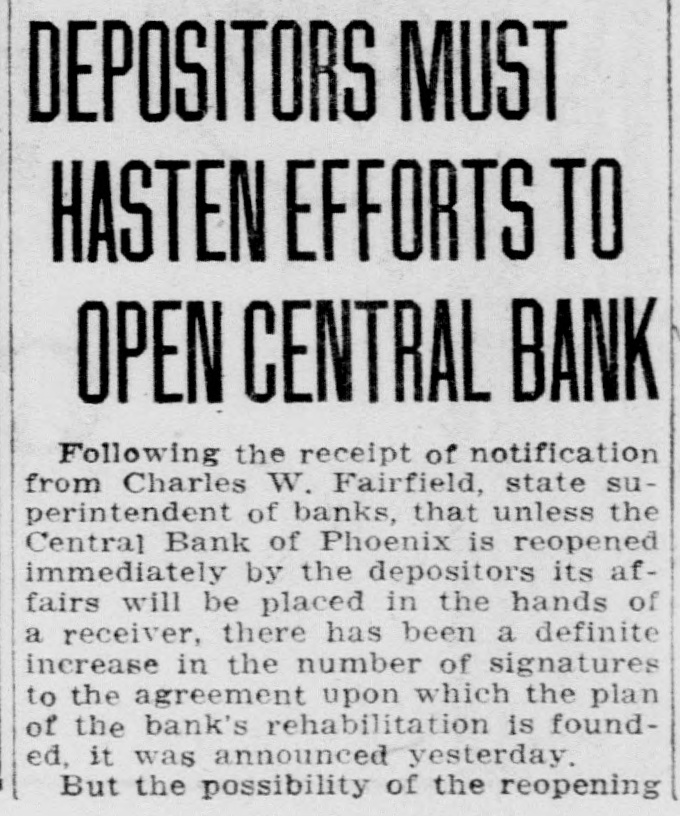
DEPOSITORS MUST HASTEN EFFORTS TO OPEN CENTRAL BANK Following the receipt of notification from Charles W. Fairfield, state superintendent of banks, that unless the Central Bank of Phoenix is reopened immediately by the depositors its affairs will be placed in the hands of a receiver, there has been a definite increase in the number of signatures to the agreement upon which the plan of the bank's rehabilitation is founded, it was announced yesterday. But the possibility of the reopening


Article from Bisbee Daily Review, May 25, 1921

Click image to open full size in new tab

Article Text

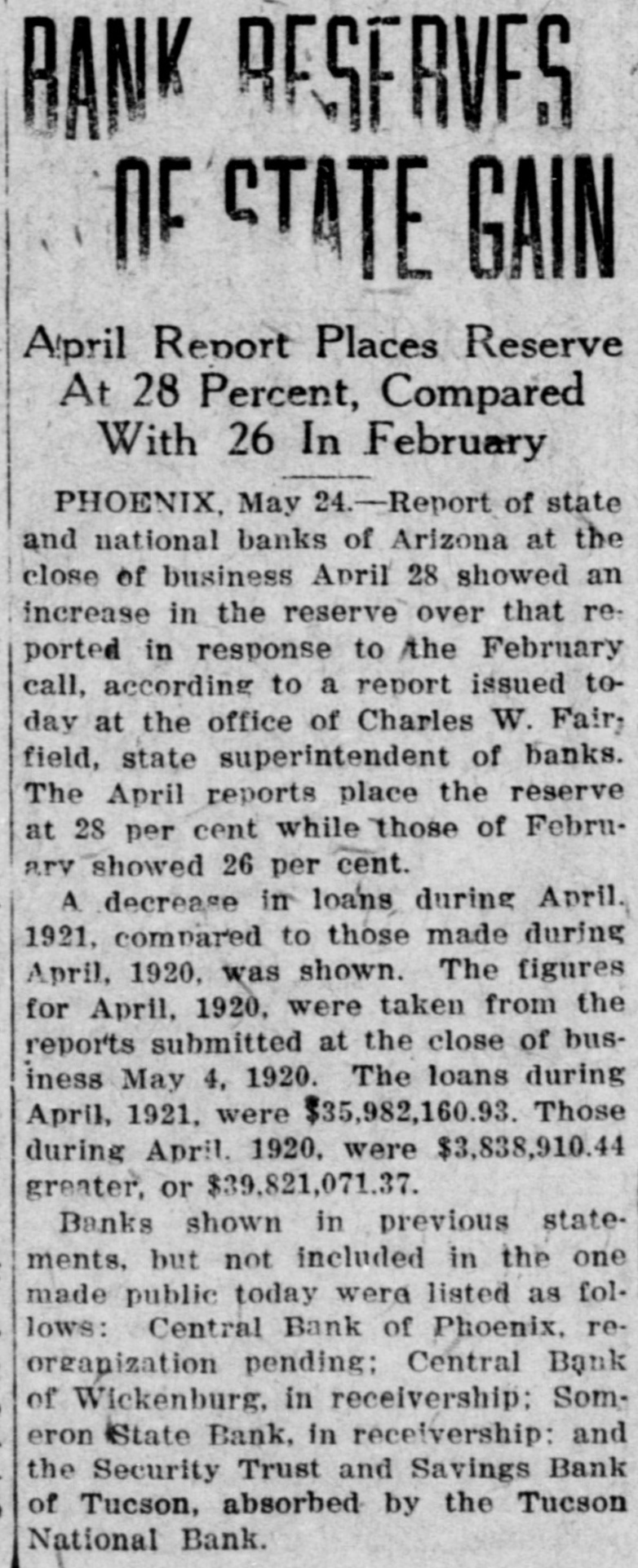
BANK RESERVES OF STATE GAIN A!pril Report Places Reserve At 28 Percent, Compared With 26 In February PHOENIX, May 24.-Report of state and national banks of Arizona at the close of business April 28 showed an increase in the reserve over that re: ported in response to /the February call, according to a report issued today at the office of Charles W. Fair, field, state superintendent of banks. The April reports place the reserve at 28 per cent while those of Februarv showed 26 per cent. A decrease in loans during April. 1921, compared to those made during April, 1920, was shown. The figures for April, 1920, were taken from the reports submitted at the close of business May 4, 1920. The loans during April, 1921, were $35,982,160.93. Those during April. 1920, were $3,838,910.44 greater, or $39,821,071.37. Banks shown in previous statements, but not included in the one made public today were listed as follows: Central Bank of Phoenix, reorganization pending: Central Bank of Wickenburg, in receivership; Someron State Bank, in receivership: and the Security Trust and Savings Bank of Tucson, absorbed by the Tucson National Bank.


Article from Arizona Republican, May 25, 1921

Click image to open full size in new tab

Article Text

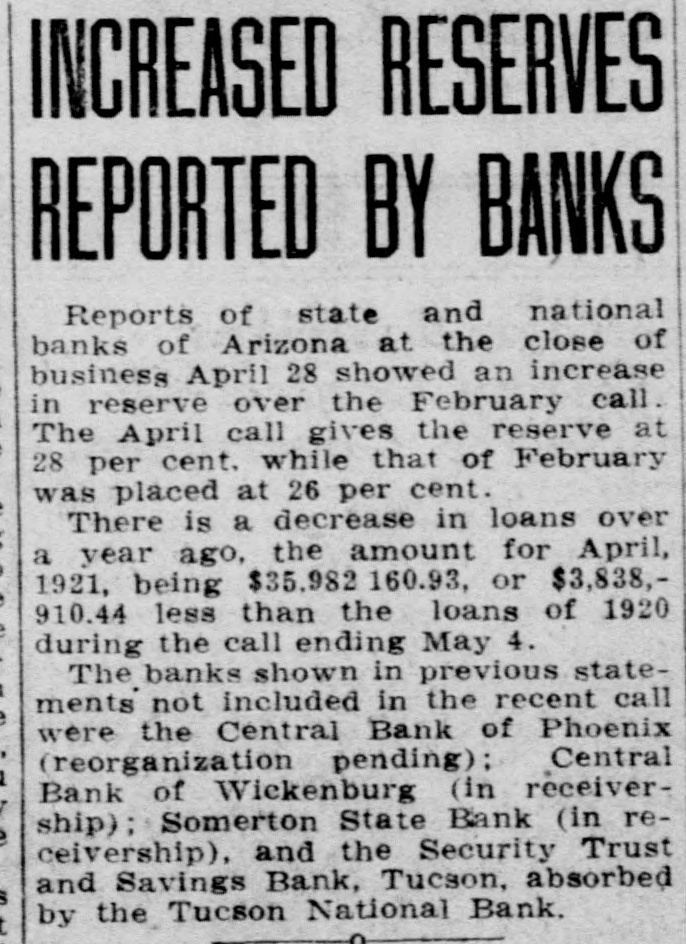
INCREASED RESERVES REPORTED BY BANKS Reports of state and national banks of Arizona at the close of business April 28 showed an increase in reserve over the February call. The April call gives the reserve at 28 per cent. while that of February was placed at 26 per cent. There is a decrease in loans over a year ago, the amount for April, 1921, being $35.982 160.93, or $3,838,910.44 less than the loans of 1920 during the call ending May 4. The banks shown in previous statements not included in the recent call were the Central Bank of Phoenix (reorganization pending): Central Bank of Wickenburg (in receivership) : Somerton State Bank (in receivership), and the Security Trust and Savings Bank, Tucson, absorbed by the Tucson National Bank.


Article from Bisbee Daily Review, June 1, 1921

Click image to open full size in new tab

Article Text

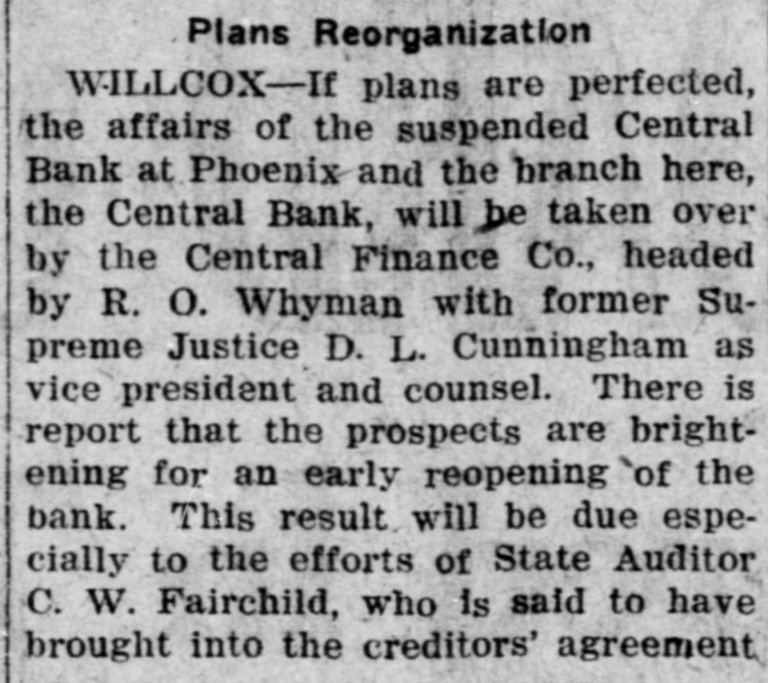
Plans Reorganization WILLCOX-If plans are perfected, the affairs of the suspended Central Bank at Phoenix and the branch here, the Central Bank, will be taken over by the Central Finance Co., headed by R. O. Whyman with former Supreme Justice D. L. Cunningham as vice president and counsel. There is report that the prospects are brightening for an early reopening of the bank. This result will be due especially to the efforts of State Auditor C. W. Fairchild, who is said to have brought into the creditors' agreement,


Article from Bisbee Daily Review, June 26, 1921

Click image to open full size in new tab

Article Text

BANK TO RE-OPEN PHOENIX, June 25. - Charles W. Fairfield, state superintendent of banks, today announced that the Central Bank of Phoenix, which suspended business more than three months ago, would be reopened on July 1.


Article from Tombstone Epitaph, July 3, 1921

Click image to open full size in new tab

Article Text

TO REOPEN CENTRAL BANK PHOENIX

June 27.-Charles W. Fairfield. state superintendent of banks, today announced that the Central. Bank of Phoenix, which suspended business more than three months ago. would be reopened on July 1.


Article from The Coconino Sun, July 8, 1921

Click image to open full size in new tab

Article Text

CENTRAL BANK OPENS AGAIN AT PHOENIX Phoenix joined in the general rejoicing when victory in the long, hard struggle to reopen the Central Bank of Phoenix, finally was written at 10 o'clock Friday morning as Charles W. Fairfield, state auditor, turned a key and threw open the doors of "The Bank of Phoenix," the name by which the institution will be known in the future, as attested by newly painted signs in the front windows. "This is one of the most pleasant days of my life," declared Mr. Fairfield, as he unlocked the double doors to admit a crowd of eager depositors and well-wishers of the bank, just three months and nine days after he had locked the same doors and business was suspended.


Article from Arizona Republican, May 14, 1922

Click image to open full size in new tab

Article Text

about all this by private inquiry, but SO far has been unsuccessful and he has invoked the aid of the court. But the receiver has this suspicion: that the notes were turned over to the state treasurer by the Central Finance corporation and that the latter as to the notes claims to have held them as security for indemnity bonds made by the Central Finance corporation signed as a surety thereon and which bonds were intended to to be used as security for deposits by the state treasurer in the Central Bank of Phoenix. But it is stated that these indemnity bonds were never accepted by the proper officers of the state and as to which the Central Finance corporation at no time became liable. It could, therefore, never have had a right to the control or possession of these notes as collateral of the bank.


Article from The Williams News, October 20, 1922

Click image to open full size in new tab

Article Text

"Any such bank desiring to avail itself of the benefits of the provisions of the next preceding section, shall make, execute and deliver a bond with good and sufficient securities of the in a penalty state of Arizona which shall not be less than the amount which the said bank shall be entitled to receive on deposit." And Paragraph 4645 still further provides: "The bond required by this title SHALL BE APPROVED BY THE GOVERNOR, THE TREASURER AND THE AUDITOR OF THE No treasurer shall deSTATE posit an amount of public money in any designated bank in excess of the bond given by said bank." If any bond was given by the Central Bank of Phoenix to the state to indemnify it against lose, that bond necessarially under the law had to be approved by the governor, the treasurer and the auditor. If no bond was given by the Central Bank, and if-as the Sun would have us believe-the money was deposited by the treasurer in that bank over the protest of the governor, why has not Governor Campbell, as is required by law, proceeded to collect this money from the treasurer and his bondsmen? If a bond was given, that bond as has been stated had to be approved by the governor, the treasurer and the auditor; and if the bond was not so approved, the deposit was illegally made by the treasurer and he and his bondsmen are legally responsible for the money. What effort, if any, has been made by the governor to recover this money? By the way: After that expert banker and accountant, "Uncle Andy" Baumert, republican national S committeeman, had been appointed receiver of the defunct bank by the S state bank examiner-who himself S had been appointed by the governa or-we would like to know if there S were any unsecured personal notes or accounts of any state official found among the alleged assets of the Cend tral Bank.


Article from The Holbrook News, November 24, 1922

Click image to open full size in new tab

Article Text

Southwest News From All Over New Mexico and Arizona in F. E. Perry died at a hospital rePrescott as a result of injuries ceived when he fell from a Santa Fรฉ electric repair car twelve miles north of Prescott and was run over by the car. Ramon Apocada of Albuquerque was held up by two highwaymen as he was returning to his home, and when the thugs found he had no money one of them beat him over the head with his gun, inflicting a bad scalp wound. The coroner's jury inquiring into the death of Owen S. Barnett at Bisbee brought in a verdict that the deceased came to his death from a gunshot wound under the left eye from a pistol held in the hands of Walter L. Bailey. William A. Denny, former employรฉ of the Rio Grande Oil Company at Globe, Ariz., was arrested in Long Beach on telegraphic instructions from Globe. A complaint has been filed against him at Globe charging embezzlement of $1,295.48 of company funds. Mrs. E. D. Nelson is believed to be dying at a road camp near Las Vegas as a result of a bullet wound, self-inflicted, officers said, after she made an unsuccessful attempt to assassinate her husband by firing a shot into a tent where he and several other men were spending the night. The bullet went wild. There are three known dead in the fire which destroyed a large warehouse on the Chambon estate at Socorro. Mrs. Jose Crespin, wife of Jose Crespin, who perished together with his son, Cornelio, is in a hospital here critically ill. She had been ill, but the news of the death of her husband and son has caused a relapse and doctors fear she will not live. At Tueson the experiment station has just published a "Timely Hint on Early Baart Wheat." This will be sent to all wheat growers in Arizona who are interested. This circular gives a short history of the introduction and distribution of Early Baart wheat in Arizona by the experiment station and of its displacing the common Sonora wheat. Early Baart wheat is the most valuable grain crop grown in Arizona now. Contrary to the opinion that most of the cattle in the southern part of New Mexico have been shipped out, it is said that there are still many for sale, most of them being in prime condition. Many announcements or cattle shipments from the southern counties have been made but the fact is that only a little over 11,000 head have been shipped to other pastures, and this is only a small part of the total which are on the ranges. Word has been received in Wagon Mound, N. M., to the effect that the Santa Fรฉ railroad will erect large stockyards at Levy during the coming year for the benefit of the local cattle and sheep men. The matter has been approved by the Corporation Commis sion and an appropriation will be made by the Santa Fรฉ for this purpose dur ing the winter. It is thought that the yards will be ready for the spring shipping. Judge R. S. Stanford of the Superior Court at Phoenix has set Dec. 11 as the date for the trial of C. N. Stafford, president, and E. Stafford, vice president, of the old Central Bank of Phoenix, indicted by a Maricopa county grand jury recently on charges growing out of the failure of the institution. Judge Stanford set Dec. 8 as the date for the trial of Phil Lewis, former president of the same bank, also indicted in connection with the same series of transactions. The auto dealers and merchants of Las Vegas are planning for the big auto and style show the last of March, 1923, the dates having been set for the 29th, 30th and 31st. The big show will be held at the armory and all the latest models in automobiles will be shown at this time. Good music will be provided for the three days and a big dance will be given each night. This is now an annual affair in the city and is said to be one of the best displays of its kind in the state, According to the reports of the Cotton Growers' Association, most of the cotton grown in the Pecos valley in New Mexico this year will run over $100 to the acre. A large part of the crop has been picked and stacked in the fields and the price has been gradually going up for some time until now the growers are getting the top netch figure for the product. The big gin which was partly destroyed by fire some time ago is running again and there is every indication that the season will be a busy one. The gin at Hagerman is running full time and is turning out about twenty bales per day. Three of the big mining companies in Arizona have refused to pay the taxes levied against them on the ground that the taxes were based on valuations in excess of the full cash value. These companies are the United Verde Extension and the United Verde, both of Jerome, and the United Eastern of Mohave county. This failure to pay the taxes was not on account of inability of the companies to pay, but the claim was made that the mining properties had been assessed for a greater sum than their full cash value.


Article from Arizona State Miner, October 6, 1923

Click image to open full size in new tab

Article Text

Sheriff's Notice of Sale on Execution and Order of Sale No. 17583.

In the Superior Court of Maricopa County, State of Arizona.

Frank R. Stewart, Plaintiff, vs. Minnie B. Swartz, J. A, Towler, Central Bank of Phoenix, a corporation, Perry M. Williams, Receiver of the Central Bank of Phoenix, Defendants. No. 17583


Article from Arizona State Miner, October 13, 1923

Click image to open full size in new tab

Article Text

Under and by virtue of an execution and order of sale issued out of the Superior Court of Maricopa County, State of Arizona, and to me as Sheriff, duly directed and delivered in an action wherein Frank R. Stewart, was Plaintiff, and Minnie B. Swartz, J. A. Towler, Central Bank of Phoenix, a corporation, Perry M. Williams, Receiver of Central Bank of Phoenix, Defendants.

Whereas, on the 17th day of September, 1923, Frank R. Stewart recovered a judgment in the Superior Court of Maricopa County, State of Arizona, against Minnie B. Swartz for the sum of one thousand one hundred and twenty and 21% 100 ($1,120.21), with interest thereon at the rate of ten per cent per annum from Sept. 17, 1923,


Article from Arizona State Miner, October 13, 1923

Click image to open full size in new tab

Article Text

Frank R

Stewart, Plaintiff, vs. Minnie B. Swartz, J.A, Towler, Central Bank of I Phoenix, a corporation, Perry M. Williams, Receiver of the Central Bank of Phoenix, Defendants.


Article from Arizona State Miner, November 1, 1924

Click image to open full size in new tab

Article Text

other towns of Arizona

Lewis is a fugitiv from justice aided by a nonprosecuting attorney's office, under a Campbell administration. Cox finds a co-operative support among Republicans as well as democrats. Republican newspapers also are giving him highly complimentary notices all over the state. Cox's opponent on the Republican ticket, Geo. W. Mickel, was a director of the P. K. Lewis institution and in the, psuedo reorganization and reopening of the Central Bank under a new title of the Bank of Phoenix was prominent as a director therein. It is now asserted that with consummate Republican gall he is still debtor to the depositors of the reorganized Bank of Phoenix for his note in the amount of $700, which is still unpaid-as a relic to the camouflaged depositors-even while running for the state senate. Can you beat it?


Article from The Coconino Sun, December 11, 1925

Click image to open full size in new tab

Article Text

NAME BAUMERT DEPUTY TO U

S. REVENUE CHIEF Andrew Baumert Jr. of Phoenix has been appointed deputy collector of internal revenue for Arizona, according to an unofficial announcement made Saturday. Mr. Baumert will assume his new position on December 20, it was stated. He will succeed C. C. Lewis, present deputy collector of internal revenue. The appointment of Mrs. Shepard Hiscox of Phoenix as secretary to the collector of internal revenue and assistant cashier was unofficially announced. Mrs. Hiscox succeeds Mrs. Nina E. Duncan, who has acted as secretary to Frank R. Stewart, former collector of internal revenue. No other immediate change in the personnel of the office of the collector in Phoenix is contemplated, it was stated. Mr. Baumert the new deputy collector of internal revenue has been identified with the republican politics in Arizona for a number of years. Mr. Baumert served as secretary to the board of directors of state instituttions during a portion of the two terms served by former Governor Campbell. He also served as receiver of the defunct Central bank of Phoenix for more than two years,


Article from Douglas Daily Dispatch, September 21, 1927

Click image to open full size in new tab

Article Text

BANK STOCKHOLDERS HELD PHOENIX, Ariz., Sept. 20 (AP) Judgments holding them liable for double the amount of stock they owned in the defunct Central Bank of Phoenix, later called the Bank of Phoenix, were affirmed against 18 stockholders of the institution. in an opinion handed down Monday by the supreme court in a suit brought by Perry Williams, receiver of the bank, against J. S. Conden and 17 other stockholders.