Article Text
Suspended. KANSAS CITY, July 17.-The Bank of Grand Avenue and the Missouri National bank suspended payment at noon today.
54897591f94f4013None
Click image to open full size in new tab
Suspended. KANSAS CITY, July 17.-The Bank of Grand Avenue and the Missouri National bank suspended payment at noon today.

Click image to open full size in new tab
TELEGRAPHIC BREVITIES. Thos. Walsh, president of the University of Notra Dame, South Bend, Ind., died there to-day. The President left Gray Gables today for a cruise. It is possible he may be bound for New York. Fannie Post, an attractive young lady of Schuyler, Neb., is thought to be held a prisoner by tramps on an island in the Platte river. Two persons were killed and four seriously injured last night by the premature explosion of a fireworks bomb at an Italian picnic near Chicago. Frank Beebe, a son of J. Arthur Beebe, member of the Boston family of millionaires, was drowned in Buzzards Bay last night by the capsizing of his boat. A disease over which the doctors are in dispute, has raged with considerable violence in Anaconda, Mont., for the last ten weeks. It is alternately called black measels and black smallpox. Admiral Wadenkolk is a prisoner and is now on his way to Rio Janeiro under a heavy guard. He has been declared to be a traitor and will no doubt be executed without much ceremony. Anna Witkower, who was until last Sunday a chambermaid at the Palmer House in Chicago, is baroness Sohlbern, wife of of a millionaire Austrian nobleman. The couple were married on Saturday. A posse has been searching since Saturday night in and around Brierfield, Ala., for a negro who, it is reported, shot and killed two women. The belief is general that the negro was last night captured and lynched. William Baxter, of Holden, Mass., was found murdered in a cow pasture yesterday afternoon. The skull was fractured in two places. A hatchet was found near the body and a long handled axe was at the side of the dead man. Goveronor Altgeld, of Illinois, is preparing, according to a statement made by a friend, an exhaustive review of the anarchist case which will be a genuine "roast" for those who secured their conviction. He will reaffirm that the men were bribed by a prejudiced judge and by a jury selected to convict. John Meyers escaped from the State hospital for the insane in Utica, N. Y., this morning and proceeding to his wife's home, murderously assaulted her with a club. Her screams attracted the attention of a neighbor who bravely tackled Meyers and the wife escaped. Meyers then rushed back into the house and cut his throat with 8 razor. It is not believed that the injuries of either will prove fatal. A young girl who was employed as a domestic at a boarding house and George B. Frame, a border at the same place, were struck by a train on the Rome, Watertown and Ogdensburg railroad while they were attempting to cross a railroad bridge on the outskirts of Watertown, N. Y., last night. The girl's body was mangled horriby and the man's skull was crushed. Both died immediately. The five-mile road race of the Calumet Cycling Club at Chicago Saturday afternoon resulted in breaking the American road record for the distance. A. L. Leonhardt did the trick in 13:30, beating the former record by eight seconds. The People's Savings, the Rocky Mountain Dime and Dollar and the Colorado Savings Banks at Denver, failed to open their doors for business this morning. The Bank of Grand Avenue and the Missouri National Bank at Kansas City suspended -day. The Duplex Company of New York assigned to-day.
Click image to open full size in new tab
Telegraphic Brevities. The Bank of Grand Avenue and the Missouri National Bank. Kansas City, suspended payment at noon yesterday. The Comptroller of the Currency has been informed that the First National Bank of Cedartown, Ga., closed its doors yesterday. Mrs. T. H. Stevens, wife of Rear-Admiral Stevens, retired. died yesterday near Silver Spring, Md., where she had gone for the summer. The Federal Treasury Department yesterday purchased 50,000 ounces of silver at .7340a7345. The total purchases for the month are 948,000 ounces. The Emperor William has extended to Colonel Keim. chief of Chancellor von Caprivi's Special Bureau, special thanks for his efforts to secure the passage of the army bill. J. H. Hathaway, of Philadelphia, was yesterday awarded the contract at $13,995 for constructing a kitchen, laundry, wharf. etc. at the Cape Charles quarantine station. The court-martial appointed to try the surviving officers of the Victoria, sunk in collision with the Camperdown, was opened yesterday at Valetta, Malta, upon the Hibernia, the flag-ship of RearAdmiral Richard E. Tracey. A negro named Odem has been arrested at Boston, Ga., charged with burning the Savannah, Florida and Western trestle over the Aucilla river Saturday night. Several attempts to wreck trains have been made on this road within the past two weeks by placing cross-ties on the track, but none of them were successful. A special from Topeka, Kan., says: State-Bank Examiner Breddenthal says Hood & Cincard's bank, at Pleasanton, Kan., has failed, and is in the hands of Deputy-State-Bank-Commissioner Osborne. The capital stock IS $80,000. Commissioner Breddenthal has information of a number of other bank failures in Kansas, but be declines to give the names until he has taken possession.
Click image to open full size in new tab
Two Kansas City Banks Fail. Kansas City, Mo., July 17.-The Bank of Grand Avenue and the Missouri National bank suspended payment at noon to-day.
Click image to open full size in new tab
Kaxeas City Banks Suspond. KANSAS CITY, July 17.-The Missouri National Lank suspended at noon today. Assistance was on the way from New York, bu: did not arrive in time. Depositors will be paid. The Bank of Grand Avenue, s small private institution, has assigned.
Click image to open full size in new tab
BANK SMASH AT KANSAS CITY. The Missonri National Sends for Uncle Sam's Examiner. KANSAS CITY, July 18.-The Missouri National bank has suspended payment, closed its doors and sent for Bank Examiner Galbraith. The comptroller of the currency at Washington was immediately notified by wire. The bank's assets are $1,264,785.50 and the liabilities outside of its capital stock are $700,000. The Missouri National bank is a new bank with choice securities and people seemed to have unlimited faith in it until Saturday, when they started a run which took about $200,000 from the vaults. Yesterday the large depositors began to draw out their accounts, though there was no run and men passing the bank could see no sign of the anxiety of the bank's officers as check after check for large sums was presented for payment. There was no crowd about the bank or in the bank during the morning. The public generally supposed the bank had stood the crucial test of Saturday successfully and would therefore pull through without further trouble. But the remarkable financial distrust that has permeated every artery of trade was surely doing its work, and as soon as the bank opened in the morning the big depositors, the friends of the bank, began to withdraw. They were not numerous, but their checks called for big amounts. The Bank of Grand avenue which carried on bu. iness at 1401 Grand avenue, closed its doors at 9:40 o'clock in the morning. Assets, $200,000; liabilities, $140,000.
Click image to open full size in new tab
Two at Kansas City. KANSAS CITY, July 18.-The Missouri National and the Bank of Grand Avenue have suspended. Total assets about $1,500,000; liabilities about the same.
Click image to open full size in new tab
eastern Kansas. It had a capital stock of $300,000 fully paid in, and has always stood all runs. A run on the People's Savings Bank was started, but the thirty day law was taken advantage of, and the bank was saved from being swamped. Topeka, Kan., July 18.-State Bank Examiner Breidenthal this morning received notice of the fail. ures of the Citizens' Bank of Kansas City, Kan.; of the Bank of Richmond, and of the Farmers' and Merchants' Bank. at Ossawattomie. The concerns all did a small business. Statements are unobtainable. The opinion Is expressed that other institutions throughout the State will soon go under. Toledo, July 18.-The Citizens' Bank of Ada, the most prominent one in Hardin County, failed to open its doors this morning. Its owner, Peter Ablfield, has controlled it for over a quarter of a century, and is one of the wealthiest men of that section. No statement of assets and liabilities, or the cause of failure, can be obtained. Anacortes, Wash.. July 18.-The Bank of Anacortes failed to open its doors yesterday, owing to inability to realize on securities. The liabilities are $29,000 and the assets, $78,000. Depositors will be paid in full. Kansas City, July 18.-Although last night the bankers of Kansas City did not expect to get through to-day without trouble. none came: and the impresston prevails that to-day marked the beginning of the end of the recent financial flurry. There is evidence to-day that the people have stopped to think. It is a notable fact that no man who had money in the bank of Kansas City or the Missouri National has the slightest doubt of getting every cent of it. The banks in Kansas City which have failed are the National Bank of Kansas City. the Missouri National Bank. the Kansas City Safe Deposit and Savings Bank. and the Bank of Grand Avenue, the latter being a State bank. Armourdale, Kan July 18.-The Citizens' Bank sugpended payment to day with assets of $151.000 and liabilities of $126,500. State Bank Commissioner Breiden that took possession of the bank. Among the heavy creditors of the bank is the county of Wyandotto, which had on deposit some $40,000 of its funds.
Click image to open full size in new tab
AT KANSAS CITY. Two Banks Forced to Suspend Pay. ment-More Trouble Likely. KANSAS CITY, July 18.- - The Bank of Grand avenue and the Missouri National bank suspended payment at noon. When the Bank of Grand Avenue opened its doors for business a long line of depositors had formed on the side. walks and as soon as the paying teller appeared at the window began drawing out their money. The run kept up until nearly noon, when the bank was forced to assign to John James Ruckel. The assets are stated to be $200,000. The bank c. ared through the National Bank of Kansas City, and, it is alleged, lost considerable money in that institution. The Missouri National bank was one of those which stood a heavy run Saturday. It had a paid up capital of a quarter of a million dollars and was a new institution. It had been deemed solid. though its statement issued at the close of business July 13 showed only $221,225 as a reserve against over $900,000 deposits. D. V. Reiger was the bank's president and Henry C. Kumpf, ex-mayor, vice president. The failures will probably precipitate more trouble here.
Click image to open full size in new tab
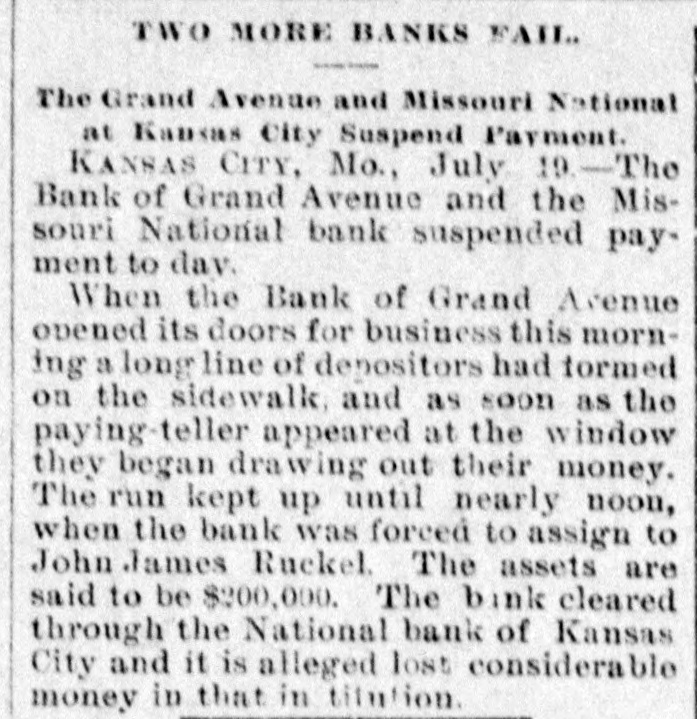
TWO MORE BANKS FAIL.. The Grand Avenue and Missouri National at Kansas City Suspend Payment. KANSAS CITY, Mo., July 19 - -The Bank of Grand Avenue and the Missouri National bank suspended payment to day. When the Bank of Grand Avenue ovened its doors for business this morning a long line of depositors had formed on the sidewalk and as soon as the paying-teller appeared at the window they began drawing out their money. The run kept up until nearly noon, when the bank was forced to assign to John James Ruckel The assets are said to be $200,000. The bink cleared through the National bank of Kansas City and it is alleged lost considerable money in that in titution.
Click image to open full size in new tab
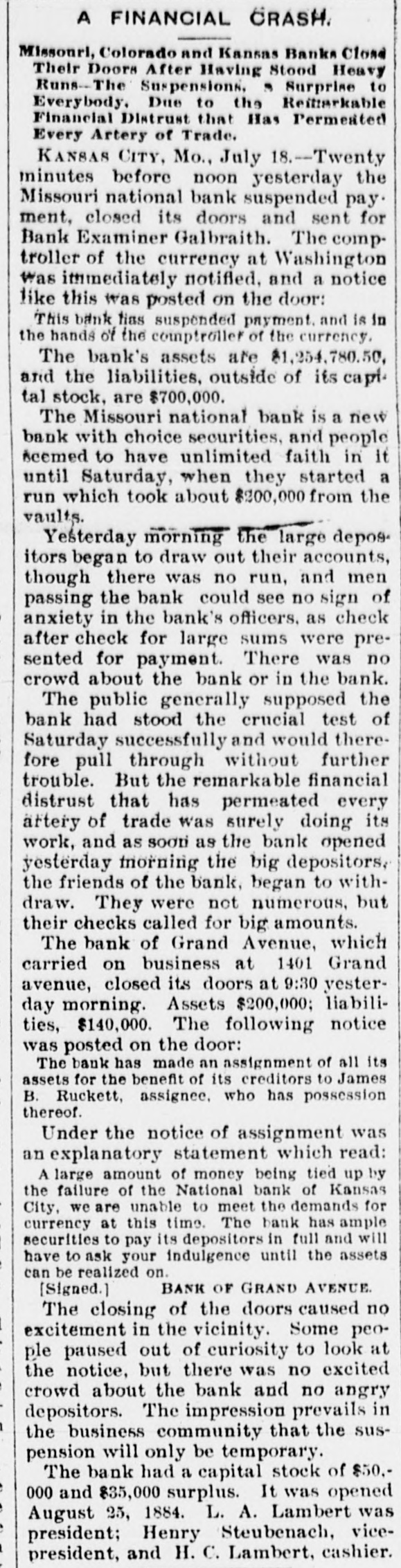
A FINANCIAL CRASH. Missouri, Colorado and Kansas Banks Close Their Doors After Having Stood Heavy Runs-The Suspensions, . Surprise to Everybody. Due to the Reitrarkable Financial Distrust that Has Permeated Every Artery of Trade. KANSAS CITY, Mo., July 18.--Twenty minutes before noon yesterday the Missouri national bank suspended pay. ment. closed its doors and sent for Bank Examiner Galbraith. The comptroller of the currency at Washington Was immediately notifled, and a notice like this was posted on the door: This bank fins suspended payment. and is in the hands of the comptroller of the currency. The bank's assets are $1,254,780.50, and the liabilities, outside of its capi. tal stock, are $700,000. The Missouri national bank is a new bank with choice securities, and people Accmed to have unlimited faith in it until Saturday, when they started a run which took about $200,000 from the vaults. Yesterday morning the large depositors began to draw out their accounts, though there was no run, and men passing the bank could see no sign of anxiety in the bank's officers. as check after check for large sums were presented for payment. There was no crowd about the bank or in the bank. The public generally supposed the bank had stood the crucial test of Saturday successfully and would therefore pull through without further trouble. But the remarkable financial distrust that has permeated every artery of trade was surely doing its work, and as soon as the bank opened yesterday morning the big depositors, the friends of the bank. began to withdraw. They were not numerous, but their checks called for big amounts. The bank of Grand Avenue, which carried on business at 1401 Grand avenue, closed its doors at 9:30 yesterday morning. Assets $200,000; liabilities, $140,000. The following notice was posted on the door: The bank has made an assignment of all its assets for the benefit of its creditors to James B. Ruckett, assignee. who has possession thereof. Under the notice of assignment was an explanatory statement which read: A large amount of money being tied up by the failure of the National bank of Kansas City, we are unable to meet the demands for currency at this time. The bank has ample securities to pay its depositors in full and will have to ask your indulgence until the assets can be realized on. BANK OF GRAND AVENUE [Signed.] The closing of the doors caused no excitement in the vicinity. Some people paused out of curiosity to look at the notice, but there was no excited crowd about the bank and no angry depositors. The impression prevails in the business community that the suspension will only be temporary. The bank had a capital stock of $50.000 and $35,000 surplus. It was opened August 25, 1884. L. A. Lambert was president; Henry Steubenach, vicepresident, and H. C. Lambert, cashier.
Click image to open full size in new tab
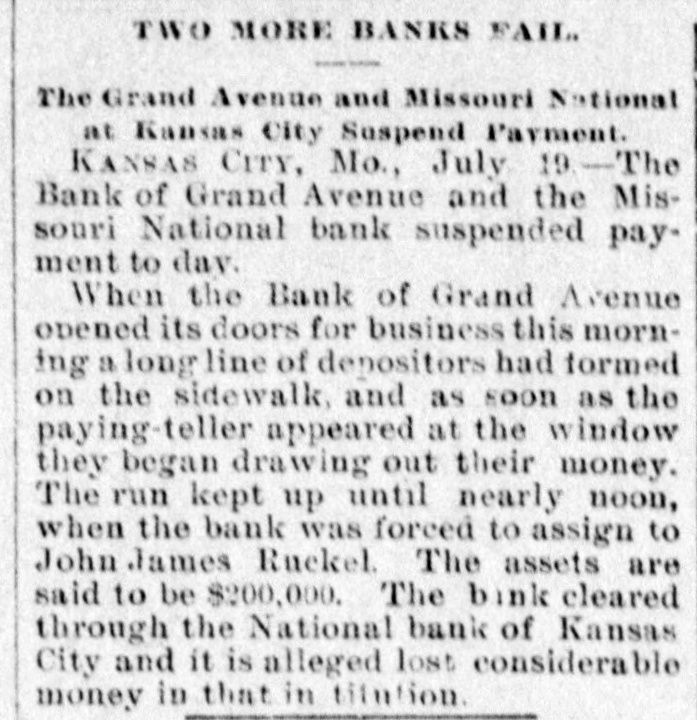
TWO MORE BANKS FAIL. The Grand Avenue and Missouri National at Kansas City Suspend Payment. KANSAS CITY, Mo., July 19 - -The Bank of Grand Avenue and the Missouri National bank suspended payment to day. When the Bank of Grand Avenue opened its doors for business this morning a long line of depositors had formed on the sidewalk and as soon as the paying-teller appeared at the window they began drawing out their money. The run kept up until nearly noon, when the bank was forced to assign to John James Ruckel The assets are said to be $200,000. The bink cleared through the National bank of Kansas City and it is alleged lost considerable money in that in titution.
Click image to open full size in new tab
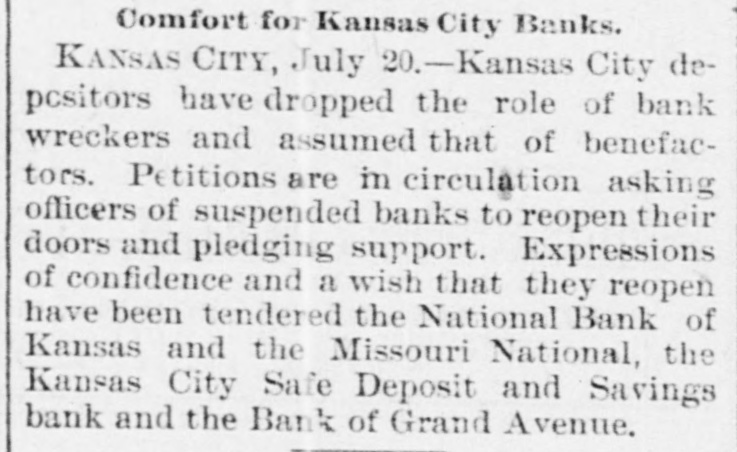
Comfort for Kansas City Banks. KANSAS CITY, July 20.-Kansas City depositors have dropped the role of bank wreckers and assumed that of benefactors. Petitions are in circulation asking officers of suspended banks to reopen their doors and pledging support. Expressions of confidence and a wish that they reopeñ have been tendered the National Bank of Kansas and the Missouri National, the Kansas City Safe Deposit and Savings bank and the Bank of Grand Avenue.
Click image to open full size in new tab
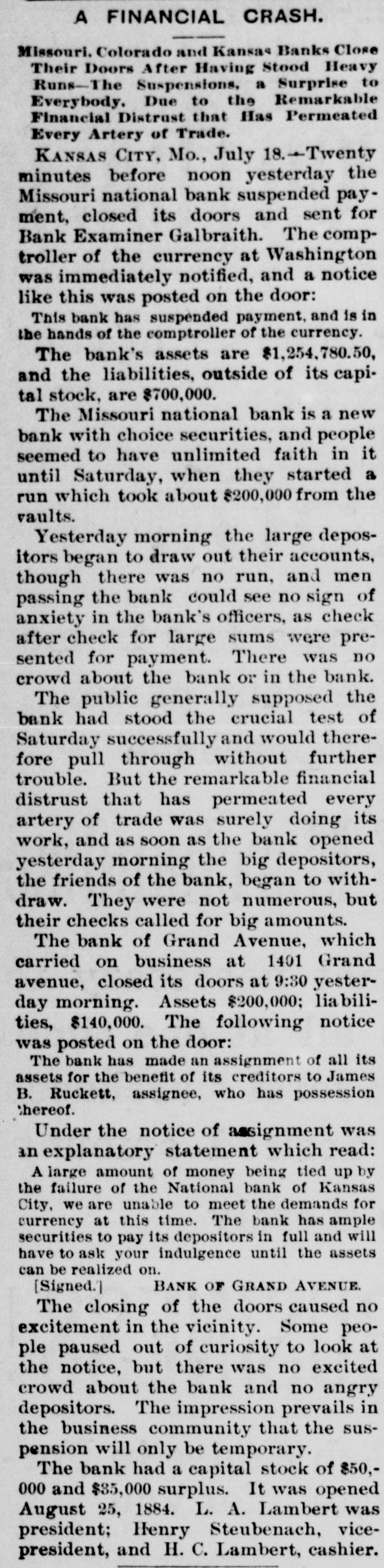
A FINANCIAL CRASH. Missouri. Colorado and Kansas Banks Close Their Doors After Having Stood Heavy Runs-The Suspensions, a Surprise to Everybody. Due to the Remarkable Financial Distrust that Has Permeated Every Artery of Trade. KANSAS CITY, Mo., July 18.-Twenty minutes before noon yesterday the Missouri national bank suspended payment, closed its doors and sent for Bank Examiner Galbraith. The comptroller of the currency at Washington was immediately notified, and a notice like this was posted on the door: This bank has suspended payment, and is in the hands of the comptroller of the currency. The bank's assets are $1,254,780.50, and the liabilities, outside of its capital stock, are $700,000. The Missouri national bank is a new bank with choice securities, and people seemed to have unlimited faith in it until Saturday, when they started a run which took about $200,000 from the vaults. Yesterday morning the large depositors began to draw out their accounts, though there was no run, and men passing the bank could see no sign of anxiety in the bank's officers, as check after check for large sums were presented for payment. There was no crowd about the bank or in the bank. The public generally supposed the bank had stood the crucial test of Saturday successfully and would therefore pull through without further trouble. But the remarkable financial distrust that has permeated every artery of trade was surely doing its work, and as soon as the bank opened yesterday morning the big depositors, the friends of the bank, began to withdraw. They were not numerous, but their checks called for big amounts. The bank of Grand Avenue, which carried on business at 1401 Grand avenue, closed its doors at 9:30 yesterday morning. Assets $200,000; liabilities, $140,000. The following notice was posted on the door: The bank has made an assignment of all its assets for the benefit of its creditors to James B. Ruckett, assignee, who has possession thereof. Under the notice of assignment was an explanatory statement which read: A large amount of money being tied up by the failure of the National bank of Kansas City, we are unable to meet the demands for currency at this time. The bank has ample securities to pay its depositors in full and will have to ask your indulgence until the assets can be realized on. BANK OF GRAND AVENUE. [Signed.] The closing of the doors caused no excitement in the vicinity. Some people paused out of curiosity to look at the notice, but there was no excited crowd about the bank and no angry depositors. The impression prevails in the business community that the suspension will only be temporary. The bank had a capital stock of $50,000 and $35,000 surplus. It was opened August 25, 1884. L. A. Lambert was president; Henry Steubenach, vicepresident, and H. C. Lambert, cashier.
Click image to open full size in new tab
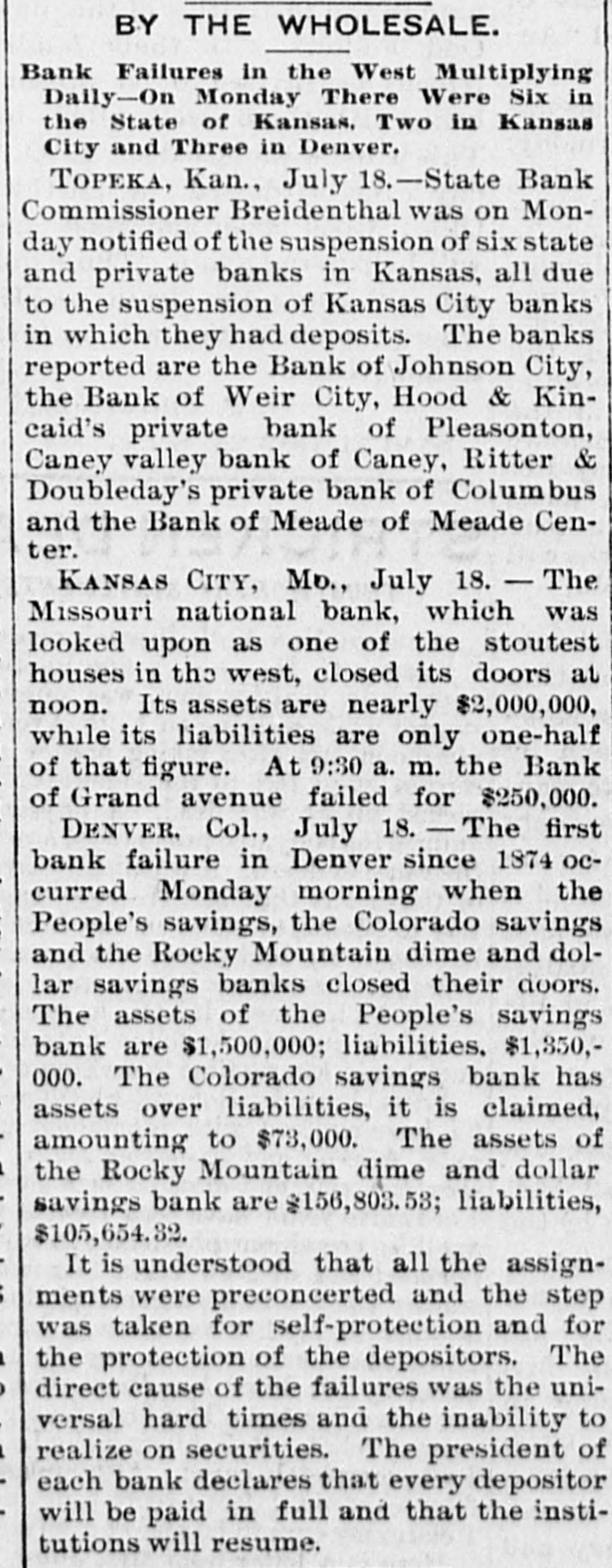
BY THE WHOLESALE. Bank Failures in the West Multiplying Daily-On Monday There Were Six in the State of Kansas, Two in Kansas City and Three in Denver. TOPEKA, Kan., July 18.-State Bank Commissioner Breidenthal was on Monday notified of the suspension of six state and private banks in Kansas, all due to the suspension of Kansas City banks in which they had deposits. The banks reported are the Bank of Johnson City, the Bank of Weir City, Hood & Kincaid's private bank of Pleasonton, Caney valley bank of Caney, Ritter & Doubleday's private bank of Columbus and the Bank of Meade of Meade Center. KANSAS CITY, Mo., July 18. - The Missouri national bank, which was looked upon as one of the stoutest houses in the west, closed its doors at noon. Its assets are nearly $2,000,000, while its liabilities are only one-half of that figure. At 9:30 a. m. the Bank of Grand avenue failed for $250,000. DENVER. Col., July 18. - The first bank failure in Denver since 1874 occurred Monday morning when the People's savings, the Colorado savings and the Rocky Mountain dime and dollar savings banks closed their doors. The assets of the People's savings bank are $1,500,000; liabilities. $1,350,000. The Colorado savings bank has assets over liabilities, it is claimed, amounting to $73,000. The assets of the Rocky Mountain dime and dollar savings bank are $156,803.53; liabilities, $105,654.32. It is understood that all the assignments were preconcerted and the step was taken for self-protection and for the protection of the depositors. The direct cause of the failures was the universal hard times and the inability to realize on securities. The president of each bank declares that every depositor will be paid in full and that the institutions will resume.
Click image to open full size in new tab
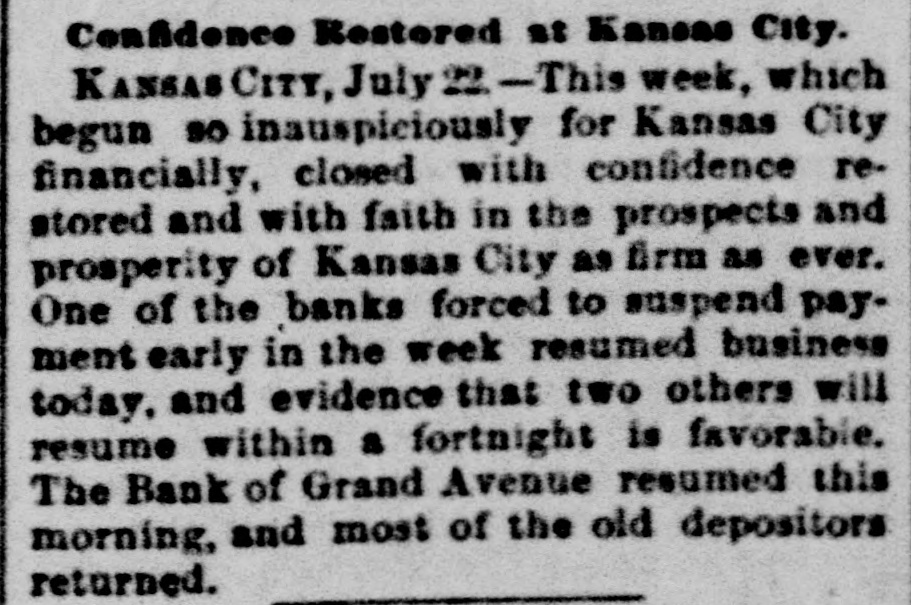
Confidence Restored at Kanone City. KANSAS CITY, July 22 -This week, which begun so inauspiciously for Kansas City financially, closed with confidence restored and with faith in the prospects and prosperity of Kansas City as firm as ever. One of the banks forced to suspend payment early in the week resumed business today. and evidence that two others will resume within a fortnight is favorable. The Bank of Grand Avenue resumed this morning, and most of the old depositors returned.
Click image to open full size in new tab
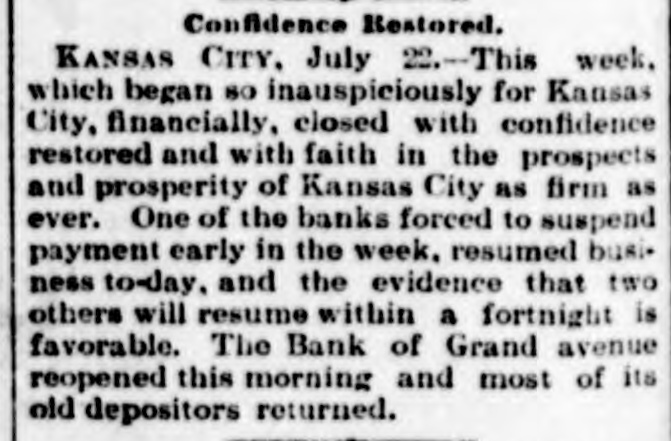
Confidence Restored. KANSAS CITY. July 22.--This week. which began so inauspiciously for Kansas City, financially, closed with confidence restored and with faith in the prospects and prosperity of Kansas City as firm as ever. One of the banks forced to suspend payment early in the week. resumed busi+ ness to-day. and the evidence that two others will resume within a fortnight is favorable. The Bank of Grand avenue reopened this morning and most of its old depositors returned.
Click image to open full size in new tab
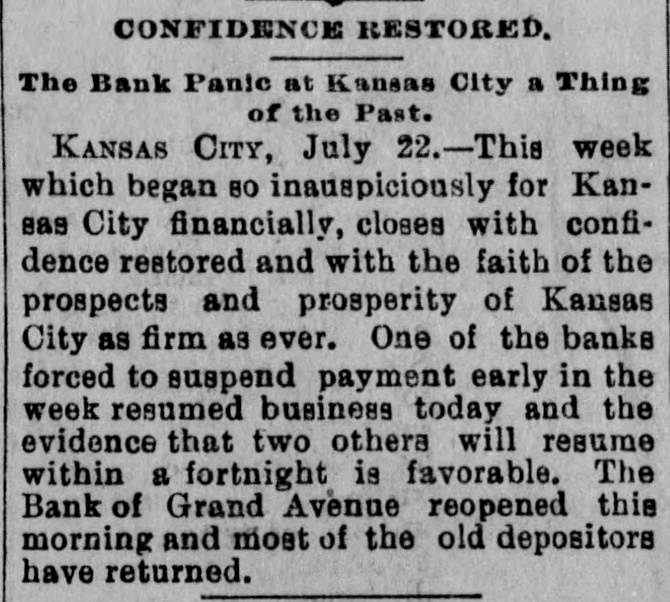
CONFIDENCE RESTORED. The Bank Panic at ansas City a Thing of the Past. KANSAS CITY, July 22.-This week which began 80 inauspiciously for Kansas City financially, closes with confidence restored and with the faith of the prospects and prosperity of Kansas City as firm as ever. One of the banks forced to suspend payment early in the week resumed business today and the evidence that two othera will resume within a fortnight is favorable. The Bank of Grand Avenue reopened this morning and most of the old depositors have returned.
Click image to open full size in new tab
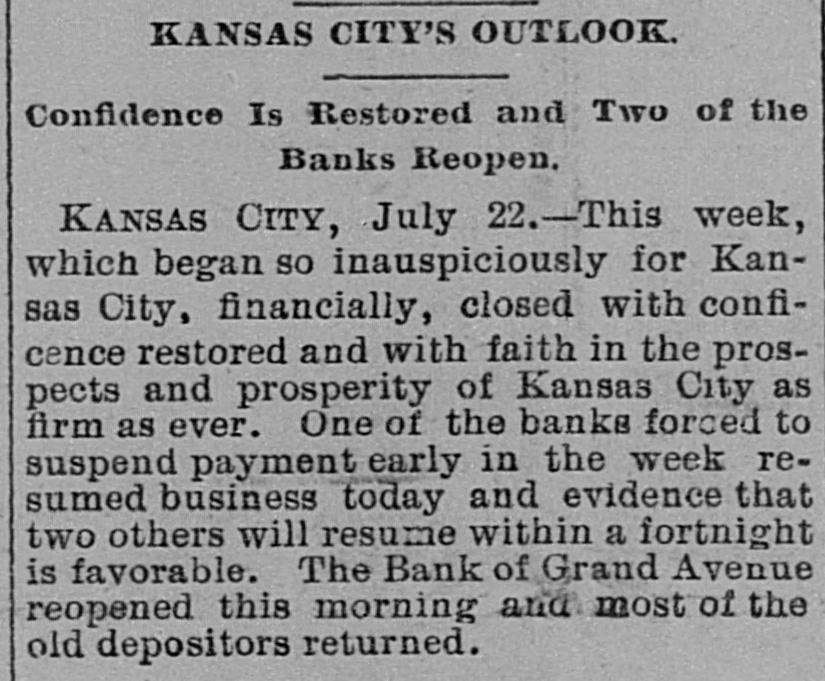
KANSAS CITY'S OUTLOOK. Confidence Is Restored and Two of the Banks Reopen. KANSAS CITY, July 22.-This week, which began so inauspiciously for Kansas City, financially, closed with conficence restored and with faith in the prospects and prosperity of Kansas City as firm as ever. One of the banks forced to suspend payment early in the week resumed business today and evidence that two others will resume within a fortnight is favorable. The Bank of Grand Avenue reopened this morning and most of the old depositors returned.
Click image to open full size in new tab
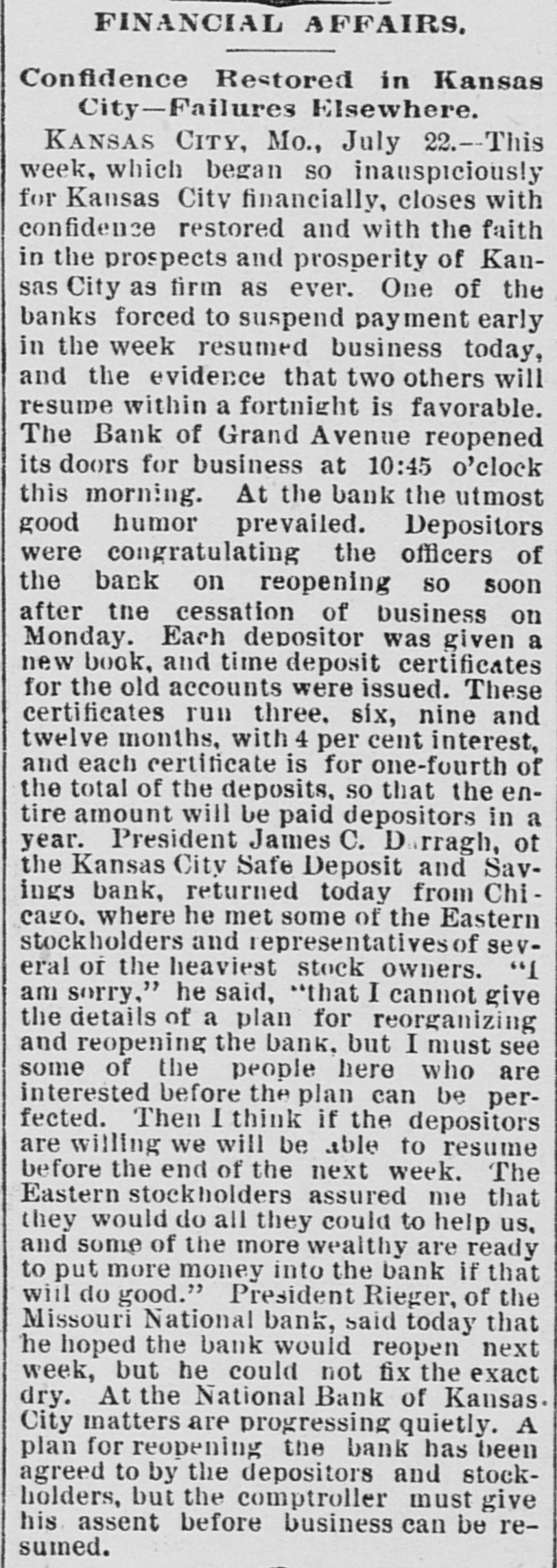
FINANCIAL AFFAIRS, Confidence Restored in Kansas City-Failures Elsewhere. KANSAS CITY, Mo., July 22.-This week, which began so inauspiciously for Kansas City financially, closes with confidence restored and with the faith in the prospects and prosperity of Kansas City as firm as ever. One of the banks forced to suspend payment early in the week resumed business today, and the evidence that two others will resume within a fortnight is favorable. The Bank of Grand Avenue reopened its doors for business at 10:45 o'clock this morning. At the bank the utmost good humor prevailed. Depositors were congratulating the officers of the bank on reopening so soon after the cessation of business on Monday. Each depositor was given a new book, and time deposit certificates for the old accounts were issued. These certificates run three. six, nine and twelve months, with 4 per cent interest, and each certificate is for one-fourth of the total of the deposits, so that the entire amount will be paid depositors in a year. President James C. Darragh, ot the Kansas City Safe Deposit and Savings bank, returned today from Chicago. where he met some of the Eastern stockholders and representativesof several of the heaviest stock owners. "I am sorry," he said, "that I cannot give the details of a plan for reorganizing and reopening the bank, but I must see some of the people here who are interested before the plan can be perfected. Then I think if the depositors are willing we will be able to resume before the end of the next week. The Eastern stockholders assured me that they would do all they could to help us, and some of the more wealthy are ready to put more money into the bank if that will do good." President Rieger, of the Missouri National bank, said today that he hoped the bank would reopen next week, but he could not fix the exact dry. At the National Bank of Kansas. City matters are progressing quietly. A plan for reopening the bank has been agreed to by the depositors and stockholders, but the comptroller must give his assent before business can be resumed.
Click image to open full size in new tab
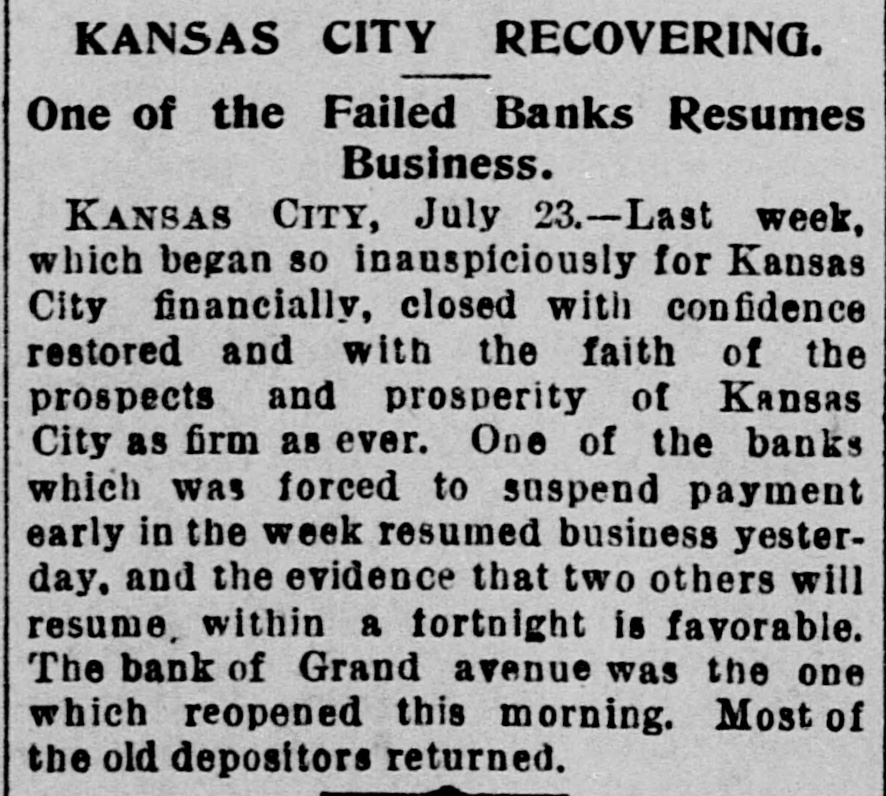
KANSAS CITY RECOVERING. One of the Failed Banks Resumes Business. KANSAS CITY, July 23.-Last week, which began 80 inauspiciously for Kansas City financially, closed with confidence restored and with the faith of the prospects and prosperity of Kansas City as firm as ever. One of the banks which was forced to suspend payment early in the week resumed business yesterday. and the evidence that two others will resume. within a fortnight is favorable. The bank of Grand avenue was the one which reopened this morning. Most of the old depositors returned.
Click image to open full size in new tab
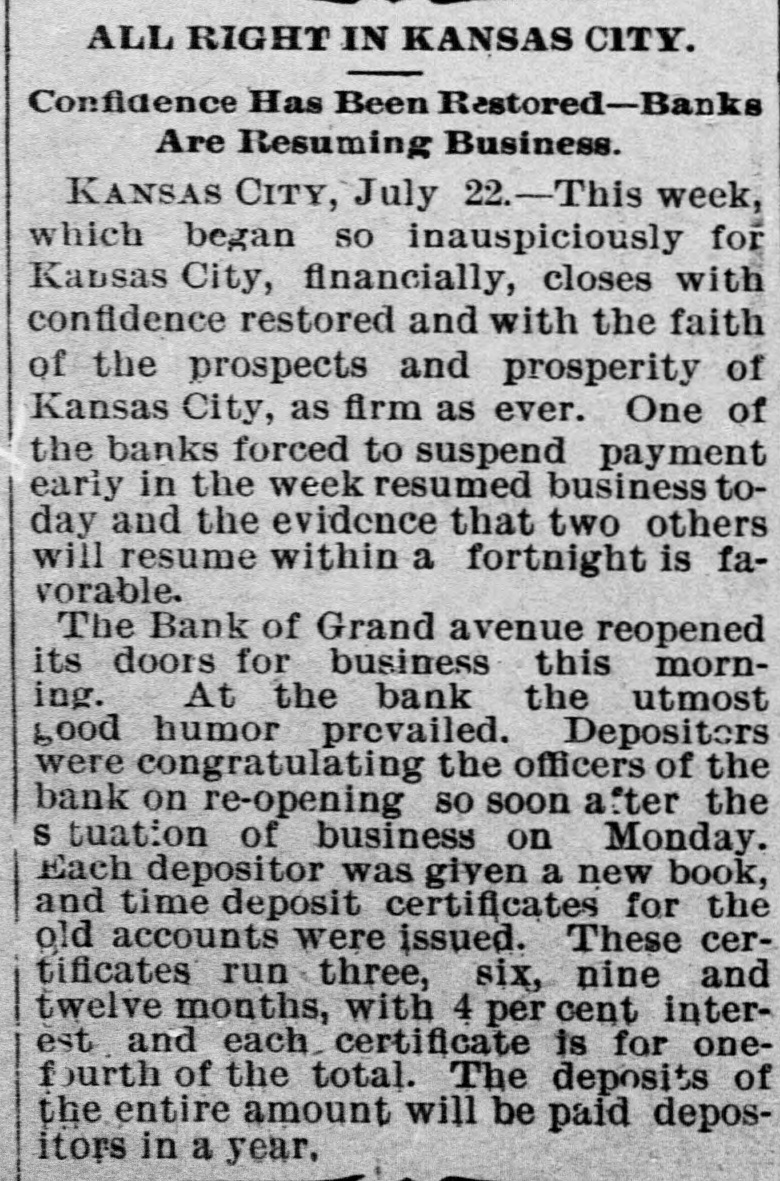
ALL RIGHT IN KANSAS CITY. Confidence Has Been Restored-Banks Are Resuming Business. KANSAS CITY, July 22.-This week, which began so inauspiciously for Kabsas City, financially, closes with confidence restored and with the faith of the prospects and prosperity of Kansas City, as firm as ever. One of the banks forced to suspend payment early in the week resumed business today and the evidence that two others will resume within a fortnight is favorable. The Bank of Grand avenue reopened its doors for business this morning. At the bank the utmost bood humor provailed. Depositers were congratulating the officers of the bank on re-opening SO soon after the S tuation of business on Monday. Each depositor was given a new book, and time deposit certificates for the old accounts were issued. These certificates run three, six, nine and twelve months, with 4 per cent interest and each certificate is for oneourth of the total. The deposits of the entire amount will be paid depositors in a year,