901. Adams & Company (San Francisco, CA)

Bank Information

Episode Type
Run โ†’ Suspension โ†’ Closure
Bank Type
private
Start Date
January 16, 1854
Location
San Francisco, California (37.780, -122.419)

Metadata

Model
gpt-5-mini
Short Digest
8152577672e01bbd

Response Measures

None

Description

Adams & Co. experienced an early, isolated run (Jan 1854) caused by a shipping/communication error, then in March 1855 was caught up in a wider panic (triggered by the failure/run on Page, Bacon & Co.), suspended payment, filed insolvency/receiver proceedings, and never resumed as a solvent bank. Receiver activity and litigation through 1855โ€“1856 indicate permanent failure/closure.

Events (4)

1. January 16, 1854 Run
Cause
Rumor Or Misinformation
Cause Details
Panic caused by the firm's name not appearing on steamer shipping list (depositors mistakenly thought they had shipped nothing).
Random Run
Yes
Random Run Snippet
Name failed to appear on steamer list; depositors supposed the firm had sent nothing
Measures
House met and continued to meet all demands; paid out shipments already sent (had shipped large sums on steamers).
Newspaper Excerpt
there was a run last evening and this morning, upon one of the leading banking houses of this city Messrs. Adams & Co ... The run was occasioned by ... the name of the firm failing to appear among the shippers by the steamers of the 16th.
Source
newspapers
2. March 17, 1855 Receivership
Newspaper Excerpt
Adams & Co. have filed a petition for insolvency... Mr. A. A. Cohen, the receiver of Adams & Co., ... Mr. Naglee, the new Receiver ... (court proceedings and receiver activities reported throughout March 1855).
Source
newspapers
3. March 23, 1855 Suspension
Cause
Local Banks
Cause Details
Run and panic in San Francisco triggered by the suspension/failure of Page, Bacon & Co. (and consequent loss of confidence), producing heavy withdrawals and Adams & Co.'s suspension.
Newspaper Excerpt
On the 22d, however, Messrs. Page, Bacon & Co., suspended payment, followed on the 23d by Messrs. Adams & Co., Wells, Fargo & Co., Robinson & Co., and Wright's Miners' Deposit.
Source
newspapers
4. March 28, 1856 Other
Newspaper Excerpt
Missing banking books of Adams & Co. were discovered washed ashore and later recovered and delivered to the receiver Mr. Naglee; ledgers considered material to ascertain assets.
Source
newspapers

Newspaper Articles (20)

Article from The Weekly Placer Herald, January 28, 1854

Click image to open full size in new tab

Article Text

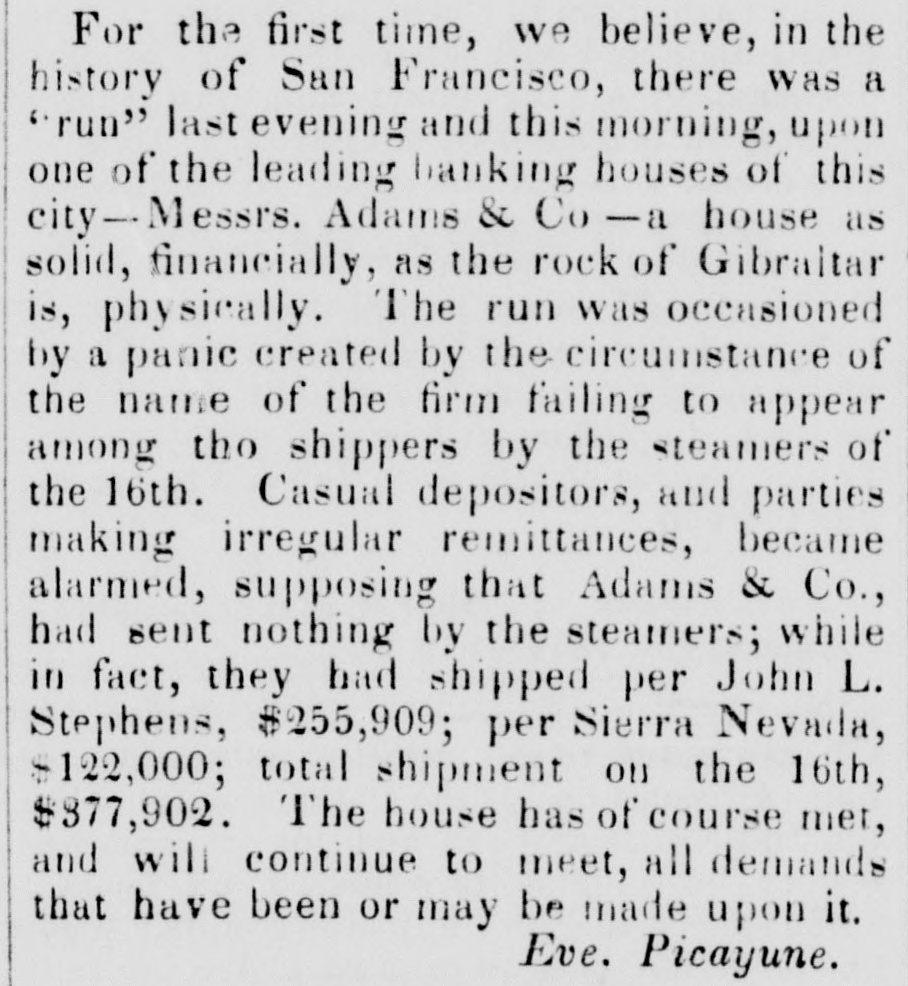
For the first time, we believe, in the history of San Francisco, there was a "run" last evening and this morning, upon one of the leading banking houses of this city Messrs. Adams & Co -a house as solid, financially, as the rock of Gibraltar is, physically. The run was occasioned by a panic created by the circumstance of the name of the firm failing to appear among tho shippers by the steamers of the 16th. Casual depositors, and parties making irregular remittances, became alarmed, supposing that Adams & Co., had sent nothing by the steamers; while in fact, they had shipped per John L. Stephens, $255,909; per Sierra Nevada, 122,000; total shipment on the 16th, $377,902. The house has of course met, and will continue to meet, all demands that have been or may be made upon it. Eve. Picayune.


Article from The Weekly Placer Herald, January 28, 1854

Click image to open full size in new tab

Article Text

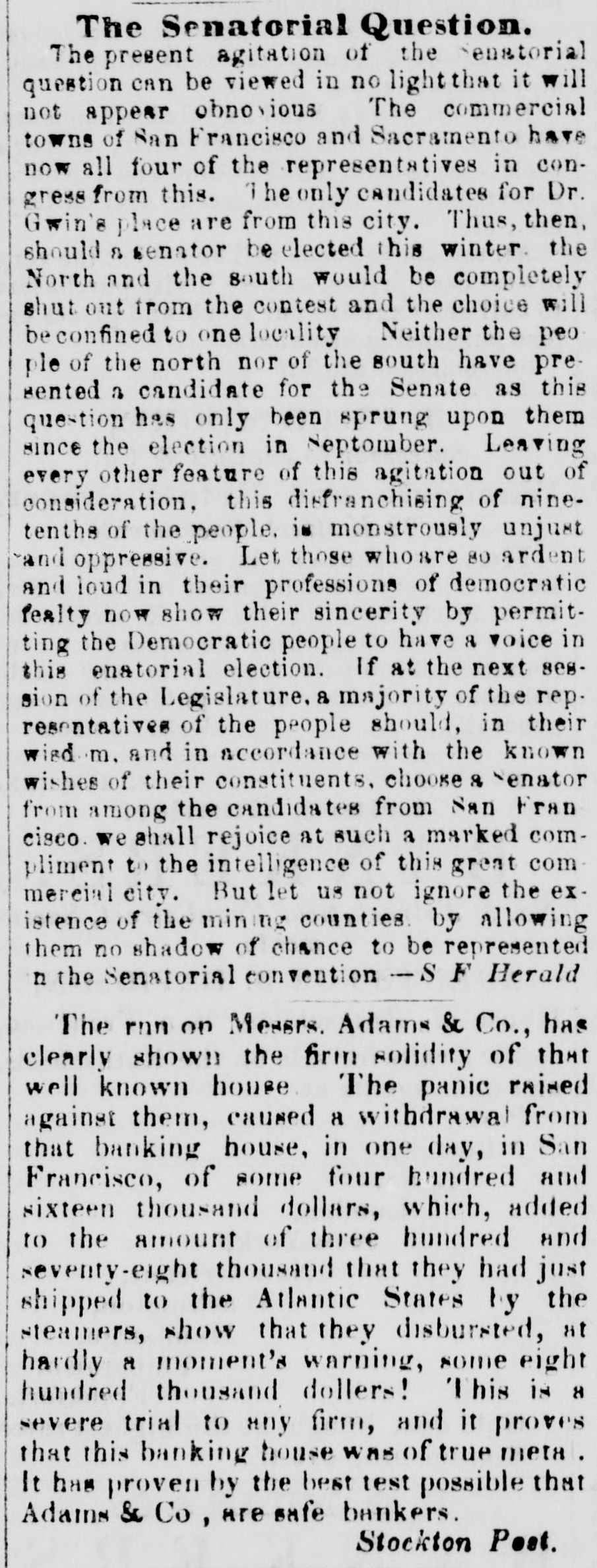
The Senatorial Question. The present agitation of the Senstorial question can be viewed in no light that it will not appear obnovious The commercial towns of San Francisco and Sacramento have now all four of the representatives in congress from this. The only candidates for Dr. Gwin's place are from this city. Thus, then, should & senator be elected this winter the North and the south would be completely shut out from the contest and the choice will be confined to one locality Neither the peo ple of the north nor of the south have presented a candidate for the Senate as this question has only been sprung upon them since the election in Septomber. Leaving every other feature of this agitation out of consideration, this disfranchising of ninetenths of the people. is monstrously unjust and oppressive. Let those whoare 80 ardent and loud in their professions of democratic fealty now show their sincerity by permitting the Democratic people to have & voice in this enatorial election. If at the next segsion of the Legislature, a majority of the rep. resentatives of the people should, in their wied m. and in accordance with the known wishes of their constituents, choose & Senator from among the candidates from San Fran cisco. we shall rejoice at such a marked compliment to the intelligence of this great com mereial city. But let us not ignore the existence of the mining counties by allowing them no shadow of chance to be represented n the Senatorial convention - S F Herald The rnn on Measrs. Adams & Co., has clearly show!! the firm solidity of that well known house The panic raised against them, caused a withdrawal from that banking house, in one day, in San Francisco, of some four hundred and sixteen thousand dollars, which, added to the amount of three hundred and seventy-eight thousand that they had just shipped to the Atlantic States by the steamers, show that they disbursted, at hardly a moment's warning, some eight hundred thousand dollers! This is 8 severe trial to any firm, and it proves that this banking house was of true meta. It has proven by the best test possible that Adams & Co, are safe bankers. Stockton Post.


Article from Georgetown Weekly News, March 1, 1855

Click image to open full size in new tab

Article Text

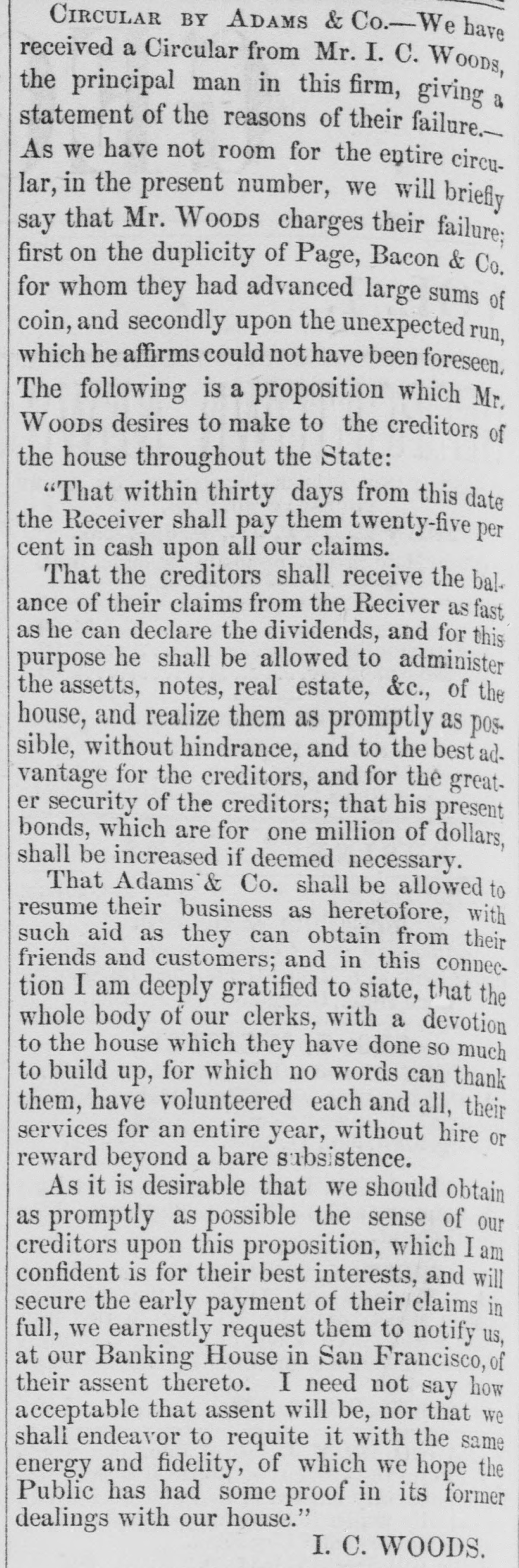
CIRCULAR BY ADAMS & Co.-We have received a Circular from Mr. I. C. WOODS, the principal man in this firm, giving a statement of the reasons of their failure. As we have not room for the entire circular, in the present number, we will briefly say that Mr. WOODS charges their failure; first on the duplicity of Page, Bacon & Co. for whom they had advanced large sums of coin, and secondly upon the unexpected run, which he affirms could not have been foreseen, The following is a proposition which Mr. WOODS desires to make to the creditors of the house throughout the State: "That within thirty days from this date the Receiver shall pay them twenty-five per cent in cash upon all our claims. That the creditors shall receive the bal. ance of their claims from the Reciver as fast as he can declare the dividends, and for this purpose he shall be allowed to administer the assetts, notes, real estate, &c., of the house, and realize them as promptly as possible, without hindrance, and to the best ad. vantage for the creditors, and for the great. er security of the creditors; that his present bonds, which are for one million of dollars, shall be increased if deemed necessary. That Adams & Co. shall be allowed to resume their business as heretofore, with such aid as they can obtain from their friends and customers; and in this connection I am deeply gratified to siate, that the whole body of our clerks, with a devotion to the house which they have done SO much to build up, for which no words can thank them, have volunteered each and all, their services for an entire year, without hire or reward beyond a bare subsistence. As it is desirable that we should obtain as promptly as possible the sense of our creditors upon this proposition, which I am confident is for their best interests, and will secure the early payment of their claims in full, we earnestly request them to notify us, at our Banking House in San Francisco, of their assent thereto. I need not say how acceptable that assent will be, nor that we shall endeavor to requite it with the same energy and fidelity, of which we hope the Public has had some proof in its former dealings with our house." C. WOODS.


Article from The Empire County Argus, March 3, 1855

Click image to open full size in new tab

Article Text

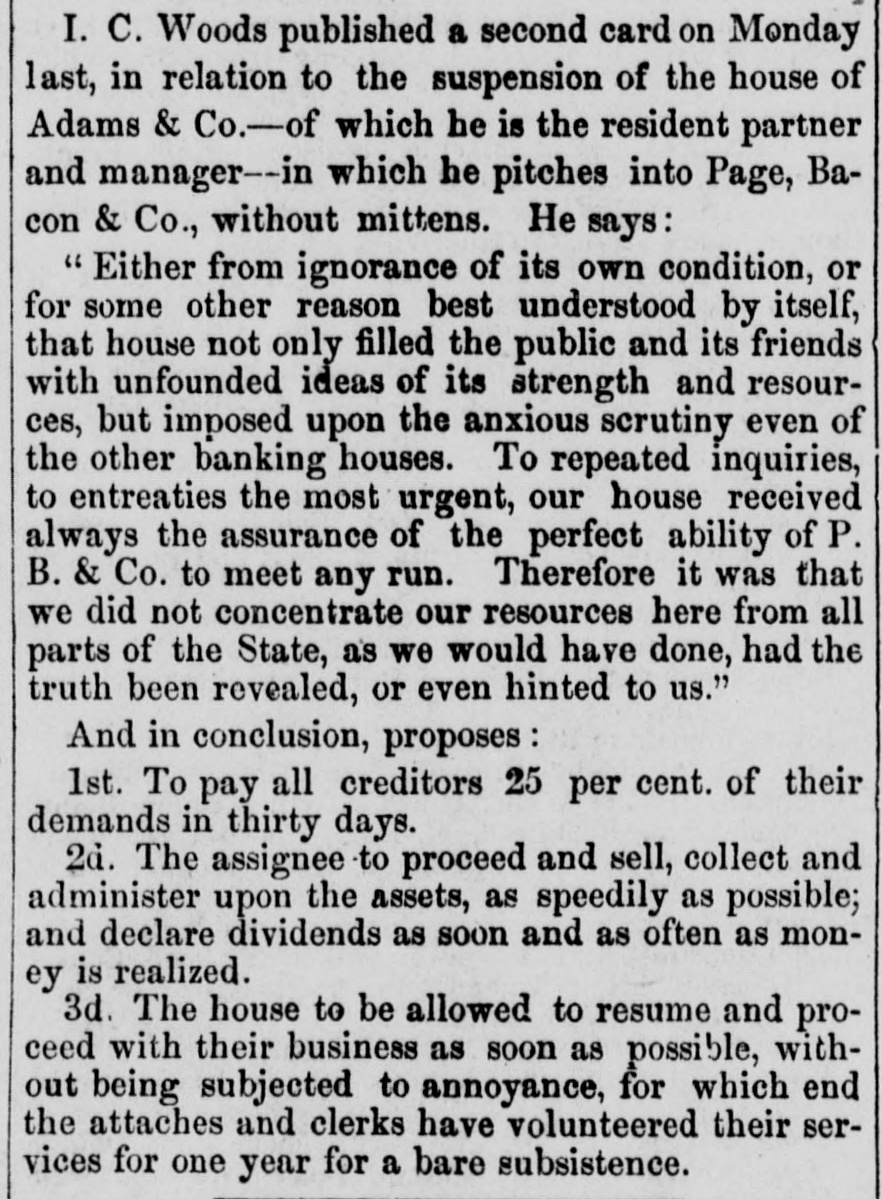
I. C. Woods published a second card on Monday last, in relation to the suspension of the house of Adams & Co.-of which he is the resident partner and manager--in which he pitches into Page, Bacon & Co., without mittens. He says: " Either from ignorance of its own condition, or for some other reason best understood by itself, that house not only filled the public and its friends with unfounded ideas of its strength and resources, but imposed upon the anxious scrutiny even of the other banking houses. To repeated inquiries, to entreaties the most urgent, our house received always the assurance of the perfect ability of P. B. & Co. to meet any run. Therefore it was that we did not concentrate our resources here from all parts of the State, as we would have done, had the truth been revealed, or even hinted to us." And in conclusion, proposes : 1st. To pay all creditors 25 per cent. of their demands in thirty days. 2d. The assignee to proceed and sell, collect and administer upon the assets, as speedily as possible; and declare dividends as soon and as often as money is realized. 3d. The house to be allowed to resume and proceed with their business as soon as possible, without being subjected to annoyance, for which end the attaches and clerks have volunteered their services for one year for a bare subsistence.


Article from Pioneer and Democrat, March 17, 1855

Click image to open full size in new tab

Article Text

# THE NEWS. We cheerfully surrender most of the inside of today's paper, to give place to the news-Earopean, Congressional. and general, which has been afforded us for the benefit of our readers-not through the agency of the mail, but, as will elsewhere be seen, by private favor, and means of the express. And we would here beg leave to acknowledge our sincere thanks to numerous friends, for the privilege of a second hand, side glance, at the late papers, kindly intended for us, by which we are enabled to make a compilation of the most important news items, for the edification of our readers abroad in the territory. From Oregon, there is no news of importance, other than general complaint of business being dull, money scarce, &c. The friends of the respective prominent democratic candidates for the nomination of delegate to congress, are waxing somewhat warm, and afford evidence that the contest in the convention will ripen into heat and bitterness. General Lane, the present delegate, it is said, took his departure from New York for San Francisco, on the steamer of the 20th of February. If this be so, it is supposed he will reach home on the next trip of the Columbia, from that city to Oregon. We hope that such a nomination will be made as will prove satisfactory to the party generally one whom they can not only unite upon, but elect. The California papers of March 1st, bring us intelligence of an unprecedented panic in the exchange and money circles in San Francisco and Sacramento, in consequence of the suspension of the well-known house of Page, Bacon & Co., followed by Adams & Co., Wells, Fargo & Co., and other banking houses. When the news first came of the failure of Page & Bacon, of St. Louis, a run commenced at once on Page, Bacon & Co., which was kept up all that day, and over four hundred thousand was withdrawn from the bank. The next day the run ceased, and matters apparently were moving on as usual, till the morning of the 22d. when their bank was not opened at the usual hour, and shortly after handbills were sent all over town, announcing that they must suspend. It seems that quite a deep run had been going on all day, till their specie was reduced to less than one hundred thousand dollars, and they feared to keep open any longer. Owing to the fact that it was a holiday, but little business was done that day; yet it seems that over two hundred thousand dollars was drawn out during the day from Adams & Co. That evening the steamer arrived with the news that Page, Bacon & Co.'s drafts had all been paid, and it was then supposed that the excitement and trouble was over. But the next morning Adams & Co. announced that they too must suspend, and shortly after Wells, Fargo & Co. followed suit. Robinson's Savings Bank, and Dr. Wright's Miner's Bank, did the same, and then came a general run on all that remained open. The greatest run was upon Drexel, Sather & Church, B. Davidson, and Lucas, Turner & Co. Tallant & Wilde and Sanders & Brenham suffered little from the panic, and paid off their depositors. Palmer, Cook & Co. were not affected by the run in the least, but paid every claim as presented. The creditors of Page, Bacon & Co. held a meeting on Sunday last, and considered a plan by which that house may be enabled to resume payment. The bank exhibits assets, over and above liabilities, of $368,868; but it is proper to state that upwards of $1,300,000 is in New York and St. Louis, whereas the liabilities of the concern are mostly due in California. It was proposed that depositors to the amount of four hundred thousand dollars should receive evidences of indebtedness, bearing interest at the rate of one per cent. per month, and payable in two, four, six and eight months; and it was thought that if depositers accepted this proposition, the house would be enabled to go on. Merchants and others affixed their names to a bond in the sum of about one million of dollars, guaranteeing the payment of these deposits, and it is now believed that the house will be enabled to resume business in the course of five or six days. Messrs. Wells, Fargo & Co. resumed payment on Tuesday, and so far all demands have been promptly paid. Adams & Co. have filed a petition for insolvency. and their schedule of assets and liabilities show a balance on the right side of about $100,000; assets, $1,814,285; liabilities, $1,636,717. Mr. Woods has given all his private property, estimated at $250,000, and this goes to make up the total of the assets. We understand that the express business of Adams & Co. will be carried on without any interruption. The joint convention of the California legislature for the election of a United States Senator, had been dissolved, and there will probably be no Senator elected by the present legislature. The first announcement of the failure or suspension of Page, Bacon & Co., was made known by their house in St. Louis, on the 13th of January, and, as has been the case in San Francisco and elsewhere in California, a general run has been commenced on other banking houses in most of the cities of the Atlantic states. In New York, New Orleans, Louisville, Cincinnati, and St. Louis, many of the banking houses had suspended, and public meetings have been held for the purpose of devising measures to avert a feared impending general bankruptcy, and restore the credit of Page, Bacon & Co., and other houses seriously effected by the suspension. A tremendous excitement had prevailed in some of the cities, and a general smash-up had been feared, not only in the banking, but large mercantile houses also. The latest dates, however, indicate more quietude, and a resumption of confidence and business anticipated. The general character of the news from the states, is anything but flattering to general prosperity, in a business point of view. Bank expansion, and consequent bankruptcy, through speculation and overtrading, is the common talk in the commercial circles, whilst destitution, lack of labor, and want of the means of procuring the necessaries of life, is being felt to an alarming and humiliating extent by the masses of the great commercial emporiums. Politically, the news from the states is of the most cheering character to the democracy-as it is ruinous to the hopes of whiggery, and its mongrel, "klonas" allies. The New York HERALD, having assumed the leadership of the know nothing movement, as directed against the re-election of Seward to the United States Senate from the state of New York, and against Wise for the Governorship of Virginia, and which paper has for months past, vauntingly trumpeted forth in advance, the certain defeat of both those gentlemen, has now cooled down in temperature almost to the freezing point, in consequence of the legislative caucus at Albany having, after the first ballot, made the nomination of Seward unanimous. The caucus numbered just one-half of each house, making their nomination equal to an election. The result has thrown the know nothing line into the utmost confusion, and the Herald pitches into the administration as having connived at their defeat, and charges blindly around, with the impeachment of treason in the know nothing.
Article from New-York Daily Tribune, March 20, 1855

Click image to open full size in new tab

Article Text

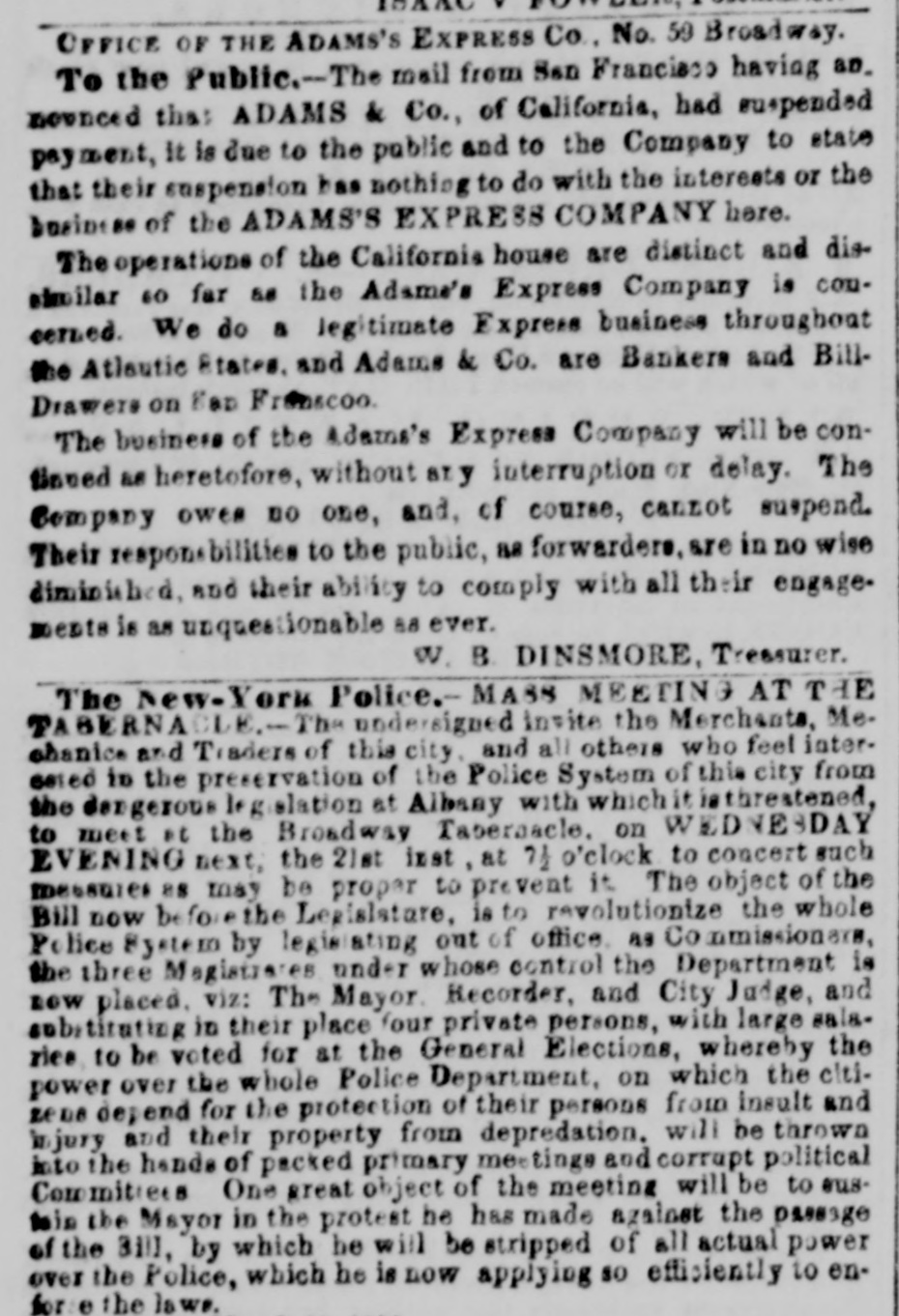
OFFICE OF THE ADAMS'S EXPRESS Co., No. 59 Broadway. To the Public.-The mail from San Francisco having an. nounced that ADAMS & Co., of California, had suspended payment, It is due to the public and to the Company to state that their suspension has nothing to do with the interests or the business of the ADAMS'S EXPRESS COMPANY here. The operations of the California house are distinct and dissimilar 60 far as the Adams's Express Company is concerned. We do a legitimate Express business throughout the Atlautic States. and Adams & Co. are Bankers and BillDiawers on Fan Frenscoo. The business of the Adams's Express Company will be confinued as heretofore, without any interruption or delay. The Company owen no one, and, of course, cannot suspend. Their responsbilities to the public, as forwarders, are in no wise diminished, and their ability to comply with all their engagements is as unquestionable 88 ever. W. B. DINSMORE, Treasurer. The New-York Police.- MA88 MEETING AT THE PABERNACLE.-The undersigned invite the Merchants, Mechanice and Traders of this city, and all others who feel interseted in the preservation of the Police System of this city from the dengerous legislation at Albany with which it isthrestened, to meet at the Broadway Taberaacle. on WEDNESDAY EVENING next, the 21st inst, at 71 o'clock to concert such measures as may be proper to prevent it. The object of the Bill now before the Legislature, is to revolutionize the whole Police 8ystem by legislating out of office. as Commissioners, the three Magistrates under whose control the Department is now placed, viz: The Mayor. Recorder, and City Judge, and substituting in their place four private persons, with large salarice, to be voted for at the General Elections, whereby the power over the whole Police Department, on which the citizens depend for the protection of their persons from insult and injury and their property from depredation. will be thrown into the hands of packed primary meetings and corrupt political Commities One great object of the meeting will be to eustain the Mayor in the protest he has made against the passage of the Bill, by which be will be stripped of all actual power over the Police, which he is now applying so efficiently to enfor the laws.


Article from New-York Daily Tribune, March 21, 1855

Click image to open full size in new tab

Article Text

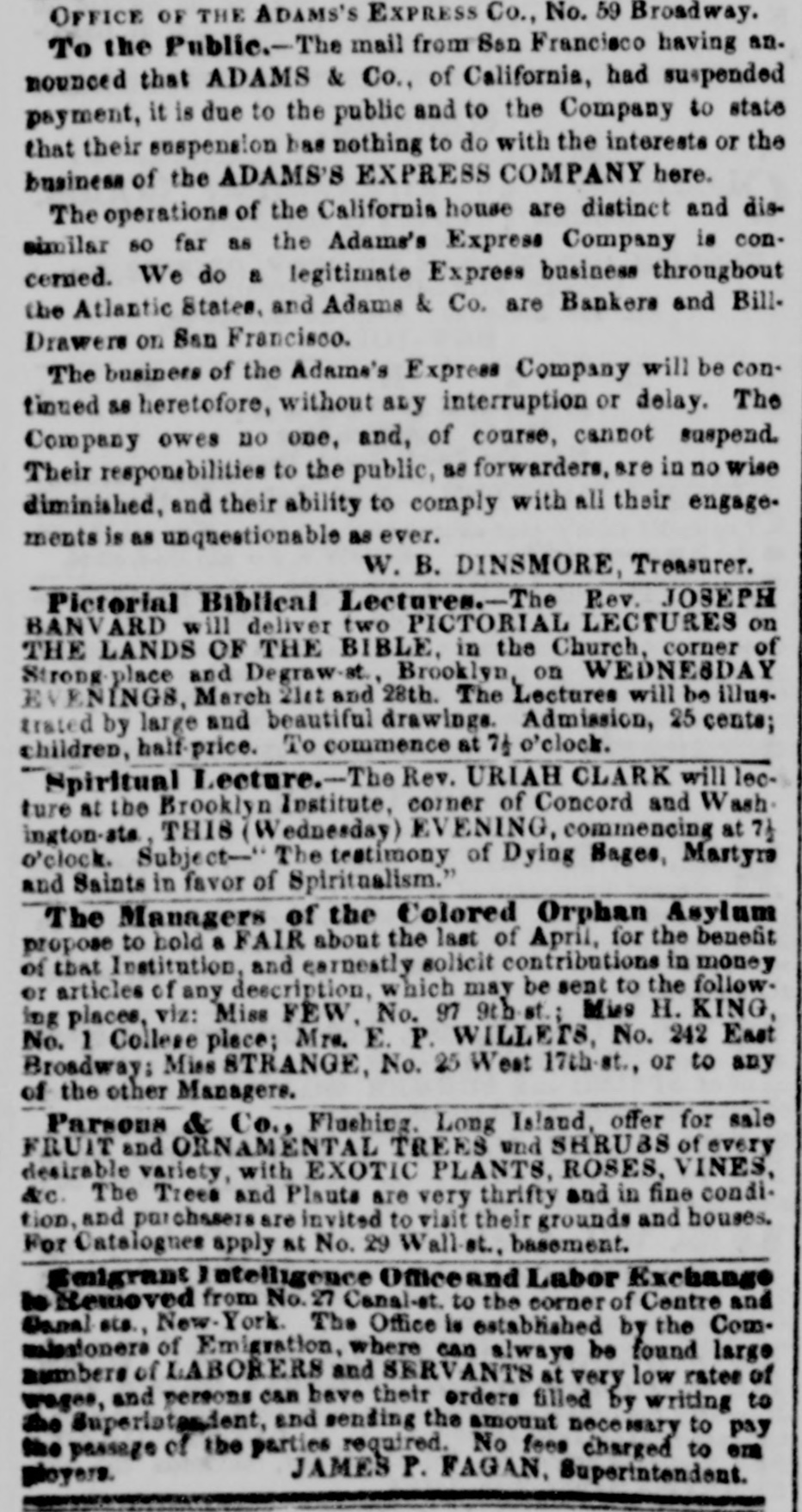
OFFICE OF THE ADAMS'S EXPRESS Co., No. 59 Broadway. To the Public.-The mail from San Francisco having an. nounced that ADAMS & Co., of California, had suspended payment, it is due to the public and to the Company to state that their suspension has nothing to do with the interests or the business of the ADAMS'S EXPRESS COMPANY here. The operations of the California house are distinct and dissimilar so far 8.8 the Adams's Express Company is concerned. We do a legitimate Express business throughout the Atlantic States, and Adams & Co. are Bankers and BillDrawers on San Francisco. The business of the Adams's Express Company will be continued as heretofore, without any interruption or delay. The Company owes no one, and, of course, cannot suspend. Their responsbilities to the public, as forwarders, are in no wise diminished, and their ability to comply with all their engagements is as unquestionable as ever. W. B. DINSMORE, Treasurer. Pictorial Biblical Lectures.-The Rev. JOSEPH BANVARD will deliver two PICTORIAL LECTURES on THE LANDS OF THE BIBLE, in the Church, corner of Strong-place and Degraw-st, Brooklyn, on WEDNESDAY EVENINGS, March 21st and 28th. The Lectures will be illus. trated by large and beautiful drawings. Admission, 25 cents; children, half-price. To commence at 71 o'clock. Spiritual Lecture.-The Rev. URIAH CLARK will lecture at the Brooklyn Institute, corner of Concord and Wash. ington-sta, THIS (Wednesday) EVENING, commencing at 71 o'clock. Subject-" The testimony of Dying Bages, Mastyrs and Saints in favor of Spiritualism." The Managers of the Colored Orphan Asylum propose to hold & FAIR about the last of April, for the benefit of that Institution, and earneatly solicit contributions in money or articles of any description, which may be sent to the following places, viz: Miss FEW, No. 97 9th-st.; Miss H. KING, No. 1 College place; Mrs. E. P. WILLETS, No. 242 East Broadway; Miss STRANGE, No. 25 Weat 17th-st., or to any of the other Managers. Parsons & Co., Flushing. Long Island, offer for sale FRUIT and ORNAMENTAL TREES und SHRUBS of every desirable variety, with EXOTIC PLANTS, ROSES, VINES, &c. The Trees and Plants are very thrifty and in fine condition, and purchasers are invited to visit their grounds and houses. For Catalogues apply at No. 29 Wall-st., basement. Emigrant , atelligence Officeand Labor Exchange to Removed from No. Canal-et. to the corner of Centre and Ganal sts., New-York. The Office is established by the Commissioners of Emigration, where can always be found large numbers of LABORERS and SERVANTS at very low rates of wages, and persons can have their orders filled by writing to the Superistendent, and sending the amount necessary to pay the passage of the parties required. No fees charged to em JAMES P. FAGAN, Superintendent. Bloyers.


Article from The Daily Union, March 22, 1855

Click image to open full size in new tab

Article Text

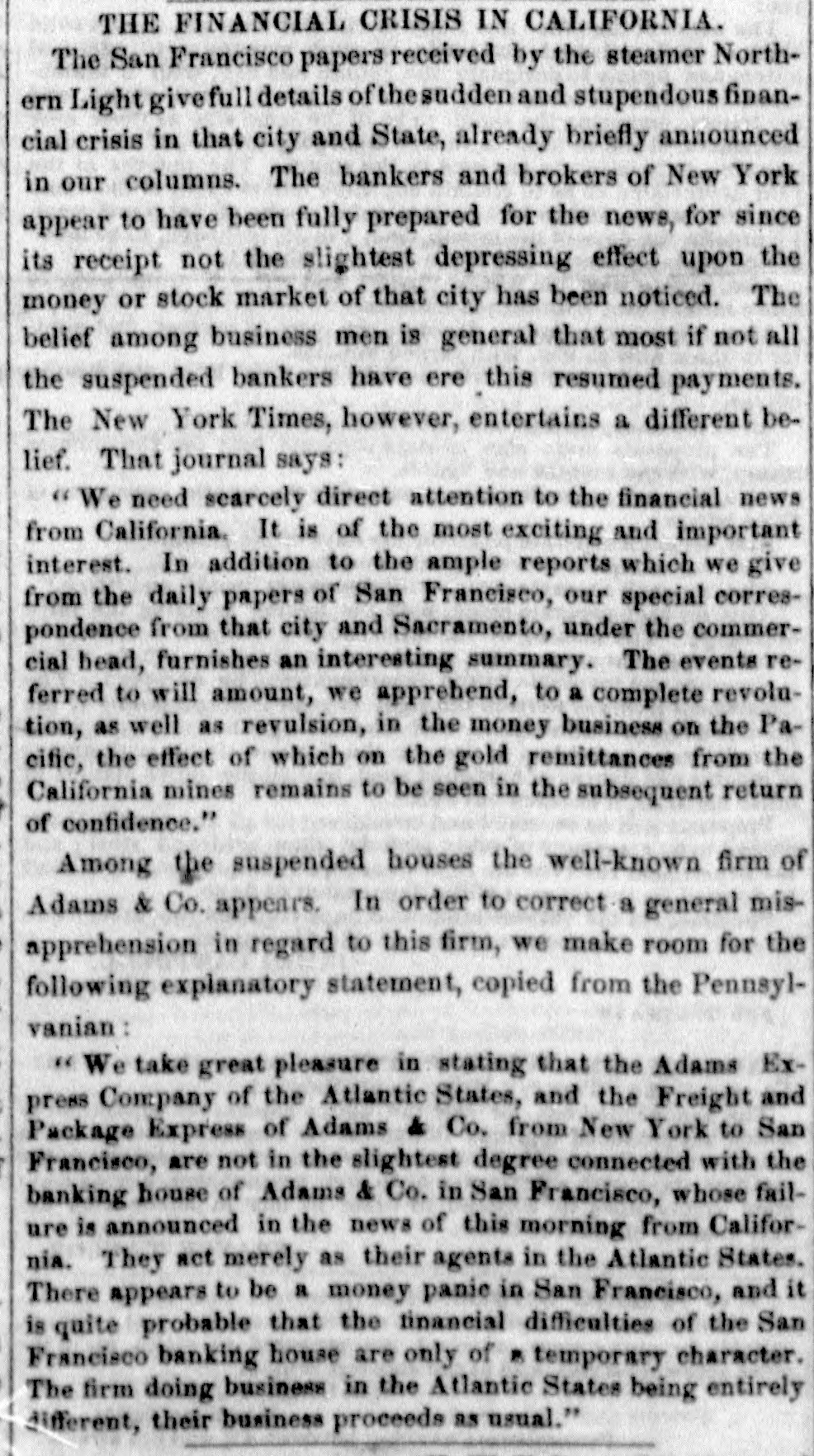
THE FINANCIAL CRISIS IN CALIFORNIA. The San Francisco papers received by the steamer Northern Light give full details of the sudden and stupendous financial crisis in that city and State, already briefly announced in our columns. The bankers and brokers of New York appear to have been fully prepared for the news, for since its receipt not the slightest depressing effect upon the money or stock market of that city has been noticed. The belief among business men is general that most if not all the suspended bankers have ere this resumed payments. The New York Times, however, entertains a different belief. That journal says: We need searcely direct attention to the financial news from California. It is of the most exciting and important interest. In addition to the ample reports which we give from the daily papers of San Francisco, our special correspondence from that city and Sacramento, under the commercial head, furnishes an interesting summary. The events referred to will amount, we apprehend, to a complete revolution, as well as revulsion, in the money business on the Pacific, the effect of which on the gold remittances from the California mines remains to be seen in the subsequent return of confidence." Among the suspended houses the well-known firm of Adams & Co. appears. In order to correct a general misapprehension in regard to this firm, we make room for the following explanatory statement, copied from the Pennsylvanian: " We take great pleasure in stating that the Adams Express Company of the Atlantic States, and the Freight and Package Express of Adams & Co. from New York to San Francisco, are not in the slightest degree connected with the banking house of Adams & Co. in San Francisco, whose failure is announced in the news of this morning from California. They act merely as their agents in the Atlantic States. There appears to be a money panie in San Francisco, and it is quite probable that the tinancial difficulties of the San Francisco banking house are only of B temporary character. The firm doing business in the Atlantic States being entirely different, their business proceeds as usual."


Article from Evening Star, March 22, 1855

Click image to open full size in new tab

Article Text

The Monetary State of California -The news of the very general smash up" in Cal. ifornia over which the Atlantic-side newspapers are now speculating, took few well informed men in this city by surprise. It has long been known here, that extravagance and speculation are the two leading characteristics of the business habits of our brethren in that far western quarter. Characteristics incident to the fact that they are Americans, and, therefore, by constitutional habit, reckless in business operations, and exist among circumstances, more likely to superinduce heedlessness in expenditures than any others to be conceived of. We do not remember ever to have known an individual whose business was nearly allied to gambling, who failed to be extravagant in his personal expenditures-to trust to luck. All the world are aware that nothing can be more common in California than extreme proverty yesterday, and full pockets to-morrow. The newspaper accounts of business affairs there in the last five years have been little more than the jotting down of instances in which men have either suddenly made or lost large sums. In any country in which manual labor may by accident pay, daily, a hundred times as much as will support the laborer, recklessness and an absence of real thrift must be marked characteristics of those who depend on manual labor for their bread; resulting, eventually, in a heavier ag. gregate of lcsses-privations-than of gainswealth. Gold mining in California, up to this period, has been little more than gambling; for it has been carried on, for the most part, without system on the part of those engaged in it, and with little aid from science, which will come into play 80 soon as the gold shall be in a measure exhausted. Then, few will continue to follow-each man or half dozen men without capital-a business in which the changes are that one lucky day will be succeeded by a dozen without success. The surface gold set the community of Cal. ifornia to gambling, and put up everything to gambling rates or prices-money to from three to five per centum a month, to be used in what is termed out there, legitimate business. The immediate cause of the failure of Page, Bacon & Co, Adams & Co., and Wells, Fargo & Co nominally houses engaged in the express bus. iness, but really the great banking houses of the new State-was the fact that they had loaned out their funds to parties in trade at from three to five per centum per month. If their borrowers are good, and some of the California papers 80 insist, they will pay every dollar. We anticipate no such agreeable termination of the general smash-up there how ever. It is impossible that the three largest and most active banks, and half a dozen with less means, in a city of the population and business of San Francisco, can suspend with out thus producing a general crash among their depositors whose money they have loaned out to parties, a large per centage of whom stand ready, of course, to pay up, if at all, in depreciated obligations of the lenders. We question, however, whether these failures will not, in the end, benefit the new State. Her true interest requires that her business habits (system) shall undergo radical and sweeping changes-shall become assimilated to the business system prevaling in older and (commercially) more prudent communities This crash will go far toward bringing about the change we indicate, which cannot fail in turn greatly to benefit the future of those in California who live by the sweat of the brow. Our sympathy is almost wholly with that class, as when they are doing well, all others are prosperous. This axiom holds good everywhere in our country, and its prevalence is really at the foundation of all we are or may hope to be as a signally happy and prosperous people. Liability of Contractors for Transportation, &c.-A case was disposed of a few days ago at the Treasury Department, wherein a contractor, who had bound himself by written agreement to transport certain army supplies from Fort Leavenworth to El Paso, was retarded on his route and


Article from Burlington Free Press, March 23, 1855

Click image to open full size in new tab

Article Text

FROM CALIFORNIA.-The Northern Light which arrived at New York on the 19th, brought word of the almost entire prostration of business, owing to the suspension of five banking-houses. The news of the suspension of Page & Bacon of St. Louis, reached San Francisco on the 17th, causing a great run on Messrs. Page, Bacon & Co., of San Francisco. They met the run, and paid out half a million of dollars. A meeting of merchants and bankers was held, and declared the house sound, restoring confidence, and matters wore a better aspect. On the 22d, however, Messrs. Page, Bacon & Co., suspended payment, followed on the 23d by Messrs. Adams & Co., Wells, Fargo & Co., Robinson & Co., and Wright's Miners' Deposit. The excitement was intense. Adams & Co., closed all their branches without paying a dollar, except at San Francisco, where on the 23d, they stood a run of $200,000. Wells, Fargo & Co., announced that they would resume payment in San Francisco on the 26th. It is feared Adams & Co., could not resume payment under sixty days, if at all. Page, Bacon & Co., would probably resume payment in a few days, depositors having granted time on $400,000. Their assets were large. The San Francisco Price Current, of the evening of the 24th, denies that there have been any failures of purely mercantile houses. Owing to the scarcity of water, but little gold had been taken from the mines, but heavy rains commenced falling on the 25th, and still continued when the steamer left. There has been no election of a U.S. Senator, the joint Convention having adjourned sine die on the 26th, by a vote of 63 to 44. On the morning of the 18th, the St. Charles Hotel, and Williams' Hotel, in San Francisco, were destroyed by fire. In Nevada, 16 houses were burned on the 16th, and in Stockton, 25 houses were destroyed by fire on the 21st. Loss, $50,000.


Article from Butte Record, March 24, 1855

Click image to open full size in new tab

Article Text

ADAMS & CO. Mr. A. A. Coher, the receiver of Adams & Co., commenced suit against Messrs. Billings & Park, on charge of extorting a $10,000 retaining fee from Mr. I. C. Woods, in the case of Alvin Adams vs. Adams & Co. Messrs. Billings and Park have published a rejoinder to the charges preferred against them, in which they assert that the money was voluntarily paid them as a retainer, and considered it a reasonable fee for so important a suit. The most intereresting portion of their statement as far as the public is concerned, is given by Mr. Billings, as follows, as follows, the circumstance having taken place on the night of the 22d of February: "I remained in my office for two hours or so, and then went down into the Banking House, where I found Mr. King, Mr. Cohen and others moving the gold dust and coin into a wagon on Merchant street." It would seem from the above statement that the able managers of the House, were prepared for a burst up, and doubtless made it a profitable speculation. The Miners Advocate says that some idea of the immense swindle perpetrated by Adams & Co., may be inferred from the fact, that their liabilities in Nevada County alone are upwards of $200,000. The Telegraph says that a hand bill has been extensively circulated at Grass Valley, of which the following is a copy: "$75.000 paid in Adams & Co's. paper for the scalp of I. C. Woods!" Mr. Woods was, we believe, a late Know Nothing candidate for U. States Senator. No one can now deny, but what he has identified himself with the interests and prosperity of California! Hur-r-o-a-r for the Know Nothinks! and their straight-forward, honest and identifying candidates! Mr. Robinson, of Savings Bank notoriety, was sent to to the Court of Sessions in San Francisco, on four different indictments for swindling. WRIGHT'S Saving Bank creditors have agreed with him upon an arrangement which allows him in conjunction with two trustees, to continue his business for eighteen months, settling it up and paying dividends at stated periods.


Article from Washington Sentinel, March 27, 1855

Click image to open full size in new tab

Article Text

GRONGE HERVELS THE ao THE LAW. Three DayS Later from California. The Financial Panic Subsided-Resumption of Wells, Fargo & Co.-The House of Page, Bacon & Co. open to special Depositorsplication of Adams & Co. for the benefit of the Insolvent Laws-The House Threatened -yung sburang D fo D fiq Shipments of Gold Excitement at ShastaRain at fast-The Mines, dec. The steamer George Law arrived at New York on Saturday with dates from San Francisco to the 1st instant, only three days later. She brought 234 passengers, among them Colonel Fremont, and $317,800 in gold. The following are the principle consignees: Messrs. Drexel & Co., $100,000: Metropolitan Bank, $70,000; Rich & Brothers, $25,000; Wells, Fargo & Co., $50,000; Adams & Co., $10,000, with other smaller amounts, reaching in all $317,800. The steamship "Golden Gate," Allan McLane, commander, left San Francisco at 10.30 p. m., on the 1st, and made the run to Panama in 11 days and 4 hours, (running time,) the quickest time ever make by any steamer on the Pacific. The outward passengers by the "George Law" were landed at Aspinwall on the morning of the 15th, and left Panama on the "Golden Age" the same day. From the San Francisco Herald, March 1st. The Bank Excitement. The excitement of the past few days seems to have, in some degree, subsided, and as the public became informed of the true position of banking affairs, a disposition is manifest to await the result rather than risk a serious loss by pressing immediate liquidation. of . "II M We take great pleasure in announcing that Wells, Fargo & Co. resumed business yesterday, and everything connected with their estab. lishment went on as usual. The suit of Washburn and others against Pordee, commenced in the Fourth District Court, in which the injunetion was granted, has been discontinued, and an order was entered vacating the appointment jo suairs the jo statement V Receiver. B jo the house shows the assets to be $743,499, and the liabilities $354,394. Nearly all their offices in the interior were able to stand the run upon them without being compelled to shut their doors. Page, Bacon & Co. The banking house of Messrs. Page, Bacon & Co., was open yesterday to special depositors, and parties having property placed in the custody of this house for safe-keeping were afforded an opportunity to withdraw the same. The bank will be open again to-day. Messrs. Page, Bacon & Co. promise, in their new arrangement for resuming their business, to issue certificates of deposit, bearing interest at one per cent per month, which certificates are guaranteed by some of our first men to the 199 dollars. Jo million B JOAO Jo funous bond guaranteeing the certificates has been uoos se puu puu executed as the amount required by the firm is made up, which will, doubtless, be done shortly, the certificates will be issued and the house placed basis. pood B uodn of TP swepv This firm have confessed themselves insolvent, and applied for the benefit of the insolvent act. A stay of all proceedings on the part of the creditors of the firm, and of I. C. Woods is ordered by Judge Lake, and notice is given that the creditors appear on the 31st of March, to show cause why the prayer of the insolvent to be discharged from his debts should not be granted. Application of Adams & Co. for the benefit JO U--AUT Instruction the 10 their affairs. A petition in insolvency was filed in the Fourth District Court by Mr. Isaiah C. Woods, of the firm of Adams & Co., praying to make a cession of his estate and that of his copartnership, to his creditors, and to be released from his debts. The petitioner recites that "in consequence of the general panic which took possession of the people throughout the State, the said firm have recently been called upon to pay an unusual large proportion of the moneys and debts which they owe, and not having on hand sufficient money to meet said demands, within the true meaning of the act," &c., &c. In submitting the schedule of his assets, the : BABS pettion "I entered into the co-partnership of Adams & Co. on the 12th day of May, 1854. I was then perfectly solvent, and possessed property and means over and above all my debts and engagements of the value of two hundred and fifty thousand dollars. I have individually sustained no losses of any considerable amount, nor has the firm of Adams & Co. since I into said co-partnership, except in the preciation of the market value of the erty owned by me and them. The cause of the failure of said firm is only the fact of being called upon to redeem all its liabilities in cash at once, which, from the nature of the business, and the well recognized implied understanding between depositors and banks, is not expected." The following is a statement of the affairs of the House, and of Mr. Woods, individually, made up from the schedules on file: Balance of bank accounts against the house, say $275,000 Balance of certificates 705'167 Bills of exchange on Adams & Co. N., York. 100,000 Liabilities of the country offices, established at 000'00S Total $1,582,19 Individual debts of C. Wood, on which judgments have been confessed. 000'19 Grand total of liabilities. The following is the account of the assets of House the Debts due by depositors, who haveoverdrawn their accounts, say $200000 Negotiable notes and bills 2735796 Notes in suit and over due, say 000'94


Article from New-York Daily Tribune, April 9, 1855

Click image to open full size in new tab

Article Text

Total From Our Own Correspondent. SAN FRANCISCO, Friday, March 16, 1855. Business of all kinds has been very dull during the past two weeks. The suspension of some of the banking houses caused such & check of credit, and created such a degree of distruct, that every person seems disposed to wait and see what will be the end of the present state of affairs. One thing is certain, that this city has not presented such a dull appearance during the last two years as it now does. atters are undergoing. a severe ordeal, and it is difficult to tell who will come out with & whole skin. Adams & Co. affairs are now in the Courts, to fee lawyers, and squander even what little the poor creditors might, under fair management, have obtained. I never saw or heard of a more wretchedly-managed concern than this has been. The house did a very extensive business, and had branches in every mining district in the State. By this means it obtained the hard earnings of thousands of laboring people, many of whom will ill now lose the last dollar they possessed. The attempt to unravel A. & Co 8 affairs necessa. rily brin gs to light other rascally transactions. A noted law firm-Halleck, Peschy & B lings-a are accused of having extorted money from Adams & Co, and Jam King, by threatening to expose their pecuniary condition unless they were paid a handsome sum as hush-money. The suit nacitated for the re. covery of what was unlawfully received asks for & judgment of $15,000, although the sum paid by Adams & Co. is supposed to have been much larger; inmor says more than $30 000. Probably there is no State in the Union where lawyers have had richer pickings and stealings than they have bad in California. Ad the value of lands became enhanced, the henorable profession began to move-and the way they walked into the pockets of every person who employed them, need not be told to any person ho really knows what the legal profession is. The amount of perjury and corrution in the Courts, the bloody fights and murders test have been committed, are fr ghtful in the extreme; and to no one class of the community are we SO much indebted for all this, 88 to the lawyers Mr. G. J. Hubert Sanders-another lawyer-has been transacting a great business of late, 8 trifle outside of his profession. In addition to his practice, be was a Notary Public Like some of our bankers, he offered his services to those who had money and didn't know how to take care of it, while he did He has obtained over $100 $100,000, upon mortgages signed with fictitious names, and acknowledged before bimself. His business was mostly with the French. He was arrested and held to bail in the sum of $10,000 but has since fled. Sanders was a very fastionable man. have in this goodly City a State Marine Hospital for the purpose of taking care of such of the sick as are unable to take care of themselves. The object of the institution is, of course, commen dable. An investigation has recently been made concerning its management, and the following testimony elicited: E. F EUSTICK- storekeeper from July to August '54; have known the steward to receipt for one hut dred or more loaves of bread more than were received; the bills were signed by Dr Mills and were passed by Trustees; have known the steward to buy brandy at $10 per gallon for private of Mills and himself the bills for which were made out for Hospital urposes and double the quantity of brandy at $5 per gailon, in order to deceive the Trustees; have known Claughlev to buy champasne and cigars for the use of Mills and himself, the same being charged to Hospital; his orders from the Trustees, to keep an account of all stores received and disbursed, were covitermanded by Dr Mills and Claughley; the later sent a new carpet belonging to the Hospital to his wife at Secramento and also purchased linen, muslin, oysters, sardines, etc., for his own use on account Witness also states have been ordered to send wines to a house of prostitution in this city, by Dr Mills and Ciaughley; it was a daily occurrence; I have been ordered by the prosecuting physician to give fresh eggs to patients, but Claughlev ordered me to give them Boston eggs, which in nine cases out of ten proved rotten; Dr Wing told me that the bills for perfumery cost so much he was ashan ed of it; these articles were bought for Dr. Mille's woman, and charged to the hospital as medicines; the woman's Lame is Louisa Haywood; the bills amounted to $75 or $80 per month and the same was also bought for Claughley's woman. also charged as medicines; I have known bills be changed by Claughiey before they were submitted to the Trustees. both in amounts and articles; have heard him remark that certain Trustees were too d -d honest, and that be would have them out or break the hospital; I have known men not patients to board at the hospit hospital for week at . time; I have known employes to be requested to vote a certain ticket, otherwise they would be discharged; patients who could go out were also told to vote the same way; Dr Mille's patients were carried out, and some of them voted four or five times; cake left at the Treasurer's office was entered as bread; five dollars was charged for brandy when one was used. Doctor S. B. Mills is the resident physician, and James A. Claughley the steward of the hospital. There is other testimony of the same sort. For the credit of California I am glad to state that the institution is about to be closed. Having had the frankness to expose all these dark spote on our character, I trust DO self- righteous Pharisee will at once jump to the conclusion th at there is nothing good in California raia There are good and bad men, here the same as everywhere re else More vice and corruption are apparent here. because there is less attempt at concealment. You see exactly what people are-doing without fear or restraint just what their natural impulses a: d inclinations lead them to do. This unlimited freedom to do as you please exhibits great variety and great excess. It would be strange were it otherwise. I do not say that it is the best state of society or of affairs, but is it not something to live outside of the straight-jacket system which is imposed upon all, because & portion is too weak to stand alene. I must not omit to state, what will be gratifying to your numerous readers. that the news of the return of Mr. Seward to the United States Senate was received by hundreds of persons in this city with great gratification. He is looked upon as the leader of the great progressive movement nt in opposition to the dom. ineering and degrading influences of those who have charge of the peculiar institution." The accounts of the extreme cold weather and the suffer suffering of the poor in your city, present a marked contrast with things here. We the havethe finest weather imagicable, and provisions in the greatest abundance. One of our city papers thus speaks of the weather: " During the Syst ten days in February the thermometer in San Francisco Lever marked lower then 600 at midday; on three days it stool at 68ยฐ, and on three others at 67ยฐ, At midnight it ranged from 49ยฐ to 57ยฐ The skies were gloriously bright, the air was sot and balmy the sun's genial rays were tempered by gentle breeze, and the climate generally so do


Article from Grand River Times, April 18, 1855

Click image to open full size in new tab

Article Text

NEW YORK, April 7. The Illinois arrived at 10 o'clock this morning, with about 300 passengers and $710,000 in treasure. The California dates are to the 16th of March, brought down by the Sonora. The John L. Ste. phens was going into San Francisco when the Sonora left. None of the suspended bankers had resumed. Robinson's saving bank yielded no assets. The deposits amounted to $200,000. He had been arrested on a charge of embezzlement. The affairs of Adams & Co. had come before the courts in a variety of,shapes. C. Hubbard Sanders, an Attorney of San Francisco, had been arrested on a charge of forgery. $20,000 bail was furnished, when Sanders immediately decamp. Abundant rains had fallen. The trial of Hamilton Brown, late Treasurer of San Francisco, indicted for embezzling public monies, had resulted in his acquittal.


Article from The Daily Dispatch, June 8, 1855

Click image to open full size in new tab

Article Text

ADDITIONAL BY THE NORTHERN LIGHT FROM CALIFORNIA.-The crops promise a heavy yield throughout the State, exceeding last year. Mining operations were progressing satifactorily, but the scarcity of money was still seriously felt. The know-nothings carried the election In Grass Valley. The Alta Californian mentions an unsuccessful attempt to reorganize the whig party. The idea that the Americans would carry the next Presi. dential election was said to be the cause of the non-reorganization. The steamer John L Stephens had not reached San Francisco on the 16th, and was several days over due. She was believed to be purposely detained to assist in 8 certain game of defalcation:The Alta, in alluding to the subject, says: "The impression with many is that the Sonora was purposely delayed on the last upward trip, in order to allow the outgoing steamer to get off with the gold that Page, Bacon & Co., had robbed the people of California of. Had the Sonora got in previous to the departure of the Golden Gate, then some three or four hundred thousand dollars which the latter took away would have been de* layed and saved to California. Page, Bacon, and Mr Aspinwall, were not ignorant of the effect which the last disastrous news would have here, and 80 It was necessary to delay it till Page, Bacon & Co. got their last shipment safely out of harbor, and then Californians might whistle for their money." A new assay office had been established, owing to the inadequacy of the mint to supply the wants of the country. Much excitement existed in San Francisco, growing out of a rumor of the escape of several hundred convicts from prison, but it proved unfounded. There was a considerable run on the banking house of Wells & Fargo, in consequence of a run mor of heavy defalcation by one of their late agents; but all demands were promptly met. Great complaints were making of the mystery surrounding the affairs of Adams & Company.The receivers pay no attention to the complaints. The Americans intend nominating a State ticket, and feel confident of success. The party had issued a new organ called "The Citizen." The Democrats were divided between Gwin and antiGwin men. Efforts were making to bring about a union of the twe. The general struggle will be between the Americans and the Democrate, Mr Henry Vaughan has recovered $5,000 damges from Captain Whitlog of the steamer Sonora, who threw him into prison on suspicion of stealing a large amount of treasure. OEEGON AND WASHINGTON. Gen. Palmer, Indian Superintendent, had called a grand council of the Indians of Oregon and WashIngton Territories to meet on the 26th, for the purpose of endeavoring to form a treaty for the relinquishment of the Indian title to lands east of the Cascade Mountains. General Lane was actively stumping the State. and his prospects of election were good. The weather was very changeable. A Free soil convention was called to meet in Washington Perritory on the 26th. The revenve cutter Jeff. Davis had arrived at Port Townsend. SANDWICH ISLANDS. Theallied fleet were contemplating another at tack on Petropoloski, and were at the Sandwich Islends pregaring therefor,


Article from New-York Daily Tribune, June 25, 1855

Click image to open full size in new tab

Article Text

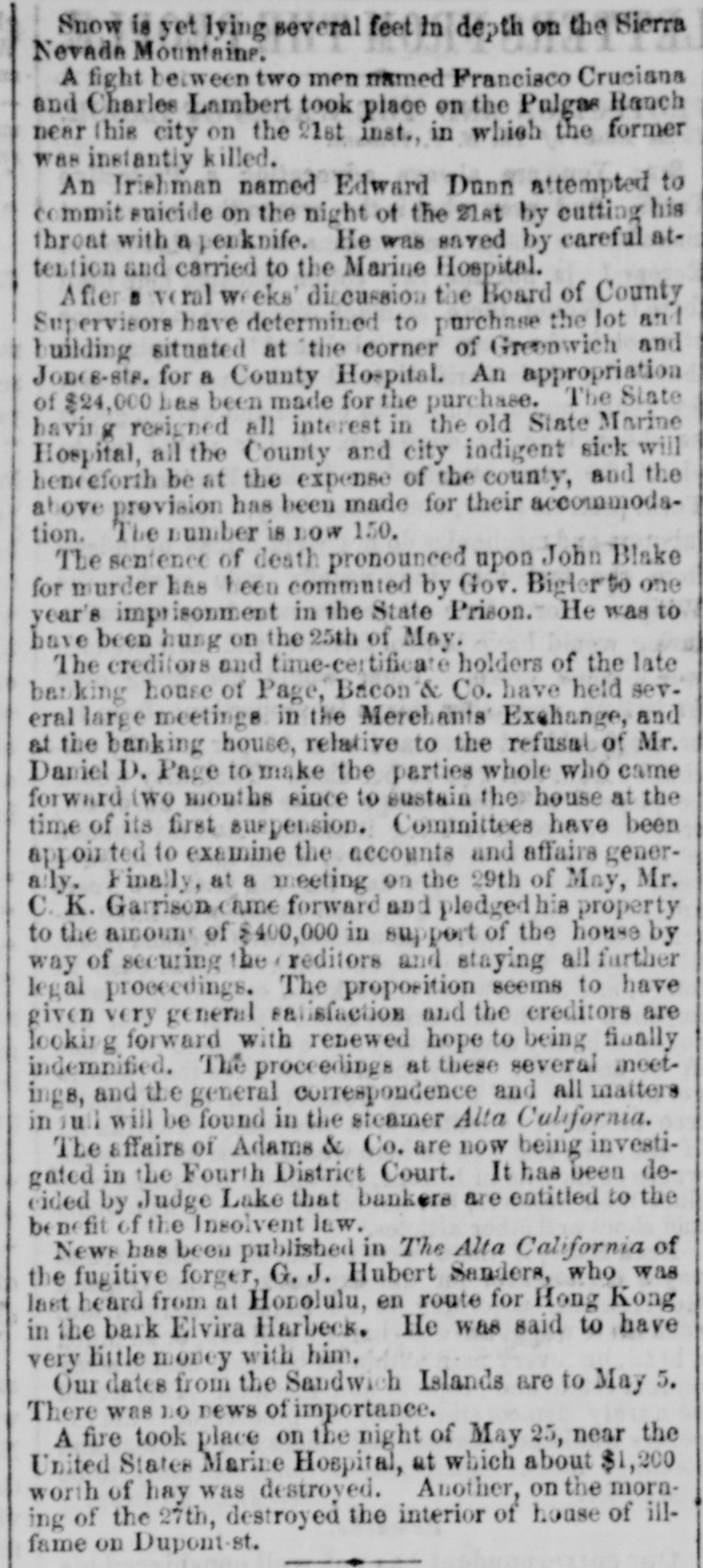
Snow is yet lying several feet In depth on the Sierra Nevada Mountains. A fight between two men named Francisco Cruciana and Charles Lambert took place on the Pulgas Ranch near this city on the 21st inst., in which the former was instantly killed. An Irishman named Edward Dunn attempted to commit suicide on the night of the 21st by cutting his throat with a penknife. He was saved by careful attention and carried to the Marine Hospital. After B veral weeks' discussion the Board of County Supervisors have determined to purchase the lot and building situated at the corner of Greenwich and Jones-sts. for a County Hospital. An appropriation of $24,000 bas been made for the purchase. The State havis X resigned all interest in the old State Marine Hospital, all the County and city indigent sick will henceforth be at the expense of the county, and the above provision has been made for their accommodation. The number is now 150. The sentence of death pronounced upon John Blake for murder has been commuted by Gov. Bigierto one year's imprisonment in the State Prison. He was to have been hung on the 25th of May. The creditors and time-certificate holders of the late banking house of Page, Bacon & Co. have held several large meetings in the Merchants Exchange, and at the banking house, relative to the refusal of Mr. Daniel D. Page to make the parties whole who came forward two months since to sustain the house at the time of its first suspension. Committees have been appointed to examine the accounts and affairs generaly. Finally, at a meeting on the 29th of May, Mr. C.K. Garrison came forward and pledged his property to the amount of $400,000 in support of the house by way of securing the reditors and staying all further legal proceedings. The proposition seems to have given very general satisfaction and the creditors are looking forward with renewed hope to being finally indemnified. The proceedings at these several meetings, and the general correspondence and all matters in Jull will be found in the steamer Alta Culifornia. The affairs of Adams & Co. are now being investigated in the Fourth District Court. It has been decided by Judge Lake that bankers are entitled to the benefit of the Insolvent law. News has been published in The Alta California of the fugitive forger, G. J. Hubert Sanders, who was last heard from at Honolulu, en route for Hong Kong in the bark Elvira Harbeck. He was said to have very bittle money with him. Our dates from the Sandwich Islands are to May 5. There was no news of importance. A fire took place on the night of May 25, near the United States Marine Hospital, at which about $1,200 worth of hay was destroyed. Another, on the morning of the 27th, destroyed the interior of house of illfame on Dupont-st.


Article from New-York Daily Tribune, March 28, 1856

Click image to open full size in new tab

Article Text

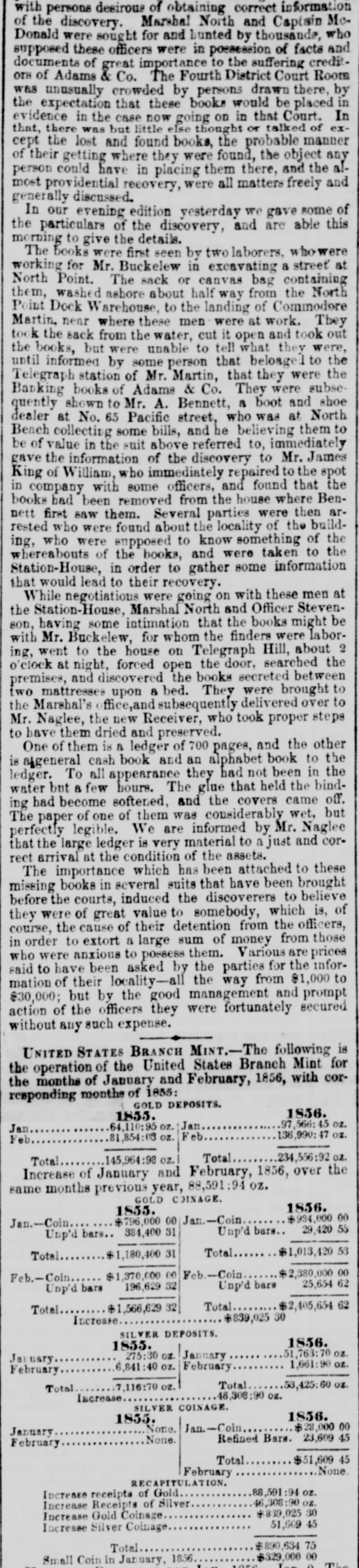
with persons desirous of obtaining correct information of the discovery. Marshal North and Captain McDonald were sought for and bunted by thousande, who supposed these officers were in presension of facts and documents of great importance to the suffering creditOTH of Adams & Co. The Fourth District Court Room was unusually crowded by persons drawn there, by the expectation that these books would be placed in evidence in the case now going on in that Court. In that, there was but little else thought or talked of except the lost and found books, the probable manner of their getting where they were found, the object any person could have in placing them there, and the almost providential recovery, were all matters freely and generally discussed. In our evening edition yesterday we gave some of the particulars of the discovery, and are able this morning to give the details. The books were first seen by two laborers, whowere working for Mr. Buckelew in excavating a street at North Point. The sack or canvas bag containing them, washed ashore about half way from the North Point Dock Warehouse, to the landing of Commodore Martin, near where these men were at work. They took the sack from the water, cut it open and took out the books, but were unable to tell what they were, until informed by some person that beloaged to the Telegraph station of Mr. Martin, that they were the Banking books of Adams & Co. They were subsequently shown to Mr. A. Bennett, a boot and shoe dealer at No. 65 Pacific street, who was at North Beach collecting some bills, and he believing them to be of value in the suit above referred to, immediately gave the information of the discovery to Mr. James King of William, who immediately repaired to the spot in company with some officers, and found that the books bad been removed from the house where Bennett first saw them. Several parties were then arrested who were found about the locality of the building, who were supposed to know something of the whereabouts of the books, and were taken to the Station-House, in order to gather some information that would lead to their recovery. While negotiations were going on with these men at the Station-House, Marshal North and Officer Stevenson, having some intimation that the books might be with Mr. Buckelew, for whom the finders were laboring, went to the house on Telegraph Hill, about 2 o'clock at night, forced open the door, searched the premises, and discovered the books secreted between two mattresses upon a bed. They were brought to the Marshal's effice,and subsequently delivered over to Mr. Naglee, the new Receiver, who took proper steps to have them dried and preserved. One of them is a ledger of 700 pages, and the other is algeneral cash book and an alphabet book to the ledger. To all appearance they had not been in the water but a few hours. The glue that held the binding had become softened, and the covers came off. The paper of one of them was considerably wet, but perfectly legible. We are informed by Mr. Naglee that the large ledger is very material to a just and correct arrival at the condition of the assets. The importance which has been attached to these missing books in several suits that have been brought before the courts, induced the discoverers to believe they were of great value to somebody, which is, of course, the cause of their detention from the officers, in order to extort a large sum of money from those who were anxious to possess them. Various are prices said to have been asked by the parties for the information of their locality-all the way from $1,000 to $30,000; but by the good management and prompt action of the officers they were fortunately secured without any such expense. UNITED STATES BRANCH MINT.-The following is the operation of the United States Branch Mint for the months of January and February, 1856, with corresponding months of 1855: GOLD DEPOSITS. 1856. 1855. 97,566:45 oz. Jan 64.110:95 oz. Jan 136,990:47 oz Feb 81,854:03 oz. Feb 234,556:92 oz. Total 145,964:98 oz. Total Increase of January and February, 1856, over the same months previous year, 88,591:94 GOLD COINAGE. 1856. 1855. $934,000 00 Jan.-Coin $796,000 00 Jan.-Coin 29,420 58 Unp'd bars. 384,400 31 Unp'd bars. $1,013,420.53 Total $1,180,400 31 Total $2,380,000 00 Feb.-Coin $1,370,000 00 Feb.-Coin 25,654 62 Unp'd bars Unp'd bars 196,629 32 $2,405,654 62 Total $1,566,629 32 Total $839,025 30 Increase SILVER DEPOSITS. 1856. 1855. 51,763:70 oz. 275:30 oz. January January 1,661:90 oz. 6,841:40 oz. February February Total 53,425:60 oz. 17,116:70 oz. Total 48,308:90 oz. Increase SILVER COINAGE. 1856. 1855. $28,000 00 Jan.-Coin None. January Refined Bars. 23,609 45 None. February Total $51,609 45 None. February RECAPITULATION. 88,591:94 oz. Increase receipts of Gold. 46,308:90 oz. Increase Receipts of Silver $839,025 30 Increase Gold Coinage 51,669 45 Increase Silver Coinage $890,634 7 Total $329,000 00 Small Coin in January, 1856


Article from Oroville Daily Butte Record, November 29, 1856

Click image to open full size in new tab

Article Text

# Judgment against Palmer, Cook & Co for $101,000. Mr. Naglee, the receiver of Adams & Co., obtained yesterday a judgment against Palmer, Cook & Co. for $101,000, despite the hard fighting of the counsel of that firm and the desperate attempt made to gain time and further profit by the laws delay. The Bulletin, governed by its hatred of the Receiver, did not even inform its readers of the judgment, and will no doubt wait before it does so, to add to it that other interesting information that Stanley is sueing for a fee of $20,000! We predict that this miscalled banking firm of Palmer, Cook & Co. will appeal this judgment to the Supreme Court, and thus still further baffle the creditors. Their useful auxiliary, the Bulletin, will cover up their defeat, no doubt, with the usual daily attacks upon the Receiver. But the time is fast approaching when these men and their supporters can no longer deceive the people by false issues and false charge.-S. F. Globe.


Article from Butte Record, December 6, 1856

Click image to open full size in new tab

Article Text

Judgment against Palmer, Cook & Co for $101,000. Mr. Naglee, the receiver of Adams & Co., obtained yesterday a judgment against Palmer, Cook & Co. for $101,000, despite the hard fighting of the counsel of that firm and the desperate attempt made to gain time and further profit by the laws delay. The Bulletin, governed by its hatred of the Receiver, did not even inform its readers of the judgment, and will no doubt wait before it does so, to add to it that other interesting information that Stanley is sueing for a fee of $20,000 We predict that this miscalled banking firm of Palmer, Cook & Co. will appeal this judgment to the Supreme Court, and thus still further baffle the creditors. Their useful auxiliary, the Bulletin, will cover up their defeat, no doubt, with the usual daily attacks upon the Receiver. But the tin. e is fast approaching when these men and their supporters can no longer deceive the people by false issues and false charge.-S. F. Globe.


Article from The Sun, February 11, 1870

Click image to open full size in new tab

Article Text

TUTC Correspondence of The Sun. SAN FRANCISCO, Jan. 30 Our Constitution pro hibits banking. but permits individuals or corporations to establish places of deposit" for the safe keeping of money. The consequence of this clause In the organic law of the St has been the encouragement of some of the grossest impositions on the people. The houses of Adams & Co., Page, Bacon & Co., Palmer Cook & Co. and several others were such places of deposit, in which up ward of $8,000,000 of the people's money was deposited, but not a dollar of which was ever recovered These firms all broke and not one ever paid dollar to its creditors So notorious had become the dishonesty of California bankers' that from 1834 to 1858 many millions in coin and dust burled, in preference to crusting them to the banks. July, 1857, and loan society was es tablished in San Francisco. Since then nine others have been established in that city, and as many more in various parts of the State, the combined capital of the whole number not exceeding $1,000. THE BANK OF CALIFORNIA was organized with a capital-on paper- of $2,000, 000: but the city assessment roll proves that its man agers swore to having a capital of only $600,000 The growth of these savings banks and expansion of the power of the Bank of California have been the nost disastrous circumstances in the financial and general history of the Pacific coast. The power of the Bank Ring," thus created, has enabled it to control the Legislatures and press of nearly the whole coast. and compelled both to serve its purpose of inflating the value of real es. tate and speculative stocks. Capital by this means has been exempted from taxation (the Tax Colector's report for 1869 shows that $12,039,763 loaned on mortgages paid no taxes). while THE BURDEN OF TAXATION presses 80 heavily OD every department of trade and productive industry that manufacturer have never flourished-coul not have existed for 3 year but for the cheap labor of the Chinese-and business has been cut off to great extent since the completion of the Pacific Railroad, by merchants in the Atlantic States being able to undersell the local merchants. through using cheaper money and paying less taxes. It is one of the most noterious facts connected with this vicious system that the Executive Com. mittee of the Board of Directors of the Bank of California are more fully REPRESENTED IN THE NATION L COUNCILS this at Washington than hare the people of coast. No aspirant for Congressional or Senatoria honors can hope for success in any State on this side the Rocky Mountains, unless he makes friends and gives pledges to the Bank of California. It is no secret in Nevada that Senators Stewart and Nye of that State had their seats in the United States Sen ate purchased with money provided by the bank. Tom Fitch, the Congre sman from that State belor Mr Sharon, the manager of the Bank's branch office in Virginia City Senators lliams and Corbett, of Oregon, are in the service of the bank Senator Casserly, of California was the bank attorney for many years prior to his election to the Senate and stili retains the same position This gentleman election was obtained solely by the FREE USE OF THE BANK'S GOLD. The Democracy never trusted him. and the Re ublicans despise him. Senator Cole of this State, has gained the hostilitv of this bank power I fusing to serve its purposes. This gentleman persisting in demanding the rem oral of certain off. cers in the Branch Mint San Francisco was an unpard offence because broke up arrange ments betw the mint and the bank which were very advanta us the latter. It is only necessary to call single fact to demonstrate the chara this connection. The bank bad "responsib rty. acted as bookkeeper for the Sub-T: rer and for the mint at the same which time, EXCEEDINGLY CONVENIENT when it was necessary to balance the accounts of the of the public service. The been would had have two for the salary M these book the mint It was the system. to the make lossee on much very bullion they the refinery. To carry out this NICE LITTLE ARRANGEMENT. certain grains of gold. ranging in value from one dollar retained by the melter, but under the new regune returned to the depositor to whom they belong refin the aim of the bank being monopolize the ing business or this coast. and thus to be dietate terms to the gold bulls and hears tion New to York. Three different bills have been Cofe to beat managed sented Congress carry out this nice little game, into To details Mr of the injuries inflicted on the enter of this State the Bank Ring. crea people financial system. would ture of ar permicious tend this letter beyond reasonable Hunte Its crown ing infamy was its HOSTILITY TO THE NATIONAL CURRENCY the This one circumstance so clearly illustrates power and machinery of the Bank Ring, some effects of our financial system, that I shall refer at length. to tha the people of California gave more The fact the soldiers and money to the fund for the relief of the Union during the late than any in mailors of the nation. is a proof of the loyalt people when they were their hearts. Yet the time of of thousands of dollars. their mone by tens the Bank LIVING the service of the press of the State in were stigmatizing as dirty rags. trash," the promises to which the heroes of the Union and the rency officers with of the Federal Government were for their services. The Legislature, UNDER THE CONTROL OF THE LOBBY, the service of the Bank. the leader of of which in Gorbam. now Secretary was George Senate, passed laws to United States national currency in Call This currency the cir ulation of the by ti.is preaching, teachfornia publishing against it, became HO odious that any one ing, and attempting to one lege cons dered guilty of the The soldier discharged from received the money here which he and the the importe money his goods New York or Bor ston for which to the be sold and goods here brought attempted to nso it, had their names publisted in the papers as persons GUILTY OF AN INFAMOUS OUTRAGE. the could survive impt politician the favoring No paper or adoption of the national tation Whoever had the temerity to say a currency despised currency. ran the same favor of this as an abolitionist before of personal violence utterar to have done by giving war would subject slavery any of the South The opinions on the Assistant Federal Treasurer. ern States. 1862, barely escaped with his life the ado) Cheese inan, in currency in public speaking the city of San Francisco, of Bank the to California, vened by that of act to e odium clings his urged against reappoint he position filled for entieman, and is now eight years of the Federal Government. This molding of public opinion by ALL OPPOSITION to the gains immense has been the them Bank Rink, goods less long than time, fins the and dollar on cents goods no among 500,000 prosperous, r gold. With people like these 1000,000 annuThe California, importer were fully fifty the cent This source of the California extravagan without liberality, vulcar,