First National Bank (New York, NY)

Episode Information

Episode UID
895701294
Episode Type
Suspension โ†’ Reopening
Bank Type
national
Bank ID
89570 national
Charter Number
8957
Start Date
October 25, 1907
Location
New York, New York

Metadata

Model
gpt-5-mini (chosen from majority vote of a three-model LLM ensemble)
Short Digest
61f746f6141ae1e1

Response Measures

None

Description

Articles specifically refer to the First National Bank of Brooklyn (Williamsburg), a Brooklyn branch of New York.

Events (5)

1. October 25, 1907 Receivership
Newspaper Excerpt
It closed on October 25, when it was forced into the hands of a receiver. John W. Schofield was appointed temporary receiver.
Source
newspapers
2. October 25, 1907 Suspension
Cause
Macro News
Cause Details
Closed during the October panic; suspended payments amid the wider banking panic.
Newspaper Excerpt
It closed on October 25, when it was forced into the hands of a receiver.
Source
newspapers
3. December 5, 1907 Chartered
Source
historical_nic
4. February 10, 1908 Reopening
Newspaper Excerpt
The First National bank of Brooklyn...was reopened for business today. The directors declare that the institution is now in a sound condition and prepared to meet all demands of depositors.
Source
newspapers
5. August 15, 1928 Voluntary Liquidation
Source
historical_nic

Newspaper Articles (21)

Article from Evening Star, January 4, 1908

Click image to open full size in new tab

Article Text

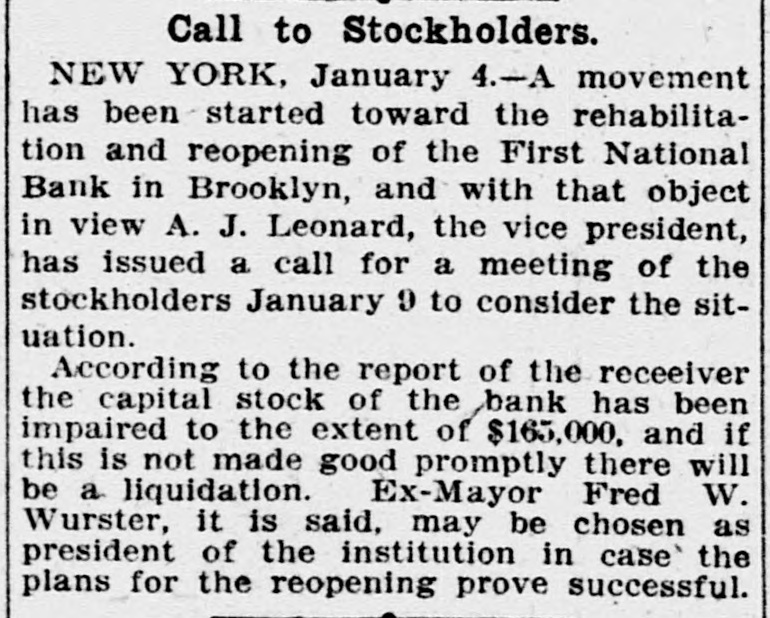
Call to Stockholders. NEW YORK, January 4.-A movement has been started toward the rehabilitation and reopening of the First National Bank in Brooklyn, and with that object in view A. J. Leonard, the vice president, has issued a call for a meeting of the stockholders January 9 to consider the situation. According to the report of the receeiver the capital stock of the bank has been impaired to the extent of $165,000. and if this is not made good promptly there will be a. liquidation. Ex-Mayor Fred W. Wurster, it is said, may be chosen as president of the institution in case` the plans for the reopening prove successful.


Article from The Washington Herald, January 17, 1908

Click image to open full size in new tab

Article Text

NATIONAL BANK TO REOPEN. Brooklyn Institution After Reorganization to Resume Business, New York, Jan. 16.-Depositors of the First National Bank, of Brooklyn, which closed its doors in the latter part of October, learned to-day that there was every likellhood of the institution resuming busIness on or about February 3. It was said that Receiver Schofield had straightened out the affairs of the bank, and that when the Jenkins Trust Company pays its indebtedness of $325,000, the First National Bank will be in excellent condition. Mr. Schofield's report has been forwarded to the Comptroller of the Currency at Washington. Before the bank is reopened It will be reorganized, and it was said to-day that none of the members of the Jenkins family would act in an official capacity. John G. Jenkins, sr., will probably retire as president, and his sons will withdraw as directors.


Article from The Star and Newark Advertiser, February 4, 1908

Click image to open full size in new tab

Article Text

BROOKLYN BANK TO RESUME. WASHINGTON, Feb. 4.-The comptroller of the currency today granted permission to the First National Bank of Brooklyn, N. Y., to resume business on Monday, February 10. The bank suspended several months ago.


Article from Evening Times-Republican, February 4, 1908

Click image to open full size in new tab

Article Text

Brooklyn Bank to Resume. Washington, Feb. 4.-The comptroller of the currency today granted permission to the First National bank of Brooklyn, N. Y., to resume business February 10. The bank suspended several months ago.


Article from Rock Island Argus, February 4, 1908

Click image to open full size in new tab

Article Text

Bank May Resume Business, Washington, Feb. 4.-The controller of the currency today granted permission to the First National bank of Brooklyn, N. Y., to resume business Feb. 10. The bank suspended several months ago.


Article from The Marion Daily Mirror, February 5, 1908

Click image to open full size in new tab

Article Text

MINOR MENTION. All hope for the steamship Blue fields, which sailed from Jacksonville, Fla., on January 21 for Philadelphia, has been abandoned. Two hundred masked "night riders" visited Dyeusburg, Ky., and burned Bennett's tobacco warehouse and distillery. Loss $40,000. The comptroller of the currency has granted permission to the First national bank of Brooklyn, N. Y., to resume business on February 10. The bank suspended several months ago. Statistics of the American Railway association on idle cars in the United States and Canada on January 22 placed the number at 338,315, or 15 per cent of the total equipment. The inference is that some 8,500 locomotives also are idle.


Article from The Salt Lake Herald, February 5, 1908

Click image to open full size in new tab

Article Text

BANK TO RESUME. Washington, Feb. 4.-The comptroller of the currency today granted permission to the First National bank of Brooklyn, N. Y., to resume business on Monday, Feb. 10. The bank suspended six months ago.


Article from Ottumwa Tri-Weekly Courier, February 6, 1908

Click image to open full size in new tab

Article Text

First National of Brooklyn to Open. Washington, Feb. 4.-The comptroller of the currency today granted permission to the First National Bank of Brooklyn, N. Y., to resume business Feb. 10. The bank suspended several months ago.


Article from The Times Dispatch, February 7, 1908

Click image to open full size in new tab

Article Text

City were increased on the security of stock and bond loans from $281,000,000 to $302,000,000. Three hundred and twelve millions loaned on collateral of Wall Street, and yet they suspended payments to their individual depositors and to their banking correspondents throughout the country. And they did it when they had money in their treasury with which to meet their obliga-tions." ### Kept Cash; Got Premium. Mr. Culberson declared that while New York had so much cash in its banks Southern banks were paying a premium for cash. The Aldrich bill, he declared, would give the banks more power and would foster stock and bond speculation by the banks and still further discriminate against the general public, and in the interest of the bondholding classes. "Against this policy," he added, "I want to enter my earnest and emphatic protest." Senator Hopkins replied briefly to Mr. Culberson. "Every statement made by the Senator," he said, "has been answered by the Secretary of the Treasury in his report." Mr. Culberson said the secretary refused to give the Texas banks deposits they asked for, and Mr. Hopkins replied that he had done the same thing in respect to Chicago banks, as he put the money where he believed the greatest emergency existed. The consideration of Mr. Culberson's resolution was postponed, and it was allowed to lie on the table.


Article from The Daily Sentinel, February 10, 1908

Click image to open full size in new tab

Article Text

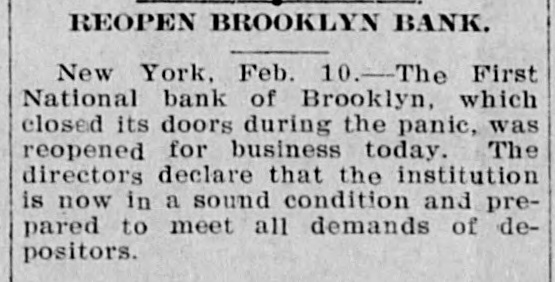
REOPEN BROOKLYN BANK. New York, Feb. 10. - The First National bank of Brooklyn, which closed its doors during the panic, was reopened for business today. The directors declare that the institution is now in a sound condition and prepared to meet all demands of depositors.


Article from Lewiston Evening Teller, February 10, 1908

Click image to open full size in new tab

Article Text

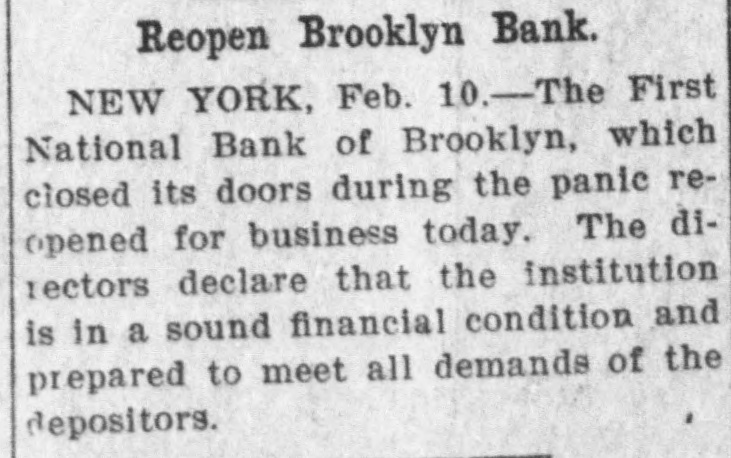
Reopen Brooklyn Bank. NEW YORK, Feb. 10.-The First National Bank of Brooklyn, which closed its doors during the panic reopened for business today. The directors declare that the institution is in a sound financial condition and prepared to meet all demands of the depositors.


Article from Bluefield Evening Leader, February 10, 1908

Click image to open full size in new tab

Article Text

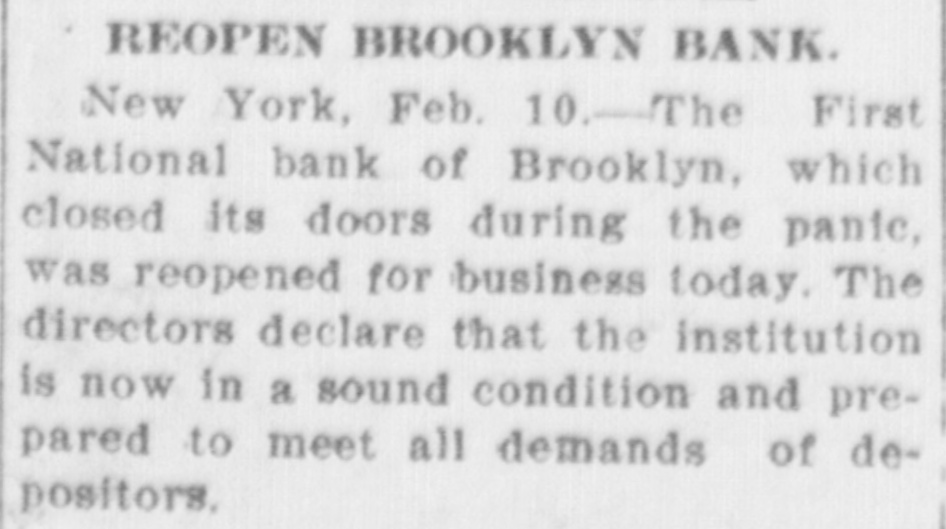
REOPEN BROOKLYN BANK. New York, Feb. 10.-The First National bank of Brooklyn, which closed its doors during the panic, was reopened for business today. The directors declare that the institution is now in a sound condition and prepared to meet all demands of depositors.


Article from The Evening World, February 10, 1908

Click image to open full size in new tab

Article Text

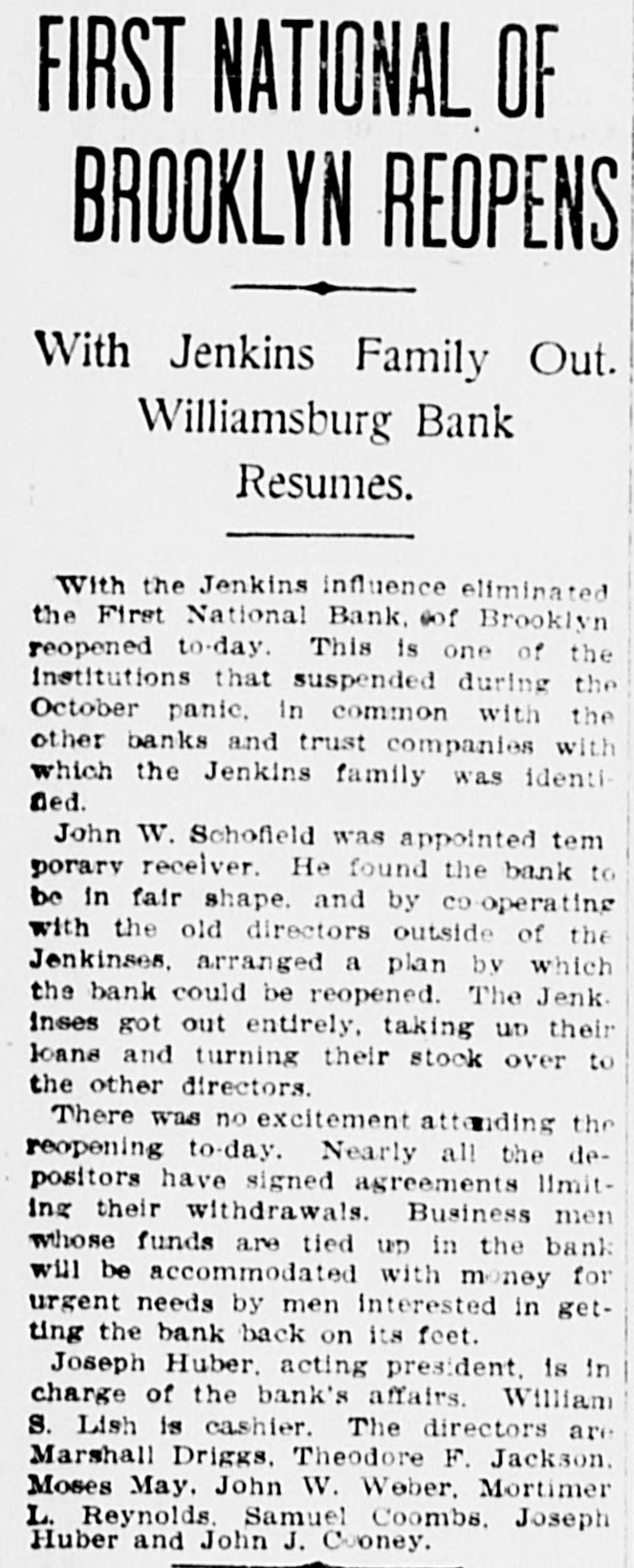
FIRST NATIONAL OF BROOKLYN REOPENS With Jenkins Family Out. Williamsburg Bank Resumes. With the Jenkins influence eliminated the First National Bank, sof Brooklyn reopened to-day. This is one of the institutions that suspended during the October panic, in common with the other banks and trust companies with which the Jenkins family was identified. John W. Schofield was appointed tem porary receiver. He found the bank to be in fair shape. and by o-operating with the old directors outside of the Jenkinses, arranged a plan by which the bank could be reopened. The Jenk. Inses got out entirely, taking up their loans and turning their stock over to the other directors. There was no excitement attending the reopening to-day. Nearly all the depositors have signed agreements limiting their withdrawals. Business men whose funds are tied up in the bank will be accommodated with money for urgent needs by men interested in getting the bank back on its feet. Joseph Huber. acting president, is in charge of the bank's affairs. William S. Lish is cashier. The directors are Marshall Driggs, Theodore F. Jackson. Moses May. John W. Weber, Mortimer L. Reynolds. Samuel Coombs. Joseph Huber and John J. Cooney.


Article from New-York Tribune, February 11, 1908

Click image to open full size in new tab

Article Text

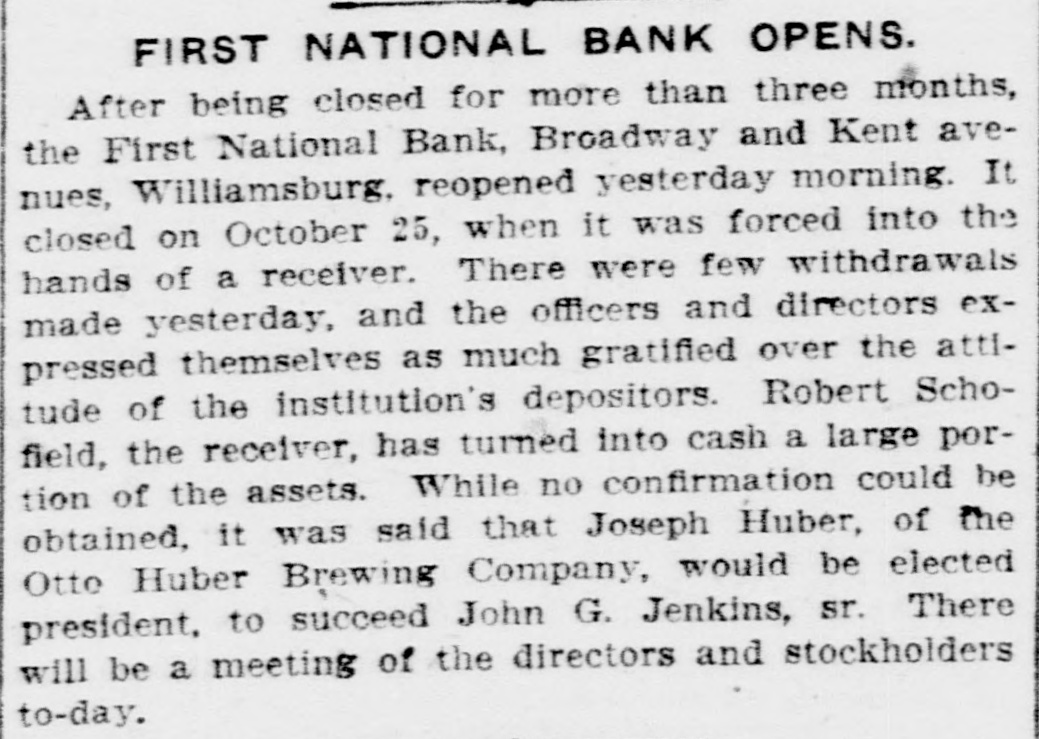
FIRST NATIONAL BANK OPENS. After being closed for more than three months, the First National Bank, Broadway and Kent avenues, Williamsburg. reopened yesterday morning. It closed on October 25, when it was forced into the hands of a receiver. There were few withdrawals made yesterday, and the officers and directors expressed themselves as much gratified over the attitude of the institution's depositors. Robert Schofield, the receiver, has turned into cash a large portion of the assets. While no confirmation could be obtained, it was said that Joseph Huber, of the Otte Huber Brewing Company, would be elected president, to succeed John G. Jenkins, sr. There will be a meeting of the directors and stockholders to-day.


Article from The Lamar Register, February 12, 1908

Click image to open full size in new tab

Article Text

In the Pennsylvania capitol graft trials the names of ex-Gov. Pennypacker and former Attorney General Carson were brought into the case in some sensational testimony given by Stanford B. Lewis, assistant to Architect Huston. A young man who formerly worked in the Kansas City street department and in other occupations throughout the west has fallen heir to an English title and valuable estates by the death of his father, Sir Genile CaveBrowne-Cave. Warrensburg, Mo., voted "dry" recently by a majority of 143 votes. Ten men are dead as the result of an explosion in a coal mine at Port Hood, Nova Scotia. Charles W. Morse, the multi-millionaire who disappeared from New York recently, has arrived at Liverpool on the liner Campania. Gov. Hoch has refused to accept the bond of State Dairy Commissioner Wilson, given by the United States Fidelity and Guaranty company, which is fighting a suit by the state relating to the First National bank bond of $250,000. The act of congress of June 1, 1898, prohibiting railroad companies from discriminating against members of labor organizations in the matter of employment has been declared unconstitutional by the United States supreme court. The Northern Pacific Railroad company has been fined $100 at Helena, Mont., for violating the 16-hour law by compelling a crew to work 23 consecutive hours. The case will be appealed to test the law. The Santa Fe has annulled ten of its principal local passenger trains in Kansas. Decrease in the road's earnings is given as the cause. John Mitchell, president of the United Mine Works, declares there is little possibility of labor organizations entering the political field in the coming campaign. The British foreign office officially denies that a squadron of war vessels is to be sent to the Pacific. A receiver has been asked for the National Hollow Brake Beam company of Chicago. The president has nominated George L. Grigsby to be United States attorney for the district of Alaska. The "Hobo" congress at St. Louis has adopted resolutions demanding that the government provide national insurance for citizens against enforced idleness or "involuntary unemployment." Kansas prison twine will be sold this year for 736 cents a pound in orders for 5,000 pounds or over. Opposition has developed in Pennsylvania to placing a statue of the late Senator M. S. Quay in the rotunda of the new state capitol at Harrisburg. The coldest weather in five years was recently experienced in eastern Pennsylvania and New York. The national convention of the soclalist party will be held in Chicago on May 10. A dispatch from the Spanish frontier says that a Portugese republic has been proclaimed at Oporto and that a provisional government has been established in that city. The Indiana republicans have selected their district delegates to the national convention. The delegation will be a unit for Vice President Fairbanks. The First National bank of Brooklyn, which suspended several months ago, has resumed business. Tulsa, Ok., has adopted the commission form of municipal government. The cruiser South Dakota built at the Union Iron works in California has been placed in commission. Coal operators in the Oklahoma field have so far refused to grant an increase in wages to miners and unless such action is taken before April 1 a strike of 10,000 will result. Harry K. Thaw has instructed his counsel that they must take some action at once looking to his release from Matteawan asylum.


Article from The Globe-Republican, February 13, 1908

Click image to open full size in new tab

Article Text

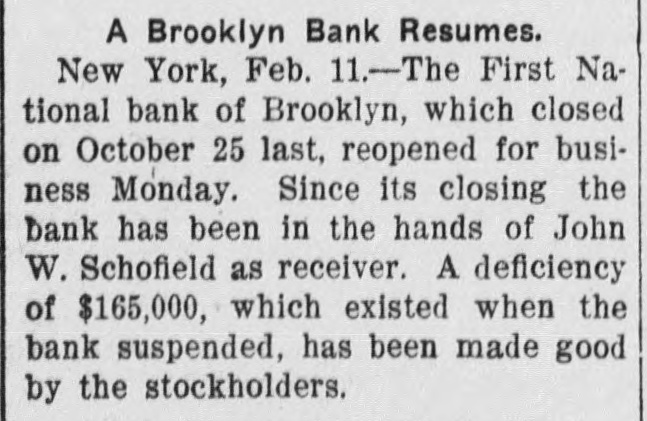
A Brooklyn Bank Resumes. New York, Feb. 11.-The First National bank of Brooklyn, which closed on October 25 last, reopened for business Monday. Since its closing the bank has been in the hands of John W. Schofield as receiver. A deficiency of $165,000, which existed when the bank suspended, has been made good by the stockholders.


Article from The Springfield Herald, February 14, 1908

Click image to open full size in new tab

Article Text

the Pennsylvania capitol graft In the names of ex-Gov. Pennypacker trials and former Attorney General case Carson were brought into the some sensational testimony given to in by Stanford B. Lewis, assistant Architect Huston. A young man who formerly worked the Kansas City street department in and in other occupations throughout the west has fallen heir to an English the title and valuable estates by Cavedeath of his father, Sir Genile Browne-Cave. Warrensburg. Mo., voted "dry" recently by a majority of 143 votes. Ten men are dead as the result of an explosion in a coal mine at Port Hood, Nova Scotia. Charles W. Morse, the multi-mil- New lionaire who disappeared from LiverYork recently, has arrived at pool on the liner Campania. Gov. Hoch has refused to accept the of State Dairy Commissioner Wilson, bond given by the United States Fidelity and Guaranty company, which is fighting a suit by the state bank relating to the First National bond of $250,000. The act of congress of June 1, 1898, prohibiting railroad companies from of discriminating against members of labor organizations in the matter employment has been declared uncon- sustitutional by the United States preme court. The Northern Pacific Railroad comhas been fined $100 at Helena, law pany Mont., for violating the 16-hour compelling a crew to work 23 consecutive by hours. The case will be ap pealed to test the law. The Santa Fe has annulled ten of in principal local passenger trains its Kansas. Decrease in the road's earnings is given as the cause. John Mitchell, president of the is United Mine Works, declares there little possibility of labor organizations comentering the political field in the ing campaign. The British foreign office officially denies that a squadron of war vessels is to be sent to the Pacific. A receiver has been asked for the National Hollow Brake Beam company of Chicago. The president has nominated George L. Grigsby to be United States attorney for the district of Alaska. The "Hobo" congress at St. Louis has adopted resolutions demanding that the government provide national insurance for citizens against enforced idleness or "involuntary unemployment.' Kansas prison twine will be sold this year for 7 1/2 cents a pound in orders for 5,000 pounds or over. Opposition has developed in Penn- late sylvania to placing a statue of the of Senator M. S. Quay in the rotunda the new state capitol at Harrisburg. The coldest weather in five years was recently experienced in eastern Pennsylvania and New York. The national convention of the socialist party will be held in Chicago on May 10. A dispatch from the Spanish frontier says that a Portugese republic has been proclaimed at Oporto and has that a provisional government been established in that city. The Indiana republicans have selected their district delegates to the national convention. The delegation will be a unit for Vice President Fair banks. The First National bank of Brookwhich suspended several months ago, lyn, has resumed business. Tulsa, Ok., has adopted the commission form of municipal government. The cruiser South Dakota built at the Union Iron works in California has been placed in commission. Coal operators in the Oklahoma field inhave so far refused to grant an crease in wages to miners and unless such action is taken before April 1 a strike of 10,000 will result. Harry K. Thaw has instructed his a counsel that they must take some action at once looking to his release from Matteawan asylum.


Article from Rocky Ford Enterprise, February 14, 1908

Click image to open full size in new tab

Article Text

packer and former Attorney General Carson were brought into the case in some sensational testimony given by Sta-ford B. Lewis, assistant to Architect Huston. A young man who formerly worked in the Kansas City street department and in other occupations throughout the west has fallen heir to an English title and valuable estates by the death of his father, Sir Genile CaveBrowne-Cave. Warrensburg. Mo., voted "dry" recently by a majority of 143 votes. Ten men are dead as the result of an explosion in a coal mine at Port Hood, Nova Seotia. Charles W. Morse, the multi-millionaire who disappeared from New York recently. has arrived at Liverpool on the liner Campania. Gov. Hoch has refused to accept the bond of State Dairy Commissioner Wilson, given by the United States Fidelity and Guaranty company. which is fighting a suit by the state relating to the First National bank bond of $250,000. The act of congress of June 1. 1898. prohibiting railroad companies from discriminating against members of labor organizations in the matter of employment has been declared unconstitutional by the United States su. preme court. The Northern Pacific Railroad company has been fined $100 at Helena. Mont., for violating the 16-hour law by compelling a crew to work 23 consecutive hours. The case will be ap pealed to test the law. The Santa Fe has annulled ten of its principal local passenger trains in Kansas. Decrease in the road's earnings is given as the cause. John Mitchell, president of the United Mine Works, declares there is little possibility of labor organizations entering the political field in the coming campaign. The British foreign office officially denies that a squadron of war vessels is to be sent to the Pacific. A receiver has been asked for the National Hollow Brake Beam company of Chicago. The president has nominated George L. Grigsby to be United States at Louis attorney The "Hobo" for the congress district of Alaska. St. has adopted resolutions demanding that the government provide national Insurance for citizens against enforced Idleness or "involuntary unemployment." Kansas prison twine will be sold this year for 7 1/2 cents a pound in orders for 5,000 pounds or over. Opposition has developed in Penn. sylvania to placing a statue of the late Senator M. S. Quay in the rotunda of the new state capitol at Harrisburg. The coldest weather in five years was recently experienced in eastern Pennsylvania and New York. The national convention of the socialist party will be held in Chicago on May 10. A dispatch from the Spanish frontier says that a Portugese republic has been proclaimed at Oporto and that a provisional government has : been established in that city. The Indiana republicans have selected their district delegates to the national convention. The delegation will be a unit for Vice President Fairbanks. The First National bank of Brooklyn. which suspended several months ago, has resumed business. Tulsa, Ok., has adopted the commission form of municipal government. The cruiser South Dakota built at the Union Iron works in California has been placed in commission. Coal operators in the Oklahoma field have so far refused to grant an increase in wages to miners and unless such action is taken before April strike of 10,000 will result. Harry K. Thaw has instructed his counsel that they must take some action at once looking to his release from Matteawan asylum. Personal. William J. Bryan addressed the Civic Forum at Carnegie hall. New York, recently on the subject, "Thou Shalt Not Steal." Ex-Premier Franco, of Portugal, who fled from Lisbon after the assassination of King Carlos, has arrived in Paris. His ultimate destination is Switzerland. Charles H. Danner of Fort Scott I has been chosen president of the Kansas State Society of Labor. Dr. W. H. Carruth has returned to the Kansas university after six months spent in Germany. E. S. D. Shortridge, former governor of North Dakota, is dead, at Devil's Lake. Gen. O. 11. Lagrange, governor of the National Soldiers' home at Saw-


Article from The Birmingham Age-Herald, March 12, 1908

Click image to open full size in new tab

Article Text

FINANCIAL BILL HOTLY DENOUNCED Senator Clarke of Arkansas Hits Several Fierce Blows ALDRICH ATTEMPTS REPLY Investigation of Causes of the Panic Is Demanded by Senator Clarke, Who Also Denounces New York Stock Exchange. Washington, March 11.-Senator Clarke of Arkansas denounced the pending currency bill in a speech in the Senate today, declaring that no currency legislation should be enacted until an investigation is held as to the causes of the panic. "No such legislation is necessary now, said Mr. Clarke. "It is not only not necesI sary, but it may become dangerous. am not disposed to tolerate the idea of giving any support to the committee bill, nor the substitute proposed by the minority members of the Senate." If emergency currency is to be provided, Mr. Clarke said, the benefits should be extended all persons whose legitimate business demands cause them to need it. Mr. Clarke denounced the operations of stock exchanges and said the American people would not be satisfied with the proposed currency legislation without a complete knowledge of causes of the panic. "The time has arrived," he said, "when the affairs of the New .York stock exchange and other stock exchanges must be looked into." Mr. Clarke's reference to the stoppage of the payments by the New York banks called Mr. Aldrich to his feet with the remark that he did not believe the people would permit that course again to be pursued. "I trust the senator from Rhode Island as a historian," retorted Mr. Clarke, "but I do not trust him as a prophet." Mr. Clarke expressed the opinion that the majority would not pass the bill allowing the emergency circulation to be retired without limitation. Mr. Clarke said he would not only require a restriction of reserves, but he would deny to a national bank the right to pay interest on checking accounts. Senator Nelson suggested that the national banks should pay interest on the $250,000,000 of government deposits. Mr. Aldrich said that five years ago he had introduced a bill providing for the payment of interest on such deposits at the rate of 1 1/2 per cent, but, he added, senators had opposed that bill on the ground that it changed the nature of the loan. Former Senator Spooner and the late Senator Morgan, he said, opposed the bill. If that objection could be overcome he declared his willingness to again bring in such a measure. He did not know any reason unless it should be a legal one, of the kind suggested, why interest should not be charged on these deposits. Mr. Culberson, he said, had introduced a bill to require payment of interest on government deposits and it was now before the committee on finance. Mr. Bailey spoke at some length suggesting that the main purpose of his substitute was to favor the principle of government money instead of bank money He explained that he had provided for a distribution of the emergency currency in accordance with population, although he realized that business necessity was a greater measure of the amount they should have. But it was not possible to make sure of the business needs of the several sections and it was a simple matter to ascertain the population. An extended argument was made by Mr. Newlands of Nevada in favor of his view that the sending of a check from one state to another makes the business of banking interstate commerce.


Article from New-York Tribune, March 17, 1908

Click image to open full size in new tab

Article Text

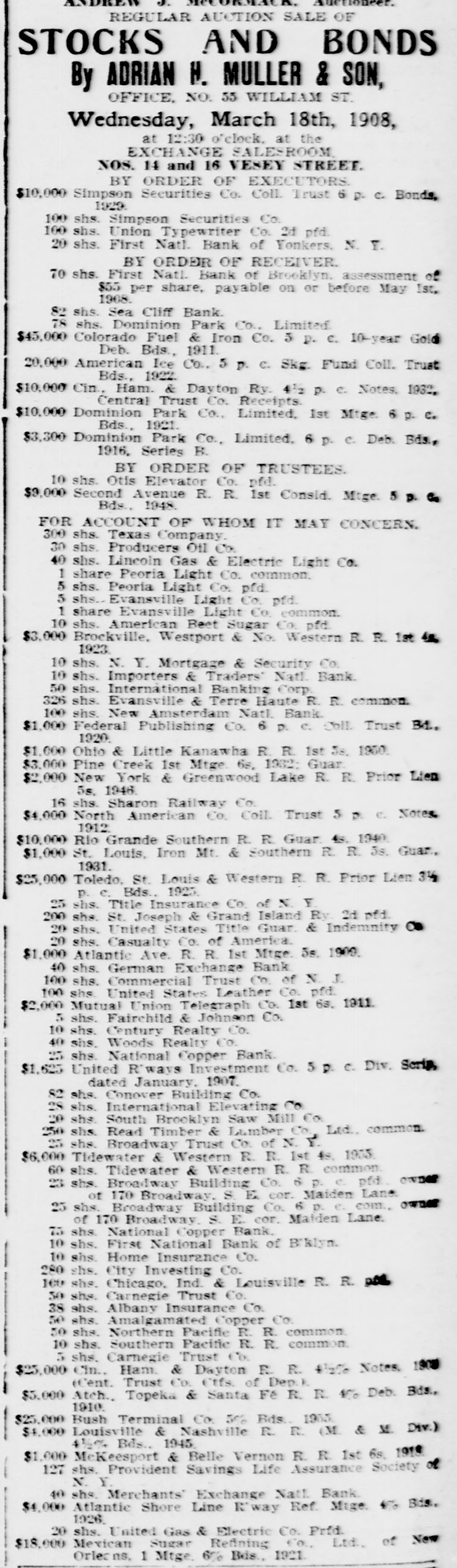
REGULAR AUCTION SALE OF STOCKS AND BONDS By ADRIAN H. MULLER & SON, OFFICE, NO. 55 WILLIAM ST. Wednesday, March 18th, 1908, at 12:30 o'clock. at the EXCHANGE SALESROOM NOS. 14 and 16 VESEY STREET BY ORDER OF EXECUTORS $10,000 Simpson Securities Co. Coll. Trust c. Bonds, 1929 100 shs. Simpson Securities Co. 100 shs. Union Typewriter Co. 2d pfd. 20 shs. First Natl. Bank of Yonkers. N. Y. BY ORDER OF RECEIVER 70 shs. First Nati. Bank of Brooklyn. assessment of $55 per share, payable on or before May 1st, 1908. 82 shs. Sea Cliff Bank. 78 shs. Dominion Park Co., Limited $45,000 Colorado Fuel & Iron Co. 3 D. c. 10-year Gold Deb. Bds., 1911. 20,000 American Ice Co., 5 p. c. Skg. Fund Coll. Trust Bds., 1922 $10,000 Cin., Ham. & Dayton Ry. 412 p. โ‚ฌ. Notes. 1932, Central Trust Co. Receipts. $10,000 Dominion Park Co., Limited, 1st Mige 6 p. C. Bds., 1921 $3,300 Dominion Park Co., Limited. 6 p. c. Deb. Bds, 1916, Series B. BY ORDER OF TRUSTEES. 10 shs. Otis Elevator Co. pfd. $9,000 Second Avenue R. R. 1st Consid. Mtge. 5 p. a Bds. 1948. FOR ACCOUNT OF WHOM IT MAY CONCERN. 300 shs. Texas Company. 30 shs. Producers Oil Co. 40 shs. Lincoln Gas & Electric Light Co. 1 share Peoria Light Co. common 5 shs. Peoria Light Co. pfd. 5 shs.. Evansville Light Co. pfd. 1 share Evansville Light Co. common 10 shs. American Beet Sugar โ‚ฌa pfd. $3,000 Brockville, Westport & No. Western R. R. 1st is 1923 10 shs. N. Y. Mortgage & Security โ‚ฌ0. 10 shs. Importers & Traders' Natl Bank 50 shs. International Banking Corp. 326 shs. Evansville & Terre Haute R. R. common 100 shs. New Amsterdam Natl. Bank $1,000 Federal Publishing Ca. 6 D. โ‚ฌ. Coll. Trust 3d., 1920. $1,000 Ohio & Little Kanawha R. R. 1st 3s. 1900 $3,000 Pine Creek 1st Mtge. 6s, 1932: Guar $2,000 New York & Greenwood Lake R. R. Prior Lien 5s. 1946 16 shs. Sharon Railway โ‚ฌo. $4,000 North American Co. Coil. Trust 5 p. โ‚ฌ. Notes. 1912 $10,000 Rio Grande Southern R. R Guar 4s. 1940 $1,000 St. Louis. Iron Mt. & Southern R. R. 3s. Guar. 1931. $25,000 Toledo, St. Louis & Western R. R. Prior Lien 31 p. โ‚ฌ. Bds. 1925 25 shs. Title Insurance Co of N. F 200 shs. St. Joseph & Grand Island Rv 2d ofd. 20 shs. United States Title Guar. & Indemnity 8 20 shs. Casualty Co. of America. $1,000 Atlantic Ave. R. R. 1st Mige 5s. 1909. 40 shs. German Exchange Bank 100 shs. Commercial Trust Co. of N. J. 100 shs United States Leather Co. pfd. $2,000 Mutual Union Telegraph Ca 1st 6s. 1911 5 shs. Fairchild & Johnson Co. 10 shs. Century Realty Co. 40 shs. Woods Realty Co. $1,625 25 shs. United National R'ways Copper Investment Bank. Co. 5 p c. Div. Scrip, dated January, 1907. 82 shs. Conover Building Co. 28 shs. International Elevating Co. 20 shs. South Brooklyn Saw Mill Ca 250 shs. Read Timber & Lumber Co. Ltd. common 25 shs. Broadway Trust Co. of N. Y. $6,000 Tidewater & Western R. R. 1st 4s. 1903 60 shs. Tidewater & Western R. R. common owner 23 shs. Broadway Building Co. 6 p. e. pfd of 170 Broadway. S E. cor. Maiden Lane owner 25 shs. Broadway Building Co. 6 D. โ‚ฌ. com. of 170 Broadway S. E. cor. Maiden Lane. 75 shs. National Copper Bank. 10 shs. First National Bank of Biklyn. 10 shs. Home Insurance Co. 280 shs. City Investing Co. 100 shs. Chicago, Ind. & Louisville R. R. so shs. Carnegie Trust โ‚ฌo. 38 shs. Albany Insurance Co. se shs. Amalgamated Copper โ‚ฌ0. 50 shs. Northern Pacific R. R. common 10 shs. Southern Pacitic R. R. common 5 shs. Carnegie Trust Co. $25,000 Cin.. Ham. & Dayton F. R. 4120 Notes. (Cent. Trust Co. Ctfs. of Dep.). $5,000 Atch. Topeka & Santa Fรฉ R. R. 4% Deb. Bds., 1910. $25,000 $4,000 Bush Louisville Terminal & Nashville Co. 5% Rds. R. R. 1965 (M. & M Div.) 41/2% Bds 1945 1918 $1,000 McKeesport & Belle Vernon R. R. 1st 6s. 127 shs. Provident Savings Life Assurance Society of N. Y 40 shs. Merchants' Exchange Nati Bank $4,000 Atlantic Shore Line R'way Ref. Mige 4% Bds. 1926 shs. United Gas & Electric Co. Prfd. $18,000 20 Mexican Sugar Refining โ‚ฌ0. Ltd. of New Orles 1 Mtge. 6% Bds., 1921

Article from The Star and Newark Advertiser, April 15, 1908

Click image to open full size in new tab

Article Text

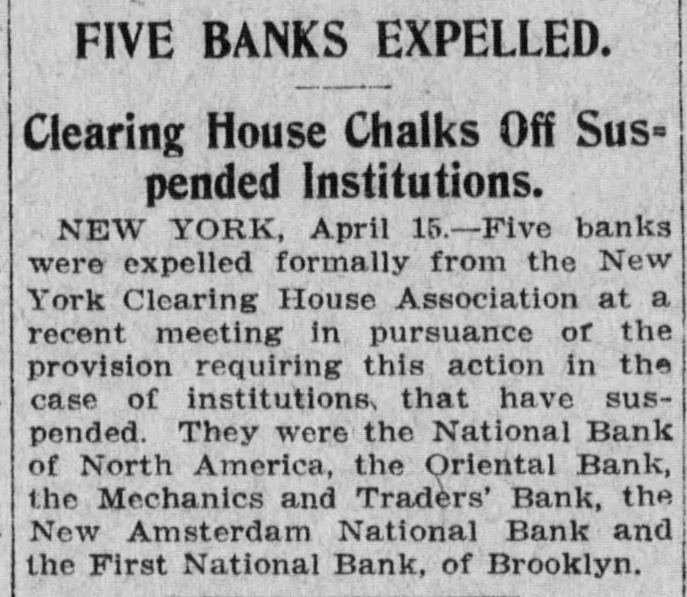
FIVE BANKS EXPELLED. Clearing House Chalks Off Sus= pended Institutions. NEW YORK, April 15.-Five banks were expelled formally from the New York Clearing House Association at a recent meeting in pursuance or the provision requiring this action in the case of institutions. that have suspended. They were the National Bank of North America, the Oriental Bank, the Mechanics and Traders' Bank, the New Amsterdam National Bank and the First National Bank, of Brooklyn.