gpt-5-mini (chosen from majority vote of a three-model LLM ensemble)
Short Digest
96620a40ceca6c5b
Response Measures
None
Description
Articles primarily describe the broad New York banking suspension/panic and a Brooklyn First National; the specific NYC First National is not clearly named as suspended.
Events (4)
1.September 10, 1907Chartered
Source
historical_nic
2.October 25, 1907Suspension
Cause
Macro News
Cause Details
Systemic financial panic of October 1907 led New York banks to suspend cash payments and invoke 30–90 day by-law provisions.
Newspaper Excerpt
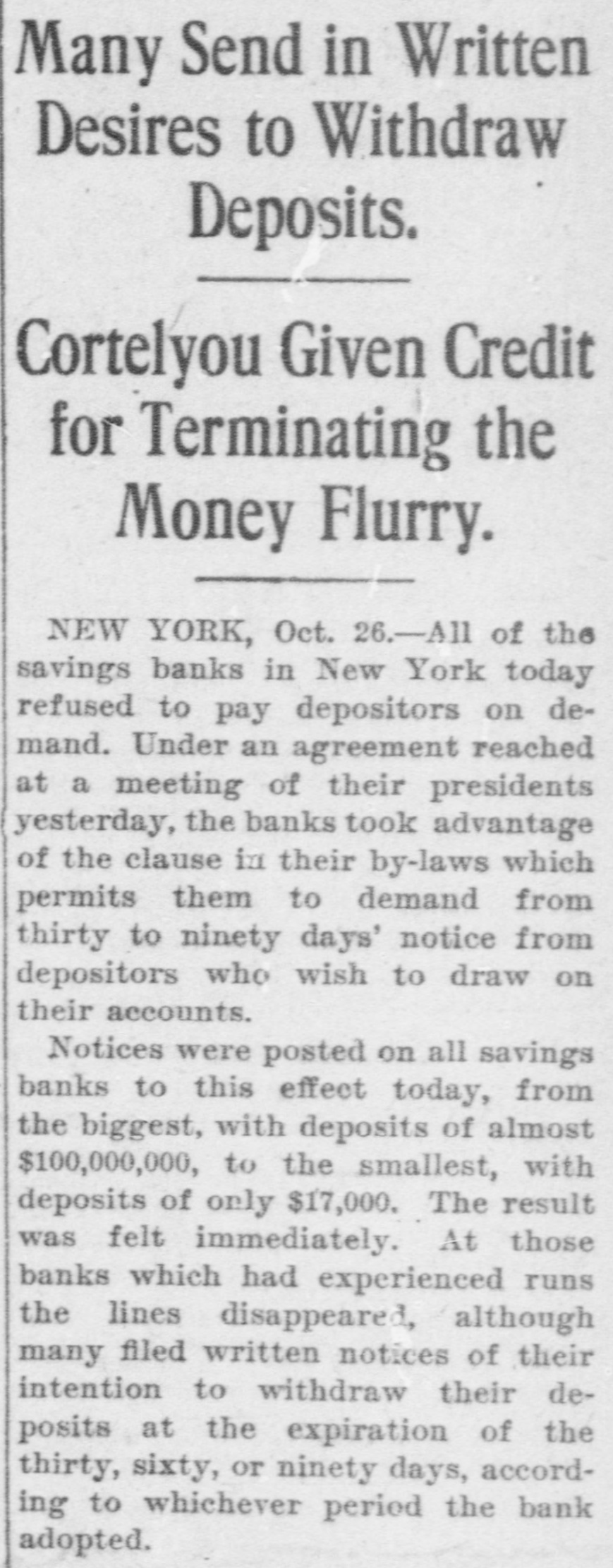
All of the savings banks in New York today refused to pay depositors on demand.
Source
newspapers
3.December 3, 1907Reopening
Newspaper Excerpt
The New York banks have been announcing for some time that specie payments are about to be resumed.
Source
newspapers
4.July 19, 1922Voluntary Liquidation
Source
historical_nic
Newspaper Articles (23)
1.October 24, 1907The Evening StatesmanWalla Walla, WA
Click image to open full size in new tab
Article Text
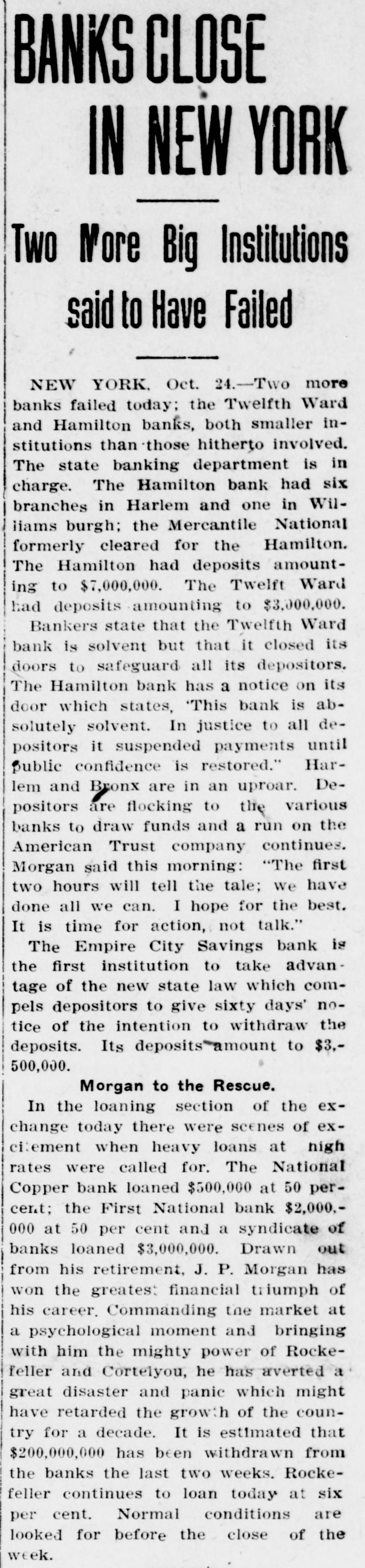
BANKS CLOSE IN NEW YORK Two More Big Institutions said to Have Failed NEW YORK. Oct. 24.-Two more banks failed today; the Twelfth Ward and Hamilton banks, both smaller institutions than those hitherto involved. The state banking department is in charge. The Hamilton bank had six branches in Harlem and one in Wiliiams burgh; the Mercantile National formerly cleared for the Hamilton. The Hamilton had deposits amounting to $7,000,000. The Twelft Ward had deposits amounting to $3,000,000. Bankers state that the Twelfth Ward bank is solvent but that it closed its doors to safeguardo all its depositors. The Hamilton bank has a notice on its door which states, 'This bank is absolutely solvent. In justice to all depositors it suspended payments until public confidence is restored." Harlem and Bronx are in an uproar. Depositors are flocking to the various banks to draw funds and a run on the American Trust company continues. Morgan said this morning: "The first two hours will tell the tale; We have done all we can. I hope for the best. It is time for action, not talk." The Empire City Savings bank is the first institution to take advantage of the new state law which compels depositors to give sixty days' notice of the intention to withdraw the deposits. Its deposits"amount to $3.500,000. Morgan to the Rescue. In the loaning section of the exchange today there were scenes of excitement when heavy loans at high rates were called for. The National Copper bank loaned $500,000 at 50 percent; the First National bank $2,000.000 at 50 per cent and a syndicate of banks loaned $3,000,000. Drawn out from his retirement, J. P. Morgan has won the greates: financial triumph of his career. Commanding the market at a psychological moment and bringing with him the mighty power of Rockefeller and Cortelyou, he has averted a great disaster and panic which might have retarded the growth of the country for a decade. It is estimated that $200,000,000 has been withdrawn from the banks the last two weeks. Rockefeller continues to loan today at six per cent. Normal conditions are looked for before the close of the week.
2.October 26, 1907Deseret Evening NewsSalt Lake City, UT
Click image to open full size in new tab
Article Text
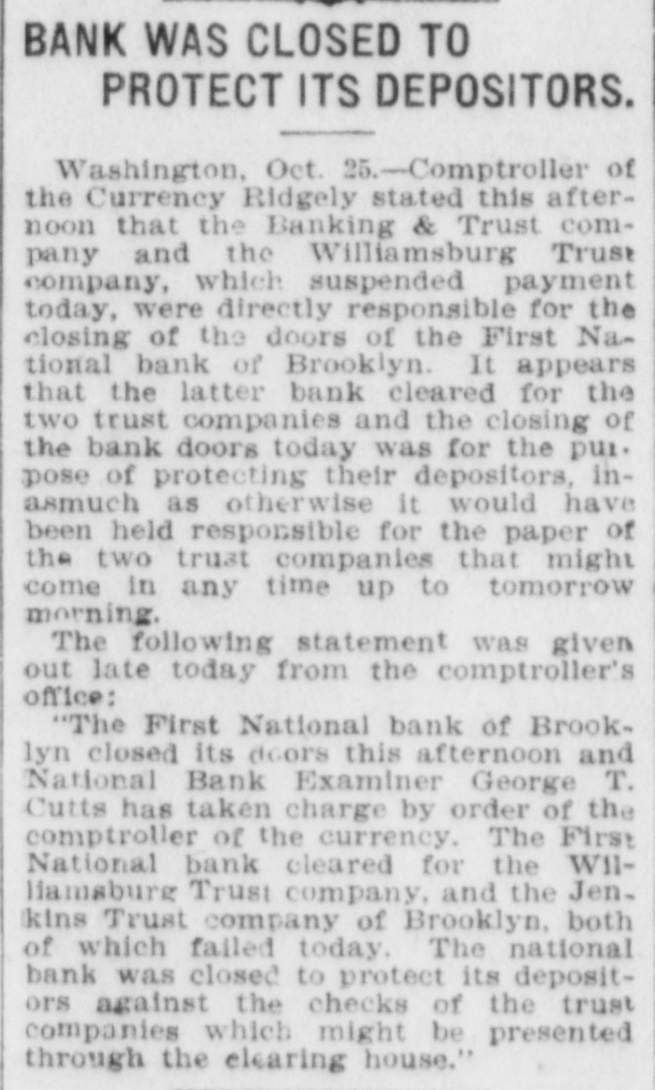
BANK WAS CLOSED TO PROTECT ITS DEPOSITORS. Washington, Oct. 25.-Comptroller of the Currency Ridgely stated this afternoon that the Banking & Trust company and the Williamsburg Trust company, which suspended payment today, were directly responsible for the closing of the doors of the First National bank of Brooklyn. It appears that the latter bank cleared for the two trust companies and the closing of the bank doors today was for the pui. pose of protecting their depositors, inasmuch as otherwise it would have been held responsible for the paper of the two trust companies that might come in any time up to tomorrow morning. The following statement was given out late today from the comptroller's office: "The First National bank of Brooklyn closed its doors this afternoon and National Bank Examiner George T. Cutts has taken charge by order of the comptroller of the currency. The First National bank cleared for the WilHamsburg Trust company, and the Jenkins Trust company of Brooklyn, both of which failed today. The national bank was closed to protect its depositors against the checks of the trust companies which might be presented through the elearing house."
3.October 26, 1907The Washington TimesWashington, DC
Click image to open full size in new tab
Article Text
Many Send in Written Desires to Withdraw Deposits. Cortelyou Given Credit for Terminating the Money Flurry. NEW YORK, Oct. 26.-All of the savings banks in New York today refused to pay depositors on demand. Under an agreement reached at a meeting of their presidents yesterday, the banks took advantage of the clause in their by-laws which permits them to demand from thirty to ninety days' notice from depositors who wish to draw on their accounts. Notices were posted on all savings banks to this effect today, from the biggest, with deposits of almost $100,000,000, to the smallest, with deposits of only $17,000. The result was felt immediately. At those banks which had experienced runs the lines disappeared, although many filed written notices of their intention to withdraw their deposits at the expiration of the thirty, sixty, or ninety days, according to whichever period the bank adopted.
4.October 26, 1907New-York TribuneNew York, NY
Click image to open full size in new tab
Article Text
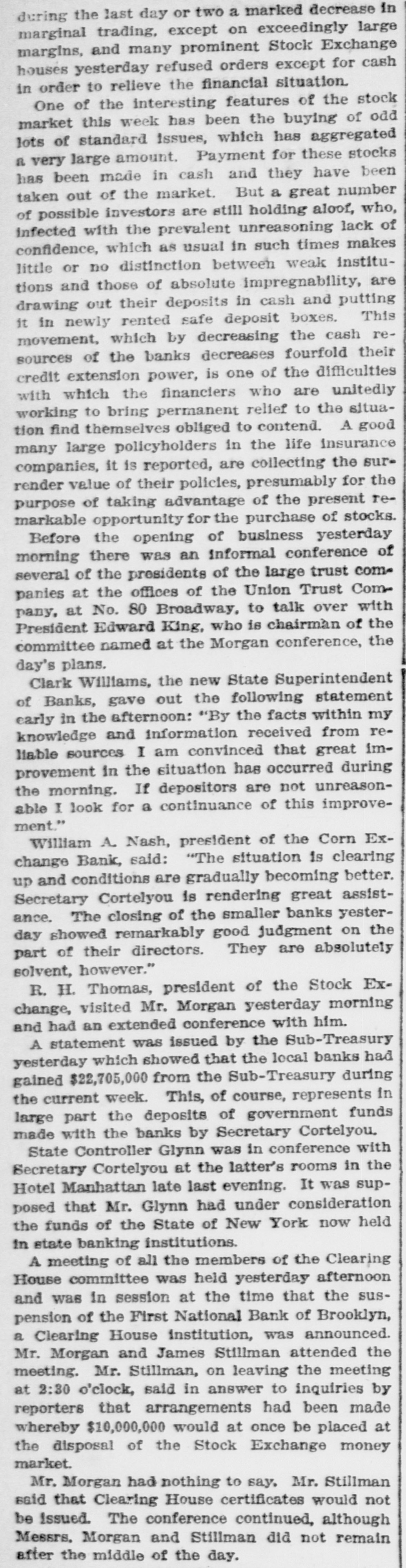
during the last day or two a marked decrease in marginal trading, except on exceedingly large margins, and many prominent Stock Exchange houses yesterday refused orders except for cash in order to relieve the financial situation. One of the interesting features of the stock market this week has been the buying of odd lots of standard issues, which has aggregated a very large amount. Payment for these stocks has been made in cash and they have been taken out of the market. But a great number of possible investors are still holding aloof, who, infected with the prevalent unreasoning lack of confidence, which as usual in such times makes little or no distinction between weak institutions and those of absolute impregnability, are drawing out their deposits in cash and putting it in newly rented safe deposit boxes. This movement, which by decreasing the cash resources of the banks decreases fourfold their credit extension power, is one of the difficulties with which the financiers who are unitedly working to bring permanent relief to the situation find themselves obliged to contend. A good many large policyholders in the life insurance companies, it is reported, are collecting the surrender value of their policies, presumably for the purpose of taking advantage of the present remarkable opportunity for the purchase of stocks. Before the opening of business yesterday morning there was an informal conference of several of the presidents of the large trust companies at the offices of the Union Trust Company, at No. 80 Broadway, to talk over with President Edward King, who is chairman of the committee named at the Morgan conference, the day's plans. Clark Williams, the new State Superintendent of Banks, gave out the following statement early in the afternoon: "By the facts within my knowledge and information received from reliable sources I am convinced that great improvement in the situation has occurred during the morning. If depositors are not unreasonable I look for a continuance of this improvement." William A. Nash, president of the Corn Exchange Bank, said: "The situation is clearing up and conditions are gradually becoming better. Secretary Cortelyou is rendering great assistance. The closing of the smaller banks yesterday showed remarkably good judgment on the part of their directors. They are absolutely solvent, however." R. H. Thomas, president of the Stock Exchange, visited Mr. Morgan yesterday morning and had an extended conference with him. A statement was issued by the Sub-Treasury yesterday which showed that the local banks had gained $22,705,000 from the Sub-Treasury during the current week. This, of course, represents in large part the deposits of government funds made with the banks by Secretary Cortelyou. State Controller Glynn was in conference with Secretary Cortelyou at the latter's rooms in the Hotel Manhattan late last evening. It was supposed that Mr. Glynn had under consideration the funds of the State of New York now held in state banking institutions. A meeting of all the members of the Clearing House committee was held yesterday afternoon and was in session at the time that the suspension of the First National Bank of Brooklyn, a Clearing House institution, was announced. Mr. Morgan and James Stillman attended the meeting. Mr. Stillman, on leaving the meeting at 2:30 o'clock, said in answer to inquiries by reporters that arrangements had been made whereby $10,000,000 would at once be placed at the disposal of the Stock Exchange money market. Mr. Morgan had nothing to say. Mr. Stillman said that Clearing House certificates would not be issued. The conference continued, although Messrs. Morgan and Stillman did not remain after the middle of the day.
5.October 28, 1907New-York TribuneNew York, NY
Click image to open full size in new tab
Article Text
any other institution for the time," he said. "All of the other members of the Clearing House received the same instruction regarding the banks for whom they were clearing That order left us without means of getting cash. We have as good securities as any other bank in the country, but when we were unable to get money upon them we had no alternative but to close our doors. The Clearing House is doing everything that it can to improve the present situation, and as soon as this flurry is over I suppose it will rescind its order regarding clearing. Of course only a certain number of banks can be members of the Clearing House, and the other banks have to clear through them. "The state accountants are still going over our books, and they will not report probably until Tuesday or later. Our bank is entirely sound. The rumor that politicians have had preferences shown them by us is entirely unfounded. As for the International Trust Company, we had never gone into that concern. The action was only proposed, but was not carried out, and now will not be." The Jenkins Trust Company, the First National Bank. the Terminal Bank, the Williamsburg Trust Company and its branches, generally known as the "Jenkins banks," it was generally understood yesterday would reopen on Tuesday. The federal and state examiners, according to the directors, have found the institutions solvent and in a position to continue doing business as soon as the ready cash was obtained. President John G. Jenkins, jr., said yesterday he did not propose to open the Williamsburg Trust Company's offices until he was satisfied he could do SO without closing his doors again. He said that his bank would never have been compelled to close up had it not been for the run which used up all the available cash. A movement is on foot, according to Jullan D. Fairchild, president of the Kings County Trust Company, to bring the banks and the trust companies closer together. "We do not need a clearing house in Brooklyn, as has been suggested," he said yesterday. "We want only one such institution. What we do want is a closer connection between the banks and the trust companies. The trust companies should go into the clearing house, either as regular or as associate members. The trust companies, like the banks, should make weekly reports concerning themselves. That would give people a reliable understanding of the banking situation of the city's institutions. The trust companies have as much. if not more, money on deposit than the banks have, and yet at present they do not take steps to keep the public informed concerning themselves. This crisis may result in bringing them into closer relation with the banks. I do not think that they should be compelled to keep on hand such large reserves as the banks. The banks must have 25 per cent of their deposits, but the trust companies are not required to keep more than about 12 per cent on hand. Their deposits are slower. not so liable to be paid out and their securities are better. The Clearing House and the trust companies should be able to determine upon some equitable arrangement whereby the trust companies could become members or associate members of the former."
BIG SHIPMENTS OF GOLD FROM EUROPE New York Bankers Have Aid on Ocean MANY MILLIONS IN CASH Bank "Run Lines"- are Dwinding Away and Deposits are Beginning to Exceed Withdrawals. NEW YORK, Oct. 29. Announcement is made that $25,000,000 in gold has been engaged in Europè to meet the demands for ready currency in New York, and some of it is already on its way. More gold will be engaged for shipment during the week. It is evident that the financial hysteria is dying a rapid death of wet feet arising from the weather and cool headedness arising from sober and saner second thought. The Trust Company of America, upon which a run has continued three days, found as the result of the day's business that they had had deposits in excess of withdrawals of $296,000. They had also been able to collect $223,000 of outstanding loans, so that the net outcome for the day was an increase in cash of $519,000. The report that has gained much credence here to the effect that the big life insurance companies had decided to extend the time within which premiums might be paid proves incorrect. It appears to have been based on a misapprehension of facts. Except at the Northern bank in Broadway every "run line" showed a marked dwindling away at both ends as the day om the head, where persons were being paid off, and from the tall, where men and women, tired out with waiting in the cold and wet, were going home. In Washington Secretary Cortelyou stated that he had received reassuring reports from New York, Chicago and other points and that everywhere confidence is being restored and conditions are much improved. The market opened strong and remained steady, a pretty good barometer of the general sentiment. All along the line a more optimistic feeling was shown. It was announced that two more of the over the river concerns which suspended temporarily last week, the Williamsburg Trust company and the First National bank of Brooklyn, would resume business inside of forty-eight hours. William H. S. Wood, who as president of the Bowery Savings bank guards $100,000,000, belonging to more than 200,000 depositors, mainly the poor of the east side, expresses the opinion the. worst was over. Then he added: "Good has come out of all this. It has proved that the savings banks of New York are substantial." Mr. Wood is looked upon as a financial prophet, for he foretold the present panie more than three months ago. He then looked into the future and weighed the causes and effects of prosperity. His own bank had just reached the $100,000,000 deposit record, and It was thought he would take an optimistle view of the business situation and the outlook.
7.October 29, 1907New-York TribuneNew York, NY
Click image to open full size in new tab
Article Text
BOROUGH BANK INQUIRY. Examiners Still Busy Finding Cause of Troubles. Bank examiners have 80 far been unable to reach the bottom of the tangled affairs of the Borough Bank. in Brooklyn, which suspended on Friday coincidently with the suspension of the International Trust Company, of Manhattan, and the Brooklyn Bank, a branch of the International Trust Company Paul Grout, of counsel for the institution, .d after R protracted meeting of the directors yesterday afternoon: "The bank examiners are still busy on our books. Until they have made a report we shall make no statement." This declaration was repeated in reply to several questions regarding a number of stories about the financial methods of the suspended institution. Howard C. Pyle, a Brooklyn real estate man, who started aspetition yesterday among the depositors, expressing their confidence in the bank's management and agreeing to leave their money on deposit for six months, said that this action was taken to forestall the possibility of the appointment of a receiver It is felt that A receivership would be distinctly against the best interests of the depositors. Of the 4,250 depositors not more than a score had signed the petition yesterday, but a meeting of the depositors has been called for 11 o'clock to-morrow morning. It will be held in The Assembly, in Pierrepont street, and at that time some action will be taken to conserve the best interests of the depositors, who represent some $2,500,000 of deposits. It was stated on the day the bank suspended that some $2,000,000 had been drawn out within a week. The Oriental Bank, of Manhattan, suddenly ceased to clear for the Borough Bank about five days before the suspension of the latter. There was a story yesterday that about $500,000 of cotlateral which the Borough Bank was supposed to have on deposit with the Oriental had been found not up to the standard and that this had something to do with the suspension. At the Oriental Bank it was said in connection with these stories: "The International Trust Company does not owe anything to the Oriental Bank and the Borough Bank has only a small loan. amply secured by satisfactory collateral. The Oriental stopped the clearing privilege of the Borough Bank because the balances of the Borough were not up to the requirements of the Oriental Bank.'' Regarding two loans, said to be of $140,000 each, said to have been made to two directors of the International Trust Company from the Borough Bank or the Oriental Bank, representatives of the latter institution said they knew nothing of such loans. William Gow, who organized the International Trust Company and owns a controlling interest in the Borough Bank, was quoted yesterday as saying that the International owed money to the Borough. He refused to go into details. Discussing the possibility of the Borough Bank being able to pay its depositors in full, one of the directors said with emphasis: "The directors will have to see that the depositors are paid. I shall insist upon it." He declared that he personally had not borrowed a dollar from the institution. An Alderman who Is running for re-election in one of the South Brooklyn districts has $10,000 tied up in the Borough Bank. This crippled him so seriously that he had to go to a savings bank yesterday to get some of his nest egg. He was allowed to take $150, and will now be able to carry on his campaign. Of the money tied up in the Borough Bank $83,000 is deposited by the city in the form of certified checks given to the city by contractors as bonds for the fulfilment of contracts. The city will be responsible for this money. Confidence was restored in financial circles in Brooklyn yesterday. The uneasiness which was plainly evident on Saturday had been replaced by assurance that the Brooklyn banking institutions were perfectly sound and that it was the part of folly to withdraw money on deposit in them. It was said to be almost certain that the First National Bank of Brooklyn, the Williamsburg Trust Company and the Jenkins Trust Company would reopen within a few days, or as soon as the bank examiners had made their report. In a majority of the institutions the receipts in cash for the day were far ahead of those taken out by depositors. There was only one institution which had a line at the paying teller's window worthy of notice at the opening of banking hours. This was the Home Trust Company. But by noon the officials of the trust company had established connections with Manhattan Institutions, which gave it more resources than it needed. In the morning the depos-
8.October 30, 1907The Madison Daily LeaderMadison, SD
Click image to open full size in new tab
Article Text
SCARE IS SUBSIDING Runs Upon New York Banks Practically Cease. STOCK MARKET UNSTEADY Calling in of Loans Causes a Decline in Prices, Canadian Pacific Leading in the Slump-Worldwide Scramble for Gold. New York, Oct. 30.-The financial situation is without notable developments. and the abating interest indicates that the public has pretty well gotten over its scare. The stock markets is a little unsteady, but without extreme agitation. The announcement at the ImpeS rial bank of Germany a raised its discount rate from 5 1/2 to 6 1/2 per cent in order to protect its gold holdings was not unexpected by bankers here. It is thought quite likely that the Bank of England will follow suit by raising its rate at the regular meeting on Thursday. The scramble for gold is such at all the financial centersLondon, Paris, Berlin and New York -that the metel will go to the highest bidder and under present conditions New York is likely to appear for a time in this role. Her ability to get gold is due not only to the need for it, but to the large credits which are being established by the movement of the crops and other products-notably wheat, cotton, copper, tobacco and meats-and by the sale of American securities. These influences are usually more potent than artificial measures to obtain the yellow metal. It is believed this will be effective to place sufficient gold at the command of the New York market and to maintain credit and cause the resumption of banking operations in the usual manner within a few days. Runs upon the banks here have practically ceased since the banks adopted the policy of paying large depositors in checks. Some transfers of accounts are being made from the smaller to the larger banks, which resulted in adverse balances against the former, but strengthening the ability of the larger institutions to meet pressure and to support the market.
9.November 30, 1907The Evening WorldNew York, NY
Click image to open full size in new tab
Article Text
$2,000,000 FROM NATIONAL BANK IN JENKINS LOANS Federal Examiners Unearth More Scandal in Brooklyn. BANK'S RECORDS GONE. Clarke District Attorney Traces Last Day Transactions to Save Insiders. Consational as the developments have stone the Kings County Grand Jury took up the investigation of the Berough Bank and the Jenkins Trust Company. more surprising revelations are looloed for in the Federal and county joint investigation of the looting of the First National Bank It is reported by men who have means of knowing what the prelimimary investigation of the National Back Examiners has revealed that the banking members of the Jenkins famBy obtained close to $2,000,000 from that institution while John G. Jenkine, sr., was Hs president. The money was as tained, 1t is alleged. through fake loans such as were made by the Williamsburg Trust Company and the Jenkins Trust Company to the brokerage firm of Frank. & J. G. Jenkins, Jr., & Co. "The First National Bank," said one of the men who knows about it to-day, "he the most hopelessly involved of any of the Brooklyn institutions that failed." Clarke Finds New Frauds. District-Attorney Clarke, with bank examiners and assistants. was busy today arranging his documentary evidence to be presented to the Grand Jury in the Brooklyn bank cases Monday. The betwork of fraud spreads hourly, and it may be days before the District-Attorney can reveal all who are enmeshed. It is known that on the day of the suspension of the bank the notes and forged papers which were used to cover up the crooked transactions of Gow. Maxwell and Campbell were destroyed. However, the District-Attorney. through the confession of Campbell and through the books which were secured from the wreck will be able to build up circumstantial cases. even with the papers absent. Through the evidence of clerks he hopes to be able to establish the identity of every "inside" depositor and director who withdrew his money on the day of the suspension, before and after the bank closed Some of these men are amenable to the law. According to a statement secured from a clerk a prominent city official withdrew $30,000 from the bank after the doors closed t and a false entry was made on the books to conceal the faot. Gow May Accuse Others. Martin W. Littleton. counsel for WillAsm Gow in & proceeding in the Kings h County Supreme Court to-day looking u to the removal of Gow's picture from the Rogues' Gallery, intimated that Gow 11 is not disposed to stand for everything p In his own defense he appears to be determined to drag in other directors F the bank. of 11 Mr. Littleton in his argument made t pointed references to "Honest Bill" Hurley. one of the directors, who has been working night and day since the close of the bank to make up the deg Sciency created by the crooked methods b employed by the officers of the institun tion. It is apparent that Gow will give G the lie to some of the directors who P have maintained that they knew nothing about the the crooked work that was going on. a The directors of the Jenkins Trust R Company are working valiantly to keep 11 the Institution from a permanent receivership. They assort that the directO a ors are willing to leave their money in K the bank for one year If the depositors will agree to limit their withdrawals to 10 per cent. of the total. should the bank be allowed to reopen. The depositors, however. are anxious to know what the Jenkins family in goins to do about repaying the great sums of money borrowed from the Jenkins Trust Company to further various schemes. /
10.December 3, 1907Deseret Evening NewsSalt Lake City, UT
Click image to open full size in new tab
Article Text
# RESUMPTION.
Horace Greely was wont to say that "the way to resume is to resume." The New York banks have been announcing for some time that specie payments are about to be resumed.
It appears that the bankers elsewhere are ready to pay cash as soon as New York decides to keep its promises. It is noted as one peculiar feature of the present panic that some of the New York bankers will become rich because of it.
And we doubt not that the most immediate cause of the suspension of cash payment by the banks all over the country was the stoppage of such payments by the banks in New York.
As long as the banks of that city continue to withhold payment of their obligations, there seems to be no reason why they might not be purchasing the government bonds and so making a profit out of withholding cash payments to the rest of the country. Such a suggestion is made in many quarters, and the way to negative any such suspicion is for the New York banks to pay their obligations inland in the current money of the realm.
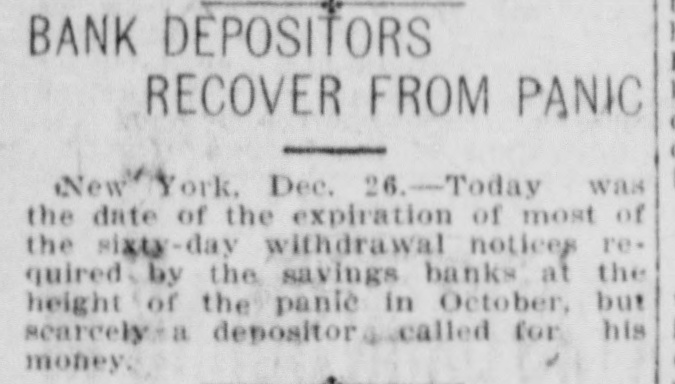
BANK DEPOSITORS RECOVER FROM PANIC (New York. Dec. 26.-Today was the date of the expiration of most of the sixty-day withdrawal notices re. quired by the savings banks at the height of the paniè in October, but searcely a depositor called for his money
12.February 7, 1908The Times DispatchRichmond, VA
Click image to open full size in new tab
Article Text
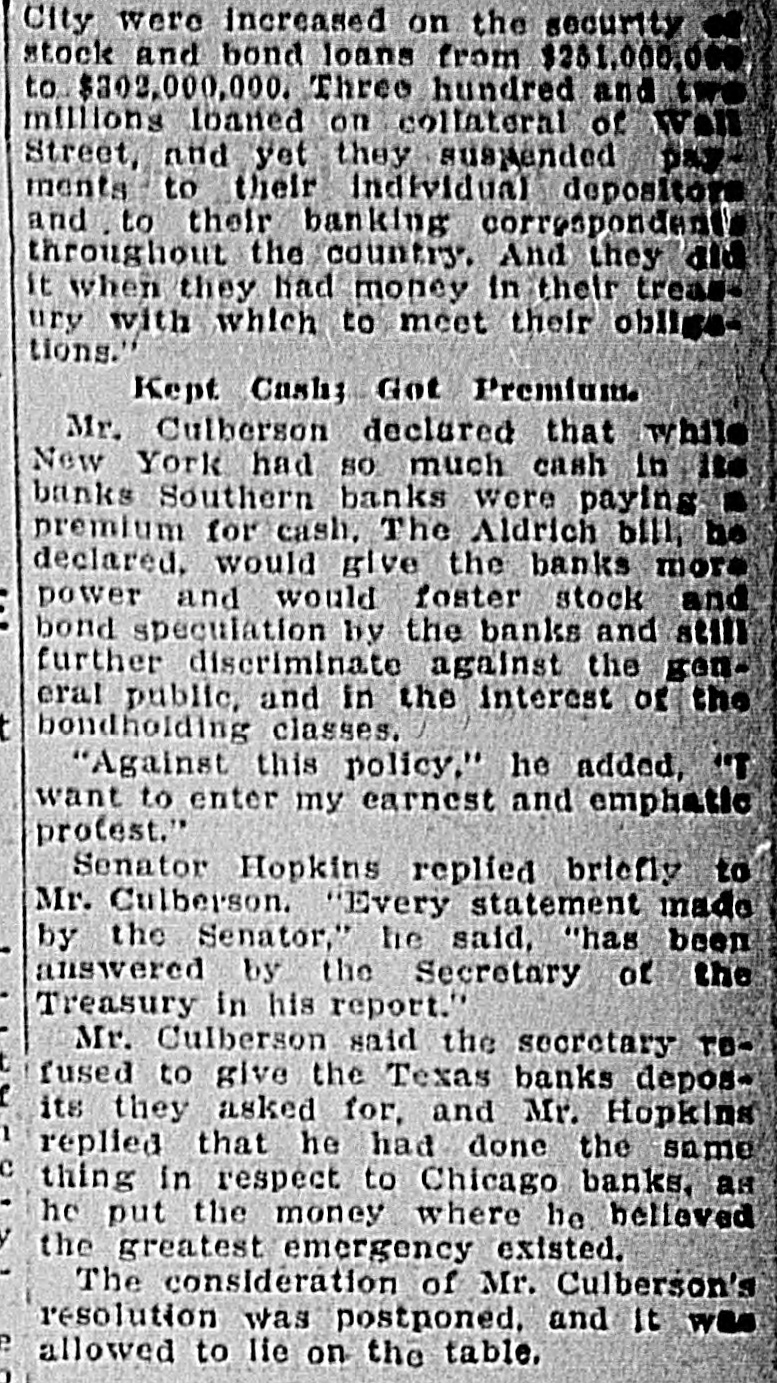
City were increased on the security of stock and bond loans from $281,000,000 to $302,000,000. Three hundred and twelve millions loaned on collateral of Wall Street, and yet they suspended payments to their individual depositors and to their banking correspondents throughout the country. And they did it when they had money in their treasury with which to meet their obliga-tions."
### Kept Cash; Got Premium.
Mr. Culberson declared that while New York had so much cash in its banks Southern banks were paying a premium for cash. The Aldrich bill, he declared, would give the banks more power and would foster stock and bond speculation by the banks and still further discriminate against the general public, and in the interest of the bondholding classes.
"Against this policy," he added, "I want to enter my earnest and emphatic protest."
Senator Hopkins replied briefly to Mr. Culberson. "Every statement made by the Senator," he said, "has been answered by the Secretary of the Treasury in his report."
Mr. Culberson said the secretary refused to give the Texas banks deposits they asked for, and Mr. Hopkins replied that he had done the same thing in respect to Chicago banks, as he put the money where he believed the greatest emergency existed.
The consideration of Mr. Culberson's resolution was postponed, and it was allowed to lie on the table.
13.February 10, 1908The Star and Newark AdvertiserNewark, NJ
Click image to open full size in new tab
Article Text
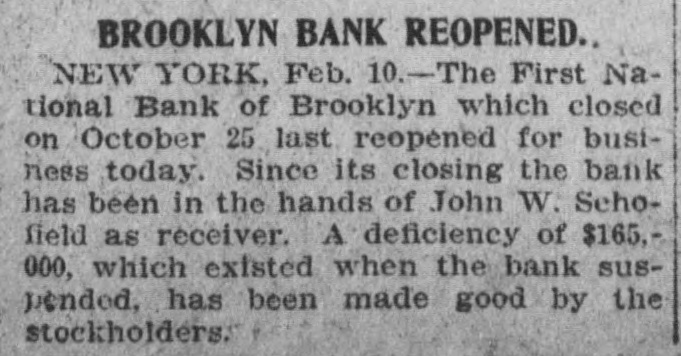
BROOKLYN BANK REOPENED. NEW YORK, Feb. 10.-The First National Bank of Brooklyn which closed on October 25 last reopened for business today. Since its closing the bank has been in the hands of John W. Schofield as receiver. A deficiency of $165,000, which existed when the bank suspendod, has been made good by the stockholders.
14.February 11, 1908New-York TribuneNew York, NY
Click image to open full size in new tab
Article Text
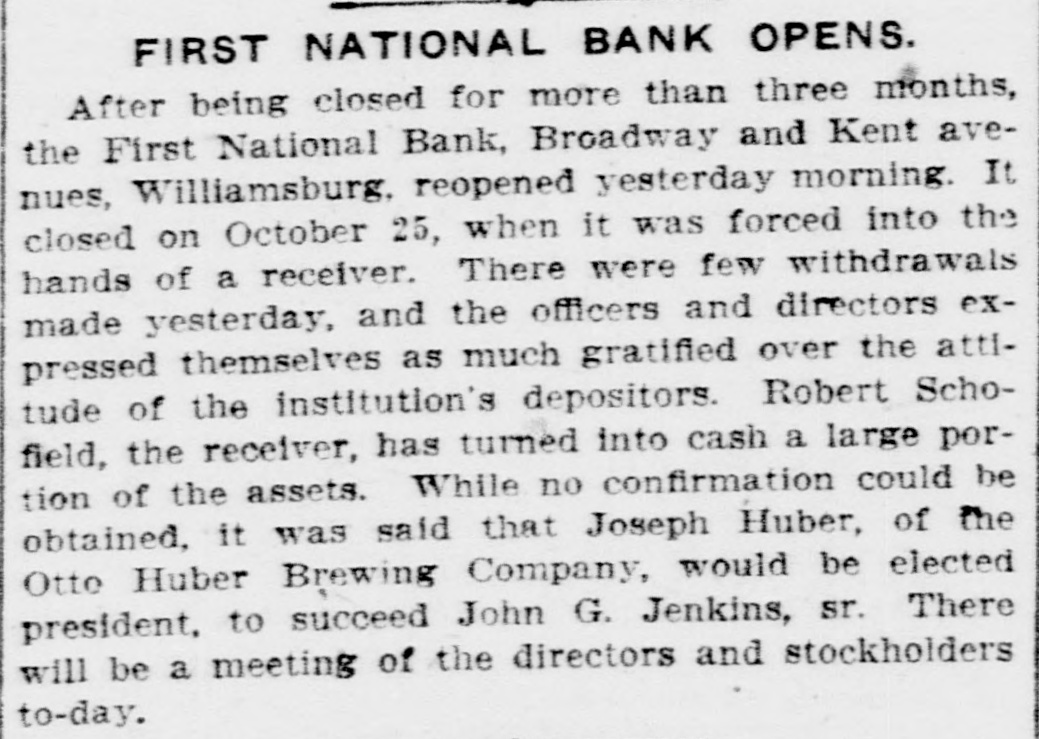
FIRST NATIONAL BANK OPENS. After being closed for more than three months, the First National Bank, Broadway and Kent avenues, Williamsburg. reopened yesterday morning. It closed on October 25, when it was forced into the hands of a receiver. There were few withdrawals made yesterday, and the officers and directors expressed themselves as much gratified over the attitude of the institution's depositors. Robert Schofield, the receiver, has turned into cash a large portion of the assets. While no confirmation could be obtained, it was said that Joseph Huber, of the Otte Huber Brewing Company, would be elected president, to succeed John G. Jenkins, sr. There will be a meeting of the directors and stockholders to-day.
15.February 11, 1908The Birmingham Age-HeraldBirmingham, AL
Click image to open full size in new tab
Article Text
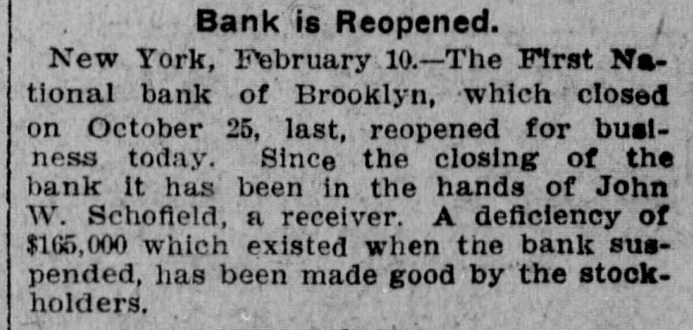
Bank is Reopened. New York, February 10.-The First National bank of Brooklyn, which closed on October 25, last, reopened for business today. Since the closing of the bank it has been in the hands of John W. Schofield, a receiver. A deficiency of $165,000 which existed when the bank suspended, has been made good by the stockholders.
16.February 13, 1908The Globe-RepublicanDodge City, KS
Click image to open full size in new tab
Article Text
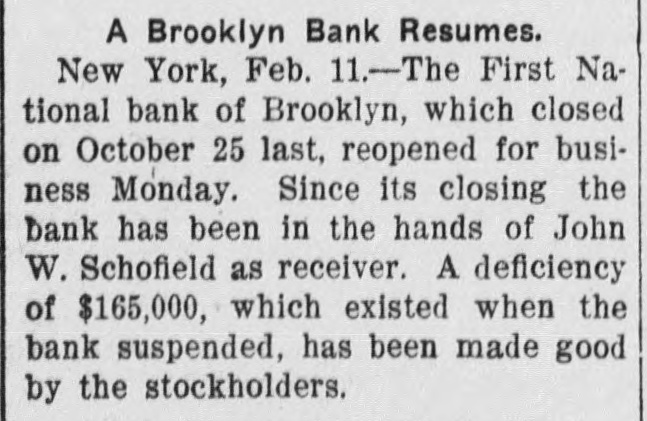
A Brooklyn Bank Resumes. New York, Feb. 11.-The First National bank of Brooklyn, which closed on October 25 last, reopened for business Monday. Since its closing the bank has been in the hands of John W. Schofield as receiver. A deficiency of $165,000, which existed when the bank suspended, has been made good by the stockholders.
17.February 13, 1908The Mena Weekly StarMena, AR
Click image to open full size in new tab
Article Text
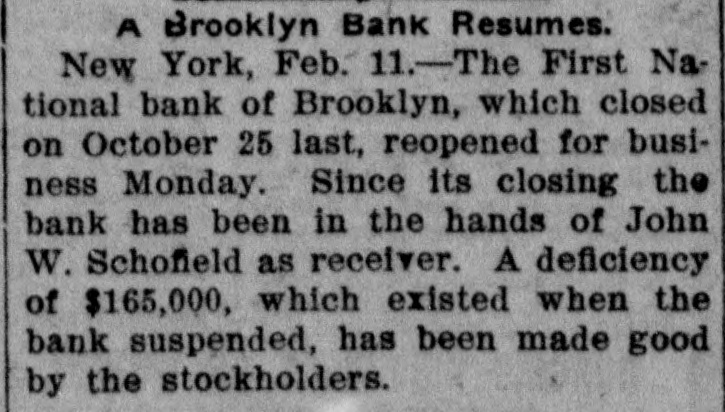
A Brooklyn Bank Resumes. New York, Feb. 11.-The First National bank of Brooklyn, which closed on October 25 last, reopened for business Monday. Since its closing the bank has been in the hands of John W. Schofield as receiver. A deficiency of $165,000, which existed when the bank suspended, has been made good by the stockholders.
18.March 12, 1908The Birmingham Age-HeraldBirmingham, AL
Click image to open full size in new tab
Article Text
FINANCIAL BILL HOTLY DENOUNCED Senator Clarke of Arkansas Hits Several Fierce Blows ALDRICH ATTEMPTS REPLY Investigation of Causes of the Panic Is Demanded by Senator Clarke, Who Also Denounces New York Stock Exchange. Washington, March 11.-Senator Clarke of Arkansas denounced the pending currency bill in a speech in the Senate today, declaring that no currency legislation should be enacted until an investigation is held as to the causes of the panic. "No such legislation is necessary now, said Mr. Clarke. "It is not only not necesI sary, but it may become dangerous. am not disposed to tolerate the idea of giving any support to the committee bill, nor the substitute proposed by the minority members of the Senate." If emergency currency is to be provided, Mr. Clarke said, the benefits should be extended all persons whose legitimate business demands cause them to need it. Mr. Clarke denounced the operations of stock exchanges and said the American people would not be satisfied with the proposed currency legislation without a complete knowledge of causes of the panic. "The time has arrived," he said, "when the affairs of the New .York stock exchange and other stock exchanges must be looked into." Mr. Clarke's reference to the stoppage of the payments by the New York banks called Mr. Aldrich to his feet with the remark that he did not believe the people would permit that course again to be pursued. "I trust the senator from Rhode Island as a historian," retorted Mr. Clarke, "but I do not trust him as a prophet." Mr. Clarke expressed the opinion that the majority would not pass the bill allowing the emergency circulation to be retired without limitation. Mr. Clarke said he would not only require a restriction of reserves, but he would deny to a national bank the right to pay interest on checking accounts. Senator Nelson suggested that the national banks should pay interest on the $250,000,000 of government deposits. Mr. Aldrich said that five years ago he had introduced a bill providing for the payment of interest on such deposits at the rate of 1 1/2 per cent, but, he added, senators had opposed that bill on the ground that it changed the nature of the loan. Former Senator Spooner and the late Senator Morgan, he said, opposed the bill. If that objection could be overcome he declared his willingness to again bring in such a measure. He did not know any reason unless it should be a legal one, of the kind suggested, why interest should not be charged on these deposits. Mr. Culberson, he said, had introduced a bill to require payment of interest on government deposits and it was now before the committee on finance. Mr. Bailey spoke at some length suggesting that the main purpose of his substitute was to favor the principle of government money instead of bank money He explained that he had provided for a distribution of the emergency currency in accordance with population, although he realized that business necessity was a greater measure of the amount they should have. But it was not possible to make sure of the business needs of the several sections and it was a simple matter to ascertain the population. An extended argument was made by Mr. Newlands of Nevada in favor of his view that the sending of a check from one state to another makes the business of banking interstate commerce.
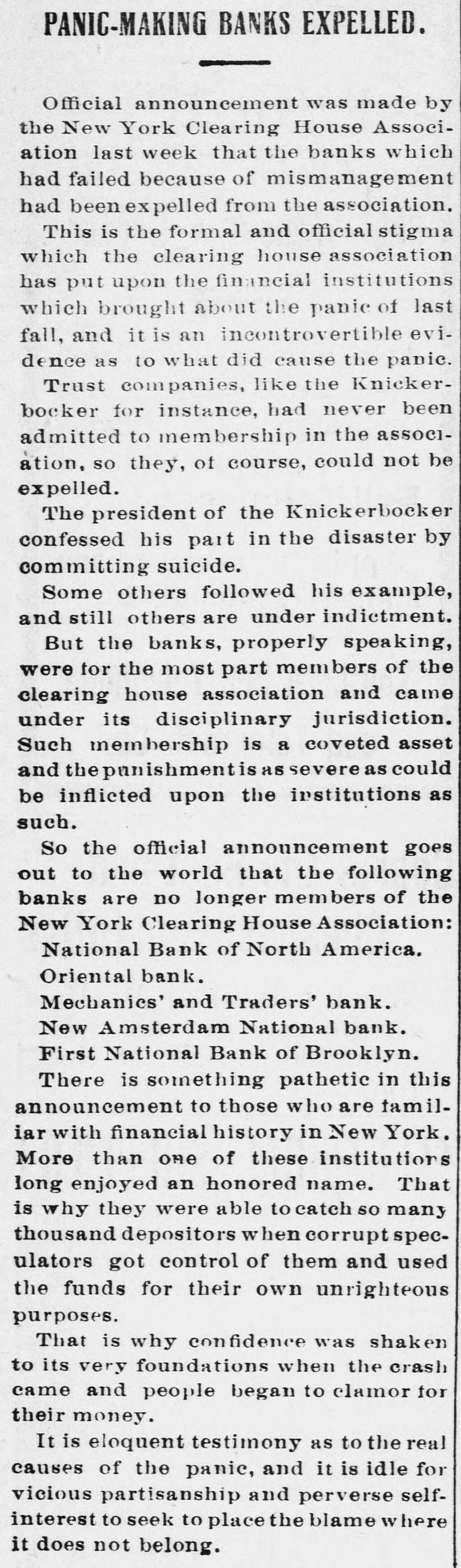
PANIC-MAKING BANKS EXPELLED. Official announcement was made by the New York Clearing House Association last week that the banks which had failed because of mismanagement had been expelled from the association. This is the formal and official stigma which the clearing house association has put upon the financial institutions which brought about the panic of last fall, and it is an incontrovertible evidence as to what did cause the panic. Trust companies, like the Knickerbocker for instance, had never been admitted to membership in the association, so they, of course, could not be expelled. The president of the Knickerbocker confessed his pait in the disaster by committing suicide. Some others followed his example, and still others are under indictment. But the banks, properly speaking, were for the most part members of the clearing house association and came under its disciplinary jurisdiction. Such membership is a coveted asset and thepunishmenti is as severe as could be inflicted upon the institutions as such. So the official announcement goes out to the world that the following banks are no longer members of the New York Clearing House Association: National Bank of North America. Oriental bank. Mechanics' and Traders' bank. New Amsterdam National bank. First National Bank of Brooklyn. There is something pathetic in this announcement to those who are familiar with financial history in New York. More than one of these institutions long enjoyed an honored name. That is why they were able to catch so many thousand depositors when corrupt speculators got control of them and used the funds for their own unrighteous purposes. That is why confidence was shaken to its very foundations when the crash came and people began to clamor for their money. It is eloquent testimony as to the real causes of the panic, and it is idle for vicious partisanship and perverse selfinterest to seek to place the blame where it does not belong.
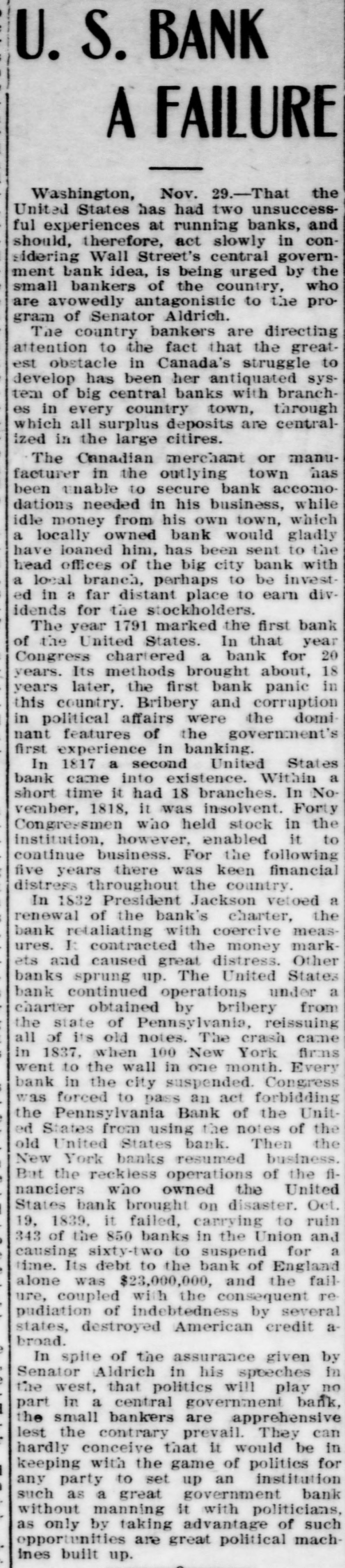
U. S. BANK A FAILURE Washington, Nov. 29.-That the United States has had two unsuccessful experiences at running banks, and should, therefore, act slowly in considering Wall Street's central government bank idea, is being urged by the small bankers of the country, who are avowedly antagonistic to the program of Senator Aldrich. The country bankers are directing attention to the fact that the greatest obstacle in Canada's struggle to develop has been her antiquated systerm of big central banks with branches in every country town, through which all surplus deposits are centralized in the large citires. The Canadian merchant or manufacturer in the outlying town has been unable to secure bank accomodations needed in his business, while idle money from his own town, which a locally owned bank would gladly have loaned him, has been sent to the head offices of the big city bank with a local branch, perhaps to be invested in a far distant place to earn dividends for the stockholders. The year 1791 marked the first bank of the United States. In that year Congress chartered a bank for 20 years. Its methods brought about, 18 years later, the first bank panic in this country. Bribery and corruption in political affairs were the domi nant features of the government's first experience in banking. In 1817 a second United States bank came into existence. Within a short time it had 18 branches. In No. vember, 1818, it was insolvent. Forty Congressmen who held stock in the institution, however, enabled it to continue business. For the following five years there was keen financial distress throughout the country. In 1832 President Jackson vetoed a renewal of the bank's charter, the bank retaliating with coercive measures. I: contracted the money markets and caused great distress. Other banks sprung up. The United States bank continued operations under a charter obtained by bribery from the state of Pennsylvania, reissuing all of its old notes. The crash came in 1837, when 100 New York firms went to the wall in one month. Every bank in the city suspended. Congress was forced to pass an act forbidding the Pennsylvania Bank of the United States from using the notes of the old United States bank. Then the New York banks resumed business. But the reckless operations of the financiers who owned the United States bank brought on disaster. Oct. 19, 1839. it failed, carrying to ruin 343 of the 850 banks in the Union and causing sixty-two to suspend for a time. Its debt to the bank of England alone was $23,000,000, and the failure, coupled with the consequent ren pudiation of indebtedness by several states, destroyed American credit abroad. In spite of the assurance given by Senator Aldrich in his speeches in the west, that politics will play no 1 part in a central government bank, the small bankers are apprehensive [ lest the contrary prevail. They can hardly conceive that it would be in I keeping with the game of politics for any party to set up an institution such as a great government bank without manning it with politicians, as only by taking advantage of such opportunities are great political machines built up. :
21.June 14, 1912The Detroit TimesDetroit, MI
Click image to open full size in new tab
Article Text
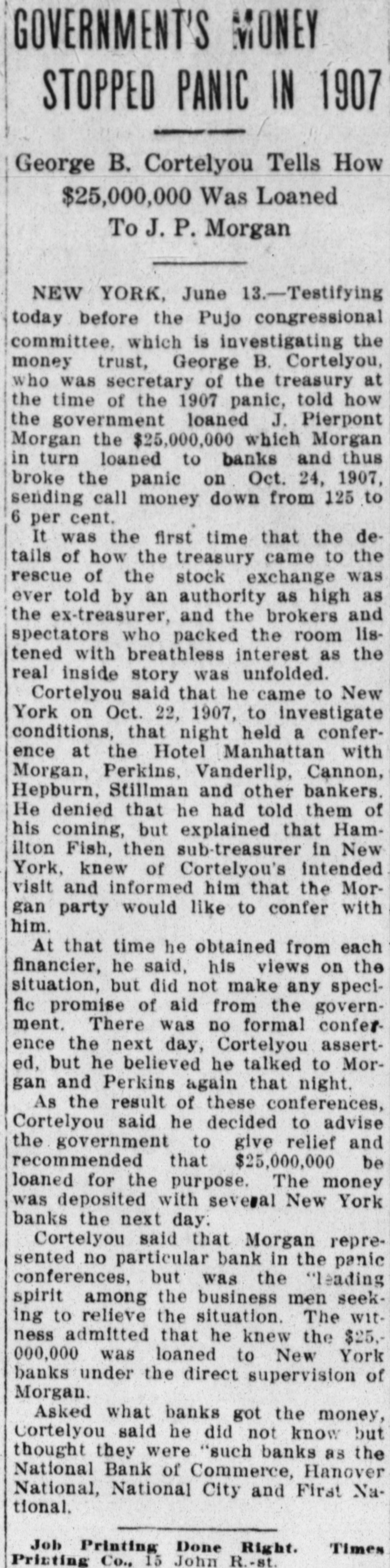
GOVERNMENT'S MONEY STOPPED PANIC IN 1907 George B. Cortelyou Tells How $25,000,000 Was Loaned To J. P. Morgan NEW YORK, June 13.-Testifying today before the Pujo congressional committee. which is investigating the money trust, George B. Cortelyou, who was secretary of the treasury at the time of the 1907 panic, told how the government loaned J. Pierpont Morgan the $25,000,000 which Morgan in turn loaned to banks and thus broke the panic on Oct. 24, 1907, sending call money down from 125 to 6 per cent. It was the first time that the details of how the treasury came to the rescue of the stock exchange was ever told by an authority as high as the ex-treasurer, and the brokers and spectators who packed the room listened with breathless interest as the real inside story was unfolded. Cortelyou said that he came to New York on Oct. 22, 1907, to investigate conditions, that night held a conference at the Hotel Manhattan with Morgan, Perkins, Vanderlip, Cannon, Hepburn, Stillman and other bankers. He denied that he had told them of his coming, but explained that Hamilton Fish, then sub-treasurer in New York, knew of Cortelyou's intended visit and informed him that the Morgan party would like to confer with him. At that time he obtained from each financier, he said, his views on the situation, but did not make any specific promise of aid from the government. There was no formal conference the next day, Cortelyou asserted, but he believed he talked to Morgan and Perkins again that night. As the result of these conferences, Cortelyou said he decided to advise the government to give relief and recommended that $25,000,000 be loaned for the purpose. The money was deposited with several New York banks the next day: Cortelyou said that Morgan represented no particular bank in the panic conferences, but was the "leading spirit among the business men seeking to relieve the situation. The witness admitted that he knew the $25,000,000 was loaned to New York banks under the direct supervision of Morgan. Asked what banks got the money, Cortelyou said he did not know but thought they were "such banks as the National Bank of Commerce, Hanover National, National City and First National. Job Printing Done Right. Times Printing Co., 15 John R.-st.
22.December 9, 1913New-York TribuneNew York, NY
Click image to open full size in new tab
Article Text
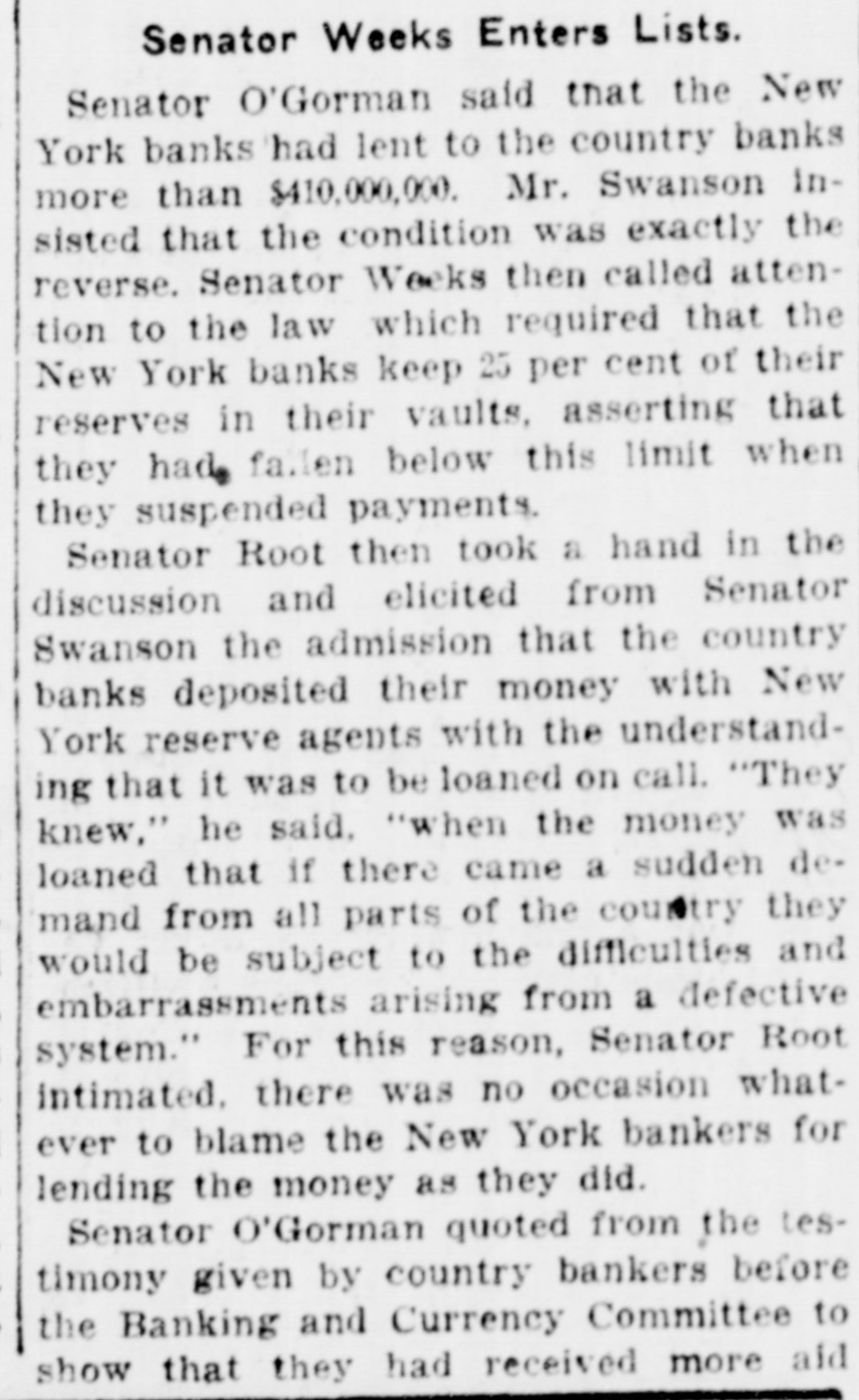
# Senator Weeks Enters Lists.
Senator O'Gorman said that the New York banks had lent to the country banks more than $410,000,000. Mr. Swanson insisted that the condition was exactly the reverse. Senator Weeks then called attention to the law which required that the New York banks keep 25 per cent of their reserves in their vaults, asserting that they had fallen below this limit when they suspended payments.
Senator Root then took a hand in the discussion and elicited from Senator Swanson the admission that the country banks deposited their money with New York reserve agents with the understanding that it was to be loaned on call. "They knew," he said, "when the money was loaned that if there came a sudden demand from all parts of the country they would be subject to the difficulties and embarrassments arising from a defective system." For this reason, Senator Root intimated, there was no occasion whatever to blame the New York bankers for lending the money as they did.
Senator O'Gorman quoted from the testimony given by country bankers before the Banking and Currency Committee to show that they had received more aid
23.August 7, 1914Evening StarWashington, DC
Click image to open full size in new tab
Article Text
be prevented, or, at least, its effects minimized can by the proper organization sysand control of a country's banking tem. No such premium upon money or taken such collapse of credit has of in of the leading that the last 100 years as Noplace general Europe during any States countries in in the United in December of 1907, war and social witnessed vember periods and of condition revolution. except of similar disastrous for a and credits in England one must Namoney back to the time of the wars of go while in Germany no such foun- ocpoleon, has taken place since the shown currence of the empire. France has the dation such a banking condition but once that in was several generations, and last defeat at the hands of Prussia, war after her payment of her billion-dollar troubles. indemity the and bitter internal There have been suspensions of banks and great failures of business and banking houses in Failures Abroad Not these countries just the same as as Heavy as Here. in the United States, yet these disasters have not (as so offen has been the case here) been alIowed to paralyze the credit of the country. In Great Britain, the powerful firm of Overend Gurney failed in 1866, the Bank of Glasgow in 1878 and the house of Baring Bros. in 1890. Yet, on each occasion, the trouble was confined and no national financial convulsion followed. In France the same ability to avert financial panic was shown upon the failof such great banking institutions as ure the Union Generale in 1882 and the Comptoir d' Escompte in 1899; while in Germany the failure of the famous Leipziger Bank in 1901 is another example. in the United States, the suspension of Yet, payments by the New York banks has been followed by distress from Maine to California. Although banking reform had been demanded for a number of years, it took the panic of 1907 to insure a thorough prosecution of the task. Minor changes in our banking laws had been made from time to time, but the great prosperity of the country caused Congress to shrink from the responsibility of undertaking extensive reconstruction of the laws to under any which business had attained such mighty proportions. * * In 1000 Congress pased a currency act for the better support of the greenbacks, the Treasury notes of 1890 Better Support of and the silver Greenbacks by Law. dollars. After the panic of 1007 the Aldrich-Vreeland act was promulgated, which provided that the national banks might organize themselves into national currency assoclations, and that a member bank, with outstanding note circulation secured by States bonds equal to 40 per cent of might extend its United its capital, note issues upon other classes of securities until the total was equal to the sum of its capital and surplus. This act was intended only to be an emergency measure, and was enacted to expire by limitation June 30, 1914. The provision for increasing their note issue up to the present has not been taken advantage of by the banks The act has been extended to June 30. 1915. Further, following the panic, the national monetary commission was established, for the purpose of investigating means for improving credit arrangements in this country. Members of this commission visited England, France and Germany, and made thorough studies of the banking systems in vogue in these coun- of tries. The banking arrangements Canada, Scotland, Belgium, Sweden. Switzerland, Italy, Russia, Mexico and Japan were also investigated. The findings of the commission were published in reforty volumes, which form a good view of the world's banking business. Out of these studies grew proposals for the establishment of a National Reserve Association, a representative association the banks, the units of which were of to all be the clearing house associations which the banks of each city now mainThe democratic Congress rejected this tain. plan in favor of the federal reserve whose provisions, wisely enforced. act, will probably be found better suited to needs of the country than would have been the any one among the numberless plans which have been proposed.
Bank runs are almost always and everywhere a deterioration of bank fundamentals.
But not for you.
You are the measure-zero exception: great fundamentals, solid bank, and yet the Diamond Dybvig fairy spread its rumor. Depositors woke up. Your collateral was not prepositioned. The Clearinghouse had it for you.
Do not pass Go. Do not collect $200. Go directly to jail… or worse.