
8819. Solon Savings Bank (Solon, ME)

Bank Information

Episode Type
Suspension → Closure
Bank Type
savings bank
Start Date
*
Location
Solon, Maine (44.950, -69.858)

Metadata

Model
gpt-5-mini
Short Digest
4175e8e2

Response Measures

None

Description

Newspaper reports state the Solon Bank is in the hands of receivers and a final dividend will soon be declared; no run or attempted reopening is mentioned. Thus this is a suspension leading to permanent closure/receivership.

Events (1)

1. * Receivership
Newspaper Excerpt
The affairs of two banks are yet in the hands of receivers, the Newport Bank and the Solon Bank. It is estimated that ... the Solon Bank ... the final dividend will soon be declared.
Source
newspapers

Newspaper Articles (2)

Article from The Portland Daily Press, December 12, 1882

Click image to open full size in new tab

Article Text

Maine Savings Banks. The report of Mr. Fred E. Richards, State Bank Examiner, is at hand, and shows that the Savings Banks of Maine are in prosperous condition. The amount of deposits, we are told, has increased, the new investments have been wisely made, and very many of the securities owned, upon which the payment of dividends or interest was suspended some years ago, have during the past twelve months become dividend-paying stocks. The only possitle loss of consequence sustained during the year is to those banks so unfortunate as to be depositors in the Pacific National Bank of Boston, and it is doubtful if any loss be éventually incurred in thistransaction. The securities held by the thirteen Savings Banks whose deposit accounts were reduced by decree of Court during the years 1877 and 1878 have, the Examiner says, so much appreciated in value that nearly all of these banks have made partial or final special dividends within the last two years to the depositors whose accounts were so reduced. He reports that, with the exception of interest, it seems probable that in the end very little loss will be sustained by those interest ed in these banks at the time of the reduction. In the case of the Wiscasset Bank, enjoined in 1879, the injunction was dismissed last April, and the Bank, he says, now merits and receives the complete confidence of its depositors. The affairs of two banks are yet in the hands of receivers, the Newport Bank and the Solon Bank. It is estimated that the first named will pay 75 per cent. to depositors, and the last named 100 per cent. In the first case several suits are pending and an early settlement of affairs is not probable. In the case of the Solon Bank there is no litigation attending settlement, and the final dividend will soon be declared. The increase of deposits is marked. In 1878 the deposits decreased $3,725,320, and in 1879 further decreased $186,363. In 1880 the deposits increased $1,968,183; in 1881 the increase was $2,900,180; from Nov. 1881 Nov. 1, 1882 the increase has been $3 029.334. The amount now on deposit is $29,503,889. The number of depositors during the year has increased 7,512, the present number being 95,487, of which 76,602 are depositors of sums not exceeding $500 each. The average amount to the credit of each depositor is $308.87. The reserved fund is $958,893, an increase during the last twelve months of $87,877 The dividends declared range from 31 to 6 per cent., thirty-five of the fifty-five banks paying four per cent. The Examiner recommends the modification of the strict law of 1877 rigidly limiting the investment of deposits, arguing that' the statute was enacted while the country was suffering from the financial panic of 1873, and that its provisions are now unnecessarily rigid. In this recommendation we are not prepared to join. The restrictive statute may to some extent interfere with sound investments, but it has proved a strong shield to those investors who can afford to take no risks, and who prefer small and certain returns to promising hazards. If error be made it is better to make it on the side of caution. The Examiner also suggests a reduction of the State tax. At the time the one per cent. tax was imposed investments yielded seven and eight per cent. But the interest is now no more than four per cent. So the tax now is much more onerous. One fourth of the gross earnings of depositors is appropriated to the State. The complaint seems well taken, and the Examiner makes a pertinent suggestion when he urges that a reasonable reduction in the rate of taxation will increase rather than diminish the aggregate amount of revenue, while a policy less liberal will have a tendency to transfer these deposits to the Savings institutions of other States, or to distribute them,among the 96,000 depositors, completely beyond the reach of taxation.

Article from Oxford Democrat, January 30, 1883

Click image to open full size in new tab

Article Text

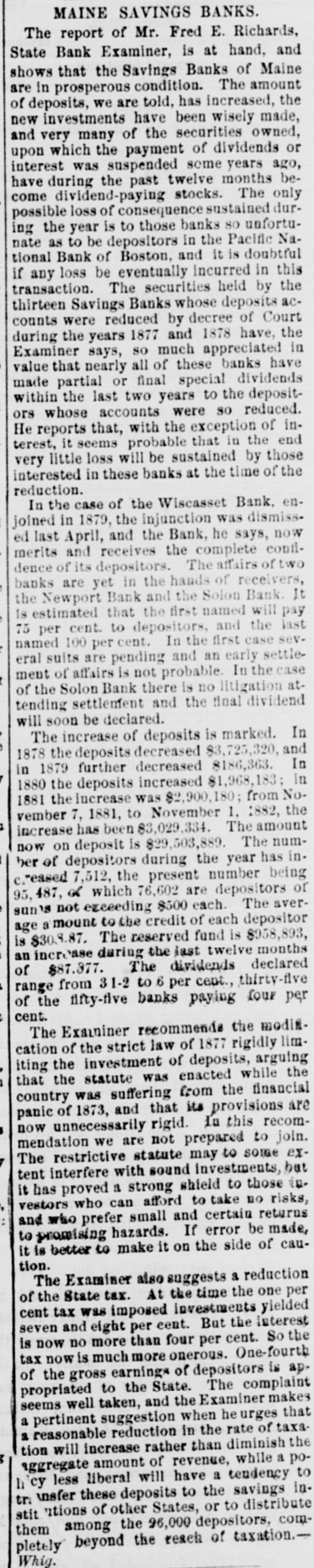
MAINE SAVINGS BANKS. The report of Mr. Fred E. Richards, State Bank Examiner, is at hand, and shows that the Savings Banks of Maine are in prosperous condition. The amount of deposits, we are told, has increased, the new investments have been wisely made, and very many of the securities owned, upon which the payment of dividends or interest was suspended some years ago, have during the past twelve months become dividend-paying stocks. The only possible loss of consequence sustained during the year is to those banks so unfortunate as to be depositors in the Pacific National Bank of Boston, and it is doubtful if any loss be eventually incurred in this transaction. The securities held by the thirteen Savings Banks whose deposits accounts were reduced by decree of Court during the years 1877 and 1878 have, the Examiner says, so much appreciated in value that nearly all of these banks have made partial or final special dividends within the last two years to the depositors whose accounts were so reduced. He reports that, with the exception of interest, it seems probable that in the end very little loss will be sustained by those interested in these banks at the time of the reduction. In the case of the Wiscasset Bank, enjoined in 1879, the injunction was dismissed last April, and the Bank, he says, now merits and receives the complete countdence of its depositors. The affairs of two banks are yet in the hands of receivers, the Newport Bank and the Solon Bank. It is estimated that the first named will pay 75 per cent. to depositors, and the last named 100 per cent. In the first case several suits are pending and an early settlement of affairs is not probable. In the case of the Solon Bank there is no litigation attending settlement and the final dividend will soon be declared. The increase of deposits is marked. In 1878 the deposits decreased $3,725,320, and in 1879 further decreased 8186,363. In 1880 the deposits increased $1,968,183; in 1881 the increase was $2,900,180; from November 7, 1881, to November 1, 1882, the increase has been 83,029,334. The amount now on deposit is $29,503,889. The numher of depositors during the year has increased 7,512, the present number being 95,487, of which 76,602 are depositors or sun's not exceeding 8500 each. The average a mount to the credit of each depositor is $30.8.87. The reserved fund is $958,893, an increas during the last twelve months of $87.377. The dividends declared range from 31-2 to 6 per cent., thirty-five of the fifty-five banks paying four per cent. The Examiner recommends the modifcation of the strict law of 1877 rigidly limiting the investment of deposits, arguing that the statute was enacted while the country was suffering from the financial panic of 1873, and that its provisions are now unnecessarily rigid. 1u this recommendation we are not prepared to join. The restrictive statute may to some extent interfere with sound investments, but it has proved a strong shield to those in. vestors who can afford to take no risks, and who prefer small and certain returns to promising hazards. If error be made, it is better to make it on the side of caution. The Examiner also suggests a reduction of the State tax. At the time the one per cent tax was imposed investments yielded seven and eight per cent. But the interest is now no more than four per cent. So the tax now is much more onerous. One-fourth of the gross earnings of depositors is ap. propriated to the State. The complaint seems well taken, and the Examiner makes a pertinent suggestion when he urges that a reasonable reduction in the rate of taxa. tion will increase rather than diminish the 3 aggregate amount of revenue, while a po- to cy less liberal will have a tendency h insfer these deposits to the savings instit tr. utions of other States, or to distribute them among the 96,000 depositors, completely beyond the reach of taxation.Whig.