8792. Richmond Savings Bank (Richmond, ME)

Bank Information

Episode Type
Run → Suspension → Closure
Bank Type
savings bank
Start Date
January 1, 1893*
Location
Richmond, Maine (44.087, -69.799)

Metadata

Model
gpt-5-mini
Short Digest
608f3014

Response Measures

Full suspension, Books examined

Other: Final dividend ordered by court; long receivership wind-up resulted in payments to depositors through 1900.

Description

Articles describe depositors' withdrawals and lack of confidence leading to the bank being examined, an injunction and appointment of a receiver in 1893. The bank remained in receivership and was wound up by the receiver; final dividend (10%) ordered in 1900, completing closure. Bank type not explicitly stated (a 'savings bank' but not labeled state/national).

Events (4)

1. January 1, 1893* Receivership
Newspaper Excerpt
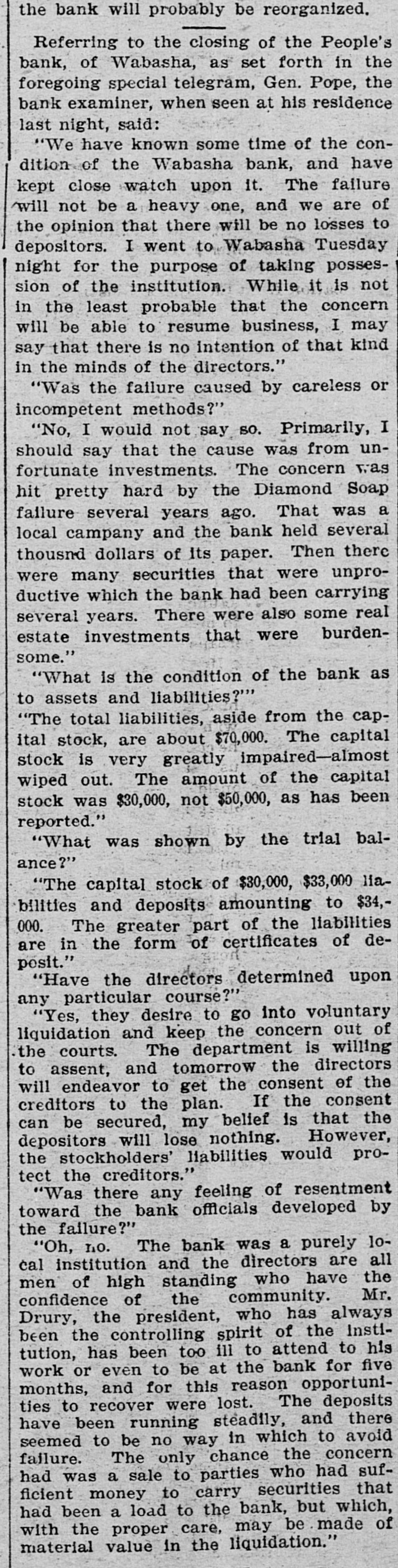
Judge Libbey placed the bank in the hands of a receiver. M. P. Milliken being given the appointment. With him has been associated G. B. Randlette ... The receiver still holds about $17,000, par value, of assets ... he will settle his final account in short time. The receiver of the Richmond Savings bank paid a further dividend of eight per cent as of October 4, 1899 ... final dividend of 10 per cent. will be paid the depositors ... This winds up the affairs of the institution. ... final dividend ordered by the court. Monday, the depositors will have received 88 per cent. of the full amount deposited. The bank was closed in 1893 ... placed in the hands of the receiver, M. P. Milliken of Richmond, he has ... paid dividend after dividend to the depositors. This continued until before the last amount was paid the sum amounted to 78 per cent. ... With the payment of the last dividend which was ordered by the court, Monday, the depositors will have received 88 per cent. of the full amount deposited. This winds up the affairs of the institution. (combined excerpts).
Source
newspapers
2. January 1, 1893* Run
Cause
Bank Specific Adverse Info
Cause Details
Depositors feared large losses on certain long-standing loans and investments, prompting withdrawals and loss of confidence.
Measures
None prior to suspension noted in articles beyond depositor withdrawals; examiner later petitioned for injunction.
Newspaper Excerpt
The circumstances leading to the closing the bank were due, largely to a lack of confidence on the part of the depositors who withdrew their deposits.
Source
newspapers
3. January 1, 1893* Suspension
Cause
Government Action
Cause Details
State bank examiner's report led to court injunction and the bank being placed in receivership (restrained from continuing business).
Newspaper Excerpt
After making an examination of the bank's condition he found that it was not such that it would warrant the institution's continuance in business. Accordingly he petitioned Judge Libbey and an injunction restraining the bank from continuing business was granted. ... Judge Libbey placed the bank in the hands of a receiver.
Source
newspapers
4. March 21, 1900 Other
Newspaper Excerpt
FINAL DIVIDEND ORDERED. Depositors of the Defunct Richmond Savings Bank Receive 10 Per Cent. A final dividend of 10 per cent. will be paid the depositors of the Richmond Savings Bank. This winds up the affairs of the institution.
Source
newspapers

Newspaper Articles (3)

Article from Daily Kennebec Journal, January 3, 1899

Click image to open full size in new tab

Article Text

LOAN AND BUILDING ASSOCIATIONS. There are now 32 associations, the Rumford Falls Loan and Building Associations having retired. The comparative statement of liabilities and resources of the years ending October 29. 1898, and November 6. 1897, show that there is now $3,009,998.77 against $2,912,963.63. I Regarding other statistics: 1897. 1898. 8,230 No. of shareholders, 8,156 45,4691/2 No. of shares outstanding, 44.7581/2 3,042 2.966 NO. of borrowers, 3.694 3.647 No. of loans, $173,744.81 $213,395 74 Amt. of div. paid, Tais is an increase of $83,231.07 in the amount of accumulated capital and advances, and $97,035.14 in the total assets: and a decrease of seventy-four in the number of shareholders. and of 711 in the number of shares outstanding. The average rate of dividends paid shareholders for the present year is 6.50. and the average premium charged borrowers 1.35, as against 6.71 and 1.47 respectively in 1897 The decrease of $39,650.93 in the amount of dividends paid is due in part to the faot that n°1897 one loan and building association. for the purpose of readjusting its accounts. charged off all dividends previously paid, and declared a new dividend upon all of its outstanding shares. This materially increased the aggregate dividends for that year. This decrease in earningsis due in some degree to the fact that loan and building associations like all other institutions that depend upon the investment of money for their income, are compelled to accept less rates than formerly. The shareholders, like dépositors in banks, must expect smaller dividends in the future. The amendment of 1897, requiring the associations to carry a larger percentage of their earnings to the guaranty fund. was passed none too soon It would have been a wise policy for these institutions to have accumulated larger reserves while they were able to pay from 7 to 9 per cent dividends. Had such a polMcy been adopted it would have given them present strength, and added to their stability and success in the future. Even now the earnings and dividends are larger than they are Likely to be in the I years to come. The institution that will t in some degree forestall these conditions and reserve such a portion of their present earnings as it N possible to spare, will be the most successful. We are pleased to report a noticeable improvement in this respect in many of the institutions, and trust this policy may be adopted by all in the future. REPORTS OF RECEIVERS. The following is a synopsis of all re) ports of receivers made 4, this department as of October 29. 1898, and a brief statement of the condition of the affairs 5 of each insolvent banking association in the State. NEWPORT SAVINGS BANK 1 In December, 1897, the receiver, John W. Hobart, made his final statement. The total amount realized was $85,700.68. The e dividends were paid depositors amounting to 81 7-40 per cent. ORONO SAVINGS BANK. Albert White, th receiver, who had charge of affairs shice August 10, 1894, in his statement of receints and expenditures shows that he has received $86,428.11. A final settlement of the affairs of this institution has given the depositors 89 per cent of their deposits, making the total loss only $9,043.28. This is much better than was at one time anticipated. The receiver is entitled to credit for this favorable settlement of the affairs of the institution, and for the large dividend received by depositors. RICHMOND SAVINGS BANK. There has been but little change in the affairs of this institution during the year. The receiver still holds about $17,000, par value, of assets, the most of which could not be disposed of without great sacrifice. He reports that an effort will be made during the year to dispose of the remaining assets, pay a nal dividend and settle the affairs of the institution. It is estimated that these assets will net about 10 per cent more to depositors. LUBEC SAVINGS BANK. Samuel D. Leavitt of Eastport. receiver of the Lubec Savings Bank, reports a full settlement of the affairs of that institution with the exception of a small balance held for the payment of expenses. The total amount of deposits, as shown by the report of the commissioners, was $24,713.20; and the amount of receipts from all sources, $6,783.23. There were preferred claims amounting to $127.48 leaving a balance of $6,655.75 for the payment of depositors and expenses. June 27, 1898, S the depositors were paid a dividend of 25 per cent, amounting to $6,178.30, leaving a


Article from The Portland Daily Press, January 19, 1900

Click image to open full size in new tab

Article Text

in public funds in Maine; $260,666.09 in railroad bonds in Maine, and $2,817,901.44 in railroad bonds out of Maine. EXAMINATION ANDSUPERVISION. This department more than ever appreciates the importance of a careful examination and supervision of all the institutions under its charge. The difficulty of establishing a system by which, with any reasonable amount of labor, it is possible to fully and absolutely verify, item by Item, the business of each instit ution, becomes more apparent as the matter is considered. Human ingenuity has so far failed to devise any method that will guard against occasional losses from disghomest employes or the mismanagement of officials. This is as true in other kinds of business as in banking. No one can name any line of investment, or kind of business, in which there is so near absolute safety as in our savings banks. When we compare the aggregate business with the total loss, the amequt becomes EO small that it seems of little consequence. Until some enti rey new method of examination is adopted it will te possible for those handling the funds of others to cover up certain amounts of irregularities. In conducting & bank, there is hardly a transaction that cannot be used by a dishouest employee to cover up some form of speculation. Absolute verification, therefore, can only be had by going over each item with the same care be stowed upon the original transaction. This would entail upon the auditor fully as much work as upon the employe who made the original entries. Anything short of this would not give absolute certainty, as opportunities would exist for accounts to be falsified. On the other hand, should the supervision be extended enough to absolutely verify every transaction we would have simply two permanent employes going over the same work. This would give only the additional protection that would come by havin g two employes engaged upon the work of the bank under the present methods. One would cease to be an auditor of the other's work-they would become co-laborers and all the force of supervision would be lost. We cannot, therefore, expect to entirely escape losses from breaches of trust such as occasionally come in all kinds of business where it in necessary to place confidence in others. A reasonable amount of oaution, however, reduces this danger within the limit where the bank can be protected by a surety bond such as every employe is by law required to give. LOAN & BUILDING ASSOCIATIONS There are now thirty-two loan and building associatoins doing business In the state. A comparison of '98 with '90 show a decrease of $34,282.30 in the total assets; $41,463.63 in the accumulated capital, and 390 1-2 in the number of shares outstanding. There has been a most satisfactory increase of $6,897.27 in the amount of the guaranty fund during the year. We are pleased to note that the associations are following the recommendations of the department by setting apart a greater portion of their earnings to this fund than heretofore. BANKS IN LIQUIDATION. Regarding the banking associations now 10 the process of liquidation in this state the report says: The receiver of the Richmond Savings bank paid a further dividend of eight per cent as of October 4, 1899, amounting to $6,850 53. This makes seventy-eight per cent, in all that has been paid to the depositors in this institution. The assets have been substantially all reduced to orsh, and the receiver advises the department that he will settle his final account in is short time. During the present year the receiver of the American Banking and Trust company of Auburn has paid the creditors a second division of 25 per cent. There has been quite an appreciation in the real estate owned by the company and the demand for it is constantly increasing and frequent sales are being made. It is expected that another dividend of at least twenty-five per cent will be paid within the next six months. At the date of the last report, there had been received from the assets of the Northern Banking company, that came to the possession of the receiver, the sum of $6,939.81. The balance of the assets have since been disposed of and the amount of cash now in his hands is $12, 839.99. The second account of the receiver has been filed in the supreme judicial court, and upon the approval of the same, and the determination by the court of the amount of the deficiency of the as sets of the company, proceedings will be instituted to determine the amount of the liability that may exist against the shareholders of the corporation on the stock held by them. The collateral BEcurity held by the various creditors has been applied in reduction of such creditors' respective claims. "The receiver of the Oxford County Loan Association reports that, when the affairs of this association were placed in


Article from Daily Kennebec Journal, March 21, 1900

Click image to open full size in new tab

Article Text

think there is no blood Scrofula. puritier like Hood's." MRS. HARVEY DICKERSON, 14 Townly Ave., Cortland, N.Y. FINAL DIVIDEND ORDERED. Depositors of the Defunct Richmond Savirgs Bank Receive 10 Per Cent. A final dividend of 10 per cent. will be paid the depositors of the Richmond Savings Bank This winds up the affairs of the institution. Although it was thought at one time that the depositors would lose the greater part of what they had in the bank it turns out that the loss will be very slight. Since the bank's affairs were put in the hands of the receiver. M. P. Milliken of Richmond, he has figured every way by which he might save as much as possible to the depositors. From time to time he has gained the permission of the court to dispose of certain securities. By taking advantage of the conditions of the market he has been able to pay dividend after dividend to the depositors. This continued until before the last amount was paid thesum amounted to 78 per cent. of the amount deposited. With the payment of the last dividend which was ordered by the court. Monday. the depositors will have received SS per cent. of the full amount deposited. making their loss only 12 per cent. By those who are familiar with the situation, the saving is considered remarkable. Mr. Milliken. the receiver. has managed the affairs in a most careful manner and through his efforts much more was saved to the depositors than was at first supposed would be possible. The settlement affects not only the people of Richmond but all those who were among the depositors. The bank was closed in 1893 through the efforts of Bank Examiner Charles R. Whitten. After making an examination of the bank's condition he found that it WIS not such that it would warrant the institution's continuance in business. Accordingly he petitioned Judge Libbey and an injunction restraining the bank from continuing business was granted. At the hearing on the injunction held in Bath, the securities were examined and Judge Libbey placed the bank in the hands of a receiver. M. P. Milliken being given the appointment. With him has been associated G. B. Randlette of Richmond, as assistant, and H. M. Health of Augusta, as counsel. The circumstances leading to the closing the bank were due. largely to a lack of confidence on the part of the depositors who withdrew their deposits. This lack of confidence was caused by the fear that the bank would lose a large amount on certain loans and investments of long standing. At the time the investments were made they were of such a character that the trustees of the bank had every reason to believe that the securities were as good as could be obtained. The deposits in the bank in 1892 were sealed to SO per cent. and it was believed at that time that the depositors would receive the full amount to which the deposits were reduced. That the affairs of the bank have been well managed is shown by the fact that the final dividend makes the full amount received. 88 per cent. of the amount of the original deposits. As the deposits were $85,462.19 it will be seen that the depositors recover $75,206.63. The sums belonging to depositors who cannot be found will. in accordance with a provision of law, be deposited in the State treasury until their representatives can be located.