17732. Bank of Plankinton (Plankinton, SD)

Bank Information

Episode Type
Suspension โ†’ Closure
Bank Type
state
Start Date
January 1, 1900*
Location
Plankinton, South Dakota (43.716, -98.485)

Metadata

Model
gpt-5-mini
Short Digest
24c79ff08a962111

Response Measures

None

Description

The Bank of Plankinton closed its doors on January 10, 1900 when cashier and principal stockholder Fred L. Stevens disappeared. A receiver was appointed and the bank remained defunct (receiver activity and asset sales continue in subsequent years). This appears to be a suspension that resulted in permanent closure (receivership), driven by bank-specific adverse information/possible embezzlement rather than a mere depositor run.

Events (5)

1. January 1, 1900* Receivership
Newspaper Excerpt
In accordance with the desire of some of the creditors Judge Frank B. Smith, of the state court, appointed a receiver, but this action was not satisfactory to other creditors, who applied to the federal court in Sioux Falls, with the above result. (article referencing receiver appointment after the Jan. 10 closure.)
Source
newspapers
2. January 10, 1900 Suspension
Cause
Bank Specific Adverse Info
Cause Details
Cashier and principal stockholder Fred L. Stevens disappeared; allegations he left after accepting deposits while bank insolvent (criminal prosecutions followed).
Newspaper Excerpt
The Bank of Plankinton closed its doors Jan. 10 last, when Fred L. Stevens, the cashier and principal stockholder, disappeared
Source
newspapers
3. March 23, 1900 Other
Newspaper Excerpt
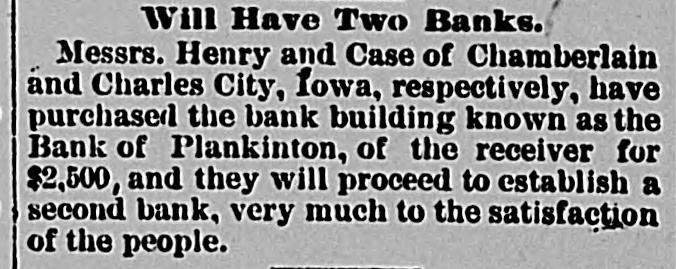
Messrs. Henry and Case ... have purchased the bank building known as the Bank of Plankinton, of the receiver for $2,500, and they will proceed to establish a second bank ... (sale of bank building by receiver).
Source
newspapers
4. August 16, 1901 Other
Newspaper Excerpt
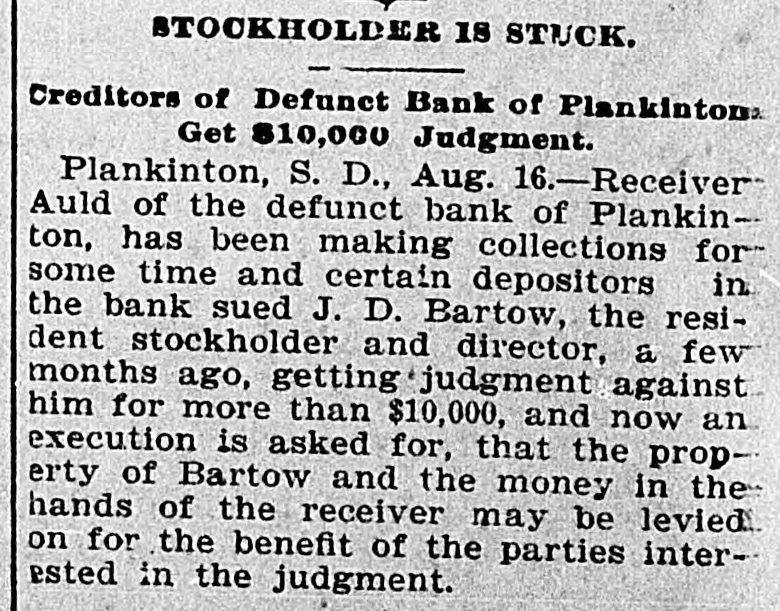
Receiver Auld of the defunct bank of Plankinton ... certain depositors ... getting judgment against [a stockholder] for more than $10,000 (collections and judgments by creditors against stockholders).
Source
newspapers
5. February 27, 1904 Other
Newspaper Excerpt
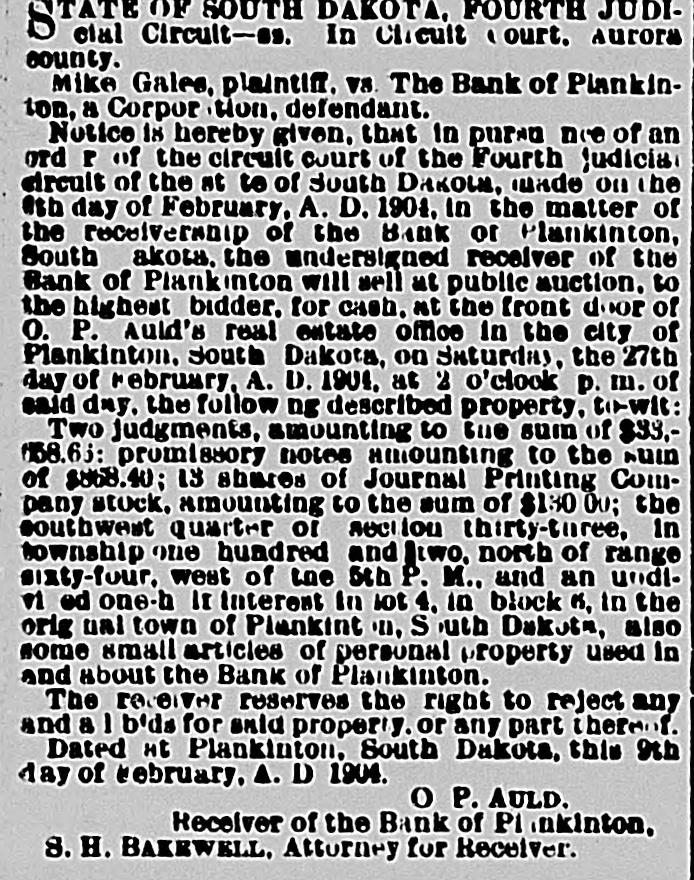
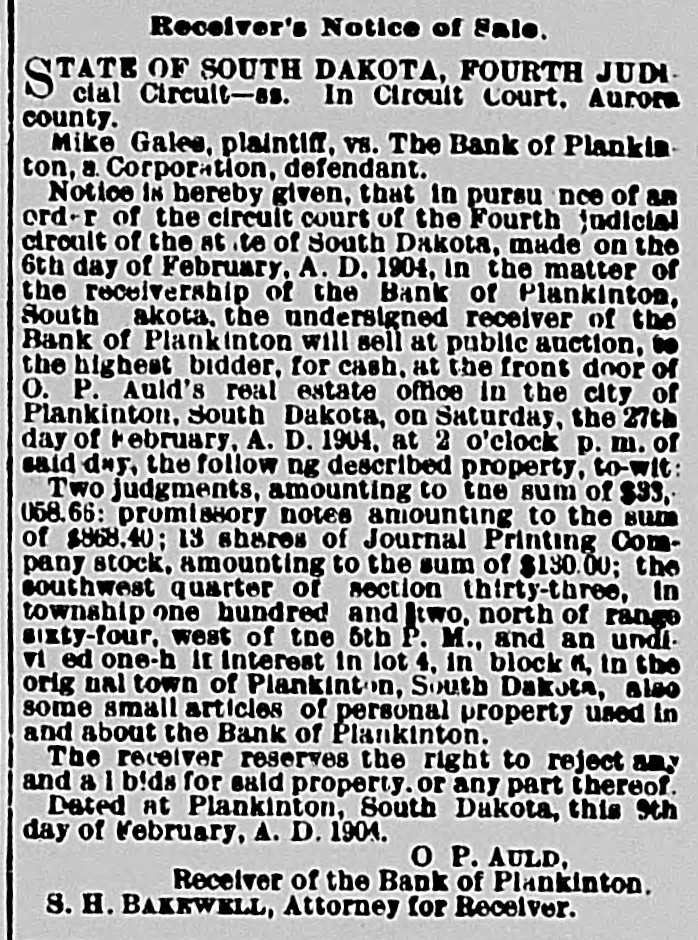
Receiver's Notice of Sale ... the undersigned receiver of the Bank of Plankinton will sell at public auction ... (notice of sale of bank assets).
Source
newspapers

Newspaper Articles (13)

Article from Hot Springs Weekly Star, March 23, 1900

Click image to open full size in new tab

Article Text

Will Have Two Banks. Messrs. Henry and Case of Chamberlain and Charles City, fowa, respectively, have purchased the bank building known as the Bank of Plankinton, of the receiver for $2,500, and they will proceed to establish a second bank, very much to the satisfaction of the people.


Article from Hot Springs Weekly Star, April 6, 1900

Click image to open full size in new tab

Article Text

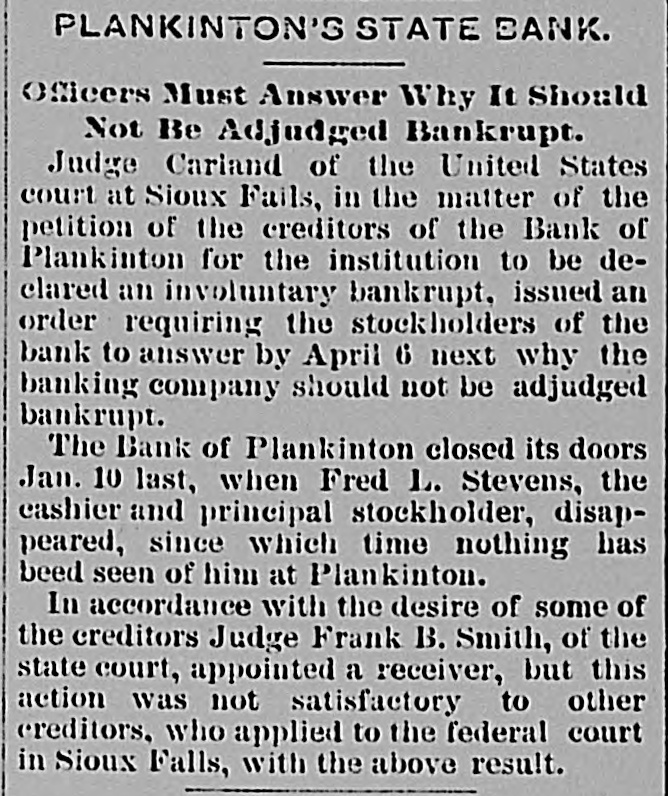
PLANKINTON'S STATE BANK. Officers Must Answer Why It Should Not Be Adjudged Bankrupt. Judge Carland of the United States court at Sioux Fails, in the matter of the petition of the creditors of the Bank of Plankinton for the institution to be declared an involuntary bankrupt, issued an order requiring the stockholders of the bank to answer by April 6 next why the banking company should not be adjudged bankrupt. The Bank of Plankinton closed its doors Jan. 10 last, when Fred L. Stevens, the eashier and principal stockholder, disappeared, since which time nothing has beed seen of him at Plankinton. In accordance with the desire of some of the creditors Judge Frank B. Smith, of the state court, appointed a receiver, but this action was not satisfactory to other creditors, who applied to the federal court in Sioux Falls, with the above result.


Article from Reporter and Farmer, March 7, 1901

Click image to open full size in new tab

Article Text

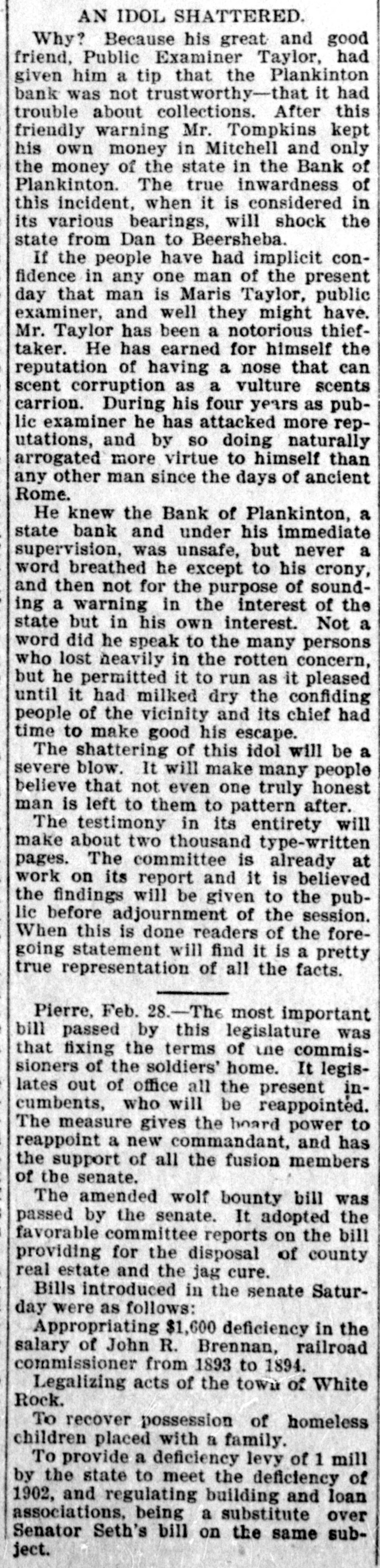
AN IDOL SHATTERED. Why? Because his great and good friend, Public Examiner Taylor, had given him a tip that the Plankinton bank was not trustworthy-that it had trouble about collections. After this friendly warning Mr. Tompkins kept his own money in Mitchell and only the money of the state in the Bank of Plankinton. The true inwardness of this incident, when it is considered in its various bearings, will shock the state from Dan to Beersheba. If the people have had implicit confidence in any one man of the present day that man is Maris Taylor, public examiner, and well they might have. Mr. Taylor has been a notorious thieftaker. He has earned for himself the reputation of having a nose that can scent corruption as a vulture scents carrion. During his four years as public examiner he has attacked more reputations, and by so doing naturally arrogated more virtue to himself than any other man since the days of ancient Rome. He knew the Bank of Plankinton, a state bank and under his immediate supervision, was unsafe, but never a word breathed he except to his crony, and then not for the purpose of sounding a warning in the interest of the state but in his own interest. Not a word did he speak to the many persons who lost heavily in the rotten concern, but he permitted it to run as it pleased until it had milked dry the confiding people of the vicinity and its chief had time to make good his escape. The shattering of this idol will be a severe blow. It will make many people believe that not even one truly honest man is left to them to pattern after. The testimony in its entirety will make about two thousand type-written pages. The committee is already at work on its report and it is believed the findings will be given to the public before adjournment of the session. When this is done readers of the foregoing statement will find it is a pretty true representation of all the facts. Pierre, Feb. 28.-The most important bill passed by this legislature was that fixing the terms of the commissioners of the soldiers' home. It legislates out of office all the present incumbents, who will be reappointed. The measure gives the board power to reappoint a new commandant, and has the support of all the fusion members of the senate. The amended wolf bounty bill was passed by the senate. It adopted the favorable committee reports on the bill providing for the disposal of county real estate and the jag cure. Bills introduced in the senate Saturday were as follows: Appropriating $1,600 deficiency in the salary of John R. Brennan, railroad commissioner from 1893 to 1894. Legalizing acts of the town of White Rock. To recover possession of homeless children placed with a family. To provide a deficiency levy of 1 mill by the state to meet the deficiency of 1902, and regulating building and loan associations, being a substitute over Senator Seth's bill on the same subject.


Article from Reporter and Farmer, March 7, 1901

Click image to open full size in new tab

Article Text

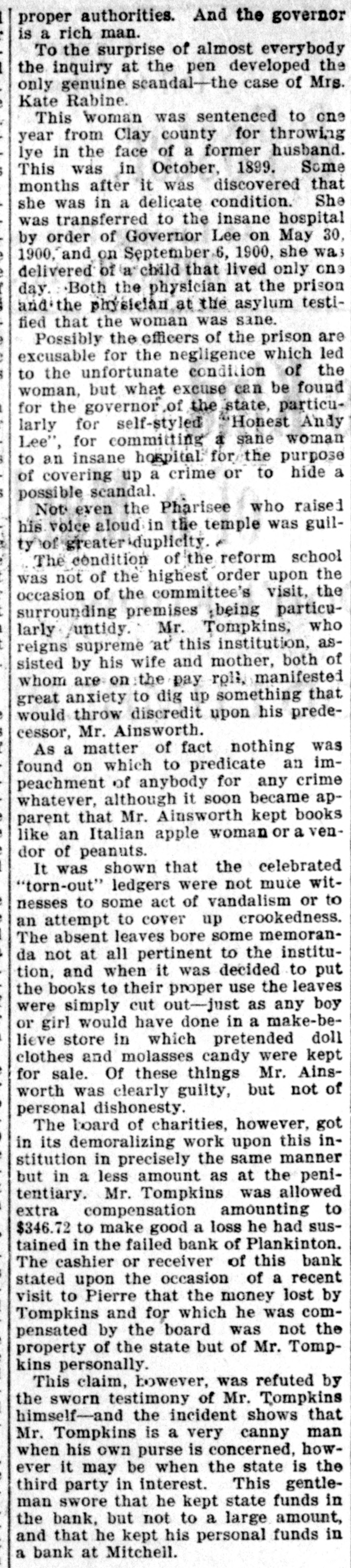
# AND THE GOVERNOR IS A RICH MAN To the surprise of almost everybody the inquiry at the pen developed the only genuine scandal-the case of Mrs. Kate Rabine. This woman was sentenced to one year from Clay county for throwing lye in the face of a former husband. This was in October, 1899. Some months after it was discovered that she was in a delicate condition. She was transferred to the insane hospital by order of Governor Lee on May 30, 1900, and on September 6, 1900, she was delivered of a child that lived only one day. Both the physician at the prison and the physician at the asylum testified that the woman was sane. Possibly the officers of the prison are excusable for the negligence which led to the unfortunate condition of the woman, but what excuse can be found for the governor of the state, particularly for self-styled "Honest Andy Lee", for committing a sane woman to an insane hospital for the purpose of covering up a crime or to hide a possible scandal. Not even the Pharisee who raised his voice aloud in the temple was guilty of greater duplicity. The condition of the reform school was not of the highest order upon the occasion of the committee's visit, the surrounding premises being particularly untidy. Mr. Tompkins, who reigns supreme at this institution, assisted by his wife and mother, both of whom are on the pay roll, manifested great anxiety to dig up something that would throw discredit upon his predecessor, Mr. Ainsworth. As a matter of fact nothing was found on which to predicate an impeachment of anybody for any crime whatever, although it soon became apparent that Mr. Ainsworth kept books like an Italian apple woman or a vendor of peanuts. It was shown that the celebrated "torn-out" ledgers were not mute witnesses to some act of vandalism or to an attempt to cover up crookedness. The absent leaves bore some memoranda not at all pertinent to the institution, and when it was decided to put the books to their proper use the leaves were simply cut out-just as any boy or girl would have done in a make-believe store in which pretended doll clothes and molasses candy were kept for sale. Of these things Mr. Ainsworth was clearly guilty, but not of personal dishonesty. The board of charities, however, got in its demoralizing work upon this institution in precisely the same manner but in a less amount as at the penitentiary. Mr. Tompkins was allowed extra compensation amounting to $346.72 to make good a loss he had sustained in the failed bank of Plankinton. The cashier or receiver of this bank stated upon the occasion of a recent visit to Pierre that the money lost by Tompkins and for which he was compensated by the board was not the property of the state but of Mr. Tompkins personally. This claim, however, was refuted by the sworn testimony of Mr. Tompkins himself-and the incident shows that Mr. Tompkins is a very canny man when his own purse is concerned, however it may be when the state is the third party in interest. This gentleman swore that he kept state funds in the bank, but not to a large amount, and that he kept his personal funds in a bank at Mitchell.


Article from Omaha Daily Bee, March 13, 1901

Click image to open full size in new tab

Article Text

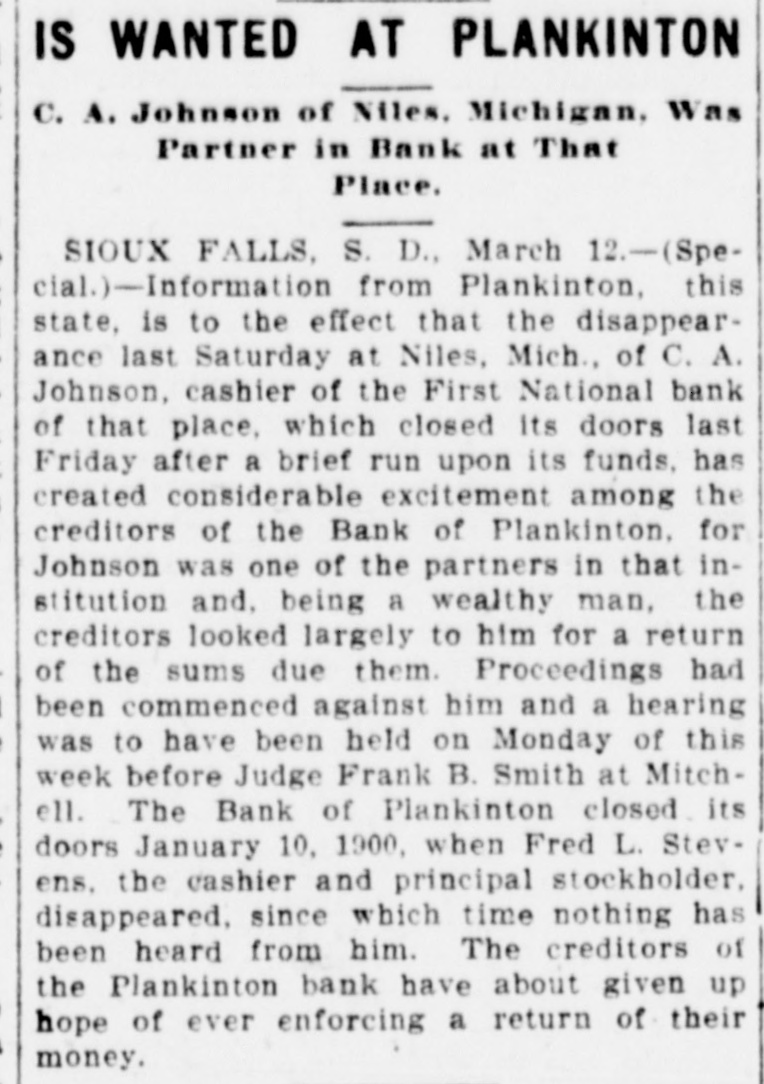
IS WANTED AT PLANKINTON C. A. Johnson of Niles. Michigan, Was Partner in Bank at That Place. SIOUX FALLS, S. D., March 12.-(Special.)-Information from Plankinton, this state, is to the effect that the disappearance last Saturday at Niles, Mich., of C. A. Johnson, cashier of the First National bank of that place, which closed its doors last Friday after a brief run upon its funds, has created considerable excitement among the creditors of the Bank of Plankinton. for Johnson was one of the partners in that institution and, being a wealthy man, the creditors looked largely to him for a return of the sums due them. Proceedings had been commenced against him and a hearing was to have been held on Monday of this week before Judge Frank B. Smith at Mitchell. The Bank of Plankinton closed its doors January 10, 1900, when Fred L. Stevens. the cashier and principal stockholder, disappeared. since which time nothing has been heard from him. The creditors of the Plankinton bank have about given up hope of ever enforcing a return of their money.


Article from The Black Hills Union, August 22, 1901

Click image to open full size in new tab

Article Text

STOCKHOLDER IS STUCK. Creditors of Defunct Bank of Plankinton Get $10,000 Judgment. Plankinton, S. D., Aug. 16.-Receiver Auld of the defunct bank of Plankin-ton, has been making collections for some time and certain depositors in the bank sued J. D. Bartow, the resident stockholder and director, a few months ago, getting judgment against him for more than $10,000, and now an execution is asked for, that the property of Bartow and the money in the hands of the receiver may be levied. on for the benefit of the parties interested in the judgment.


Article from The Denison Review, December 3, 1901

Click image to open full size in new tab

Article Text

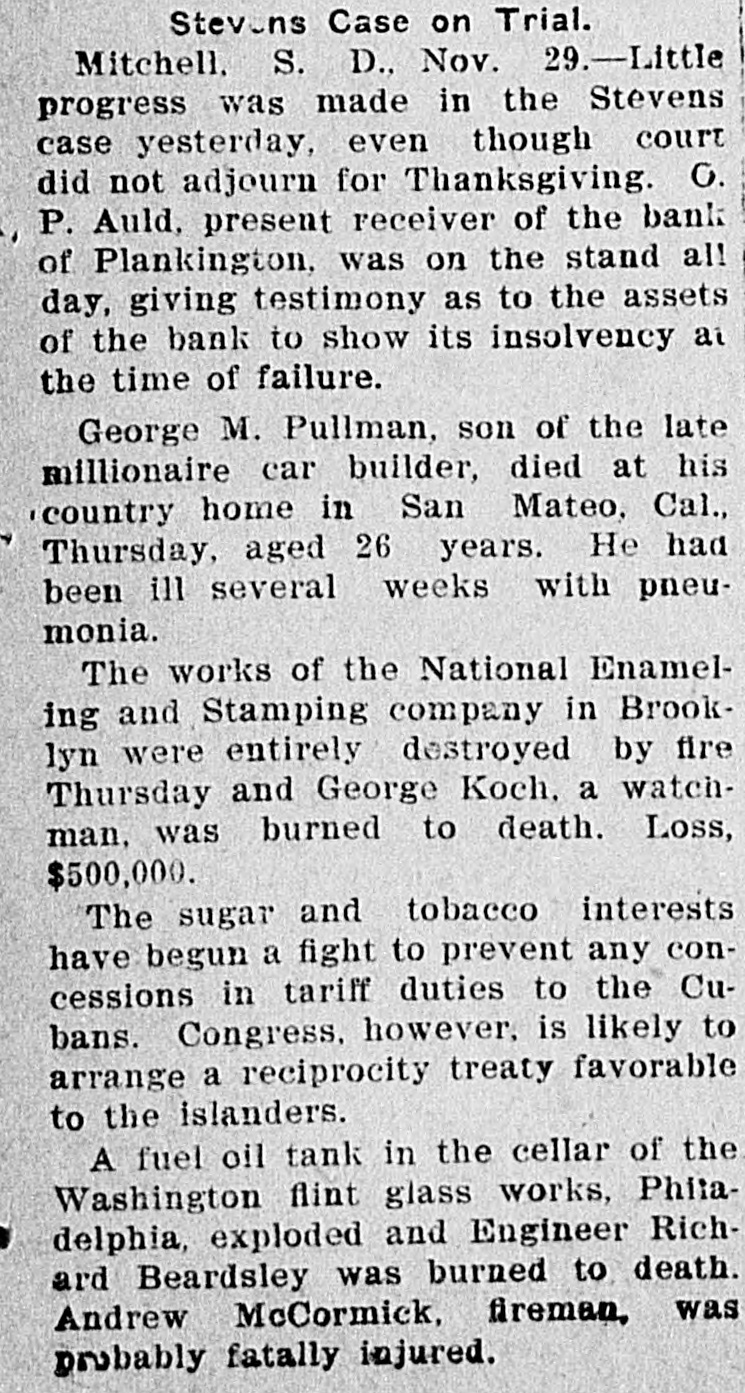
Stevens Case on Trial. Mitchell, S. D., Nov. 29.-Little progress was made in the Stevens case yesterday, even though court did not adjourn for Thanksgiving. G. P. Auld, present receiver of the bank of Plankington, was on the stand all day, giving testimony as to the assets of the bank to show its insolvency at the time of failure. George M. Pullman, son of the late millionaire car builder, died at his country home in San Mateo, Cal., Thursday, aged 26 years. He had been ill several weeks with pneumonia. The works of the National Enameling and Stamping company in Brooklyn were entirely destroyed by fire Thursday and George Koch, a watchman, was burned to death. Loss, $500,000. The sugar and tobacco interests have begun a fight to prevent any concessions in tariff duties to the Cubans. Congress, however, is likely to arrange a reciprocity treaty favorable to the islanders. A fuel oil tank in the cellar of the Washington flint glass works, Phitadelphia, exploded and Engineer Richard Beardsley was burned to death. Andrew McCormick, fireman, was probably fatally injured.


Article from The Mitchell Capital, November 6, 1903

Click image to open full size in new tab

Article Text

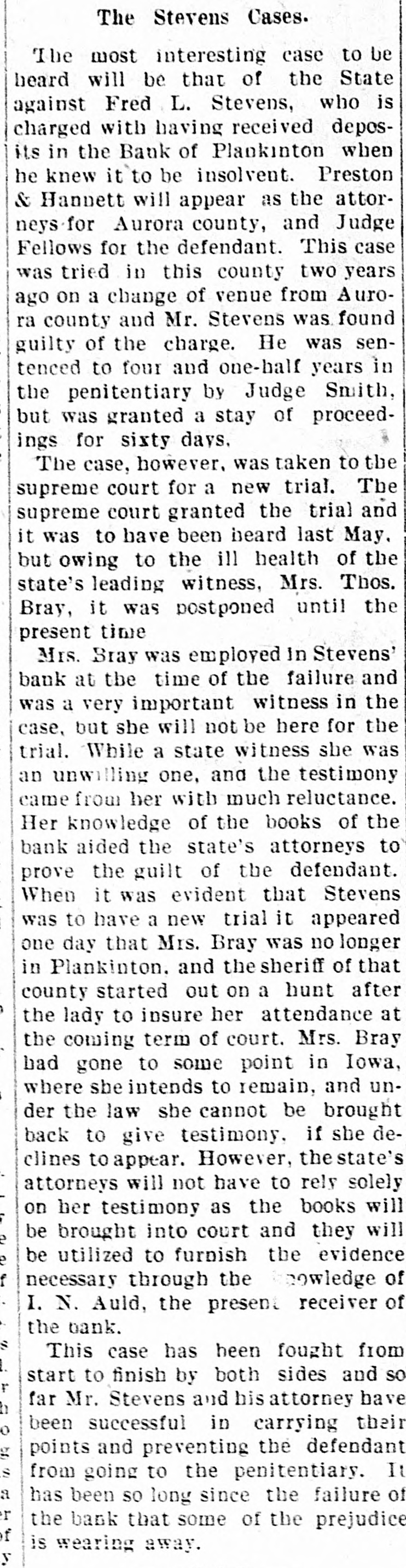
# The Stevens Cases. The most interesting case to be heard will be that of the State against Fred L. Stevens, who is charged with having received deposits in the Bank of Plankinton when he knew it to be insolvent. Preston & Hannett will appear as the attorneys for Aurora county, and Judge Fellows for the defendant. This case was tried in this county two years ago on a change of venue from Aurora county and Mr. Stevens was found guilty of the charge. He was sentenced to four and one-half years in the penitentiary by Judge Smith, but was granted a stay of proceedings for sixty days. The case, however, was taken to the supreme court for a new trial. The supreme court granted the trial and it was to have been heard last May. but owing to the ill health of the state's leading witness, Mrs. Thos. Bray, it was postponed until the present time Mrs. Bray was employed in Stevens' bank at the time of the failure and was a very important witness in the case, but she will not be here for the trial. While a state witness she was an unwilling one, and the testimony came from her with much reluctance. Her knowledge of the books of the bank aided the state's attorneys to prove the guilt of the defendant. When it was evident that Stevens was to have a new trial it appeared one day that Mrs. Bray was no longer in Plankinton, and the sheriff of that county started out on a hunt after the lady to insure her attendance at the coming term of court. Mrs. Bray had gone to some point in Iowa, where she intends to remain, and under the law she cannot be brought back to give testimony, if she declines to appear. However, the state's attorneys will not have to rely solely on her testimony as the books will be brought into court and they will be utilized to furnish the evidence necessary through the cowledge of I. N. Auld, the present receiver of the bank. This case has been fought from start to finish by both sides and so far Mr. Stevens and his attorney have been successful in carrying their points and preventing the defendant from going to the penitentiary. It has been so long since the failure of the bank that some of the prejudice is wearing away.


Article from The Mitchell Capital, November 13, 1903

Click image to open full size in new tab

Article Text

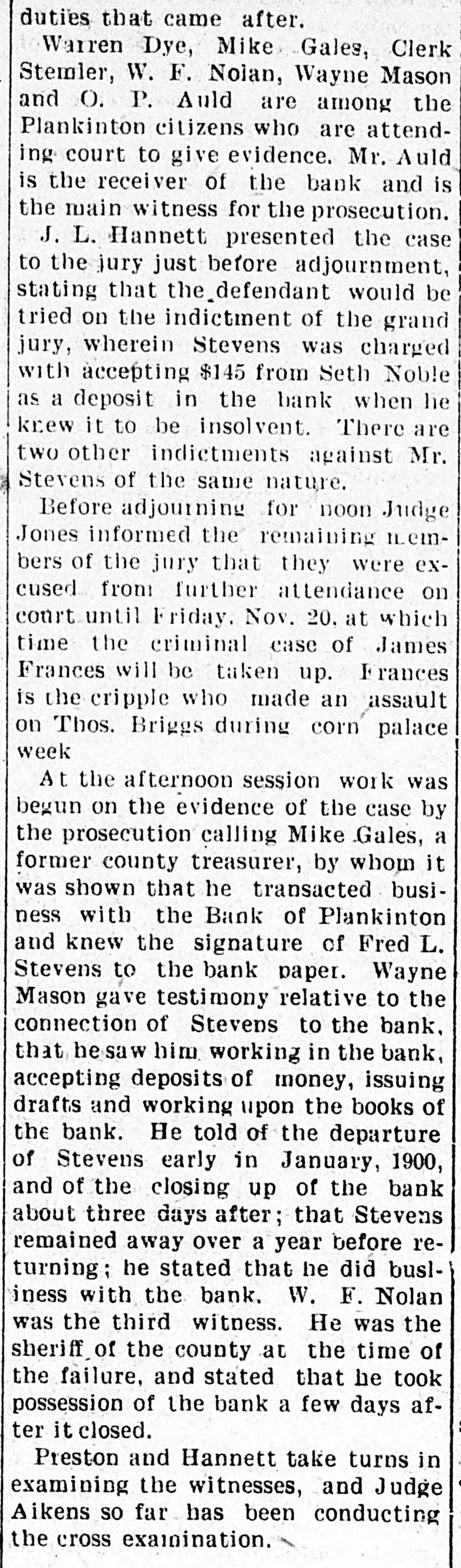
duties that came after. Warren Dye, Mike Gales, Clerk Stemler, W. F. Noian, Wayne Mason and O. P. Auld are among the Plankinton citizens who are attending court to give evidence. Mr. Auld is the receiver of the bank and is the main witness for the prosecution. J. L. Hannett presented the case to the jury just before adjournment, stating that the defendant would be tried on the indictment of the grand jury, wherein Stevens was charged with accepting $145 from Seth Nob!e as a deposit in the bank when he krew it to be insolvent. There are two other indictments against Mr. Stevens of the same nature. Before adjourning for noon Judge Jones informed the remaining IL embers of the jury that they were excused from further attendance on court until Friday. Nov. 20. at which time the criminal case of James Frances will be taken up. Frances is the cripple who made an assault on Thos. Briggs during corn palace week At the afternoon session work was begun on the evidence of the case by the prosecution calling Mike Gales, a former county treasurer, by whom it was shown that he transacted business with the Bank of Plankinton and knew the signature of Fred L. Stevens to the bank paper. Wayne Mason gave testimony relative to the connection of Stevens to the bank, that he saw him working in the bank, accepting deposits of money, issuing drafts and working upon the books of the bank. He told of the departure of Stevens early in January, 1900, and of the closing up of the bank about three days after; that Stevens remained away over a year before returning ; he stated that he did busliness with the bank. W. F. Nolan was the third witness. He was the sheriff of the county at the time of the failure, and stated that he took possession of the bank a few days after it closed. Preston and Hannett take turns in examining the witnesses, and Judge Aikens so far has been conducting the cross examination.


Article from The Mitchell Capital, November 20, 1903

Click image to open full size in new tab

Article Text

OFFERING THE EVIDENCE The State Producing the Evidence in the Stevens Case-Many Witnesses Examined. Thursday afternoon O. P. Auld was called to the witness stand in the Stevens case after the retirement of ex-Sheriff Nolan. Mr. Auld is the receiver of the defunct bank. and has held that position since its doors were closed nearly four years ago. Preston & Hannett questioned him as to the condition of the bank -the amount of its assets and the amount that had been collected. He stated that the amount secured in the past three years and ten months on the assets was $18,044 13. The receiver now has in his possession a number of old notes of doubtful value, the half interest in some property on Main street in Plankinton, which at the time of the failure was worth $300, and a quarter section of land, the value of which at the time of the failure was $800. The books of the bank were placed in evidence, and doubtless Mr. Auld will be examined further on them. Wayne Mason and Mike Gales were recalled to the stand at the opening session of court Friday morning to identify a letter that was written by Stevens to Maud Howard, the clerk in the bank, on or about Jan. 6, 1900. In this letter Mr. Stevens notified Miss Howard not to open the bank on the day after the letter was received by her on account of its embarrassing financial condition. J. L. Hannett was also placed on the stand to show that he had received that letter into his possession. H. P. Beckwith, of Elk Point, was the next witness called. At the time of the failure Mr. Beckwith was associated with the First National bank of this city. On the day that Fred Stevens left Plankinton he wired the oank to have $1,000 in currency for him at the train when he was to go through that day. Mr. Stevens bad that much money in"the First National to the credit of the Bank of Plankinton. Mr. Beckwith testified that he took the amount to the train and delivered it into the posesssion of Mr. Stevens. Public Examiner Heminway was on the stand at the close of the morning session to verify the statements of the bank made to Maris Taylor former public examiner, from the files of the public examiner's office. the last one being made in October. 1889. J. D. Stemler was the last witness called and he simply veritied the signature of Stevens to a paper. At this point the prosecution rested its case. The defense placed O. L. Branson, president of the First National bank, on the stand as the only witness it cared to produce. Shortly after the failure of the bank, Mr. Branson was requested to make an examination of its condition, which he showed upon the witness stand. From the books he placed the assets of the bank at $56,654.22, and the liabilities at $38,774.75. At this point the defense rested. J. L. Hannett for the prosecution addressed the jury and he was followed by Judge Aiken or the defense. The other attorneys will speak and the case will be given to the jury after the instructions.of Ludge Lones.


Article from The Mitchell Capital, February 12, 1904

Click image to open full size in new tab

Article Text

TATE OF SOUTH DAKOTA, FOURTH JUDIcial Circuit-. In Clicult , ourt. Aurora county. Mike Gales, plaintiff. vs. The Bank of Plankinton, a Corpor Hon. defendant. Notice 18 hereby given. that in puran nee of an ord r of the circuit court of the Fourth Judicial circuit of the at to of South DAKOLM, made on the 8th day of February, A. D. 1904, in the matter of the receivership of the BANK or Plankinton, South akota. the undersigned receiver of the Bank of Plankinton will well at public auction. to the highest bidder. for cash. nt the front door of O. P. Auld's real estate office in the city of Plankinton. South Dakota, on Saturday, the 27th day of February, A. D. 1904. at 2 o'clook p. m. of said day. the follow ng described property, Cirwit: Two judgments, amounting to tue sum of $33.058.63: promissory notes amounting to the win of $868.40; 13 shares of Journal Printing Company stock. amounting to the sum of $130 Ou; the southwest quarter or section thirty-tirree, in township one hundred and two. north of range sixty-four, west of the 5th P. M., and an undin ed one-h It Interest In lot 4. in block K, in the orig uni town of Plankint n. S uth Dakuta, also some small articles of personal property used In and about the Bank of Plankinton. The receiver reserves the right to reject any and a 1 b'ds for said properly. or any part thereof. Dated Ht Plankinton, South Dakota, this 9th day of February, A. D 1904. o P. AULD. Receiver of the Bank of P1 nkinton. 8. H. BAKEWELL. Attorney for Receiver.


Article from The Mitchell Capital, February 12, 1904

Click image to open full size in new tab

Article Text

O P. AULD. Receiver of the Bank of Plankinton. S. H. BAKEWELL, Attorney for Receiver.

Article from The Mitchell Capital, February 19, 1904

Click image to open full size in new tab

Article Text

Receiver's Notice of Sale. STATE OF SOUTH DAKOTA, FOURTH JUDI. Circuit-ss. In Circuit Court. Aurora county. Mike Gales, plaintiff, VS. The Bank of Plankin ton, a. Corporation, defendant. Notice IN hereby given, that in pursu nce of an ord-r of the circuit court of the Fourth judicial ctrcuit of the at to of South Dakota, made on the 6th day of February, A. D. 1904, in the matter of the receivership of the Bank of Plankinton, South akota, the undersigned receiver of the Bank of Plankinton will sell at public auction, to the highest bidder, for cash. at the front door of O. P. Auid's real estate office in the city of Plankinton, South Dakota, on Saturday, the 27th day of February, A. D. 1904, at 2 o'clock p. m. of said day, the follow ng described property, to-wit: Two judgments, amounting to the sum of $33,058.66: promissory notes amounting to the sum of $868.40; 13 shares of Journal Printing Company stock, amounting to the sum of $130.00; the southwest quarter of section thirty-three, In township one hundred and two, north of range sixty-four, west of the 5th P. M., and an undiVI ed one-h It Interest In lot 4, in block 6, in the orig nal town of Plankinton, South Dakota, also some small articles of personal property used in and about the Bank of Plankinton. The receiver reserves the right to reject any and a 1 bids for said property. or any part thereof. Dated at Plankinton, South Dakota, this 9th day of February, A. D. 1904. 0 P. AULD, Receiver of the Bank of Plankinton, S. H. BAKEWELL, Attorney for Receiver.