Article Text
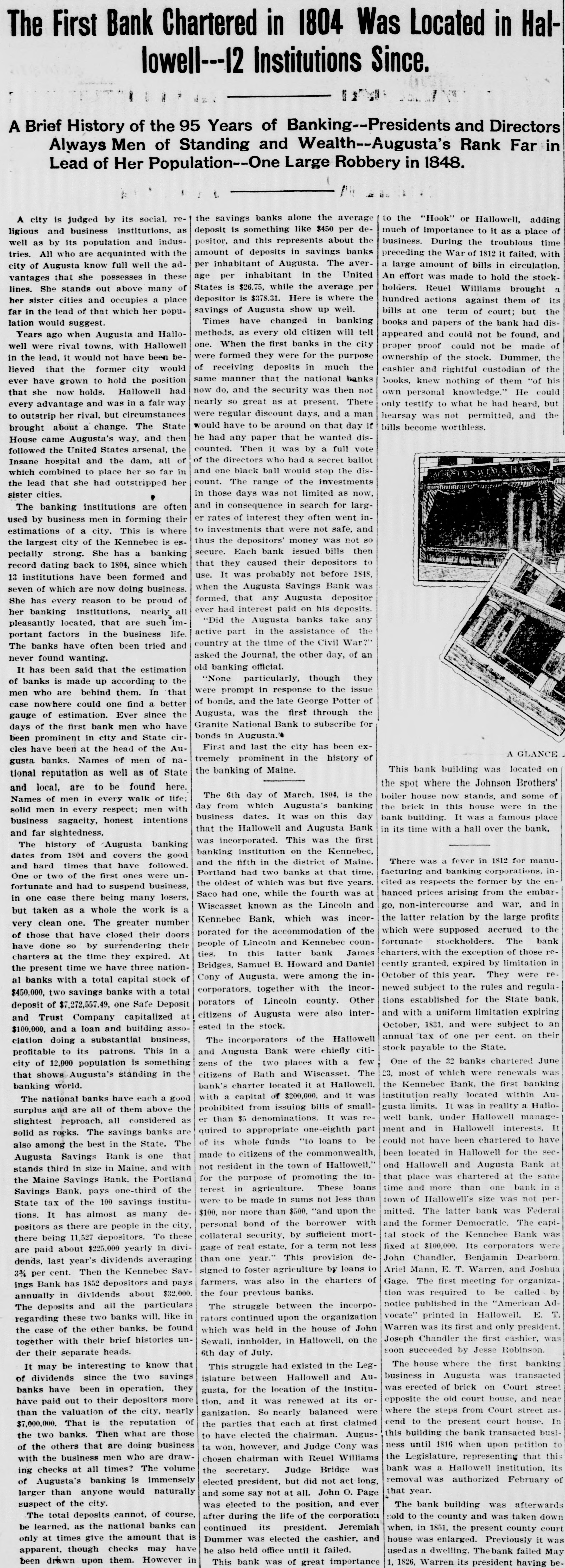
# The First Bank Chartered in 1804 Was Located in Hallowell--12 Institutions Since. # A Brief History of the 95 Years of Banking--Presidents and Directors Always Men of Standing and Wealth--Augusta's Rank Far in Lead of Her Population--One Large Robbery in 1848. A city is judged by its social, re- ligious and business institutions, as well as by its population and indus- tries. All who are acquainted with the city of Augusta know full well the ad- vantages that she possesses in these lines. She stands out above many of her sister cities and occupies a place far in the lead of that which her popu- lation would suggest. Years ago when Augusta and Hallo- well were rival towns, with Hallowell in the lead, it would not have been be- lieved that the former city would ever have grown to hold the position that she now holds. Hallowell had every advantage and was in a fair way to outstrip her rival, but circumstances brought about a change. The State House came Augusta's way, and then followed the United States arsenal, the Insane hospital and the dam, all of which combined to place her so far in the lead that she had outstripped her sister cities. The banking institutions are often used by business men in forming their estimations of a city. This is where the largest city of the Kennebec is es- pecially strong. She has a banking record dating back to 1804, since which 13 institutions have been formed and seven of which are now doing business. She has every reason to be proud of her banking institutions, nearly all pleasantly located, that are such im- portant factors in the business life. The banks have often been tried and never found wanting. It has been said that the estimation of banks is made up according to the men who are behind them. In that case nowhere could one find a better gauge of estimation. Ever since the days of the first bank men who have been prominent in city and State cir- cles have been at the head of the Au- gusta banks. Names of men of na- tional reputation as well as of State and local, are to be found here. Names of men in every walk of life; solid men in every respect; men with business sagacity, honest intentions and far sightedness. The history of Augusta banking dates from 1804 and covers the good and hard times that have followed. One or two of the first ones were un- fortunate and had to suspend business, in one case there being many losers, but taken as a whole the work is a very clean one. The greater number of those that have closed their doors have done so by surrendering their charters at the time they expired. At the present time we have three nation- al banks with a total capital stock of $450,000, two savings banks with a total deposit of $7,272,557.49, one Safe Deposit and Trust Company capitalized at $100,000, and a loan and building asso- ciation doing a substantial business, profitable to its patrons. This in a city of 12,000 population is something that shows Augusta's standing in the banking world. The national banks have each a good surplus and are all of them above the slightest reproach, all considered as solid as rocks. The savings banks are also among the best in the State. The Augusta Savings Bank is one that stands third in size in Maine, and with the Maine Savings Bank, the Portland Savings Bank, pays one-third of the State tax of the 100 savings institu- tions. It has almost as many de- positors as there are people in the city, there being 11,527 depositors. To these are paid about $225,000 yearly in divi- dends, last year's dividends averaging 334 per cent. Then the Kennebec Sav- ings Bank has 1852 depositors and pays annually in dividends about $32.000. The deposits and all the particulars regarding these two banks will, like in the case of the other banks, be found together with their brief histories un- der their separate heads. It may be interesting to know that of dividends since the two savings banks have been in operation, they have paid out to their depositors more than the valuation of the city, nearly $7,000,000. That is the reputation of the two banks. Then what are those of the others that are doing business with the business men who are draw- ing checks at all times? The volume of Augusta's banking is immensely larger than anyone would naturally suspect of the city. The total deposits cannot, of course, be learned, as the national banks can only at times give the amount that is apparent, though checks may have been drawn upon them. However in the savings banks alone the average deposit is something like $450 per de- positor, and this represents about the amount of deposits in savings banks per inhabitant of Augusta. The aver- age per inhabitant in the United States is $26.75, while the average per depositor is $378.31. Here is where the savings of Augusta show up well. Times have changed in banking methods, as every old citizen will tell one. When the first banks in the city were formed they were for the purpose of receiving deposits in much the same manner that the national banks now do, and the security was then not nearly so great as at present. There were regular discount days, and a man would have to be around on that day if he had any paper that he wanted dis- counted. Then it was by a full vote of the directors who had a secret ballot and one black ball would stop the dis- count. The range of the investments in those days was not limited as now, and in consequence in search for larg- er rates of interest they often went in- to investments that were not safe, and thus the depositors' money was not so secure. Each bank issued bills then that they caused their depositors to use. It was probably not before 1848, when the Augusta Savings Bank was formed, that any Augusta depositor ever had interest paid on his deposits. "Did the Augusta banks take any active part in the assistance of the country at the time of the Civil War?" asked the Journal, the other day, of an old banking official. "None particularly, though they were prompt in response to the issue of bonds, and the late George Potter of Augusta, was the first through the Granite National Bank to subscribe for bonds in Augusta." First and last the city has been ex- tremely prominent in the history of the banking of Maine. The 6th day of March, 1804, is the day from which Augusta's banking business dates. It was on this day that the Hallowell and Augusta Bank was incorporated. This was the first banking institution on the Kennebec, and the fifth in the district of Maine. Portland had two banks at that time, the oldest of which was but five years. Saco had one, while the fourth was at Wiscasset known as the Lincoln and Kennebec Bank, which was incor- porated for the accommodation of the people of Lincoln and Kennebec coun- ties. In this latter bank James Bridges, Samuel B. Howard and Daniel Cony of Augusta, were among the in- corporators, together with the incor- porators of Lincoln county. Other citizens of Augusta were also inter- ested in the stock. The incorporators of the Hallowell and Augusta Bank were chiefly citi- zens of the two places with a few citizens of Bath and Wiscasset. The bank's charter located it at Hallowell, with a capital of $200,000, and it was prohibited from issuing bills of small- er than $5 denominations. It was re- quired to appropriate one-eighth part of its whole funds "to loans to be made to citizens of the commonwealth, not resident in the town of Hallowell," for the purpose of promoting the in- terest in agriculture. These loans were to be made in sums not less than $100, nor more than $500, "and upon the personal bond of the borrower with collateral security, by sufficient mort- gage of real estate, for a term not less than one year." This provision de- signed to foster agriculture by loans to farmers, was also in the charters of the four previous banks. The struggle between the incorpo- rators continued upon the organization which was held in the house of John Sewali, innholder, in Hallowell, on the 6th day of July. This struggle had existed in the Leg- islature between Hallowell and Au- gusta, for the location of the institu- tion, and it was renewed at its or- ganization. So nearly balanced were the parties that each at first claimed to have elected the chairman. Augus- ta won, however, and Judge Cony was chosen chairman with Reuel Williams the secretary. Judge Bridge was elected president, but did not act long, and some say not at all. John O. Page was elected to the position, and ever after during the life of the corporation continued its president. Jeremiah Dummer was elected the cashier, and he also held office until it failed. This bank was of great importance to the "Hook" or Hallowell, adding much of importance to it as a place of business. During the troublous time preceding the War of 1812 it failed, with a large amount of bills in circulation. An effort was made to hold the stock- holders. Reuel Williams brought hundred actions against them of its bills at one term of court; but the books and papers of the bank had dis- appeared and could not be found, and proper proof could not be made of ownership of the stock. Dummer, the cashier and rightful custodian of the books, knew nothing of them "of his own personal knowledge." He could only testify to what he had heard, but hearsay was not permitted, and the bills become worthless. A GLANCE This bank building was located on the spot where the Johnson Brothers' boiler house now stands, and some of the brick in this house were in the bank building. It was a famous place in its time with a hall over the bank. There was a fever in 1812 for manu- facturing and banking corporations, in- cited as respects the former by the en- hanced prices arising from the embar- go, non-intercourse and war, and in the latter relation by the large profits which were supposed accrued to the fortunate stockholders. The bank charters, with the exception of those re- cently granted, expired by limitation in October of this year. They were re- newed subject to the rules and regula- tions established for the State bank, and with a uniform limitation expiring October, 1831, and were subject to an annual tax of one per cent. on their stock payable to the State. One of the 32 banks chartered June 23, most of which were renewals was the Kennebec Bank, the first banking institution really located within Au- gusta limits. It was in reality a Hallo- well bank, under Hallowell manage- ment and in Hallowell interests. It could not have been chartered to have been located in Hallowell for the sec- ond Hallowell and Augusta Bank at that place was chartered at the same time and more than one bank in a town of Hallowell's size was not per- mitted. The latter bank was Federal and the former Democratic. The capi- tal stock of the Kennebec Bank was fixed at $100,000. Its corporators were John Chandler, Benjamin Dearborn, Ariel Mann, E. T. Warren, and Joshua Gage. The first meeting for organiza- tion was required to be called by notice published in the "American Ad- vocate" printed in Hallowell. E. T. Warren was its first and only president. Joseph Chandler the first cashier, was soon succeeded by Jesse Robinson. The house where the first banking business in Augusta was transacted was erected of brick on Court street opposite the old court house, and near where the steps from Court street as- cend to the present court house. In this building the bank transacted busi- ness until 1816 when upon petition to the Legislature, representing that this bank was a Hallowell institution, its removal was authorized February of that year. The bank building was afterwards sold to the county and was taken down when, in 1851, the present county court house was enlarged. Previously it was used as a dwelling. The bank failed May 1, 1826, Warren its president having be-