8714. Capital Trust & Savings Bank (St Paul, MN)

Bank Information

Episode Type
Suspension โ†’ Closure
Bank Type
trust
Start Date
May 4, 1924
Location
St Paul, Minnesota (44.944, -93.093)

Metadata

Model
gpt-5-mini
Short Digest
e8474685be693a45

Response Measures

None

Description

The Capital Trust & Savings Bank was ordered closed by the Minnesota state superintendent of banks in early May 1924 because of frozen assets (mortgages). The closure is described as a failure; articles report deposits and that it was closed by the superintendent, and that its failure triggered runs and a merger to protect depositors of the separate Capital National Bank. No reopening is described; this is a regulator-ordered closure (failure).

Events (1)

1. May 4, 1924 Suspension
Cause
Government Action
Cause Details
State superintendent of banks ordered the Capital Trust & Savings Bank closed because of frozen assets (large holdings of North Dakota and Montana mortgages that could not be collected).
Newspaper Excerpt
closed Saturday by the state superintendent of banks because of frozen assets.
Source
newspapers

Newspaper Articles (5)

Article from Evening Star, May 4, 1924

Click image to open full size in new tab

Article Text

TWO ST. PAUL BANKS MAY CONSOLIDATE Merger May Result From Collapse of Capital Trust-Frozen Assets Blamed for Crash. ST. PAUL, May 3.-Two of the larger banks in St. Paul may be merged as a result of the closing of the Capital Trust and Savings Bank of St. Paul today by J. Veigel, state superintendent of banks. The report of the merger emanated from a meeting of the leading bankers of the city tonight. The Capital Trust had a capital of $500,000 and deposits of $5,000,000. It was ordered closed because of "frozen assets in the form of North Dakota and Montana mortgages, Mr. Veigel said Closing of the bank caused ร  run on the Capital National Bank, which is in the same building. There is no direct financial connection between the two institutions. When the Capital National closed after its regular business today there was a long line of depositors waiting to withdraw their savings. It is not thought the run will affect that institution, as officials announced tonight they would continue to do business as usual next week. General Depression Blamed. A statement issued by J. L. Mitchell, president of the Capital Trust Bank, said that "because of the general depression in land values it has been impossible to make collections on these mortgages." "A large number of foreclosures has been necessary with the result that the bank has acquired a large amount of land which is a frozen asset at the present time. "If the bank could dispose of these assets for close to normal value it would be able to pay its liabilities in full.
Article from Evening Star, May 5, 1924

Click image to open full size in new tab

Article Text

BANKS PLAN MERGER TO AID DEPOSITORS St. Paul Institutions Consolidate to Avert Possible Run by Alarmed Patrons. By the Associated Press. ST. PAUL, Minn., May 5.-A move to protect interests of depositors of the Capital National Bank of St. Paul from a possible run was taken last night when the boards of directors of the Merchants' National Bank and the Capital National Bank voted to merge. Announcement of the action said: "As a result of action taken by the boards of directors of the Capital National Bank and the Merchants' National Bank the Merchants' National Bank assumes all deposit liabilities of the Capital National Bank. All banking operations will be conducted from the office of the Merchants' National Bank." The Capital National was in the same building as the Capital Trust and Savings Bank, which was closed Saturday by the state superintendent of banks because of "frozen assets." The Capital Trust had deposits of $5,000,000. Closing of the Capital Trust started a run on the Capital National, although the two had no financial connection. With the more than $12,000,000 in deposits of the Capital National the Merchants' will have $40,000,000 in deposits.


Article from New Britain Herald, May 5, 1924

Click image to open full size in new tab

Article Text

BIG BANKS MERGE -Capital National Bank of St. Paul Joins With Merchants Bank to Proteet its Depositors. St. Paul, May 5.-A move to protect the interests of depositors of the Capital National Bank of St. Paul from a possible run was taken last night when the board of directors of the Merchants' National bank and the Capital National voted to merge. Announcement of the action said: "As a result of action taken by the boards of directors of the Capital National band and the Merchants' Nation bank. the Merchants' National bank assumes all deposit liabilities of the Capital National bank. All banking operations will be conducted from the office of the Merchants' National bank The Capital National was in the same building at the Capital Trust and Savings bank, which was closed Saturday by the state superintendent of banks, because of "frozen assets." The Capital Trust had deposits of $5,000,000. Closing of the Capital Trust started a run on the Capital National, although the two had no financial connection. With the more than $12,000,000 in depostis of the Capital National, the Merchants wilf have $10,000,000 in deposits.


Article from The Daily Worker, May 7, 1924

Click image to open full size in new tab

Article Text

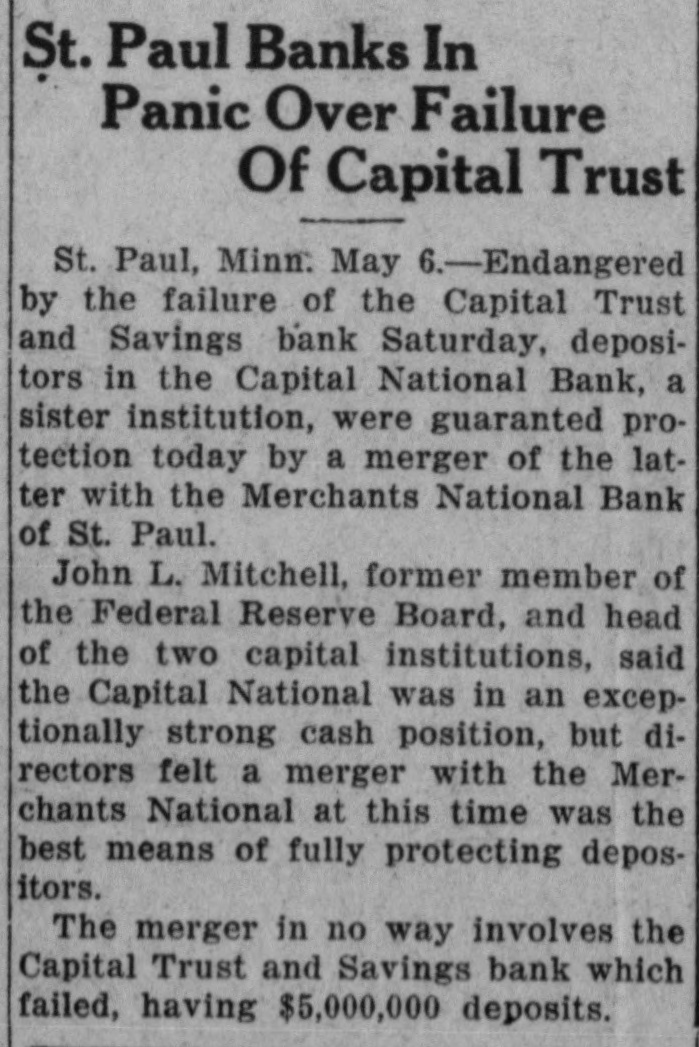
St. Paul Banks In Panic Over Failure Of Capital Trust St. Paul, Minn. May 6.-Endangered by the failure of the Capital Trust and Savings bank Saturday, depositors in the Capital National Bank, a sister institution, were guaranted protection today by a merger of the latter with the Merchants National Bank of St. Paul. John L. Mitchell, former member of the Federal Reserve Board, and head of the two capital institutions, said the Capital National was in an exceptionally strong cash position, but directors felt a merger with the Merchants National at this time was the best means of fully protecting depositors. The merger in no way involves the Capital Trust and Savings bank which failed, having $5,000,000 deposits.


Article from The Elk Mountain Pilot, October 30, 1924

Click image to open full size in new tab

Article Text

Defunct Bank's Head Made Reserve Agent J. R. Mitchell, Former Presi. dent Trust Company Which Failed, Gets Important Federal Post. Washington, D. C.-John R. Mithell, of St. Paul, recently appointed by President Coolidge to be Federal Reserve Agent and chairman of the board of directors of the Ninth District Federal Reserve Bank, Minneapolis, is remembered by many hundreds of farmers in the Northwest as president of the Capital Trust and Savings Bank, which failed on May 4 last. The failure of this bank caused heavy losses to its depositors and stockholders. At the time its doors were ordered closed it had deposits of ,000,000. Its capital was $500,000. The collapse of the Capital Trust concern started "runs" on other banks in St. Paul and for a time threatened the stability of the Capital National Bank, of which also Mitchell was president. The Capital Trust & Savings Bank had operated for many years with a large portion of its funds invested in first mortgages on agricultural lands Because of the heavy decline in the value of these lands, following the ruinous decrease in the prices of agricultural products during the Harding-Coolidge administration, it was impossible for the bank to make collections of either principal or interest from many of its borrowers. President Mitchell himself attrib uted the bank's failure to this exensive holding of "frozen" assets. Opposed Present Reserve System Mitchell's appointment by President Coolidge is by many regarded as a reward for his efforts to organize farmers for the Republican ticket. In 1913, when the bill to create the Federal Reserve System was pending, the Wilson administration fought for the plan to establish twelve regional banks instead of a central bank. Big financial interests in New York urged the central bank and relentlessly opposed the regional system. They were accused of attempting to get one bank in New York because they could more easily control one than twelve. Mitchell was active in the fight for the central bank and against the regional bank, notwithstanding that the bankers of Minnesota had indorsed the regional plan. He was in Washington frequently during the autumn of 1913 when the opposition to the bill was strongest. A month after President Harding took office Mitchell was appointed a member of the Federal Reserve Board for a term of ten years. He resigned on May 12, 1923. Recently he was promoting the McNary-Haugen bill at a time when President Coolidge was reported as opposing it.