Click image to open full size in new tab
Article Text
WHAT THE DECISION
BY BELLINGER MEANS
Continued from Fourth Page.
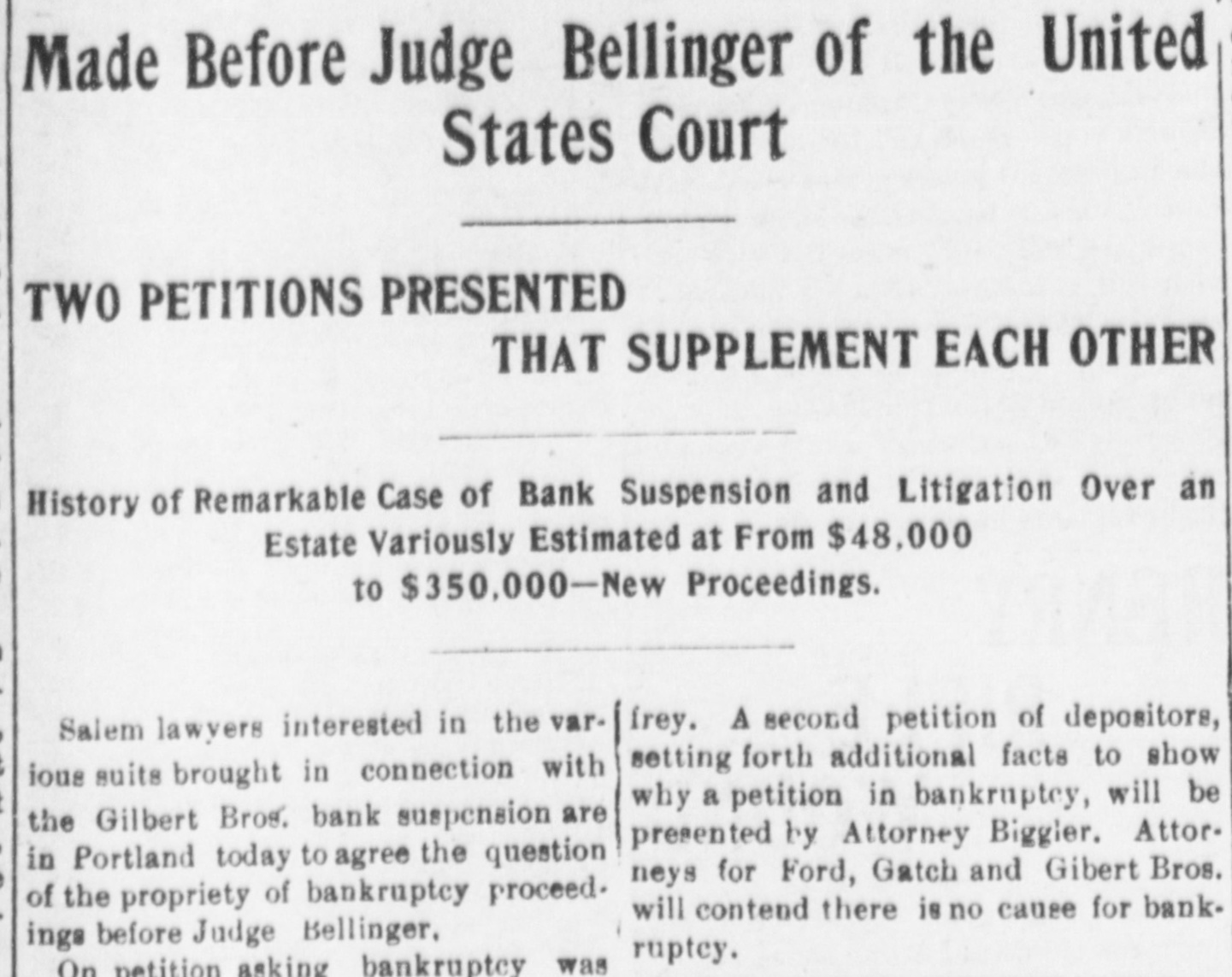
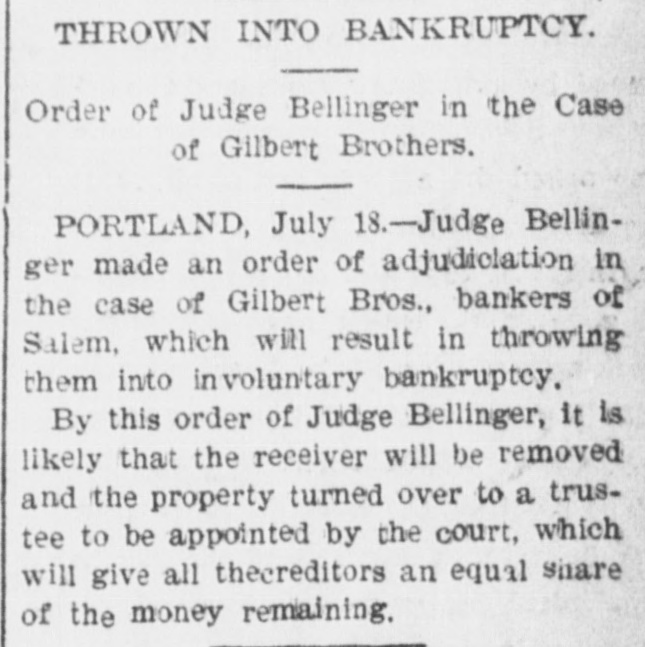
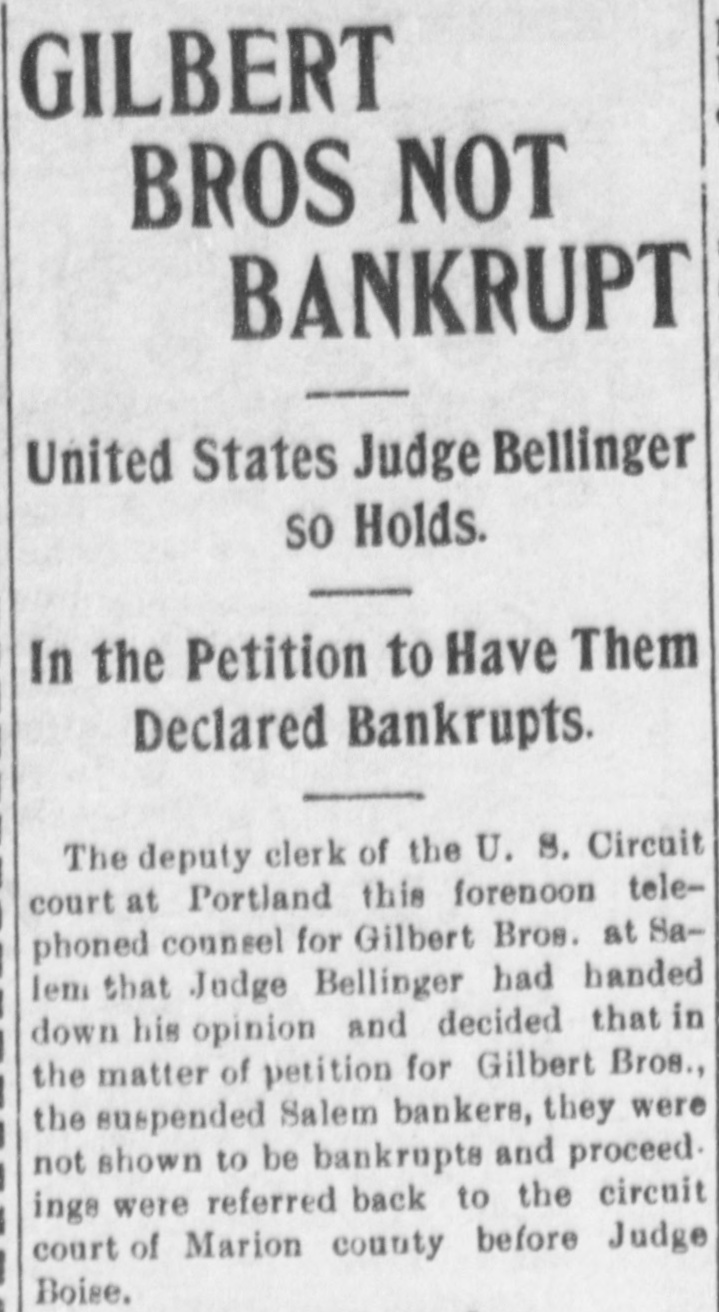
This is a proceeding in involuntary bankruptcy against A. T. and F. N. Gilbert, as partners in the conduct of the banking business of Gilbert Brothers, at Salem, Or. The petitioners in the original and amended petitions are: Ida Muthe, William Iwan and A. S Eppley, creditors of Gilbert Brothers in the aggregate sum of $1978. Subsequently one Loo Jim, a creditor in the sum of $500, also filed a petition praying for an order of adjudication in bankruptcy. The acts of bankruptcy relied upon by the creditors are alleged as follows: That Gilbert Brothers, being insolvent, did within four months of the filing of the original petition transfer securities by way of preference to certain creditors to the aggregate amount in the value of $7000; that subsequent to the filing of the original petition, A. T. Gilbert entered into a written stipulation in a suit then pending against Gilbert Brothers brought by or in the interest of the heirs of William Cosper, deceased, whereby it was stipulated that one Claud Gatch might be appointed receiver of said firm, and that said Gatch should convert the assets of the firm into cash for the payment of all the firm's creditors and the winding up of its business; that to this end A. T. Gilbert suffered a decree to be entered in said suit, and that he thereafter transferred the assets of the firm to the receiver. Other acts of bankruptcy were alleged in the petitions filed, but upon the hearing, these were abandoned.
It is contended that F. N. Gilbert is a partner in the business of Gilbert Brothers, and this is a question in the case, material only in the event that an act of bankruptcy is proven as alleged.
The stipulation that a receiver might be appointed, and the subsequent transfer by A. T. Gilbert, do not have the effect of a general assignment within the meaning of the bankruptcy act. This question was decided by the Circuit Court of Appeals in the Second Circuit in a recent case, in which the court says: "When the statute declares that a general assignment for the benefit of credito sie an act of bankruptcy, can it be construed to include an act which is not a general assignment? We think that it cannot, because the term has a universally understood and recognized meaning throughout the different states, and means a transfer and conveyance by a person of all his property to a named person upon a trust, which is to be worked out in some states by a court of probate and insolvency, in some states by a court of common law, and in some states by a trustee, subject only to the supervision to which any trustee is subjected. It is a deed or conveyance which the grantor makes voluntarily, or sometimes by compulsion, at the instance of a court of insolvency. A petition for the appointment of a receiver is not that proceeding which is universally recognized as an assignment, and its 'equivalency' of result, if equivalency exists, is not important. The bankruptcy statute has said that the one is an act of bankruptcy and has said nothing about the other, in direct terms; and when acts of bankruptcy are classified, as they are in the statute of 1898, it is not the province of a court to enlarge the classification because the omitted class seems to partake of the sin of the named class," In re. Empire Metallic Bedstead Co., 98 Fed. Rep. 981.
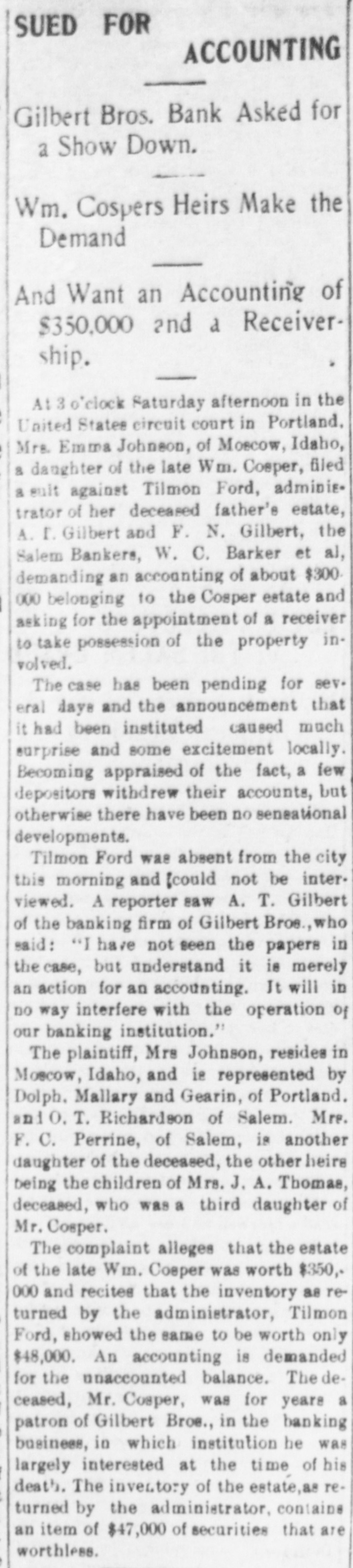
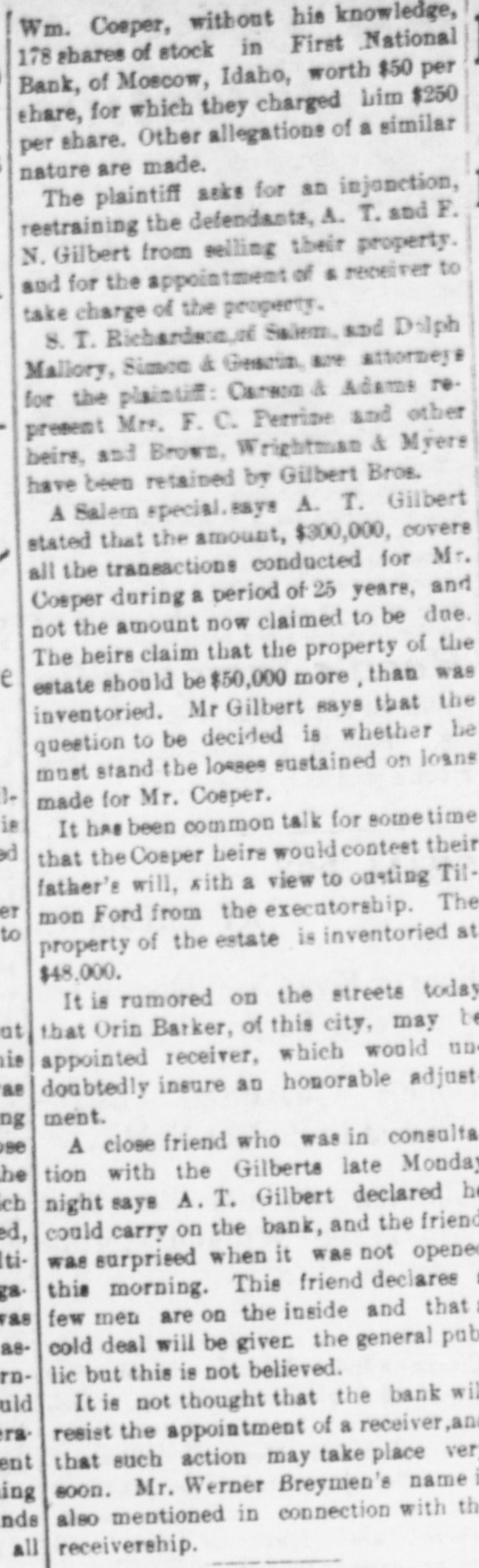
There is a much stronger case against the contention that consent to the appointment of a receiver operates as an assignment within the meaning of the bankruptcy act, than that from which the above quotation is made. The suit in which Receiver Gatch was appointed was not a friendly suit. It is not claimed that it was procured or acquiesced in by A. T. Gilbert. The bank of Bilbert Brothers had already been forced to supend by reason of a suit previously brought in the Circuit Court of the United States for this district by one of the heirs of William Cosper, claiming a liability from the bank to said heirs in the sum of $350.000. A receiver was appointed to take charge of the property aud assets of the suspended bank during the pendency of the suit. The bill of complaint in that suit was dismissed for want of jurisdiction. In the meantime the administrator of the Cosper estate brought in the State Court the suit in which Gatch was appointed receiver. Both of these suits were in the same right, and hostile to the respondents. In stipulating, as he did, A. T. Gilbert acquiesced in what he could not help, and thereby saved needless expense to the estate and delay in its distribution.
To authorize an adjudication of bankruptcy, it must appear that the transfers complained of were made with intent to prefer the creditors to whom they were made. If the respondent was insolvent, and had knowledge of the fact, an intent to prefer wilt be conclusively presumed. There is a further presumption that the debtor knows his financial condition as to solvency, but this is a disputable presumption and if the debtor honestly believes himself to be solvent or if he establishes his want of knowledge as to his insolvency he then rebuts the presumption of an intent to prefer which arises from the fact of actual insolvency. Collier on Bankruptcy, 31. The bankruptcy act declares that a person shall be deemed insolvent within the provisions of the act whenever the aggregate of his property, exclusive of any property which he may have conveyed, transferred, concealed or removed, or permitted to be concealed or removed, with intent to defraud, hinder or delay his creditors, shall not at a fair valuation be sufficient in amount to pay his debts.
It is then necessary to know whether the respondent, A. T. Gilbert, was insolvent when he made the transfers referred to, and if so, has he established his want of knowledge at the time as to his financial condition?
It is contended for the petitioner that A. T. Gilbert must be presumed insolvent because he did not in his answer