First National Bank (Vancouver, WA)

Episode Information

Episode UID
303101216
Episode Type
Suspension β†’ Closure
Bank Type
national
Bank ID
30310 national
Charter Number
3031
Start Date
April 20, 1901
Location
Vancouver, Washington (45.639, -122.661)

Metadata

Model
gpt-5-mini (chosen from majority vote of a three-model LLM ensemble)
Short Digest
f4738b80f88b5e98

Response Measures

None

Receivership Details

Depositor recovery rate
100.0%
Date receivership started
1901-04-20
Date receivership terminated
1904-06-14
OCC cause of failure
Fraud
Share of assets assessed as good
55.0%
Share of assets assessed as doubtful
40.6%
Share of assets assessed as worthless
4.4%

Events (4)

1. August 15, 1883 Chartered
Source
historical_nic
2. April 20, 1901 Receivership
Source
historical_nic
3. April 20, 1901 Receivership
Newspaper Excerpt
Mr. Maxwell has been placed in charge of the bank as temporary receiver.
Source
newspapers
4. April 20, 1901 Suspension
Cause
Bank Specific Adverse Info
Cause Details
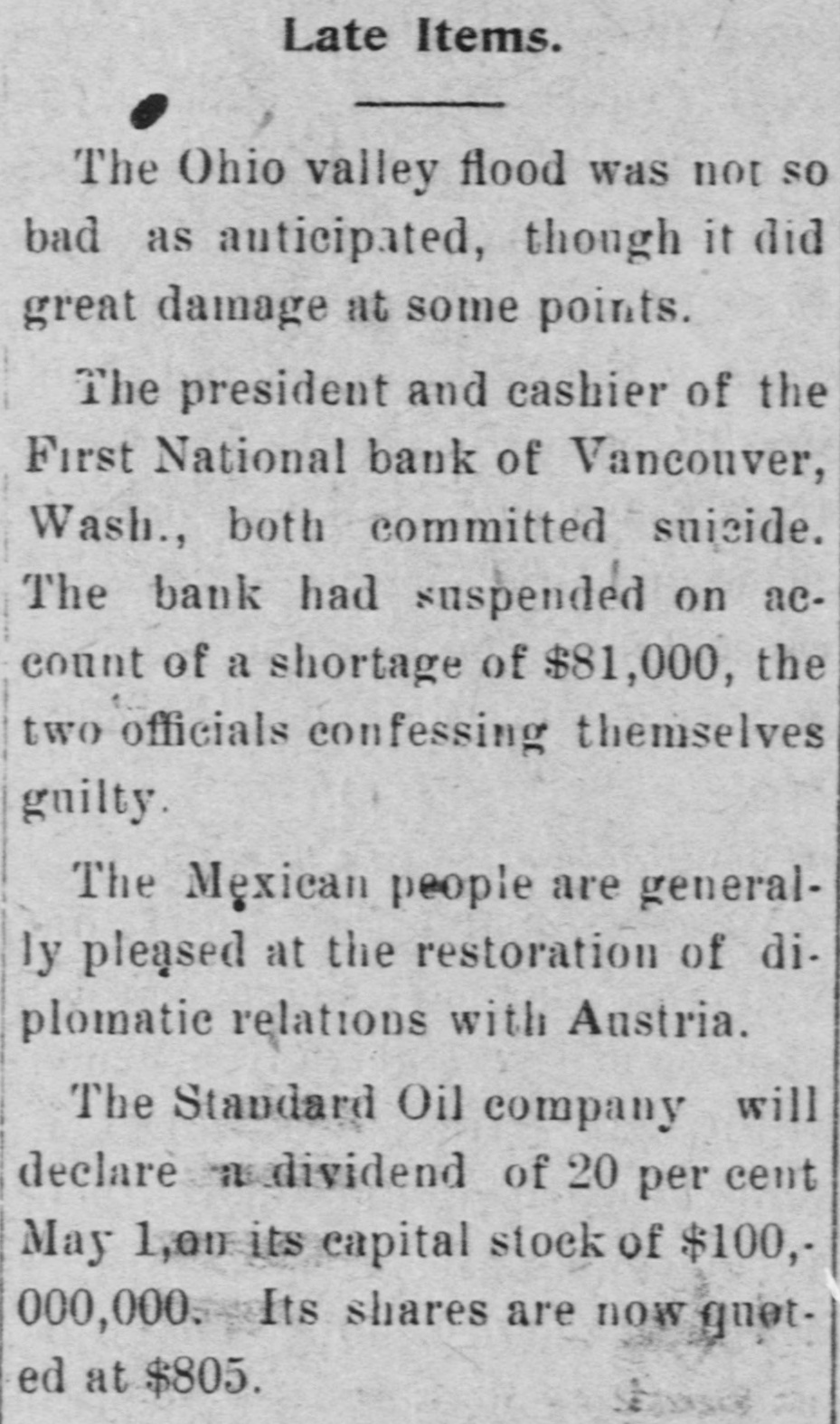
Comptroller/examiner found a shortage of ~$81,000 tied to loans and personal notes of the president and cashier (embezzlement/speculation).
Newspaper Excerpt
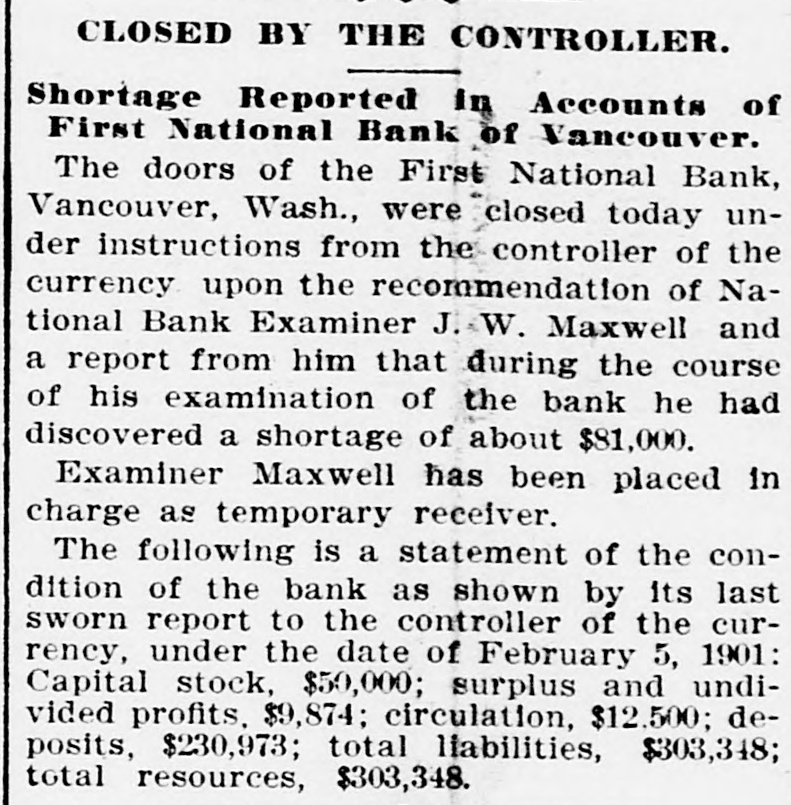
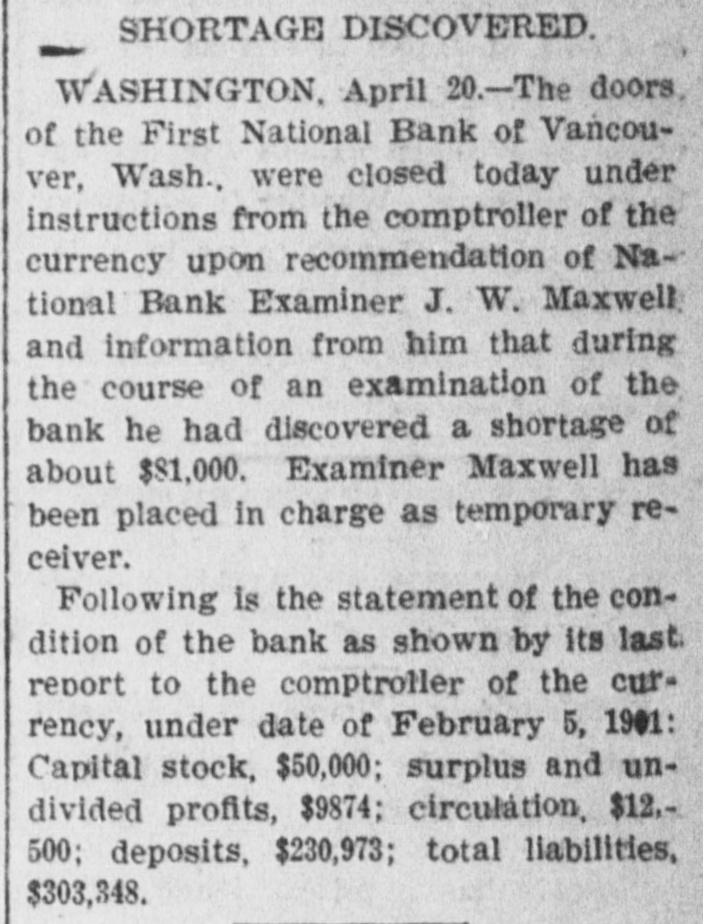
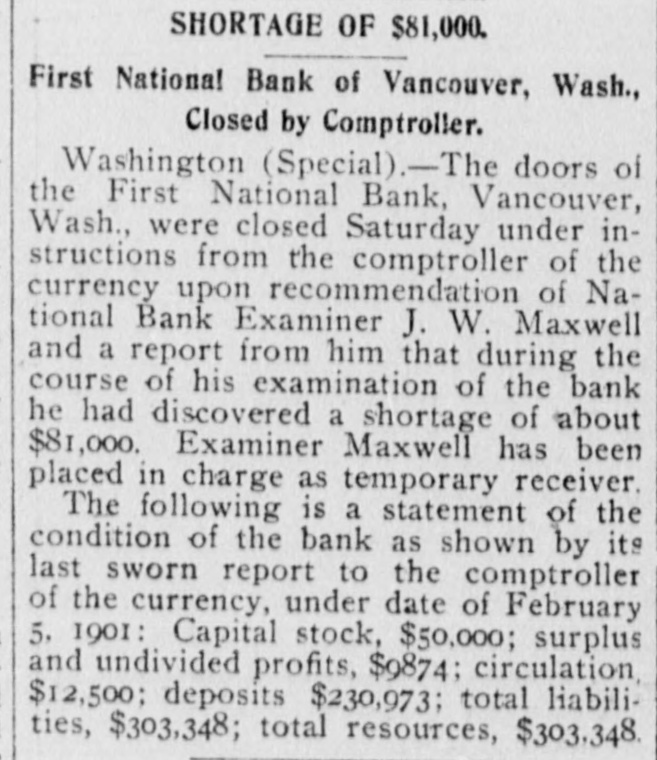
The Comptroller of the Currency this morning announced that the First National Bank of Vancouver, Wash., closed its doors today ... he discovered a shortage of about $81,000.
Source
newspapers

Newspaper Articles (18)

Article from The Evening Times, April 20, 1901

Click image to open full size in new tab

Article Text

A NATIONAL BANK CLOSED. Speculation Working Injury to Financial Institutions. The Comptroller of the Currency this morning announced that the First National Bank of Vancouver, Wash., closed its doors today. This was in accordance with the Comptroller's orders, which was issued on the recommendation of J. W. Maxwell, National Bank Examiner, who reports that upon a recent examination of the Dank he discovered a shortage of about $81,000. Mr. Maxwell has been placed in charge of the bank as temporary receiver. The Vancouver Bank had a capital of $50,000 and deposits of $230,973. Its surplus and undivided profits amounted to $9,874. This is the third national bank failure reported within the last few days and the frequency of the financial reverses has aroused some comment at the Treasury Department. Nothing is known here as yet regarding the causes of the Vancouver failure. It is believed that speculation is unusually rife throughout the country and such periods are always unfortunate for the banking interests.


Article from The Morning Astorian, April 21, 1901

Click image to open full size in new tab

Article Text

National Examiner Finds $81,000 Missing. OFFICIALS ALSO DISAPPEAR Connty and City Lose Heavily-Receiver Appointed-Great Excitement in City Up the Columbia-Statement of Bank's Condition. VANCOUVER, Wash., April 20.-This city was thrown into a fever of excitement this morning by the report that the First National Bank had failed. The first intimation of the occurrence was the appearance of the following notice on the front door of the bank at the beginning of banking hours: "This bank is closed and in the hands of the comptroller of the currency," signed, "J. W. Maxwell, Bank Examiner." Nothing could be learned today relative to the financial condition of the concern as Bank Examiner Maxwell was not prepared to give out any statement. The heavy depositors in the bank are generally of the opinion that the failure was due to bad investments made by the officials of the bank during the past ten years and carried along as assets until discovered by the bank examiners. Charles Brown, the president, and E. L. Canby, the cashier, have both disappeared and their present whereabouts are unknown. The failure is a heavy blow to the town. There is scarcely a man of property in the city who is not affected directly or indirectly. The bank was established in 1883. It was a profitable institution many years, paying big dividends to the stockholders. E. L. Canby has been the cashier since its organization. Among the heaviest losers are the fol lowing: County Clerk Galther, eleven thousand dollars paid into court two weeks ago by the Oregon-Washington Railroad Co., as payment for right of way; John Cander, treasurer of Skamania county, ten thousand; E. M. Scanlonkan, treasurer of the city of Vancouver, thirtysix hundred.


Article from The Indianapolis Journal, April 22, 1901

Click image to open full size in new tab

Article Text

Sensational Outcome of the Closing of the National Bank of Vancouver, Wash., on Saturday. THERE IS A LARGE DEFICIT . MOSTLY REPRESENTED BY PERSONAL NOTES OF THE DEAD MEN. Admitted Their Guilt to the Bank Examiner-Condition and Ownership of the Institution. . VANCOUVER Wash., April 21.-Charles Brown and E. L. Canby, president and cashier, respectively, of the First National Bank of Vancouver, which was closed yesterday by the controller of the currency, committed suicide last night two miles from this city by shooting themselves with a revolver. Their bodies were found this morning lying together in a small clump of bushes about half a mile north of the Columbia school, which is situated on the outskirts of the town. They both used the same weapon and Canby evidently died first, as the revolver was in Brown's hand. It is evident that Canby put the muzzle of the revolver in his mouth and blew the top of his head off. Brown then took it and shot himself in exactly the same way, falling over Canby's body. The fact that Brown's bicycle and a number of articles belonging to Canby were found a short distance out of town last night led to the belief that the two bank officials had taken their lives. Early this morning a searching party started out, and after several hours' hunt the bodies were found in the clump of bushes. On Friday evening Canby upon being told by Bank Examiner Maxwell that the bank would not be permitted to open Saturday went out in the yard behind the bank and attempted to shoot himself. The revolver failed to explode, although all five chambers were loaded. After failing to shoot himself Canby came back into the bank and he and President Brown left together, taking his revolver. When Examiner Maxwell confronted the bank officials with the shortage of $81,000 which he had discovered both men admitted their guilt. It is stated that Brown and Canby had been speculating in stocks. Beside Brown's body there was found a package containing $25 and a note saying that the money belonged to his daughter. Upon Canby's body the following brief note was found: "My Dear Wife-I feel what I am about to do is for the best. Forgive me if you can and try to live for our dear children. NED." God bless you all. Good-bye. Brown, who was fifty-four years of age, had lived in Vancouver since 1862. His father was the first receiver of the Vancouver land office. He had served as auditor of Clark county, was married and had a family. His connection with the bank as its president dates back ten years. Canby was fifty-two years of age and was well connected. His wife was Miss Frances Burnside, daughter of an Oregon pioneer. A brother is a paymaster in the United States army. Another brother committed suicide by jumping off the wharf at Vancouver several years ago. While Bank Examiner Maxwell, who is now in charge as receiver, has made no official statement, it is known that the bank has loaned a large sum of money on insufficient security. According to his report to the controller of the currency there is a shortage of $81,000 in the bank's accounts, and it is understood that a considerable portion of this was loaned to Brown and Canby on their personal notes. About a year ago the bank reduced its capital stock from $100,000 to $50,000. At that time about one-half of the so-called bad assets was "charged off" and has been carried as an asset since that time. The heaviest stockholder is Col. Stephen 0 P. Joslyn, of the regular army, member of General Shafter's staff. His post was Vancouver when the bank was organized, and eye since that time he has been the (CONTINUED ON PAGE 5, COL. 4.)


Article from The Daily Morning Journal and Courier, April 22, 1901

Click image to open full size in new tab

Article Text

Then Went and Blew Their Heads OffTheir Bodies Found Together-Used the Same Revolver-One President and the Other Cashier of the Vancouver First National Bank. Vancouver, Wash., April 21.-Charles Brown and E. L. Canby, president and cashier, respectively, of the First National bank, of Vancouver, which was closed yesterday by the controller of the currency, committed suicide last night two miles from this city, by shooting themselves with revolvers. Their bodies were found this morning lying together in a small clump of bushes. Both used the same weapon and Canby evidently died first, as the revolver was found in Brown's hand. Each put the muzzle of the revolver in his mouth and blew the top of his head off. The fact that Brown's bicycle and an umbrella of Canby were found a short distance out of town last night, led to the belief that they had taken their lives. A searching party started out today and after several hours' search the bodies were found. Canby upon being told by Bank Examiner J. W. Maxwell, on Friday evening, that the bank would not be permitted to open Saturday went out in the yard behind the bank and attempted to shoot himself. His revolver failed to explode. After failing to shoot himself, Canby came back into the bank and he and President Brown left together, taking his revolver. When Examiner Maxwell confronted the bank officials with the shortage of $81,000 both men admitted their guilt. It is said that Brown and Canby had been speculating in stocks. Besides Brown's body there was found a package containing $25 and a note saying that the money belonged to his daughter. Upon Canby's body the following brief note was found: "My Dear Wife: I feel what I am about to do is for the best. Forgive me if you can and try to live for our dear children. God bless you all. Good bye. Ned. April 20." Brown, who was fifty years of age, has lived in Vancouver since 1866. Canby was fifty-two years of age and was well connected. A brother is paymaster in the United States army. Another brother committed suicide by jumping off the wharf at Vancouver several years ago. While Bank Examiner Maxwell, who is now in charge as receiver, has made no official statement, it is known that the bank has loaned a large sum of money on insufficient security. According to his report to the controller of the currency there is a shortage of $81,000 in the bank's accounts and it is understood that a considerable portion of this amount was loaned to Brown and Canby on their personal notes. About a year ago the bank reduced its capital stock from $100,000 to $50,000. At that time about one-half of the socalled bad assets were "charged off" and carried as an asset since that time. The heaviest stockholder is Colonel Stephen Joslyn, of the regular army, a member of Gen. Shafter's staff. Colonel Joslyn is stationed at San Francisco. He was stationed at Vancouver when the bank was organized in 1883 According to the last statement issued in February, the bank had deposits amounting to about $230,000.


Article from Evening Journal, April 22, 1901

Click image to open full size in new tab

Article Text

SOUGHT DEATH BY HIS OWN HAND Suicide of Former Wilmingtoi Man in West SPECULATED WITH BANK'S CASH Edmund Lea Canby, Well Connected Here, Admits Guilt and Commits Suicide Vancouver, Wash. April 22.-Charles Brown and E.L. Canby, president and cashier, respectively, of the First National bank, of Vancouver, which was on the of committed Satclosed the urday currency. night Saturday by controller suicide two miles from this city were found in yesterday by shooting. morning Their lying bodies together a small clump of bushes. Both used the same weapon, and Canby evidently died first, as the revolver was found in Brown's hand. Each put the muzzle of the revolver in his mouth and blew the top of his head off. The fact that Brown's bicycle and an umbrella were found a short distance out of town Saturday night led to the belief that they had taken their lives. A searching party started out yeaterday, and after several hours' search the T bodies were found. a Canby, upon being told by Bank Ex aminer J. W. Maxwell on Friday evening that the bank would not be permitopen went out in the and to yard ted to behind Saturday, the bank attempted His to failing to it came back self shoot explode. Canby himself. After revolver into shoot the failed bank him Brown to a revolver and gether, he taking and President with left them In When Examiner Maxwell confronted T with the of it. men admitted their y the $81,000 bank both officials shortage guilt dIt is said that Brown and Canby had we been speculating in stocks. n, By the side of Brown's twas a $25 ly a that the be and found note saying package containing body money there Ly longed to his daughter. Upon Canby's y, body the following brief note was ed found: nt I feel lo"My Dear do is Wife: what I an a about to for the best. Forgive m re if you can and try to live for our deal ht children. God bless you all. Goodbye in Ned. April 19." who was of has 1since 1862. lived Brown, in Vancouver 54 years age, Canby twas 52 years of age, and was well conenected. A brother is a paymaster in on the United States army. Another n. rbrother committed suicide by jumping of off the wharf at Vancouver several years ago. sieWhile Bank Examiner Maxwell, who is is now in charge as receiver, has made is no official statement, it is known the an bank has loaned a large sum of money on insufficient,security. According to his report to the controller of the cur rency there is a shortage of $81,000 in the bank's accounts, and it is under ps stood that a considerable portion o this amount was loaned to Brown and Canby on their personal notes. About he a year ago the bank reduced its capi er tal stock from $100,000 to $50,000. A the that time about one-half of the so to er called bad assets were "charged off, and have been carried as an asset since that time as t: Edmund Lea Canby was well and fa K. vorably known here. He was the thir son of Edmund T. and Mary Canby on and was born in 1847 at Harmon the Mills, below Stanton, where his fathe be was engaged in the milling busines Edmund was educated at Delaware Co lege and in other institutions. Afte reaching this majority he entered th employ of the late firm of W. R. an H. Gause, lumber merchants, and late Sit with the Springer, Morely & Gaus Co. He went to Vancouver in 1877 accept a clerkship in the First Na the tional Bank, in which position he re lamained a very short time before bein iaappointed cashier of the institution. of came East two years ago on busines and visited his relatives here befo vill returning home. ed Friends of Mr. Canby cannot believ nce that he was in possession of his rig) aymind during the period he appropriate ent the money. They say he was generor Asto a fault; genial, whole-souled, obli of ing, and in every way a good citize He was known as a man who w above suspicion. He was of fine ph sique and handsome appearance. Se eral years ago he married a Miss Burr ave side, of Vancouver, and she, wit ake three young children, survive him. nia Relatives of the dead man receive turword of his death yesterday. in; hith and KIENLE WILL PRESENTED


Article from The Savannah Morning News, April 22, 1901

Click image to open full size in new tab

Article Text

WITH SAME WEAPON DEFAULTING BANK OFFICIALS END THEIR LIVES. BOTH HAD ADMITTED GUILT. EACH WITH PISTOL IN MOUTH BLEW TOP OF HEAD OFF. Bank Examiner Maxwell's Statement of Their Shortage of $81,000 Proved Death Warrant of Prestdent Brown and Cashier Canby of Vancouver National Bank-Had Borrowed Large Amounts From the Bank on Their Personal Notes. Col. Stephen Joslyn. of Gen.Shafter's StRIf, the Bank's Heaviest Stockholder. Vancouver, Wash., April 21.-Charles Brown and E. L. Canby, president and cashier, respectively, of the First National Bank of this city, which was forced to suspend yesterday, committeed suicide last night two miles from here. Their bodies were found this morning. Both used the same weapon and Canby evidently died first as the revolver was found in Brown's hand. Each put the muzzle of the revolver in his mouth and blew the top of his head off. Canby, upon being told by Bank Examiner J. W. Maxwell on Friday evening that the bank would not be permitted to open Saturday. went out in the yard behind the bank and attempted to shoot himself. His revolver failed to explode. Canby came back into the bank and he and President Brown left together, taking a revolver with them. When Examiner Maxwell confronted the bank officials with the shortage of $81,000 both men admitted their guilt. It is said that Brown and Canby had been speculating in stocks. Beside Brown's body there was a package containing $25 and a note saying that the money belonged to his daughter. Upon Canby's body the following brief note was found: "My dear Wife: I feel what I am about to do is for the best. Forgive me if you can and try to live for our dear children. Ned. God bless you all. Good-byeApril 19." Brown, who was 54 years of age, has lived in Vancouver since 1862. Canby was 52 years of Age, and was well connected. A brother is a paymaster in the United States army. Another brother committed sΓΊicide by jumping off the wharf at Vancouver several years ago. While Bank Examiner Maxwell, who is now in charge as receiver, has made no official statement, it is known that the bank has loaned a large sum of money on insufficient securities. According to his report to the controller of the currency there is a shortage of $81,000 in the bank's accounts, and it is understood that a considerable portion of this amount was loaned to Brown and Canby on their personal notes. About a year ago the bank reduced its capital stock from $100,000 to $50,000. At that time about onehalf of the so-called bad assets were "charged off" and have not been carried as an asset since that time. The heaviest stockholder of the bank is Col. Stephen Josiyn of the regular army, a member of Gen. Shafter's staff. According to the last statement, issued in February, the bank had deposits amounting to about $230,000.


Article from New-York Tribune, April 22, 1901

Click image to open full size in new tab

Article Text

SUICIDE OF BANK OFFICERS PRESIDENT AND CASHIER OF WRECKED VANCOUVER BANK BLOW OUT THEIR BRAINS. Vancouver, Wash., April 21.-Charles Brown and E. L. Canby, president and cashier, respectively, of the First National Bank of Vancouver, which was closed yesterday by the Controller of the Currency, committed suicide last night two miles from this city, by shooting themselves with revolvers. Their bodies were found this morning lying together in a small clump of bushes. Both used the same weapon, and Canby evidently died first, as the revolver was found in Brown's hand. Each put the muzzle of the revolver in his mouth and blew the top of his head off. The fact that Brown's bicycle and an umbrella of Canby were found a short distance out of town last night led to the belief that they had taken their lives. A searching party started out to-day, and after several hours the bodies were found. Canby upon being told by Bank Examiner J. W. Maxwell on Friday evening that the bank would not be permitted to open on Saturday went out in the yard behind the bank and attempted to shoot himself. His revolver failed to go off. After failing to shoot himself Canby came back into the bank, and he and President Brown went away together, taking his revolver. When Examiner Maxwell confronted the bank officials with the shortage of $81,000 both men admitted their guilt. It is said that Brown and Canby had been speculating in stocks. Beside Brown's body there was found a package containing $25 and a note saying that the money belonged to his daughter. Upon Canby's body the following brief note was found: My Dear Wife: I feel what I am about to do is for the best. Forgive me if you can. and try to live for our dear children. God bless you all. Goodby.-Ned, April 19. Brown, who was fifty-four years old, had lived in Vancouver since 1862. Canby was fifty-two years old, and was well connected. A brother is a paymaster in the United States Army. Another brother committed suicide by jumping off the wharf at Vancouver several years ago. While Bank Examiner Maxwell, who is now in charge as receiver, has made no official statement. it is known that the bank has loaned a large sum of money on insufficient security. According to his report to the Controller of the Currency there is a shortage of $81,000 in the bank's accounts, and it is understood that a considerable portion of this amount was loaned to Brown and Canby on their personal notes. About a year ago the bank reduced its capital stock from $100,000 to $50,000. At that time about one-half of the so-called bad assets were "charged off." and has been carried as an sset since that time. The heaviest stockholder is Colonel Stephen M. Joslyn, of the Regular Army, a member of General Shafter's staff. Colonel Joslyn is stationed at San Francisco. He was stationed at Vancouver when the bank was organized, in 1883, and ever since that time he has been the heaviest stockholder. According to the last statement, issued in February, the bank had deposits amounting to about $230,000.


Article from Rock Island Argus, April 22, 1901

Click image to open full size in new tab

Article Text

TELEGRAPH BRIEFS. Thomas R. Hinds, of Butte, Mont., was awarded $231,116.30 for acting as receiver and counsel for five days for the Boston and Montana Mining company. Senator Frye, who has been to San Domingo. says the people there do not love us. The aing of Saxony opened the International Art exposition at Dresden Saturday. The census returns show a total of 760,329 population in Glasgow, an increase in a decade of 194,615. John I. Sabin is reported to be perfecting in New York'a $90,000.000 telephone combine that shall control the chief companies in the country. Dr. Joseph Muir, American consul general at Stockholm, lost $10,000 playing poker with sharpers while crossing the ΠΎΠ²Π΅Π°ΠΈ. The First National bank of Vancouver, Wash., is closed, owing depositors about $200,000. President Hill. of the Great Northern railway, went from Seattle to St. Paul in a special train in forty-five hours and fifty minutes. al Kansas City carpenter, threatened with arrest for bigamy. made peace with both wives, placating one by securing for her another husband. Captain Garnett Ripley was acquitted at Frankfort, Ky., of complicity in the assassination of William Goebel. The peace of Europe is imperiled by conditions in the Balkans, now rapidly nearing a crisis. Dr., W. C. Browning, who attended Chris L. Magee of Pittsburg in his last illness. has presented a bill against the estate for $190,000.


Article from Evening Star, April 22, 1901

Click image to open full size in new tab

Article Text

EMBEZZLERS COMMIT SUICIDE. Charles Brown and E. L. Canby Were Bank Officers. A dispatch from Vancouver, Wash., yesterday says: Charles Brown and E. L. Canby, president and cashier, respectively, of the First National Bank of Vancouver, which was closed yesterday by the controller of the currency, committed suicide last night two miles from this city by shooting themselves with a revolver. Their bodies were found this morning lying together in a small clump of bushes. Both used the same weapon. Canby evidently died first, as the revolver was found in Brown's hand. Each put the muzzle of the revelver to his mouth and blew the top of his head off. The fact that Brown's bicycle and an umbrella of Canby's were found a short distance out of town last night led to the belief that they had taken their lives. A searching party started out today, and after several hours' search the bodies were found. Canby, upon being told by Bank Examiner J. W. Maxwell on Friday evening that the bank would not be permitted to open Saturday, went out in the yard behind the bank and attempted to shoot himself. His revolver failed to explode. He then returned to the bank, and he and President Brown left together, taking a revolver with them. When Examiner Maxwell confronted the bank officials with the shortage of $81,000 both men admitted their guilt. It is said that Brown and Canby had been speculating in stocks. Beside Brown's body there was found a package containing $25 and a note saying that the money belonged to his daughter. Upon Canby's body the following brief note was found: My Dear Wife: I feel what I am about to do is for the best. Forgive me if you can, and try to live for our dear children. NED. God bless you all. Good-bye. April 19. Brown, who was fifty-four years of age, had lived in Vancouver since 1862. Canby was fifty-two years of age, and was well connected. A brother is a paymaster in the United States army. Another brother. committed suicide by jumping off the wharf at Vancouver several years ago., 18 While Bank Examiner Maxwell, who is now in charge, as receiver, has made no official statement, it is known that the bank has loaned a. large sum of money on insufficient securities. According to his report to the, controller of the currency there is a shortage, of $81,000 in the bank's accounts, and it isjunderstood that a considerable portien of this amount was loaned to Brown and Canby on their personal notes. About a year ago the bank reduced its capital stock from $100,000 to $50,000. At that time about one-half of the so-called bad assets were "charged off," and have been carried as an asset since that time. The heaviest stockholder is Col. Stephen Joslyn of the regular army, a member of General Shafter's staff.


Article from The Star, April 24, 1901

Click image to open full size in new tab

Article Text

TWO BANK OFFICIALS SUICIDE. SHORT $81,000. President and Cashier of Vancouver, Wash., Institution Could not Stand the Disgrace and Killed Themselves. Charles Brown and E. L. Canby, president and cashier, respectively, of the First National bank of Vancouver, Wash., which has been closed by the controller of the currrency, committed suicide by shooting themselves with revolvers. Their bodies were found lying together in a small clump of bushes near the town. Both used the same weapon, and Canby evidenty died first, as the revolver was found in Brown's hands. Each put the muzzle of the revolver in his mouth and blew the top of his head o.ff Brown, who was 54 years of age, has lived in Vancouver since 1862. Canby was 52 years-of age and was well connected. A brother is a paymaster in the United States army. Another brother committed suicide by jumping off the wharf at Vancouver several years ago. While Bank Examiner Maxwell, ho is now in charge as receiver, has ade no official statement it is known at the bank has loaned a large sum money on insufficient security. according to his report to the conoller of the currency there is a shortge of $81,000 in the bank's accounts, nd it is understood that a considerble portion of this amount was aned to Brown and Canby on their ersonal notes.


Article from Morris Tribune, April 27, 1901

Click image to open full size in new tab

Article Text

CRIMINAL NEWS. I Two convicts were killed in an attempt to escape from the New Mexican penitentiary at Santa Fe. Captain Ripley, the fourth man to be tried in connection with the murder of Governor Goebel of Kentucky, has been acquitted. Marvin R. Baldwin, former congressman from the Duluth district, committed suicide at Seattle, Wash., because of financial troubles. An express train on the Choctaw, Oklahoma and Gulf railway was held up near Bridge Junction, Ark. The express messenger and porter were wounded in resisting the robbers. The Le Mars (Ia.) National bank has suspended. Thomas F. Ward, vice president and manager of the institution, is a self-confessed embezzler to an amount of from $25,000 to $30,000. Charles Brown and E. L. Canby, president and cashier, respectively, of the First National bank of Vancouver, Wash., which was closed Saturday by the controller of the currency, committed suicide by shooting themselves with a revolver.


Article from The Daily Morning Alaskan, May 4, 1901

Click image to open full size in new tab

Article Text

NEW DEPARTURE THIS When a bank goes under because of the crooked metions of those in charge. it is usual to let the stockholders and depositors walk the floor. The guilty officials as a rule, hire some shrewd lawyers to keep them out of prison on technicalities or by confus ing the minds of the jurors as to whether the men accused are deserving of a vote of thanks because they left the bank vault behind. The cases of the president and the cashier of the bursted First National bank of Vancouver, Washington, have instituted a radical departure from es tablished customs On Saturday the bank was forced to suspend. On Sunday their bodies were found a few miles from town. They had committed sui cide during the night-anyhow that is the reasonable deduction from the cir cumstances and surroundings. It shows a feeling for the unfortun ate depositors and stockholders which is unusual. As a rule the people who suffer are about the last to receive any thought from those who make them suffer.


Article from The Billings Gazette, May 17, 1901

Click image to open full size in new tab

Article Text

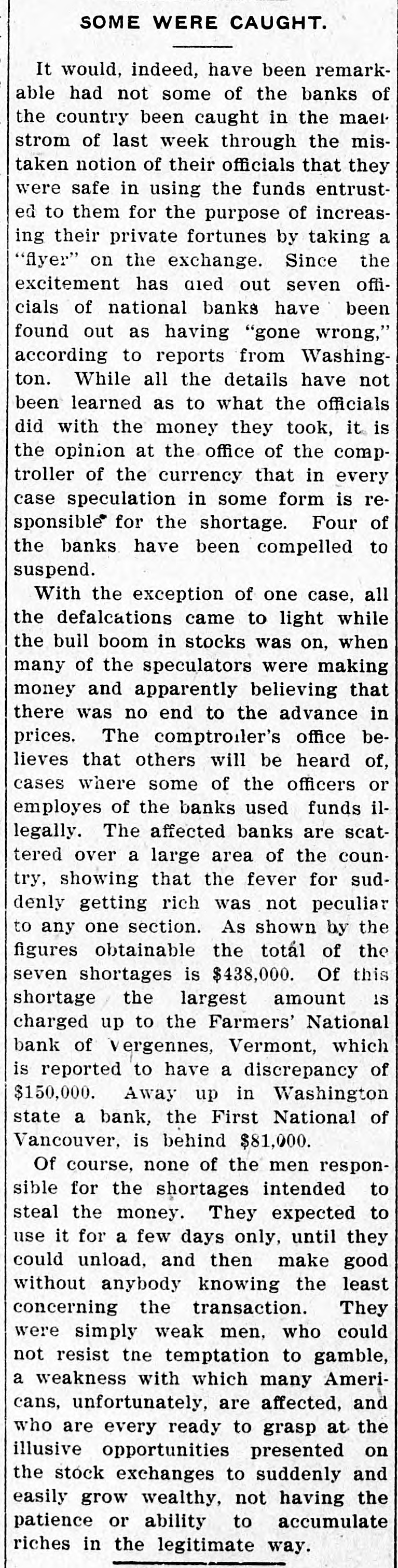
SOME WERE CAUGHT. It would, indeed, have been remarkable had not some of the banks of the country been caught in the maelstrom of last week through the mistaken notion of their officials that they were safe in using the funds entrusted to them for the purpose of increasing their private fortunes by taking a "flyer" on the exchange. Since the excitement has aied out seven officials of national banks have been found out as having "gone wrong," according to reports from Washington. While all the details have not been learned as to what the officials did with the money they took, it is the opinion at the office of the comptroller of the currency that in every case speculation in some form is responsible* for the shortage. Four of the banks have been compelled to suspend. With the exception of one case, all the defalcations came to light while the bull boom in stocks was on, when many of the speculators were making money and apparently believing that there was no end to the advance in prices. The comptroiler's office believes that others will be heard of, cases where some of the officers or employes of the banks used funds illegally. The affected banks are scattered over a large area of the country, showing that the fever for suddenly getting rich was not peculiar to any one section. As shown by the figures obtainable the total of the seven shortages is $438,000. Of this shortage the largest amount IS charged up to the Farmers' National bank of Vergennes, Vermont, which is reported to have a discrepancy of $150,000. Away up in Washington state a bank, the First National of Vancouver, is behind $81,000. Of course, none of the men responsible for the shortages intended to steal the money. They expected to use it for a few days only, until they could unload, and then make good without anybody knowing the least concerning the transaction. They were simply weak men, who could not resist the temptation to gamble, a weakness with which many Americans, unfortunately, are affected, and who are every ready to grasp at the illusive opportunities presented on the stock exchanges to suddenly and easily grow wealthy, not having the patience or ability to accumulate riches in the legitimate way.


Article from The Seattle Star, July 23, 1901

Click image to open full size in new tab

Article Text

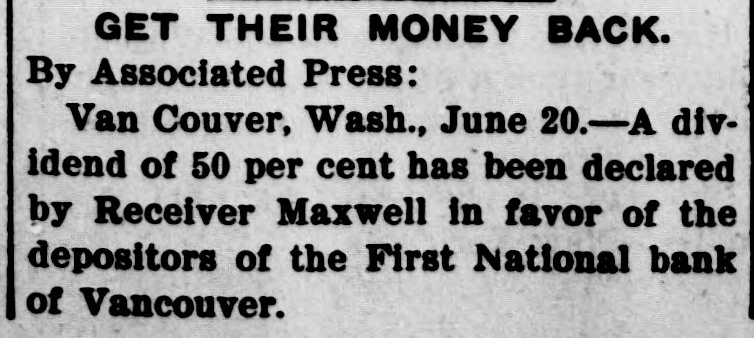
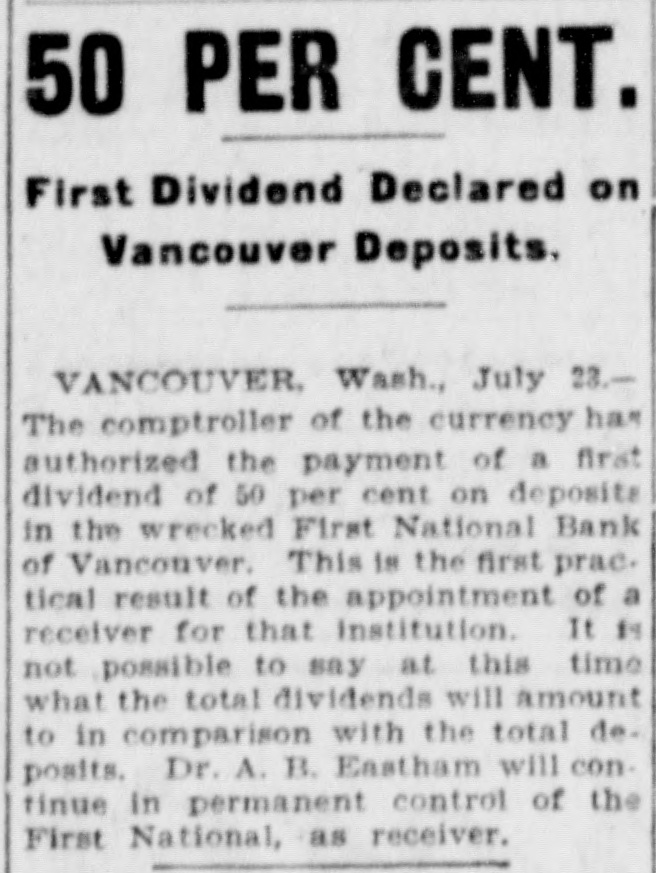
50 PER CENT. First Dividend Declared on Vancouver Deposits. VANCOUVER, Wash., July 23.The comptroller of the currency has authorized the payment of a first dividend of 50 per cent on deposits in the wrecked First National Bank of Vancouver. This is the first prac. tical result of the appointment of a receiver for that Institution. It 11 not possible to say at this time what the total dividends will amount to in comparison with the total deposits. Dr. A. B. Eastham will continue in permanent control of the First National, as receiver.


Article from The Morning Astorian, July 24, 1901

Click image to open full size in new tab

Article Text

It is not what you eat that supports life and makes you grow. It is what you eat of a character that will do you good. Pastry in healthy If made with good baking powder. Schilling's Best will do you good because It in good ROSS, HIGGINS & CO. Baptis: Church. Friday evening. at 8 o'clock: admission 25 cents, children 15 cents, Stereoptican excursion ugh lovely scenes in many climes, including Alaska, "The Land of the Midnight Sun." by Prof. John C. Douglass, who has traveled extensively. Mrs. R. Ingleton la now displaying a full line of the latest styles in fall millinery at the establishment recently opened by her at 658 Commercial street, opposite the Budget office. Mrs. Ingleon also carries a full line of ladies' and children's furnishing goods. Over $2000 has already been subscribed in Portland for the erection of a free swimming bath for boys, The committee in charge are determined to raise $5000, the amount they claim will be necessary to carry the enterprise through to successful completion. The semi-annual report of County Clerk Wherity will show an excess of the county's liabilities over its resources of $30,000. This does not take into conalderation the $7000 to the credit of the Nehalem road fund. Last January the excess of liabilities was over $60,000. Major Humphries. who will have charge of the fortifications at the mouth of the Columbia river, has arrived from Manila and is now in Portland. He was granted a leave of absence by the department of thirty days and as soon as that expires he will assume charge of this station The second week of the harvest in the Wella Walla wheatfields is now in progress and the crop is a splendid one. There is plenty of help to care for 11, and with prices scaring because of the drouth in the East and South. farmers in the Walla Walla country are pleased with their prospective prosperity The proved claims of the First National Bank of Vancouver affected by the declaration of a 50 per cent dividend aggregate $213,558. Temporary Receiver Maxwell will be succeeded, on August 15. by A. B. Eastham, of Vancouver, who has been appointed permanent receiver, and will wind up the bank's affairs. The special train carrying the party of Portland business men to Lewiston, where they will meet the congressional committee on rivers and harbors, who will arrive from Seattle over the Northern Pacific The entire party will arrive in Portland on the return trip Friday and will Immediately proceed eastward over the O. R. & N. The incorporation papers of the Ne halem Coal Company were filed in Sa lem Monday The plans and scope of the company have been previously published. The capital stock is $150,000 11vided into shares of $100 each. W. H Copeland. James A. Fay. W J. Cook and J. F. Hamilton are the incorporators of record. Owing to a delay growing out of the steel workers' strike in the East. Contractors Ferguson & Houston are not progressing as rapidly as they expected on the installation of the Fort Stevens water system A consignment of machinery ordered some time ago has not yet arrived and the probable date of its delivery is uncertain. The Oregonian recently stated that there was a chance for the development of deep sea fishing industry off the Oreron coast. As a matter of fact numerous attempts have been made to work the fishing banks below the Columbia but the fish have been found so Inferfor as to be practically unsaleable a condition attributed to a mineral contamination of the water the exact nature of which is not definitely known Letson Balliet, the Baker City mine promoter. whose mail was temporarily stopped by the United States authorities has returned to Eastern Oregon. After visiting Washington, where he satisfied the postal officials that his business was legitimate. Balliet purchased a newspaper in Boston. which Is being fitted with a complete new plant. The city of Browning and beans has long escaped "yellow journalism": perhaps Mr. Balliet will show them what It is. Preparations are maturing for the


Article from The Morning Astorian, July 24, 1901

Click image to open full size in new tab

Article Text

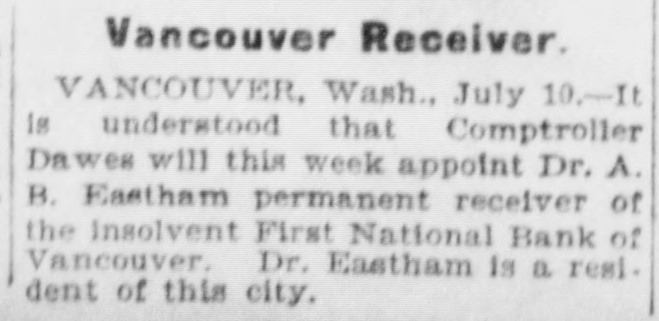
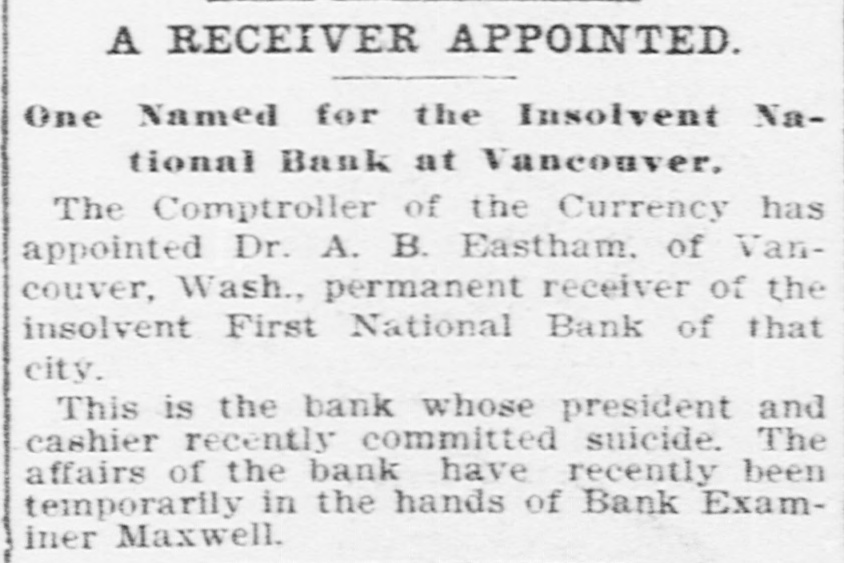
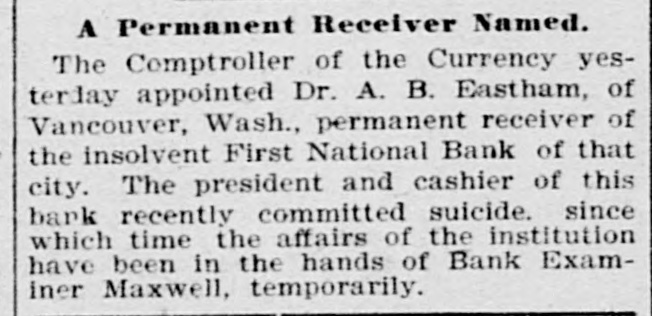
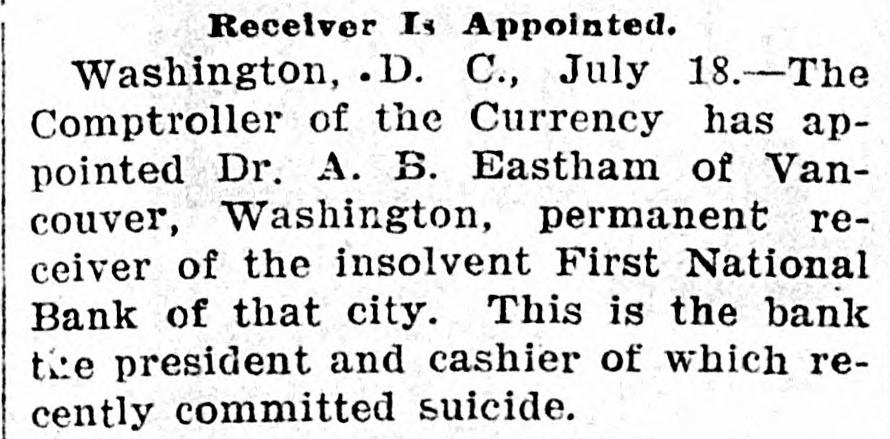
The proved claims of the First National Bank of Vancouver affected by the declaration of a 50 per cent dividend aggregate $213,558. Temporary Receiver Maxwell will be succeeded, on August 15, by A. B. Eastham, of Vancouver, who has been appointed permanent receiver, and will wind up the bank's affairs.


Article from The Morning Astorian, August 25, 1901

Click image to open full size in new tab

Article Text

BOY ACCIDENTALLY KILLED. VANCOUVER, Aug. 24.-Jocelyn Canby, 12 years cld, son of the late E. L. Canby, who was cashier of the suspended First National bank, was accidentally shot and killed today by a boy who was shooting at a target.


Article from The Ellensburg Dawn, January 18, 1902

Click image to open full size in new tab

Article Text

Smallpox has broken out at Coupville. The outlook for a crop of ice in this state is very poor. Indications point to an early spring on the Pacific coast. Roy Young, of Aberdeen, was held up and relieved of $25. Mrs. Ole Nelson, near Edgewood, suicided with strychnine. Penitentiary sacks will be sold for $63.50 per thousand this year. Wilson Creek, in Douglas county, has a newspaper called "The Chief." The Pembrokeshire stove a hole in her bottom on a reef in the Columbia river last Monday, The health officer of Seattle, has ordered the school children of that city to be vaccinated. Tishka dam, built at Aberdeen for floating logs to tide water, has been pronounced unsafe. The jury in the Lewis embezzlement case in Spokane, failed to agree and a new trial will be had. H. T. Howard, alias H. C. Collins, late of the state penitentiary, iscashing bogus checks over the state. An electric railroad is to be built be tween Aberdeen and Hoquiam, the two metropoles of Grays Harbor. Robert Hamm, of Seattle attempted suicide by laudnum recently, because of disappointment in love affairs. A rabbit drive in the Bitter Creek county, near Pendleton, resulted in the killing of 4,000 in two hours_time Robert Firth, an old pioneer of Friday Harbor, was seriously injured last week by being thrown from a wagon. Lieutenant Bevin, of the eighth artillery, was found dead in his bed at Ft. Canby. A supposed case of suicide. Tom McCoal a 17-year-old boy of Spokane, was shot in the abdomen by a boy of his own age as the result of a quarrell. The Weyerhaeuser syndicate purchased the Bell-Nelson sawmill and ship yards at Everett. Consideration, $280,000. There is a race war on in Seattle. Six bell boys in the Seattle hotel struck because two colored boys were added to their force. During the past year Washington has been the banner coal state of the northwest, the product being 2,474,093 short tons. Albert Weed, an inmate of the Snohomish connty jail attempted suicide New Years' day by cutting his throat with a pocket knife. Five youths under the age of 16 were arrested in Freemont, a suburb of Se attle; were arrested Tuesday and admitted to two burglaries. The receiver of the First National bank, of Vancouver is paying a 25-per cent dividend, and he thinks that it will eventually pay out. A daring thief hurled a coupling pin through a plate glass window of a jewelry store in Seattle recently and escaped with a tray of diamonds valued at $1,500.