Click image to open full size in new tab
Article Text
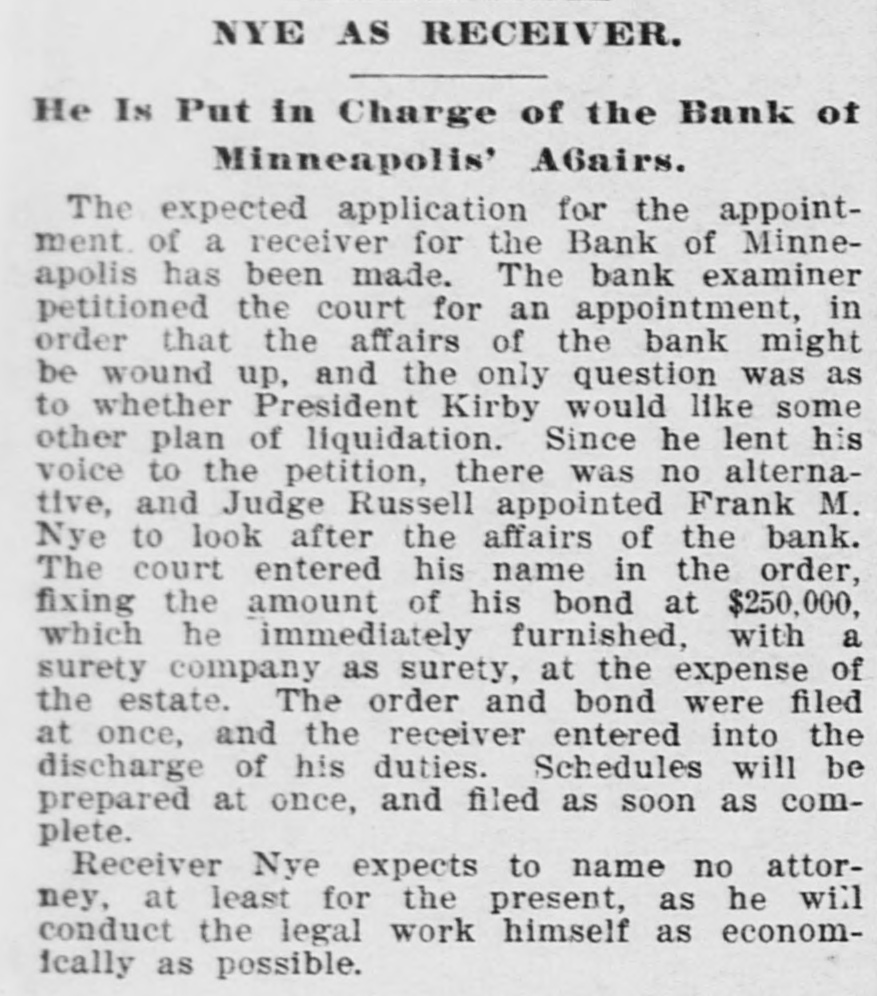
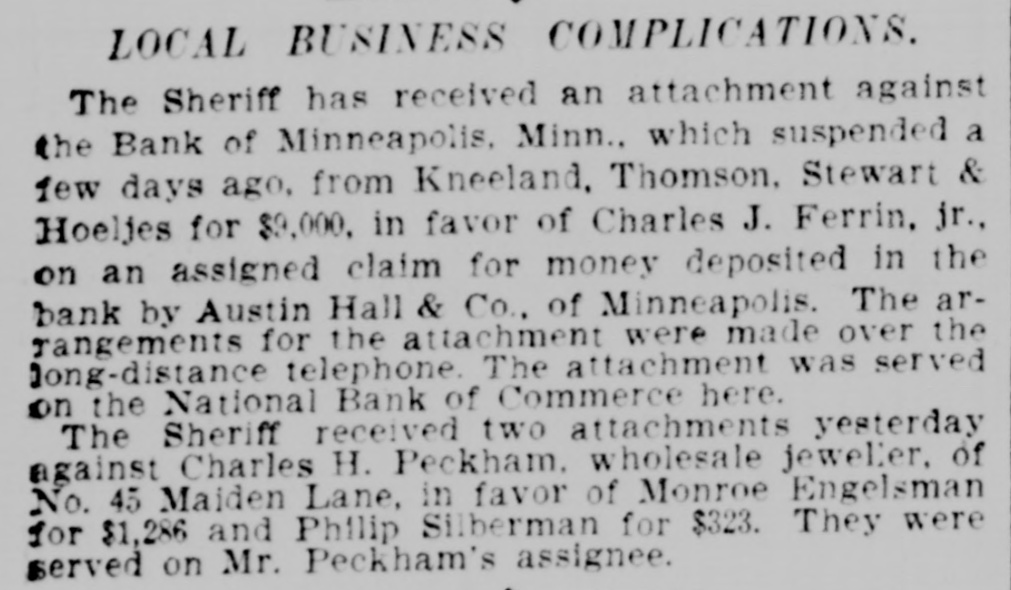
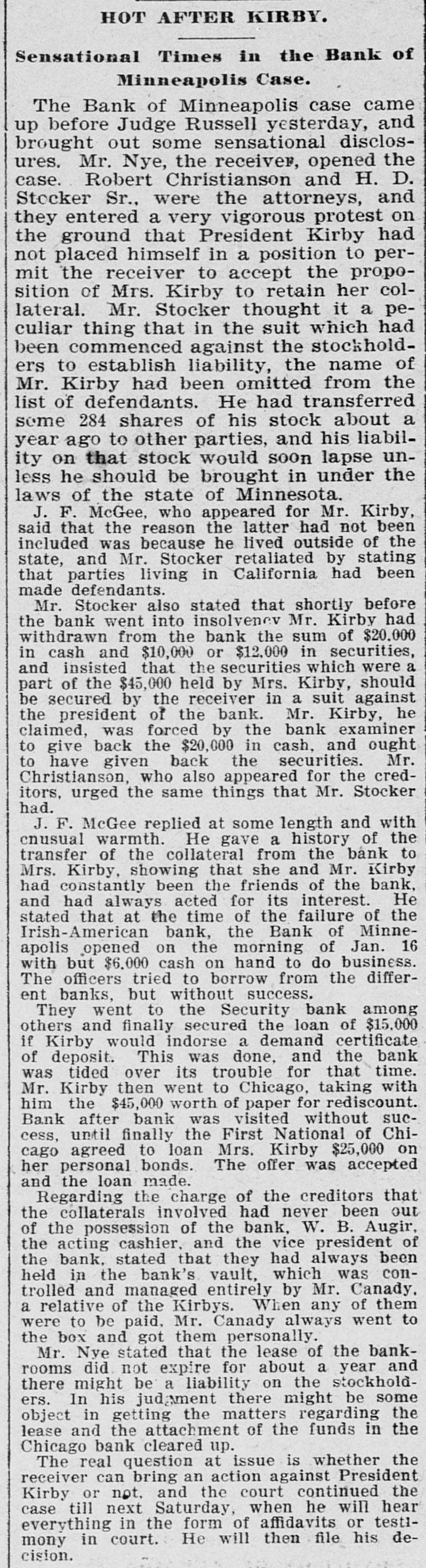
HOT AFTER KIRBY. Sensational Times in the Bank of Minneapolis Case. The Bank of Minneapolis case came up before Judge Russell yesterday, and brought out some sensational disclosures. Mr. Nye, the receiver, opened the case. Robert Christianson and H. D. Stocker Sr., were the attorneys, and they entered a very vigorous protest on the ground that President Kirby had not placed himself in a position to permit the receiver to accept the proposition of Mrs. Kirby to retain her collateral. Mr. Stocker thought it a peculiar thing that in the suit which had been commenced against the stockholders to establish liability, the name of Mr. Kirby had been omitted from the list of defendants. He had transferred some 284 shares of his stock about a year ago to other parties, and his liability on that stock would soon lapse unless he should be brought in under the laws of the state of Minnesota. J. F. McGee, who appeared for Mr. Kirby, said that the reason the latter had not been included was because he lived outside of the state, and Mr. Stocker retaliated by stating that parties living in California had been made defendants. Mr. Stocker also stated that shortly before the bank went into insolvenev Mr. Kirby had withdrawn from the bank the sum of $20,000 in cash and $10,000 or $12,000 in securities, and insisted that the securities which were a part of the $45,000 held by Mrs. Kirby, should be secured by the receiver in a suit against the president of the bank. Mr. Kirby, he claimed, was forced by the bank examiner to give back the $20,000 in cash, and ought to have given back the securities. Mr. Christianson, who also appeared for the creditors, urged the same things that Mr. Stocker had. J. F. McGee replied at some length and with cnusual warmth. He gave a history of the transfer of the collateral from the bank to Mrs. Kirby, showing that she and Mr. Kirby had constantly been the friends of the bank, and had always acted for its interest. He stated that at the time of the failure of the Irish-American bank, the Bank of Minneapolis opened on the morning of Jan. 16 with but $6,000 cash on hand to do business. The officers tried to borrow from the different banks, but without success. They went to the Security bank among others and finally secured the loan of $15,000 if Kirby would indorse a demand certificate of deposit. This was done, and the bank was tided over its trouble for that time. Mr. Kirby then went to Chicago, taking with him the $45,000 worth of paper for rediscount. Bank after bank was visited without success, until finally the First National of Chicago agreed to loan Mrs. Kirby $25,000 on her personal bonds. The offer was accepted and the loan made. Regarding the charge of the creditors that the collaterals involved had never been out of the possession of the bank, W. B. Augir, the acting cashier. and the vice president of the bank. stated that they had always been held in the bank's vault, which was controlled and managed entirely by Mr. Canady. a relative of the Kirbys. When any of them were to be paid. Mr. Canady always went to the box and got them personally. Mr. Nye stated that the lease of the bankrooms did not expire for about a year and there might be a liability on the stockholders. In his judgment there might be some object in getting the matters regarding the lease and the attachment of the funds in the Chicago bank cleared up. The real question at issue is whether the receiver can bring an action against President Kirby or not, and the court continued the case till next Saturday, when he will hear everything in the form of affidavits or testimony in court. He will then file his decision.