8510. Central Trust Company (Frederick, MD)

Bank Information

Episode Type
Suspension → Closure
Bank Type
trust company
Start Date
September 3, 1931
Location
Frederick, Maryland (39.414, -77.411)

Metadata

Model
gpt-5-mini
Short Digest
bbdedbe5

Response Measures

None

Description

Directors voted to place the Central Trust Co. in the hands of the State banking commissioner on Sept 3, 1931; the commissioner qualified as receiver and announced liquidation. Newspapers explicitly deny a panic-style run and describe gradual seepage of deposits and frozen real-estate assets as the cause. The institution remained in receivership and was liquidated, with later distributions to depositors.

Events (2)

1. September 3, 1931 Receivership
Newspaper Excerpt
Commissioner Page qualified this afternoon as receiver for the bank before Judges Hammond Urner and Arthur D. Willard ... he announced he would proceed immediately to liquidate the assets of the bank.
Source
newspapers
2. September 3, 1931 Suspension
Cause
Bank Specific Adverse Info
Cause Details
Directors placed bank in hands of State banking commissioner because large proportion of assets were 'frozen' real-estate loans and resources had shrunk amid the Depression; directors cited 'seepage of deposits' and frozen assets in Washington real estate as reason.
Newspaper Excerpt
Doors of the Central Trust Company of Frederick and 11 (12) branches ... were closed today. Decision not to open the bank was announced following a special meeting of the directors ... George W. Page, state banking commissioner, has taken possession of the institution
Source
newspapers

Newspaper Articles (23)

Article from Times Herald, September 3, 1931

Click image to open full size in new tab

Article Text

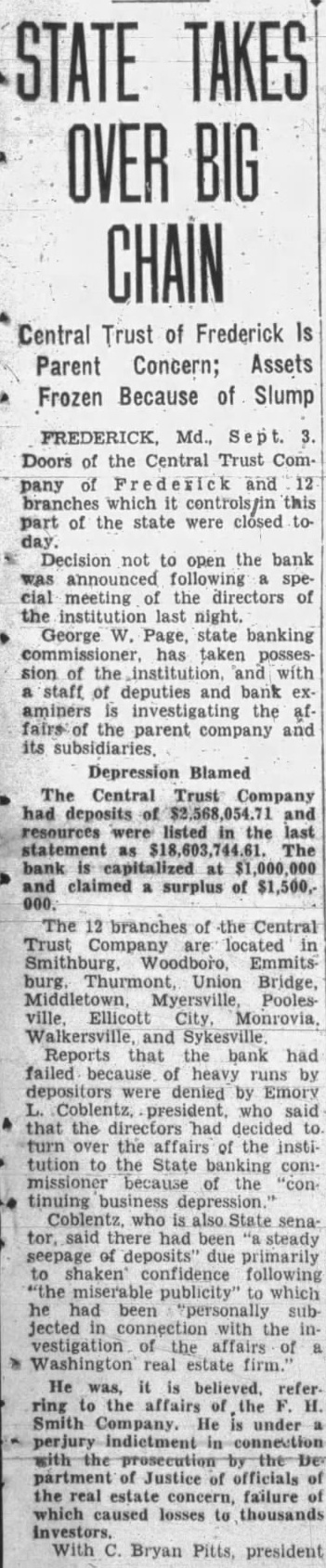
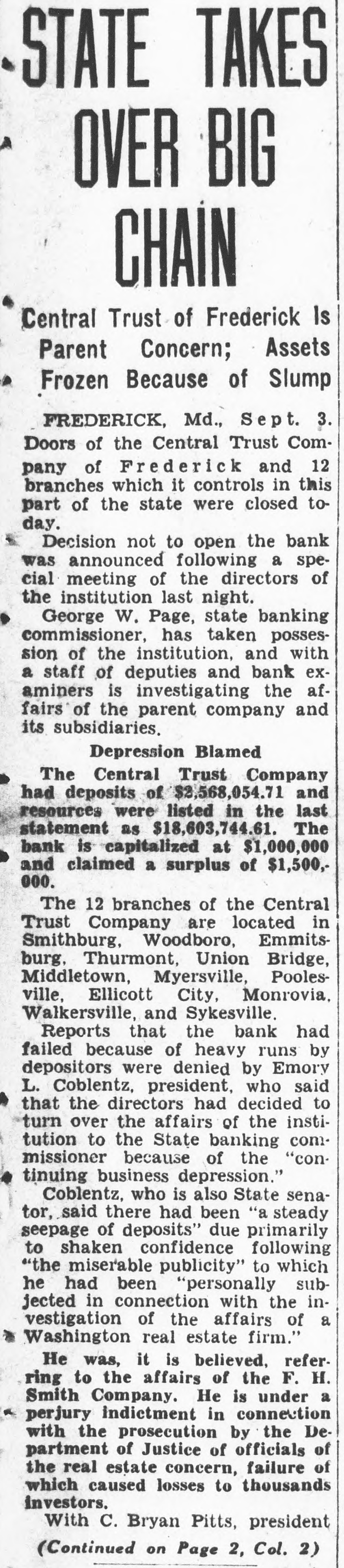
STATE TAKES OVER BIG CHAIN Central Trust of Frederick Is Parent Concern; Assets Frozen Because of Slump FREDERICK, Md., Sept. 3. Doors of the Central Trust Company of and 12 branches which it controls in this part of the state were closed today. Decision not to open the bank was announced following a special meeting of the directors of the institution last night. George W. Page, state banking commissioner, has taken possession of the institution and with a staff of deputies and bank ex aminers is investigating the af fairs the parent company and its subsidiaries. Depression Blamed The Central Trust Company had deposits of $2,568,054.71 and resources were listed in the last statement as $18,603,744.61. The bank is capitalized at $1,000,000 and claimed a surplus of $1,500,000. The 12 branches of the Central Trust Company are located in Smithburg. Woodboro, Emmits burg. Thurmont, Union Bridge, ville. Ellicott City Monrovia. Walkersville, and Sykesville Reports that the bank had failed because of heavy runs by depositors were denied by Emory L. Coblentz. president. who said that the directors had decided to turn over the affairs of the institution to the State banking commissioner because of the "continuing business depression. Coblentz. who is also State senator, said there had been "a steady seepage of deposits' due primarily to shaken confidence following "the miserable publicity" to which he had been "personally sub jected in connection with the investigation of the affairs of Washington real estate firm." He was, it is believed. referring to the affairs of the F. H. Smith Company. He is under a perjury indictment in connection with the prosecution by the Der partment of Justice of officials of the real estate concern, failure of which caused losses to thousands With C. Bryan Pitts, president


Article from Evening Star, September 3, 1931

Click image to open full size in new tab

Article Text

State Examiner Takes Over Frederick Institution and 11 Branches; Deposits of $14,000,000 Involved. DIRECTORS TAKE ACTION AS RESOURCES SHRINK State Senator Said to Have Lost $2,225,000 in Washington Real Estate Transactions; Faces Trial in Connection With Pitts Prosecution. Special Dispatch to The Star. FREDERICK, Md., September 3. -The Central Trust Co. of Maryland and 11 branch banks in this and adjoining counties closed their doors today, and the affairs of the institution were taken over immediately by George W. Page, State bank commissioner. State Senator Emory L. Coblentz, president of the bank, issued a statement blaming frozen assets and "miserable publicity" received by himself in connection with the Federal investigation of the F. H. Smith Co. of Washington, for the failure of the bank. Coblentz was one of the principal witnesses at the trial of three Smith company officers in Washington last year. He is now under indictment in the Capital for "aiding in the commission of perjury" as a result of his testimony. He said the publicity attending his indictment disturbed public confidence and caused a seepage of deposits. Directors Reach Decision. Decision to close the bank and its branches was reached at a meeting of the directors yesterday. The Central Trust Co. holds deposits of approximately $14,000,000 about one-third of the total bank deposits of Fredcrick County. Mr. Coblentz said the bank's assets would be "more than sufficient in normal times" to meet its obligations. A notice signed by the directors said a plan of reorganization was being considered. Commissioner Page qualified this afternoon as receiver for the bank before Judges Hammond Urner and Arthur D. Willard of the Circuit Court. Immediately afterward he announced he would proceed immediately to liquidate the assets of the bank. He was unable to say whether the assets were sufficient to pay off all depositors in full. A complete audit of the trust company's accounts will not be necessary, Mr. Page declared, since he had the full co-operation of the bank directors. He said he did not know how long it would take to settle the accounts. Mr. Page blamed the failure on the fact that the bank had "a very large commitment in real estate outside of Maryland which is illiquid at the present time." The branch banks which closed are at Ellicott City, Emmittsburg, Middletown. Monrovia, Myersville, Poolesville, Smithsburg, Sykesville, Thurmont, Union Bridge and Walkersville. Of these branches. the most recent additions are the Washington Trust Co. of Ellicott City, the Valley Savings Bank of Middletown, the Poolesville National, the Walkersville Savings Bank and the two Smithsburg banks. Montgomery County had $50,000 on deposit in the Poolesville branch. Coblentz's Statement. The statement by Mr. Coblentz follows: "The board of directors of the Central Trust Co., at a meeting this afternoon, voted to place the bank in the hands of the bank commissioners in order that its assets might be conserved for the benefit of its depositors and stockholders. "As a result of the serious depression through which the country is passing, affecting as it does the value of securities and real estate, the bank finds itself with too large a proportion of its assets in a frozen condition. This is particularly true with reference to the loans (Continued on Page 2. Column 1.)


Article from The Washington Times, September 3, 1931

Click image to open full size in new tab

Article Text

STATE TAKES OVER BIG CHAIN Central Trust of Frederick Is Parent Concern; Assets Frozen Because of Slump FREDERICK, Md., Sept. 3. Doors of the Central Trust Company of Frederick and 12 branches which it controls in this part of the state were closed today. Decision not to open the bank was announced following a special meeting of the directors of the institution last night. George W. Page, state banking commissioner, has taken possession of the institution, and with a staff of deputies and bank examiners is investigating the affairs of the parent company and its subsidiaries, Depression Blamed The Central Trust Company had deposits of $2,568,054.71 and resources were listed in the last statement as $18,603,744.61. The bank is capitalized at $1,000,000 and claimed a surplus of $1,500,000. The 12 branches of the Central Trust Company are located in Smithburg, Woodboro, Emmitsburg, Thurmont, Union Bridge, Middletown, Myersville, Poolesville, Ellicott City, Monrovia, Walkersville, and Sykesville. Reports that the bank had failed because of heavy runs by depositors were denied by Emory L. Coblentz, president, who said that the directors had decided to turn over the affairs of the institution to the State banking commissioner because of the "continuing business depression." Coblentz, who is also State senator, said there had been "a steady seepage of deposits" due primarily to shaken confidence following "the miserable publicity" to which he had been "personally subjected in connection with the investigation of the affairs of a A Washington real estate firm." He was, it is believed, referring to the affairs of the F. H. Smith Company. He is under a perjury indictment in connection with the prosecution by the Department of Justice of officials of the real estate concern, failure of which caused losses to thousands investors. With C. Bryan Pitts, president (Continued on Page 2, Col. 2)


Article from Evening Star, September 3, 1931

Click image to open full size in new tab

Article Text

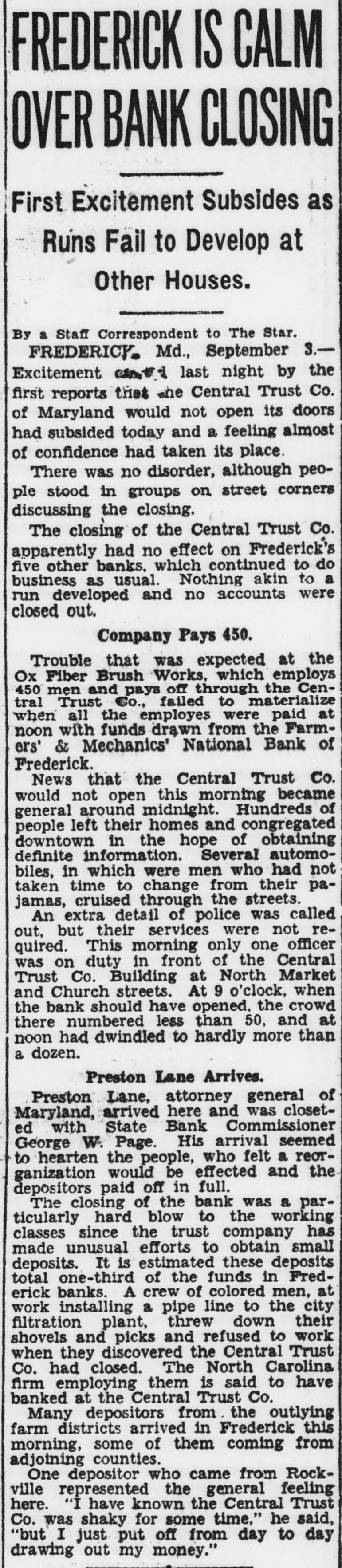
FREDERICK IS CALM OVER BANK CLOSING First Excitement Subsides as Runs Fail to Develop at Other Houses. By a Staff Correspondent to The Star. FREDERICK Md., September 3.Excitement used last night by the first reports the one Central Trust Co. of Maryland would not open its doors had subsided today and a feeling almost of confidence had taken its place. There was no disorder, although people stood in groups on street corners discussing the closing. The closing of the Central Trust Co. apparently had no effect on Frederick's five other banks. which continued to do business as usual. Nothing akin to a run developed and no accounts were closed out. Company Pays 450. Trouble that was expected at the Ox Fiber Brush Works, which employs 450 men and pays off through the Central Trust Co., failed to materialize when all the employes were paid at noon with funds drawn from the Farmers' & Mechanics' National Bank of Frederick. News that the Central Trust Co. would not open this morning became general around midnight. Hundreds of people left their homes and congregated downtown in the hope of obtaining definite information. Several automobiles, in which were men who had not taken time to change from their pajamas, cruised through the streets. An extra detail of police was called out, but their services were not required. This morning only one officer was on duty in front of the Central Trust Co. Building at North Market and Church streets. At 9 o'clock, when the bank should have opened, the crowd there numbered less than 50, and at noon had dwindled to hardly more than a dozen. Preston Lane Arrives. Preston Lane, attorney general of Maryland, arrived here and was closeted with State Bank Commissioner George W. Page. His arrival seemed to hearten the people, who felt a reorganization would be effected and the depositors paid off in full. The closing of the bank was a particularly hard blow to the working classes since the trust company has made unusual efforts to obtain small deposits. It is estimated these deposits total one-third of the funds in Frederick banks. A crew of colored men, at work installing a pipe line to the city filtration plant, threw down their shovels and picks and refused to work when they discovered the Central Trust Co. had closed. The North Carolina firm employing them is said to have banked at the Central Trust Co. Many depositors from the outlying farm districts arrived in Frederick this morning, some of them coming from adjoining counties. One depositor who came from Rockville represented the general feeling here. "I have known the Central Trust Co. was shaky for some time," he said, "but I just put off from day to day drawing out my money."


Article from Evening Star, September 4, 1931

Click image to open full size in new tab

Article Text

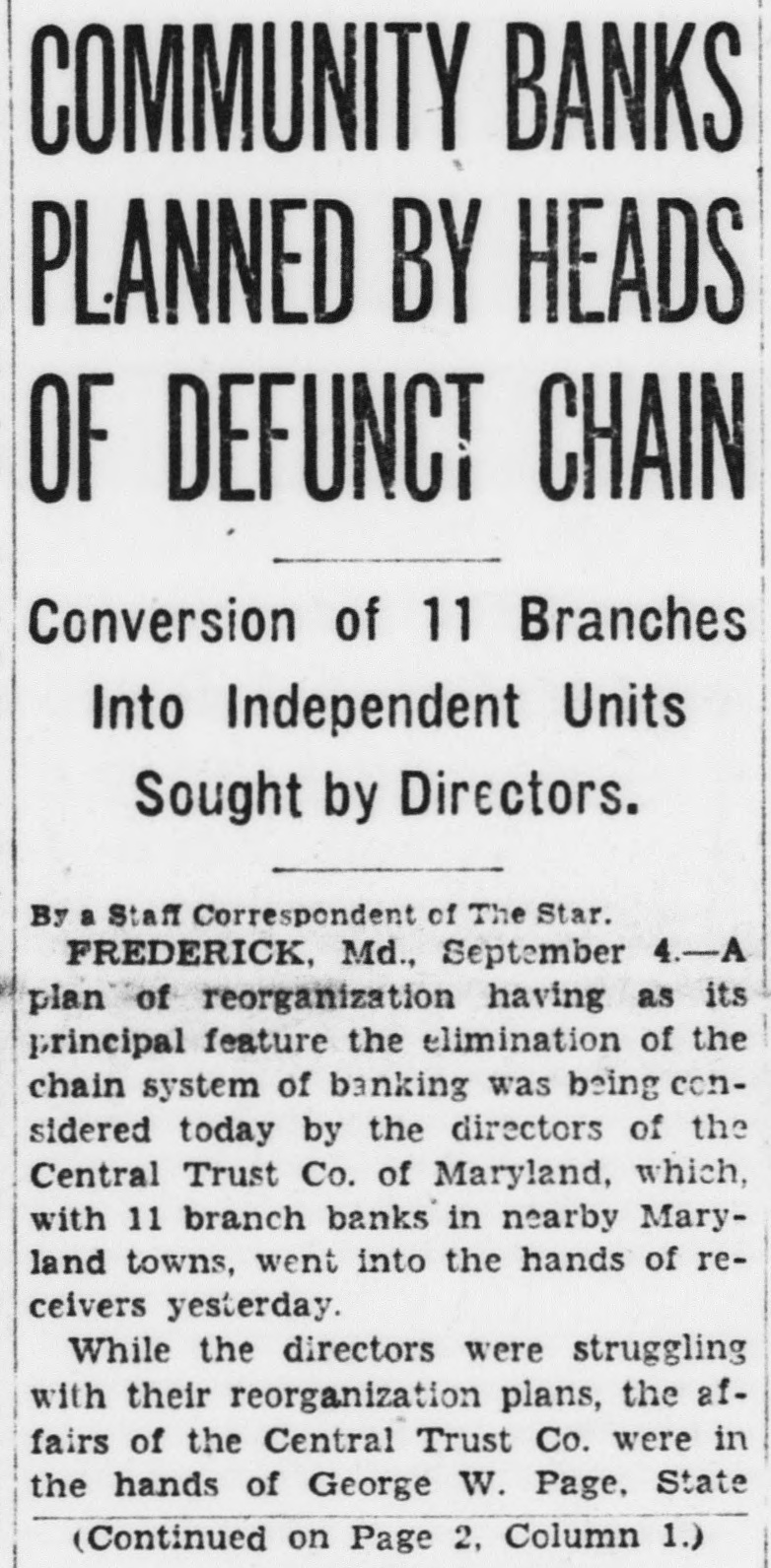
COMMUNITY BANKS PLANNED BY HEADS OF DEFUNCT CHAIN Conversion of 11 Branches Into Independent Units Sought by Directors. By a Staff Correspondent of The Star. FREDERICK, Md., September 4.-A plan of reorganization having as its principal feature the elimination of the chain system of banking was being considered today by the directors of the Central Trust Co. of Maryland, which, with 11 branch banks in nearby Maryland towns, went into the hands of receivers yesterday. While the directors were struggling with their reorganization plans, the affairs of the Central Trust Co. were in the hands of George W. Page, State (Continued on Page 2, Column 1.)


Article from The Washington Times, September 4, 1931

Click image to open full size in new tab

Article Text

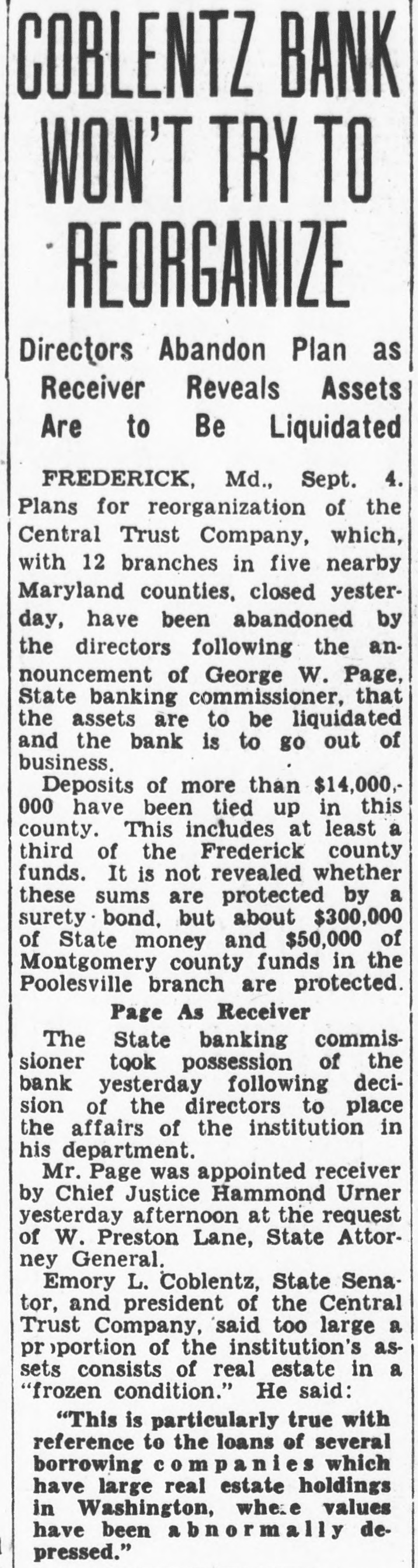
COBLENTZ BANK WON'T TRY TO REORGANIZE Directors Abandon Plan as Receiver Reveals Assets Be to Are Liquidated FREDERICK, Md., Sept. 4. Plans for reorganization of the Central Trust Company, which, with 12 branches in five nearby Maryland counties, closed yesterday, have been abandoned by the directors following the announcement of George W. Page, State banking commissioner, that the assets are to be liquidated and the bank is to go out of business. Deposits of more than $14,000,000 have been tied up in this county. This includes at least a third of the Frederick county funds. It is not revealed whether these sums are protected by a surety bond, but about $300,000 of State money and $50,000 of Montgomery county funds in the Poolesville branch are protected. Page As Receiver The State banking commissioner took possession of the bank yesterday following decision of the directors to place the affairs of the institution in his department. Mr. Page was appointed receiver by Chief Justice Hammond Urner yesterday afternoon at the request of W. Preston Lane, State Attorney General. Emory L. Coblentz, State Senator, and president of the Central Trust Company, said too large a pr portion of the institution's assets consists of real estate in a "frozen condition." He said: "This is particularly true with reference to the loans of several borrowing companies which have large real estate holdings in Washington, whe.e values have been abnormally depressed."


Article from Montgomery County Sentinel, September 11, 1931

Click image to open full size in new tab

Article Text

To speed Action On Frederick Bank. The liquidation of the assets of the Central Trust Company of Maryland will be proceeded with immedrately and as rapidly as possible, George W. Page, State Bank Commissioner, said. The bank's main offices at Frederick City, Md., and its eleven branches throughout Frederick, Washington, Carroll, Montgomery and Howard counties in Western Maryland, did not open on Thursday of of last week, the directorate Wednesday having voted voluntarily to suspend operations and place the bank in Mr. Page's hands. Friday Judges Hammond Urner and Arthur D. Willard, sitting in Frederick County Court, named Mr. Page receiver for the bank and John S. Newman as his counsel, in response to a receivership petition filed by W. Preston Lane, Attorney General, and Willis R. Jones, Deputy Attorney General. "Closing of the bank and its branches was deemed advisable by the directors for the purpose of conserving the assets of the institution and for the best interest of the depositors," Mr. Page said. "The situation in which they found the bank is in no wise a reflection of industrial and agricultural conditions in the counties served by the bank. It was brought about wholly through the institution,s having a very large commitment in Washington real estate which is 'frozen' and cannot be realized upon at the present time." State Senator Emory L. Coblentz, of Middletown, president of the Central Trust Company, in a statement issued after the directors' meeting, had said "As a result of the serious depression through which the country is passing affecting as it does the value of securities' and real estate, the bank finds itself with too large a proportion of its assets in a 'frozen' condition. This is particularly true with reference to the loans of several borrowing companies which have large holdings in Washington real estate, where values have been abnormally depressed." Mr. Page said there had been "a gradual seepage of deposits in recent weeks, but there was nothing of the sort of thing commonly called a 'run.'' A third of the Frederick County Board of Commissioners' funds were on deposit in the bank. John M. Dennis, State Treasurer, said the Central Trust Company was depository for a little more than $300,000 of State funds and that the entire sum was protected by surety bonds. Montgomery County's $50,000 deposit in the bank is similarly protected, said J. Forest Walker, County Treasurer. At the same time that Mr. Page and his deputy, John D. Hospelhorn, took over the bank's main offices, they sent assistants to take charge of the branches at Ellicott City, Emmitsburg, Monrovia, Myersville, Middletown, Poolesville, Smithburg, Sykesville, Thurmont, Walkersville and Union Bridge. Each branch had an auxiliary board of directors. The parent bank's directorate comprised: Mr. Coblentz, Dr. Joseph H. Apple, Lawrence A. Chiswell, William T. Delaplaine, Frank M. Dertzbaugh, Harry L. Ebert, John A. Engle, Thomas B. Hayward, Abram Hemp, John C. Leatherman, R. Rush Lewis, Charles McC. Mathias, Guy K. Motter, Frank C. Norwood, Vernon W. Nicodemus, Benjamin C. Perry, Richard P. Ross. Eli C. Renn. Charles F. Seeger, Dr. William M. Smith, Charles Wertheimer and Harry J. Lebherz. Mr. Norwood was chairman of the executive board. The Central Trust Company of Maryland was organized by Mr. Coblentz in 1913 as a State bank to take over the Central National Bank of Frederick, which dated back to 1808 and was the county's oldest bank. It had expanded rapidly since 1927, adding five branches during that period. Mr. Coblentz, who is 62, had been prominent in Western Maryland business and industry for many years. His financial interests extended to Washington and Philadelphia, where he had real estate holdings. In his statement he said he had placed back of the bank "in various ways practically all of my personal worth." A native of Middletown, Md., educated in public and private schools, he began his business career as a grocer's clerk and did not enter banking until 1887. His rise in banking was rapid. While he worked in that field he studied law and in 1898 was admitted to the bar. Eight years later he was made vice-president of the Frederick and Middletown Electric Railway Company and a director of the Central National Bank, whose president he became in 1908. That same year he organized and became

Article from Evening Star, September 28, 1931

Click image to open full size in new tab

Article Text

Frederick and Hagerstown Failures Are Traced to Central Trust. WITHDRAWALS HEAVY, SAYS COMMERCIAL HEAD Board of Directors Requests State Commissioner to Take Charge Immediately. Special Dispatch to The Star. FREDERICK, Md., September 28.Affected indirectly by the recent failure of the Central Trust Co. of Frederick and its 11 branches, two more Maryland banks and three branch institutions closed their doors today. The institutions which failed to open this morning are the Mechanics Loan and Savings Bank of Hagerstown and the Commercial Bank of Maryland, at Frederick. The latter bank has branches at Adamstown, Jefferson and Mount® Airy, which also were closed. It was understood both of the banks closed today sustained heavy withdrawals of deposits following the closing on September 3 of the Central Trust Co. and its branches, operated by Emory L. Coblentz. Casper C. Cline, president of the Commercial Bank of Maryland, issued the following statement: Board Orders Action. "Foliowing the closing of the Central Trust Co. of Maryland and 11 branches on September 3. various rumors and gossip of a damaging nature have been circulated about this institution, causing large withdrawals and the giving of notices for a very considerable amount of time-deposit money soon due for payment. It was ordered by the board of directors at a special meeting this morning that we request the bank commissioner of Maryland to take charge of the bank immediately. "This action was felt necessary to protect interests of all depositors and stockholders. Notwithstanding the present deflation and unusual depression through which we are passing, we believe the depositors should receive the amounts due them. It is most regretable, indeed, that this action has been found necessary, but every possible effort has been made to prevent it and no other prudent course remains open in fairness to depositors and stockholders. Consideration may be given to a plan of reorganization, but nothing definite can be stated at this time." Capitalized for $400,000. Mr. Cline's bank is capitalized for $400,000 and has resources of $3,200,000. This would make its deposits amount to approximately $2,080,000. A notice on the door of the Mechanics' Loan & Savings Bank stated that "This institution is in the hands of the State bank commissioner." The directors of the Mechanics' Loan & Savings Bank, at Hagerstown, issued this statement: "We announce with regret that we have felt it necessary to suspend the business of the Mechanics Loan & Savings Bank for the protection of our depositors and for the best interests of our many stockholders. During the past two years we have been suffering from the effects of the general depression existing throughout the Nation, and the unusual demands made upon this institution by its depositors have depleted its more liquid assets. "On July 1, 1930, the deposits of our bank were nearly $3,000,000, and at the close of business last Saturday we had on deposit a total of $1,970,632. We have endeavored to be conservative in the management of our institution and have tried to render at all time to this community efficient banking service. "It was impossible to liquidate our mortgages and other investments rapidly enough to meet the unusual demands made upon us, resulting from false and unfounded rumors recently circulated by irresponsible persons. Acting in the best interest of our people and the community at large. we did not feel justified in sacrificing the value of our assets, and our final action is the result of our best judgment in this regard. Although we regret the necessity of this action, we feel confident that with proper and orderly liquidation our depositors will be paid. Henry Holzapsel, president of the bank, refused to make any statement at this time, but it was learned a steady seepage of deposits since the failure of the Central Trust Co. is responsible for the bank's closing. The bank's statement of June 30, 1931, showed resources of $2,950,489 and deposits, both savings and special, of $1,756,730. George W. Page, State bank commissioner, began an examination of the books of both institutions this morning. The Central Trust Co. at the time of its failure held deposits of $14,000,000, about one-third of the total bank deposits of Frederick County. Coblentz blamed frozen assets and "miserable publicity" received by himself in connection with the Federal investigation of the F. H. Smith Co. of Washington for the bank's failure. Coblentz is under indictment in Washington on a charge of aiding in commission of perjury in connection with the operations of the Smith company.


Article from The Washington Times, September 28, 1931

Click image to open full size in new tab

Article Text

TWO MARYLAND BANKS CLOSE (Continued From Page 1) run for withdrawals since the day of the closing of the Central Company. Cline's Statement Mr. Cline, in a statement to The Washington Times, said: "Following the closing of the Central Company of Maryland and its 11 branches on September 3, various rumors and gossip of a damaging nature have been circulated about this institution causing large withdrawals and the giving of notices for a very considerable amount of time deposit money soon due for payment. "It was voted by the board of directors at a special meeting at 8:30 o'clock this morning that we request the bank commissioner of Maryland to take charge of the bank immediately. This action was felt necessary to protect the interest of all. depositors and stockholders. Only Course Left "Notwithstanding the present deflation and unusual depression through which we are passing, we believe depositors should receive the amounts due them. ident of the Central Company. that this action has been found necessary, but every possible effort has been made to prevent it, and no other pruduent course remained open in fairness to the depositors and stockholders. "Consideration may be given to a plan of reorganization, but nothing definite can be stated at this time." The Commercial Bank had branches in Maryland at Mt. Airy, Adamstown, and Jefferson. Deposits $2,500,000 Mr. Cline said the deposits at the bank amounted to $2,500,000 and the capital and surplus was $400,000. All the branches were closed today and also placed under the State bank commissioner. Leading business men and politicians of Frederick said today that they feel certain that, despite its closing, the Commercial Bank will give a higher return to the depositors than the Central Trust Company. H. E. Meeks, assistant State bank commissioner of Maryland, who took charge of the Commercial Bank, said he has not been able to study conditions there sufficiently to make a state ment as to its assets and liabilities. Back to Pitts Case The Central Trust Company had deposits amounting to $14,000,000. Emory L. Coblentz, State senator f: Frederick, was president of the Centray Company. Mr. Coblentz was recently indicted by the local Federal Grand Jury on charges of perjury in connection with testimony he gave in the defense of G. Bryan Pitts, president of the Smith Company, at his trial last fall.


Article from Montgomery County Sentinel, March 4, 1932

Click image to open full size in new tab

Article Text

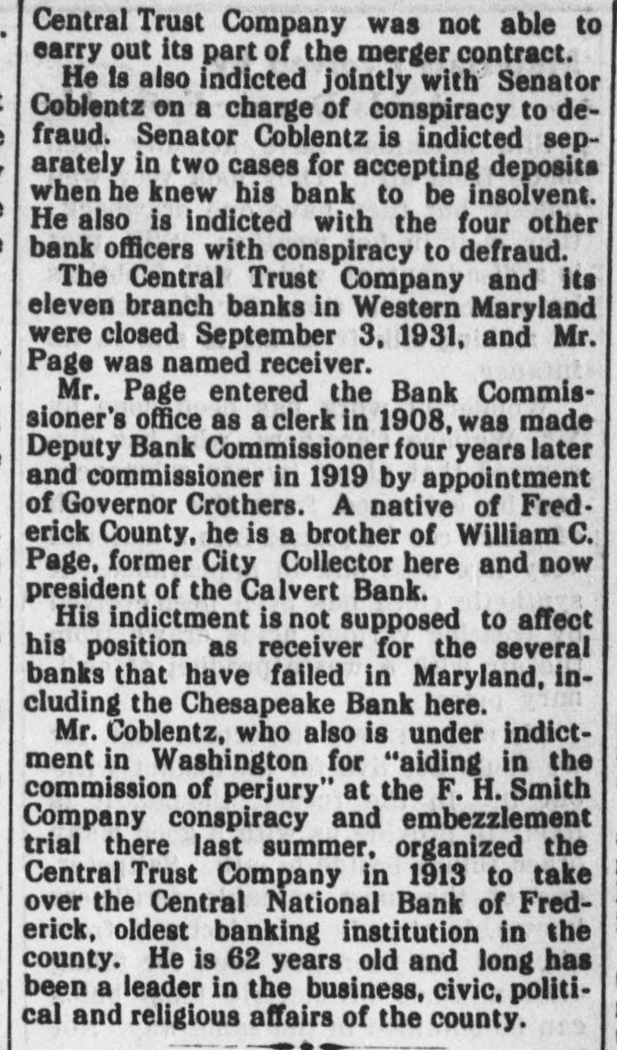
Central Trust Company was not able to earry out its part of the merger contract. He is also indicted jointly with Senator Coblentz on a charge of conspiracy to defraud. Senator Coblentz is indicted separately in two cases for accepting deposits when he knew his bank to be insolvent. He also is indicted with the four other bank officers with conspiracy to defraud. The Central Trust Company and its eleven branch banks in Western Maryland were closed September 3. 1931, and Mr. Page was named receiver. Mr. Page entered the Bank Commissioner's office as a clerk in 1908, was made Deputy Bank Commissioner four years later and commissioner in 1919 by appointment of Governor Crothers. A native of Frederick County, he is a brother of William C. Page, former City Collector here and now president of the Calvert Bank. His indictment is not supposed to affect his position as receiver for the several banks that have failed in Maryland, including the Chesapeake Bank here. Mr. Coblentz, who also is under indictment in Washington for "aiding in the commission of perjury" at the F. H. Smith Company conspiracy and embezzlement trial there last summer, organized the Central Trust Company in 1913 to take over the Central National Bank of Frederick, oldest banking institution in the county. He is 62 years old and long has been a leader in the business, civic, political and religious affairs of the county.


Article from Evening Star, May 31, 1932

Click image to open full size in new tab

Article Text

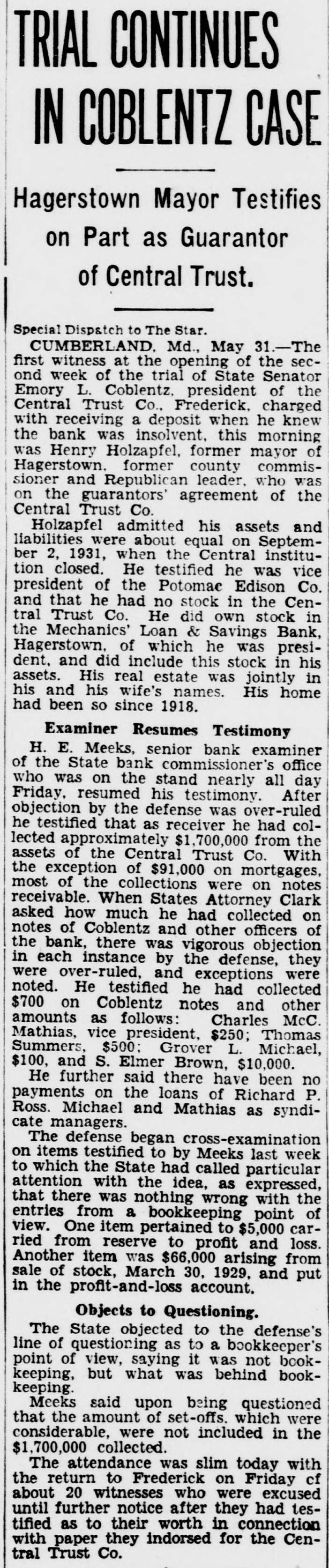
TRIAL CONTINUES IN COBLENTZ CASE Hagerstown Mayor Testifies on Part as Guarantor of Central Trust. Special Dispatch to The Star. CUMBERLAND, Md., May 31.-The first witness at the opening of the second week of the trial of State Senator Emory L. Coblentz, president of the Central Trust Co., Frederick, charged with receiving a deposit when he knew the bank was insolvent. this morning was Henry Holzapfel, former mayor of Hagerstown. former county commissioner and Republican leader, who was on the guarantors' agreement of the Central Trust Co. Holzapfel admitted his assets and liabilities were about equal on September 2, 1931, when the Central institution closed. He testified he was vice president of the Potomac Edison Co. and that he had no stock in the Central Trust Co. He did own stock in the Mechanics' Loan & Savings Bank, Hagerstown, of which he was president. and did include this stock in his assets. His real estate was jointly in his and his wife's names. His home had been so since 1918. Examiner Resumes Testimony H. E. Meeks, senior bank examiner of the State bank commissioner's office who was on the stand nearly all day Friday. resumed his testimony. After objection by the defense was over-ruled he testified that as receiver he had collected approximately $1,700,000 from the assets of the Central Trust Co. With the exception of $91,000 on mortgages, most of the collections were on notes receivable. When States Attorney Clark asked how much he had collected on notes of Coblentz and other officers of the bank, there was vigorous objection in each instance by the defense, they were over-ruled, and exceptions were noted. He testified he had collected $700 on Coblentz notes and other McC. amounts as follows: Charles Mathias, vice president, $250; Thomas Summers. $500; Grover L. Michael, $100, and S. Elmer Brown, $10,000. He further said there have been no payments on the loans of Richard P. Ross. Michael and Mathias as syndicate managers. The defense began cross-examination on items testified to by Meeks last week to which the State had called particular attention with the idea, as expressed, that there was nothing wrong with the entries from a bookkeeping point of view. One item pertained to $5,000 carried from reserve to profit and loss. Another item was $66,000 arising from sale of stock, March 30, 1929, and put in the profit-and-loss account. Objects to Questioning. The State objected to the defense's line of questioning as to a bookkeeper's point of view, saying it was not bookkeeping, but what was behind bookkeeping. Meeks said upon being questioned that the amount of set-offs. which were considerable, were not included in the $1,700,000 collected. The attendance was slim today with the return to Frederick on Friday cf about 20 witnesses who were excused until further notice after they had testified as to their worth in connection with paper they indorsed for the Central Trust Co.


Article from Evening Star, June 4, 1932

Click image to open full size in new tab

Article Text

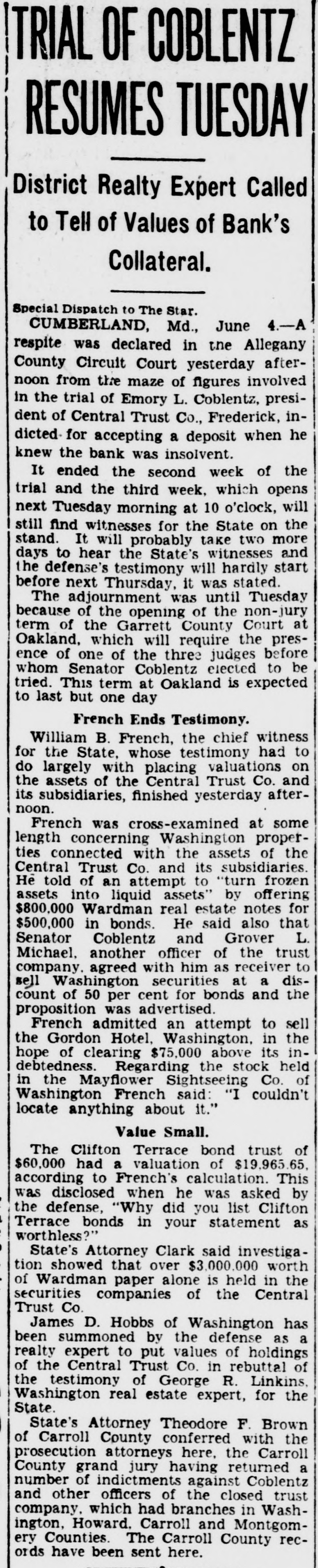
TRIAL OF COBLENTZ RESUMES TUESDAY District Realty Expert Called to Tell of Values of Bank's Collateral. Special Dispatch to The Star. CUMBERLAND, Md., June 4.-A respite was declared in the Allegany County Circuit Court yesterday afternoon from the maze of figures involved in the trial of Emory L. Coblentz, president of Central Trust Co., Frederick, indicted- for accepting a deposit when he knew the bank was insolvent. It ended the second week of the trial and the third week, which opens next Tuesday morning at 10 o'clock, will still find witnesses for the State on the stand. It will probably take two more days to hear the State's witnesses and the defense's testimony will hardly start before next Thursday, it was stated. The adjournment was until Tuesday because of the opening of the non-jury term of the Garrett County Court at Oakland, which will require the presence of one of the three judges before whom Senator Coblentz elected to be tried. This term at Oakland is expected to last but one day French Ends Testimony. William B. French, the chief witness for the State, whose testimony had to do largely with placing valuations on the assets of the Central Trust Co. and its subsidiaries, finished yesterday afternoon. French was cross-examined at some length concerning Washington properties connected with the assets of the Central Trust Co. and its subsidiaries. He told of an attempt to "turn frozen assets into liquid assets" by offering $800.000 Wardman real estate notes for $500,000 in bonds. He said also that Senator Coblentz and Grover L. Michael. another officer of the trust company. agreed with him as receiver to sell Washington securities at a discount of 50 per cent for bonds and the proposition was advertised. French admitted an attempt to sell the Gordon Hotel, Washington, in the hope of clearing $75,000 above its indebtedness. Regarding the stock held in the Mayflower Sightseeing Co. of Washington French said: "I couldn't locate anything about it." Value Small. The Clifton Terrace bond trust of $60,000 had a valuation of $19,965.65, according to French's calculation. This was disclosed when he was asked by the defense, "Why did you list Clifton Terrace bonds in your statement as worthless?" State's Attorney Clark said investigation showed that over $3,000,000 worth of Wardman paper alone is held in the securities companies of the Central Trust Co. James D. Hobbs of Washington has been summoned by the defense as a realty expert to put values of holdings of the Central Trust Co. in rebuttal of the testimony of George R. Linkins. Washington real estate expert, for the State. State's Attorney Theodore F. Brown of Carroll County conferred with the prosecution attorneys here, the Carroll County grand jury having returned a number of indictments against Coblentz and other officers of the closed trust company, which had branches in Washington, Howard. Carroll and Montgomery Counties. The Carroll County records have been sent here.


Article from The Washington Times, June 10, 1932

Click image to open full size in new tab

Article Text

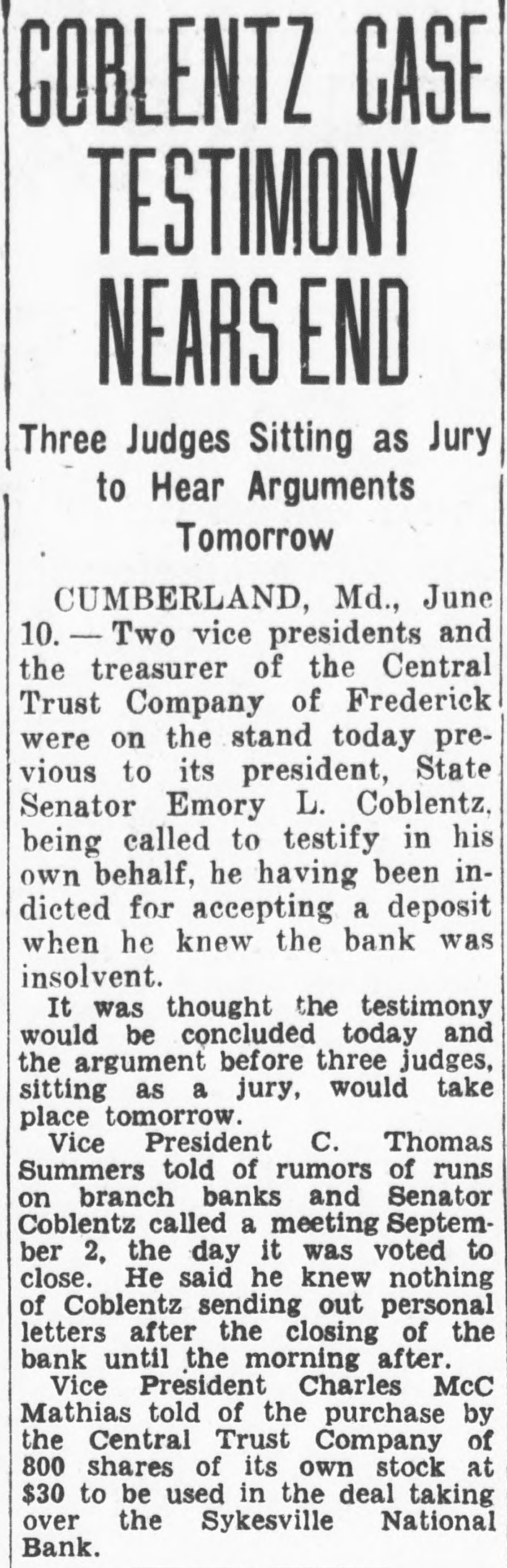
GOBLENTZ CASE GAJE TESTIMONY NEARS END Three Judges Sitting as Jury to Hear Arguments Tomorrow CUMBERLAND, Md., June 10. 1 Two vice presidents and the treasurer of the Central Trust Company of Frederick were on the stand today previous to its president, State Senator Emory L. Coblentz, being called to testify in his own behalf, he having been indicted for accepting a deposit when he knew the bank was insolvent. It was thought the testimony would be concluded today and the argument before three judges, sitting as a jury, would take place tomorrow. Vice President C. Thomas Summers told of rumors of runs on branch banks and Senator Coblentz called a meeting September 2, the day it was voted to close. He said he knew nothing of Coblentz sending out personal letters after the closing of the bank until the morning after. Vice President Charles McC Mathias told of the purchase by the Central Trust Company of 800 shares of its own stock at $30 to be used in the deal taking over the Sykesville National Bank.


Article from Montgomery County Sentinel, October 28, 1932

Click image to open full size in new tab

Article Text

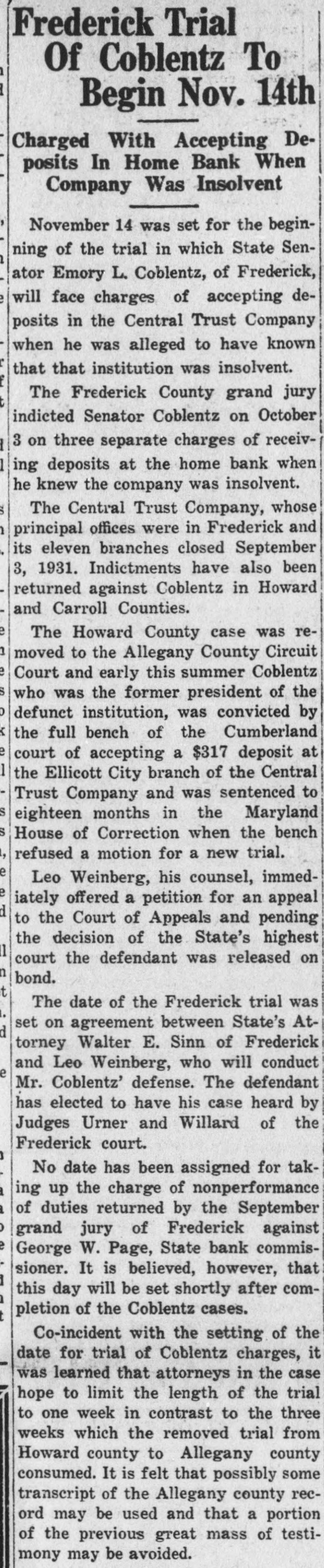
Frederick Trial Of Coblentz To Begin Nov. 14th Charged With Accepting Deposits In Home Bank When Company Was Insolvent November 14 was set for the beginning of the trial in which State Senator Emory L. Coblentz, of Frederick, will face charges of accepting deposits in the Central Trust Company when he was alleged to have known that that institution was insolvent. The Frederick County grand jury indicted Senator Coblentz on October 3 on three separate charges of receiving deposits at the home bank when he knew the company was insolvent. The Central Trust Company, whose principal offices were in Frederick and its eleven branches closed September 3, 1931. Indictments have also been returned against Coblentz in Howard and Carroll Counties. The Howard County case was removed to the Allegany County Circuit Court and early this summer Coblentz who was the former president of the defunct institution, was convicted by the full bench of the Cumberland court of accepting a $317 deposit at the Ellicott City branch of the Central Trust Company and was sentenced to eighteen months in the Maryland House of Correction when the bench refused a motion for a new trial. Leo Weinberg, his counsel, immediately offered a petition for an appeal to the Court of Appeals and pending the decision of the State's highest court the defendant was released on bond. The date of the Frederick trial was set on agreement between State's Attorney Walter E. Sinn of Frederick and Leo Weinberg, who will conduct Mr. Coblentz' defense. The defendant has elected to have his case heard by Judges Urner and Willard of the Frederick court. No date has been assigned for taking up the charge of nonperformance of duties returned by the September grand jury of Frederick against George W. Page, State bank commissioner. It is believed, however, that this day will be set shortly after completion of the Coblentz cases. Co-incident with the setting of the date for trial of Coblentz charges, it was learned that attorneys in the case hope to limit the length of the trial to one week in contrast to the three weeks which the removed trial from Howard county to Allegany county consumed. It is felt that possibly some transcript of the Allegany county record may be used and that a portion of the previous great mass of testimony may be avoided.


Article from Evening Star, May 14, 1933

Click image to open full size in new tab

Article Text

Bank Loses Court Plea. FREDERICK, Md., May 13.-Application of the Fidelity and Deposit Co., Baltimore, requesting the court to modify the decree, which included the assignment of four mortgages now in the hands of the receiver of the closed Central Trust Co., Frederick, to the People's Banking Co., Smithsburg, was denied by Chief Judge Hammond Urner D Willard,


Article from The Herald-Mail, June 26, 1933

Click image to open full size in new tab

Article Text

Bank Liquidation Plans Go Forward The first step toward liquidating the Peoples' Banking Company, Smithsburg. was taken recently with the filing in. court of an order signed by Judge Prank (:. Wagaman authorizing the receiver, John J. Ghingher, to determine stockhold ers' liability and proceed with collecting and enforcing payment of assessments on stock It is understood that steps will be taken at once to liquidate the af. fairs of the hank, the closing of which was caused, it is alleged, by the collapse of the Central Trust Company, Frederick, with which it had been merged. Several months ago. after lengthy court litigation. the merger was res. cinded and the Peoples Bank restor. ed as an individual institution.


Article from The Washington Times, August 23, 1933

Click image to open full size in new tab

Article Text

COBLENTZ AIRS BANK DEALS FREDERICK, Md., Aug. 23. Emory L. Coblentz, president of the closed Central Trust Company, was called as a witness yesterday in the case in which the Washington Trust Company of Ellicott City is seeking the return of a number of mortgages held by the Fidelity and Deposit Company of Baltimore. Coblentz, who recently was acquitted on charges of violation of the banking laws in connection with the closing of his banking company, was called in because the mortgages in question were among the assets of the Washington Trust Company at the time it merged with Coblentz's bank. The mortgages were assigned to the Fidelity Company, and the Ellicott City organization is attempting to have the assignments set aside on the grounds that the Central Trust was insolvent at the time the Washington Trust was taken over by the Baltimore institution. The complainants contend the merger was consummated through fraud and misrepresentation on the part of the officers of the Central Trust, but Coblentz yesterday denied all implications. He said he felt his organization could make a profitable branch at Ellicott City.


Article from The Baltimore Sun, November 16, 1933

Click image to open full size in new tab

Article Text

Central Trust Plan Offered To Depositors Branch System Would Be Discarded And Six Individual Units Established Frederick, Nov. 15 (Special) six new unit banks within the next six weeks and make cash distribution of five per cent. to depositors upon reopening, being submitted depositors of the Central Trust Company, it was announced today. The bank in process of reorganization has been in receivership since September 3, 1931. When at least twenty-five per cent. of deposits the closed bank are signed the plan will be submitted to John Ghingher. State Bank Commissioner and receiver for the trust company, for approval. It is understood that Mr. Ghingher looks with favor upon the reorganization plan. The new plan calls for six separate Institutions, one in Frederick to be known the Western Maryland Trust Company; one Middletown, the Middletown State Bank; one in Walkersville, Walkersville State Bank; one in Monrovia, State Bank; one in Sykesville, Sykesville State Bank, and in Poolesville, the Poolesville State Bank. The branch bank system discarded, and each town to organize and manage its own institution.


Article from The Washington Herald, February 10, 1934

Click image to open full size in new tab

Article Text

BALTIMORE LIVE STOCK Court Hearing Set Cattle On Bank Receiver fair to medium. fair, $4.25@4.50; to to med ium to fair to to plain, good fair medium, Good medium plain and head market good market about light Western higher than quotations. 25 market $4.50@7 Special the Washington Herald FREDERICK Md., Feb. 9.-A hearing on the petition of John J. Ghingher State bank commis sioner and receiver of the closed Central Trust Company, to terminate the receivership be held befor Chief Judge Hammond Urner and Judge Arthur D. Will liard. in the Circuit Court Mon day, it was announced today. It is expected to be one of the most important hearings during the two and a half years of the trust company's receivership.


Article from The Evening Sun, February 12, 1934

Click image to open full size in new tab

Article Text

Arguments On Receivership Bench Studies Question [By the Associated Press] Frederick, Feb. 12-Argument completed and the question of termination of the receivership the Central Trust Company taken under advisement in Circuit Court here day. proceedings instituted John Ghingher, State Bank Commissioner, receiver for the closed He asked that the ship be ended and that fair liquidavalue fixed for some 200 positors who not favored ganization of the institution. Some Time Court attaches expressed the opinion be length of time before might some decision was rendered, as there question to whether not some would be able meet liabilities the trust company reopened. Efforts have been going forward ascertain liabilities met. Attaches said it was probable further investigation would be made before decision returned. The hearing was held before Chief Judge Urner Judge thur Willard. Ghingher present, has been representing his of the plan of November.


Article from The Daily Mail, December 26, 1934

Click image to open full size in new tab

Article Text

Depositors To Receive Funds Central Trust Liquidating Company To Distribute $200,000. FREDERICK Md., Dec. 26.-The distribution of approximately $200,000 in this and nearby communities will result from a dividend voted by the directors of the Peoples Liquidating Corporation. holder of the assets of the defunct Central Trust Company of Maryland. W. Clinton McSherry, president of the corporation announced after a directors' meeting yesterday that a payment of 2 per cent will be made soon to depositors holding certificates of beneficial interest in the Central Trust Company. Dissenting depositors were allowed 22 per cent as the fair valuation placed upon the assets by the Circuit Court for Frederick County. The Peoples Liquidating Corporation has been working to secure the most out of the assets it holds without sacrificing possible future values or working R. hardship on those indebted to the Central Trust. At present. the corporation holds all assets with the exception of the stockholders' liability due on stock which is still being collected by the bank's receiver. Efforts. it was explained, are being made to close the receivership as soon as possible. The per cent distribution proposed will be paid to certificate holders on a face value basis, McSherry said.


Article from The Baltimore Sun, December 26, 1934

Click image to open full size in new tab

Article Text

DEPOSITORS Distribution To Result From Dividend Voted By Holding Company PAYMENT OF 2% TO BE MADE SOON Efforts Started To Close Receivership As Early As Possible [By the Associated Frederick. Dec. 25-The distribution approximately $200,000 in this nearby communities will result from dividend voted by the directors the People's Liquidating Corporation, holder of the assets of the defunct Central Trust Company of Maryland. W. Clinton McSherry, president the corporation, announced after director's meeting yesterday that payment of two per cent. would made soon depositors holding certificates of beneficial interest in the Central Trust Company. An earlier dividend of six per cent. was paid the time of the opening new banks formed in connection with reorganization plan. Allowed Per Cent. Dissenting depositors were allowed twenty-two per cent the fair valuation placed the assets by the Circuit Court for Frederick county. The People's Liquidating Corporation has been working obtain the most out of the assets holds without sacrificing possible future values working hardship those indebted to the Central Trust. At present, the corporation holds all assets with the exception the liability due stock which still is being lected by the bank's receiver. To Be Paid On Face Value Basis Efforts. was explained. were being close the receivership as soon The two per cent. distribution posed will be paid certificate holdbasis, McSherry Each certificate probably will have to presented that entry showing the distribution be made. McSherry reported publication the full details of the plan would delayed until later, but that the corporation desired make the payment promptly the assets can be verted into cash.


Article from The Washington Times, October 7, 1935

Click image to open full size in new tab

Article Text

600 Stockholders In Bank Face Suit HAGERSTOWN, Md., Oct. 7. The list of stockholders of the defunct Central Trust Company, Frederick, being sued by the receiver to collect statutory liability assessments, has passed 600 with the filing of 31 more names, a number of who are Hagerstown stockholders. They held stock ranging from three shares up to 405 shares per sstockholder.