8439. Union Trust Company (Baltimore, MD)

Bank Information

Episode Type
Run → Suspension → Reopening
Bank Type
trust company
Start Date
October 19, 1903
Location
Baltimore, Maryland (39.290, -76.612)

Metadata

Model
gpt-5-mini
Short Digest
f6d1011a

Response Measures

Borrowed from banks or large institutions, Public signal of financial health, Capital injected, Full suspension

Description

Union Trust Company experienced a depositor run triggered by the failure/suspension of the Maryland Trust Company (withdrawals ~ $150,000), closed/suspended Oct 19/20 with Miles White Jr. appointed receiver, and later resumed operations (court discharged receiver / reopened) Dec 23, 1903.

Events (4)

1. October 19, 1903 Receivership
Newspaper Excerpt
Miles White, Jr., was appointed receiver of the company, filing bonds of a million.
Source
newspapers
2. October 19, 1903 Run
Cause
Local Banks
Cause Details
Depositors withdrew funds (about $150,000 reported) after announcement of the Maryland Trust Company's failure, prompting a run on Union Trust.
Measures
Closed doors at 1 p.m.; receiver appointed; sought assistance from clearing house and incoming currency from New York/Philadelphia.
Newspaper Excerpt
the closing of the doors of the company was due to the run upon it by the depositors in consequence of the failure of the Maryland Trust Company.
Source
newspapers
3. October 19, 1903 Suspension
Cause
Local Banks
Cause Details
Suspension followed a depositor run triggered by the Maryland Trust Company's failure; administrators cited inability to realize quickly on securities and heavy withdrawals.
Newspaper Excerpt
The Union Trust Company closed its doors at 1 p. m. today. Miles White, Jr., was appointed receiver of the company, filing bonds of a million.
Source
newspapers
4. December 23, 1903 Reopening
Newspaper Excerpt
The Union Trust company... opened its doors today and resumed business.
Source
newspapers

Newspaper Articles (23)

Article from Deseret Evening News, October 19, 1903

Click image to open full size in new tab

Article Text

BULL OPERATORS DISCOURAGED. Market Was Flooded With Liquidating Sales From All Quarters. PRICES YIELDED EVERYWHERE. Nothing Showed Strength and the Bears Had Everything Their Own Way. New York Oct. 19.-The London market today was depressed by renewed apprehension over the far eastern outlook and the financial situation. Opening prices in the stock market there fell back sharply in response and there were large blocks of many leading stocks thrown upon the market. Declines of 1 to 1% were recorded by Pennsylvania, New York Central, Baltimore & Ohio, Southern Pacific, Rock Island, Canadian Pacific, Union Pacific, Atchison, Amalgamated. United States Steel preferred, American Car and Tennuessee Coal. Confirmation of the rumored embarrassment of the Maryland Trust company of Baltimore led to a flood of liquidating sales from all quarters, under which prices yielded further. A dozen or more stocks sold 2 points below Saturday's close, including Amalgamated Copper, American Car preferred. Smelting preferred, Republic Steel preferrd, Locomotiv preferred Tennesse Coal, Sugar, Pennsylvania, Canadian Pacific, Union Pacific, Southrn Railway preferred and Missouri Pacific. Selling of Baltimore & Ohio and United States Steel was particularly heavy and they fell 2 points. The market showed no strength at any other point and the readiness with which stocks gave way under the attack discouraged the bull operators. Pressure slackened for a time but the rally was 80 spiritiess that bear selling was renewed against it. The selling was less in the second hour, but only slight rallies in prices resulted. American Car with a recovery of a point led the upward reaction. Rock Island fell 2, Delaware & Hudson 214, St. Louis-Southwestern preferrd 2½ and Southern Railway preferred 3. There was an isolated rise of 3 points in Railway Steel Spring preferred. United States Steel second 58 declined 1½. Otherwise bonds were little affected up to noon by the weakness in stocks. A few stocks rallied in the neighborhood of a point, notably Sugar and United States:Steel preferred. Otherwise prices were not essentially changed from the noon level and business was very dull. General Electric lost 3. Selling was resumed with vigor again when the announcement of another trust company suspension was made-that of the Union Trust company of Baltimore. Leading stocks sold lower than in the morning break and there was particular pressure against the southern stocks. Union Pacifie and Baltimore & Ohio sold at 69% and 72% respectively, and Atchison St. Paul, Southern Pacific, New York Central. Reading. Illinois Central Kansas City & Texas preferred and Brooklyn Transit were added to the list of stocks which showed losses of 2 points or more. Steel preferred dropped 2% and Amalgamated 2½. At 2 clock the market was still on the down grade. Westinghouse Electric fell 8 points. The failure of the Maryland Trust company of Baltimore caused a weak stock market today. Liquidation was general. but the decline in Baltimore and Southern Railway preferred was attributed directly to selling induced by the failure. These stocks, United States Steel preferred and Amalgamated Copper were notably weak, but losses of 1½ to over 2 points were quite general during the first hour. The industrials were conspicuous in the decline also. Selling by foreign houses owing to the renewed uneasiness over the far eastern situation and the financiel conditions in London aggravated the weakness.

Article from Evening Times-Republican, October 19, 1903

Click image to open full size in new tab

Article Text

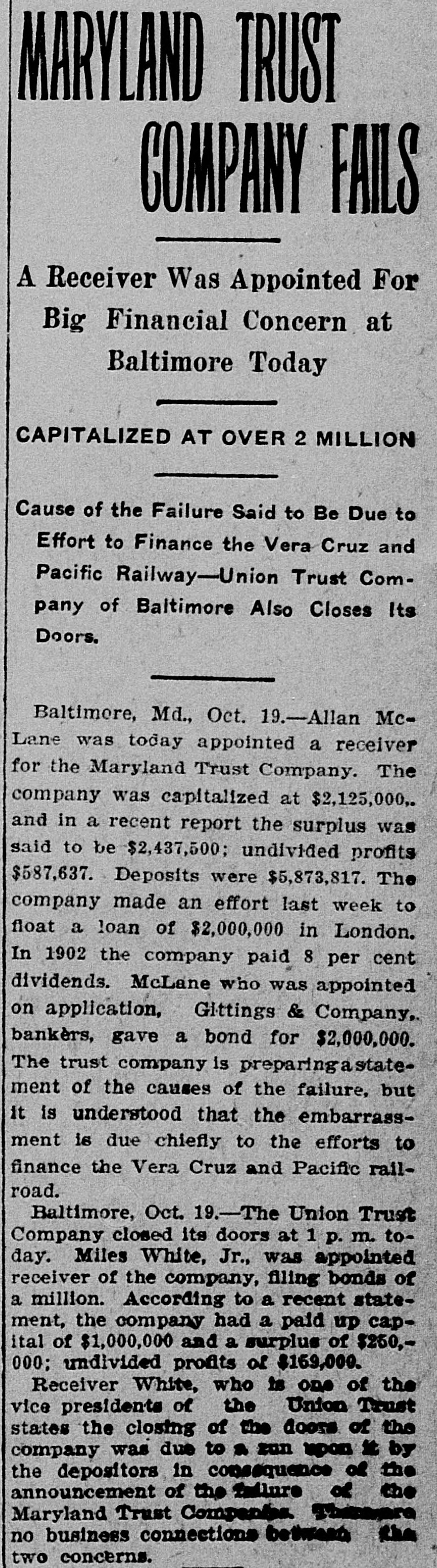
MARYLAND TRUST COMPANY FAILS A Receiver Was Appointed For Big Financial Concern at Baltimore Today CAPITALIZED AT OVER 2 MILLION Cause of the Failure Said to Be Due to Effort to Finance the Vera Cruz and Pacific Railway-Union Trust Company of Baltimore Also Closes Its Doors. Baltimore, Md., Oct. 19.-Allan McLane was today appointed a receiver for the Maryland Trust Company. The company was capitalized at $2,125,000.. and in a recent report the surplus was said to be $2,437,500; undivided profits $587,637. Deposits were $5,873,817. The company made an effort last week to float a loan of $2,000,000 in London. In 1902 the company paid 8 per cent dividends. McLane who was appointed on application, Gittings & Company, bankers, gave a bond for $2,000,000. The trust company is preparingastate= ment of the causes of the failure, but it is understood that the embarrassment is due chiefly to the efforts to finance the Vera Cruz and Pacific railroad. Baltimore, Oct. 19.-The Union Trust Company closed its doors at 1 p. m. today. Miles White, Jr., was appointed receiver of the company, filing bonds of a million. According to a recent statement, the company had a paid up capital of $1,000,000 and a surplus of $250,000; undivided profits of $169,000. Receiver White, who is one of the vice presidents of the Union Trust states the closing of the doors of the company was due to a zun upon it by the depositors in consequence of the announcement of the Tullure of the Maryland Trust Companias the no business connections between two concerns.


Article from The Topeka State Journal, October 19, 1903

Click image to open full size in new tab

Article Text

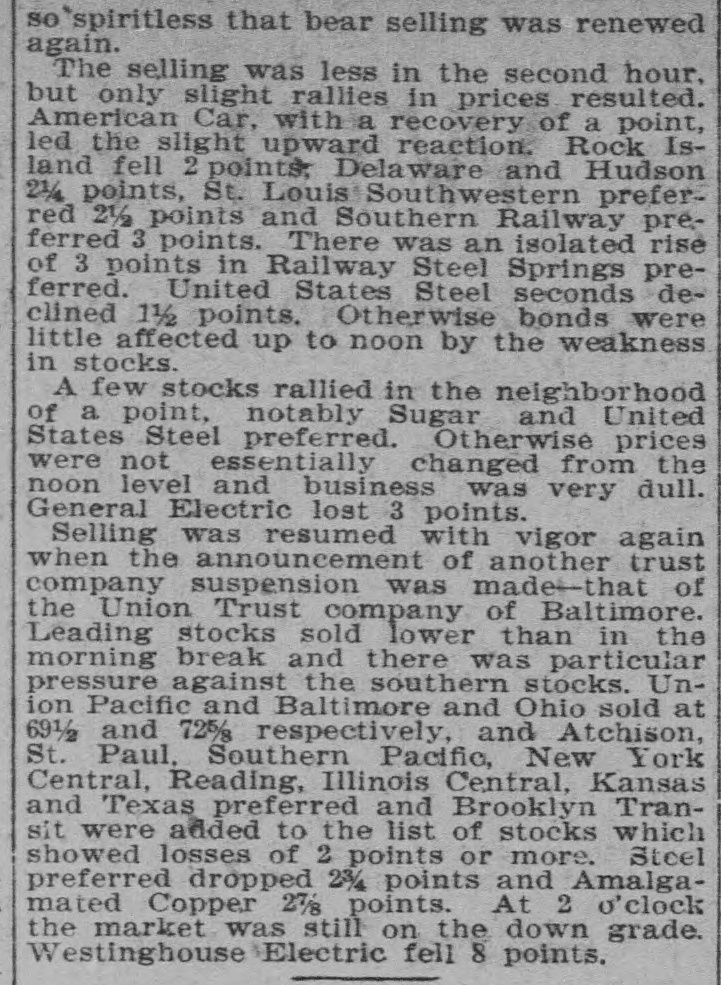
so "spiritless that bear selling was renewed again. The selling was less in the second hour, but only slight rallies in prices resulted. American Car, with a recovery of a point, led the slight upward reaction. Rock Island fell 2 points, Delaware and Hudson 21/4 points, St. Louis Southwestern preferred 2½ points and Southern Railway preferred 3 points. There was an isolated rise of 3 points in Railway Steel Springs preferred. United States Steel seconds declined 1½ points. Otherwise bonds were little affected up to noon by the weakness in stocks. A few stocks rallied in the neighborhood of a point, notably Sugar and United States Steel preferred. Otherwise prices were not essentially changed from the noon level and business was very dull. General Electric lost 3 points. Selling was resumed with vigor again when the announcement of another trust company suspension was made-that of the Union Trust company of Baltimore. Leading stocks sold lower than in the morning break and there was particular pressure against the southern stocks. Union Pacific and Baltimore and Ohio sold at 691/2 and 725/8 respectively, and Atchison, St. Paul, Southern Pacific, New York Central, Reading, Illinois Central, Kansas and Texas preferred and Brooklyn Transit were added to the list of stocks which showed losses of 2 points or more. Steel preferred dropped 23/4 points and Amalgamated Copper 2½ points. At 2 o'clock the market was still on the down grade. Westinghouse Electric fell 8 points.


Article from The Sun, October 20, 1903

Click image to open full size in new tab

Article Text

FINANCIAL AND COMMERCIAL. MONDAY, Oct. 19. It is not at all improbable that prices on the Stock Exchange would have declined to-day anyway, from mere selling of stocks by speculators for the purpose of hiving profits that had accumulated in the recent rapid upward movement in quotations last Friday and Saturday. The market was also weakened to some extent by the retirement of a portion, at least, of the short interest, and was therefore doubly in a position to suffer from bad news. That the news received from Baltimore to-day was bad must be frankly admitted, and it would have shaken convictions even much stronger than those which are generally entertained as to the stability of market values. The troubles connected with the Seaboard Air Line's issue of stock and the recent business suspensions in Baltimore of a prominent Southern capitalist and of a leading brokerage house have indicated that in Baltimore as well as in Pittsburg and other cities in this country and in Canada capital was under a strain. Nevertheless, the announcement of receiverships for two such institutions as the Maryland and the Union Trust companies of Baltimore came to the financial community to-day most unexpectedly. It seems to be in the case of each of these companies the old story of extension of credit to various business enterprises which, although sound and promising well, did not provide easily realizable assets. In the case of the Maryland Trust Company it seems clear that the capital and surplus of the company is sufficient to meet all the claimsof depositors, and, indeed, it is doubtful if any depositor in either of the companies will lose money by what has happened. It is true, on the other hand, that pending the final adjustment of the affairs of the companies, something over $8,000,000 of deposits, most of it probably belonging to people in Baltimore, will be tied up. The trouble about such events as these is not their direct, but their indirect, effect. If the assurance could be had that the present disaster was purely a Baltimore affair, even if it was far greater than it is and if the worst about it has not yet been fully revealed, it would be a matter which would not amount to a great deal. Such happenings, however, at such times as the present serve further to impair general confidence and cause an inspection of credit in various directions more minute than has previously been witnessed. The feeling of speculators is naturally, under the circumstances, that the results of the test may not be wholly satisfactory. The news of the difficulty in Baltimore seemed to be known in London before it was here, for London prices to-day for our securities came heavily reduced from Saturday's closing, and there was large selling for London account immediately after the opening of business upon the Stock Exchange. Rumors that an out of town concern was in trouble shortly afterward circulated on the floor of the Stock Exchange and were followed soon by the announcement of the application for a receivership for the Maryland Trust Company. The announcement in regard to the Union Trust Company was made after midday. Quotations for nearly all the active stocks fell under these developments about three points. Much of the selling, of course, came from operators for the fall, who pressed their advantage to the utmost, but a good deal of it also proceeded from disgusted speculators who had been confidently looking to-day for a strong market. In the day's unfavorable news budget were also stories of the closing of two small banks in Wisconsin because of forgeries committed by their officers, and of the semi-riot in Fifth avenue of the stockholders of a large insolvent building and loan company. Such favorable news as that comprised in the earnings statements of various important railways, notably of the soft coal roads, where, it had been rumored, a marked lessening of traffic had occurred, and the annual report of the Chicago, Burlington and Quincy Railway's increase in surplus for the year of nearly $3,250,000 attracted small attention. Bear operators also attempted to make capital out of the news that the Pennsylvania Railroad proposed to cut down, in the sum of nearly $10,000,000, proposed expenditures for improvements. Inasmuch as one of the arguments most prominently brought forward by these same speculators in the past in support of their attacks upon Pennsylvania stock has been that expenditures upon the road, past and prospective, were extravagant the criticism last made does not seemdisquieting. The real interest nsuch postponement or abandonment of plans of improvement as announced by the Pennsylvania people lies in its probable effect upon the labor market and that for iron and steel products. New York Stock Exchange Sales, Oct. 19.


Article from The Washington Times, October 20, 1903

Click image to open full size in new tab

Article Text

BANKS OF BALTIMORE WEATHER THE STORM Contrary to Expectations, No "Runs" Today. PREPARED FOR EMERGENCY Statement of Receiver McLane, of Maryland Trust Comany, Inspires Confidence. BALTIMORE, Oct. 20.-Rumors were flying thick and fast in financial circles this morning. It was said that this or that institution was in a shaky condition, with really nothing substantial on which to support the statements. There was much excitement manifested and much anxiety on the part of depositors. There were some withdrawals, but up to 11 o'clock there had been nothing which could be called a run. Prepared for Emergencies. Should a run be commenced on any of the institutions, it is more than probable that they have prepared themselves for the emergency. There was a general feeling among financiers that the break of the Maryland Trust, which was due to financing the Vera Cruz and Pacific Railroad, would not affect any other financial institution in the city. The satement of Receiver McLane to this effect was generally thought to be conservative and put a good deal of confidence in the doubting ones. In spite of the fact that there were certain institutions specifically mentioned in the rumors of coming breaks, there was not the slightest sign of nervousness among their officers and none whatever among their depositors, the morning being unusually quiet. Suits for Co-Receivers. There were several small suits filed this morning asking for co-receivers, but up to noon there was no indication of any action against any other trust company or bank. Late yesterday Receiver White, of the Union Trust Company, said that the cause of the failure was an inability to realize on securities which he claims are absolutely good. He further asserts now that each creditor will get every cent due him. This has caused a better feeling. When the Maryland Trust Company went down it caused a run on the Union Trust Company, which was entirely unexpected and which the company was unprepared for. They could not realize fast enough and they decided to close the doors.


Article from The News & Observer, October 20, 1903

Click image to open full size in new tab

Article Text

One the Maryland, the Other the Union, Both of Baltimore. THE FAILURES DISTINC The Total Liabilities of the Two Companies Exceed Ten Million Dollars--- To Many the Annou cement Came Like a Thunder Clap. (By the Associated Press.) Baltimore, Md., Oct. 19.-This has been a day of marked excitement and subdued ciranxiety in the financial and business cles of Baltimore a day full of momentous events and of wild. irresponsible, |damaging rumors in those streets and marts over to monetary transactions. a dozen reports well to Luckily given calculated a wholesale run on banks got no than the precincts of and further provoke South Street streets, Baltimore's Wall and did not reach the army district, erman great city, thus depositors throughout the ime for the of giving ample popular conservative leaders of business to allay apprehension before it reached dangerous proportions. The day began with the announcement the failure of the Maryland Trust Comand except to only an few, news came like a bolt out a of pany, the initiated of clear sky, spreading consternation in all direc- that tions. To these few it was known the Maryland Trust Company had long with undigested securities, of sustained heavy and that, finally, on to deposits that been struggling it withdrawals Saturday last it had failed in its supreme effort nebridge over the yawning chasm by gotiating a $2,000,000 loan in. London. While the bankers in their offices, and in- elusters the dealers generally and brokers money street and business corners, in the exchange were still excitedly the collapse of of there came another discussing men Company, the bolt Maryland of out the a transparent sky, the suspension this Union Trust Company, and it was latter event which happened at a late hour in the day, that gave impetus to a varied number of baseless rumors as to other financial institutions, which might been well have created a panic had they given currency earlier in the day. One of these rumors, however, assumed and more definite shape than the others, a it is well known that at the request of another trust company the name of which the was freely bandied out, the clerk of circuit court kept his office open an hour later than the accustomed time to accommodale one more applicant for a receiverBut the applicant did not the day ended ship. ialize and with with only mater- two the to its credit and of of the cool headed that all peril of a suspensions assurance the city financiers panic had passed, and that tomorrow would note the of dissipation of every sign and portend further trouble. A leading banker, perhaps, the most prominent n Baltimore, said: "It all depends upon how the people of act. If they do not lose their the trouble will blow over in and will be hurt; if heads, time altimore nobobdy but they become panic stricken the conse- time quences will be serious. This IS a to use calm judgment. The plain facts in today's history are as follows: Two trust companies closed their doors. The Maryland Trust Company was was the first to announce its suspension. This followed a few hours later by the clo. ing of the doors of the Union Trust Company. Alian McLane, third vice-president of the Maryland Trust Company, was appointed to take charge of the affairs first of that company Miles White, Jr., of the Union Trust Comwas appointed receiver inpany, vice-president bonds of that in the stitution. Mr. McLane gave sum of $2,000,000 and Mr. White gave bond in the sum of $1,0000,000. The last statement of the Maryland Trust Company, issued on June 30, 1903, showed capital stock of $2,125,000, surplus $2,437,500, and undivided profits of $677,998.86. The company has demanded time amounting to $5,773,817.15. Trust Company at The deposits Union has the close of business on March 31, 1903, a capital stock of $1,000,000, surplus of $250. 000 and undivided profits of $159,687.55. Trust Company to nearly two amounting The Union millions. has deposits The refiling of the first applications for ceivers for the embarrassed companies was followed by petitions for co-receivers for both companies. The total liabilities of the two companies exceed $10,000,000. cause of the Maryland Trust Com failure was due to the assessments of the company in pany's of The the investment Mexican Railway securities which could not be marketed. The Union Trust Company failed because of a run on its banking department, about $150,000 having been withdrawn by depositors today, but real troubles of the company bad in the of the their the origin organization Virginia South and Western Railway in in which a capitalization of about $11,000,000 was contemplated. The Union company was the fiscal agent for the Virginia enterprise just as the Maryland Company was the fiscal agent for the Western Railway. Though these two failures followed so


Article from Ottumwa Tri-Weekly Courier, October 20, 1903

Click image to open full size in new tab

Article Text

BIG FIRM BANKRUPT MARYLAND TRUST CO., CAPITALIZED AT $2,125,000. IN RECEIVERS' HANDS. Baltimore, Oct. 19.-Allan McLane was today appointed receiver for the Maryland Trust Co. The company is capitalized at $2,125,000 and in a recent report the surplus was said to be $2,437,500, the undivided profits, $587,632 and the deposits $5,873,817. Attempts Big Loan. The company made an effort last week to float a loan of $2,000,000 in London. In 1902 the company paid an eight per cent dividend. McLane, who was appointed on application of Git-tings & Co., bankers, gave bond for $2,000,000. Railway Caused Failure. The trust company is preparing a statement of the causes of the failure but it is understood the embarrassment is due chiefly to the efforts to finance the Vera Cruz & Pacific railroad. Another Firm Fails. The Union Trust Co. closed its doors at 1 o'clock this afternoon. In Good Conditions. Miles White Jr., was appointed receiver for the Union Trust Co., filing bonds of $1,000,000. According to a recent statement the company had a paid up capital of $1,000,000, a surplus of $250,000 and undivided profits of $159,000. Run on Company. Receiver White, who is one of the vice presidents of the Union Trust Co., states the closing of the doors of the company is due to the run upon it by depositors in consequence of the failure of the Maryland Trust Co. There is no business connections between the two concerns.


Article from Rock Island Argus, October 20, 1903

Click image to open full size in new tab

Article Text

ANOTHER RECEIVER NAMED FOR AN EASTERN CONCERN Wilmington, Del., Oct. 20.-James H. Hughes was today appointed receiver for the International Bank and Trust company of America. Baltimore, Oct. 20.-The Union Trust company officials announced today that they would resume business probably tomorrow.


Article from Evening Journal, October 20, 1903

Click image to open full size in new tab

Article Text

EXCITEMENT OVER BIG FAILURES Maryland TrustCompany and Union Trust Company of Baltimore, Go Under LIABILITIES ARE OVER $10,000,000 Baltimore, Oct. 20.-The suspension of the Maryland Trust Company created intense excitement in financial and business circles, and many people hurried to the vicinity to verify the news. The excitement was greatly intensified two hours afterwards by the announcement that the Union Trust Company had also faked. Bankers and financiers generally however, combined to allay what ever panicky feeling was made manifest am by assurances that the troubles of the companies were only Allan temporary. McLane, third vice president of the Maryland Trust d'ompany, was appointed receiver of the a oncern, giving a bond of $2,000,000, a nd Miles White, Jr., vice president of a Union was appointed er his Trust of that Company, corporation, bond\ receiv- being ane at $1,000,000. Receiver issued a general placed promptly statet Mch nt to that the embarrassmen of Company was to the the Maryland effect Vera due Cruz the heavy loans made to the and Pacific Railroad Company, aggregating $6,000,000. The Maryland Trust Company was fiscal agent of the railroad. It is officially announced that the company's local investments had nothwith its arranged a ing trust to company do embarrassment. loan of The $2.in London on last of 000,000 purpose supplying the week Vera for Cruz with the and Pacific Railroad Company needed cash in connection with construction, but before the money was to the fiscal neturned over agent and the this gotiations were broken off precipitated the suspension. The suspension of the Union Trust was owing to a run it depositors upon Company by in consequence made of the announced failure of the Maryland company. So far as known, there is no financial or business connection between the two suspended companies. The last statement of the Maryland Company, issued on June 30, capital stock Trust 1903, showed and of $2,125.- undi000, surplus $2,4377,5000. of has demand and time pany vided profits $677,998.86. The deposits comamounting to $5,773,817.15. The Union Trust Company at the close of business on March 31, 1903, had capital stock of $1,000,000, surplus of $125,000 and undivided profits of $159,687.55. The Union Trust Comhas deposits amounting to nearly The filing two pany millions. of the the first applications for receivers for embarrassed companies was followed by petitions for co-receivers for both companies. The total liabinties of the two companies exceed $10,000. The cause of the Maryland Trust t Conpany's failure was due, as is set fortn in the statement of Receiver McLane, to the investment of the assets of the company in Mexican railwy securities which could not be marketed. The Union Trust Company failed because of a run on its banking departd at ment, about $150,000 having been withd, drawn by depositors, but the real troua bles of the company had their origin y in the organization of the South and e Western Railway in Virginia, in which d a capitalization of about $11,000,000 e was contemplated. The Union Company was the fiscal agent for the Viren ginia enterprise, just as the Maryland by in Company was the fiscal agent for the Mexican railway. on


Article from New-York Tribune, October 20, 1903

Click image to open full size in new tab

Article Text

New-York Daily Tribune TUESDAY, OCTOBER 20, 1903. THE NEWS THIS MORNING. FOREIGN.-A draft of the decision reached by the Alaska Boundary Commission was signed by a majority of the commissioners, Mr. Aylesworth and Sir Louis A. Jetté refusing to adix their names: the award of the tribunal will be read in public to-day. John Morley, speaking at Manchester, made a spirited attack on the policy of protection, and upheld the measures of Cobden and Bright; Sir Robert Finlay, the Attorney General, spoke in opposition to Mr. Balfour's plans. A dispatch from Yokohama said that the Russo-Japanese negotiations had again temporarily ceased; a majority of the Russian warships left Port Arthur, and the Japanese squadron sailed from Masanpho. An indictment against Alonzo Cruzen, Collector of Customs at San Juan, P. R., was made of no effect by the action of the District Attorney. The freedom of the city of Waterford was bestowed on Andrew Carnegie. A satisfactory trial of M. Santos-Dumont's new dirigible balloon was held near Paris. The British battleship Prince George, injured in a collision with the Hannibal, was beached at Ferral. DOMESTIC.-The Maryland Trust Company and the Union Trust Company, both of Baltimore, went into the hands of receivers; there were also failures of two banks in Wisconsin and one in Washington State and one in California. President Roosevelt is expected to issue his proclamation to-day calling Congress to meet in extraordinary session on November 9. The President has directed that men removed from the Philadelphia Mint for political reasons be reinstated. The Immigration Bureau has discovered evidence of extensive violations of the Contract Labor law, by which hundreds of Welsh miners are being brought to this country. Eight men were killed and five seriously injured by an accident at the new Wabash Bridge in Pittsburg. William Carthew was arrested in California charged with embezzling $100,000 from a bank in this city. CITY.-Stocks were down 1 to 3 points. "Boss" McLaughlin triumphed over Senator McCarren at the meeting in Brooklyn of the Kings County Democracy General Committee. W. S. Devery intimated that Charles F. Murphy was receiving protection money from a disorderly house. Mayor Low was enthusiastically received at four fusion meetings which he addressed on the East Side. Colonel McClellan spoke at two Democratic meetings in Brooklyn, at one of which Controller Grout told how his bargain was made with Tammany, and at one meeting in Manhattan. THE WEATHER.-Indications for to-day: Fair, fresh southwest winds. The temperature yesterday: Highest, 58 degrees; lowest, 44.


Article from New-York Tribune, October 21, 1903

Click image to open full size in new tab

Article Text

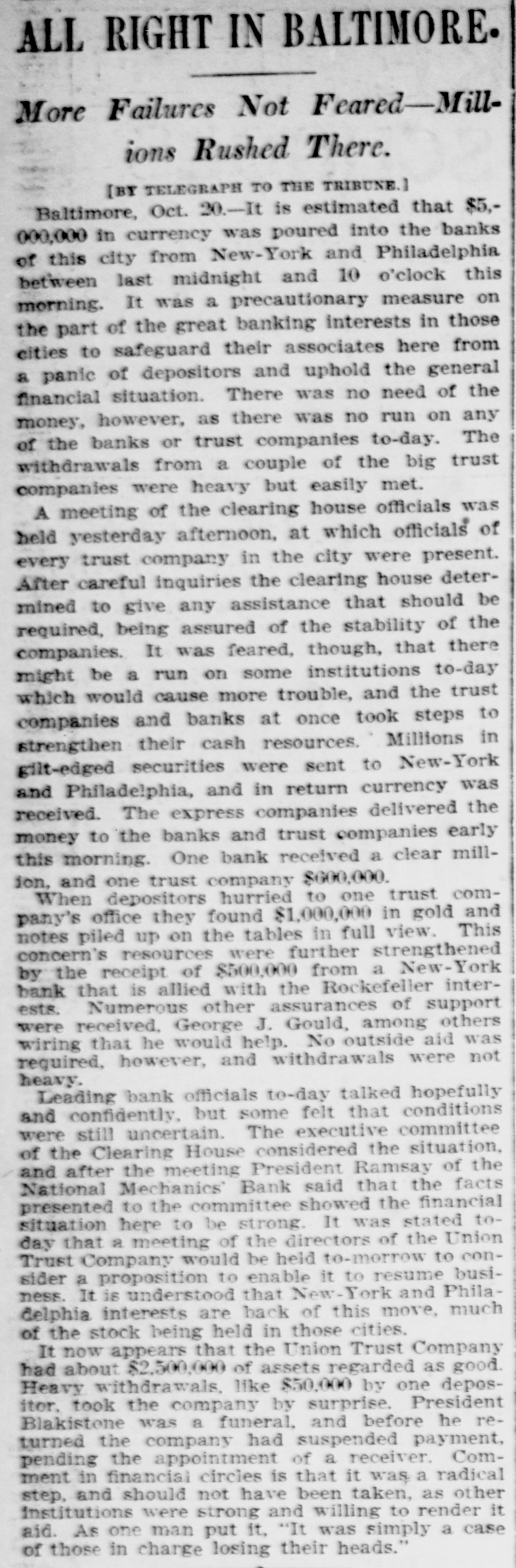
ALL RIGHT IN BALTIMORE. More Failures Not Feared-Millions Rushed There. [BY TELEGRAPH TO THE TRIBUNE.] Baltimore, Oct. 20.-It is estimated that $5,000,000 in currency was poured into the banks of this city from New-York and Philadelphia between last midnight and 10 o'clock this morning. It was a precautionary measure on the part of the great banking interests in those cities to safeguard their associates here from a panic of depositors and uphold the general financial situation. There was no need of the money, however, as there was no run on any of the banks or trust companies to-day. The withdrawals from a couple of the big trust companies were heavy but easily met. A meeting of the clearing house officials was held yesterday afternoon, at which officials of every trust company in the city were present. After careful inquiries the clearing house determined to give any assistance that should be required, being assured of the stability of the companies. It was feared, though, that there might be a run on some institutions to-day which would cause more trouble, and the trust companies and banks at once took steps to strengthen their cash resources. Millions in gilt-edged securities were sent to New-York and Philadelphia, and in return currency was received. The express companies delivered the money to the banks and trust companies early this morning. One bank received a clear million, and one trust company $600,000. When depositors hurried to one trust company's office they found $1,000,000 in gold and notes piled up on the tables in full view. This concern's resources were further strengthened by the receipt of $500,000 from a New-York bank that is allied with the Rockefeller interests. Numerous other assurances of support were received. George J. Gould, among others wiring that he would help. No outside aid was required, however, and withdrawals were not heavy. Leading bank officials to-day talked hopefully and confidently, but some felt that conditions were still uncertain. The executive committee of the Clearing House considered the situation. and after the meeting President Ramsay of the National Mechanics' Bank said that the facts presented to the committee showed the financial situation here to be strong. It was stated today that a meeting of the directors of the Union Trust Company would be held to-morrow to consider a proposition to enable it to resume business. It is understood that New-York and Philadelphia interests are back of this move, much of the stock being held in those cities. It now appears that the Union Trust Company had about $2,500,000 of assets regarded as good. Heavy withdrawals. like $50,000 by one depositor, took the company by surprise. President Blakistone was a funeral. and before he returned the company had suspended payment, pending the appointment of a receiver. Comment in financial circles is that it was a radical step, and should not have been taken, as other Institutions were strong and willing to render it aid. As one man put it, "It was simply a case of those in charge losing their heads."


Article from The Washington Times, October 21, 1903

Click image to open full size in new tab

Article Text

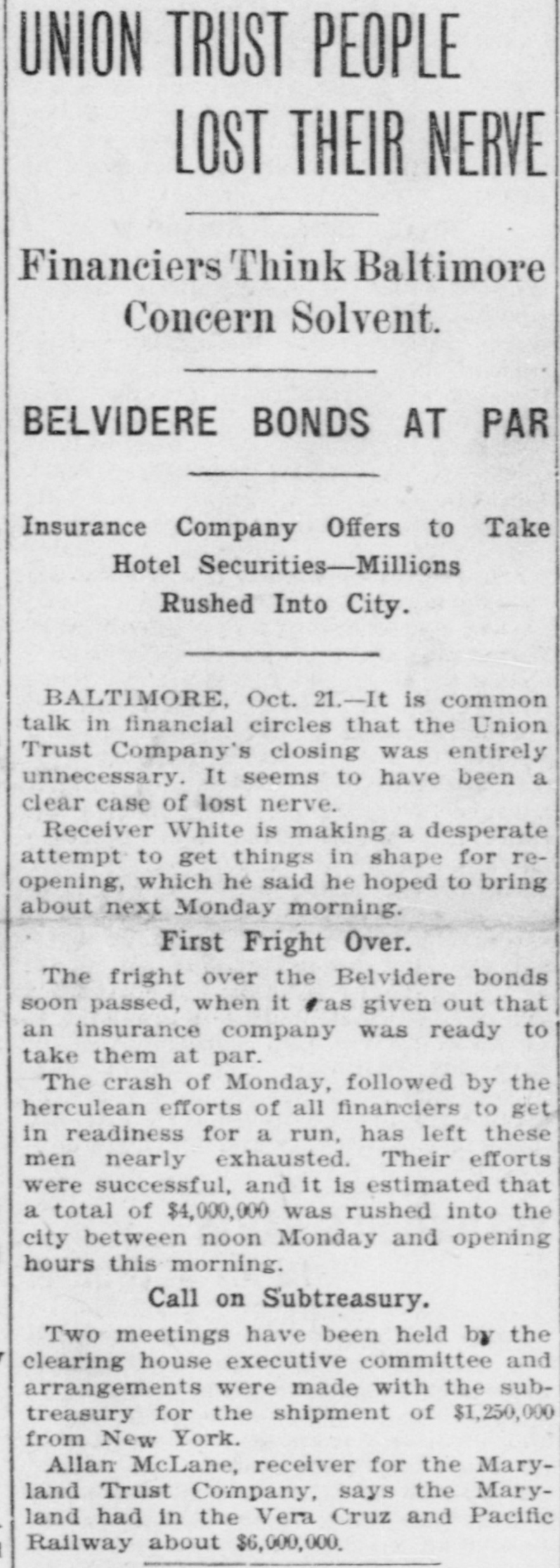
UNION TRUST PEOPLE LOST THEIR NERVE Financiers Think Baltimore Concern Solvent. BELVIDERE BONDS AT PAR Insurance Company Offers to Take Hotel Securities-Millions Rushed Into City. BALTIMORE, Oct. 21.-It is common talk in financial circles that the Union Trust Company's closing was entirely unnecessary. It seems to have been a clear case of lost nerve. Receiver White is making a desperate attempt to get things in shape for reopening, which hé said he hoped to bring about next Monday morning. First Fright Over. The fright over the Belvidere bonds soon passed, when it as given out that an insurance company was ready to take them at par. The crash of Monday, followed by the herculean efforts of all financiers to get in readiness for a run, has left these men nearly exhausted. Their efforts were successful, and it is estimated that a total of $4,000,000 was rushed into the city between noon Monday and opening hours this morning. Call on Subtreasury. Two meetings have been held by the clearing house executive committee and arrangements were made with the subtreasury for the shipment of $1,250,000 from New York. Allan McLane, receiver for the Maryland Trust Company, says the Maryland had in the Vera Cruz and Pacific Railway about $6,000,000.


Article from The Barre Daily Times, October 21, 1903

Click image to open full size in new tab

Article Text

BAD FINANCIAL FAILURES Two Big Institutions In Baltimore Close Their Doors. ONE HIT BY MEXICAN LOAN Failure of Maryland Trust Company Starts a Run on the Union Trust Company, Which Is Soon Foreed to Suspend. Baltimore, Oct. 20.-The Maryland Trust company and the Union Trust company, two of the largest Institutions of the kind in the state, have closed their doors. The failure of the Maryland Trust company, which was the first to be announced, was a great surprise to the general public, though in financial circles it had been known for several days that the company was embarrassed and that its continuance in business would be dependent on the outcome of efforts that were under way to borrow money in London to tide over pressing difficulties. Last week the Maryland company had almost completed arrangements for a loan of $2,000,000 in London, but on Saturday afternoon, according to the admissions of company officials here, the prospective lenders abruptly with drew from further negetiations. It was this failure to realize available funds which precipitated the suspension of the institution. Wreeked by Mexican Loans. There are many reports rife as to the causes which brought about the failure but, according to a preliminary state ment made by the company officials and by Receiver Allan McLane, the suspension is solely due to large loans advanced to the Vera Cruz and Pacific railroad. It is said that these loans aggregate an excess of $6,000,000. Mr. McLane gave bond for $2,000,000. The receiver was appointed on appli cation of John S. Gitting & Co., bank ers, of this city. Receiver McLane is now engaged in the preparation of a detailed statement setting forth all the material facts ex planatory of the failure. The Maryland Trust company is the second largest trust company in Baltimore. The capital stock is $2,125,000 the surplus and undivided profits $3, 161,150, deposits $5,313,540 and loans at discount $6,299,610. The Union Trust company closed its doors at 1:15 p. m. Miles White, Jr. has been appointed receiver. He gave bonds for $1,000,000. The Union Trust company, according to a recent state ment, had a paid up capital of $1,000, 000, a surplus of $250,000 and undivid ed profits of $159,000. Miles White, Jr., who is one or the vice presidents of the Union Trust company and who has been appointed receiver, states that the closing of the doors of that company was due to 8 run upon it by depositors in conse quence of the announcement of the failure of the Maryland Trust com pany. It is stated that there are no business connections whatever be tween the two suspended companies.


Article from Evening Journal, October 21, 1903

Click image to open full size in new tab

Article Text

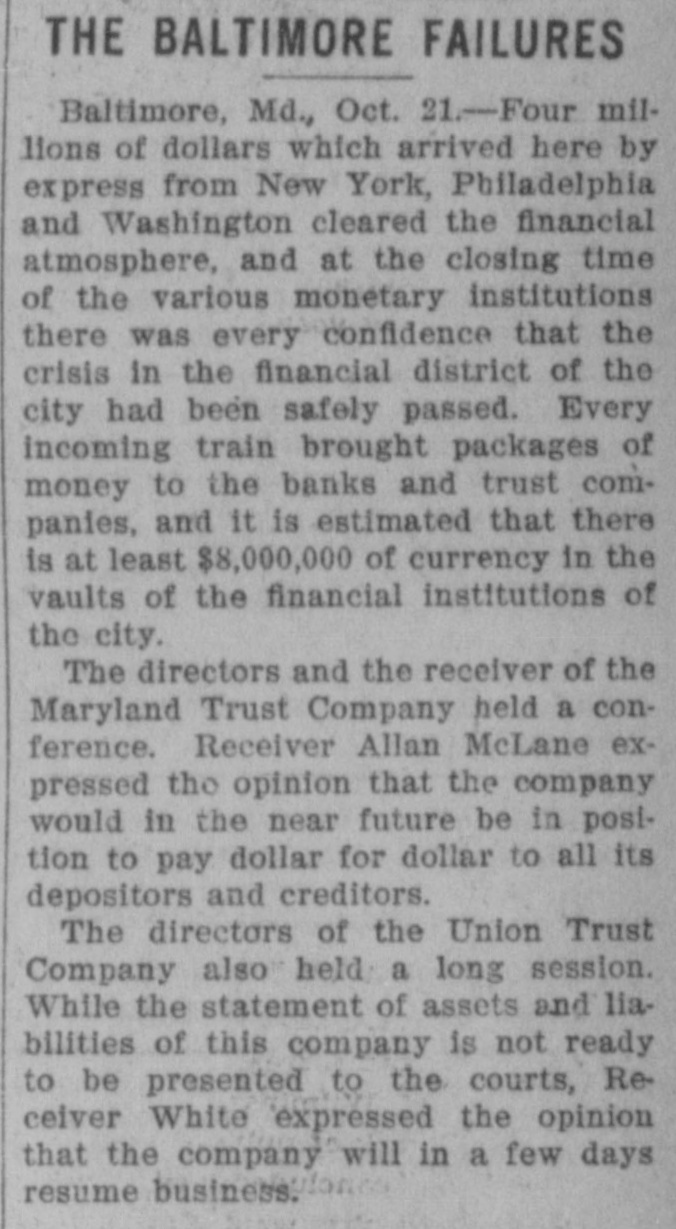
THE BALTIMORE FAILURES Baltimore, Md., Oct. 21.-Four millions of dollars which arrived here by express from New York, Philadelphia and Washington cleared the financial atmosphere, and at the closing time of the various monetary institutions there was every confidence that the crisis in the financial district of the city had been safely passed. Every incoming train brought packages of money to the banks and trust companies, and it is estimated that there is at least $8,000,000 of currency in the vaults of the financial institutions of the city. The directors and the receiver of the Maryland Trust Company held a conference. Receiver Allan McLane expressed the opinion that the company would in the near future be in position to pay dollar for dollar to all its depositors and creditors. The directors of the Union Trust Company also held a long session. While the statement of assets and liabilities of this company is not ready to be presented to the courts, Receiver White expressed the opinion that the company will in a few days resume business.


Article from The Indianapolis Journal, October 21, 1903

Click image to open full size in new tab

Article Text

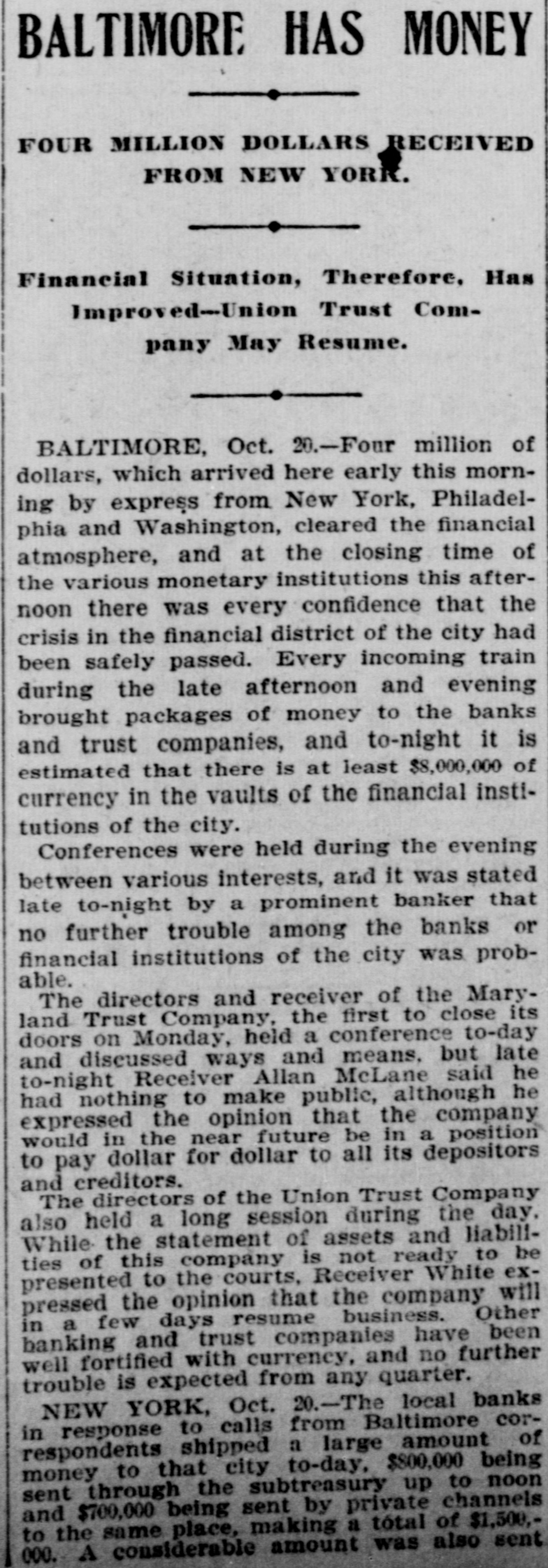
BALTIMORE HAS MONEY FOUR MILLION DOLLARS RECEIVED FROM NEW YORK. Financial Situation, Therefore, Has Improved-Union Trust Company May Resume. BALTIMORE, Oct. 20.-Four million of dollars, which arrived here early this morning by express from New York, Philadelphia and Washington, cleared the financial atmosphere, and at the closing time of the various monetary institutions this afternoon there was every confidence that the crisis in the financial district of the city had been safely passed. Every incoming train during the late afternoon and evening brought packages of money to the banks and trust companies, and to-night it is estimated that there is at least $8,000,000 of currency in the vaults of the financial institutions of the city. Conferences were held during the evening between various interests, and it was stated late to-night by a prominent banker that no further trouble among the banks or financial institutions of the city was probable. The directors and receiver of the Maryland Trust Company, the first to close its doors on Monday, held a conference to-day and discussed ways and means, but late to-night Receiver Allan McLane said he had nothing to make public, although he expressed the opinion that the company would in the near future be in a position to pay dollar for dollar to all its depositors and creditors. The directors of the Union Trust Company also held a long session during the day. While the statement of assets and liabilities of this company is not ready to be presented to the courts, Receiver White expressed the opinion that the company will in a few days resume business. Other banking and trust companies have been well fortified with currency, and no further trouble is expected from any quarter. NEW YORK, Oct. 20.-The local banks in response to calls from Baltimore correspondents shipped a large amount of money to that city to-day, $800,000 being sent through the subtreasury up to noon and $700,000 being sent by private channels to the same place, making a tótal of $1,500,000. A considerable amount was also sent


Article from The Bamberg Herald, October 22, 1903

Click image to open full size in new tab

Article Text

TWO BIG FAILURES Shock People of Baltimore. Trust Companies Collapse. MILLIONS ARE INVOLVED Concerns Forced to the Wall are the Maryland Trust Company and the Union Trust Company, Both Immense Corporations. Monday was a day of marked excitement and subditied soxiety in. the financial and business circles of Ealtimore, a day full of momentous events and of wild, irresponsible damaging rumors in those streets and marts given over to monetary transactions. The day began with the announce ment of the failure of the Maryland Trust Company, and, except to only an initiated few, the news came like a bolt out of a clear sky, spreading consternation in all directions. To these few it was known that the Maryland Trust Company had long be struggling with undigested securities, of that it sustained heavy withdrawals deposits, and that, finally, on Saturday effort last, it had failed in its supreme by to bridge over the yawning chasm Los negotiating a $2,000,000 loan in don. While the bankers in their offices and brokers in clusters on the street corners, and money dealers generally and businss men in the exchange, colwere still excitedly discussing the there lapse of the Maryland company came another bolt out of a transparent sky, the suspension of the Union later Trust Company, and it was this hour event, which happened at a late in the day, that gave impetus to a va- to ried number of baseless rumors which as other financial institutions had might well have created a panic in they been given currency earlier the day. Receivers Appointed. Allen McLane, third vice president was of the Maryland Trust Company, appointed to take charge of the affairs Jr., of that company. Miles White, first vice president of the Union Trust of Company, was appointed receiver bond that company Mr. McLane gave Mr. the sum of $2,000,000. and in White gave bond in the sum of $1,000, 000. The last statement of the Maryland 30, Trust Company, issued on June 1903, showed capital stock of $1,125, 000, surplus $2,437,500 and undivided profits of $67,998.86. The company has demand time deposits amount ing to $5,773,817.15. at The Union Trust Company, the close of business on March 21, 1903, of had a capital of $1,000,000, surplus $250,000 and undivided profits of $159, has 687.55. The Union Trust Company deposits amounting to nearly $2,000. 000. The filing of the first applications for receivers for the embarrassed companies was followed by petitions for co-receivers for both companies. The total liabilities of the two companies exceed $10,000,000. The cause of the Maryland Trust inCompany's failure was due to the vestment of the assets of the company which Mexican railway securities, in could not be marketed. The Union a Trust Company failed because about of run on its banking department, by $150,000 having been withdrawn of depositors; but the real troubles company had their origin in West- the organization the of the South and a railway in Virginia, in which capitalization ern of about $11,000,000 was contemplated. The Union company was the fiscal agent for the Virginia comenterprise, just as the Maryland Mexpany was the fiscal agent for the ican railway. Though these two failures followed closely, it can be stated on unquestioned so authority that there was no two. coanection whatever between the the The Maryland Trust Company and Union Trust Company were not jointly that interested in any enterprise, so the suspension of one had no direct bearing upon the other.


Article from The Citizen-Republican, October 22, 1903

Click image to open full size in new tab

Article Text

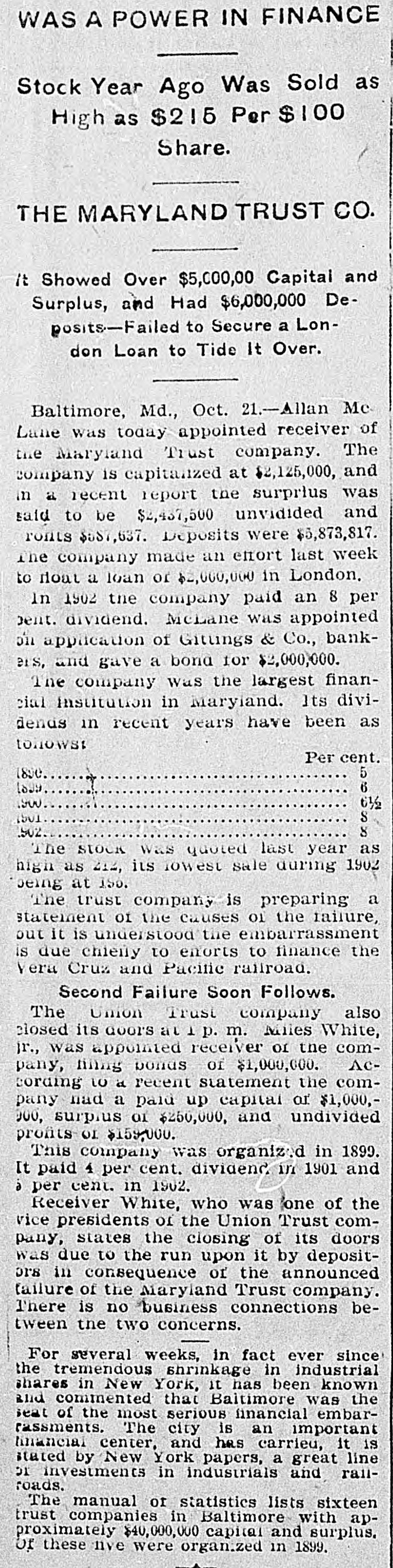
WAS A POWER IN FINANCE Stock Year Ago Was Sold as High as $215 Per $100 Share. THE MARYLAND TRUST CO. it Showed Over $5,000,00 Capital and Surplus, and Had $6,000,000 Deposits-Failed to Secure a London Loan to Tide It Over. Baltimore, Md., Oct. 21.-Allan Mc Lane was today appointed receiver of the Maryland Trust company. The company is capitalized at $2,125,000, and in a recent report the surprius was said to be $2,437,500 unvidided and ronts $587,637. Deposits were $5,873,817. The company made an effort last week to doat a loan or $2,000,000 in London. In 1902 the company paid an 8 per bent. dividend. McLane was appointed on application of Gittings & Co., bankBIS, and gave a bond for $2,000,000. The company was the largest financial institution in Maryland. Its dividends in recent years have been as tonows: Per cent. 5 1890 6 1899 .900 6½ S Ibvi 8 502 The STOCK was quoted last year as high as 412, its lowest sale during 1902 being at 190. The trust company is preparing a statement of the causes 01 the failure, out it is understood the embarrassment is due chiefly to enorts to finance the Vera Cruz and Pacific railroad. Second Failure Soon Follows. The Union Trust company also closed its doors at 1 p. m. Miles White, jr., was appointed receiver or the company, mmg Donds or $1,000,000. According to a recent statement the company nad a Dalu up capital or $1,000,900, surplus or $250,000, and undivided profits or $159,000. This company was organized in 1899. It paid 4 per cent. dividend in 1901 and à per cent. in 1902. Receiver White, who was one of the vice presidents of the Union Trust company, states the closing of its doors was due to the run upon it by depositDIS in consequence or the announced failure of the Maryland Trust company. There is no business connections between the two concerns. For several weeks, in fact ever since the tremendous shrinkage in industrial shares in New York, It has been known and commented that Baitimore was the seat of the most serious financial embarrassments. The city is an important financial center, and has carried, it is stated by New York papers, a great line DI investments in industrials and railroads. The manual of statistics lists sixteen trust companies in Baltimore with approximately $40,000,000 capital and surplus. Of these five were organized in 1899.


Article from The News & Observer, October 22, 1903

Click image to open full size in new tab

Article Text

INASHOWER OF GOLD. Four Million Dollars Received at Paltimore Clears the Financial Atmosphere. (By the Associated Press.) Baltimore, Oct. 20.-Four millions of dollars which arrived here early this morning by express from New York, Philadelphia and Washington cleared the financial atmosphere, and at the closing time of the various monetary institutions this afternoon there was every confidence that the crisis in the financial district of the city had been safely passed. Everv incoming train during the afternoon and evening brought packages of money to the banks and trust companies and tonight it is estimated that there is at least $8,000,000 of currency in the vaults of the financial institutions of the city. Conferences were held during the evening between various interests, and it was stated late tonight by a prominent banker that no further trouble among the banks or financial institutions was probable. The directors and the receiver of the Maryland Trust Company, the first to close its doors on Monday, held a conference today and discussed ways and means, but late tonight Receiver Allan McLane said he had nothing to make public though he expressed the opinion that the company would in the near future be in position to pay dollar for dollar to depositors and creditors. The directors of the Union Trust Company also held a long session during the dáy. While the statement of assets and liabilities of this company is not ready to be presented to the courts, Receiver White expressed the opinion that the company will in a few days resume business. Other banking and trust companies have been well fortified with currency, and no further trouble is expected from any quarter.


Article from The Free Lance, October 22, 1903

Click image to open full size in new tab

Article Text

TWO BIG FAILURES Maryland Trust Co. and Union Trust Co., of Baltimore, Go Under. LIABILITIES ARE OVER $10,000,000 Failures Caused Intense Excitement In Financial and Buisness Circles. Receivers Have Been Named For Both Concerns. Baltimore, Oct. 20.-The suspension of the Maryland Trust Company created intense excitement in financial and business circles, and many people hurried to the vicinity to verify the news. The excitement was greatly intensified two hours afterwards by the announcement that the Union Trust Company had also failed. Bankers and financlers generally, however, combined to allay what ever of panicky feeling was made manifest and by assurances that the troubles of the companies were only temporary. Allan McLane, third vice president of the Maryland Trust Company. was appointed receiver of the concern. giving a bond of $2,000,000, and Miles White Jr., vice president of the Union Trust Company. was appointed receiver of that corporation, his bond being placed at $1,000,000. Receiver McLane promptly issued a general statement to the effect that the embarrassment of the Maryland Company was due to the heavy loans made to the Vera Cruz and Pacific Railroad Company, aggregating $6,000,000. The Maryland Trust Company was fiscal agent of the railroad. It is officially announced that the company's local investments had noth ing to do with its embarrassment. The trust company arranged a loan of $2.000,000 in London on last week for the purpose of supplying the Vera Cruz and Pacific Railroad Company with needed cash in connection with construction. but before the money was turned over to the fiscal agent the negotiations were broken off and this precipitated the suspension. The suspension of the Union Trust Company was owing to a run made upon it by depositors in consequence of the announced failure of the Maryland company. So far as known, there is no financial or business connection between the two suspended companies. The last statement of the Maryland Trust Company, issued on June 30 1903, showed capital stock of $2,125.000, surplus $2,4277,5000 and undivided profits of $677,998.86 The company has demand and time deposits amounting to $5,773,817.15 The Union Trust Company at the elose of business on March 31. 1903, had capital stock of $1,000,000, surplus of $125,000 and undivided profits of $159,687.55. The Union Trust Company has deposits amounting to nearly two millions. The filing of the first applications for receivers for the embarrassed companies was followed by petitions for co-receivers for both companies. The total liabilities of the two companies exceed $10,000. The cause of the Maryland Trust Conpany's failure was due, as is set fortn in the statement of Receiver MeLane, to the investment of the assets of the company in Mexican railwy securities which could not be marketed. The Union Trust Company failed because of a run on its banking department, about $150,000 having been withdrawn by depositors, but the real troubles of the company had their origin in the organization of the South and Western Railway in Virginia, in which a capitalization of about $11,000,000 was contemplated, The Union Company was the fiscal agent for the Virginia enterprise, just as the Maryland Company was the fiscal agent for the


Article from The Coalville Times, October 23, 1903

Click image to open full size in new tab

Article Text

TWO BALTIMORE BANKS sus. PEND BUSINESS. Liabilities of the Two Will Reach in the Neighborhood of $11,000,000. Monday was a day of marked excitement and subdued anxiety in the financial and business circles of Baltimore, Md. Luckily a dozen reports well calculated to provoke a wholesale run on banks did not reach the great army of depositors throughout the city, thus giving ample time for conservative leaders of business to allay popular aprehension before it reached dangerous proportions. The day began with the announcement of the failure of the Maryland Trust company, and except to a few the news came as a bolt out of a clear sky, spreading consternation in all directions. To these few it was known that the trust company had long been struggling with "undigested securities," that it had sustained heavy withdrawals of deposits, and that, finally, on Saturday last. It had failed In its efforts to negotiate a $2,000,000 loan in London. The suspension of the Union Trust company, which happened at a late hour in the day, gave impetus to reany baseless rumors as to other financial Institutions, which might well have created a panic had they been given currency early in the day. The total liabilities of the two companies ceed $10,000,000. The cause of the Maryland Trust company's failure was due, as set forth in the statement of Receiver McLane, to the Investment of the assets of the company in Mexican railway securities which could not be marketed. The Union Trust company failed because of a run on its banking department, about $150,000 having been withdrawn by depositors today, but the real troubles of the company had their origin in the organization of the Southwestern railway in Virginia, in which a capitalization of about $11,000,000 was contemplated.


Article from The Wisconsin Tobacco Reporter, October 23, 1903

Click image to open full size in new tab

Article Text

Depends on the Baltimore People. Or as another leading banker, perhaps the most prominent in Baltimore, put it: "It all depends upon how the people of Baltimore act. If they do not lose their heads the trouble will blow over in time and nobody will be hurt; but if they become panic-stricken the consequences will be serious. This is a time to use calm judgment." TOTAL LIABILITIES $10,000,000 Concerns in No Way Connected-No Widows Nor Orphans Involved. The plain facts in the day's history are as follows: Two trust companies closed their doors. The Maryland Trust company was the first to announce its suspension. This was followed a few hours later by the closing of the doors of the Union Trust company. Allan McLane, third vice president of the Maryland Trust company, was appointed to take charge of the affairs of that company. Miles White, Jr., first vice president of the Union Trust company, was appointed receiver of that institution. McLane gave bond in the sum of $2,000,000, and White gave bond in the sum of $1,000,000. The total liabilities of the two companies exceed $10,000,000. The Maryland Trust company's failure was due, as is set forth in the statement of Receiver McLane, to the investment of the assets of the company in Mexican railway securities, which could not be marketed. The Union Trust company failed because of a run on its banking department, about $150,000 having been withdrawn by depositors; but the real troubles of the company had their origin in the organization of the South and Western railway in Virginia, in which a capitalization of about $11,000,000 was contemplated. The Union company was the fiscal agent for the Virginia enterprise just as the Maryland company was the fiscal agent for the Mexican railway. Though these two failures followed SO closely it can be stated on unquestioned authority that there was no connection whatever between the two. The Maryland Trust company and the Union Trust company were not jointly interested in any enterprise, SO that the suspension of one had no direct bearing upon the other. It may also be stated that neither company managed trust estates. This is the business in which the trustees take charge of properties and manage them in the interest of widows, orphans and other heirs.


Article from The Montgomery Advertiser, December 22, 1903

Click image to open full size in new tab

Article Text

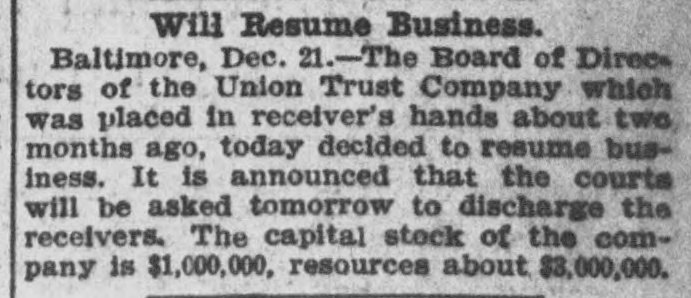
Will Resume Business. Baltimore, Dec. 21.-The Board of Direct tors of the Union Trust Company which was placed in receiver's hands about two months ago, today decided to resume business. It is announced that the courts will be asked tomorrow to discharge the receivers. The capital stock of the company is $1,000,000, resources about $3,000,000.


Article from Evening Times-Republican, December 23, 1903

Click image to open full size in new tab

Article Text

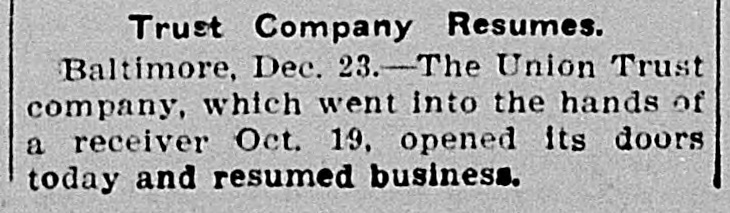
Trust Company Resumes. Baltimore, Dec. 23.-The Union Trust company, which went into the hands of a receiver Oct. 19, opened its doors today and resumed business.