Elgin State Bank (Elgin, KS)

Episode Information

Episode UID
83081971480
Episode Type
Suspension → Closure
Bank Type
state
Bank ID
8308197 routing
Routing Number
83-0819
Start Date
April 25, 1923
Location
Elgin, Kansas (37.004, -96.277)

Metadata

Model
gpt-5-mini (chosen from majority vote of a three-model LLM ensemble)
Short Digest
1635f35c3a4e9748

Response Measures

None

Description

Closure followed an admitted $40,000 defalcation by the cashier; state banking department took charge.

Events (1)

1. April 25, 1923 Suspension
Cause
Bank Specific Adverse Info
Cause Details
Admitted defalcation/embezzlement of approximately $40,000 by cashier J. R. Burns, prompting state closure
Newspaper Excerpt
taken over by the state banking department Wednesday
Source
newspapers

Newspaper Articles (7)

Article from The Emporia Gazette, April 26, 1923

Click image to open full size in new tab

Article Text

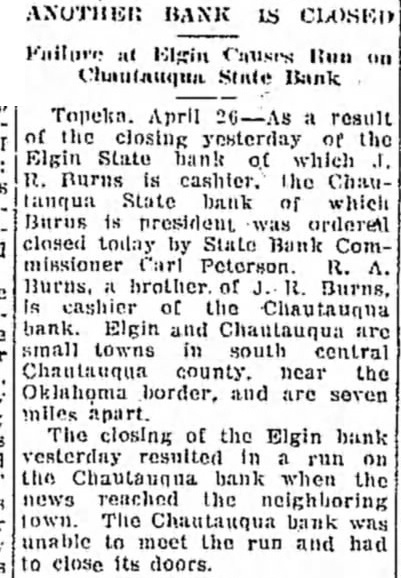
ANOTHER BANK IS CLOSED Failure at Elgin Causes Run on Chautauqua State Bank Topeka, April 26—As a result of the closing yesterday of the Elgin State bank of which J. R. Burns is cashier, the Chautauqua State bank of which Burns is president was ordered closed today by State Bank Commissioner Carl Peterson. R. A. Burns, a brother of J. R. Burns, is cashier of the Chautauqua bank. Elgin and Chautauqua are small towns in south central Chautauqua county, near the Oklahoma border, and are seven miles apart. The closing of the Elgin bank yesterday resulted in a run on the Chautauqua bank when the news reached the neighboring town. The Chautauqua bank was unable to meet the run and had to close its doors.


Article from The Kansas City Post, April 26, 1923

Click image to open full size in new tab

Article Text

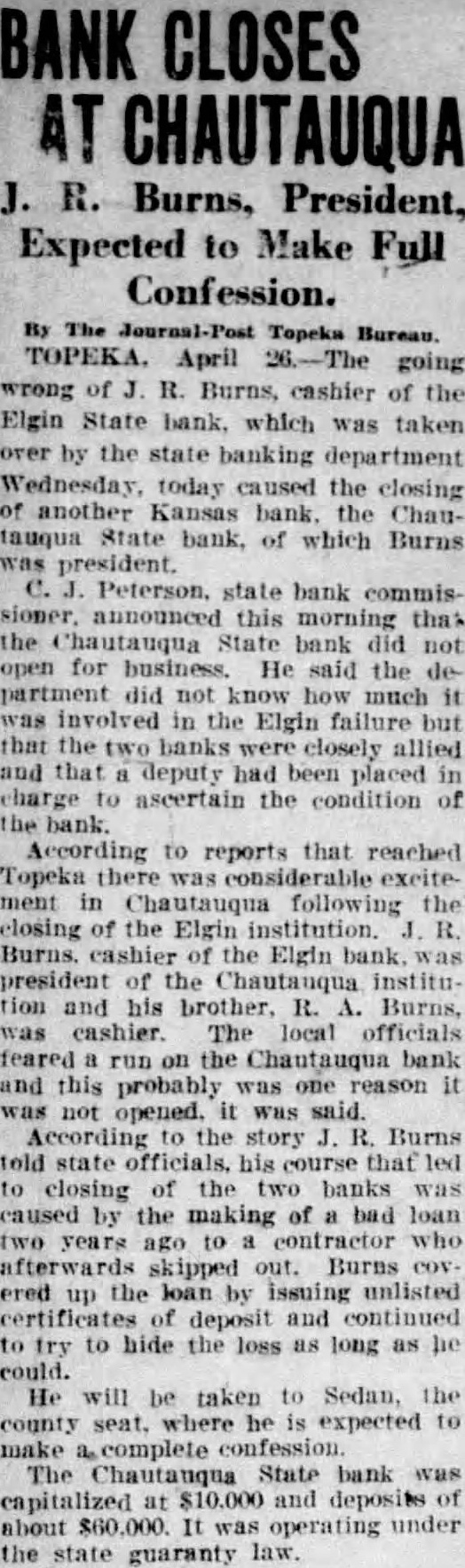
BANK CLOSES AT CHAUTAUQUA J. R. Burns, President, Expected to Make Full Confession. By The Journal-Post Topeka Bureau. TOPEKA, April 26.—The going wrong of J. R. Burns, cashier of the Elgin State bank, which was taken over by the state banking department Wednesday, today caused the closing of another Kansas bank, the Chautauqua State bank, of which Burns was president. C. J. Peterson, state bank commissioner, announced this morning that the Chautauqua State bank did not open for business. He said the department did not know how much it was involved in the Elgin failure but that the two banks were closely allied and that a deputy had been placed in charge to ascertain the condition of the bank. According to reports that reached Topeka there was considerable excitement in Chautauqua following the closing of the Elgin institution. J. R. Burns, cashier of the Elgin bank, was president of the Chautauqua institution and his brother, R. A. Burns, was cashier. The local officials feared a run on the Chautauqua bank and this probably was one reason it was not opened, it was said. According to the story J. R. Burns told state officials, his course that led to closing of the two banks was caused by the making of a bad loan two years ago to a contractor who afterwards skipped out. Burns covered up the loan by issuing unlisted certificates of deposit and continued to try to hide the loss as long as he could. He will be taken to Sedan, the county seat, where he is expected to make a complete confession. The Chautauqua State bank was capitalized at $10,000 and deposits of about $60,000. It was operating under the state guaranty law.
Article from Concordia Blade-Empire, April 26, 1923

Click image to open full size in new tab

Article Text

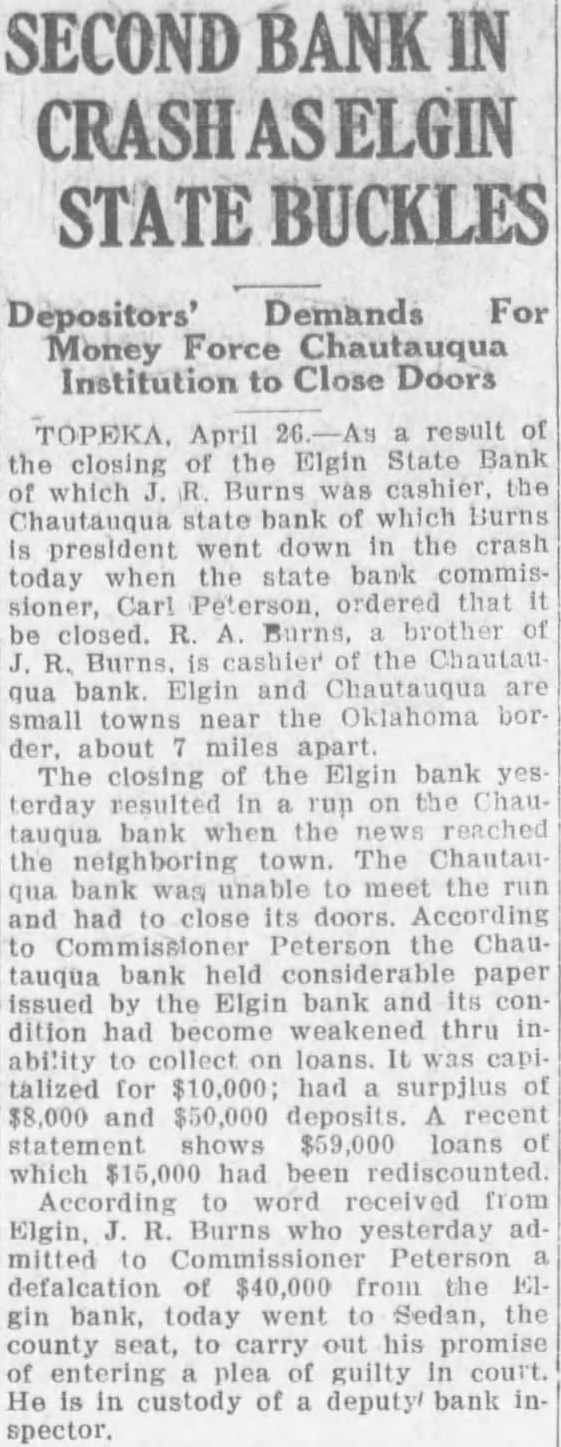
SECOND BANK IN CRASH AS ELGIN STATE BUCKLES Depositors' Demands For Money Force Chautauqua Institution to Close Doors TOPEKA, April 26.—As a result of the closing of the Elgin State Bank of which J. R. Burns was cashier, the Chautauqua state bank of which Burns is president went down in the crash today when the state bank commissioner, Carl Peterson, ordered that it be closed. R. A. Burns, a brother of J. R. Burns, is cashier of the Chautauqua bank. Elgin and Chautauqua are small towns near the Oklahoma border, about 7 miles apart. The closing of the Elgin bank yesterday resulted in a run on the Chautauqua bank when the news reached the neighboring town. The Chautauqua bank was unable to meet the run and had to close its doors. According to Commissioner Peterson the Chautauqua bank held considerable paper issued by the Elgin bank and its condition had become weakened thru inability to collect on loans. It was capitalized for $10,000; had a surplus of $8,000 and $50,000 deposits. A recent statement shows $59,000 loans of which $15,000 had been rediscounted. According to word received from Elgin, J. R. Burns who yesterday admitted to Commissioner Peterson a defalcation of $40,000 from the Elgin bank, today went to Sedan, the county seat, to carry out his promise of entering a plea of guilty in court. He is in custody of a deputy bank inspector.


Article from Winfield Daily Courier, April 26, 1923

Click image to open full size in new tab

Article Text

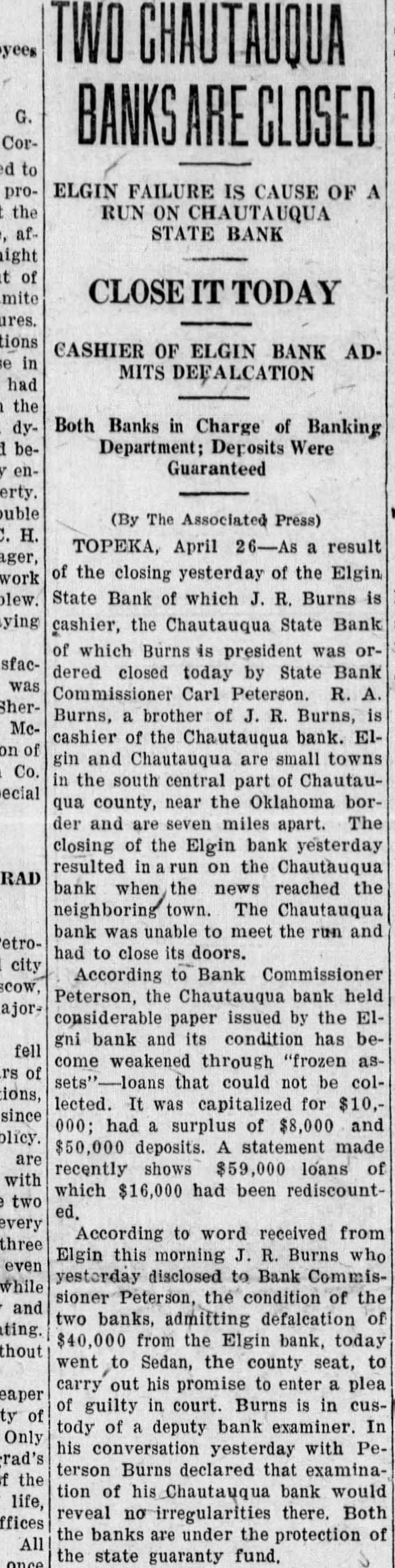
TWO CHAUTAUQUA BANKS ARE CLOSED ELGIN FAILURE IS CAUSE OF A RUN ON CHAUTAUQUA STATE BANK CLOSE IT TODAY CASHIER OF ELGIN BANK ADMITS DEFALCATION Both Banks in Charge of Banking Department; Deposits Were Guaranteed (By The Associated Press) TOPEKA, April 26—As a result of the closing yesterday of the Elgin State Bank of which J. R. Burns is cashier, the Chautauqua State Bank of which Burns is president was ordered closed today by State Bank Commissioner Carl Peterson. R. A. Burns, a brother of J. R. Burns, is cashier of the Chautauqua bank. Elgin and Chautauqua are small towns in the south central part of Chautauqua county, near the Oklahoma border and are seven miles apart. The closing of the Elgin bank yesterday resulted in a run on the Chautauqua bank when the news reached the neighboring town. The Chautauqua bank was unable to meet the run and had to close its doors. According to Bank Commissioner Peterson, the Chautauqua bank held considerable paper issued by the Elgin bank and its condition has become weakened through "frozen assets"—loans that could not be collected. It was capitalized for $10,000; had a surplus of $8,000 and $50,000 deposits. A statement made recently shows $59,000 loans of which $16,000 had been rediscounted. According to word received from Elgin this morning J. R. Burns who yesterday disclosed to Bank Commissioner Peterson, the condition of the two banks, admitting defalcation of $40,000 from the Elgin bank, today went to Sedan, the county seat, to carry out his promise to enter a plea of guilty in court. Burns is in custody of a deputy bank examiner. In his conversation yesterday with Peterson Burns declared that examination of his Chautauqua bank would reveal no irregularities there. Both the banks are under the protection of the state guaranty fund.


Article from Muskogee Times-Democrat, April 26, 1923

Click image to open full size in new tab

Article Text

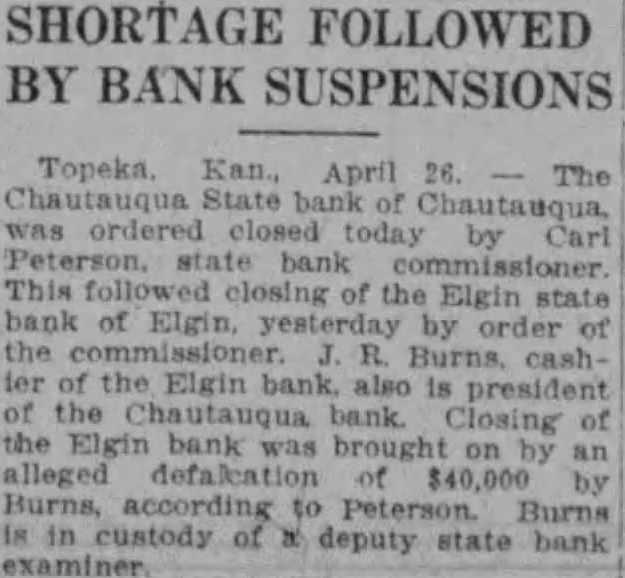
SHORTAGE FOLLOWED BY BANK SUSPENSIONS Topeka, Kan., April 26. — The Chautauqua State bank of Chautauqua, was ordered closed today by Carl Peterson, state bank commissioner. This followed closing of the Elgin state bank of Elgin, yesterday by order of the commissioner. J. R. Burns, cashier of the Elgin bank, also is president of the Chautauqua bank. Closing of the Elgin bank was brought on by an alleged defalcation of $40,000 by Burns, according to Peterson. Burns is in custody of a deputy state bank examiner.


Article from The Evening Kansan-Republican, April 26, 1923

Click image to open full size in new tab

Article Text

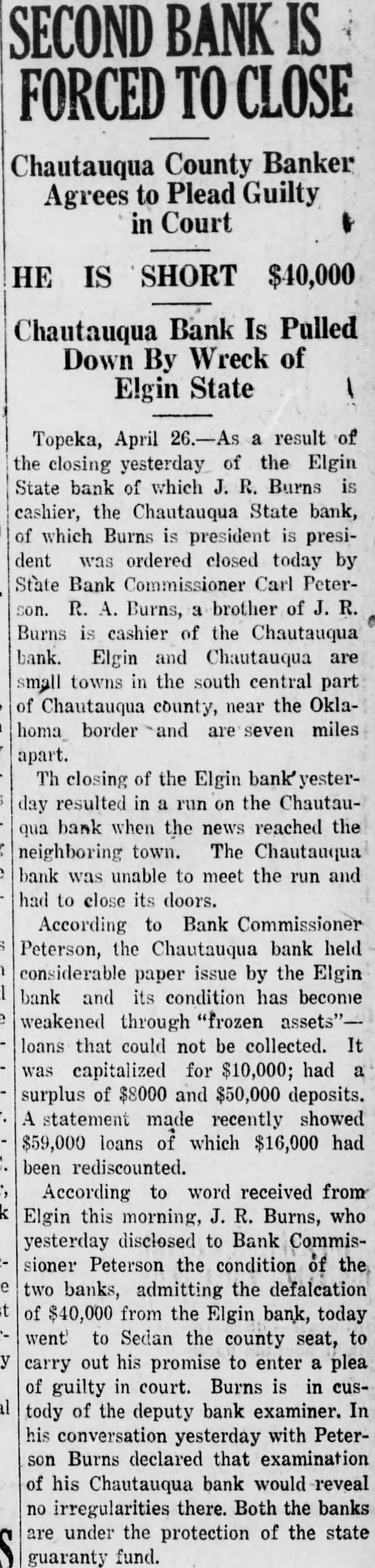
SECOND BANK IS FORCED TO CLOSE Chautauqua County Banker Agrees to Plead Guilty in Court HE IS SHORT $40,000 Chautauqua Bank Is Pulled Down By Wreck of Elgin State Topeka, April 26.—As a result of the closing yesterday of the Elgin State bank of which J. R. Burns is cashier, the Chautauqua State bank, of which Burns is president was ordered closed today by State Bank Commissioner Carl Peterson. R. A. Burns, a brother of J. R. Burns is cashier of the Chautauqua bank. Elgin and Chautauqua are small towns in the south central part of Chautauqua county, near the Oklahoma border and are seven miles apart. The closing of the Elgin bank yesterday resulted in a run on the Chautauqua bank when the news reached the neighboring town. The Chautauqua bank was unable to meet the run and had to close its doors. According to Bank Commissioner Peterson, the Chautauqua bank held considerable paper issue by the Elgin bank and its condition has become weakened through "frozen assets"—loans that could not be collected. It was capitalized for $10,000; had a surplus of $8000 and $50,000 deposits. A statement made recently showed $59,000 loans of which $16,000 had been rediscounted. According to word received from Elgin this morning, J. R. Burns, who yesterday disclosed to Bank Commissioner Peterson the condition of the two banks, admitting the defalcation of $40,000 from the Elgin bank, today went to Sedan the county seat, to carry out his promise to enter a plea of guilty in court. Burns is in custody of the deputy bank examiner. In his conversation yesterday with Peterson Burns declared that examination of his Chautauqua bank would reveal no irregularities there. Both the banks are under the protection of the state guaranty fund.


Article from The Weekly Kansas City Star, May 2, 1923

Click image to open full size in new tab

Article Text

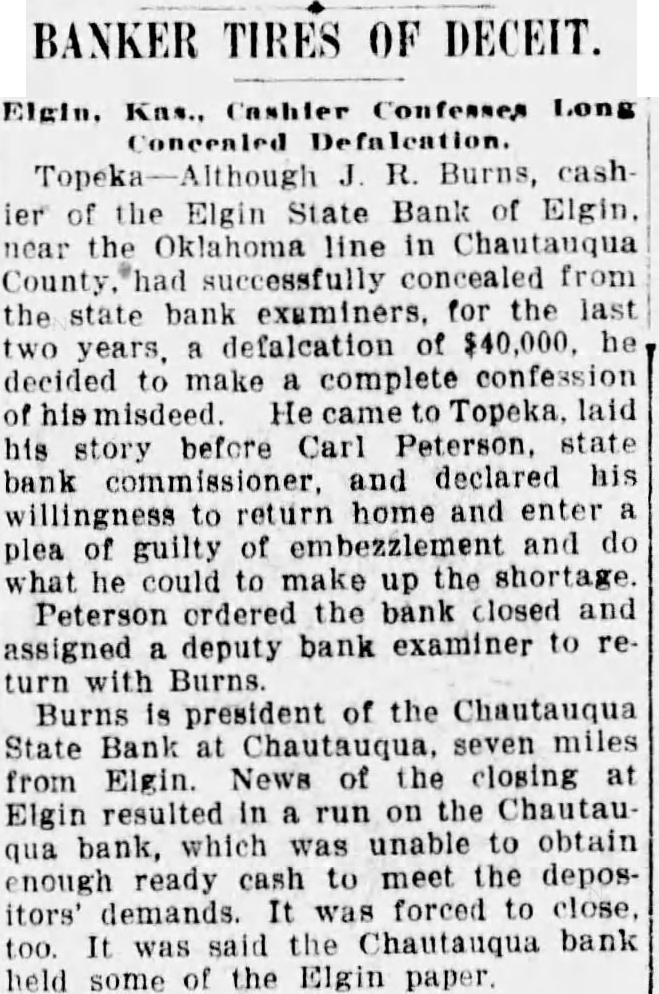
BANKER TIRES OF DECEIT. Elgin, Kas., Cashier Confesses Long Concealed Defalcation. Topeka—Although J. R. Burns, cashier of the Elgin State Bank of Elgin, near the Oklahoma line in Chautauqua County, had successfully concealed from the state bank examiners, for the last two years, a defalcation of $40,000, he decided to make a complete confession of his misdeed. He came to Topeka, laid his story before Carl Peterson, state bank commissioner, and declared his willingness to return home and enter a plea of guilty of embezzlement and do what he could to make up the shortage. Peterson ordered the bank closed and assigned a deputy bank examiner to return with Burns. Burns is president of the Chautauqua State Bank at Chautauqua, seven miles from Elgin. News of the closing at Elgin resulted in a run on the Chautauqua bank, which was unable to obtain enough ready cash to meet the depositors' demands. It was forced to close, too. It was said the Chautauqua bank held some of the Elgin paper.