Citizens Savings & Trust Company (York, PA)

Episode Information

Episode UID
60016071480
Episode Type
Suspension → Run → Reopening
Bank Type
trust
Bank ID
6001607 routing
Routing Number
60-0160
Start Date
April 24, 1923
Location
York, Pennsylvania (39.963, -76.728)

Metadata

Model
gpt-5-mini (chosen from majority vote of a three-model LLM ensemble)
Short Digest
34cd2a834859962e

Response Measures

None

Description

Sources differ on the exact June 1924 reopening date (June 11 vs June 24).

Events (3)

1. April 24, 1923 Suspension
Cause
Government Action
Cause Details
State banking commissioner took possession and closed the City Bank of York after examiners found a large shortage (~$800,000–$1,110,000).
Newspaper Excerpt
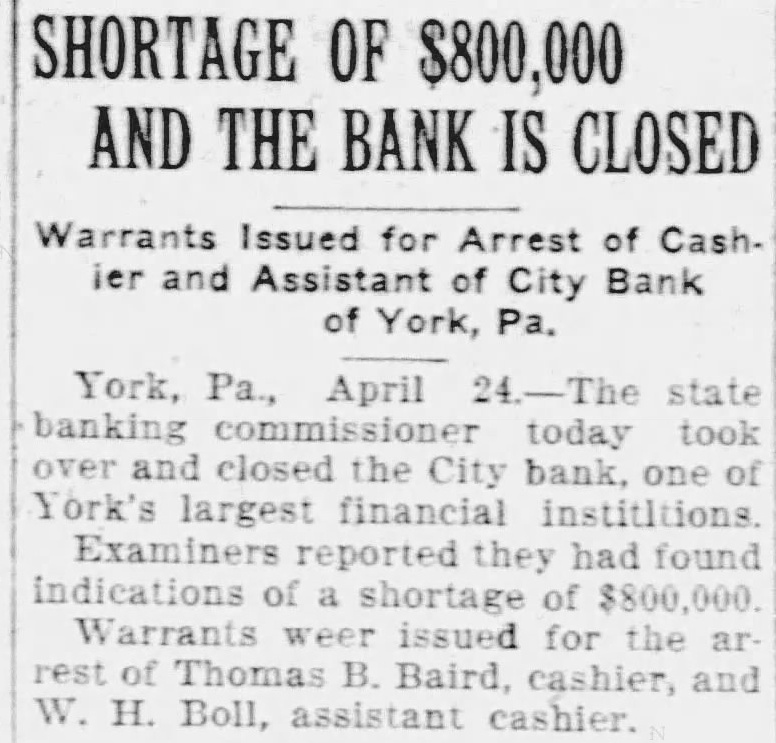
The state banking commissioner today took over and closed the City bank
Source
newspapers
2. June 24, 1924 Reopening
Newspaper Excerpt
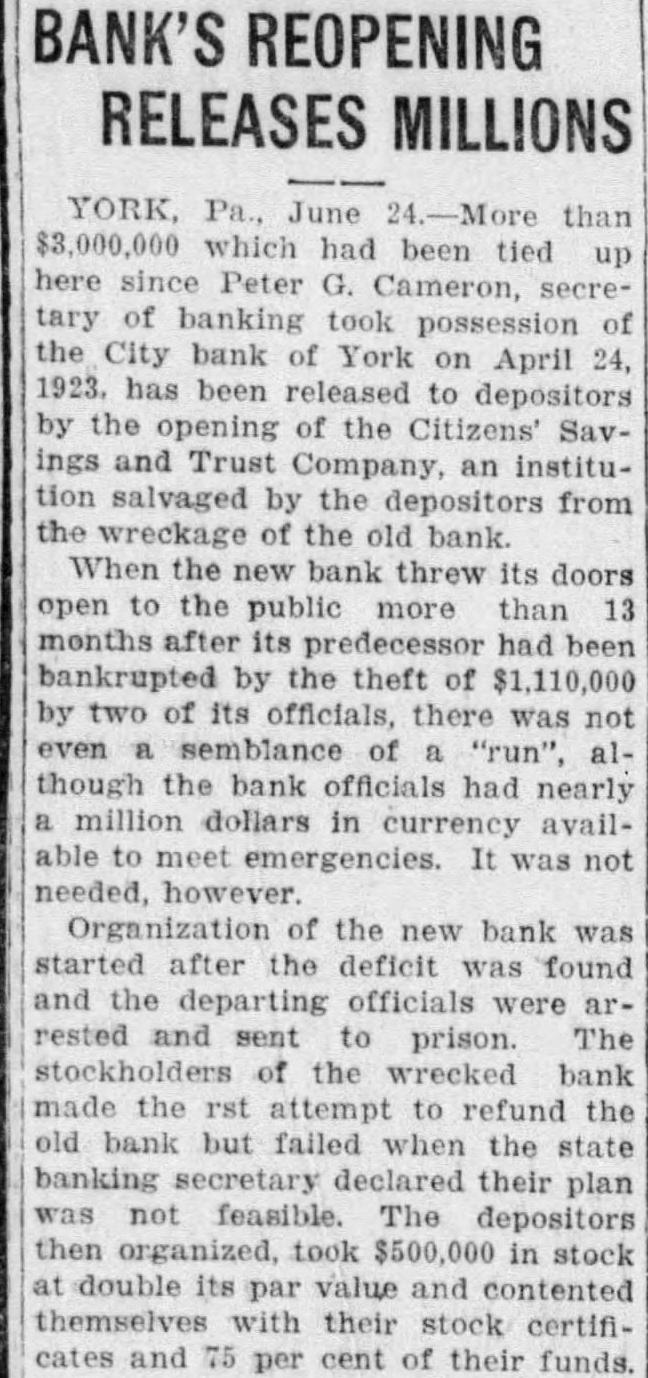
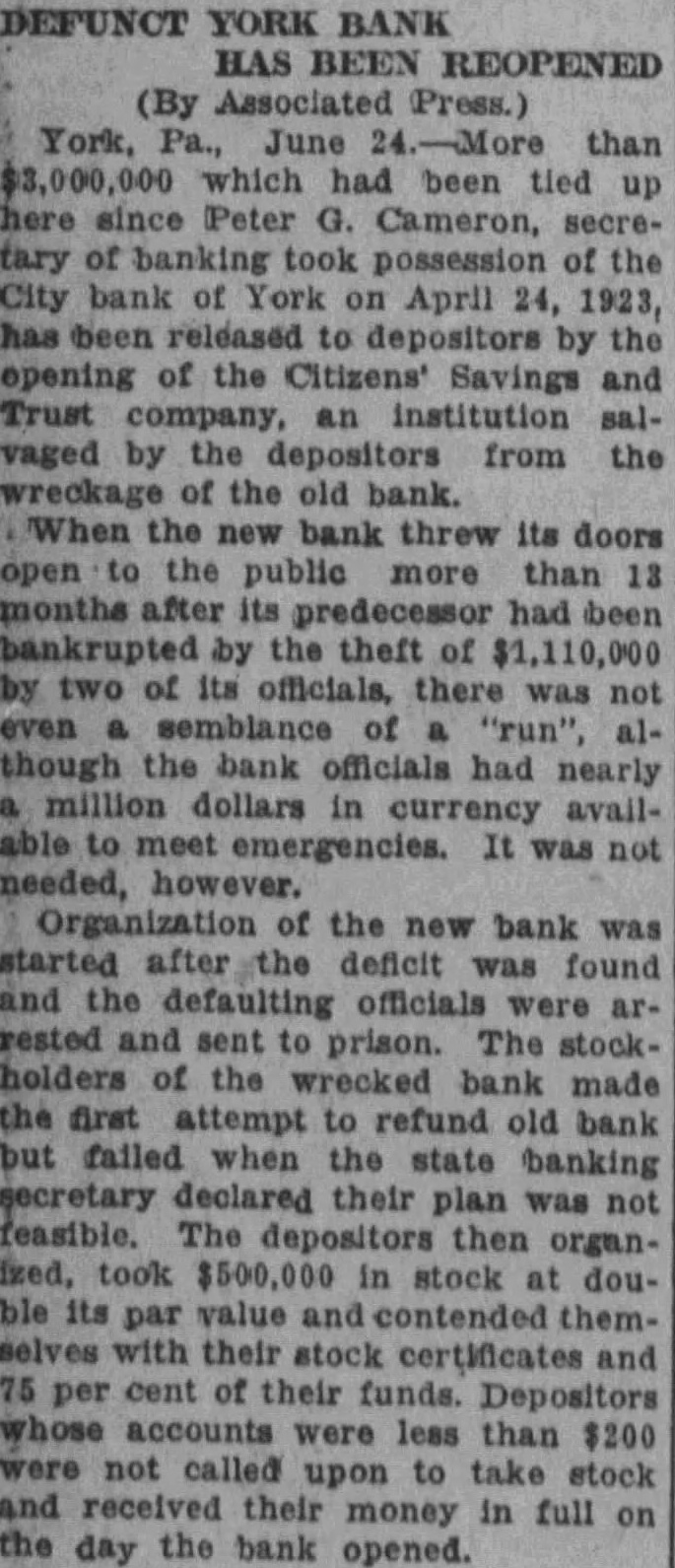
More than $3,000,000 ... has been released to depositors by the opening of the Citizens' Savings and Trust Company, an institution salvaged by the depositors from the wreckage of the old bank.
Source
newspapers
3. June 24, 1924 Run
Cause Details
Deposit holders rushed to the newly reopened bank to demand pass-books and certificates upon reopening; the run was driven by depositor action following the institution's reorganization and reopening.
Measures
Bank had large currency on hand (nearly $1,000,000) to meet emergencies; officials ready to pay small accounts in full
Newspaper Excerpt
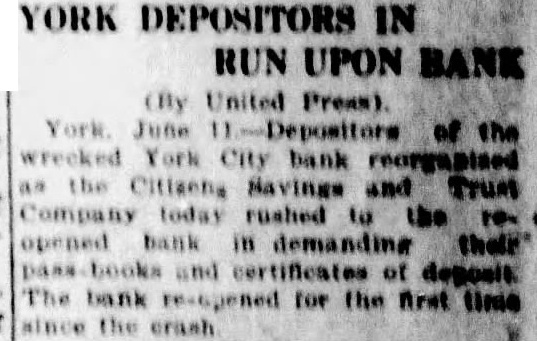
Depositors of the wrecked York City bank reorganized as the Citizens Savings and Trust Company today rushed to the reopened bank in demanding their pass-books
Source
newspapers

Newspaper Articles (20)

Article from Omaha World-Herald, April 25, 1923

Click image to open full size in new tab

Article Text

SHORTAGE OF $800,000 AND THE BANK IS CLOSED Warrants Issued for Arrest of Cashier and Assistant of City Bank of York, Pa. York, Pa., April 24.—The state banking commissioner today took over and closed the City bank, one of York's largest financial institutions. Examiners reported they had found indications of a shortage of $800,000. Warrants were issued for the arrest of Thomas B. Baird, cashier, and W. H. Boll, assistant cashier.


Article from The Gazette and Daily, April 26, 1923

Click image to open full size in new tab

Article Text

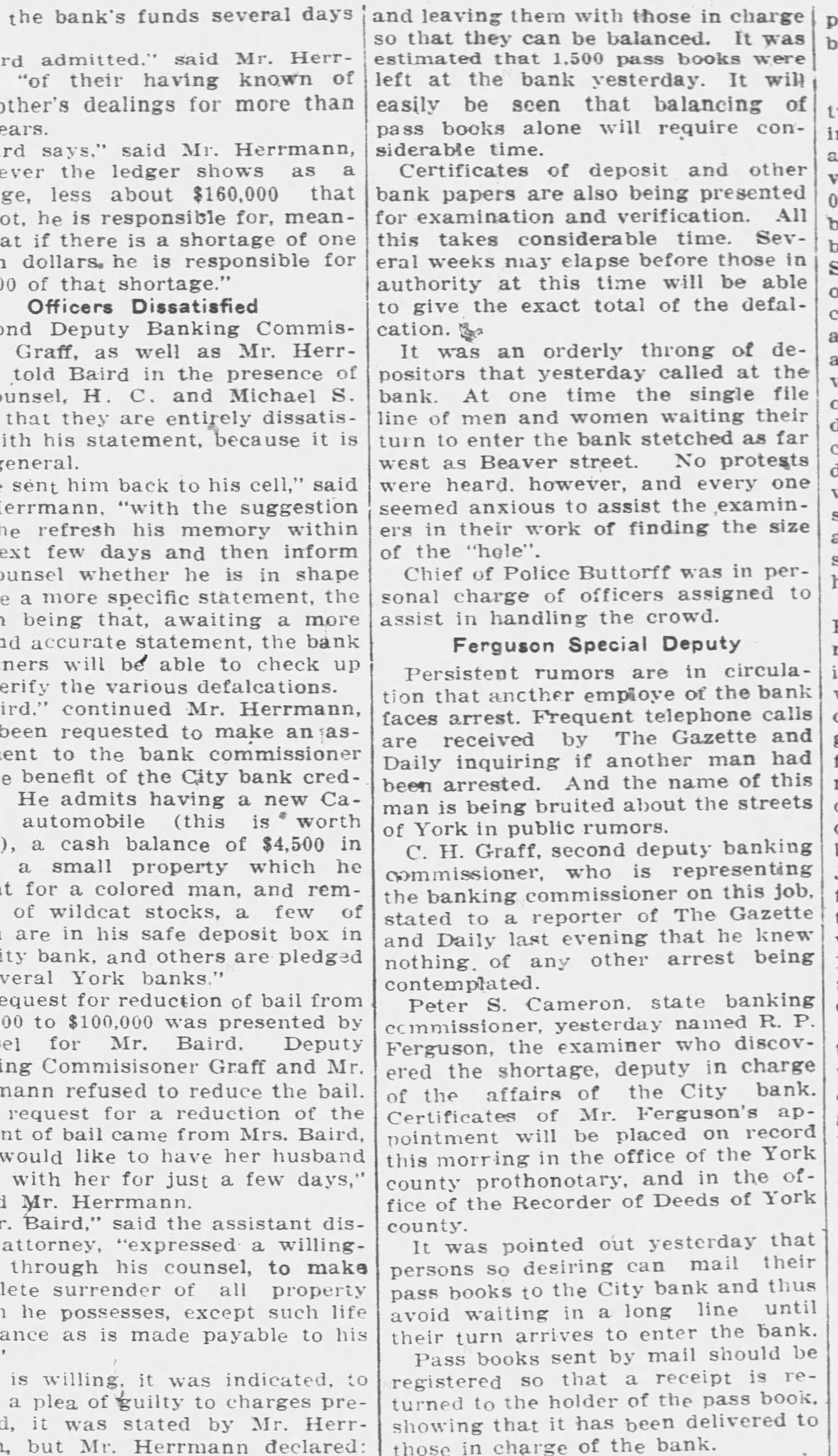
the bank's funds several days rd admitted," said Mr. Herrmann, "of their having known of other's dealings for more than ears. rd says," said Mr. Herrmann, ever the ledger shows as a ge, less about $160,000 that ot, he is responsible for, mean-at if there is a shortage of one dollars, he is responsible for 00 of that shortage." Officers Dissatisfied ond Deputy Banking Commis-Graff, as well as Mr. Herr-told Baird in the presence of unsel, H. C. and Michael S. that they are entirely dissatis-ith his statement, because it is general. e sent him back to his cell," said Herrmann, "with the suggestion he refresh his memory within ext few days and then inform ounsel whether he is in shape e a more specific statement, the n being that, awaiting a more nd accurate statement, the bank ners will be able to check up erify the various defalcations. ird," continued Mr. Herrmann, been requested to make an as-ent to the bank commissioner e benefit of the City bank cred- He admits having a new Ca-automobile (this is worth ), a cash balance of $4,500 in a small property which he t for a colored man, and rem-of wildcat stocks, a few of are in his safe deposit box in ity bank, and others are pledged veral York banks." equest for reduction of bail from 00 to $100,000 was presented by el for Mr. Baird. Deputy ing Commissioner Graff and Mr. mann refused to reduce the bail. request for a reduction of the nt of bail came from Mrs. Baird, would like to have her husband with her for just a few days," d Mr. Herrmann. r. Baird," said the assistant dis-attorney, "expressed a willing-through his counsel, to make lete surrender of all property n he possesses, except such life ance as is made payable to his, is willing, it was indicated, to a plea of guilty to charges pre-d, it was stated by Mr. Herr-a, but Mr. Herrmann declared: and leaving them with those in charge so that they can be balanced. It was estimated that 1,500 pass books were left at the bank yesterday. It will easily be seen that balancing of pass books alone will require considerable time. Certificates of deposit and other bank papers are also being presented for examination and verification. All this takes considerable time. Several weeks may elapse before those in authority at this time will be able to give the exact total of the defalcation. It was an orderly throng of depositors that yesterday called at the bank. At one time the single file line of men and women waiting their turn to enter the bank stretched as far west as Beaver street. No protests were heard, however, and every one seemed anxious to assist the examiners in their work of finding the size of the "hole". Chief of Police Buttorff was in personal charge of officers assigned to assist in handling the crowd. Ferguson Special Deputy Persistent rumors are in circulation that another employe of the bank faces arrest. Frequent telephone calls are received by The Gazette and Daily inquiring if another man had been arrested. And the name of this man is being bruited about the streets of York in public rumors. C. H. Graff, second deputy banking commissioner, who is representing the banking commissioner on this job, stated to a reporter of The Gazette and Daily last evening that he knew nothing of any other arrest being contemplated. Peter S. Cameron, state banking commissioner, yesterday named R. P. Ferguson, the examiner who discovered the shortage, deputy in charge of the affairs of the City bank. Certificates of Mr. Ferguson's appointment will be placed on record this morning in the office of the York county prothonotary, and in the office of the Recorder of Deeds of York county. It was pointed out yesterday that persons so desiring can mail their pass books to the City bank and thus avoid waiting in a long line until their turn arrives to enter the bank. Pass books sent by mail should be registered so that a receipt is returned to the holder of the pass book, showing that it has been delivered to those in charge of the bank.


Article from The Gazette and Daily, April 26, 1923

Click image to open full size in new tab

Article Text

Bills in Legislature Word comes from Harrisburg that two bills intended to place all banking institutions in Pennsylvania on an equal basis for taxation, also providing an estimated increase of $500,000 in revenue for the state if they become laws, have been passed finally by the House and are now before the Senate Committee on Finance. One of the measures would repeal the clause making it optional for state and national banks to pay state tax at the rate of 10 mills on the par value of capital stock, or four mills on actual values of shares, based on division of number of shares into capital stock paid in, surplus and undivided profits. Instead these banks would pay on the four-mill basis, the same as is required of all title insurance and trust companies in the state at present, such institutions not having the optional provision. Both measures were sponsored by Representative David J. Jones, Lawrence. The second one amends existing laws also, as does the first, providing that title insurance and trust companies shall file with the auditor general a statement on or before the first day of February of each year a report as of the close of business December 31 of the preceding year, in order that the amount of tax due can be determined. This is a change from June 20, the present final date for filing, for the trust institutions, also the state and national banks. All would make statements by February 1 under the new plan, all would pay the four-mill tax on the actual value of stock. Other changes in the laws relating to all banking institutions would be to change the time limit for payment of the tax as settled by the auditor general from 40 to 60 days; and provide a penalty of 10 per cent for failure to pay, making of false statements to the house, failure or refusal of officers to appear and produce books of the banks in order that the actual stock value can be ascertained and the tax figured. Among the national or state banks which would be affected by the elimination of the optional rate of payment of tax on capital stock, present tax paid at 10-mill rate; total value of resources, including capital stock paid in, surplus and undivided profits, and the mill rate on this value which they now pay, as compared to a four-mill charge, are the following: Bank. Tax amount. Resources. Rate in Mills. Peoples', Hanover... $ 500 $171,137 2.9 Drovers & Mechanics' Nat'l., York.. 1,000 256,161 3.9 Farmers & Merch., Red Lion 750 296,838 3.9 York Co. Nat., York 3,000 889,371 3.4 Savings Fund Soc., Hanover 500 293,419 1.7 In addition to York city school funds to the amount of about $245,091.92, and York county funds to the amount of $174,468.66, there are state funds to the amount of $25,000 on deposit in the bank. The latter are fully covered by sureties. Cameron Explains The City Bank of York was not examined for eighteen months, Banking Commissioner P. G. Cameron said yesterday because of the shortage of bank examiners. "We now have a force of about forty examiners," the commissioner explained. "But we could use twice that many. Examiners are paid from $2,400 to $3,600, according to the commissioner, and usually as soon as the department gets hold of a good man and teaches him his work, some bank offers him a bigger salary and the state force is depleted again. Larger salaries, the commissioner thought, would make the position more attractive and would help to hold the men the department is about to secure. The commissioner also declared the legislature, by defeating the bill to provide a more frequent inspection of building and loan associations, took a step which some day may result in a similar failure to that of the City Bank of York. No further reports have been received at Mr. Cameron's office of the amount of loss and he added that he thought the final figures would be substantially the same as those first reported.


Article from The Gazette and Daily, April 26, 1923

Click image to open full size in new tab

Article Text

"Baird admitted," said Mr. Herrmann, "of their having known of each other's dealings for more than two years. "Baird says," said Mr. Herrmann, "whatever the ledger shows as a shortage, less about $160,000 that Boll got, he is responsible for, meaning that if there is a shortage of one million dollars, he is responsible for $800,000 of that shortage." Officers Dissatisfied Second Deputy Banking Commissioner Graff, as well as Mr. Herrmann, told Baird in the presence of his counsel, H. C. and Michael S. Niles, that they are entirely dissatisfied with his statement, because it is only general. "We sent him back to his cell," said Mr. Herrmann, "with the suggestion that he refresh his memory within the next few days and then inform his counsel whether he is in shape to give a more specific statement, the reason being that, awaiting a more full and accurate statement, the bank examiners will be able to check up and verify the various defalcations. "Baird," continued Mr. Herrmann, "has been requested to make an assignment to the bank commissioner for the benefit of the City bank creditors. He admits having a new Cadillac automobile (this is worth $5,000), a cash balance of $4,500 in bank, a small property which he bought for a colored man, and remnants of wildcat stocks, a few of which are in his safe deposit box in the City bank, and others are pledged in several York banks." A request for reduction of bail from $200,000 to $100,000 was presented by counsel for Mr. Baird. Deputy Banking Commissioner Graff and Mr. Herrmann refused to reduce the bail. "The request for a reduction of the amount of bail came from Mrs. Baird, who would like to have her husband home with her for just a few days," stated Mr. Herrmann. "Mr. Baird," said the assistant district attorney, "expressed a willingness, through his counsel, to make complete surrender of all property which he possesses, except such life insurance as is made payable to his wife." He is willing, it was indicated, to enter a plea of guilty to charges preferred, it was stated by Mr. Herrmann, but Mr. Herrmann declared: "His plea will not be accepted until the banking department is thoroughly satisfied that they have made a full and exhaustive examination of the bank and its condition." Right to Petition Court Mr. Herrmann pointed out that the prisoner has a right to go into court and present a petition alleging that the bail demanded is excessive, and if the court deems it proper the court might reduce the amount of bail. Baird, according to his confession, it was stated, used a double system of bookkeeping, using a separate ledger which was never shown to the bank examiner. One method of covering shortages was by running the safety deposits with the general fund. It is also stated that in presenting books for examination to the bank examiners forged checks would be used and charged up against individual accounts, and after the examiner left the accounts would be corrected by crossing such entries off as errors. "Up until about twelve years ago," Mr. Herrmann said, "he did business largely through the bucket shops, on margin. Since that time he has dealt with other brokerage concerns. "One of his ventures was the purchase of the Vulture Mining company. He sunk $150,000 in this. "Another big source of loss were flyers in sugar. He was unable to recoup through this, the market going against him, and he lost heavily. He also lost in dabbling in railroad stocks. "Many of the bucket shops with whom he claims to have done business have passed from existence. One of the brokerage concerns with whom he says he dealt was that of W. L. Bear, a former Yorker, who did business in Philadelphia. He has since failed." Boll was taken into the counsel room for a conference shortly after Baird was removed to his cell. He admitted to defalcations of approximately $160,000. Said he had not speculated, but his shortage was due to the "high cost of living." Took Funds "to Hire a Lawyer" Boll admitted that while the bank examiner was at work in the bank on Monday night he stole $500 "to hire a lawyer." Baird took $1,000. Baird has not stated that this was to "hire a lawyer." In a statement to Bank Examiner Ferguson after his arrest on Tuesday afternoon, Boll stated that he had lost his money in stock operations. When pressed for the value of any on hand he thought it was worth $10,000. An official of the state department of banking is not inclined to place absolute credence in Mr. Baird's story. It smacks of an attempt to "cover up." There were statements made in the course of the interview, according to this man, which reflected upon the honesty of a former cashier of the bank, now dead. Then another fact pointed out by this man is that Baird claims that bucket shops with which he did business years ago, have gone out of business. As dead men tell no tales and records of defunct bucket shops are no more, it can be seen that the examiners will have some trouble in checking up on the story of Baird. But the checking up is in progress. One Million, Or Over Representatives of the state department of banking now working on the bank's books and accounts are unable to give any definite information as to the size of the "hole" in the bank's resources. While the embezzlement is estimated to amount to one million dollars, or more, the bank examiners are not in possession of data upon which they can definitely fix the amount of the defalcation. It may reach $1,000,000, and it may go even higher. All day yesterday depositors of the bank were presenting their pass books

Article from The Gazette and Daily, April 26, 1923

Click image to open full size in new tab

Article Text

Graff, as well as Mr. Herrmann, told Baird in the presence of counsel, H. C. and Michael S. that they are entirely dissatisfied with his statement, because it is general. "We sent him back to his cell," said Mr. Herrmann, "with the suggestion that he refresh his memory within the next few days and then inform the counsel whether he is in shape to make a more specific statement, the idea being that, awaiting a more full and accurate statement, the bank examiners will be able to check up and verify the various defalcations. Baird," continued Mr. Herrmann, "has been requested to make an assignment to the bank commissioner for the benefit of the City bank creditors." He admits having a new Cadillac automobile (this is worth It was an orderly throng of depositors that yesterday called at the bank. At one time the single file line of men and women waiting their turn to enter the bank stretched as far west as Beaver street. No protests were heard, however, and every one seemed anxious to assist the examiners in their work of finding the size of the "hole". Chief of Police Buttorff was in personal charge of officers assigned to assist in handling the crowd. Ferguson Special Deputy Persistent rumors are in circulation that another employe of the bank faces arrest. Frequent telephone calls are received by The Gazette and Daily inquiring if another man had been arrested. And the name of this man is being bruited about the streets of York in public rumors.


Article from The Gazette and Daily, April 26, 1923

Click image to open full size in new tab

Article Text

OTHER BANKS MAY GO TO CITY'S ASSISTANCE "If the situation is not altogether hopeless, something may be done by the banks of this city to aid the City bank to recover from its unfortunate position," said an officer of the York Clearing House association yesterday. "As an accurate statement as to the City bank's condition and exact amount of shortage is lacking at this time, the Clearing House association is not in a position to know what can be done. "I think a receiver for the bank will be appointed after the state banking commission finishes its examination of the institution's affairs. Then a statement of the bank's officers should be available. If the bank can show solvency, then the other banks of the city can come to its aid. If the bank is wholly insolvent, then the other banks cannot help, as the law would not allow the banks to make loans to an insolvent institution. "Once the doors of a bank are closed, it is difficult for a clearing house to take hold and give aid. But we are going to try to save business from being inconvenienced or disrupted if the position of the City bank is such that it will permit of a solution. "We do not think that depositors need worry. We believe that the involved bank has assets, holdings and securities upon which sufficient funds can be realized to pay off depositors in full course of time. The bank has various resources to fall back upon under the state banking law the directors and stockholders can be held responsible for the payment of depositors. Upon the surface, the situation does not appear hopeless. However, time alone can reveal the true state of bank's affairs. "If it so occurs that the other banks find the way clear to come to the assistance of the City bank, the depositors would be expected to cooperate by entering into some sort of agreement to the effect that they would not make a run upon the bank to withdraw deposits. This and various other emergencies would have to be considered before the Clearing House could act to rally the banks to save York from being hit hard by this financial disaster."


Article from The Gazette and Daily, April 26, 1923

Click image to open full size in new tab

Article Text

Examiners are paid from $2,400 to $3,600, according to the commissioner, and usually as soon as the department gets hold of a good man and teaches him his work, some bank offers him a bigger salary and the state force is depleted again. Larger salaries, the commissioner thought, would make the position more attractive and would help to hold the men the department is about to secure. The commissioner also declared the legislature, by defeating the bill to provide a more frequent inspection of building and loan associations, took a step which some day may result in a similar failure to that of the City Bank of York. depositors. Upon situation does However, time true state of ba "If it so oc banks find the the assistance depositors would operate by enter agreement to would not make to withdraw dep ious other emer be considered House could act save York from this financial di


Article from Blackwell Journal-Tribune, April 28, 1923

Click image to open full size in new tab

Article Text

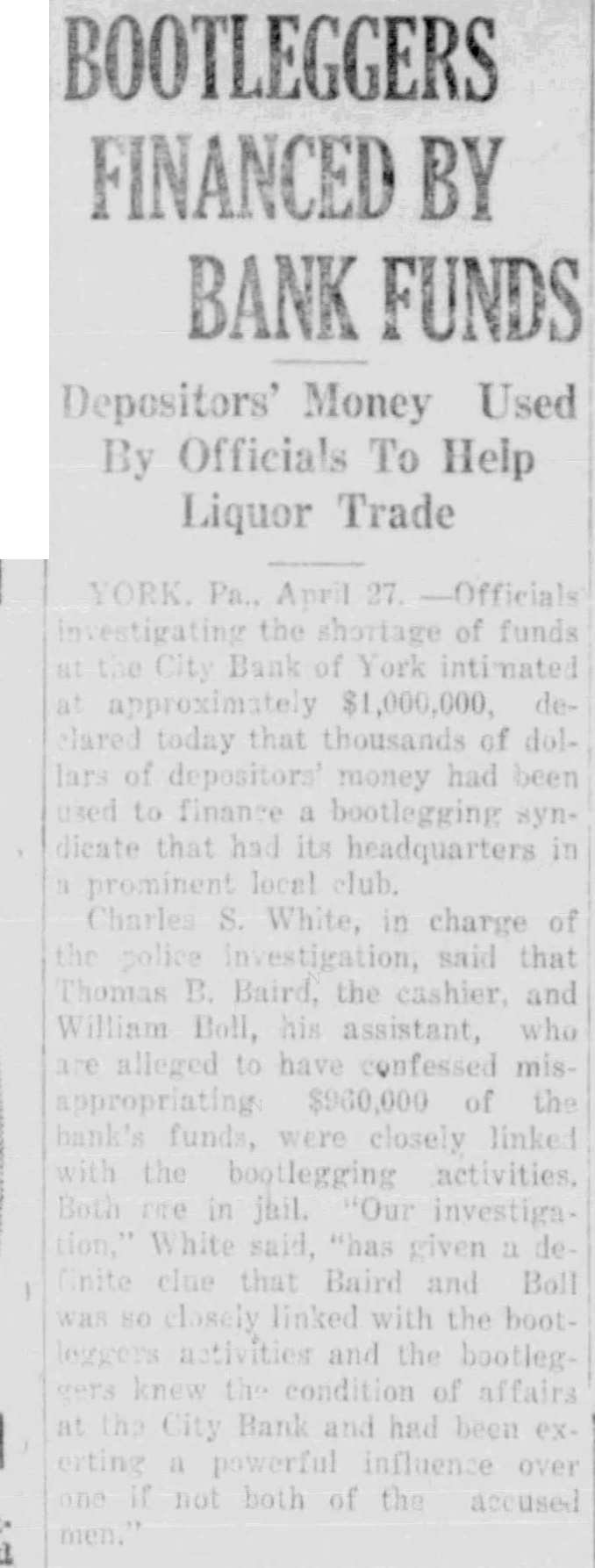
BOOTLEGGERS FINANCED BY BANK FUNDS Depositors' Money Used By Officials To Help Liquor Trade YORK, Pa., April 27. — Officials investigating the shortage of funds at the City Bank of York intimated at approximately $1,000,000, declared today that thousands of dollars of depositors' money had been used to finance a bootlegging syndicate that had its headquarters in a prominent local club. Charles S. White, in charge of the police investigation, said that Thomas B. Baird, the cashier, and William Boll, his assistant, who are alleged to have confessed misappropriating $960,000 of the bank's funds, were closely linked with the bootlegging activities. Both are in jail. "Our investigation," White said, "has given a definite clue that Baird and Boll was so closely linked with the bootleggers activities and the bootleggers knew the condition of affairs at the City Bank and had been exerting a powerful influence over one if not both of the accused men."


Article from Danville Register and Bee, May 1, 1923

Click image to open full size in new tab

Article Text

CRASH OF A "BOOTLEG BANK." A sensation has been caused in York, Pa., by a published charge that the failure of the City Bank of York, a State institution, with a deficit estimated at a million dollars, is attributable to its identification with the lawless traffic in liquors and the loaning of its funds in financing a gigantic liquor buying and selling syndicate. The cashier and assistant cashier of the bank have been arrested and at last reports were being held in custody because of their failure to raise a bond of $300,000 fixed by the courts. One of the warrants issued charges the assistant cashier with forgery and another charges the cashier with perjury. It is also reported that there is a move among those who have shared in the loot of the wrecked bank to provide $100,000 bail for the assistant cashier. This anticipated plan is said to be attributable to a fear by others that unless the man's release is secured on bond, he may make a clean breast of the whole remarkable story and thereby drag in the names of many others who shrink from the notoriety involved, if not from the criminal prosecutions which may follow. This official of the bank is also alleged to have the reputation of being a sport and a drinker and was a member of a club which was recently raided by prohibition agents, because of a belief that it was the chief source of "irrigation" among a large number of the thirsty. The actual wrecking of the bank is attributed to reckless loans on worthless notes on which the institution could not realize and on which prudent bankers would never have loaned the bank's funds. The cashier is said by the chief of detectives who investigated the crime to have admitted that "it was all up" when the bank examiner called. He is also reported as having said: "I knew I was caught because all previous bank examiners reported to me for duty, and I got away with all of them," meaning that he succeeded in thwarting any thoroughgoing examination of the bank's condition and affairs. Such a situation which has continued for so long a period would not have been possible with any adequate bank examination by capable men, and the wrecking of the bank is hardly less a condemnation of the examiners who had permitted such a condition to continue than of the men who availed themselves of almost unlimited opportunities to abuse their trust so grossly and dissipate its funds. If it can be proved that these officials lent money recklessly on worse than worthless securities in order that a gigantic illicit liquor traffic might be financed, it is fair to presume that the two bank officials shared in the proceeds of the law-defying traffic. Greed and avarice and the get-rich-quick ambition proved the downfall of these trusted employes and the destruction of the bank. Just how much of the reputed assets of the bank can be realized on does not yet appear, but the prospect is far from promising. We direct attention to this Pennsylvania affair in order to emphasize the contrast between the control and management of the York bank with that of Danville's banking institutions, all of which are as safe and sound as a government bond. Virginia's State bank examiners are men of both ability and unimpeachable probity, and all of them are men of sobriety and of the highest personal character and habits. Dishonesty in an occasional and notorious instance such as that alleged at York, Pa., merely serves to emphasize by contrast the soundness of our own institutions and the high character and conservatism of our bankers. Heavy punishment of the accused men, if their guilt can be established would have a wholesome deterrent effect upon all "wildcat banking," such as is charged in this instance.


Article from New Castle Herald, May 1, 1923

Click image to open full size in new tab

Article Text

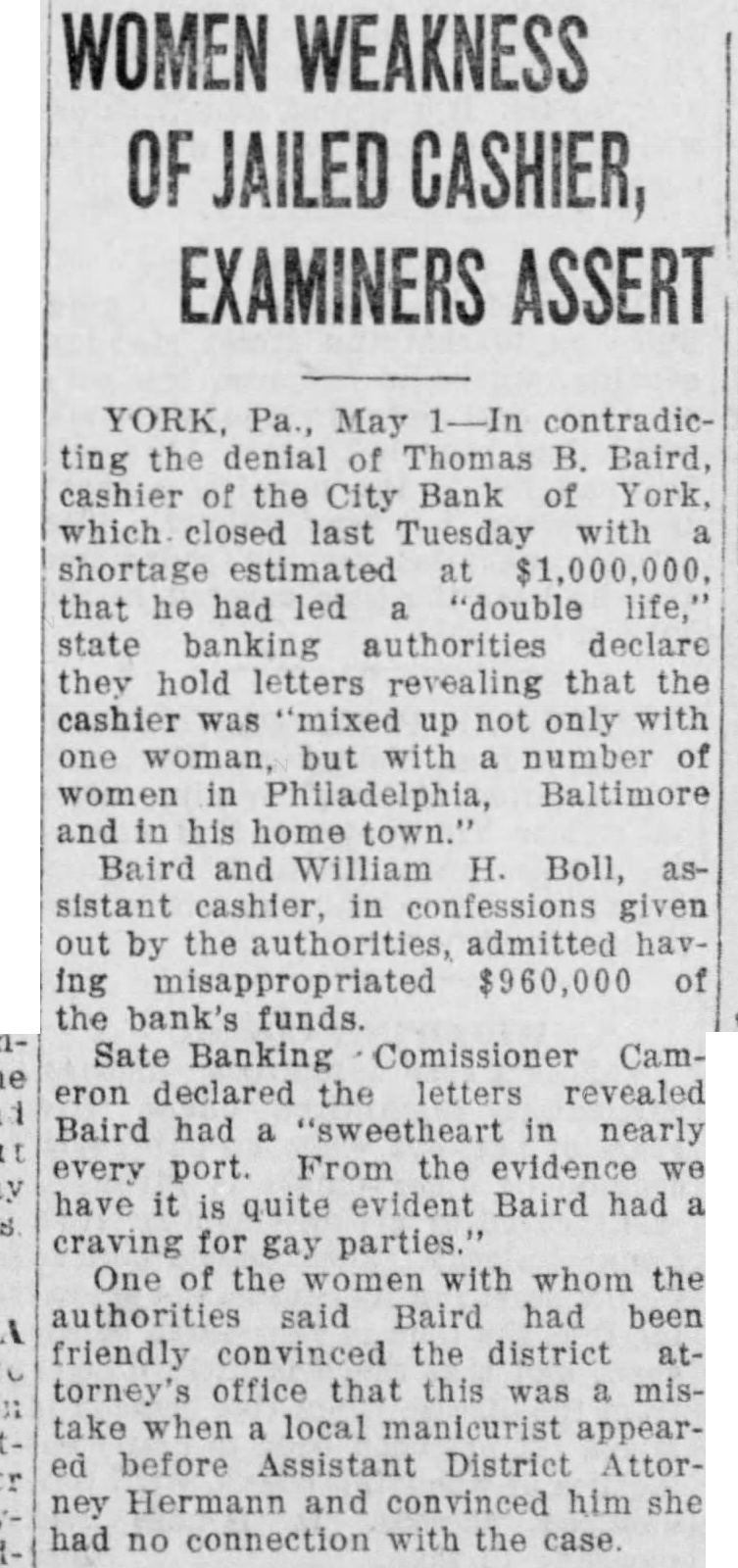
WOMEN WEAKNESS OF JAILED CASHIER, EXAMINERS ASSERT YORK, Pa., May 1—In contradicting the denial of Thomas B. Baird, cashier of the City Bank of York, which closed last Tuesday with a shortage estimated at $1,000,000, that he had led a "double life," state banking authorities declare they hold letters revealing that the cashier was "mixed up not only with one woman, but with a number of women in Philadelphia, Baltimore and in his home town." Baird and William H. Boll, assistant cashier, in confessions given out by the authorities, admitted having misappropriated $960,000 of the bank's funds. State Banking Commissioner Cameron declared the letters revealed Baird had a "sweetheart in nearly every port. From the evidence we have it is quite evident Baird had a craving for gay parties." One of the women with whom the authorities said Baird had been friendly convinced the district attorney's office that this was a mistake when a local manicurist appeared before Assistant District Attorney Hermann and convinced him she had no connection with the case.


Article from New Castle Herald, May 1, 1923

Click image to open full size in new tab

Article Text

YORK, Pa., May 1—In contradicting the denial of Thomas B. Baird, cashier of the City Bank of York, which closed last Tuesday with a shortage estimated at $1,000,000, that he had led a "double life," state banking authorities declare they hold letters revealing that the cashier was "mixed up not only with one woman, but with a number of women in Philadelphia, Baltimore and in his home town." Baird and William H. Boll, assistant cashier, in confessions given out by the authorities, admitted having misappropriated $960,000 of the bank's funds. State Banking Commissioner Cameron declared the letters revealed Baird had a "sweetheart in nearly every port. From the evidence we have it is quite evident Baird had a craving for gay parties."


Article from The York Dispatch, May 9, 1923

Click image to open full size in new tab

Article Text

WILL NOT BE CENSURED FOR THEFT Neither Will the State Banking Department for Neglect of Duty, Chairman of Investigating Committee Announces After Hearing Testimony HEARING AT HARRISBURG Inquiry Will Result In Standardizing of Forms, Statements and Bookkeeping Methods Throughout State NEW LOVE NEST STORY CANNOT BE VERIFIED Dispatch From Reading Says Baird and Boll Spent Week-Ends In the Berks County City With Women Not Their Wives—Report Has It That Defaulting Cashier Bought $500 Fur Coat For Girl—Clearing House Members Says It Is Idle to Talk of Re-Opening Bank Till Assets Are Determined Neither the directors of the defunct City bank nor the state banking department will be censured by the legislative investigating committee, according to a statement made by Chairman Bromley, chief of the investigators, following the meeting at Harrisburg yesterday afternoon when directors and bank employes appeared before the committee and were questioned. There had been rumors that it would be found that the directors had been careless, but Mr. Bromley declared the directors apparently had exercised their full duties as far as the committee's investigation disclosed. It was apparent yesterday, from the trend of discussion following the meeting at which the probe was conducted, that the investigation had veered away from further specific investigation as far as the City bank is concerned and from any relief which might be brought to York depositors. "That money is gone," said the members of the committee which made the investigation. Instead the trend of the investigation is toward methods which might be adopted to prevent further failures. Closer examination of banks, it is said, will also result from the inquiry. When the York delegation arrived at Harrisburg yesterday afternoon there was considerable displeasure exhibited because the hearing was held behind closed doors. W. C. Stevens, after the hearing was afters committee, demanded that his committee of three be admitted to the session and at first the privilege was denied. Finally, after reconsideration by the investigators, there was a compromise and Stevens, as head of his committee was admitted. Chairman Bromley declared that Stevens, after the hearing, was apparently satisfied that the committee was not whitewashing nor passing over anything. One result of the inquiry, it was intimated will be the effort by the banking department to standardize the forms, statements and general bookkeeping methods in use by boards of the state. It was also suggested that hereafter bank examiners will not allow employes of institutions being examined to assist in any of the work of examination. The great rush of work devolving upon bank examiners, it is said, has made this necessary in times past. The house banks and banking committee was expected as a result of the investigation to report out senate bill 163 today. Reading Report Vague A dispatch from Reading today carried information of alleged investigations concerning visits to have been made there by Baird. The reports could not be verified, here, and as far as is known Baird seldom went to Reading except to participate in golf matches. Several directors approached today relative to the matter said they knew absolutely nothing of it. The dispatch follows: "Two directors of the City bank of York were in Reading three days last week running down reports that Thomas B. Baird, cashier, and William H. Boll, assistant cashier, bank officials charged with embezzlement, lavished money on women in this city. "The directors, working with city detectives, found, it is said, that Baird purchased a $500 fur coat at a Reading store and gave it to a woman whom he is alleged to have maintained here. The directors also discovered it is said, that Boll and Baird frequently registered with strange women at a local hotel. "It was in Reading, the directors say, that Baird and Boll found each other playing the same game. The cashier, reports indicate, was registered with a woman at the same hotel in which his assistant was staying with a Reading girl. "The York bank directors allege they have sufficient evidence to prove Baird and Boll spent considerable money on two women in Reading. Other purchases, mostly clothing, were made in local stores and the bank officials are said to have paid the bills. "That Reading was the place where Baird and Boll spent most of their week-ends, was the charge of the directors after their investigation here. The investigators allege they found Baird registering at a local hotel with a woman, and under his own name. It is likely they will subpoena the clerk, and the register of the hotel, when the case against the bank officials comes up. "While Baird insists most of the money he is alleged to have embezzled went into oil stocks and other fly-by-night investments, the directors are not ready to accept the story and their investigations in Philadelphia and Reading tend to disprove the statements, they assert. "Every move of Baird and Boll in Reading is being checked up by the two bank directors and city detectives, and their clandestine meetings here will be aired at the hearing." "It is idle talk of reorganizing and reopening the City bank while the exact state of that institution's affairs is in doubt," said a member of the Clearing House association to


Article from The Gazette and Daily, May 10, 1923

Click image to open full size in new tab

Article Text

STATE BANKING DEPARTMENT TO BE OVERHAULED Standard System Of Bookkeeping As Result Of City Bank Crash DIRECTORS WILL ESCAPE CENSURE Mrs. Baird Denies That Her Husband Visited Reading Alone The State Banking department will likely attempt to standardize the forms, statements and general bookkeeping systems in use by boards of directors of state banks as a result of the inquiry now being made by a special legislative committee relative to the conduct of the state banking department. The inquiry was brought about largely through the finding of a shortage of nearly $1,000,000 in the funds of the City bank, of York. Thomas B. Baird, cashier, and William H. Boll, assistant cashier, have acknowledged responsibility for the shortage. Peter G. Cameron, banking commissioner for about ten months, since assuming the duties of that position endeavored to make needed changes and improvements in the conduct of the department, and passage of a bill now before the state Senate is being urged as vital to the further strengthening and improvement of the department's work. Not to Censure Directors Chairman Bromley, of the Special Legislative Investigating committee is quoted as saying that neither the directors of the City bank nor the State Banking department will be censured by the committee, as a result of the closing of the City bank. He is reported as having said that the directors apparently had exercised their full duties as far as the committee's investigation disclosed, and that W. C. Stevens, chairman of the Depositors' committee was apparently satisfied that the committee was not whitewashing nor passing over anything. Chairman Stevens last evening took exception to the statement as attributed to Mr. Bromley, and declared that, although he is not a banker, he feels there was plenty of information developed at the hearing to show that the directors were not on the job, and he expressed the thought that school boys, twelve years old, could run a bank more efficiently than did these directors. Mr. Stevens declared that it is up to the public to pass judgement on the work of the direc- (Continued on Fifth Page)


Article from The York Dispatch, May 17, 1923

Click image to open full size in new tab

Article Text

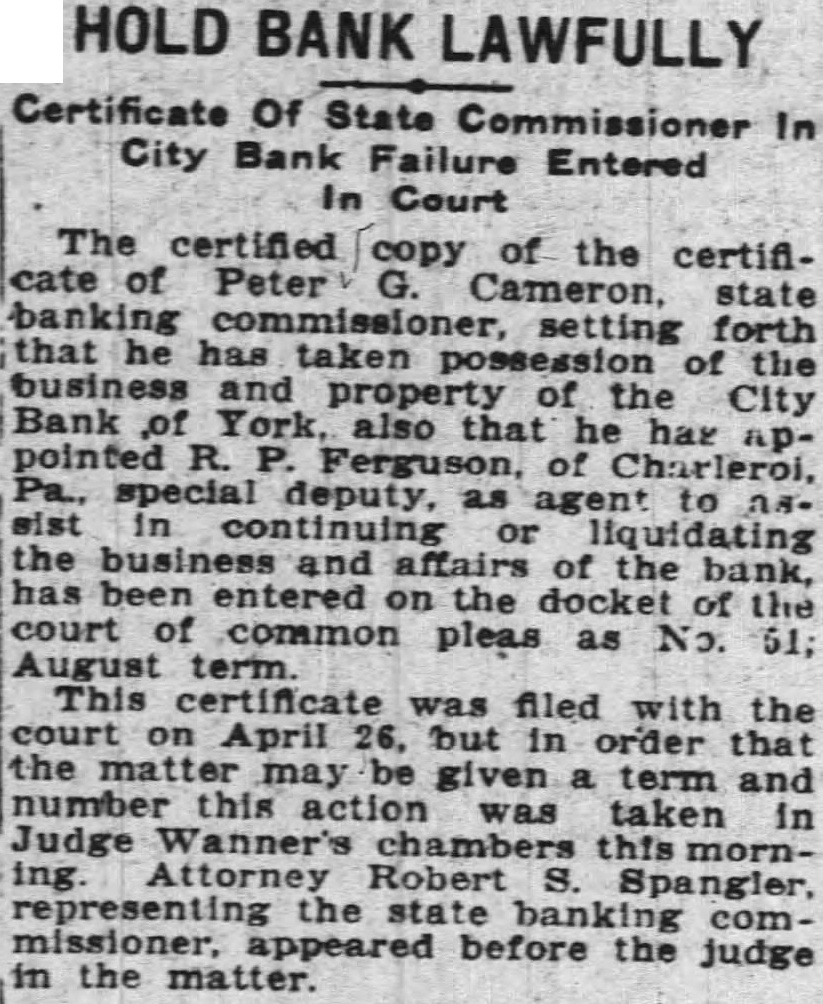
HOLD BANK LAWFULLY Certificate Of State Commissioner In City Bank Failure Entered In Court The certified copy of the certificate of Peter G. Cameron, state banking commissioner, setting forth that he has taken possession of the business and property of the City Bank of York, also that he has appointed R. P. Ferguson, of Charleroi, Pa., special deputy, as agent to assist in continuing or liquidating the business and affairs of the bank, has been entered on the docket of the court of common pleas as No. 51; August term. This certificate was filed with the court on April 26, but in order that the matter may be given a term and number this action was taken in Judge Wanner's chambers this morning. Attorney Robert S. Spangler, representing the state banking commissioner, appeared before the judge in the matter.


Article from The Greensboro Record, June 11, 1923

Click image to open full size in new tab

Article Text

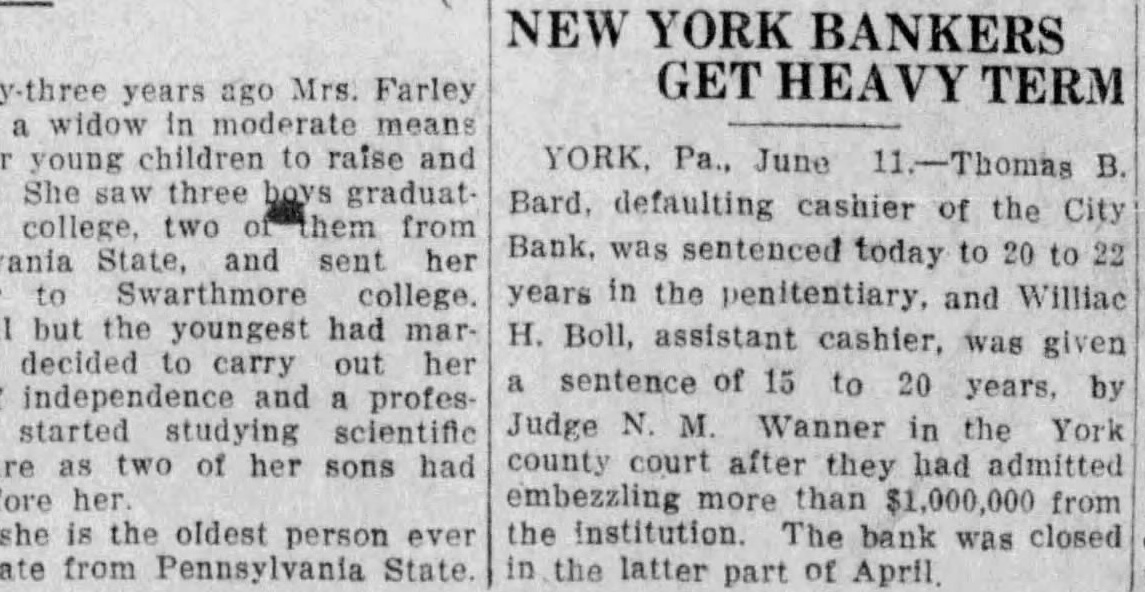
NEW YORK BANKERS GET HEAVY TERM YORK, Pa., June 11.—Thomas B. Bard, defaulting cashier of the City Bank, was sentenced today to 20 to 22 years in the penitentiary, and William H. Boll, assistant cashier, was given a sentence of 15 to 20 years, by Judge N. M. Wanner in the York county court after they had admitted embezzling more than $1,000,000 from the institution. The bank was closed in the latter part of April.


Article from The York Dispatch, September 18, 1923

Click image to open full size in new tab

Article Text

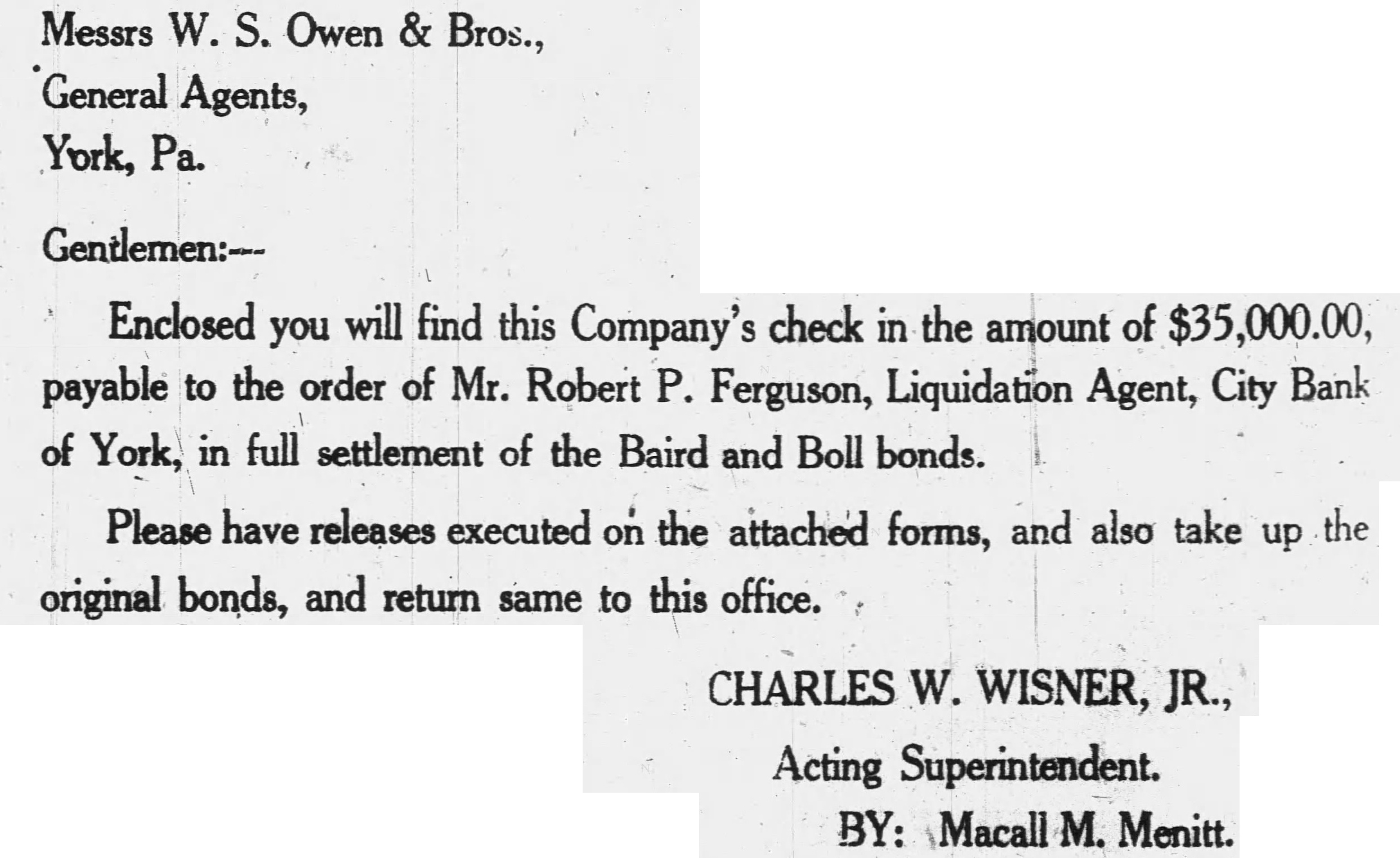
Messrs W. S. Owen & Bros., General Agents, York, Pa. Gentlemen:--- Enclosed you will find this Company's check in the amount of $35,000.00, payable to the order of Mr. Robert P. Ferguson, Liquidation Agent, City Bank of York, in full settlement of the Baird and Boll bonds. Please have releases executed on the attached forms, and also take up the original bonds, and return same to this office. CHARLES W. WISNER, JR., Acting Superintendent. BY: Macall M. Menitt.


Article from Berwick Enterprise, June 11, 1924

Click image to open full size in new tab

Article Text

YORK DEPOSITORS IN RUN UPON BANK (By United Press). York, June 11.—Depositors of the wrecked York City bank reorganized as the Citizens Savings and Trust Company today rushed to the reopened bank in demanding their pass-books and certificates of deposit. The bank reopened for the first time since the crash.


Article from Lancaster New Era, June 24, 1924

Click image to open full size in new tab

Article Text

BANK'S REOPENING RELEASES MILLIONS YORK, Pa., June 24.—More than $3,000,000 which had been tied up here since Peter G. Cameron, secretary of banking took possession of the City bank of York on April 24, 1923, has been released to depositors by the opening of the Citizens' Savings and Trust Company, an institution salvaged by the depositors from the wreckage of the old bank. When the new bank threw its doors open to the public more than 13 months after its predecessor had been bankrupted by the theft of $1,110,000 by two of its officials, there was not even a semblance of a "run", although the bank officials had nearly a million dollars in currency available to meet emergencies. It was not needed, however. Organization of the new bank was started after the deficit was found and the departing officials were arrested and sent to prison. The stockholders of the wrecked bank made the first attempt to refund the old bank but failed when the state banking secretary declared their plan was not feasible. The depositors then organized, took $500,000 in stock at double its par value and contented themselves with their stock certificates and 75 per cent of their funds.


Article from Altoona Tribune, June 25, 1924

Click image to open full size in new tab

Article Text

POLITICS BLAIR and Cambria counties fared well at the opening of the Democratic national convention in New York City. Thomas H. Greevy, chairman for Blair county, was named honorary chairman of the Pennsylvania delegation, and Judge John H. McCann, of Cambria county, was given the post as Pennsylvania member of the resolutions committee. Whether or not there is anything significant in the selection of Judge McCann as a member of that committee remains, of course, to be seen. Judge McCann sat on the bench during some of the hearings of the cases that grew out of the Lilly disturbance between Klansmen and citizens of the town in which several persons lost their lives. The jurist may be called upon to say something on the Klan plank that seems to be oozing its way into the platform program. Mr. Greevy, who has long been a staunch Democrat and sincere party chairman for this county, was once the nominee of his party for the lieutenant-governorship of Pennsylvania. Aside from that he has been prominent in the counsels of the party, both state and national, for many years and his selection as honorary chairman on Monday is a tribute to his services. THE Pennsylvania Democratic delegation at New York has been polled a dozen or more times, but thus far every poll has differed. It would seem that Al Smith has from 45 to 50 delegates. That may be high so far as the first ballot is concerned, as the McAdoo people claim 20 delegates certainly—with a possible 30. There has been a slight drift towards Davis, but if Smith were out of the running most of his followers in the Pennsylvania delegation would be found voting for Underwood. MORE than $3,000,000 which had been tied up at York since Peter G. Cameron, secretary of banking took possession of the City bank of York on April 24, 1923, has been released to depositors by the opening of the Citizens' Savings and Trust company, an institution salvaged by the depositors from the wreckage of the old bank. When the new bank threw its doors open to the public more than 13 months after its predecessor had been bankrupted by the theft of $1,110,000 by two of its officials, there was not even a semblance of a "run", although the bank officials had nearly a million dollars in currency available to meet emergencies. It was not needed, however. Organization of the new bank was started after the deficit was found and the defaulting officials were arrested and sent to prison. The stockholders of the wrecked bank made the first attempt to refund the old bank but failed when the state banking secretary declared their plan was not feasible. The depositors then organized, took $500,000 in stock at double its par value and contented themselves with their stock certificates and 75 per cent of their funds. Depositors whose accounts were less than $200 were not called upon to take stock and received their money in full on the day the bank opened. STATE CHAIRMAN W. HARRY BAKER looks for early organization of the Republican national campaign, and is getting the Pennsylvania ends into shape for conferences with the leaders of the party in the country. The women's part of the campaign is rapidly taking form under the direction of Vice-chairman Hannah Durham, who is energetically working on a plan for every county. The women will be given every facility to help in the campaign.


Article from The Morning Press, June 25, 1924

Click image to open full size in new tab

Article Text

DEFUNCT YORK BANK HAS BEEN REOPENED (By Associated Press.) York, Pa., June 24.—More than $3,000,000 which had been tied up here since Peter G. Cameron, secretary of banking took possession of the City bank of York on April 24, 1923, has been released to depositors by the opening of the Citizens' Savings and Trust company, an institution salvaged by the depositors from the wreckage of the old bank. When the new bank threw its doors open to the public more than 13 months after its predecessor had been bankrupted by the theft of $1,110,000 by two of its officials, there was not even a semblance of a "run", although the bank officials had nearly a million dollars in currency available to meet emergencies. It was not needed, however. Organization of the new bank was started after the deficit was found and the defaulting officials were arrested and sent to prison. The stockholders of the wrecked bank made the first attempt to refund old bank but failed when the state banking secretary declared their plan was not feasible. The depositors then organized, took $500,000 in stock at double its par value and contented themselves with their stock certificates and 75 per cent of their funds. Depositors whose accounts were less than $200 were not called upon to take stock and received their money in full on the day the bank opened.