Article Text
FIRST NATIONAL STOCK SALE TO RFC SANCTIONED
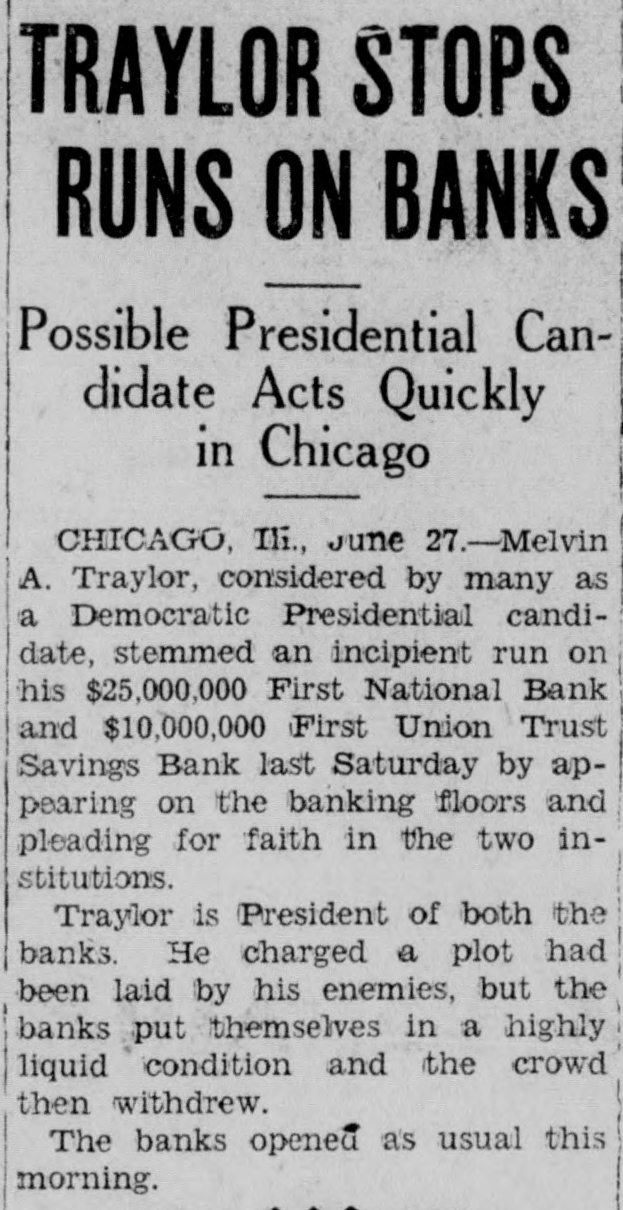
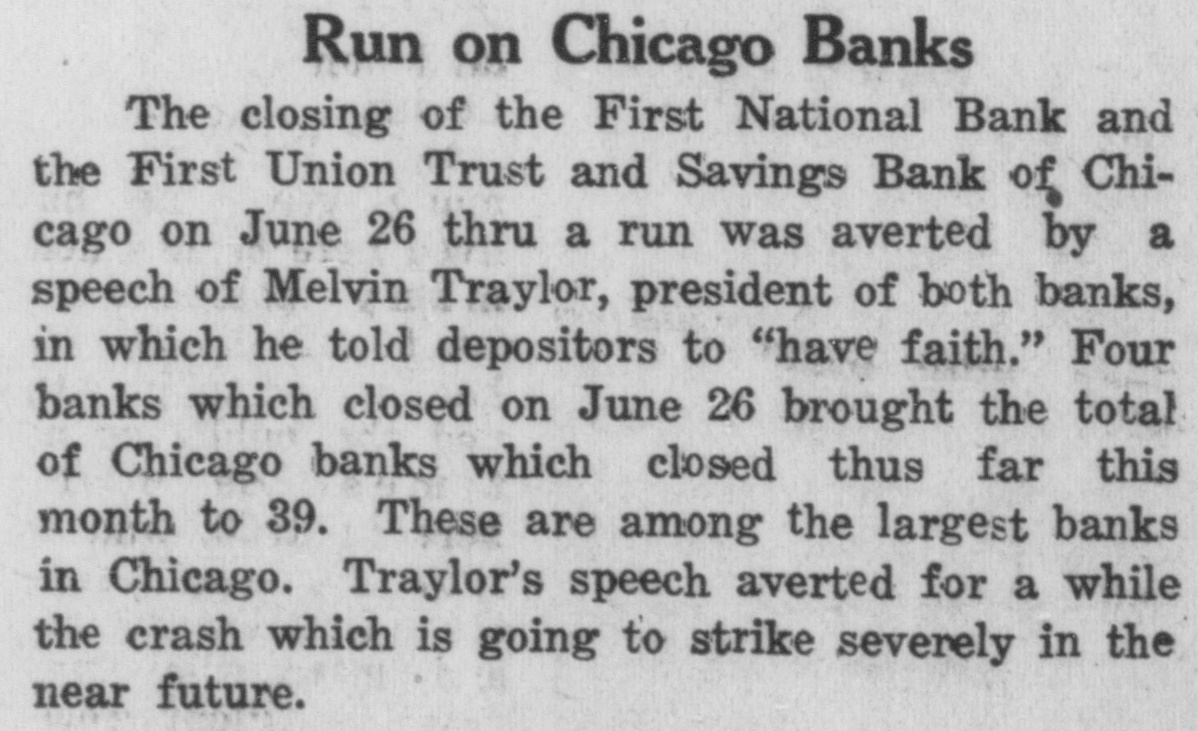
Traylor Doubts U. S. Will Seek Control.
BY THOMAS FURLONG.
Stockholders of the First National Bank of Chicago ratified the sale of $25,000,000 of preferred stock to the Reconstruction Finance corporation and reduced the board of directors of the bank from 44 to 25 members.
The management's proposal to sell preferred stock to the RFC was approved overwhelmingly. Questioned by stockholders, President Melvin A. Traylor said that he was not concerned over the possibility that the sale of the stock would mean RFC dictation of the bank's management.
"If the RFC elected to do so, at the next annual meeting," he said, "it could control the selection of officers of the bank. If I had any fear that we would lose control, provided we conduct the bank properly, I would be concerned. If they are satisfied with our management they will be content to let us run the bank."
Woman Stockholder Fears Control.
Among the stockholders who questioned Mr. Traylor about the possibility of the RFC taking control of the bank through the preferred stock was Mrs. Ethel G. Phillips, 985 Hill road, Winnetka. She pointed out that selling $25,000,000 worth of stock to the RFC would in practice give the government bureau control, as it would own as much stock as all other shareholders combined.
"In presenting my views," Mrs. Phillips said, "I want to make it plain I do not believe it unpatriotic to criticize the centralization of government. There has been too much tendency to brand every criticism as unpatriotic."
In reply to her argument Mr. Traylor said that the banking act of 1933 had so effectively placed the banks under the control of the controller of currency and the federal reserve board that the granting of additional control to the RFC made no practical difference. He said that he understood a bill will be introduced at this session of congress requiring a capital deposit ratio of 1 to 8, which would make an increase of the First National's capital essential.
Board Reduced Under Law.
The reduction in the board of directors from 44 to 25 members was made in accordance with the terms of the banking act passed last year. All the new directors elected were members of the old board. They are:
Philip D. Block, Potter Palmer, Edward E. Brown, George A. Ranney, Ralph Budd, Edward G. Seubert, Augustus A. Carpenter, Silas H. Strawn, Richard J. Collins, R. Douglas Stuart, Mark W. Cressap, Bernard E. Sunny, Charles K. Foster, George G. Thorp, Bentley G. McCloud, Melvin A. Traylor, Charles A. McCulloch, Albert H. Wetten, Harold F. McCormick, Harry A. Wheeler, Ira N. Morris, C. J. Whipple, James Norris, John P. Wilson, John P. Oleson.
Retiring directors are:
William R. Abbott, Col. R. R. McCormick, Carl R. Gray, Charles S. Pearce, James B. Forgan, George Pick, John H. Hardin, Frederick H. Prince, Craig B. Hazlewood, Frederick H. Rawson, Marvin Hughitt Jr., Guy A. Richardson, John Hertz, Charles R. Walgreen, Walter J. Kohler, Daniel Willard, Albert D. Lasker, Thomas E. Wilson, Chauncey McCormick.
All the retiring directors asked to be relieved of their duties, Mr. Traylor explained. Several expressed a desire to retire during the last twelve months, but were prevailed upon to finish their terms, he said.
Stockholders May Waive Rights.
Stockholders will have prior right to subscribe to the new preferred stock, but it is expected that all of the stock, which will pay 5 per cent cumulative dividends, will be taken by the government agency.
In explaining the stock sale to shareholders Mr. Traylor emphasized that $15,000,000 of the $25,000,000 preferred issue is callable at the option of the bank at any time, providing the controller of the currency did not object, and that the remaining $10,000,000 may be retired at any time unconditionally.
The new stock will boost the capital of the bank to $50,000,000, equally divided between common and preferred stock. In addition the bank will have surplus of $10,000,000, undivided profits of about $1,000,000, and special reserves of $5,000,000 under the new setup. After putting into effect the changes the common stock will have a book value of $140 a share, Mr. Traylor stated.
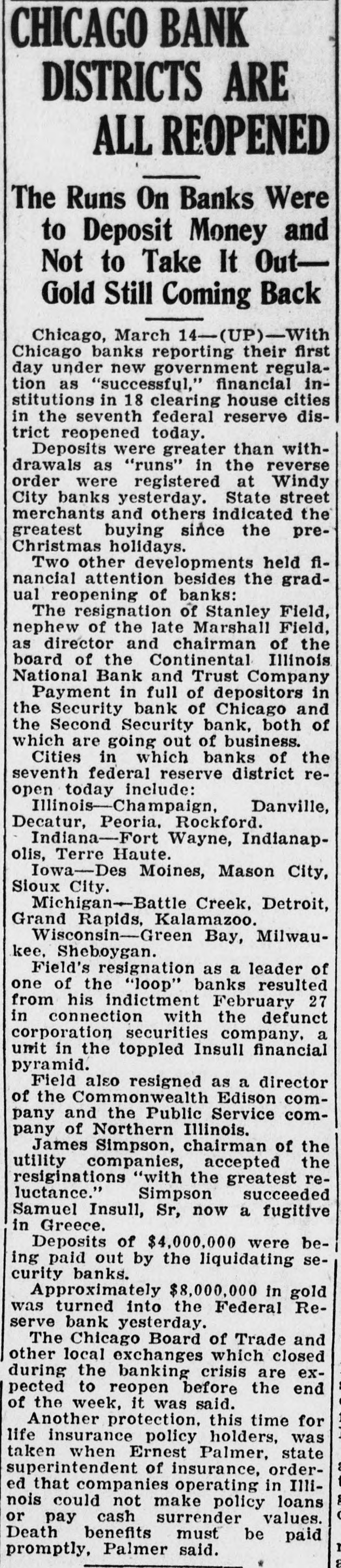
During the course of his remarks to stockholders Mr. Traylor revealed that the bank had paid out $165,000,000 to depositors without resort to borrowing in the period from Feb. 14 to March 3 last year immediately preceding the bank moratorium.
Mr. Traylor said he was unwilling to predict when dividends would be resumed, but added that if conditions improve the bank will be in a favorable position to profit.
After the stockholders' meeting the directors met and reëlected all present officers of the bank. J. T. Keckeison was made an assistant secretary.