First National Bank (Chicago, IL)

Episode Information

Episode UID
801294
Episode Type
Run โ†’ Suspension โ†’ Reopening
Bank Type
national
Bank ID
80 national
Charter Number
8
Start Date
October 28, 1907
Location
Chicago, Illinois (41.850, -87.650)

Metadata

Model
gemini-3-flash-preview (chosen from majority vote of a three-model LLM ensemble)
Short Digest
514409be91656106

Response Measures

Accommodated withdrawals, Public signal of financial health, Capital injected, Partial suspension, Books examined

Other: The bank imported gold from London to reassure depositors and later issued clearing house certificates/scrip as a medium of exchange during the currency famine.

Clearinghouse involved: Yes (loan, examination, or other measures)

Description

During the Panic of 1907, the bank experienced a run and suspended cash payments (switching to a checking/scrip basis) before resuming normal operations.

Events (5)

1. June 22, 1863 Chartered
Source
historical_nic
2. May 1, 1882 Chartered
Source
historical_nic
3. October 28, 1907 Run
Cause
Macro News
Cause Details
Systemic financial panic originating in New York (Panic of 1907) causing local nervousness.
Measures
The bank invoked the 30/60 day rule on savings accounts and switched to paying commercial depositors in bank checks/scrip instead of currency.
Newspaper Excerpt
Within an hour after the opening of the doors fully 400 people were lined up at the withdrawal windows
Source
newspapers
4. October 28, 1907 Suspension
Cause
Macro News
Cause Details
Systemic panic and exhaustion of currency reserves due to the situation in New York.
Newspaper Excerpt
The banks of this city are today largely upon a checking basis. They refuse to pay out large amounts of currency
Source
newspapers
5. January 1, 1908* Reopening
Newspaper Excerpt
Chicago banks have returned to cash basis and financial situation is just what it was before the pinch. (January 11, 1908 article reporting recent return to cash basis)., date: 1908-01-00
Source
newspapers

Newspaper Articles (23)

Article from Hutchinson Gazette, January 16, 1902

Click image to open full size in new tab

Article Text

carried 1,434,517 passengers. Enterprise has had another fine, this one figuring at $1,000 of loss. In Lawrence there is n plan to build a $20,000 Y. M. c. A. building. George M. Munger, of Greenwood county, offers his farm for $75,000. The president has nominated Adna Clarke, of Kansas, for a lieutenancy. The Frisco line is to have heavier steel between Wichita and Carthage. There is an epidemic of emallpox among a German colony near Stafford. Kansas Turkey wheat sells 2 or 3 cents better than the Nebrasica Turkey wheat. Clark Kincaid has bought 3,000 acres of wheat land in Meade county for $7,500. The Pottawatomie Indians in Kansas have a brass band. Agent Honnell is the leader. Anthony people raised $43,000 in two days for the purpose of securing the Choctaw road. Mr. Helby, of Elwood, Indiana, is looking for a location for a glass manufactory in Kansas. A. F. Watson, of Salina, has been apto a in pointed high salaried clerkship the postoffice department. Judge Benson, of Ottawa, succeeds E. F. Brown, of Chiengo, as receiver of the First National bank of Chicago. A vein of coal has been found in Mitchell county which is three feet thick. It will have to be mined by stripping. Bert Cirtwell, of Nortonville, has sold Buffalo Bill fifty white horses to take the places of those killed in a wreck a month ago. There is a plan forming to build a trolley line from Salina to Lincoln, a distance of thirty-five miles. The Salina commercial club is considering it. J.O. Butler, secretary of the Farmers' Co-operative Grain and Live Stock Association, attributes the present high price of wheat to the work of his association. Two carloads of garden seeds from Germany cleared through the Kansas City custom house. The entire shipment was consigned to a Lawrence seed house. It is thought that the Bourbon county now find grand jury in officers session and will those bills against county of the city of Fort Scott, as well as against the booze dealers. An old negro brought his son from Kentucky to Augusta to visit his old master, G. W. Sweeney. They found that both his old master and mistress were dead, and his grief was pititur to see. Mrs. Minnie Y. Trickey, widow of L. C. Trickey, who was clerk of the district court of Wyandotte county about fifteen years ago, has been appointed city treasurer of Rosedale by a unanimous vote of the council. A. J. Anderson, of Logan county, was found guilty in the United States circuit court of forging testimony in a land allotment case. His fine was fixed at 825 and costs which makes the entire sum something over $100. Stafford county people deny the ex. istence there of a smallpox epidemic. The only death in Stafford of late was an old lady who died of old age, being over 87 years old. No one there believes there are as many as five cases in the county. Wichita wholesalers have been figuring together and they declare that their gross business in 1901 reached ten and three-fourths million dollars. The requirements for the teacher's diploma at Kansas university, which are, in accordance with the provisions of the Grattan certificate law, the standard for all Kansas colleges, have been approved by the state board of education; so that students receiving the teacher's diploma will also receive state teacher's certificates good for three years. Secretary Coburn estimates the value of livestock in Kansas at $153,000,000 which is an increase of $40,000,000 since 1890. There are a mililon more cattle and half a million more swine in Kansas than in 1890. A Union Pacific brakeman was hurt out near Wamego and the local doctor said he must be taken to a hospital as


Article from The Chanute Times, January 24, 1902

Click image to open full size in new tab

Article Text

ANSAS ITEMS OF INTEREST. Three small boys of Chanute drank paint and died. Enterprise has had another fine, this one figuring at $1,000 of loss. In Lawrence there is a plan to build $20,000 Y. M. C. A. building. George M. Munger, of Greenwood county, offers his farm for $75,000. Clark Kincaid has bought 3,000 acres of wheat land in Meade county for $7,500. Out of 380 so-called cases of smallpox reported in Kansas in December there was but one fatal case. Judge Benson, of Ottawa, succeeds E. F. Brown, of Chicago, as receiver of the First National bank of Chicago. The school children of district 48, in Barber county, numbering 44 pupils, sent in $7.25 to the McKinley memorial fund. A vein of coal has been found in Mitchell county which is three feet thick. It will have to be mined by stripping. The old county jail in the court house square at Garnett is to be torn down at last. The county commissioners have so ordered. Bert Cirtwell, of Nortonville, has sold Buffalo Bill fifty white horses to take the places of those killed in a wreck a month ago. Mrs. Henry Moberly, of Anderson county, and her 12-year-old son lost their lives while crossing a railroad in a farm wagon. A Dunkard church is being built in a country district of Osborne county which will cost $2,000 and will be paid for when completed. The executive council has contracted for the removal of the horrid "decorations" of the rotunda of the state house and for re-frescoing it. Two years ago Ewing Herbert sold a quarter section of Brown county land for $5,500. A Nebraska man has just paid $7,200 for the same land. Judge Glass, of Marysville county, quietly surrendered his position to Jndge Kimball, of Manhattan, who was appointed for that district. Contracts have been let for building a $25,000 observatory at Washburn college. There will be expended on telescope and furnishings $50,000. Jewell county farmers are learning what oldest settlers of the west have long known; to go on high ground to find living water at a less depth than on low lands. A system of promotion has been adopted at the state industrial school for girls at Beloit. They are taught everything of woman's work, from kitchen work to dressmaking. An old negro brought his son from Kentucky to Augusta to visit his old master, G. W. Sweeney. They found that both his old master and mistress were dead, and his grief was pitiful to see. Senator S. J. Stewart, of Allen county, who is a regent of the state agricultural college, is in Washington in the interest of the college in connection with the Fort Hays agricultural experiment station. Stafford county people deny the existence there of a smallpox epidemic. The only death in Stafford of late was an old lady who died of old age, being over 87 years old. No one there believes there are as many as five cases in the county. Former students of Kansas University living in Sedgwick county, are forming an organization for the purpose of working for their alma mater. Five former school teachers of Emporia are now in the schools of Colorado Springs, and one ex-Emporian is a member of the school board of that city. S. H. McManigle, of Harper, and formerly a Wichita druggist, was walkin his yard with his wife, when he sank to the ground and died immediately. Judge Andrews opened court at La Crosse in defiance of the appointment of C. E. Lobdell as his successor. Lobdell will await the action of the supreme court. Judges Lawrence, appointee, and McBride, holdover, of Sumner county, reached an understanding to prevent trouble in the court room. They agree that court shall be adjourned until February 3, by which time it is expected that the supreme court will have decided upon the validity of appointment


Article from The Indianapolis Journal, March 26, 1902

Click image to open full size in new tab

Article Text

THE COURT RECORD. # SUPERIOR COURT. Room 1-John L. McMaster, Judge. Elizabeth Marshall vs. Charles Kissel et al.; to set aside conveyance. Dismissed by agreement. Judgment against defendants for costs. Wesley Banks vs. Alva Jarks et al.; damages. Dismissed and costs paid. Sophia Busch vs. John Troup et al.; injunction and damages. On trial by court. Room 3-Vinson Carter, Judge. J. Harry Roberts vs. William F. Koss et al.; contract. Evidence heard. Taken under advisement. The First National Bank of Chicago vs. Lafayette Perkins, trustee, et al.; on petition of receiver. On trial by court. # CIRCUIT COURT. Henry Clay Allen, Judge. August Wacker vs. Louis Wacker; to convey real estate. Insanity of defendant suggested and Collie E. Kinney appointed guardian ad litem. Submitted to court. Plaintiff authorized to transfer property. Costs paid. Horace M. Cooney vs. Frank L. Glass et al.; damages. Plea in abatement submitted to court. Evidence heard. # NEW SUITS FILED. Emma A. Smock vs. Pamelia Hall et al.; to quiet title. Circuit Court. Goldie Washburn vs. Harry T. Washburn; divorce. Superior Court, Room 3. Carrie Shelton vs. James R. Shelton; divorce. Circuit Court. Allen Caylor vs. Milton A. Woolen; for accounting. Circuit Court. Andrew Steffen vs. Edward H. Decker; on account. Superior Court, Room 2. Della Quinlan vs. Morris J. Quinlan; divorce. Superior Court, Room 1. Robert Picken et al vs. Nancy P. Beville


Article from The Indianapolis Journal, March 28, 1902

Click image to open full size in new tab

Article Text

THE COURT RECORD. # SUPERIOR COURT. Room 1-John L. McMastter, Judge. Honora Sullivan vs. Edward Sullivan et al.; partition. Finding that plaintiff is owner of undivided one-third of said real estate for life. Finding for each defendant on cross-complaint that each, except Fred Smith, is owner of an undivided one-fourth in fee simple of said real estate, subject to life estate of plaintiff. The court further finds that the present value of plaintiff's life estate is $488. The court further finds that said real estate is not susceptible of division, and it is ordered that same be sold at private sale for not less than appraised value on notice of one week by publication and Charles Harrington is appointed commissioner to make sale, he to give bond in the sum of $2,500. Munson Lightning Conductor Company vs. C. F. Wishmeyer; Room 2. Finding and judgment for plaintiff against defendant for $62.50 and costs. Room 2-W. W. Spencer, Special Judge. Henry M. Mock et al. vs. Charles Boyer et al.; on note. On trial by court. Room 3-Vinson Carter, Judge. The First National Bank of Chicago vs. Lafayette Perkins, trustee, et al.; on petition of receiver for allowance. D. W. Coffin allowed the sum of $7,500 in full for services as receiver. L. C. Walker allowed


Article from The Minneapolis Journal, December 1, 1903

Click image to open full size in new tab

Article Text

TOLD IN A LINE Chicago-Major Charles E. Kilbourne. U. S. A. paymaster of the department of Dakota, is dead. Hamilton. Ohio-Stay of execution was granted Alfred A. Knapp, sentenced to death for the murder of his wife. New York-Directors of the Republic Iron and Steel company postponed the usual dividend at the meeting yesterday. Jackson, Mich.-Charges of attempted bribery caused the prison board to postpone the award of a $15,000 contract. Omahn-The federal grand jury has resumed its investigation of alleged bribery in connection with postoffice appointments in Nebraska. Chicago-Cashier Francis B. Wright of the First National Bank of Dundee. which suspended Nov. 22, was arrested for embezzlement. Carthage, Mo.-Two men were blown to atoms and four injured by an explosion in the mixhouse of the Independent Powder company. Peoria-The price of whisky has advanced from $1.25 to $1.27, effective to-day. Spirits have been advanced half a cent. The demand is strong. Hodgenville, Ky.-Custer Gardner assassinated Squire Osborne and his son David and wounded two others. He was caught and pailed after a desperate fight. Dallas, Texas-The Beaumont confederated oil and pipe line company has been placed in the hands of a receiver. The company was capitalized for $2,000,000. Greensburg, Pa.-Alleged confessions by Charles E. Kruger, under sentence of death for murdering a policeman, were invented to promote the sale of a story of his life. Laredo, Texas-Yesterday Governor Lanham raised the quarantine against yellow fever, which had been in force since Sept. 26. Ther ehave been 1,025 cases and ninety-nine deaths. Manila-Lavedo Toledo, the ladrone leader who gave the military authorities considerable trouble by his operations in the province of Albay, has been convicted and sentenced to death.

Article from The San Francisco Call, April 28, 1905

Click image to open full size in new tab

Article Text

OWES EXPOSURE TO HIS BROTHER . MILWAUKEE, April 27.-The latest step in the career of Frank G. Bigelow, the former bank president who defaulted in the sum of a million and a half dollars, is the filing of a petition in voluntary bankruptcy. The revised schedules show a total liability on the part of Bigelow of $3,277,000, of which $1,975,000 is wholly or in part secured. Of the remainder $1,110,000 is a secondary liability on notes and bills discounted, in which Bigelow figures as indorser. These items are notes of the National Electric Company, the Grand Rapids Edison Company and S. W. Watkins, and are evidently connected with the financing of the National Electric Company. The balance, $192,000, represents unsecured loans, the largest one being an indebtedness of $100,000 to the Brodhead estate, of which Bigelow was executor. The assets of the bank are estimated at $1,849,800, against which a homestead exemption of $5000 is placed. The rest of the assets consist chiefly of stocks in various industrial and other enterprises and 1600 acres of coal land in Huerfano County, Colorado, valued at $100,000. The filing of the schedule revealed the fact that Bigelow, who has been looked upon as a model of business sagacity, pursued startlingly loose methods in the transaction of his private business. He was not positive of the names of several of his creditors, and had no memoranda with which to refresh his memory. Under the bankruptcy laws the turning over by Bigelow of $300,000 worth of property as a restitutionary measure to the bank is null and void, the transfer having been made within four months of the filing of the petition in bankruptcy. This, however, will not affect the bank, the directors having more than made up the entire deficiency caused by the defalcations of the president. Late to-day Judge Landis appointed the Wisconsin Trust and Security Company receiver of the bankrupt estate of Frank G. Bigelow. CHICAGO, April 27.-William Bigelow. cashier of the First National Bank and brother of Frank G. Bigelow, defaulter, accidentally exposed his brother to the directors is the story that is accepted in banking circles as the true version as to how the crime It became known Saturday night. seems that Frank G. Bigelow was called out of town Saturday and that the affairs of the bank were left in the hands of his brother. Saturday morning a telegram came addressed to Bigelow from a New York bank, stating that it was willing to take care of a draft for $50.000, even though the bank was already indebted to the New York house for $200,000. William Bigelow could not understand the matter and was more puzzled when he discovered that the New York bank was charged in the books with being indebted to the First National for $200,000. He asked the bank to explain and found that the telegram was correct. An examination of the books followed, and he found so many queer things that he decided not to wait for his brother to return, but to consult with Mr. Pfister. They immediately suspected one of the cashiers of defaulting and called a special meeting of the directors. Frank G. Bigelow returned, but did not see his brother until he reached the bank in the evening to attend the meeting. When the directors had assembled William Bigelow told what he had discovered and stated he had no idea of the amount taken or who the criminal was. Thereupon his brother arose and made the startling disclosure that he was a defaulter for more than $1,000,000.


Article from The Daily Morning Journal and Courier, December 19, 1905

Click image to open full size in new tab

Article Text

BANKS GUILTY OF TRICKERY (Continued) from First Page.) should make a simultaneous investigation. This showed that the institutions had lent a large amount, estimated all the way from $10,000,000 to $15,000,000, on the securities of the railroads that were owned almost entirely by Mr. Walsh. It is said that the paper for these loans was signed by clerks, and that the collateral was the bonds of Mr. Walsh's railroads, the Southern Indiana, the Chicago Southern, the latter an extension of the Southern Indiana, and the Wisconsin and Michigan. When the examiners had concluded their report Mr. Walsh asked for time, saying that he could raise the money to straighten out everything. He was not as successful in this as he hoped to be. When Comptroller Ridgely was informed of the situation he came at once to Chicago. Comptroller Ridgely called a meeting of the members of the Chicago clearing house and informed them of the situation. The meeting was held in the office of the president of the First National bank and continued from 3 o'clock Sunday afternoon until 5 o'clock this morning. It was then announced by the comptroller in a statement that the banks had suspended and that all depositors would be paid in full by the other banks of the city.


Article from The Topeka State Journal, September 14, 1906

Click image to open full size in new tab

Article Text

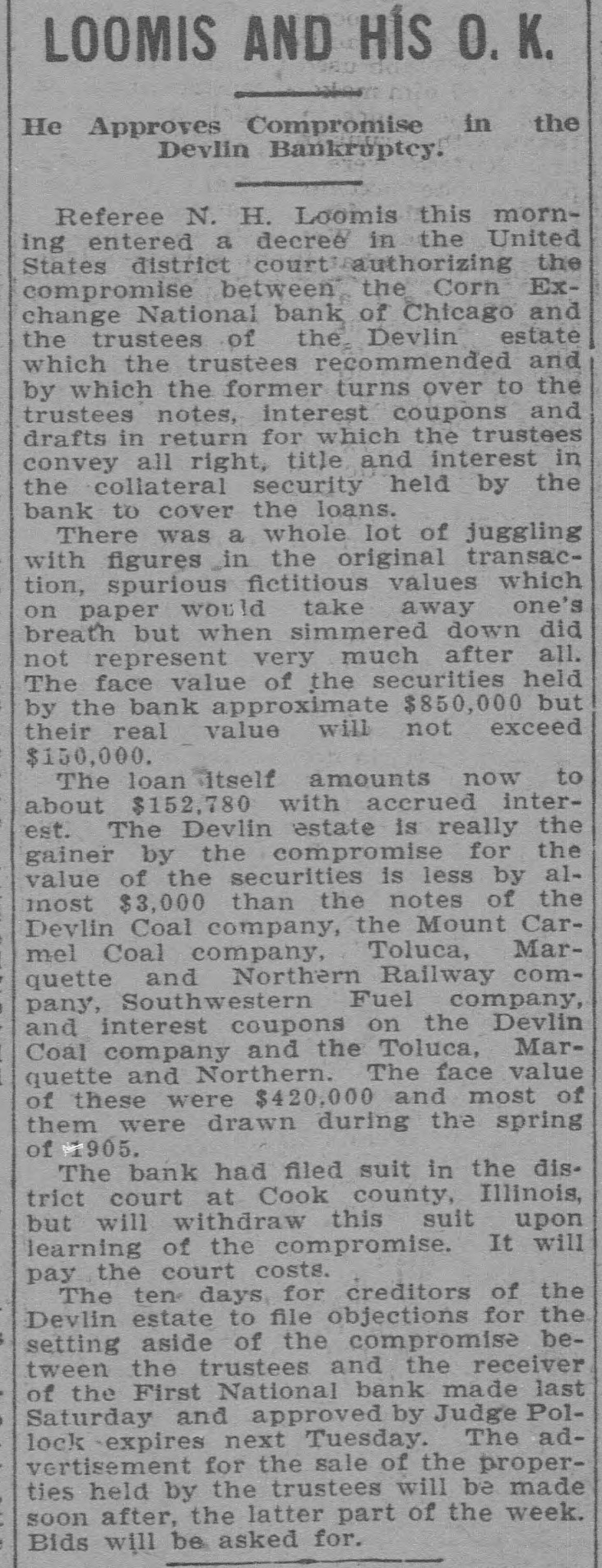
LOOMIS AND HIS 0. K. He Approves Compromise in the Devlin Bankruptcy. Referee N. H. Loomis this morning entered a decree in the United States district court1sauthorizing the compromise between the Corn Exchange National bank of Chicago and the trustees of the Devlin estate which the trustees recommended and by which the former turns over to the trustees notes, interest coupons and drafts in return for which the trustees convey all right, title and interest in the collateral security held by the bank to cover the loans. There was a whole lot of juggling with figures in the original transaction, spurious fictitious values which on paper would take away one's breath but when simmered down did not represent very much after all. The face value of the securities held by the bank approximate $850,000 but their real value will not exceed $150,000. The loan itself amounts now to about $152,780 with accrued interest. The Devlin estate is really the gainer by the compromise for the value of the securities is less by almost $3,000 than the notes of the Devlin Coal company, the Mount Carmel Coal company, Toluca, Marquette and Northern Railway company, Southwestern Fuel company, and interest coupons on the Devlin Coal company and the Toluca, Marquette and Northern. The face value of these were $420,000 and most of them were drawn during the spring of 1905. The bank had filed suit in the district court at Cook county, Illinois, but will withdraw this suit upon learning of the compromise. It will pay the court costs. The ten days for creditors of the Devlin estate to file objections for the setting aside of the compromise between the trustees and the receiver of the First National bank made last Saturday and approved by Judge Pollock expires next Tuesday. The advertisement for the sale of the properties held by the trustees will be made soon after, the latter part of the week. Bids will be asked for.


Article from Ottumwa Tri-Weekly Courier, September 15, 1906

Click image to open full size in new tab

Article Text

TAKING OUT MONEY. The world of fianance feels the first flutter of distrust. Depending upon the circumstances sometimes it is to a high degree and sometimes lower. In Chicago the result of the Stensland bank scandal has been a falling off in deposits in the other banks to the amount of three per cent. Going out through hundreds of different persons it is hard to tell what is being done with it. This is the time of the year when the savings on deposit begin to increase, but under the abnormal conditions in Chicago the unusual results. Some of it may be placed in the strong boxes, some may have thought it safer to invest in real estate than to place money in the banks, and some may have concluded that they might as well spend it themselves as to have somebody else spend it. But it is gone from the vaults and the books of the banks. Perhaps the wonder should be that more have not withdrawn their deposits, but the greater portion of the people are reasonable and have an ordinary amount of business sense. They know that where there is one who would steal their savings there are a thousand who will protect them. The run on the Pullman bank was stopped by the action of some of the "kings" of the foreign element in the car shop town, who had faith in the institution to such an extent that in the face of the mob that was demanding its money they went calmly in and laid down more that was to be placed upon deposit to their credit. Example was better than precept and was sufficient to convince the more ignorant, who follow their leaders, who are depended upon to know better the ways of the American, that there was nothing to fear.


Article from The Topeka State Journal, October 28, 1907

Click image to open full size in new tab

Article Text

PAYING WITH CHECKS. Chicago Banks Are Hanging On to Their Cash. Chicago, Oct. - -The banks of this city are today largely upon a checking basis. They refuse to pay out large amounts of currency, and will not return to paying in cash until the finan-cial condition in the east improves. Depositors seeking today to withdraw money were given checks of the bank instead of cash. Commercial depositors are allowed to draw the full amount of their balances, but must accept the bank's checks instead of currency. The rule requiring savings bank depositors to give thirty days' notice before drawing out less than $100, and 60 days' notice before drawing out more than $100 was also put in force. The local banks declare they were compelled to adopt these rules because of the action taken by the banks in the east, which would soon have drained this city of its cash resources. Within an hour after the opening of the doors fully 400 people were lined up at the withdrawal windows of the Illinois Trust and Savings bank, which has the largest number of savings accounts in the city. Depositors were allowed, if they wished to take out sums under $100, but for all amounts over, the full legal notice was required. The majority of those in the banks during the early part of the day gave notice of their intention to draw money. There was no excitement. In the Hibernian Savings bank about 100 people had given notice of withdrawal by 11 o'clock and many more were waiting in line. At all other savings banks business appeared to be on a normal basis. Depositors having checking accounts did not appear to be worried in the least by the situation and business proceeded upon normal lines in all the banks.


Article from The Madison Daily Leader, October 29, 1907

Click image to open full size in new tab

Article Text

NOT GIVEN ACTUAL CASH. Chicago Depositors Paid by Check on Withdrawal. Chicago, Oct. 29.-The banks of this city are largely upon a checking basis. They have taken the step of refusing to pay out large amounts of currency and will not return to the former manner of doing business until the financial condition in the East improves. In all banks belonging to the Clearinghouse association or affiliated with it depositors seeking to withdraw money were given checks of the bank itself instead of the actual cash. The depositors are allowed to draw the full amount of their balances, but they were compelled to accept the bank's checks instead of currency. The rule requiring savings bank depositors to give thirty days' notice before drawing out less than $100 and sixty days' notice before drawing out more than $100 was also put in force. The local banks declare that they were compelled to adopt these rules because of the action taken by the banks in the East, which would soon have drained this city of its cash resources. Within an hour after the opening of the doors fully 400 people were lined up at the withdrawal windows of the Illinois Trust and Savings bank, which has the largest number of savings accounts in the city. Depositors were allowed, if they wished, to take out sums under $100, but for all amounts over this the full legal notice was required. The general agreement on the part of the banks to protect their supplies of currency affected the city government. City Treasurer Traeger ran short of cash and City Comptroller Wilson stopped the payment of the salaries of city employes by checks on the city treasury.


Article from The Washington Herald, October 30, 1907

Click image to open full size in new tab

Article Text

WEST REPORTS ARE ALL RIGHT Financial Situation There Is Declared to Be Satisfactory. Check and Certificate Plan Said to Be Working Well in All Sections, Chicago, Oct. 29.-There is better conditions among Chicago banks, there being fewer people at the tellers' windows. giving notice of withdrawals of funds. Depositors seem to be firmly assured of the strength of the local banks. At four of the largest savings banks, which have an aggregate of 250,000 depositors, it was reported that the number of sixtyday notices for withdrawals filed on Monday did not exceed 500. Depositors who give notice of withdrawals now lose interest at the rate of 3 per cent from July 1. Bankers generally feel that Chicago and other points will be in position to return to a currency basis again within thirty days. The continued movement of produce for export is growing to proportions that will warrant large importations of gold for some time to come. The movement of currency from Chicago to the interior has been nearly as large in October thus far as it was last year, when local banks made their high record shipments of more than $30,000,000. The decision made by Chicago clearinghouse banks on Monday not to send any more currency to the country until the present crisis is past has developed that country banks have drawn heavily upon Chicago for currency, in anticipation of such a step being taken. Rural institutions are believed, therefore, to be very strongly intrenched, and since banks in the clearing-house association at all money centers have thrown a safeguard around their money supplies, the country banks have been constrained to adopt similar measures, but their position in these matters is entirely individual and local in effect. If country banks can hold their communities to the custom of paying and receiving in checks, such as is now in vogue in all the cities, trouble probably will be averted. The position of country banks in this respect can well be realized when it is taken into consideration that these interior institutions have carried larger surpluses of money than ever before in history, due to the abnormal prosperity in agricultural districts in the West. But, at the same time, the banks have been eager to make money, and funds available in excess of the 15 per cent reserve requirements have been allowed to remain in the hands of reserve agents of the money centers for investment in commercial paper at the high rates of interest which have prevailed throughout the summer and fall.


Article from The Birmingham Age-Herald, October 31, 1907

Click image to open full size in new tab

Article Text

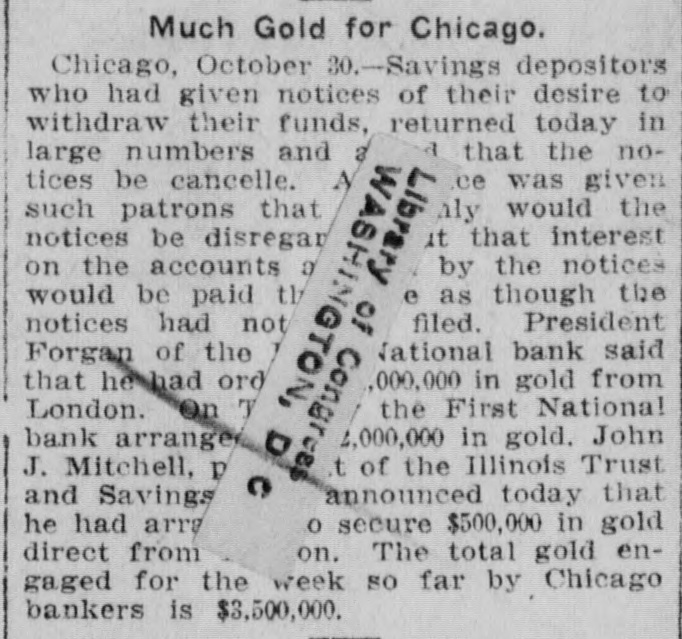
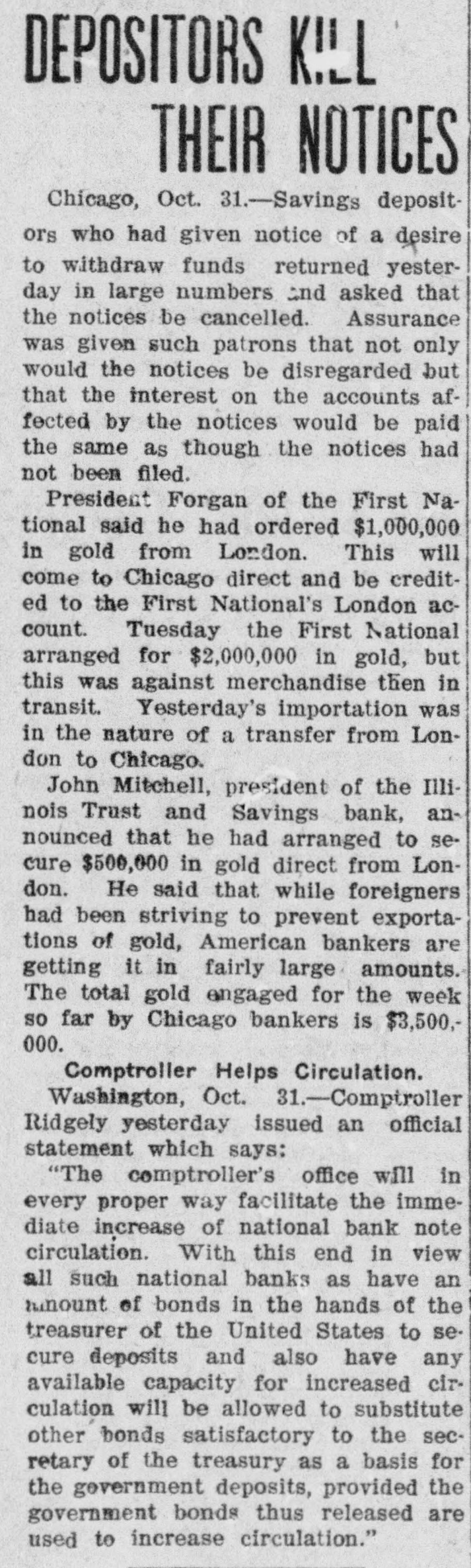
Much Gold for Chicago. Chicago, October 30.-Savings depositors who had given notices of their desire to withdraw their funds, returned today in a that the nolarge numbers and of tices be cancelle. ce was given such patrons that aly would the it that interest notices be disregar on the accounts by the notices e as though the would be paid tl filed. President notices had not National bank said Forgan of the that he had ord ,000,000 in gold from London. On y / the First National 4,000,000 in gold. John bank arrange DE t of the Illinois Trust J. Mitchell, p announced today that and Savings he had arry o secure $500,000 in gold direct from on. The total gold engaged for the week so far by Chicago bankers is $3,500,000.


Article from The Citizen-Republican, October 31, 1907

Click image to open full size in new tab

Article Text

# CHICAGO BANKS ON # A CHECKING BASIS Chicago, Oct. 30. -The banks of this city are today largely upon a checking basis. They refuse to pay out large amounts of currency, and will not return to paying cash until the financial condition in the east improves. Depositors seeking today to withdraw their money were given checks on the bank instead. Commercial depositors were allowed to draw the full amount of their balances, but they must accept bank checks instead of currency. The rule requiring savings bank depositors to give thirty days' notice before drawing out less than $100, and sixty days' notice before drawing out more than $100 was also put in force.


Article from The Worthington Advance, November 1, 1907

Click image to open full size in new tab

Article Text

# NOT GIVEN ACTUAL CASH. Chicago Depositors Paid by Check on Withdrawal. Chicago, Oct. 28. -The banks of this city are largely upon a checking basis. They have taken the step of refusing to pay out large amounts of currency and will not return to the former manner of doing business until the financial condition in the East improves. In all banks belonging to the Clearing-house association or affiliated with it depositors seeking to withdraw money were given checks of the bank itself instead of the actual cash. The depositors are allowed to draw the full amount of their balances, but they were compelled to accept the bank's checks instead of currency. The rule requiring savings bank depositors to give thirty days' notice before drawing out less than $100 and sixty days' notice before drawing out more than $100 was also put in force.


Article from Lewiston Evening Teller, November 22, 1907

Click image to open full size in new tab

Article Text

Chicago banks are ready to resume cash business and will do so whenever New York banks consent and co-operate. The magnates who have been asking the people to have confidence can now reciprocate and loosen up the wheels of trade bot' east and west. It was the east that locked the doors on western reserves and started the flurry among western institutions. but in spite of that the west has had no run on its. banks and has only used due precaution In guarding its cash waiting for the east to get over its scare and resume normal business relations. New York can very properly be instructed that the only proper way to resume is to resume.


Article from The Maui News, November 23, 1907

Click image to open full size in new tab

Article Text

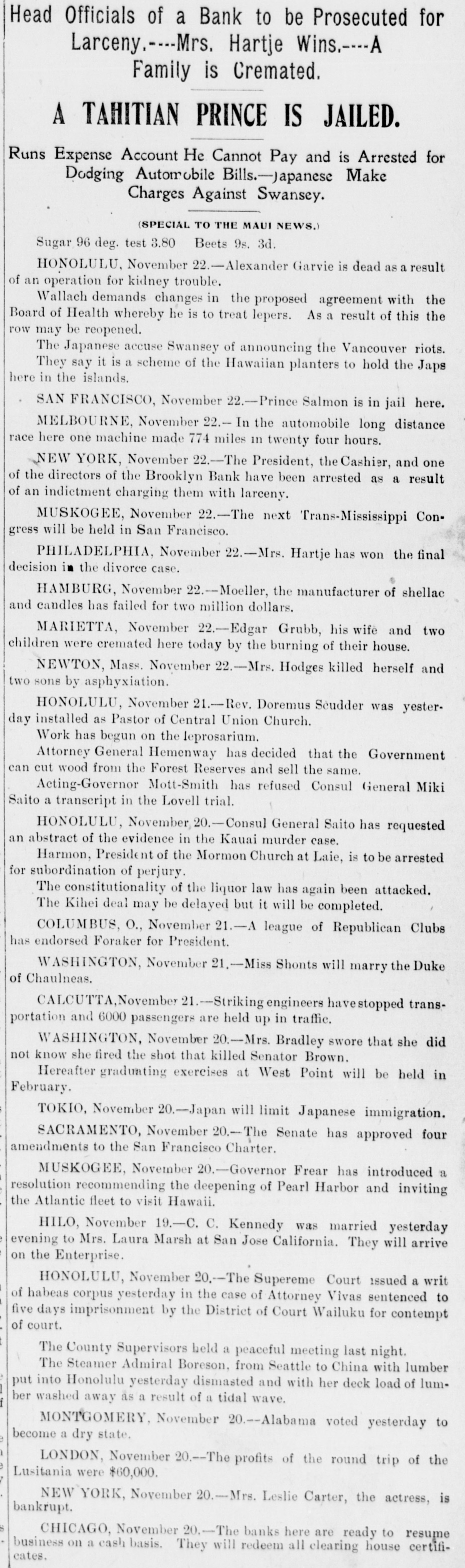
Head Officials of a Bank to be Prosecuted for Larceny.----Mrs. Hartje Wins.----A Family is Cremated. A TAHITIAN PRINCE IS JAILED. Runs Expense Account He Cannot Pay and is Arrested for Dodging Autorrobile Bills.-Japanese Make Charges Against Swansey. (SPECIAL TO THE MAUI NEWS.) Sugar 96 deg. test 3.80 Beets 9s. 3d. HONOLULU, November 22.-Alexander Garvie is dead as a result of an operation for kidney trouble. Wallach demands changes in the proposed agreement with the Board of Health whereby he is to treat lepers. As a result of this the row may be reopened. The Japanese accuse Swansey of announcing the Vancouver riots. They say it is a scheme of the Hawaiian planters to hold the Japs here in the islands. SAN FRANCISCO, November 22.-Prince Salmon is in jail here. MELBOURNE, November 22.- In the automobile long distance race here one machine made 774 miles in twenty four hours. ,NEW YORK, November 22.-The President, the Cashier, and one of the directors of the Brooklyn Bank have been arrested as a result of an indictment charging them with larceny. MUSKOGEE, November 22.-The next Trans-Mississippi Congress will be held in San Francisco. PHILADELPHIA, November 22.-Mrs. Hartje has won the final decision in the divorce case. HAMBURG, November 22.--Moeller, the manufacturer of shellac and candles has failed for two million dollars. MARIETTA, November 22.-Edgar Grubb, his wife and two children were cremated here today by the burning of their house. NEWTON, Mass. November 22.-Mrs. Hodges killed herself and two sons by asphyxiation. HONOLULU, November 21.-Rev. Doremus Seudder was yesterday installed as Pastor of Central Union Church. Work has begun on the leprosarium. Attorney General Hemenway has decided that the Government can cut wood from the Forest Reserves and sell the same. Acting-Governor Mott-Smith has refused Consul General Miki Saito a transcript in the Lovell trial. HONOLULU, November -Consul General Saito has requested an abstract of the evidence in the Kauai murder case. Harmon, President of the Mormon Church at Laie, is to be arrested for subordination of perjury. The constitutionality of the liquor law has again been attacked. The Kihei deal may be delayed but it will be completed. COLUMBUS, O., November 21.-A league of Republican Clubs has endorsed Foraker for President. WASHINGTON, November 21.-Miss Shonts will marry the Duke of Chaulneas. CALCUTTA,November 21.-Striking engineers havestopped transportation and 6000 passengers are held up in traffic. WASHINGTON, November 20.-Mrs. Bradley swore that she did not know she fired the shot that killed Senator Brown. Hereafter gradunting exercises at West Point will be held in February. TOKIO, November 20.-Japan will limit Japanese immigration. SACRAMENTO, November 20.-The Senate has approved four amendments to the San Francisco Charter. MUSKOGEE, November 20.-Governor Frear has introduced a resolution recommending the deepening of Pearl Harbor and inviting the Atlantic fleet to visit Hawaii. HILO, November 19.-C. C. Kennedy was married yesterday evening to Mrs. Laura Marsh at San Jose California. They will arrive on the Enterprise. HONOLULU, November 20.--The Supereme Court issued a writ of habeas corpus yesterday in the case of Attorney Vivas sentenced to five days imprisonment by the District of Court Wailuku for contempt of court. The County Supervisors held a peaceful meeting last night. The Steamer Admiral Boreson, from Seattle to China with lumber put into Honolulu yesterday dismasted and with her deck load of lumber washed away as a result of a tidal wave. MONTGOMERY, November 20.--Alabama voted yesterday to become a dry state. LONDON, November 20.--The profits of the round trip of the Lusitania were $60,000. NEW YORK, November 20.-Mrs. Leslie Carter, the actress, is bankrupt. CHICAGO, November 20.-The banks here are ready to resume business on a cash basis. They will redeem all clearing house certificates.


Article from The Birmingham Age-Herald, November 26, 1907

Click image to open full size in new tab

Article Text

Resumption Past and Present Although the gold engagements now aggregate $85,000,000 the cash reserve in the clearing-house banks of New York was increased last week to the extent of only $436,650. It now stands at 19.9 per cent of the total deposits. It is short $54,103,600 of the 25 per cent required by law. And yet the state banks in Chicago hold the largest cash reserve in their entire history. They have in cash $102,339,497, or 30.03 per cent of their deposits. The reserves in Chicago are being increased rapidly. If New York sends money to Chicago to move crops, it is plain Chicago is not sending plain everyday cash to the lesser cities in the wheat belt. The banks everywhere are reducing loans, and are accumulating specie, and the inquiry begins to arise as to when they will get back to a currency basis. Chicago is awaiting a cue from New York. Chicago is ready for a resumption of cash payments. In 1893 a panic was precipitated by the failure of the Erie railroad on July 26, and gold imports were resorted to just as they have been this year. On September 2 the banks returned to a cash basis-just 39 days. Already 32 days have elapsed in the course of the present financial troubles, and unless resumption come in the next six days the present tie-up will outlast that of 1893. "The root of the whole trouble," says the Philadelphia Inquirer, "is in New York and it is to be found in the thoroughly selfish and short-sighted policy of its banks. Although millions of Philadelphia money are on deposit there, they are refusing to accept Philadelphia checks except for collection, and are playing the part of the dog in the manger. Were some big New York bank to announce its readiness to pay all comers in cash the deadlock would be broken, the financial machine would get off the 'dead center' and business would again begin to hum. As Horace Greeley once remarked, the way to resume is to resume." The suspension of cash payments lasted eight weeks in 1857, and a little less than six weeks in 1873, and in 1893 full resumption came in New York in a little over five weeks. Confidence in the soundness of the banks and in the general trade of the country has returned, and there seems to be no reason why the country cannot safely come back to a cash basis, even if New York in its desire to help crop-movers has not been able to accumulate the legal requirement in cash reserves.


Article from Omaha Daily Bee, November 28, 1907

Click image to open full size in new tab

Article Text

It Will Cost Millions and Much Time to Regain It. BANKERS BLAME IT FOR PANIC Westerners Believe New York Sought to Protect Itself Only. FORGAN BACK FROM WASHINGTON Three Hundred Bankers in Mid-West Write that They Are Ready to Do Business on Cash Basis. Nov. 27.-Former Secretary Leslie M. Shaw, of NEW the Treasury YORK, president returned Carnegie Trust company, York yesterday from conferred with many of to where the New he Chicago, bankers In disregarding the financial gituation. cussing conditions, he said: west has lost confidence in the will cost us here of we regain the east. dollars "The It before prestige millions The men and relationship of the past. west say that refor the financial of cordial sponsible the New stringency; York is that came the to clearing York when the resorted squeeze banks house of of certifi- New the cates first and forced the rest country to do the same. The bankers of western cities have no love now for the bankers of New York. They had placed their money on deposit here, but when they asked for it they were refused. They say New York sought to protect only itself and tied up everything so that all the rest of the country was forced to adopt urgent measures to save itself. Lazard Freres announced the engagement of $1,000,000 in gold today. This brings the total during the present movement to $88,400,000. Forgan Back from Washington. CHICAGO, Nov. 27.-James B. Forgan, president of the First National bank, returned yesterday from Washington. where he had a conference with President Roosevelt regarding the financial situation. "I was a busy man during the three and a half hours I spent in Washington," said Mr. Forgan. "The president asked many questions concerning the financial situation in Chicago and other western cities and I gave him my views. I told him matters were improving every day and I was hopeful that normal currency payments would be resumed before long. He seemed glad to receive this information." Nearly 700 letters were received yesterday from western bankers by the Chicago Clearing house committee in response to the letter sent out asking their views on the resumption of normal currency payments. Most of the letters indicated that the bankers were ready and desirous of resuming currency payments. The letters are from bankers in Illinois, Iowa, Michigan, Kansas, Nebraska, Minnesota, Wisconsin and Missouri. Bankers in the far west have not had time to reply. Washington Situation Better. WASHINGTON Nov. 27. .-The situation at the treasury was so far relaxed this afternoon that Secretary Cortelyou was able to leave early to attend the wedding of Miss Rott and Lieutenant Grant. There is no longer any doubt felt among treasury officials of the success of both the loans-the Panama canal bonds and the one-year treasury certificates. If considerably lless than $1,000,000,000 is alloted in the certificates it will not be because the subscriptions are not more than sufficient to cover the amount. It will be because so large an issue 18 no longer felt to be necessary to restore the situation. Calculations are already being made as to the probable conditions in the money market next spring and the ability to call in part of the certificates. If the amount issued should be only $50.000.000 and half of these should be paid off in six months, the interest charges would fall materialy below the $3,000,000 originally calculated upon the full issue for one year. The sum of $25,000,000 for six months would draw interest to the amount of $375,000 and an additional amount of $25,000,000 for one year would draw $750,000. making a total of $1,125.I 000. This would be at the rate of less than 1 1/2 cents per capita for the people h of the country, and it is argued that this would be a cheap means of escape from difficulty even for the humbleat citizen, 1 whose labor might be affected by the con) tinuance of the crisis. Des Moines is Ready. 1 DES MOINES, Nov. 27.-A circular to I the banks of Iowa has been sent out by ) the Des Moines clearing house committee urging them to aid in an effort to get currency in circulation so that Des Moines banks will be ready to follow the lead of Chicago and New York and resume currency payments in full in two weeks. ASSIST THE FARMERS


Article from Imperial Valley Press, January 11, 1908

Click image to open full size in new tab

Article Text

NEWS IN BRIEF Happenings of the Week Boiled Down For Busy Readers New York landlords cause great suffering to poor people on East Side by wholesale evictions. U.S. Senator Owen, of Oklahoma, accused of acquiring illegally 4,000 acres of land from Indians. Chicago banks have returned to cash basis and financial situation is just what it was before the pinch. President Roosevelt denounces the patronage system and urges enforcement of civil service rules in Census Bureau. Chicago Great Western railroad has been placed in lhe hands of receivers. Overcapitalization caused the trouble. H.O. Havemeyer's will leaves estate of $25,000,000 to widow and three children. No bequests to public institutions. Many gun fights, assaults and on in of tumults Brooklyn and New other Year's camps day the wild and woolly east. This is really important. Los Angeles court decides that a woman need not pay for a tailormade suit that doesn't fit. George Pettibone, accused of complicity in murder of Ex-Gov. Steunenberg, of Idaho, acquitted. Case against Moyer dismissed. District Court of Austin, Texas, appoints receiver to take charge of all property in the state belonging to Standard Oil. Proceedings to dissolve combination between Union Pacific and Southern Pacific to be begun soon by Attorney-General Bonaparte. London Times passes from control of Walter family and into hands of C. A. Pearson, publisher of several newspapers and magazines. Jury in Caleb Powers case disagrees, ten for acquittal and two of for conviction. Fifth trial Powers for the murder of Goebel set for July 6. John D. Rockefeller gives $2, 000,000 to Chicago University as New Year present, making total contribution more than $23, ,000,000. But he hasn't paid that fine yet. United States Supreme Court, by five to four, decides that the employers' liability act, applicable to common carriers engaged in interstate commerce, is unconstitutional. F. Augustus Heinze, the copper operator, indicted and arrested in New York for aiding his brother in looting the Mercantile National Bank to the tune of $400,000. Fowler banking bill proposes to retire all outstanding national bank bond secured notes, and thorizes in lieu thereof a currency based on the general assets of the bank. Hudson Maxim announces invention of torpedo boat to travel


Article from The Idaho Republican, September 29, 1920

Click image to open full size in new tab

Article Text

something that happened ten years after the other events that I told you about when he used his fortune to prevent a panic and to keep business stabilized. You may wonder why I am saying so much about Marshall Field, but to me he is a dictionary of good business principles and we ca.. afford to saturate ourselves in them. We can afford to study his operations a great deal and take plenty of time to let it soak into us. What I told you about how he prevented a painic during the world's fair applies in some measure to a condition right here in Bingham county at the present time. This other story that I am going to tell you is a little different but it applies to a set of circumstances that confront somebody in Bingham county right now. Thoughtful persons will see the connection and will draw a lesson from it and apply it to their business transactions, to their own advantage and the advantage of their fellow men in the county. # Walsh Bank Failure About the beginning of the present century John R. Walsh was the president of the First National bank of Chicago. It was a very strong bank and Mr. Walsh was a big man in business. He conceived a plan to build a connecting line with the Chicago & Central Illinois railroad to tap the coal mines of Central Illinois and taking a direct short cut into Chicago. It was a good enterprise, a bold stroke and was capable of releiving some of the other roads of their burdens of freight, and quickening the delivery of coal into Chicago. Mr. Walsh thought he could build the road and he went about it with his private fortune. When his own money was used up he used the bank's money, loaning it to himself and his railroad company. In doing this he violated the banking laws more severely than the Anderson bank at Idaho Falls violated the banking laws when it loaned upwards of a hundred thousand dollars to A. J. Stanger, who went about buying sheep and writing checks on the Anderson bank when he had no money to his credit. It was against the law for the Anderson bank to loan more than $40,000 to any one man. It was a violation of the laws for Mr. Walsh to take money out of the First National Bank of Cnicago to back his railroad enterprise. Before the road was completed Mr. walsh and the bank were in so deep that they were financially embarrassed and had to give an accounting and 'fess up. If Mr. Walsh had succeeded with his enterprise he would have come thru all right and he would have been considered a great man. # Big Bank Failure Mr. Walsh failed and the bank failed for many millions. Big failures like this are what start financial panics. When one firm cannot pay, another firm depending on them canot pay and many other firms depending on them fail, and so the damage goes on down the line until everybody connected wtih it fails. Then all the firms depending on these firms are embarrassed, they cannot pay their employes and their various other obligations, work stops pay checks do not come any longer, families go hungry, and there is a condition which we call a panic. # Consternation Among Bankers The First National Bank of Chicago was such a large bank, such a financial pillar for all the other banks in the city, that they called a meeting to see what could be done. It was a terrible surprise to find that this man walsh had goth in so deep and was involved in criminal charges. It was a terrible shock to all the other bankers to find that what was supposed to be one of the best banks in town was involved in failure and that involved them and they too, might fail. All of the enterprises depending on their own banks might fail and as they considered the matter there seemed to be no end to the failures that were likely to follow. These men sat in conference all day and all night trying to plan some way to prevent the failure. This tremendous amount of debts was no obligation of theirs and it was a criminal affair. The men responsible for it could not pay and it was not their own debt to pay, so they spent a great deal of time going over the matter to see how it all came about. But after they had been in conference twenty-four hours they were still confronted with the fact that the firm had failed and that unless something was done pretty quick, other firms would fail


Article from The Idaho Republican, September 29, 1920

Click image to open full size in new tab

Article Text

# Beets, Politics and Progress By Byrd Trego Chapter XXV I want to tell you another story about Marshall Field. It is about something that happened ten years after the other events that I told about when he used his fortune to prevent a panic and to keep business stabilized. You may wonder why I am saying so much about Marshall Field, but to me he is a dictionary of good business principles that we can afford to saturate ourselves in them. We can afford to apply his operations a great deal and take plenty of time to let it soak into us. What I told you about how he prevented a painic during the World's fair applies in some measure to the condition right here in Bingham county at the present time. This other story that I am going to tell you is a little different but it applies to a set of circumstances that confront somebody in Bingham county right now. Thoughtful persons will see the connection and will draw a lesson from it and apply it to their business transactions, to their own advantage and the advantage of their fellow men in the county. # Walsh Bank Failure About the beginning of the present century John R. Walsh was the president of the First National bank of Chicago. It was a very strong bank and Mr. Walsh was a big man in business. He conceived a plan to build a connecting line with the Chicago & Central Illinois railroad to reach the coal mines of Central Illinois and taking a direct short cut into Chicago. It was a good enterprise, a bold stroke and was capable of relieving some of the other roads of their burdens of freight, and quick-ing the delivery of coal into Chicago. Mr. Walsh thought he would build the road and he went at it with his private fortune. When his own money was used up he used the bank's money, loaning it to himself and his railroad company. In doing this he violated the banking laws more severely than the Anderson bank at Idaho Falls violated the banking laws when it loaned upwards of a hundred thousand dollars to A. J. Stanger, who went about buying sheep and writing checks on the Anderson bank when he had no money to his credit. It was against the law for the Anderson bank to loan more than $40,000 to any one man. It was a violation of the laws for Mr. Walsh to take money out of the First National bank of Chicago to back his railroad enterprise. Before the road was completed Mr. walsh and the bank were in so deep that they were financially embarrassed and had to give an accounting and 'fess up. If Mr. Walsh had succeeded with his enterprise he would have come thru all right and he would have been considered a great man. # Big Bank Failure Mr. Walsh failed and the bank closed for many millions. Big failures like this are what start financial panics. When one firm cannot pay, another firm depending on them canot pay and many other firms depending on them fail, and the damage goes on down the line with everybody connected wtih it. Then all the firms depending on these firms are embarrassed, they cannot pay their employes and their various other obligations, work stops and checks do not come any longer, families go hungry, and there is a condition which we call a panic. It was Sunday and as the day wore away with men coming and going and a large conference in session all the time, they decided to send for Marshall Field and see what he would say about it. # Marshall Field's Advice Mr. Field threw a bomb into that conference of bankers and financiers by telling them to pool their interests and pay off the tremendous pile of debts contracted by Mr. Walsh and pour enough money into the treasury of the First National bank of Chicago to pay all its obligations and to stop the run on the bank and make it perfectly safe. # The Bankers' Surprise Imagine the surprise of these bankers when he told them to put up their own good money to pay the obligations of other men and a competitive bank engaged in criminal operations. But Marshall Field stood pat. He analyzed the situation on a big broad plan and told them that they had enough money to do this, that there was plenty of it to cover the losses and save everybody from peril. That if they did not do this a panic was sure to follow and the losses they would sustain in the panic would be tremendous, not counting the losses of all the others who were unable to do anything to prevent disaster. He explained to them the disastrous effect of the panic on the city of Chicago, the state of Illinois and the states of the Union doing business with them. He pictured to them the opposite effect. The effect of saving everybody by this generous act and of the effect that would have on the commercial confidence on the state and nation. He talked to them for two hours and then retired. Ten years before that he had talked to them about a similar matter during a panic and they had refused to act on his advice. He went out and acted on his own advice himself and became famous for it. Now he had again offered them this advice and they did not exactly refuse it, but they did not accept it. Before the meeting adjourned they adopted a resolution that they themselves would put up their own money to protect from losses all the people who were affected by a criminal man carrying on criminal transactions thru a competitive bank that was busted. On Monday morning they poured their millions of dollars into the treasury of that bank and kept pouring it in until the run on the bank was satisfied, obligations all paid and confidence fully restored. # Our Beet Scrip Panic If you remember the panic of 1907 and of how it embarrassed you remember that about three or four years before that there was another panic under way which was prevented by that two hours' talk of Marshall Field before those bankers on a certain Sunday afternoon. There isn't any bank that can fail in a city without causing losses to all the other banks and business houses. There isn't any firm operating in Bingham county that can fail without causing some losses to some other people. If there is any large firm operating in Bingham county that should fail it would affect many people. It is our duty to ourselves and others to so arrange our business and patronage that every firm that is rendering a needed service on right principles shall have a good chance to succeed. (To be continued.).


Article Text

CLEARING HOUSE SCRIP AIDS CITY IN PANIC OF 1907 Recall Successful Operation of Certificates. Issuance of clearing house certifiChicago during money panic recalled yesterday many banking authorities considered adoption of the system operated satisfactorily quarter century ago. famine forced Chicago deposit the 1907 October of and demand for some medium exchange the special of Bankers for begged revision the laws. were advocated. Plea for Certificates. On the John late R. Thompthen county treasurer. the late Forgan, president the National bank. joined in for certificates. officials of the clearing they would adopt the proposal the movement sufficient impetus. Business leaders announced they would accept the certificates. Labor unions and other workers joined in the demand. For time agitation ceased when $3,500,000 gold was brought First National bank from London. It carried across the ocean on the Lusitania which was sunk torpedo ten years later in the greatest marine tragedies the Only Temporary Relief. This offered only temporary relief cry for certificates sumed. On Nov. the first cates [about $200,000 worth] were leased. Within three days there more than of the checks in circulation. The certificates were issued in $1, and $10 each denomination on paper of color. In appearance they resembled They Stocks bonds total value onethird than the amount of the certificates circulation were deposited for the checks. The certificates ac. cepted throughout the city and them found they back to the banks deposits. Spreads to Other Cities. Soon the plan spread to other cities also proved Within two weeks Banker Forgan initiated resume currency After with banks in the midwest the certifi. from circulation. By the middle of Decem ber, at the expiration of the period of had to reney payment. With resumption of currency payments deposits with drawals almost normal course the great panic of 1907 became history. D. Kelly. president of The Fair store, who was the organizers of the plan the clearing house certificates recalled those times last night. The clearing house certificates worked." said Kelly. turned out to be very practical."