New Orleans Clearing House (New Orleans, LA)

Episode Information

Episode UID
7448954991294
Episode Type
Suspension โ†’ Reopening
Bank Type
trust
Bank ID
744895499 hash
Start Date
October 29, 1907
Location
New Orleans, Louisiana (29.955, -90.075)

Metadata

Model
gpt-5-mini (chosen from majority vote of a three-model LLM ensemble)
Short Digest
071ffbfc063b7295

Response Measures

None

Events (1)

1. October 29, 1907 Suspension
Cause Details
Clearing House association issued clearing house certificates, limited daily withdrawals and enforced 60-day rule to restrict outflows
Newspaper Excerpt
The decision of the Clearing House here to issue Clearing House certificates, to restrict the daily withdrawals of cash, and to enforce the sixty-day rule for savings deposits,
Source
newspapers

Newspaper Articles (3)

Article from New-York Tribune, October 30, 1907

Click image to open full size in new tab

Article Text

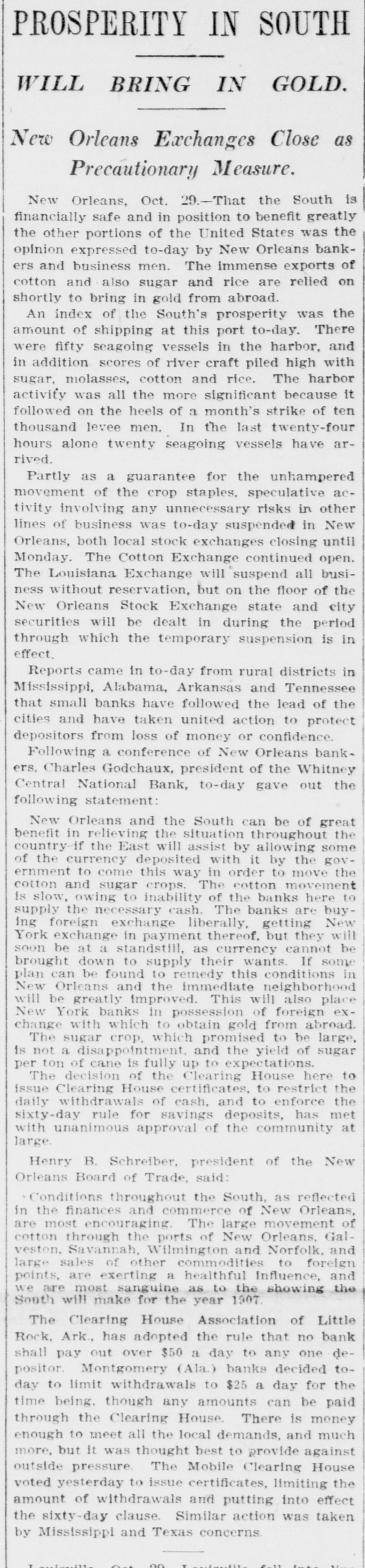
PROSPERITY IN SOUTH WILL BRING IN GOLD. New Orleans Exchanges Close as Precautionary Measure. New Orleans, Oct. 29.-That the South is financially safe and in position to benefit greatly the other portions of the United States was the opinion expressed to-day by New Orleans bankers and business men. The immense exports of cotton and also sugar and rice are relied on shortly to bring in gold from abroad. An index of the South's prosperity was the amount of shipping at this port to-day. There were fifty seagoing vessels in the harbor, and in addition scores of river craft piled high with sugar, molasses, cotton and rice. The harbor activity was all the more significant because it followed on the heels of a month's strike of ten thousand levee men. In the last twenty-four hours alone twenty seagoing vessels have arrived. Partly as a guarantee for the unhampered movement of the crop staples, speculative activity involving any unnecessary risks in other lines of business was to-day suspended in New Orleans, both local stock exchanges closing until Monday. The Cotton Exchange continued open. The Louisiana Exchange will suspend all business without reservation, but on the floor of the New Orleans Stock Exchange state and city securities will be dealt in during the period through which the temporary suspension is in effect. Reports came in to-day from rural districts in Mississippi, Alabama, Arkansas and Tennessee that small banks have followed the lead of the cities and have taken united action to protect depositors from loss of money or confidence. Following a conference of New Orleans bankers, Charles Godchaux, president of the Whitney Central National Bank, to-day gave out the following statement: New Orleans and the South can be of great benefit in relieving the situation throughout the country-if the East will assist by allowing some of the currency deposited with it by the government to come this way in order to move the cotton and sugar crops. The cotton movement is slow, owing to inability of the banks here to supply the necessary cash. The banks are buying foreign exchange liberally, getting New York exchange in payment thereof. but they will soon be at a standstill, as currency cannot be brought down to supply their wants. If some plan can be found to remedy this conditions in New Orleans and the immediate neighborhood will be greatly improved. This will also place New York banks in possession of foreign exchange with which to obtain gold from abroad. The sugar crop. which promised to be large, is not a disappointment, and the yield of sugar per ton of cane is fully up to expectations. The decision of the Clearing House here to issue Clearing House certificates, to restrict the daily withdrawals of cash, and to enforce the sixty-day rule for savings deposits, has met with unanimous approval of the community at large Henry B. Schreiber, president of the New Orleans Board of Trade, said: Conditions throughout the South, as reflected in the finances and commerce of New Orleans, are most encouraging The large movement of cotton through the ports of New Orleans, Galveston, Savannah, Wilmington and Norfolk, and large sales of other commodities to foreign points, are exerting a healthful Influence, and we are most sanguine as to the showing the South will make for the year 1907 The Clearing House Association of Little Rock, Ark., has adopted the rule that no bank shall pay out over $50 a day to any one depositor. Montgomery (Ala.) banks decided today to limit withdrawals to $25 a day for the time being. though any amounts can be paid through the Clearing House. There is money enough to meet all the local demands, and much more, but it was thought best to provide against outside pressure. The Mobile Clearing House voted yesterday to issue certificates, limiting the amount of withdrawals and putting into effect the sixty-day clause. Similar action was taken by Mississippi and Texas concerns 00


Article from The Birmingham Age-Herald, October 30, 1907

Click image to open full size in new tab

Article Text

SOUTH'S FINANCES ARE SANE AND SAFE New Orleans Bankers Express Satisfaction REPORTS ARE OPTIMISTIC News From Principal Southern States Indicates That Banks Are Solid and That the Crop Movement Is Good. New Orleans, October 29.-That the south is financially safe and in position to benefit greatly. the other portions of the United States was the opinion expressed today by New Orleans bankers and business men. The immense exports of cotton and also sugar and rice are relied on shortly to bring in gold from abroad. An index of the south's prosperity was the amount of shipping at this port today. There were fifty seagoing vessels in the harbor and in addition. scores of river craft piled high with sugar, molasses, cotton and rice. The harbor activity was all the more significant because it followed on the heels of a month's strike of 10,000 levee men. Within the past twentyfour hours alone, twenty seagoing vessels have arrived. Partly as a guarantee for the unhampered movement of the crop staples, speculative activity involving any unnecessary risks in other lines of business was today suspended in New Orleans, both local stock exchanges closing until Monday. The cotton exchange continued open. Reports came in today from rural districts in Mississiippi, Alabama, Arkansas and Tennessee that small banks have followed the lead of the cities and have taken united action to protect depositors from loss of money or confidence. Following a conference of New Orleans bankers, Charles Godchaux, produce ident of the Whitney Central National bank. today gave out the following: 'New Orleans and the south can be of great benefit in relieving the situation throughout the country if the east will assist by allowing some of the currency deposited with it by the government to come this way in order to move the cotton and sugar crops. "The cotton movement is slow. owing to the inability of the banks here to supply the necessary cash. The banks are buying foreign exchange liberally, getting New York exchange in payment therefor, but they will soon be at a standstill, as currency cannot be brought down to supply their wants. If some plan can be found to remedy this, conditions in New Orleans and the immediate neighborhood greatly This will improved. also will place be New York banks in possession of foreign exchange with which to obtain gold from abroad. "The sugar crop, which promised to be large, is not a disappointment and the yield of sugar per ton of cane is fully up to expectations. "The decision of the clearing house here to issue clearing house certificates to restrict the daily withdrawals of to enforce the deposits, has met cash, unanimous for savings and sixty-day with rule approval of the community at large.' Henry B. Schreiber, president of the New Orleans Board of throughout as "Conditions Trade, the said: south reflected in the finance and are most of The New large Orleans encouraging commerce movements of cotton ports of New Orleans. Wilmington and sales of other Savannah, and the large Galveston, through Norfolk points buyers are to healthful foreign commodities exerting a influence, and we are most 1 sanguine as to the showing the south


Article from Edgefield Advertiser, November 6, 1907

Click image to open full size in new tab

Article Text

# South Financially Safe. That the South is financially sound in position to benefit greatly other portions of the United States was the opinion expressed by Orleans bankers and business. The immense exports of cotton also sugar and rice are relied shortly to bring in gold from abroad. An index of the South's prosperity was the amount of shipping at port. There were fifty sea vessels in the harbor, and in addition scores of river craft piled with sugar, molasses, cotton and rice. The harbor activity was the more significant because it followed on the heels of a monster strike of 10,000 levee men. Within the past 24 hours alone 20 sea going vessels have arrived. Partly as a guarantee for the hampered movement of the staples, speculative activity involving any unnecessary risks in other lines of business was suspended in New Orleans, both local stock exchanges closing until Monday. The cotton exchange continued open. Reports came in from rural districts in Mississippi, Alabama, Kansas and Tennessee that the banks have followed the lead of cities and have taken united action to protect depositors from loss of money or confidence. # Cotton Movement Slow. Following a conference of New Orleans Bankers, Charles Godchaux, president of the Whitney Central National Bank, gave out the following: "New Orleans and the South will be of great benefit in relieving the situation throughout the country, and the East will assist by allowing some of the currency deposited with it by the government to come this way in order to move the cotton and sugar crops. "The cotton movement is slow, owing to inability of the banks here to supply the necessary cash. The banks are buying foreign exchange liberally, getting New York exchange in payment thereof, but they will soon be at a standstill, as currency cannot be brought down to supply their wants. If some plan can be found to remedy this conditions, New Orleans and the immediate neighborhood will be greatly improved. This will also place New York banks in possession of foreign exchange with which to obtain gold from abroad. "The sugar crop, which promises to be large, is not a disappointment and the yield of sugar per ton of cane is fully up to expectations. "The decision of the clearing house here to issue clearing house certificates to restrict the daily withdrawals of cash, and to enforce the 60-day rule for savings deposits, has met with unanimous approval of the community at large." Henry B. Schreiber, president of the New Orleans board of trade, said: "Conditions throughout the South as reflected in the finances and commerce of New Orleans are most encouraging. The large movements of cotton through the ports of New Orleans, Galveston, Savannah, Wilmington and Norfolk, and large sales of other commodities to foreign points, are exerting a healthful influence and we are not sanguine as to the showing the South will make in the year 1907."