8. Fairbanks Banking Company (Fairbanks, AK)

Bank Information

Episode Type
Run → Suspension → Closure
Bank Type
state
Start Date
January 4, 1911
Location
Fairbanks, Alaska (64.838, -147.716)

Metadata

Model
gpt-5-mini
Short Digest
8fe34592

Response Measures

Full suspension

Description

Bank closed/failure January 4, 1911; receivers appointed. Articles indicate a depositor run/large withdrawals and serious bank-specific problems (overdraft with Dexter Horton, many uncollectable loans). Bank did not reopen; receivers paid dividends and are liquidating assets.

Events (3)

1. January 4, 1911 Receivership
Newspaper Excerpt
Judge Overfield appointed Frank W. Hawkins and E.H. Mack, receivers ... The bank failed owing depositors $921,357.56, but of this sum $460,678.78 has been paid to them. The receiver has also paid all running expenses of the receivership to date. (Douglas Island News, 1913-01-08).
Source
newspapers
2. January 4, 1911 Run
Cause
Bank Specific Adverse Info
Cause Details
Shortage of cash due to overdraft with Dexter Horton and many uncollectable loans leading depositors to withdraw
Measures
None reported prior to closure; receivers later appointed to manage funds and pay dividends
Newspaper Excerpt
the bank has closed its doors, probably from a shortage O. ready cash, insufficient to meet a run of depositors that doubtless took place.
Source
newspapers
3. January 4, 1911 Suspension
Cause
Bank Specific Adverse Info
Cause Details
Bank failure due to insolvency: large overdraft with Dexter Horton, many bad/uncollectable notes and insufficient cash to meet withdrawals; led to closure and receivership
Newspaper Excerpt
At the time of the failure of the Fairbanks Banking Co. on January 4, 1911, Judge Overfield appointed Frank W. Hawkins and E.H. Mack, receivers
Source
newspapers

Newspaper Articles (4)

Article from Iditarod Pioneer, January 15, 1911

Click image to open full size in new tab

Article Text

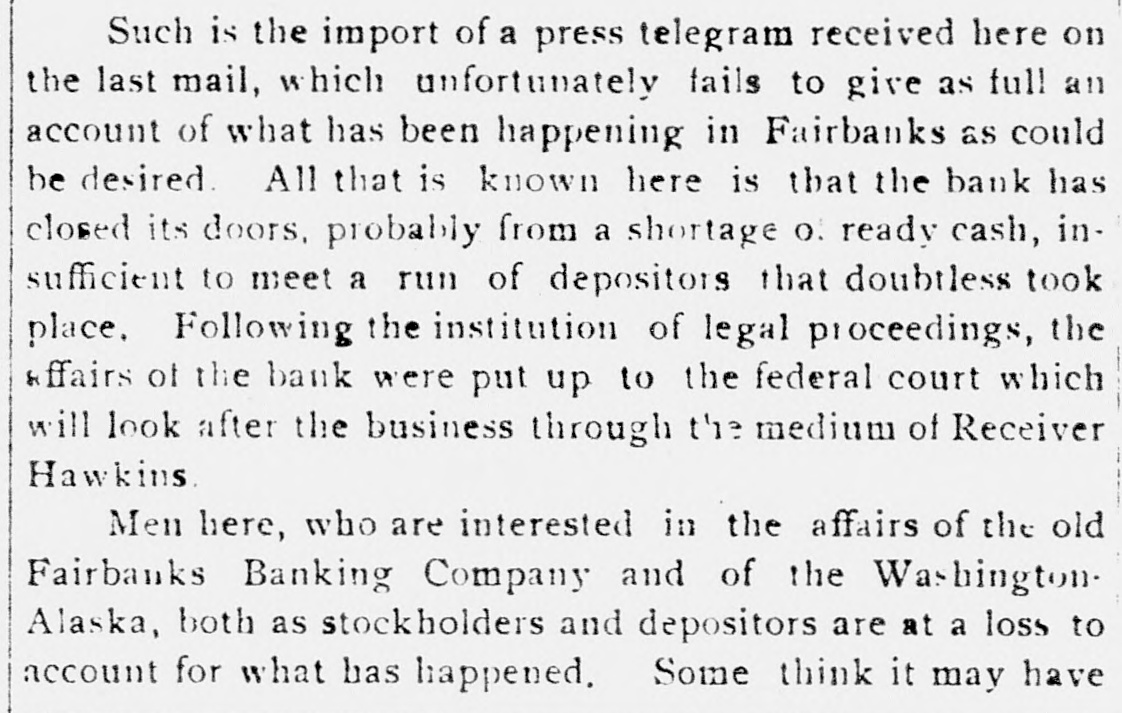
Such is the import of a press telegram received here on the last mail, which unfortunately fails to give as full an account of what has been happening in Fairbanks as could be desired All that is known here is that the bank has closed its doors, probably from a shortage O. ready cash, insufficient to meet a run of depositors that doubtless took place. Following the institution of legal proceedings, the ffairs of the bank were put up to the federal court which will look after the business through the medium of Receiver Hawkins Men here, who are interested in the affairs of the old Fairbanks Banking Company and of the Washington Alaska, both as stockholders and depositors are at a loss to account for what has happened. Some think it may have


Article from The Alaska Citizen, January 23, 1911

Click image to open full size in new tab

Article Text

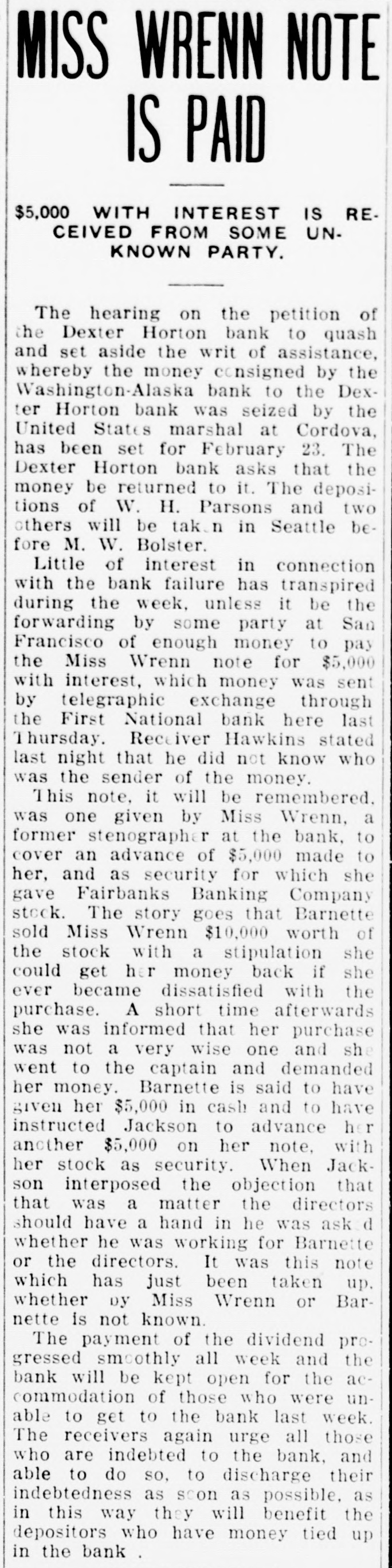
MISS WRENN NOTE IS PAID $5,000 WITH INTEREST IS RECEIVED FROM SOME UNKNOWN PARTY. The hearing on the petition of the Dexter Horton bank to quash and set aside the writ of assistance, whereby the money consigned by the Washington-Alaska bank to the Dexter Horton bank was seized by the United States marshal at Cordova, has been set for February 23. The Dexter Horton bank asks that the money be returned to it. The depositions of W. H. Parsons and two others will be taken in Seattle before M. W. Bolster. Little of interest in connection with the bank failure has transpired during the week. unless it be the forwarding by some party at San Francisco of enough money to pay the Miss Wrenn note for $5,000 with interest, which money was sent by telegraphic exchange through the First National bank here last Thursday. Receiver Hawkins stated last night that he did not know who was the sender of the money. This note, it will be remembered, was one given by Miss Wrenn, a former stenographer at the bank, to cover an advance of $5,000 made to her, and as security for which she gave Fairbanks Banking Company stock. The story goes that Barnette sold Miss Wrenn $10,000 worth of the stock with a stipulation she could get her money back if she ever became dissatisfied with the purchase. A short time afterwards she was informed that her purchase was not a very wise one and she went to the captain and demanded her money. Barnette is said to have given her $5,000 in cash and to have instructed Jackson to advance her another $5,000 on her note, with her stock as security. When Jackson interposed the objection that that was a matter the directors should have a hand in he was ask d whether he was working for Barnette or the directors. It was this note which has just been taken up. whether by Miss Wrenn or Barnette is not known. The payment of the dividend progressed smoothly all week and the bank will be kept open for the accommodation of those who were unable to get to the bank last week. The receivers again urge all those who are indebted to the bank, and able to do so, to discharge their indebtedness as soon as possible, as in this way they will benefit the depositors who have money tied up in the bank


Article from The Daily Alaskan, February 23, 1911

Click image to open full size in new tab

Article Text

WILLIAM NOTE IS PAID According to the Alaska Citizen, the hearing on the petition of the Dexter Horton bank to quash and set aside the writ of assistance. whereby the money consigned by the Washington-Alaska bank to the Dexter Horton bank was seized by the United States marshal at Cordova, has been set for February 23. The Dexter Horton bank asks that the money be returned to it. The depositions of W. H. Parsons and two others will be taken in Seattle before M. W. Bolster. Little of interest in connection with the bank failure has transpired during the week, unless it be the forwarding by some party in San Francisco of enough money to pay the Miss Wrenn note for $5,000 with interest, which money was sent by telegraphic exchange through the First National bank here last Thursday. Receiver Hawkins stated last night that he did not know who was the sender of the money. This note, it will be remembered, was one given by Miss Wrenn, a former stenographer at the bank, to cover an advance of $5,000 made to her, and as security for which she gave Fairbanks Banking Company stock The story goes that Barnette sold Miss Wrenn $10,000 worth of the stock with a stipulation she could get her money back if she ever became dissatisfied with the purchase A short time afterwards she was informed that her purchase was not a very wise one and she wert to the captain and demanded her money. Barnette is said to have given her $5,000 in cash and to have instructed Jackson to advance her another $5,000 on her note, with her stock as security. When Jackson interposed the objection that that was a matter the directors should have a hand in he was asked whether he was working for Barnette or the directors. It was this note which has just been taken up, whether by Miss Wrenn or Barnette is not known. The payment of the dividend progressed smoothly all week and the bank will be kept open for the accommodation of those who were unable to get to the bank last week. The receivers again urge all those who are indebted to the bank, and able to do so, to discharge their indebtedness as soon as possible, as in this way they will benefit the depositors who have money tied up in the bank -


Article from Douglas Island News, January 8, 1913

Click image to open full size in new tab

Article Text

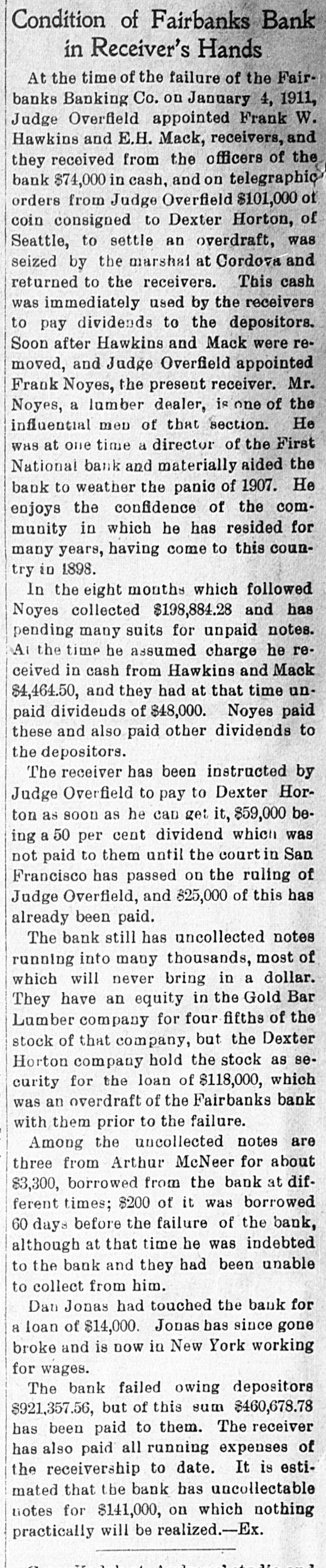
Condition of Fairbanks Bank in Receiver's Hands At the time of the failure of the Fairbanks Banking Co. on January 4, 1911, Judge Overfield appointed Frank W. Hawkins and E.H. Mack, receivers, and they received from the officers of the bank $74,000 in cash, and on telegraphic orders from Judge Overfield $101,000 of coin consigned to Dexter Horton, of Seattle, to settle an overdraft, was seized by the marshal at Cordova and returned to the receivers. This cash was immediately used by the receivers to pay dividends to the depositors. Soon after Hawkins and Mack were removed, and Judge Overfield appointed Frank Noyes, the present receiver. Mr. Noyes, a lumber dealer, is one of the influential men of that section. He was at one time a director of the First National bank and materially aided the bank to weather the panic of 1907. He enjoys the confidence of the community in which he has resided for many years, having come to this country in 1898. In the eight months which followed Noyes collected $198,884.28 and has pending many suits for unpaid notes. Ai the time he assumed charge he received in cash from Hawkins and Mack $4,464.50, and they had at that time unpaid dividends of $48,000. Noyes paid these and also paid other dividends to the depositors. The receiver has been instructed by Judge Overfield to pay to Dexter Horton as soon as he can get it, $59,000 being a 50 per cent dividend which was not paid to them until the court in San Francisco has passed on the ruling of Judge Overfield, and $25,000 of this has already been paid. The bank still has uncollected notes running into many thousands, most of which will never bring in a dollar. They have an equity in the Gold Bar Lumber company for four fifths of the stock of that company, but the Dexter Horton company hold the stock as security for the loan of $118,000, which was an overdraft of the Fairbanks bank with them prior to the failure. Among the uncollected notes are three from Arthur McNeer for about $3,300, borrowed from the bank at different times; $200 of it was borrowed 60 days before the failure of the bank, although at that time he was indebted to the bank and they had been unable to collect from him. Dan Jonas had touched the bank for a loan of $14,000. Jonas has since gone broke and is now in New York working for wages. The bank failed owing depositors $921,357.56, but of this sum $460,678.78 has been paid to them. The receiver has also paid all running expenses of the receivership to date. It is estimated that the bank has uncollectable notes for $141,000, on which nothing practically will be realized.-Ex.