7983. Pacific bank (Boston, MA)

Bank Information

Episode Type
Suspension → Closure
Bank Type
state
Start Date
November 26, 1881
Location
Boston, Massachusetts (42.358, -71.060)

Metadata

Model
gpt-5-mini
Short Digest
2c75ab52

Response Measures

None

Description

No explicit depositor run is described in the articles. Examiners found the bank in unfavorable condition; the U.S. Comptroller requested nomination of receivers and winding up of affairs (Nov 26–28, 1881). Stockholders briefly considered subscription to rescue the bank, but a receiver was later active (Receiver Price referenced in 1883). Classified as suspension -> permanent closure/receivership.

Events (3)

1. November 26, 1881 Suspension
Cause
Bank Specific Adverse Info
Cause Details
Examiners found the bank's condition unfavorable due to alleged malfeasance, bad loans and inadequate collateral; reports of collapse and criminal matters involving the president; insolvency discovered by examiners.
Newspaper Excerpt
The bank examiners completed the examination of the affairs of the Pacific banks ... the condition of the banks is so unfavorable that the United States Comptroller to-day requested the associated banks to nominate 2 receiver and wind up their affairs.
Source
newspapers
2. November 27, 1881 Other
Newspaper Excerpt
An extension of time before the appointment of a receiver of the Pacific bank, granted by Comptroler Knox is one week from Saturday last. A meeting of stockholders will be held ... It is stated many stockholders have expressed a willingness to subscribe ... and re-establish the bank ... nothing whatever was done toward nominating a receiver or new president.
Source
newspapers
3. February 10, 1883 Receivership
Newspaper Excerpt
For instance, Receiver Price has a claim against Edward Crane of New York for $190,000 ... The receiver says that he has begun suit against Mr. Crane for that amount.
Source
newspapers

Newspaper Articles (4)

Article from The Portland Daily Press, November 22, 1881

Click image to open full size in new tab

Article Text

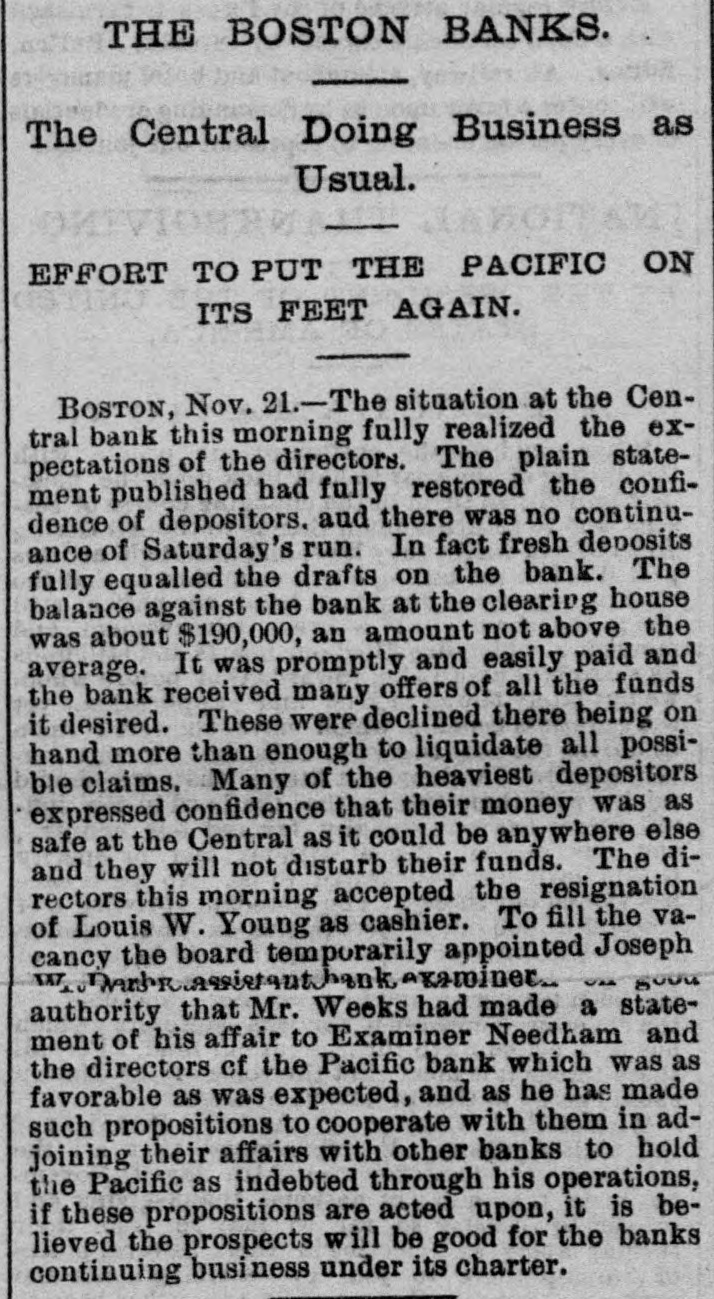
THE BOSTON BANKS. The Central Doing Business as Usual. EFFORT TO PUT THE PACIFIC ON ITS FEET AGAIN. BOSTON, Nov. The situation at the Central bank this morning fully realized the expectations of the directors. The plain statement published had fully restored the confidence of depositors. and there was no continuance of Saturday's run. In fact fresh deposits fully equalled the drafts on the bank. The balance against the bank at the clearing house was about $190,000, an amount not above the average. It was promptly and easily paid and the bank received many offers of all the funds it desired. These were declined there being on hand more than enough to liquidate all possible claims. Many of the heaviest depositors expressed confidence that their money was as safe at the Central as it could be anywhere else and they will not distarb their funds. The directors this morning accepted the resignation of Louis W. Young as cashier. To fill the vacancy the board temporarily appointed Joseph goou authority that Mr. Weeks had made a statement of his affair to Examiner Needham and the directors of the Pacific bank which was as favorable as was expected, and as he has made such propositions to cooperate with them in adjoining their affairs with other banks to hold the Pacific as indebted through his operations, if these propositions are acted upon, it is believed the prospects will be good for the banks continuing business under its charter.
Article from Wheeling Register, November 28, 1881

Click image to open full size in new tab

Article Text

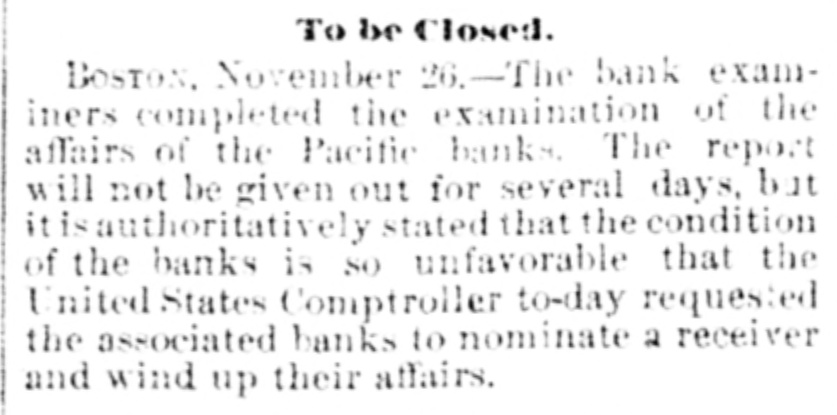
To be Closed. BOSTON November 26.-The bank examiners completed the examination of the affairs of the Pacific banks The report will not be given out for several days, but itisauthoritatively stated that the condition of the banks is so unfavorable that the United States Comptroller to-day requested the associated banks to nominate 2 receiver and wind up their affairs.


Article from Daily Globe, November 28, 1881

Click image to open full size in new tab

Article Text

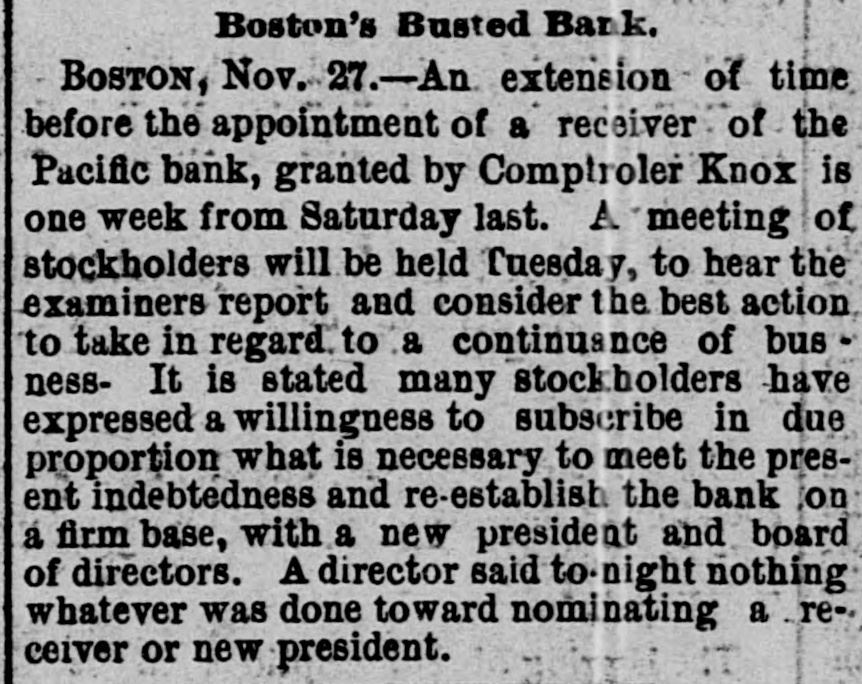
Boston's Busted Bank. BOSTON, Nov. 27.-An extension of time before the appointment of a receiver of the Pacific bank, granted by Comptroler Knox is one week from Saturday last. A meeting of stockholders will be held fuesday, to hear the examiners report and consider the best action to take in regard. to a continuance of bus ness- It is stated many stockholders have expressed a willingness to subscribe in due proportion what is necessary to meet the present indebtedness and re-establish the bank on a firm base, with a new president and board of directors. A director said to-night nothing whatever was done toward nominating a re-, ceiver or new president.


Article from Daily Globe, February 10, 1883

Click image to open full size in new tab

Article Text

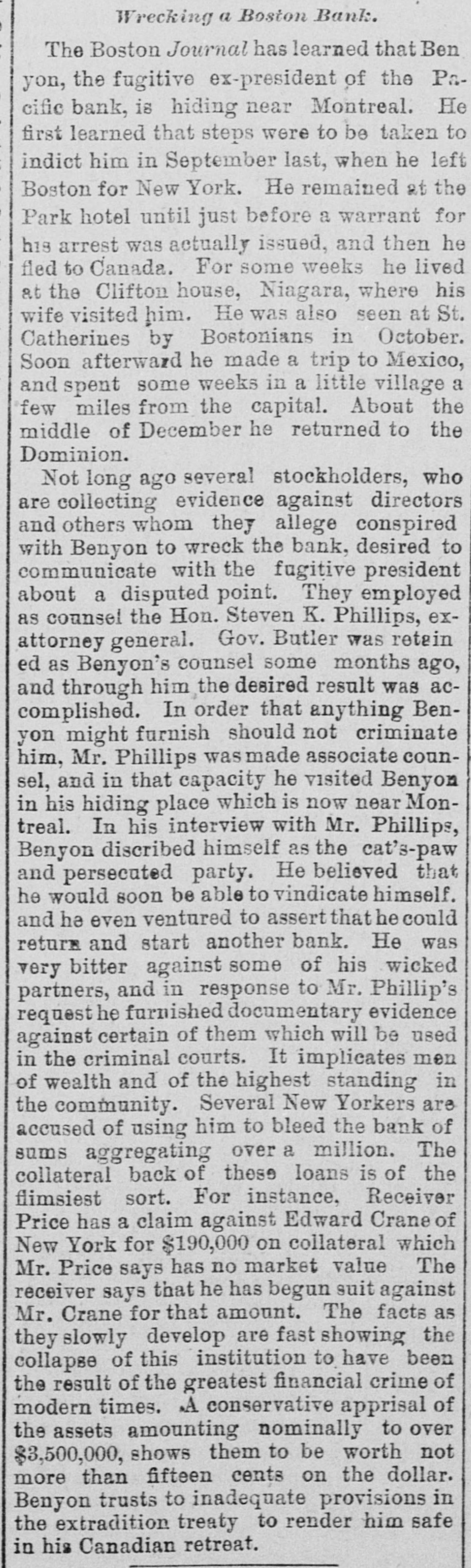
Wrecking a Boston Bank. The Boston Journal has learned that Benyon, the fugitive ex-president of the Pacific bank, is hiding near Montreal. He first learned that steps were to be taken to indict him in September last, when he left Boston for New York. He remained at the Park hotel until just before a warrant for his arrest was actually issued, and then he fled to Canada. For some weeks he lived at the Clifton house, Niagara, where his wife visited him. He was also seen at St. Catherines by Bostonians in October. Soon afterward he made a trip to Mexico, and spent some weeks in a little village a few miles from the capital. About the middle of December he returned to the Dominion. Not long ago several stockholders, who are collecting evidence against directors and others whom they allege conspired with Benyon to wreck the bank, desired to communicate with the fugitive president about a disputed point. They employed as counsel the Hon. Steven K. Phillips, ex-attorney general. Gov. Butler was retained as Benyon's counsel some months ago, and through him the desired result was accomplished. In order that anything Benyon might furnish should not criminate him, Mr. Phillips was made associate counsel, and in that capacity he visited Benyon in his hiding place which is now near Montreal. In his interview with Mr. Phillips, Benyon discribed himself as the cat's-paw and persecuted party. He believed that he would soon be able to vindicate himself. and he even ventured to assert that he could return and start another bank. He was very bitter against some of his wicked partners, and in response to Mr. Phillip's request he furnished documentary evidence against certain of them which will be used in the criminal courts. It implicates men of wealth and of the highest standing in the community. Several New Yorkers are accused of using him to bleed the bank of sums aggregating over a million. The collateral back of these loans is of the flimsiest sort. For instance, Receiver Price has a claim against Edward Crane of New York for $190,000 on collateral which Mr. Price says has no market value The receiver says that he has begun suit against Mr. Crane for that amount. The facts as they slowly develop are fast showing the collapse of this institution to have been the result of the greatest financial crime of modern times. A conservative apprisal of the assets amounting nominally to over $3,500,000, shows them to be worth not more than fifteen cents on the dollar. Benyon trusts to inadequate provisions in the extradition treaty to render him safe in his Canadian retreat.