7965. Michigan State Bank (Detroit, MI)

Bank Information

Episode Type
Suspension → Closure
Bank Type
state
Start Date
March 29, 1839
Location
Detroit, Michigan (42.331, -83.046)

Metadata

Model
gpt-5-mini
Short Digest
418629ade87a1beb

Response Measures

None

Description

Articles (1839 and a 1931 retrospective) report the Michigan State Bank (Detroit) suspended on April 2, 1839, with George F. Porter appointed assignee/receiver. This appears to be a suspension tied to the post-1837 financial troubles and the bank did not resume operations (liquidation/assignee). No explicit depositor run is described in the provided snippets.

Events (3)

1. March 29, 1839 Other
Newspaper Excerpt
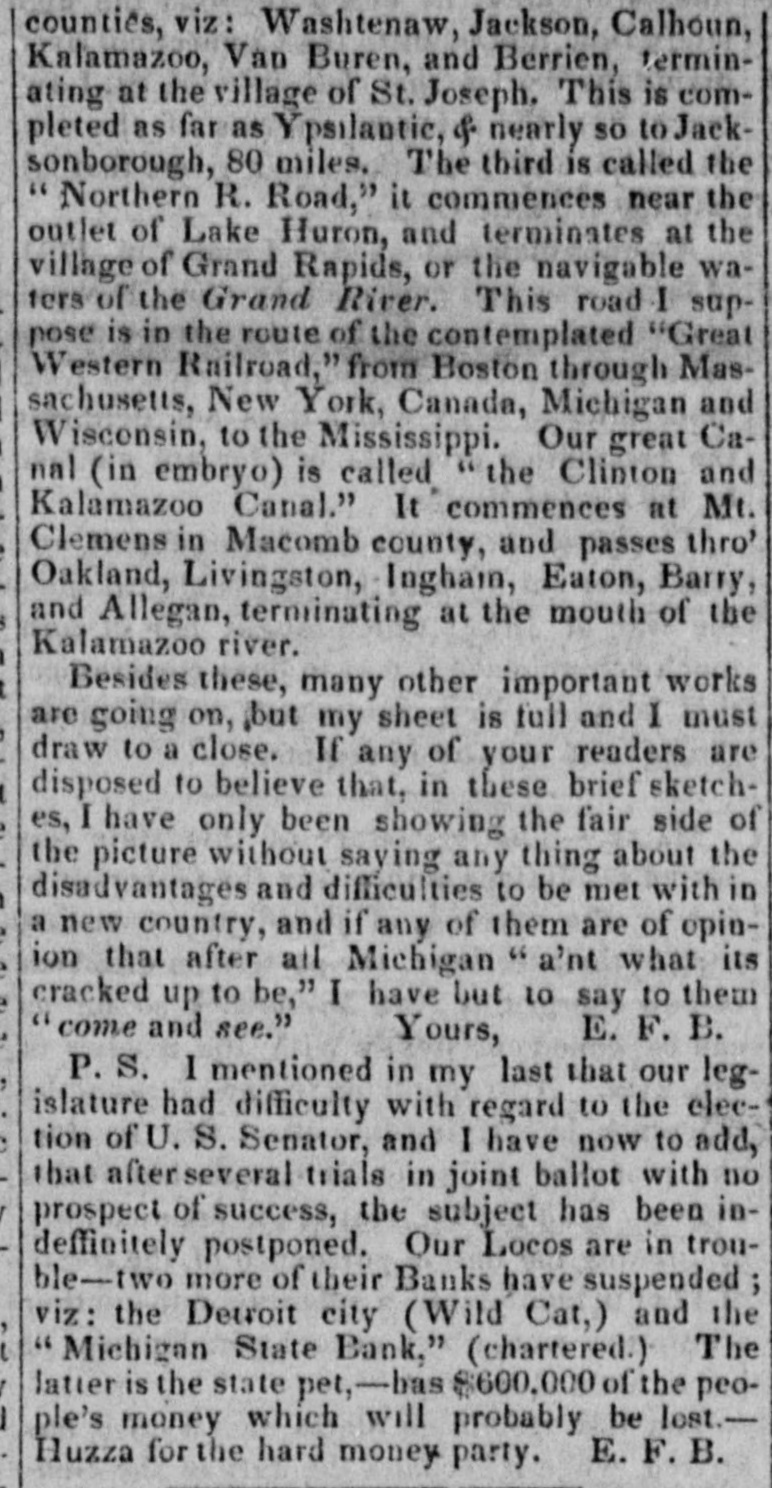
two more of their Banks have suspended viz: the Detroit city (Wild Cat,) and the 'Michigan State Bank,' (chartered.) The latter is the state pet,-has $600,000 of the people's money which will probably be lost.
Source
newspapers
2. April 2, 1839 Receivership
Newspaper Excerpt
George F. Porter was appointed assignee.
Source
newspapers
3. April 2, 1839 Suspension
Cause
Macro News
Cause Details
Suspension occurred in the aftermath of the Panic of 1837 and the general banking distress that followed; articles link it to the wider panic and local bank failures.
Newspaper Excerpt
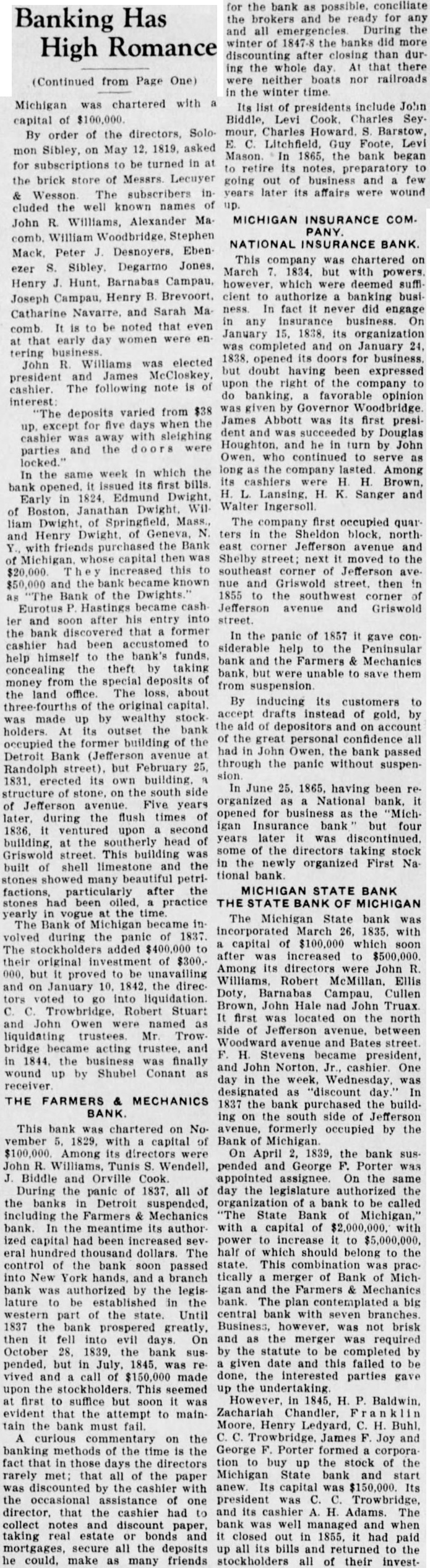
On April 2, 1839, the bank suspended and George F. Porter was appointed assignee.
Source
newspapers

Newspaper Articles (3)

Article from Vermont Phœnix, March 29, 1839

Click image to open full size in new tab

Article Text

counties, viz: Washtenaw, Jackson, Calhoun, Kalamazoo, Van Buren, and Berrien, terminating at the village of St. Joseph. This is completed as far as Y ipsilantic, & nearly so to Jacksonborough, 80 miles. The third is called the "Northern R. Road," it commences near the outlet of Lake Huron, and terminates at the village of Grand Rapids, or the navigable wafers of the Grand River. This road I suppose is in the route of the contemplated "Great Western Railroad, 'from Boston through Massachusetts, New York, Canada, Michigan and Wisconsin, to the Mississippi. Our great Canal (in embryo) is called "the Clinton and Kalamazoo Canal." It commences at Mt. Clemens in Macomb county, and passes thro' Oakland, Livingston, Inghain, Eaton, Barry, and Allegan, terminating at the mouth of the Kalamazoo river. Besides these, many other important works are going on, but my sheet is full and I must draw to a close. If any of your readers are disposed to believe that, in these briefsketches, I have only been showing the fair side of the picture without saying any thing about the disadvantages and difficulties to be met with in a new country, and if any of them are of opinion that after all Michigan "a'nt what its cracked up to be," I have but to say to them "come and see." E.F.B. Yours, P. S. I mentioned in my last that our legislature had difficulty with regard to the election of U. S. Senator, and I have now to add, that after several trials in joint ballot with no prospect of success, the subject has been indeffinitely postponed. Our Locos are in trouble-two more of their Banks have suspended viz: the Detroit city (Wild Cat,) and the "Michigan State Bank," (chartered.) The latter is the state pet,-bas $600,000 of the people's money which will probably be lost.Huzza for the hard money party. E.F.B.


Article from Daily Globe, December 16, 1882

Click image to open full size in new tab

Article Text

not uncommon for parties of travelers to go from Detroit to Monroe or St. Clair ON THE ICE. At that time the winters were very long and regular. Navigation opened the first of June and closed the first of September, none but foolhardy persons venturing upon the water out of the regular season. The bank of Michigan was chartered by the governor and judges in 1818 and in 1813 Mr. Trowbridge became its cashier at a salary of $500 per year, which was then considered large pay. He continued in this position until 1836 when he resigned. Next year came the great financial panic and all the banks in the Northwest with the exception of the Indiana state bank went under. The Michigan state bank was subsequently revived by James F. Coy, Zachariah Chandler, H. P. Baldwin, Franklin Moore, C. F. Porter, Henry Ledyard, C. H. and F. Buhl and Mr. Trowbridge, the latter being elected president. The bank was conducted for thirteen years, until the expiration of its charter, when it retired from business, after paying handsome dividends. There are still living in Detroit a few of the old residents who remember Mr. Trowbridge's connection with this bank, and as the reporter was writing this article Saturday, Philo Parsons happened into the editorial room. He chanced to see what the scribe was at and said: Some of the dearest and sweetest memories of my commercial life are connected with Charles C. Trowbridge when he was an officer of the old Michigan state bank. Today I spoke to an old friend of his connection with that institution and, with tears in his eyes, that old friend said, "God bless him, his ready hand once saved me from great financial disaster.' I believed that old friend echoed the sentiment of many another man who knew him in the dark, days of '37 and later." Mr. Trowbridge was intimately connected with # THE EARLY RAILROAD HISTORY OF MICHIGAN having been secretary and treasurer of the Oakland & Ottawa, subsequently the Detroit & Pontiac, and now the Detroit Grand Haven & Milwaukee railroad. To build railroads in those days the projectors of them had to furnish the capital. Money could not be borrowed for construction as it is to-day. He was also connected with the building of the Detroit & St. Joseph railroad, now the Michigan Central. The road was completed as far as Ypsilanti, when the work stopped because the money gave out. Its subsequent history the public is generally acquainted with. Mr. Trowbridge was elected mayor of Detroit in 1834 and was the city's executive during the terrible ravages by cholera in that year. Two years before the cholera had swept over the lower portion of the city, making sad havoc among the Irish immigrants, but in 1834 it raged among the best classes of people and the destruction was terrible. Many who had left the city in the hope of escaping the pestilence died on the way of fever and exhaustion. Mr. Trowbridge said it was a remarkable fact that of those who were actively engaged in caring for the sick and dying not one was attacked by the disease, while those who fled through fear died by the wayside, With the early history of the Protestant Episcopal church in this state Mr. Trowbridge is also very familiar, because he was one of the very first members. He has taken an active part in all the struggles and triumphs of the church from its earliest history to the present day, and the present strength and extent of the church organization is due in no small degree to his earnest and well directed labors in its behalf.! Politically, Mr. Trowbridge has always been a stanch Republican since the formation of that party. He was the candidate of the Whig party in the first canvass for the governor of Michigan, but was defeated by the then popular and revered Stevens T. Mason. He has seen Detroit grow from the French village of two-wheeled carts and swamps to the prosperous and beautiful metropolis of to-day. His years and his honors, his achievements and his friends, are alike many.


Article from Detroit Free Press, May 10, 1931

Click image to open full size in new tab

Article Text

Banking Has High Romance (Continued from Page One) Michigan was chartered with capital of $100,000 By order of the directors, Solomon Sibley, on May 12. 1819. asked for subscriptions to be turned in at the brick store of Messrs Lecuyer & Wesson The subscribers in cluded the well known names of John R. Williams, Alexander Ma comb. William Woodbridge Stephen Mack. Peter J. Desnoyers. Eben ezer S. Sibley. Degarmo Jones. Henry J. Hunt. Barnabas Campau. Joseph Campau, Henry B. Brevoort. Catharine Navarre. and Sarah Ma comb It is to be noted that even at that early day women were en tering John R. Williams was elected president and James McCloskey, cashier. The following note is of interest: "The deposits varied from $38 up. except for five days when the cashier was away with sleighing and the doors were parties locked." week in which the In the same bank opened. it issued its first bills. Early in 1824. Edmund Dwight. of Boston, Janathan Dwight. William Dwight, of Springfield, Mass., Dwight. of N. and Henry as "The Bank of the Dwights." ier and soon after his entry into street. the bank discovered that former cashier had been accustomed to himself to the bank's funds. help concealing the theft by taking money from the special deposits of the land office. The loss, about three-fourths of the original capital. was made up by wealthy stock holders. At its outset the bank occupied the former building of the Detroit Bank (Jefferson avenue at Randolph street). but February 25, 1831. erected its own building. structure of stone, on the south side of Jefferson Five years later. during the flush times of 1836, it ventured upon second building. at the southerly head of Griswold street. This building was built of shell limestone and the stones showed many beautiful petrifactions, particularly after the stones had been oiled, a practice yearly in vogue at the time. The Bank of Michigan became in volved during the panic of 1837. The stockholders added $400,000 to their original investment of $300.000, but it proved to be unavailing and on January 10. 1842, the directors voted to go into liquidation. C. C. Trowbridge. Robert Stuart and John Owen were named as liquidating trustees Mr. Trow bridge became acting trustee, and in 1844. the business was finally wound up by Shubel Conant as receiver THE FARMERS & MECHANICS BANK. This bank was chartered on No. vember 5, 1829, with a capital of $100,000 Among its directors were John R. Williams, Tunis S. Wendell. J. Biddle and Orville Cook. During the panic of all of the banks in Detroit suspended, including the Farmers & Mechanics bank. In the meantime its author ized capital had been increased sev. eral hundred thousand dollars. The control of the bank soon passed into New York hands. and branch bank was authorized by the legislature to be established in the western part of the Until 1837 the bank prospered greatly. then it fell into evil days On October 1839, the bank sus pended, but in July, 1845. was revived and call of $150,000 made upon the stockholders. This seemed at first to suffice but soon it was evident that the attempt to maintain the bank must fail. curious commentary on the banking methods of the time is the fact that in those days the directors discounted by the cashier with the occasional assistance of one that the cashier had to for the bank as possible, conciliate the brokers and be ready for any and all emergencies During the winter of 1847-8 the banks did more discounting after closing than during the whole day At that there were neither boats nor railroads in the winter time Its list of presidents include John Biddle, Levi Cook. Charles Sey. mour, Charles Howard. S. Barstow, E. C. Litchfield. Guy Foote, Levi Mason. In 1865, the bank began to retire its notes, preparatory to going out of business and a few years later its affairs were wound up. MICHIGAN INSURANCE COM. PANY. NATIONAL INSURANCE BANK. This company was chartered on March 7. 1834. but with powers however. which were deemed sufficient to authorize a banking business In fact it never did engage in any insurance business On January 15. 1838. its organization was completed and on January 24. 1838. opened its doors for business but doubt having been expressed upon the right of the company to do banking. favorable opinion was given by Governor Woodbridge James Abbott was its first president and was succeeded by Douglas Houghton, and he in turn by John Owen. who continued to serve as long as the company lasted Among its cashiers were H. H. L. H. K. Sanger and Walter The company first occupied quar ters in the Sheldon north1855 to the southwest corner of In the panic of 1857 it gave con siderable help to the Peninsular bank and the Farmers & Mechanics but were unable to save them from suspension By inducing its customers to accept drafts instead of gold, by the aid of depositors and on account of the great personal confidence all had in John Owen. the bank passed through the panic without suspension In June 25. 1865, having been reorganized as National bank. it opened for business as the "Michigan Insurance bank but four years later it was discontinued. some of the directors taking stock in the newly organized First Na tional bank MICHIGAN STATE BANK THE STATE BANK OF MICHIGAN The Michigan State bank was incorporated March 26, 1835, with capital of $100,000 which soon after was increased to $500,000. Among its directors John R. Williams. Robert McMillan. Ellis Doty, Barnabas Campau. Cullen Brown, John Hale nad John Truax It first was located on the north side of Jefferson avenue. between Woodward avenue and Bates street. F. H. Stevens president, and John Norton. Jr. cashier One day in the week, Wednesday, was designated as "discount day In 1837 the bank purchased the build. ing on the south side of Jefferson avenue, formerly occupied by the Bank of Michigan On April 2, 1839, the bank suspended and George F. Porter was appointed assignee. On the same day the legislature authorized the organization of bank to be called "The State Bank Michigan.' with a capital of $2,000,000. with power to increase it to $5,000,000. half of which should belong to the state. This combination was practically merger of Bank of Michigan and the Farmers & Mechanics bank The plan contemplated big central bank with seven branches Business, however, was not brisk and as the merger was required by the statute to be completed by given date and this failed to be done, the interested parties gave up the undertaking However, in 1845, H. P. Baldwin, Zachariah Chandler, Moore. Henry Ledyard C. H. Buhl. C.C. Trowbridge James F. Joy and George F. Porter formed a corpora tion to buy up the stock of the anew Its capital was $150,000. Its president was C. C. and its cashier A. H. Adams The