7907. City Bank (Detroit, MI)

Bank Information

Episode Type
Run โ†’ Suspension โ†’ Closure
Bank Type
state
Start Date
March 14, 1839
Location
Detroit, Michigan (42.331, -83.046)

Metadata

Model
gpt-5-mini
Short Digest
0727703e026f68fa

Response Measures

None

Description

Contemporary 1839 reports state the City Bank of Detroit suspended specie payments for sixty days because of a continued run for specie (Article 1). Later items (1909, 1911) refer to the City Bank in receivership and as a past failure, supporting eventual permanent closure. I do not infer details beyond what the articles provide. Bank charter/type not specified in the texts, so set to unknown.

Events (3)

1. March 14, 1839 Run
Cause
Macro News
Cause Details
Continued run on the bank for specie (widespread specie demand / panic conditions in 1839).
Measures
None specified other than later suspension of specie payments for sixty days.
Newspaper Excerpt
they have suspended for sixty days, owing to a continued run on them for specie.
Source
newspapers
2. March 14, 1839 Suspension
Cause
Macro News
Cause Details
Suspended specie payments for sixty days because of continued run for specie (temporary suspension invoked during specie shortage/panic).
Newspaper Excerpt
The City Bank of Detroit... have suspended specie payments. Both of these banks announce to the public, that they have suspended for sixty days, owing to a continued run on them for specie.
Source
newspapers
3. April 9, 1909 Receivership
Newspaper Excerpt
award... to the Union Trust Co., receiver of the City bank, ... (Detroit Times, 1909-04-09).
Source
newspapers

Newspaper Articles (5)

Article from Lynchburg Virginian, March 14, 1839

Click image to open full size in new tab

Article Text

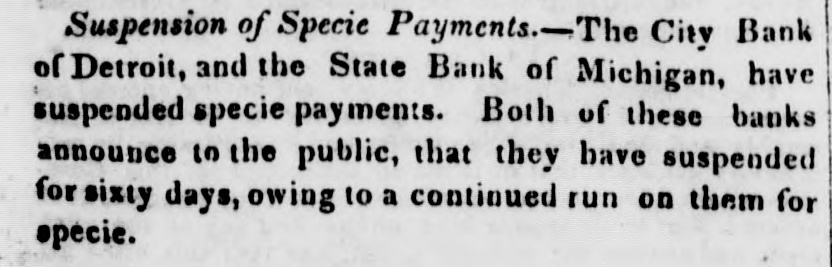
Suspension of Specie Payments.-The City Bank of Detroit, and the State Bank of Michigan, have suspended specie payments. Both of these banks announce to the public, that they have suspended for sixty days, owing to a continued run on them for specie.


Article from Morning Herald, October 5, 1839

Click image to open full size in new tab

Article Text

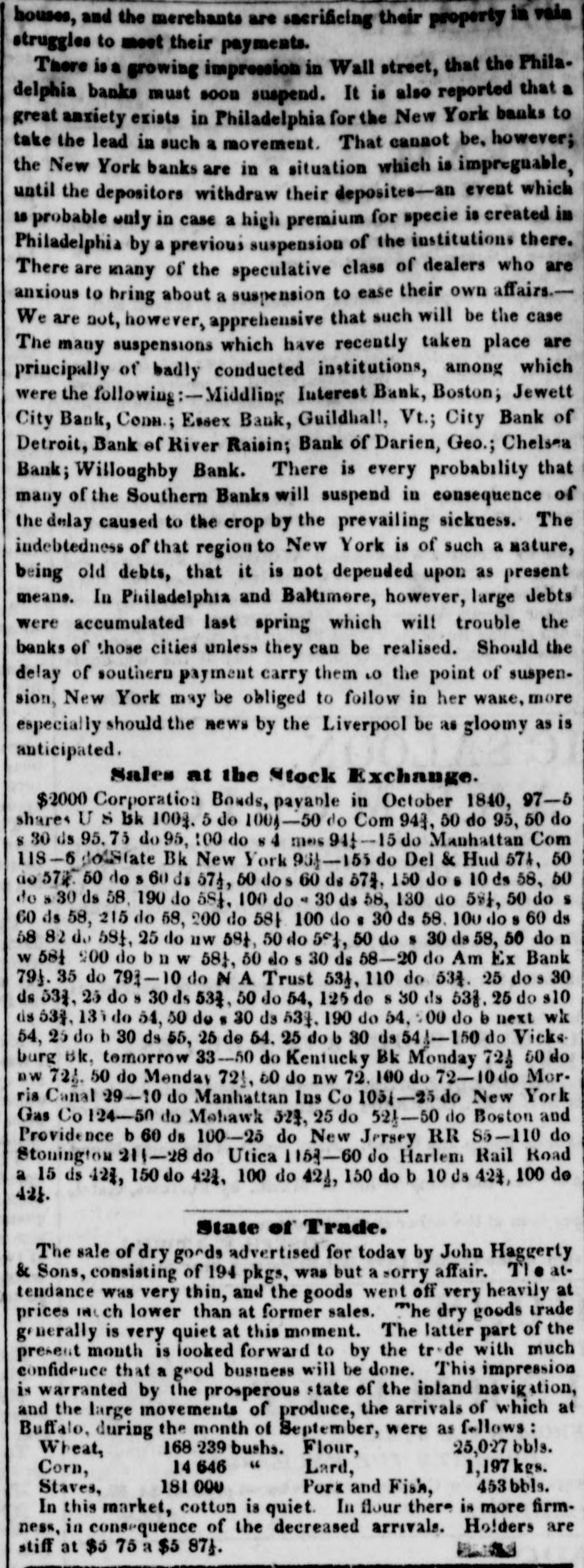
houses, and the merchants are sacrificing their property in vaia struggles to meet their payments. There is growing impression in Wall street, that the Philadelphia banks must soon suspend. It is also reported that a great anxiety exists in Philadelphia for the New York banks to take the lead in such a movement. That cannot be, however; the New York banks are in a situation which is impregnable, until the depositors withdraw their deposites-an event which is probable only in case a high premium for specie is created in Philadelphia by a previous suspension of the institutions there. There are many of the speculative class of dealers who are anxious to bring about a suspension to ease their own affairs.We are not, however, apprehensive that such will be the case The many suspensions which have recently taken place are principally of badly conducted institutions, among which were the following:-Middling Interest Bank, Boston, Jewett City Bank, Conn; Essex Bank, Guildhall, Vt.; City Bank of Detroit, Bank el River Raisin; Bank of Darien, Geo.; Chelsea Bank; Willoughby Bank. There is every probability that many of the Southern Banks will suspend in consequence of the delay caused to the crop by the prevailing sickness. The indebtedness of that region to New York is of such a nature, being old debts, that it is not depended upon as present means. In Philadelphia and Baltimore, however, large Jebts were accumulated last spring which will trouble the banks of those cities unless they can be realised. Should the delay of southern payment carry them to the point of suspension, New York may be obliged to follow in her wake, more especially should the news by the Liverpool be as gloomy as is anticipated. Sales at the Stock Exchange. $2000 Corporation Bonds, payable in October 1840, 97-5 shares U S Bk 100g. 5 do 100A-50 do Com 943, 50 do 95, 50 do 30 ds 95.75 do 95, :00 do 84 mes941-15 do Manhattan Com 118-6 do4State Bk New York 93)-155 do Del & Hud 574, 50 do 57th 50 do s 60 ds 574, 50 dos 60 ds 573. 150 do s 10 ds 58, 50 do S 30 ds 58, 190 do 5St, 100 do a 30 ds 58, 130 do 581, 50 do S 60 ds 58, 215 do 58, 200 do 58 100 do 8 30 ds 58. 100 do S 60 ds 58 82 do 581, 25 do nw 581, 50 do 5th, 50 do S 30 ds 58, 50 do n w 581 900 do b n W 581, 50 do S 30 ds 58-20 do Am Ex Bank 79}. 35 do 791-10 do N A Trust 531, 110 do 534. 25 dos 30 ds 53 25 do 8 30 ds 537, 50 do 54, 125 de S 30 ds 53g. 25 do s10 ds 53g. 13i do 54, 50 do s 30 ds 534. 190 do 54, 00 do b next wk 54, 25 do b 30 ds 55, 25 de 54. 25 do b 30 ds 544-150 do Vicks burg Bk. tomorrow 33-50 do Kentucky Bk Monday 72 50 do nw 724. 50 do Menday 721, 50 do nw 72.100 do 72-10do Morris Canal 29-10 do Manhattan Ins Co 1051-25 do New York Gas Co 124-50 do Mohawk 524, 25 do 521-50 do Boston and Providence 60 ds 100-25 do New Jersey RR SS-110 do Stonington 211-28 do Utica 1153-60 do Harlem Rail Road a 15 ds 124, 150 do 421, 100 do 424, 150 do b 10 ds 424, 100 de 421. State of Trade. The sale of dry goods advertised for today by John Haggerty & Sons, consisting of 194 pkgs, was but a sorry affair. Tle attendance was very thin, and the goods went off very heavily at prices mach lower than at former sales. The dry goods trade generally is very quiet at this moment. The latter part of the present month is looked forward to by the tr de with much confidence that a good business will be done. This impression is warranted by the prosperous state of the inland navigation, and the large movements of produce, the arrivals of which at Buffalo, during the month of September, were as follows 25,027 bbls. 168 239 bushs. Flour, Wheat, " 14 646 1,197 kgs. Lard, Corn, 453 bbls. 181 000 Staves, Pork and Fish, In this market, cotton is quiet. In flour there is more firmness, in consequence of the decreased arrivals. Holders are stiff at $5 75 a $5 87}.
Article from The Detroit Times, April 9, 1909

Click image to open full size in new tab

Article Text

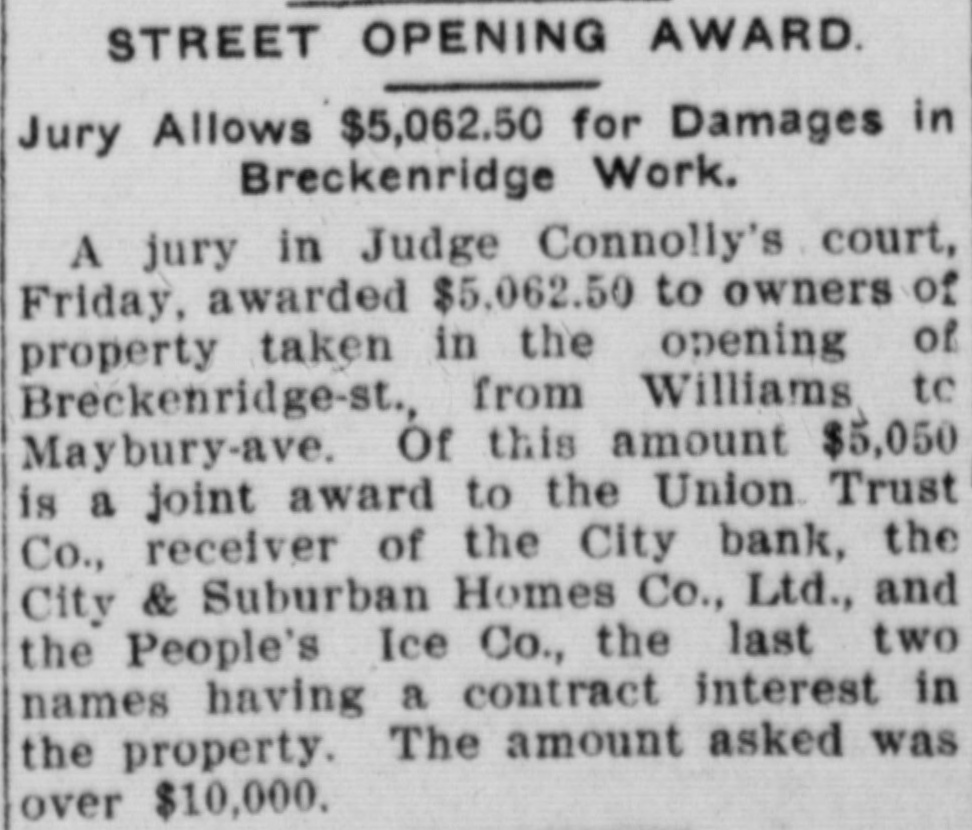
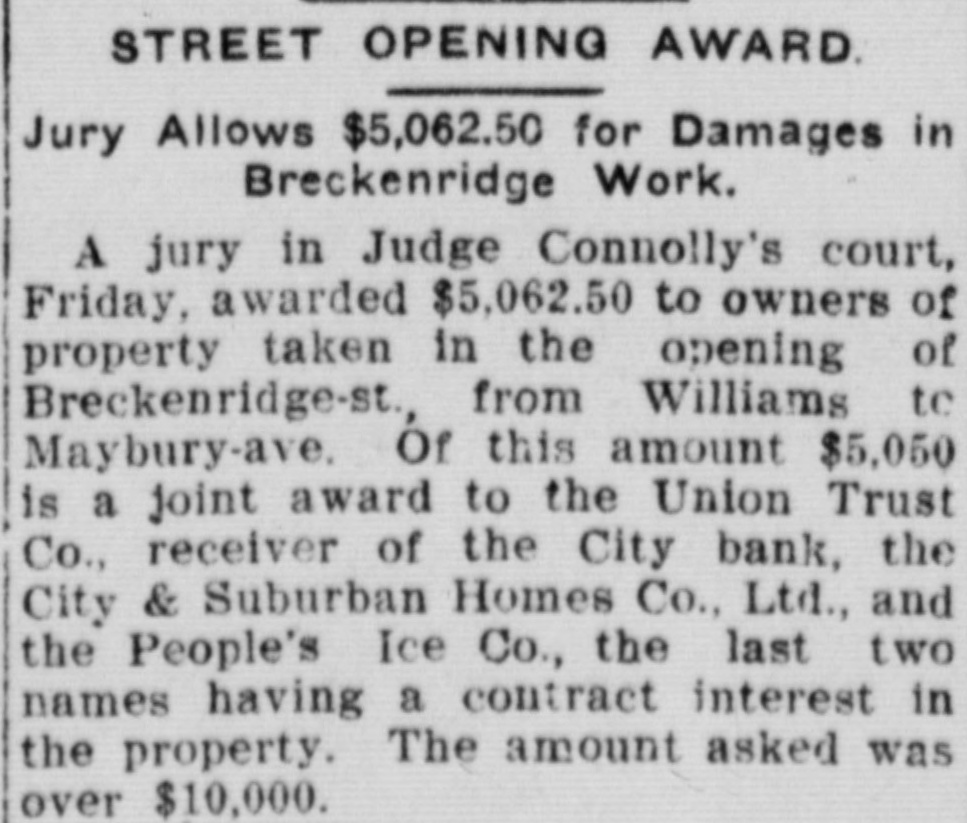
# STREET OPENING AWARD. Jury Allows $5,062.50 for Damages in Breckenridge Work. A jury in Judge Connolly's court, Friday, awarded $5.062.50 to owners of property taken in the opening of Breckenridge-st., from Williams to Maybury-ave. Of this amount $5,050 is a joint award to the Union Trust Co., receiver of the City bank, the City & Suburban Homes Co., Ltd., and the People's Ice Co., the last two names having a contract interest in the property. The amount asked was over $10,000.


Article from The Detroit Times, April 10, 1909

Click image to open full size in new tab

Article Text

# STREET OPENING AWARD. Jury Allows $5,062.50 for Damages in Breckenridge Work. A jury in Judge Connolly's court, Friday, awarded $5,062.50 to owners of property taken in the opening of Breckenridge-st., from Williams to Maybury-ave. Of this amount $5,050 is a joint award to the Union Trust Co., receiver of the City bank, the City & Suburban Homes Co., Ltd., and the People's Ice Co., the last two names having a contract interest in the property. The amount asked was over $10,000.


Article from The Detroit Times, November 11, 1911

Click image to open full size in new tab

Article Text

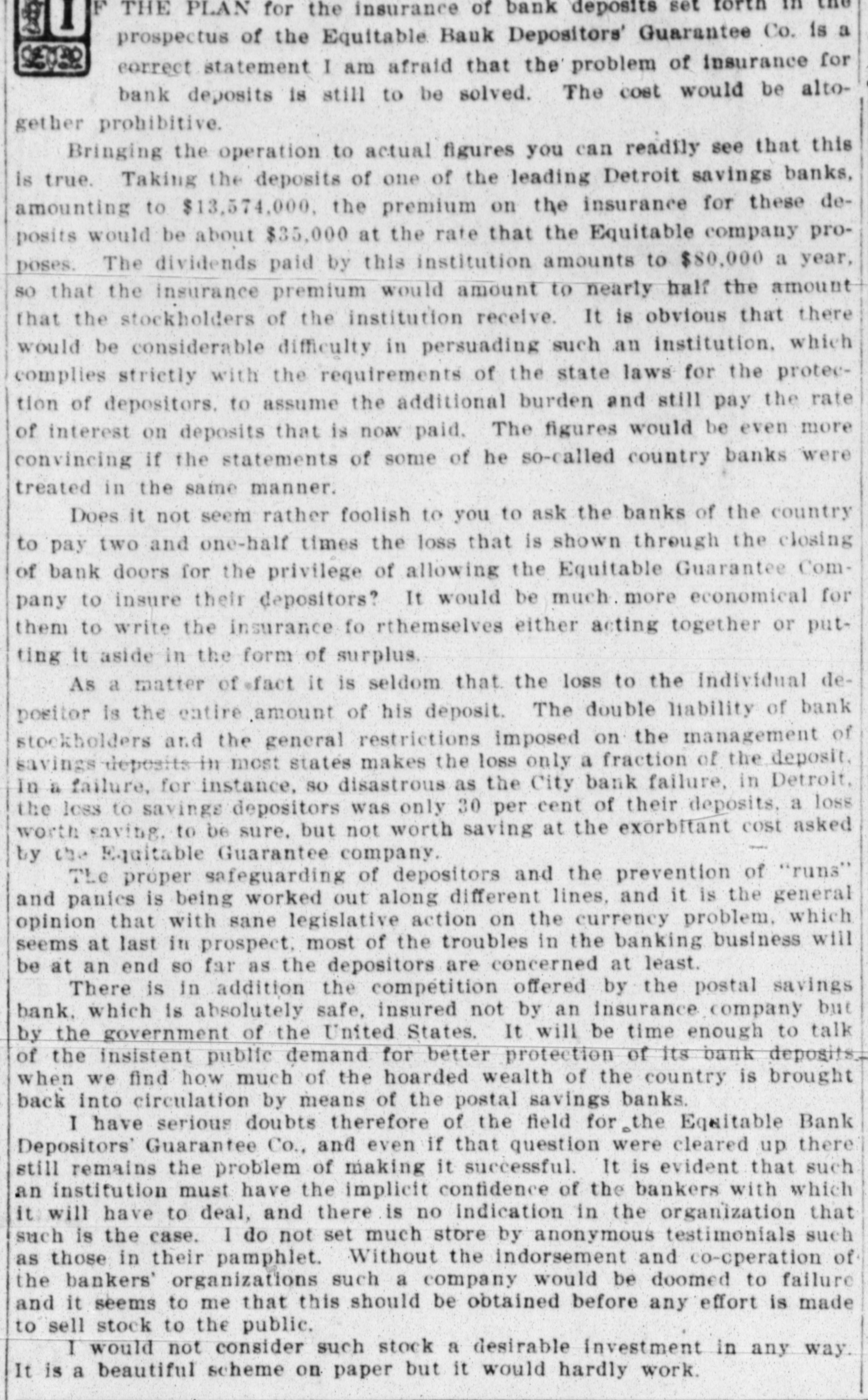
F THE PLAN for the insurance of bank deposits set forth in the prospectus of the Equitable Bauk Depositors' Guarantee Co. is a correct statement I am afraid that the problem of insurance for bank deposits is still to be solved. The cost would be altogether prohibitive. Bringing the operation to actual figures you can readily see that this is true. Taking the deposits of one of the leading Detroit savings banks, amounting to $13,574,000, the premium on the insurance for these deposits would be about $35,000 at the rate that the Equitable company proposes. The dividends paid by this institution amounts to $80,000 a year, so that the insurance premium would amount to nearly half the amount that the stockholders of the institution receive. It is obvious that there would be considerable difficulty in persuading such an institution, which complies strictly with the requirements of the state laws for the protection of depositors, to assume the additional burden and still pay the rate of interest on deposits that is now paid. The figures would be even more convincing if the statements of some of he so-called country banks were treated in the same manner. Does it not seem rather foolish to you to ask the banks of the country to pay two and one-half times the loss that is shown through the closing of bank doors for the privilege of allowing the Equitable Guarantee Company to insure their depositors? It would be much more economical for them to write the insurance fo rthemselves either acting together or putting it aside in the form of surplus. As a matter of fact it is seldom that the loss to the individual depositor is the entire amount of his deposit. The double liability of bank stockholders and the general restrictions imposed on the management of savings deposits in most states makes the loss only a fraction of the deposit. In a failure, for instance, so disastrous as the City bank failure, in Detroit, the less to savings depositors was only 30 per cent of their deposits, a loss worth saving, to be sure, but not worth saving at the exorbitant cost asked by the Equitable Guarantee company. The proper safeguarding of depositors and the prevention of "runs" and panics is being worked out along different lines, and it is the general opinion that with sane legislative action on the currency problem, which seems at last in prospect, most of the troubles in the banking business will be at an end so far as the depositors are concerned at least. There is in addition the competition offered by the postal savings bank, which is absolutely safe, insured not by an insurance company but by the government of the United States. It will be time enough to talk of the insistent public demand for better protection of its bank deposits when we find how much of the hoarded wealth of the country is brought back into circulation by means of the postal savings banks. I have serious doubts therefore of the field for the Equitable Bank Depositors' Guarantee Co., and even if that question were cleared up there still remains the problem of making it successful. It is evident that such an institution must have the implicit confidence of the bankers with which it will have to deal, and there is no indication in the organization that such is the case. I do not set much store by anonymous testimonials such as those in their pamphlet. Without the indorsement and co-operation of the bankers' organizations such a company would be doomed to failure and it seems to me that this should be obtained before any effort is made to sell stock to the public. I would not consider such stock a desirable investment in any way. It is a beautiful scheme on paper but it would hardly work.