Click image to open full size in new tab
Article Text
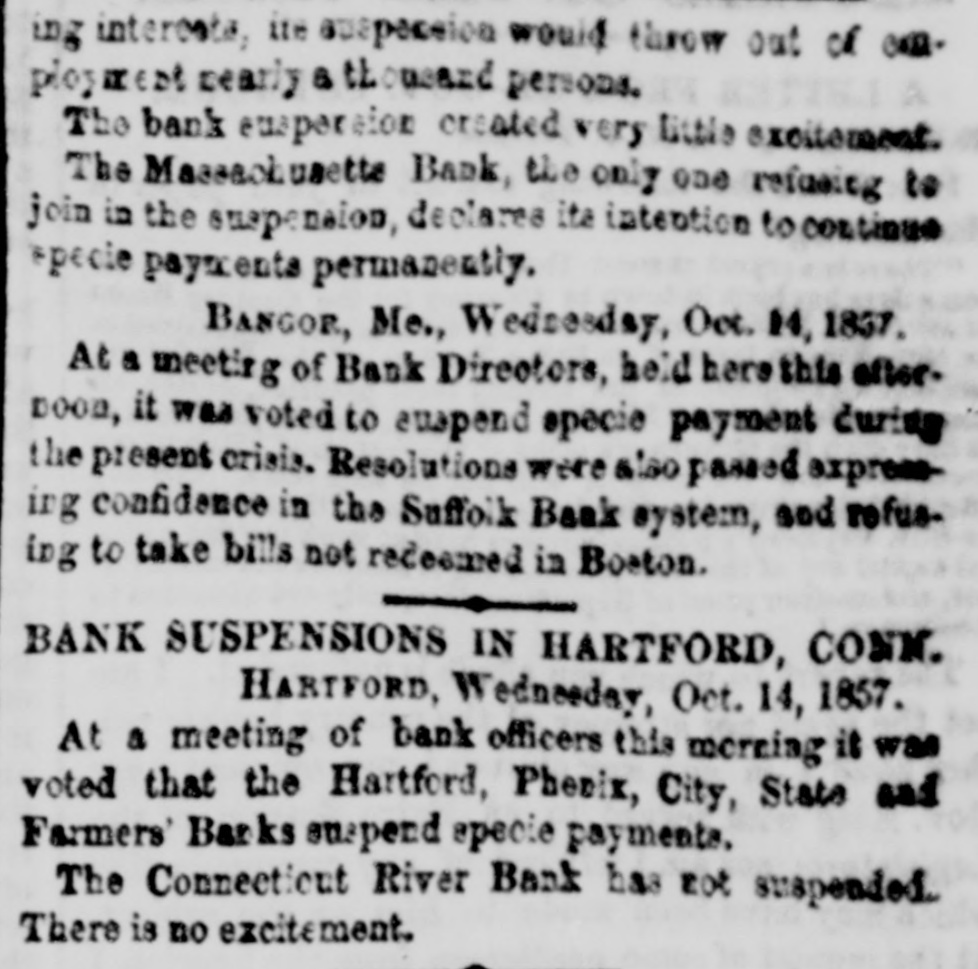
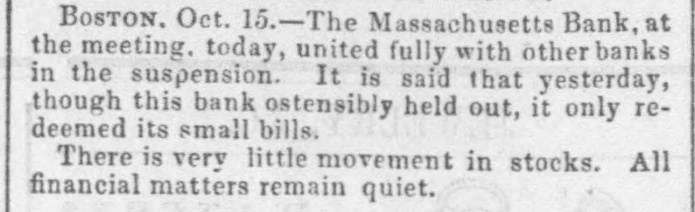
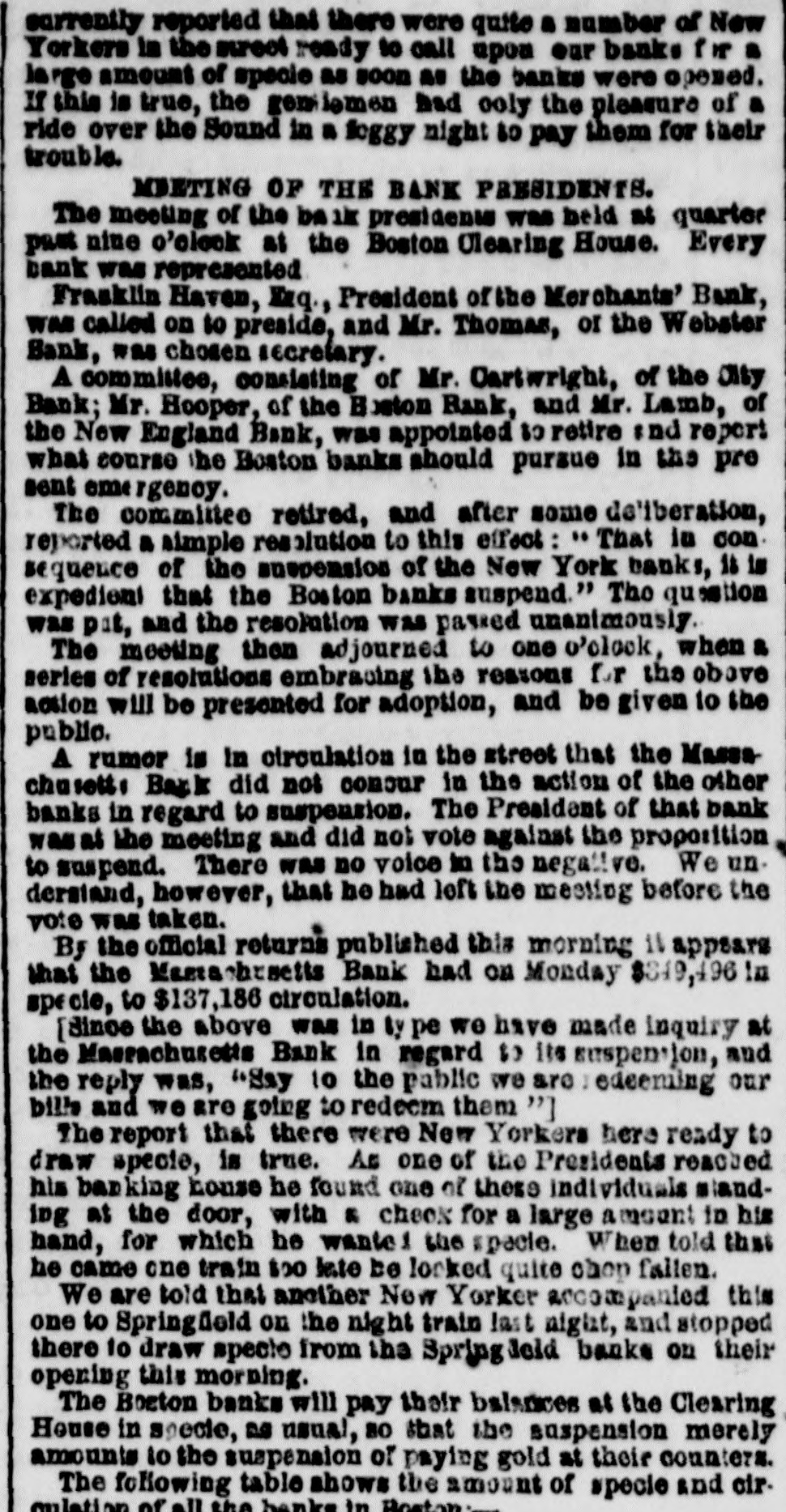
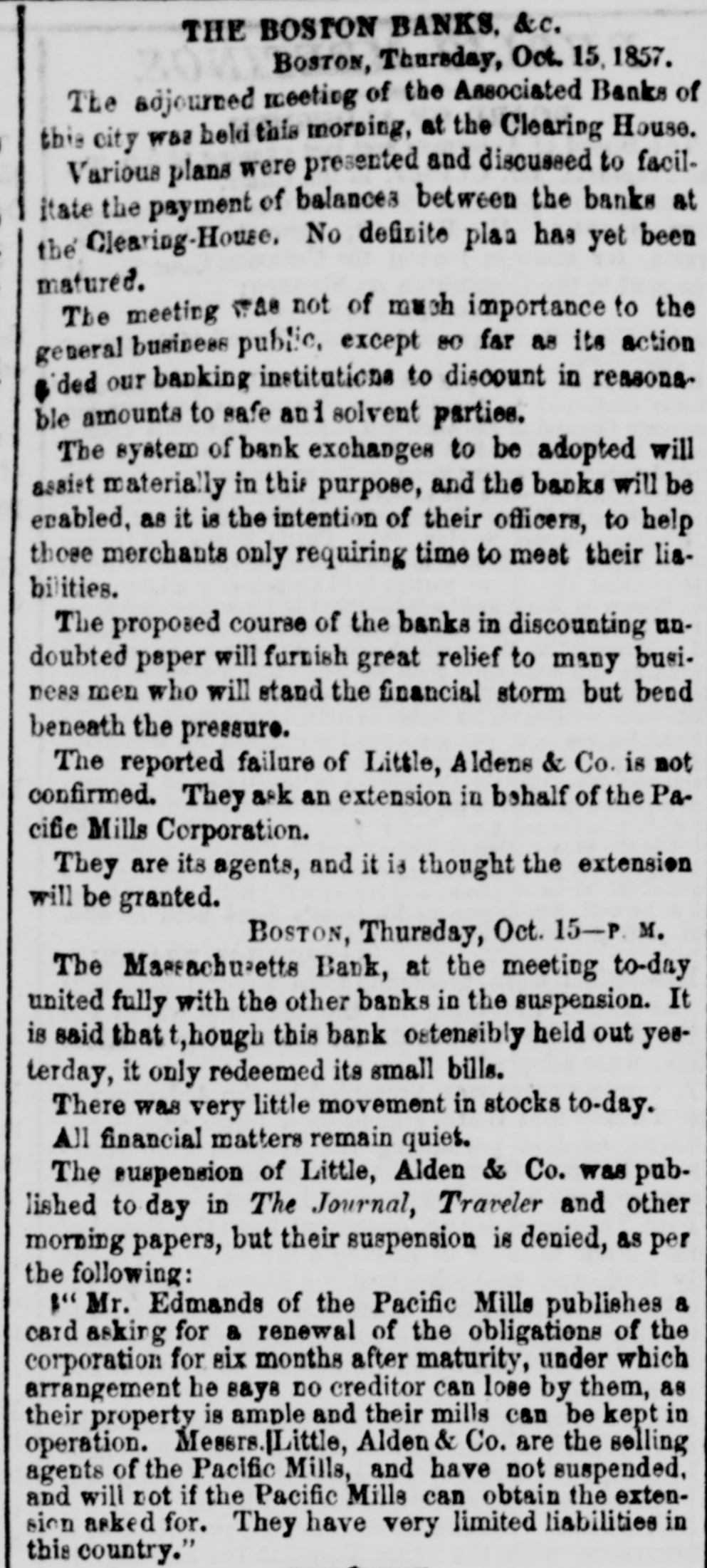
THE CASE OF THE CASHIER OF THE AGRICULTURAL BANK OF HERKIMER. HERKIMER, vis Unoa, Oct. 16, 1857. The Grand Jury have dismissed as unfounded all the complaints made against Harvey Doolitile, cashior of the Agricultural Bank of Herkimer. A meeting of the direc tore and stockholders of the bank, representing four fifths of its capital, bad previously unanimously certified that the charges were unfounded, and that they had entire confidence in the receiver, and that his appointment was necessary and judicious, and that they requested his confinuance. THE MONEY CRISIS IN MASSACHUSETTS. THE BOSTON BANK-MIEETING OF BOSTON MESCHANTS. Boston,Ost. 15-P. M. The Massachussetts Bank at the meeting to-day united fully with the other banks in the suspension. It is said though this bank catenaibly held out yesterday, but it only redeemed its small bills. There was very little movement in stocks to day. All financ al matters remain quiet. The suspensi n of Little, Alden & Co. was published today in the Journal, Traveller, and other morning papers, but their suspension is denied as per the following: Mr. Edwands, of the Pacific Mills, publishes a card ask ing for renewal of the obligations of the corporation for six months after maturity, under which arrangements, he says, no creditor can lose by them, as their property is BD ple and their raills can be kept in operation. Messrs Little, Alden & Co. are the selling agents of the Pacific Mills, and ba ve not suspended, and will not if the Pacto Mills can obtain the extension asked for. They have very limited liabilities in this country. BOSTON, Oct. 16, 1867. A meeting of bank directors and leading merchants was held this forenoon, at which the policy of an extension of money facilities was discussed. Mr. WM APPLETON thought that the banks might safely increase heir loans to the amount of that of last Augustabout $63,000,000. At the present time they amount to about $40,000,000 Mr. NATHAN APPLETON expressed similar views. Measrs. LAMB and HALL, for the bank officers, expressed their earnest demire to act, so far as their present position would justify, for the relief of the business community. The meeting then adjourned uu to-morrow morning. The money market remains quiet, and everybody ap. pears to be waiting the result of the suspension. Stocks show a little more activity. The specie broker: are realizing small gains, gold being plenty at one per cont premium. HON. N. P. BANKS ON FINANCIAL AFFAIRS. BOSTON, Oct. 15, 1857. In the face of a drizzling rain and thick fog Faneuil Hall was crowded to night to hear the address of the Hon. N. P. Banks, the Republican candidate for Governor of this State, on financial affairs. The meeting was a political one, but the announcement that the distinguished gestleman would devole most of his address to the causes and remedies of the present all absorbing financial convulsion, filled the hall early with people of every shade of politics and social position. Hon John A. Wilkins presided, and introduced Mr. Banks, who was received with the greatest entbusiasm. Mr. BANKS commenced by saying that when he engaged to speak in Faneuil Hall, he designed 60 speak on the sub ject of the policy of the State and nation, and not on the great monetary crisis which had been brought upon the country the distress caused by which 16 was impossible to pass over in silence. He complimented the men of the city of Boston for the courage and vigor with which they had met the storm which had so suddenly broken upon them, and for the union of interests and purposes employed to fend off its evil effects. The steadiness of their position bad sustained the business character of the city, which was her chief honor. Recurring again to the subject, Mr. Banks said that no one could possibly avoid a ling of sorrow and distress on account of the suffering which the monetary crisis had occasioned. Fortunes that had been the result of fifty years of close at ention, great in tell genoe, and unwearied industry and frugality had been dissipated in night: and in the wasting away of the great commercial landmark, there had been a corresponding wreck of other interests Every one must feel sympathy for labor without employment and support; labor made houseless unexpectedly, with some reason to fear that in the coming winter It would be breadless. With all the the suffering and loss consequent on the crisis which Boston had experienced there would be always means to supply the wants of those suffering without faults of their own. One view of the subject indicated, It seemed to Mr. Banks, that the general disability of the period would be but temporary The country was never richer than to day, for the agricultural crops were estimated at a value of two thousand millions of dollars, and the product of manufacturing indus at about fifteen hunnred millions With our means of intercourse with other parts of the world. the enterprise of our merchants, the economy of our families-in fact all persons would infuse into the condi tion of the country confidence which would enable us in a few months to arise from the fail we had ex perienced The spirit of economy which might be imparted to our national life would enable us speedily to recover from digneter. There could be no just comparison between the condition now and what it was in 1837 The speculations of that period were fruitless, both as regards agriculture and manufactures. Capital in the latter mentioned perio 1 was in city lots, whereas now 14 was invested in the in dustrial interests of the country. There was in 1837 but 000 000 in specie in the whole country, with 000 of circulation in bank paper Now, at least in 1856, as cording to the statement of the Secretary of the Treasury, there was $250 000,000 in specie Probably tere was now as much as 000 00 to $176 000 000 of bank notes in circulation. In this State the banking interest was in safer conditi ID at present than in 1887. and the condence at the people in this particular was greate and the feeling of hostility to the banks was far 1004. In regard to the cause of the crists ifferent people held different vie vs, an cording to their political bearings and here Mr. Banks wish ed that his purpose was to spesk of the policy and not to reprehension of parties or of men-ani also according to their conceptions of monetary affairs. A few leadi * facts would probably precede other observations Mr. Banks had to make, and tend to beget A just understanding of our po sition and a fair eive dation or our difficulties As an im portant fact in this connection 1: might be said that If this crisis had been deferred another two months it would not have occurred this year. An opportunity to have irans ported the agricultural products from the valler of the Min stasippt, which had yielded nearly double its asual value to the Atlantic coast, would have 00 stituted suc) wealth as would have enabled our merchants and paople to meet all demands agains them. It was, therefore, to some sort a panic that had produced the difficulty Mr Banks would not discoss the cause of the panic, but that which had contributed materially to bring It about Among her things the facts were to be recognized that the government of this country was a power: that the government had both an open and a tacts llaence-it had duties which It could not avod and responsibili ties which It had to meet The common opinion that the inflation of the currency was the sole cause of the extravagance of the times, both la expend ture and in trade, must be lasen with some qualideati 10 There were other and deener causes to which we might not only attribute public and private extra agance in the ordinary experses of life and to the extens of our unet ness relations, but to which we might also attribute lead log blame in the inflation of the currency Paper money must have breathed into 11 the breath of life, other It could not go alone. It cannot endow Itself with life, but a vitality must be imparted to 11, whether It is produced by the people or by the R vernment. Measures may be devised to give the currency of the coun try greater stability by limiting its issues upon Its specie capital. There were fifty millions of dollars of bank notes in circulation of the denomination of fire dollars and un der, and the time was not far distant when there would be a concurrence in the adoption of permanent measures that will tend to the substitution of gold and sliver in the hands of the people for the small notes they no hold in compensation for their labor, and that would tend more than any other event to give sta bility of a solid character to our currency There was a disposition current to retain gold and silver. People parted with every other product with pleasure, but the precious meta's they retained as long as possible Gold and silver for the pay of labor, and bank notes of the higher denominations for commercial pur DOBAR would be ever: where comfortable and safe media of