Federal National Bank (Chicago, IL)

Episode Information

Episode UID
792601293
Episode Type
Suspension โ†’ Closure
Bank Type
national
Bank ID
79260 national
Charter Number
7926
Start Date
September 28, 1907
Location
Chicago, Illinois (41.850, -87.650)

Metadata

Model
gpt-5-mini (chosen from majority vote of a three-model LLM ensemble)
Short Digest
fa000d8a7addb5dd

Response Measures

None

Events (3)

1. September 28, 1905 Chartered
Source
historical_nic
2. September 28, 1907 Suspension
Cause
Bank Specific Adverse Info
Cause Details
Investigation by clearing house committee found doubtful paper/unsound loans and alleged fraud/misrepresentations by management; directors ordered winding up due to insufficient business.
Newspaper Excerpt
It closed its doors September 28, 1907, after an investigation by the clearing house committee.
Source
newspapers
3. November 2, 1907 Voluntary Liquidation
Source
historical_nic

Newspaper Articles (12)

Article from Rock Island Argus, October 2, 1907

Click image to open full size in new tab

Article Text

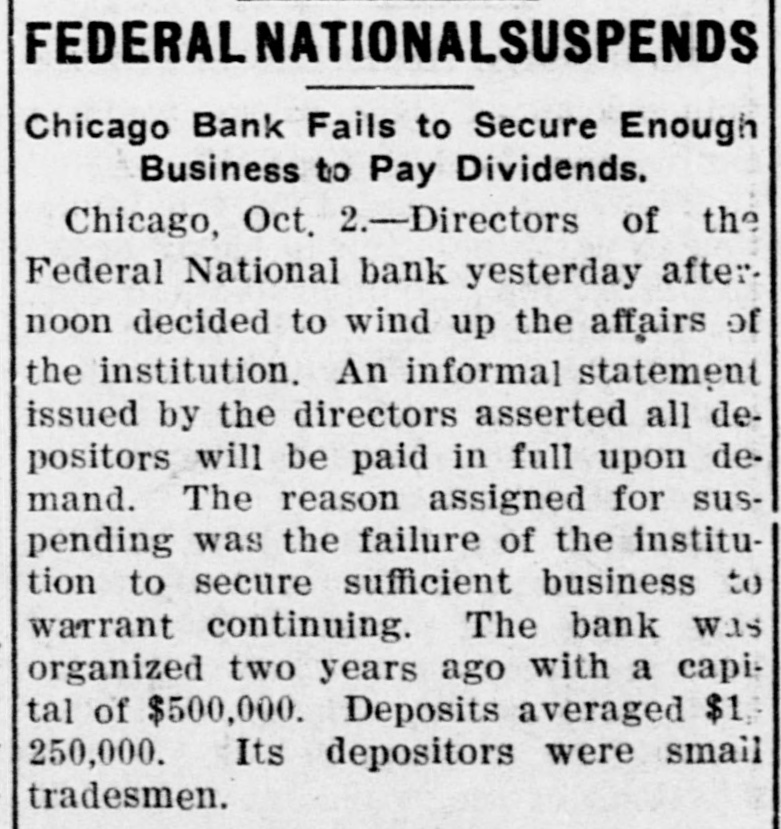
FEDERALNATIONALSUSPENDS Chicago Bank Fails to Secure Enough Business to Pay Dividends. Chicago, Oct. 2.-Directors of the Federal National bank yesterday afternoon decided to wind up the affairs of the institution. An informal statement issued by the directors asserted all depositors will be paid in full upon demand. The reason assigned for suspending was the failure of the institution to secure sufficient business to warrant continuing. The bank was organized two years ago with a capital of $500,000. Deposits averaged $1 250,000. Its depositors were smail tradesmen.


Article from The Cairo Bulletin, October 2, 1907

Click image to open full size in new tab

Article Text

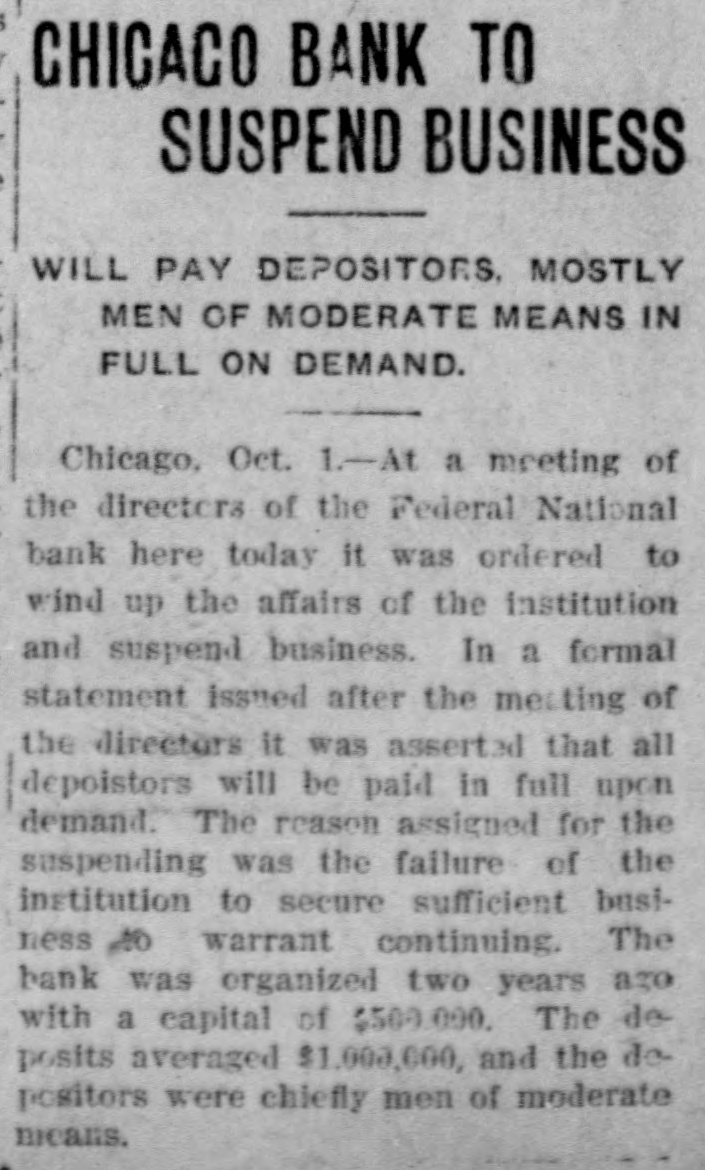
CHICACO BANK TO SUSPEND BUSINESS WILL PAY DEPOSITORS, MOSTLY MEN OF MODERATE MEANS IN FULL ON DEMAND. Chicago. Oct. 1.-At a meeting of the directors of the Federal National bank here today it was ordered to wind up the affairs of the institution and suspend business. In a formal statement issued after the meating of the directors it was asserted that all depoistors will be paid in full upon demand. The reason assigned for the suspending was the failure of the institution to secure sufficient business to warrant continuing. The bank was organized two years azo with a capital of $500.000. The deposits averaged $1.000,000, and the depositors were chiefly men of moderate means.


Article from The Red Cloud Chief, October 4, 1907

Click image to open full size in new tab

Article Text

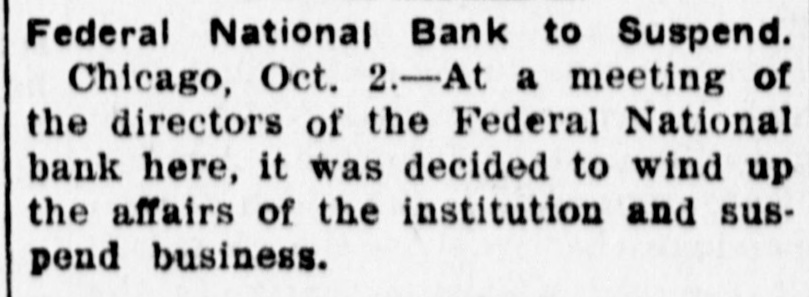
Federal National Bank to Suspend. Chicago, Oct. 2.-At a meeting of the directors of the Federal National bank here, it was decided to wind up the affairs of the institution and suspend business.


Article from The Topeka State Journal, October 28, 1907

Click image to open full size in new tab

Article Text

PAYING WITH CHECKS. Chicago Banks Are Hanging On to Their Cash. Chicago, Oct. - -The banks of this city are today largely upon a checking basis. They refuse to pay out large amounts of currency, and will not return to paying in cash until the finan-cial condition in the east improves. Depositors seeking today to withdraw money were given checks of the bank instead of cash. Commercial depositors are allowed to draw the full amount of their balances, but must accept the bank's checks instead of currency. The rule requiring savings bank depositors to give thirty days' notice before drawing out less than $100, and 60 days' notice before drawing out more than $100 was also put in force. The local banks declare they were compelled to adopt these rules because of the action taken by the banks in the east, which would soon have drained this city of its cash resources. Within an hour after the opening of the doors fully 400 people were lined up at the withdrawal windows of the Illinois Trust and Savings bank, which has the largest number of savings accounts in the city. Depositors were allowed, if they wished to take out sums under $100, but for all amounts over, the full legal notice was required. The majority of those in the banks during the early part of the day gave notice of their intention to draw money. There was no excitement. In the Hibernian Savings bank about 100 people had given notice of withdrawal by 11 o'clock and many more were waiting in line. At all other savings banks business appeared to be on a normal basis. Depositors having checking accounts did not appear to be worried in the least by the situation and business proceeded upon normal lines in all the banks.


Article from Deseret Evening News, October 28, 1907

Click image to open full size in new tab

Article Text

CHICAGO BANKS DOING A CHECKING BUSINESS Chicago, Oct. 28.-The banks of this city are today largely upon a checking basis. They refuse to pay out large amounts of currency, and will not return to paying in cash until the financial condition in the east improves. Depositors seeking today to withdraw money were given checks of the bank instead of cash. Commercial depositors are allowed to draw the full amount of their balances, but must accept the banks' checks instead of currency. The rule requiring savings banks depositors to give 30 days' notice before drawing out less than $100 and 60 days' notice before drawing out force. more than $100 was also put into The local banks in the city declare they were compelled to adopt these rules because of the action taken by the banks in the east, which would scon have drained this city of its capital resources. An hour after the opening of the foors fully 500 people were lined 1172 the withdrawals window of the Tinois Trust & Savings bank, which has the largest nume in the city. Howed. if they wished to take out sums under $100, but for all amounts over this, the full legal notice required. The majority of these in the banks during the early part of the day gave notice of their intention to draw money. There was no excitement. Shortly after noon a call was sent from the Hibernian Savings bank for a number of police. At the bank about 100 people were in line anxious to withdraw funds or give notice of withdrawal, and the officers were destred for keeping the line in order There was no excitement and the situation there was unchanged. Depositers having checking accounts 414 not appear to be worried in the least by the situation and bustITCMM proceeded upon normal lines in all the banks


Article from The Madison Daily Leader, October 29, 1907

Click image to open full size in new tab

Article Text

NOT GIVEN ACTUAL CASH. Chicago Depositors Paid by Check on Withdrawal. Chicago, Oct. 29.-The banks of this city are largely upon a checking basis. They have taken the step of refusing to pay out large amounts of currency and will not return to the former manner of doing business until the financial condition in the East improves. In all banks belonging to the Clearinghouse association or affiliated with it depositors seeking to withdraw money were given checks of the bank itself instead of the actual cash. The depositors are allowed to draw the full amount of their balances, but they were compelled to accept the bank's checks instead of currency. The rule requiring savings bank depositors to give thirty days' notice before drawing out less than $100 and sixty days' notice before drawing out more than $100 was also put in force. The local banks declare that they were compelled to adopt these rules because of the action taken by the banks in the East, which would soon have drained this city of its cash resources. Within an hour after the opening of the doors fully 400 people were lined up at the withdrawal windows of the Illinois Trust and Savings bank, which has the largest number of savings accounts in the city. Depositors were allowed, if they wished, to take out sums under $100, but for all amounts over this the full legal notice was required. The general agreement on the part of the banks to protect their supplies of currency affected the city government. City Treasurer Traeger ran short of cash and City Comptroller Wilson stopped the payment of the salaries of city employes by checks on the city treasury.


Article from The Washington Herald, October 30, 1907

Click image to open full size in new tab

Article Text

WEST REPORTS ARE ALL RIGHT Financial Situation There Is Declared to Be Satisfactory. Check and Certificate Plan Said to Be Working Well in All Sections, Chicago, Oct. 29.-There is better conditions among Chicago banks, there being fewer people at the tellers' windows. giving notice of withdrawals of funds. Depositors seem to be firmly assured of the strength of the local banks. At four of the largest savings banks, which have an aggregate of 250,000 depositors, it was reported that the number of sixtyday notices for withdrawals filed on Monday did not exceed 500. Depositors who give notice of withdrawals now lose interest at the rate of 3 per cent from July 1. Bankers generally feel that Chicago and other points will be in position to return to a currency basis again within thirty days. The continued movement of produce for export is growing to proportions that will warrant large importations of gold for some time to come. The movement of currency from Chicago to the interior has been nearly as large in October thus far as it was last year, when local banks made their high record shipments of more than $30,000,000. The decision made by Chicago clearinghouse banks on Monday not to send any more currency to the country until the present crisis is past has developed that country banks have drawn heavily upon Chicago for currency, in anticipation of such a step being taken. Rural institutions are believed, therefore, to be very strongly intrenched, and since banks in the clearing-house association at all money centers have thrown a safeguard around their money supplies, the country banks have been constrained to adopt similar measures, but their position in these matters is entirely individual and local in effect. If country banks can hold their communities to the custom of paying and receiving in checks, such as is now in vogue in all the cities, trouble probably will be averted. The position of country banks in this respect can well be realized when it is taken into consideration that these interior institutions have carried larger surpluses of money than ever before in history, due to the abnormal prosperity in agricultural districts in the West. But, at the same time, the banks have been eager to make money, and funds available in excess of the 15 per cent reserve requirements have been allowed to remain in the hands of reserve agents of the money centers for investment in commercial paper at the high rates of interest which have prevailed throughout the summer and fall.


Article from The Citizen-Republican, October 31, 1907

Click image to open full size in new tab

Article Text

# CHICAGO BANKS ON # A CHECKING BASIS Chicago, Oct. 30. -The banks of this city are today largely upon a checking basis. They refuse to pay out large amounts of currency, and will not return to paying cash until the financial condition in the east improves. Depositors seeking today to withdraw their money were given checks on the bank instead. Commercial depositors were allowed to draw the full amount of their balances, but they must accept bank checks instead of currency. The rule requiring savings bank depositors to give thirty days' notice before drawing out less than $100, and sixty days' notice before drawing out more than $100 was also put in force.


Article from The Worthington Advance, November 1, 1907

Click image to open full size in new tab

Article Text

# NOT GIVEN ACTUAL CASH. Chicago Depositors Paid by Check on Withdrawal. Chicago, Oct. 28. -The banks of this city are largely upon a checking basis. They have taken the step of refusing to pay out large amounts of currency and will not return to the former manner of doing business until the financial condition in the East improves. In all banks belonging to the Clearing-house association or affiliated with it depositors seeking to withdraw money were given checks of the bank itself instead of the actual cash. The depositors are allowed to draw the full amount of their balances, but they were compelled to accept the bank's checks instead of currency. The rule requiring savings bank depositors to give thirty days' notice before drawing out less than $100 and sixty days' notice before drawing out more than $100 was also put in force.


Article from The Evening Star and Newark Advertiser, December 4, 1907

Click image to open full size in new tab

Article Text

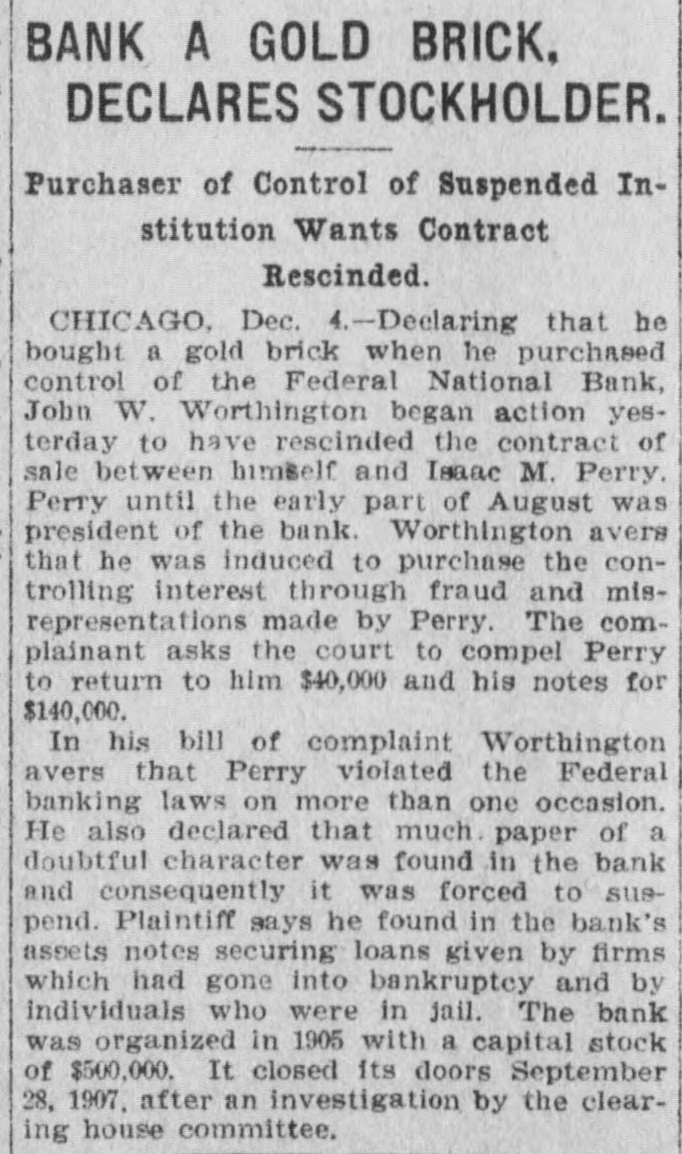
BANK A GOLD BRICK. DECLARES STOCKHOLDER. Purchaser of Control of Suspended Institution Wants Contract Rescinded. CHICAGO, Dec. 4.-Declaring that he bought a gold brick when he purchased control of the Federal National Bank, John W. Worthington began action yesterday to have rescinded the contract of sale between himself and Isaac M. Perry. Perry until the early part of August was president of the bank. Worthington avers that he was induced to purchase the controlling interest through fraud and misrepresentations made by Perry. The complainant asks the court to compel Perry to return to him $40,000 and his notes for $140,000. In his bill of complaint Worthington avers that Perry violated the Federal banking laws on more than one occasion. He also declared that much. paper of a doubtful character was found in the bank and consequently it was forced to suspend. Plaintiff says he found in the bank's assets notes securing loans given by firms which had gone into bankruptcy and by individuals who were in jail. The bank was organized in 1905 with a capital stock of $500,000. It closed its doors September 28, 1907, after an investigation by the clearing house committee.


Article from Evening Star, December 4, 1907

Click image to open full size in new tab

Article Text

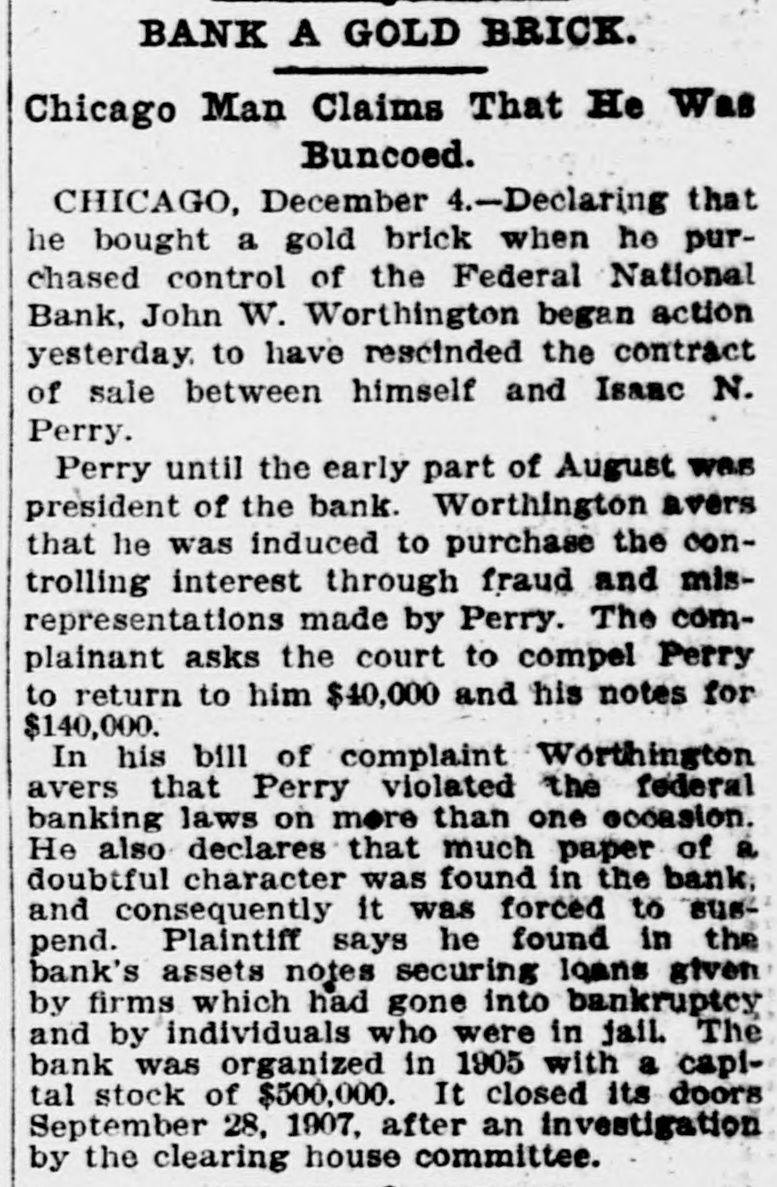
BANK A GOLD BRICK. Chicago Man Claims That He Was Buncoed. CHICAGO, December 4.-Declaring that he bought a gold brick when he purchased control of the Federal National Bank, John W. Worthington began action yesterday. to have rescinded the contract of sale between himself and Isaac N. Perry. Perry until the early part of August was president of the bank. Worthington avers that he was induced to purchase the controlling interest through fraud and misrepresentations made by Perry. The complainant asks the court to compel Perry to return to him $40,000 and his notes for $140,000. In his bill of complaint Worthington avers that Perry violated the federal banking laws on more than one occasion. He also declares that much paper of a doubtful character was found in the bank, and consequently it was forced to suspend. Plaintiff says he found in the bank's assets notes securing loans given by firms which had gone into bankruptcy and by individuals who were in jail. The bank was organized in 1905 with a capital stock of $500,000. It closed its doors September 28, 1907, after an investigation by the clearing house committee.


Article from Deseret Evening News, December 4, 1907

Click image to open full size in new tab

Article Text

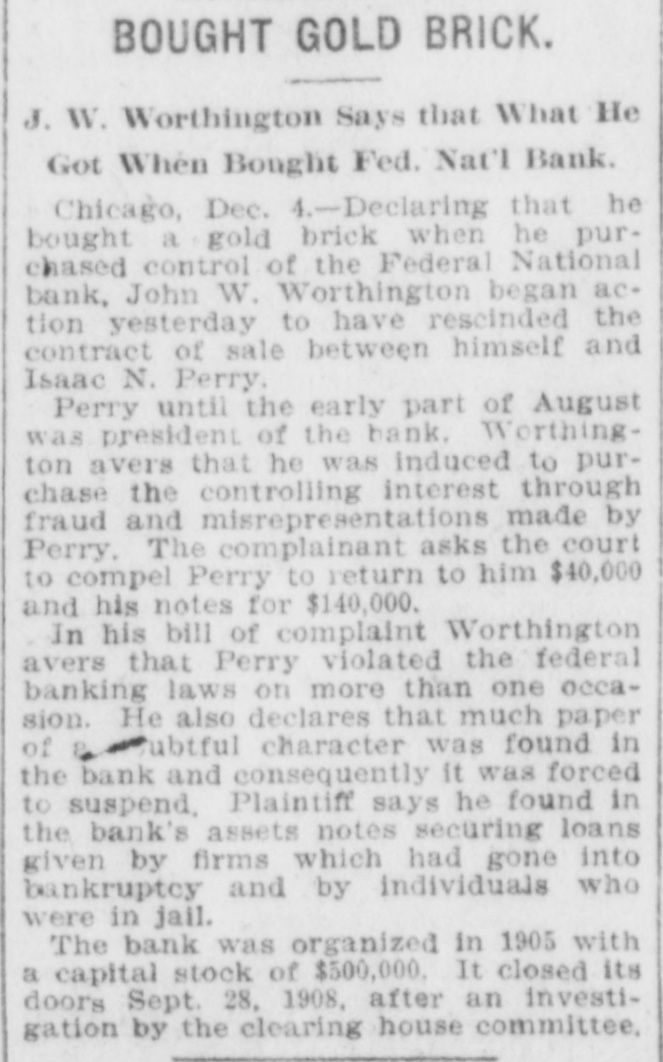
BOUGHT GOLD BRICK. J. W. Worthington Says that What He Got When Bought Fed. Nat'l Bank. Chicago, Dec. 4.-Declaring that he bought a gold brick when he purchased control of the Federal National bank, John W. Worthington began action yesterday to have rescinded the contract of sale between himself and Isaac N. Perry. Perry until the early part of August was president of the bank. Worthington avers that he was induced to purchase the controlling interest through fraud and misrepresentations made by Perry. The complainant asks the court to compel Perry to return to him $40,000 and his notes for $140,000. In his bill of complaint Worthington avers that Perry violated the federal banking laws on more than one occasion. He also declares that much paper of lubtful character was found in the bank and consequently it was forced to suspend. Plaintiff says he found in the bank's assets notes securing loans given by firms which had gone into bankruptcy and by individuals who were in jail. The bank was organized in 1905 with a capital stock of $500,000. It closed its doors Sept. 28, 1908, after an investigation by the clearing house committee.