7902. Bank of Michigan (Detroit, MI)

Bank Information

Episode Type
Suspension โ†’ Closure
Bank Type
state
Start Date
January 10, 1842
Location
Detroit, Michigan (42.331, -83.046)

Metadata

Model
gpt-5-mini
Short Digest
432d9a233934c656

Response Measures

None

Description

Articles describe the historic Bank of Michigan (Detroit). The bank was involved in the Panic of 1837 and ultimately the directors voted to go into liquidation on January 10, 1842; business was wound up with a receiver. No discrete depositor run is described in these extracts, rather suspension/liquidation following the panic. Dates and facts corrected/standardized from OCR (e.g., '3d inst.' refers to April 3 and liquidation vote dated January 10, 1842).

Events (1)

1. January 10, 1842 Suspension
Cause
Macro News
Cause Details
The bank was weakened by the Panic of 1837 and subsequent adverse conditions; attempts by stockholders to recapitalize failed and directors voted to liquidate in 1842.
Newspaper Excerpt
the Bank of Michigan became involved during the panic of 1837... on January 10, 1842, the directors voted to go into liquidation.
Source
newspapers

Newspaper Articles (3)

Article from Weekly Expositor, April 12, 1883

Click image to open full size in new tab

Article Text

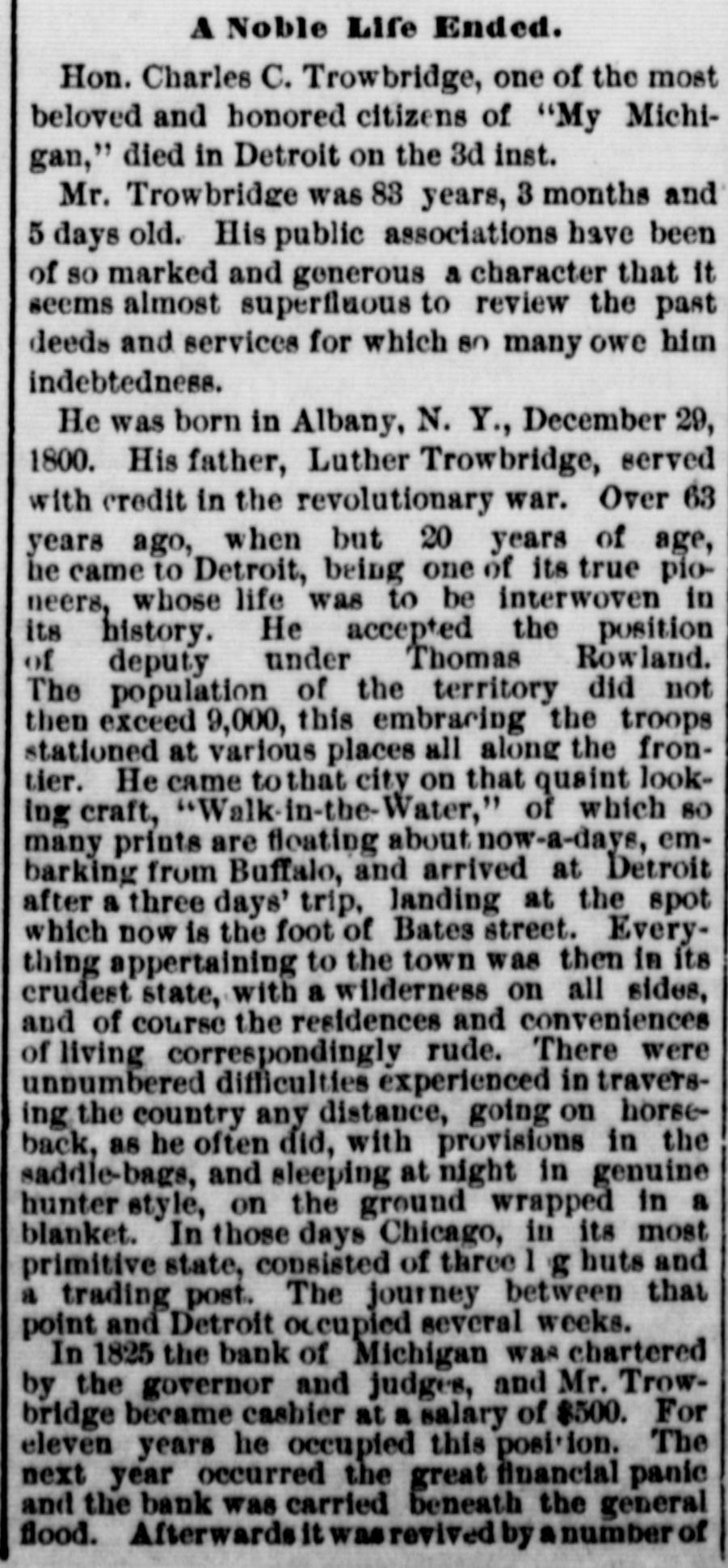
A Noble Life Ended. Hon. Charles C. Trowbridge, one of the most beloved and honored citizens of "My Michigan," died in Detroit on the 3d inst. Mr. Trowbridge was 83 years, 3 months and 5 days old. His public associations have been of so marked and generous a character that it seems almost superfluous to review the past deeds and services for which 80 many owe him indebtedness. He was born in Albany, N. Y., December 29, 1800. His father, Luther Trowbridge, served with credit in the revolutionary war. Over 63 years ago, when but 20 years of age, he came to Detroit, being one of its true pioneers, whose life was to be interwoven in its history. He accepted the position of deputy under Thomas Rowland. The population of the territory did not then exceed 9,000, this embracing the troops stationed at various places all along the frontier. He came to that city on that quaint looking craft, "Walk-in-the-Water," of which 80 many prints are floating about now-a-days, embarking from Buffalo, and arrived at Detroit after a three days' trip, landing at the spot which now is the foot of Bates street. Everything appertaining to the town was then in its crudest state, with a wilderness on all sides, and of course the residences and conveniences of living correspondingly rude. There were unnumbered difficulties experienced in traversing the country any distance, going on horseback, as he often did, with provisions in the saddle-bags, and sleeping at night in genuine hunter style, on the ground wrapped in a blanket. In those days Chicago, in its most primitive state, consisted of three 1 g huts and a trading post. The journey between that point and Detroit occupied several weeks. In 1825 the bank of Michigan was chartered by the governor and judges, and Mr. Trowbridge became cashier at a salary of $500. For eleven years he occupied this position. The next year occurred the great financial panic and the bank was carried beneath the general flood. Afterwards it was revived by a number of


Article from Detroit Free Press, May 10, 1931

Click image to open full size in new tab

Article Text

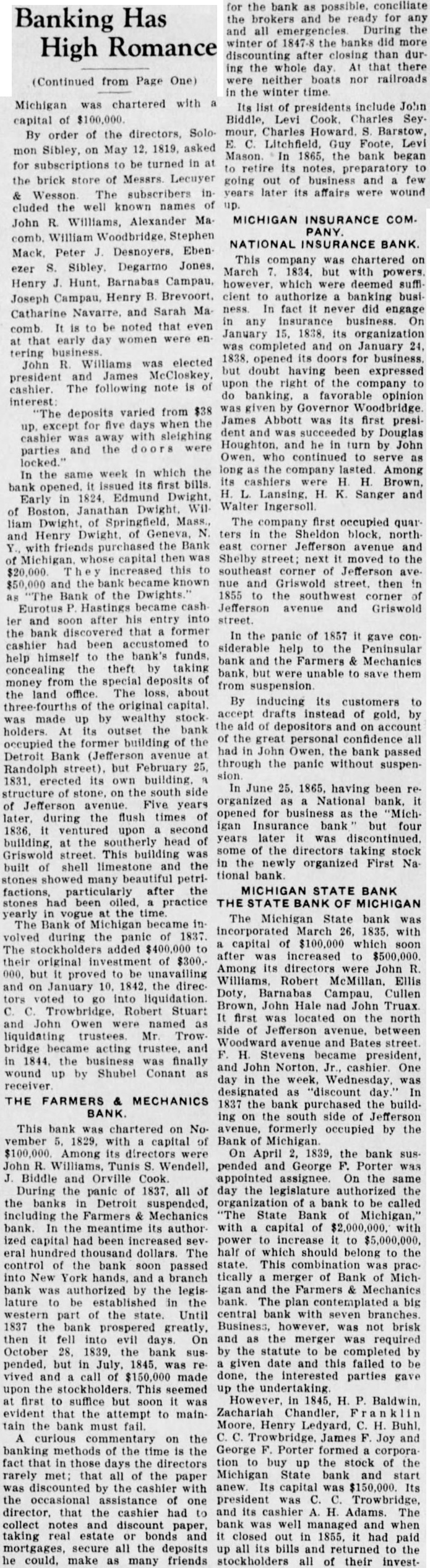
Banking Has High Romance (Continued from Page One) Michigan was chartered with capital of $100,000 By order of the directors, Solomon Sibley, on May 12. 1819. asked for subscriptions to be turned in at the brick store of Messrs Lecuyer & Wesson The subscribers in cluded the well known names of John R. Williams, Alexander Ma comb. William Woodbridge Stephen Mack. Peter J. Desnoyers. Eben ezer S. Sibley. Degarmo Jones. Henry J. Hunt. Barnabas Campau. Joseph Campau, Henry B. Brevoort. Catharine Navarre. and Sarah Ma comb It is to be noted that even at that early day women were en tering John R. Williams was elected president and James McCloskey, cashier. The following note is of interest: "The deposits varied from $38 up. except for five days when the cashier was away with sleighing and the doors were parties locked." week in which the In the same bank opened. it issued its first bills. Early in 1824. Edmund Dwight. of Boston, Janathan Dwight. William Dwight, of Springfield, Mass., Dwight. of N. and Henry as "The Bank of the Dwights." ier and soon after his entry into street. the bank discovered that former cashier had been accustomed to himself to the bank's funds. help concealing the theft by taking money from the special deposits of the land office. The loss, about three-fourths of the original capital. was made up by wealthy stock holders. At its outset the bank occupied the former building of the Detroit Bank (Jefferson avenue at Randolph street). but February 25, 1831. erected its own building. structure of stone, on the south side of Jefferson Five years later. during the flush times of 1836, it ventured upon second building. at the southerly head of Griswold street. This building was built of shell limestone and the stones showed many beautiful petrifactions, particularly after the stones had been oiled, a practice yearly in vogue at the time. The Bank of Michigan became in volved during the panic of 1837. The stockholders added $400,000 to their original investment of $300.000, but it proved to be unavailing and on January 10. 1842, the directors voted to go into liquidation. C. C. Trowbridge. Robert Stuart and John Owen were named as liquidating trustees Mr. Trow bridge became acting trustee, and in 1844. the business was finally wound up by Shubel Conant as receiver THE FARMERS & MECHANICS BANK. This bank was chartered on No. vember 5, 1829, with a capital of $100,000 Among its directors were John R. Williams, Tunis S. Wendell. J. Biddle and Orville Cook. During the panic of all of the banks in Detroit suspended, including the Farmers & Mechanics bank. In the meantime its author ized capital had been increased sev. eral hundred thousand dollars. The control of the bank soon passed into New York hands. and branch bank was authorized by the legislature to be established in the western part of the Until 1837 the bank prospered greatly. then it fell into evil days On October 1839, the bank sus pended, but in July, 1845. was revived and call of $150,000 made upon the stockholders. This seemed at first to suffice but soon it was evident that the attempt to maintain the bank must fail. curious commentary on the banking methods of the time is the fact that in those days the directors discounted by the cashier with the occasional assistance of one that the cashier had to for the bank as possible, conciliate the brokers and be ready for any and all emergencies During the winter of 1847-8 the banks did more discounting after closing than during the whole day At that there were neither boats nor railroads in the winter time Its list of presidents include John Biddle, Levi Cook. Charles Sey. mour, Charles Howard. S. Barstow, E. C. Litchfield. Guy Foote, Levi Mason. In 1865, the bank began to retire its notes, preparatory to going out of business and a few years later its affairs were wound up. MICHIGAN INSURANCE COM. PANY. NATIONAL INSURANCE BANK. This company was chartered on March 7. 1834. but with powers however. which were deemed sufficient to authorize a banking business In fact it never did engage in any insurance business On January 15. 1838. its organization was completed and on January 24. 1838. opened its doors for business but doubt having been expressed upon the right of the company to do banking. favorable opinion was given by Governor Woodbridge James Abbott was its first president and was succeeded by Douglas Houghton, and he in turn by John Owen. who continued to serve as long as the company lasted Among its cashiers were H. H. L. H. K. Sanger and Walter The company first occupied quar ters in the Sheldon north1855 to the southwest corner of In the panic of 1857 it gave con siderable help to the Peninsular bank and the Farmers & Mechanics but were unable to save them from suspension By inducing its customers to accept drafts instead of gold, by the aid of depositors and on account of the great personal confidence all had in John Owen. the bank passed through the panic without suspension In June 25. 1865, having been reorganized as National bank. it opened for business as the "Michigan Insurance bank but four years later it was discontinued. some of the directors taking stock in the newly organized First Na tional bank MICHIGAN STATE BANK THE STATE BANK OF MICHIGAN The Michigan State bank was incorporated March 26, 1835, with capital of $100,000 which soon after was increased to $500,000. Among its directors John R. Williams. Robert McMillan. Ellis Doty, Barnabas Campau. Cullen Brown, John Hale nad John Truax It first was located on the north side of Jefferson avenue. between Woodward avenue and Bates street. F. H. Stevens president, and John Norton. Jr. cashier One day in the week, Wednesday, was designated as "discount day In 1837 the bank purchased the build. ing on the south side of Jefferson avenue, formerly occupied by the Bank of Michigan On April 2, 1839, the bank suspended and George F. Porter was appointed assignee. On the same day the legislature authorized the organization of bank to be called "The State Bank Michigan.' with a capital of $2,000,000. with power to increase it to $5,000,000. half of which should belong to the state. This combination was practically merger of Bank of Michigan and the Farmers & Mechanics bank The plan contemplated big central bank with seven branches Business, however, was not brisk and as the merger was required by the statute to be completed by given date and this failed to be done, the interested parties gave up the undertaking However, in 1845, H. P. Baldwin, Zachariah Chandler, Moore. Henry Ledyard C. H. Buhl. C.C. Trowbridge James F. Joy and George F. Porter formed a corpora tion to buy up the stock of the anew Its capital was $150,000. Its president was C. C. and its cashier A. H. Adams The
Article from Lansing State Journal, September 20, 1933

Click image to open full size in new tab

Article Text

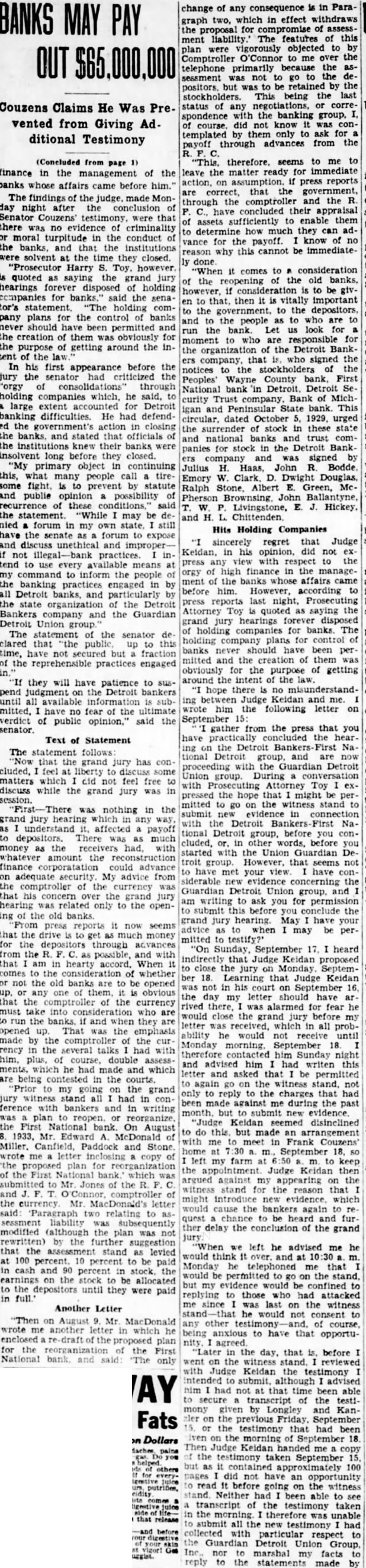
BANKS MAY PAY OUT Couzens Claims He Was Prevented from Giving Additional Testimony (Concluded from page finance in the management of the banks whose affairs came before him." The findings the judge, made Monnight after conclusion of testimony, were that there was evidence of criminality moral turpitude in the conduct the banks, and that the institutions were solvent the time they closed. "Prosecutor Harry S. Toy. however. quoted as saying the grand jury hearings forever disposed of holding companies for banks." said the senator's "The holding company plans for the control of banks never should been permitted and the creation of them was obviously for the purpose of getting around the intent In his first appearance before the jury the senator criticized the "orgy of through holding which, he said, large extent for Detroit banking difficulties. He had defendthe government's closing the banks. and stated that officials of institutions knew their banks were insolvent long before they closed. "My primary object continuing this, what many people call some fight, prevent by statute and public opinion possibility recurrence of these conditions," said the statement. "While may be nied forum in my own state, have the senate forum to expose and discuss unethical and improperpractices. tend to available means command to inform the people the banking practices engaged in all Detroit banks, and the the Detroit Bankers company and the Guardian Detroit Union The statement of the senator declared that up to this time, have not but fraction the reprehensible practices engaged they will have patience to pend judgment the Detroit bankers until all available information mitted, have no fear of the ultimate verdict of public opinion," said the senator. Text of Statement The statement follows the grand jury has concluded, liberty matters which not feel free discuss while the grand jury was was nothing in the grand jury hearing which any way, understand affected payoff There much money as the receivers had, with whatever amount the reconstruction finance corporatation could advance on adequate My advice from the comptroller of the currency was that his concern over the jury hearing related only to the openof the old press reports now seems that the drive to get much money for the through from the possible, and with that in hearty accord. When comes the consideration of whether the old banks are to be opened obvious that the comptroller of the currency must take into consideration who are run the and when they are opened That was the emphasis made by the comptroller of the rency the several talks had with him, plus, of assesshe had made and which are being the courts. "Prior my going on the grand witness stand all had in conference with bankers and in writing plan the First National bank. On August 1933, Mr. Edward McDonald Miller. Paddock and Stone wrote letter inclosing copy plan for reorganization of the First Mr. of the and of the currency Mr. MacDonald's letter said: relating to sessment liability modified (although the plan was not rewritten) the further suggestion that the assessment stand levied 100 percent. 10 percent to be paid cash and 90 percent in the earnings on stock allocated to the depositors until they were paid full. Another Letter "Then on August Mr. MacDonald wrote another letter which he plan for the the First National only change of any consequence is in Paragraph two, which in effect withdraws the proposal for compromise of assessliability. The features of this ment plan were vigorously objected to Comptroller O'Connor me over the telephone primarily the sessment not to go positors. but was retained by the stockholders. This being the last status of any negotiations, correspondence the banking group, of course did not know was contemplated by them only to for payoff through advances from the "This, therefore, seems to me to leave the matter ready immediate action, on assumption. press reports are correct, that the the comptroller and the through have concluded their appraisal assets sufficiently to them how much they can adfor the payoff. know of no vance reason why this cannot be immediatedone "When it comes to consideration of the the old banks, however, if consideration to be given to then vitally important to the government, to the depositors, and to people as to who the bank. Let us look for moment to who are responsible for the of the Detroit Bankers that who signed the notices stockholders the Peoples' Wayne County bank, First National bank 'in Detroit. Detroit Se. curity Trust company. Bank of Michigan and Peninsular bank This circular. dated October 1929. urged the surrender stock in these state and national and trust companies for stock the Detroit Bankand signed Julius H. Haas, John Bodde Emory W. D. Dwight Douglas, Ralph Stone Albert Green, Mc. Pherson Brownsing John Ballantyne, Livingstone, E. J. and H. Hits Holding Companies sincerely regret that Judge Keidan, his opinion, did not with the orgy of high finance in the management the banks affairs came before him. However, according press reports night, Prosecuting Attorney Toy quoted as saying the grand hearings forever disposed holding companies for banks. The holding company plans for control banks never should have been permitted and the creation of them obviously for the purpose of getting around the intent the hope there no misunderstanding between Judge Keidan me. wrote him the following letter on September 15: gather from the press that you have concluded the ing the Detroit Bankers National Detroit group, are now proceeding with the Detroit Union group. During with Prosecuting Attorney Toy pressed the hope that might be permitted to go on the witness stand to submit new evidence in connection with the Detroit Bankers First National Detroit group, before you concluded, other before started with the Union Detroit group. that seems not have met your view have considerable evidence concerning the Guardian Detroit Union and am writing to ask you for permission submit this before you the grand jury hearing. May have advice as may be permitted to testify?' "On Sunday, September heard indirectly that Judge Keidan proposed the jury September 18. Learning that Judge Keidan not in his 16, the day my letter should have rived there, alarmed for fear he would close the grand jury before my letter was received. which in all probability would not receive until Monday morning. September 18 therefore contacted him Sunday night and advised him had writen this letter and asked that be permitted again go on the witness stand. not only reply the charges that had against me during the past month. but evidence "Judge Keldan disinclined to do this but an with me Frank Couzens' home at September farm to keep Judge Keidan then argued against appearing on the witness stand for the reason that might introduce new which would cause the bankers again quest and fur. ther delay the conclusion of the grand jury we left he advised me he would think over m. Monday telephoned me that would permitted the but my evidence would replying to those had attacked me since was last on the witness he would not consent to any other of being anxious to have that opportu"Later in day, that is. before went on the witness with Judge the testimony advised had not at that time been able secure transcript of the testimony given by Longley and Kanthe previous September the testimony that had been the morning of September Then Judge Keidan handed copy testimony taken September contained approximately 100 have an opportunity before going on the witness Neither to see transcript the taken the was submit all the testimony had collected particular respect Guardian Detroit Group. nor marshal my facts the statements made by